The #1 Reason Solo Lawyers Face Bar Complaints (And How AI Agents Prevent It)
Most bar complaints aren’t about lawyers who steal from clients or commit fraud. Those cases exist and they’re serious, but they’re not the majority. The majority of disciplinary matters filed against attorneys in the United States come down to something much more mundane: a client who couldn’t reach their lawyer, or a matter that sat untouched for weeks, or a filing deadline that slipped past without anyone catching it.
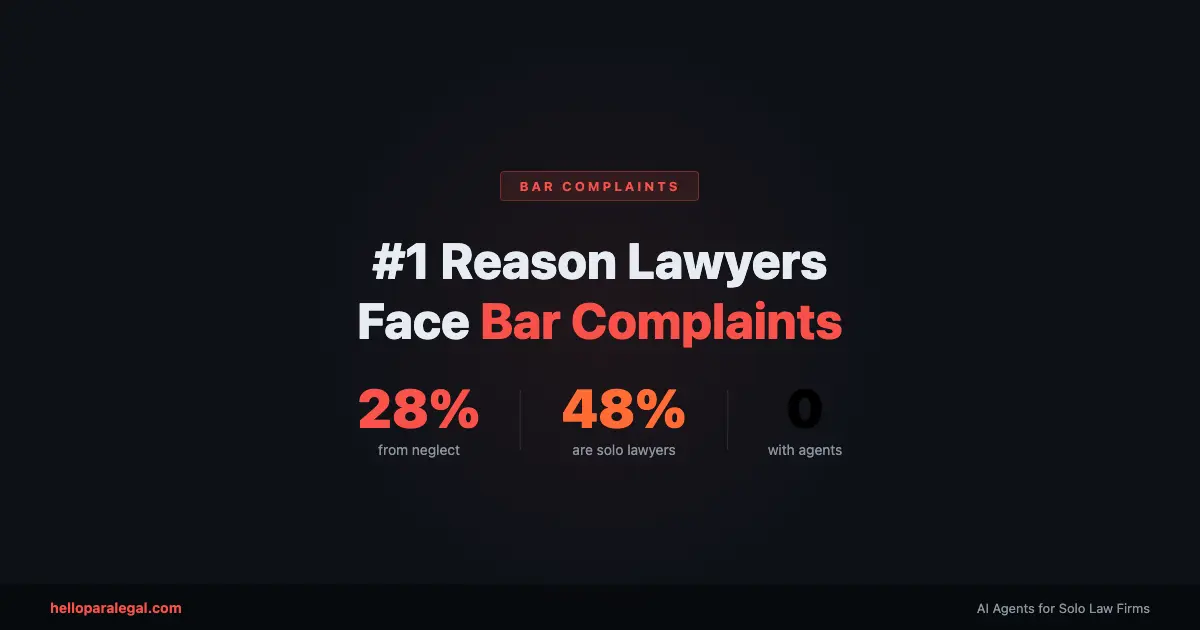
Communication failures and client neglect account for the largest single category of bar complaints across virtually every state. The ABA reports that lack of communication is consistently the leading complaint type, year after year. And when you look at who gets hit hardest, it’s solo attorneys.
That’s not because solo lawyers are less ethical. It’s because they’re one person running an entire law firm. There’s no receptionist, no paralegal, no associate to cover the phones while you’re in depositions. When you’re overwhelmed, communication suffers. When communication suffers, clients file complaints. That’s the pattern, and it plays out thousands of times every year.
This post breaks down exactly why solo attorneys are vulnerable, what the common patterns look like, and how AI agents break the cycle before it reaches the bar.
The Numbers Behind Bar Complaints
Every state tracks disciplinary data differently, but the patterns are remarkably consistent. In California, the State Bar reports that communication-related violations represent approximately 25% of all attorney discipline cases. In Texas, the pattern holds. In New York, Florida, and Illinois, same story.
The specific rule violations that show up most often across states include failure to communicate (Model Rule 1.4), neglect of a legal matter (Rule 1.3), and failure to keep clients reasonably informed. These aren’t abstract professional responsibility concepts. They’re specific, preventable failures with specific, preventable causes.
Solo and small firm attorneys are disciplined at disproportionately high rates relative to large firm lawyers. A 2023 analysis of ABA disciplinary data found that solo practitioners account for roughly 48% of all disciplinary actions despite representing only about 20% of the bar. The concentration of risk at the solo end of the profession is stark.
What Client Neglect Actually Looks Like
It almost never starts with bad intent. Here’s how it typically unfolds.
You have 40 active matters. You’re handling a trial for one client that’s consuming your days. Another client calls twice, leaves voicemails. You see the notification, tell yourself you’ll call back after the hearing. The hearing runs long. By the time you’re back at your desk it’s 6 PM and you have emails to answer. The callback gets pushed to tomorrow.
Tomorrow comes and the trial is still going. The callback gets pushed again. Three weeks later, that client has called seven times, sent four emails, and is now talking to your state bar. The matter itself is completely fine. Nothing was missed. But the client felt abandoned, and feeling abandoned is enough to trigger a complaint.
That scenario plays out in thousands of solo practices every year. It’s not a character flaw. It’s a capacity problem. One person cannot maintain constant communication with 40 clients while also practicing law, managing billing, handling intake, and keeping up with deadlines.
The Four Communication Failures That Lead to Bar Complaints
1. Slow Response to Client Inquiries
Model Rule 1.4 requires “reasonable” communication. What’s reasonable? State bars vary, but the practical standard courts and disciplinary panels apply is that clients should hear back within 24-48 hours, and certainly within a few days for anything substantive.
Solo attorneys routinely fail this standard during busy periods. Not because they’re ignoring clients, but because a week of depositions, a filing crunch, or a family emergency can easily create a 5-7 day communication gap with multiple clients simultaneously.
2. Missed Deadlines With No Notice
Missing a deadline is serious by itself. Missing a deadline and not telling the client is worse. A client who learns from the opposing party that their attorney missed a filing date has every reason to file a complaint. The failure to communicate about the failure compounds the original problem.
3. Status Vacuum During Long Matters
Litigation can take years. Estate administration takes months. Immigration matters stretch on. During those periods, clients who haven’t heard from you in 60 days start to wonder if you’re still working their case. Many of them aren’t wrong to wonder. In some cases, nothing has happened. But even when work is happening behind the scenes, the silence reads as neglect.
4. Returned Phone Tag That Never Gets Resolved
The eternal problem: client calls, you’re unavailable, they leave a message. You call back, they’re unavailable. This goes back and forth for days. The client’s question never gets answered. Their frustration builds. A client who can’t reach their own lawyer for two weeks often decides the bar is their next option.
How AI Agents Break This Pattern
The common thread in every one of these failure modes is capacity. A solo attorney can’t respond to every client within 24 hours during a trial week. That’s not a personal failing. It’s physics. You can’t be in two places at once.
An AI agent doesn’t have that constraint. It responds at 11 PM. It responds during your deposition. It responds on weekends. And it does so with substantive, case-specific information because it has access to the matter file.
Here’s what that looks like in practice across each failure mode.
Agent Fix for Slow Response: Immediate Acknowledgment, Always
A communication agent monitors your client channels. When a client emails or calls, the agent responds immediately. Not with a form letter, but with a substantive acknowledgment that references their matter, confirms you’ve received their message, explains when they’ll hear back with a full response, and answers any question it can handle directly.
That immediate response changes everything. The client knows they were heard. They’re not sitting in silence wondering if their email went into a void. Complaints don’t usually come from slow resolution of legal issues. They come from feeling ignored.
Agent Fix for Missed Deadlines: Preparation, Not Just Notification
Most deadline management software sends you a reminder. That’s it. You still have to take action. If you miss the reminder, you miss the deadline.
A deadline agent does more. It monitors every matter in your system against the applicable procedural rules for your jurisdiction. When a deadline is 14 days out, it starts preparing the required documents. When it’s 7 days out, it escalates to you with a specific to-do list. When it’s 48 hours out and something still isn’t done, it alerts you with an urgency flag that’s hard to miss.
The agent also communicates with the client proactively. “Your motion is due in two weeks. We’re preparing it now and will have it to you for review on Thursday.” That one message prevents a complaint even if something goes sideways later, because the client knows you’re on top of it.
Agent Fix for Status Vacuum: Scheduled Proactive Updates
A communication agent monitors your case management system for activity. When something happens on a matter, it generates a client-facing update automatically. “The opposing counsel filed their response brief on April 1. We’re reviewing it and will have our reply strategy ready by April 15.”
When nothing is happening (as is often the case during waiting periods), the agent sends a scheduled check-in anyway. Once a month, every client hears from someone. “Your matter is in the discovery phase. We’re waiting on document production from the opposing party. No action needed from you right now. Here’s what to expect over the next 30 days.”
That proactive update eliminates the anxious check-in calls. More importantly, it creates a documented communication record. If a complaint is ever filed, you have evidence that the client received regular updates throughout the representation.
Agent Fix for Phone Tag: Direct Question Answering
Most client calls are about status, next steps, or simple procedural questions. “What’s happening with my case?” “When will I hear back?” “What do I need to bring to the meeting?” A communication agent can answer all of these directly, using information from the matter file, without requiring you to call back.
The calls that require your actual judgment, an attorney showing up on the phone or the strategic conversation, those get escalated immediately. The agent identifies those and routes them to you with a summary of what the client wants to discuss. You spend your time on the calls that need you, not on status updates you could have automated.
The Documentation Advantage
Bar complaints often come down to a credibility contest. The client says you never responded. You believe you called them back. Neither of you has documentation. In those situations, bar investigators default toward taking the complaint seriously because they have nothing to disprove it.
An AI agent creates a complete communication record automatically. Every message sent, every response given, every call handled, every update dispatched. That record is timestamped, stored, and retrievable. If a complaint is ever filed, you can produce a complete communication log showing exactly what the client received and when.
That documentation doesn’t just help you respond to complaints. It prevents them. Clients are less likely to file a complaint when they know they’ve been receiving regular updates, because the updates are evidence that you were working their case.
What the Bar Actually Looks For
State bar investigators reviewing a communication complaint are looking for two things: did the client receive timely responses to inquiries, and did the attorney keep the client reasonably informed about the status of the matter.
An AI agent system addresses both directly. Inquiries get a response within minutes, 24/7. Status updates go out on a scheduled cadence across all active matters. The documentation shows both. You’re not relying on your memory or a vague belief that you “usually” respond quickly. You have records.
This doesn’t mean agents make you untouchable. If you’re actually neglecting clients’ legal matters, missing court appearances, or failing to take required action, no communication agent fixes that. But the vast majority of bar complaints against solo attorneys aren’t about legal incompetence. They’re about feeling abandoned. Agents fix that.
The Risk Profile of Solo Practice
It’s worth being honest about something: solo practice is genuinely harder to run cleanly from a communication standpoint than a firm with staff. That’s not an insult to solo practitioners. It’s an acknowledgment of structural reality.
At a large firm, partners aren’t answering their own phones. They have assistants, associates, and paralegals who form a communication layer. A client can reach someone knowledgeable about their matter even when the partner is unavailable. That communication layer is what prevents bar complaints.
Solo attorneys have historically had three options: hire staff (expensive), bill fewer clients (revenue hit), or accept elevated complaint risk (dangerous). AI agents are a fourth option. They’re the communication layer that solo attorneys couldn’t previously afford, running autonomously without headcount.
Building a Bar-Complaint-Resistant Practice
A bar-resistant practice isn’t complicated. It has three characteristics: clients hear back quickly, clients know what’s happening with their matter, and nothing falls through the cracks on deadlines. All three of those are agent-compatible tasks.
Hello Paralegal builds communication and deadline agents specifically for solo law firms. The communication agent handles first response, status updates, and routine question answering. The deadline agent monitors your docket, prepares documents proactively, and escalates anything at risk. Together, they create the communication infrastructure that used to require a paralegal on staff.
The bar complaint risk that solo attorneys carry disproportionately isn’t inevitable. It’s a capacity problem. And capacity problems have solutions.
You didn’t go to law school to spend your evenings returning client calls about case status. You didn’t build a practice to live in fear of a bar complaint from a client you genuinely were working for. Agents handle the communication infrastructure. You handle the law.
Leave a Reply