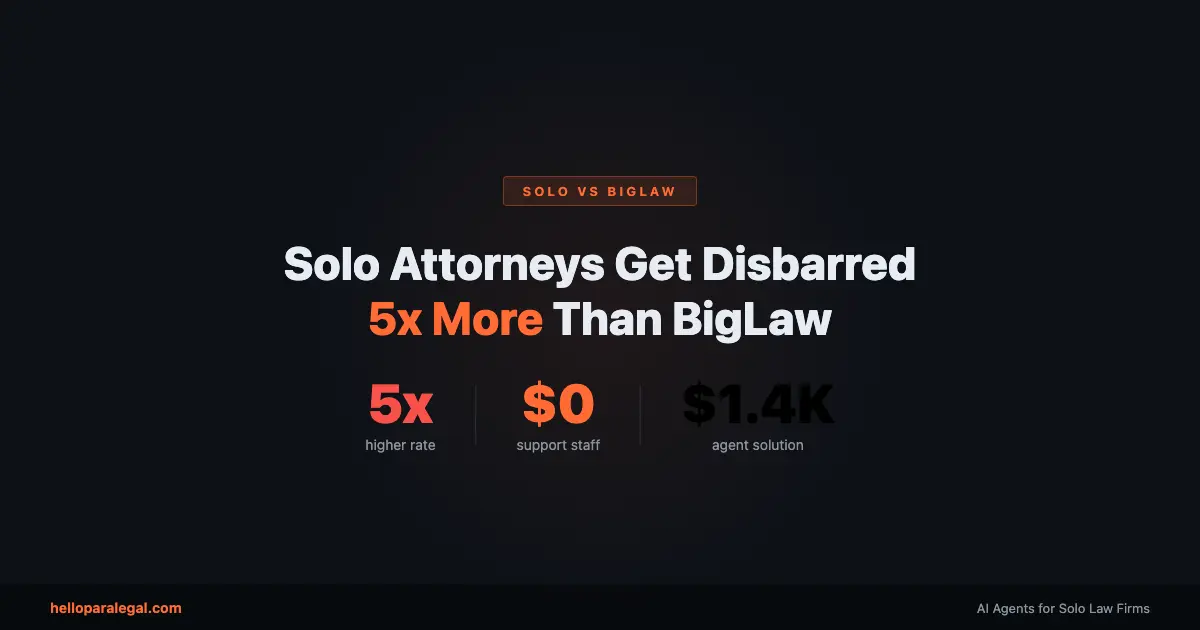
Solo attorneys get disbarred at roughly 5 times the rate of lawyers at large firms. That number has held steady for decades, and the legal profession mostly shrugs at it.
The standard explanation is that solo lawyers are just less qualified, less careful, less professional. That’s wrong, and it’s insulting. The real explanation is structural. BigLaw lawyers have armies of support staff, calendar systems, billing departments, and compliance teams watching their backs. Solo lawyers have themselves.
This post breaks down the actual data, explains exactly why solo attorneys face this disparity, and shows how AI agents are changing the equation.
The Numbers Are Real
The ABA’s National Lawyer Regulatory Data Bank tracks attorney discipline across all 50 states. Year after year, the data shows solo practitioners receiving public discipline at disproportionate rates compared to their representation in the bar.
Solos make up roughly 49% of the practicing bar. They account for well over 60% of public disciplinary actions in most states. In some states, the overrepresentation is even more stark.
A 2020 study published in the Georgetown Journal of Legal Ethics analyzed 15 years of disciplinary data across 10 states. The finding: solo practitioners were disciplined at 4.8 times the rate of attorneys at firms with 10 or more lawyers. The researchers controlled for practice area, years of experience, and geography. The pattern held.
This isn’t a talent gap. It’s an infrastructure gap.
The Five Root Causes
1. Missed Deadlines
Calendaring failures are the single leading cause of discipline for solo practitioners. The ABA estimates that missed deadlines account for approximately 27% of malpractice claims filed against solo attorneys.
At a large firm, a statute of limitations doesn’t just live in one lawyer’s calendar. It’s in the firm’s docketing system. A paralegal confirms it. A supervising attorney gets a reminder. There are three or four redundant checkpoints before the date passes.
A solo lawyer running on a combination of Outlook, sticky notes, and memory has one checkpoint: themselves. When they’re in trial, sick, dealing with a family emergency, or just buried under 40 open files, that one checkpoint fails.
2. Client Communication Breakdowns
The number one bar complaint in every state is failure to communicate. Lawyers who don’t return calls, don’t send updates, don’t explain what’s happening with a case.
At BigLaw, a client calling in gets routed to a junior associate, a paralegal, or a client service team. Somebody picks up. Somebody follows up. The client feels attended to.
A solo lawyer with 60 active files, a deposition at 9am, a motion due at 5pm, and a difficult client on line 2 is going to let some calls go to voicemail. Then the voicemail sits. Then the client gets angry and files a complaint.
3. Billing Irregularities and Trust Account Problems
IOLTA trust account violations are career-ending, and they’re devastatingly common among solo practitioners. Not because solos are dishonest, but because trust accounting is genuinely complex and errors compound fast.
BigLaw has dedicated financial compliance teams, external auditors, and billing software configured specifically to prevent commingling. A solo lawyer using QuickBooks and a separate checking account is one bookkeeping mistake away from a disciplinary investigation.
4. Competence in Fast-Moving Areas
Tax law changes. Immigration rules shift overnight. Family law statutes get amended. At a large firm, someone tracks these changes. There are practice group meetings, internal memos, CLE requirements enforced by HR.
Solo lawyers are responsible for their own continuing education, their own research updates, their own awareness of rule changes. Most are doing their best. Some fall behind without realizing it.
5. Mental Health and Burnout
A 2016 study by the Hazelden Betty Ford Foundation and the ABA Commission on Lawyer Assistance Programs found that 28% of practicing lawyers experienced depression, 19% experienced anxiety, and 21% reported problematic drinking. Solo practitioners showed higher rates across all three categories.
Burnout isn’t just a wellness issue. It’s a risk management issue. A lawyer who’s exhausted misses things. A lawyer who’s depressed lets files sit. A lawyer dealing with a substance problem makes decisions they wouldn’t make otherwise.
BigLaw has employee assistance programs, reduced-hours tracks, internal support systems. Solo lawyers have none of that by default.
The Infrastructure Gap in Plain Terms
Here’s what a midsize BigLaw associate actually has working for them on any given day:
- A dedicated legal secretary managing their calendar and client calls
- A firm-wide docketing system with automatic deadline reminders
- A billing department handling invoices, collections, and trust accounting
- A paralegal handling document prep, filing logistics, and research
- A legal administrator managing compliance and bar reporting
- A conflicts team that flags potential issues before they become problems
- A marketing or BD team managing the firm’s reputation and client relationships
That’s six to eight people supporting one attorney. And the attorney still has their name partner watching their work.
A solo lawyer has themselves. Maybe a part-time virtual assistant. That’s it.
The cost difference is staggering. A mid-tier BigLaw associate costs the firm $350,000 to $500,000 per year in salary, benefits, support staff, and overhead. A solo attorney trying to replicate that support system would need to hire four to six people, which runs $200,000 to $350,000 per year in payroll alone. That’s not viable for a solo practice bringing in $300,000 to $600,000 in gross revenue.
Solo vs. BigLaw: What the Support Gap Actually Looks Like
| Support Function | BigLaw Associate | Solo Lawyer (Traditional) |
|---|---|---|
| Deadline tracking | Firm docketing system + paralegal reminders | Personal calendar, manual entry |
| Client communication | Secretary + junior associate backup | Lawyer answers or nobody answers |
| Billing and collections | Dedicated billing department | Lawyer bills when they have time |
| Trust accounting | Financial compliance team | Lawyer or bookkeeper, manually reconciled |
| New client intake | Client relations team + intake specialists | Lawyer takes calls when available |
| Document prep and filing | Paralegal team | Lawyer does it themselves |
| Performance feedback | Annual reviews, managing partner oversight | None |
This table explains the 5x disbarment gap better than any theory about attorney quality. It’s not about who’s smarter or who cares more. It’s about who has backup.
What AI Agents Actually Do About This
AI agents aren’t software tools you click around in. They’re autonomous systems that monitor your practice, make decisions based on rules you set, take actions without you initiating them, and loop you in only when they need your judgment.
That’s a different category than legal research software or document assembly tools. Those still require you to sit down, open the application, run a query, review results, and do something with them. An AI agent does the work and brings you the output.
Here’s how agents address each of the five root causes of solo disbarment:
Deadline Agents
A deadline agent reads your case files, identifies every date-sensitive obligation, calculates appropriate lead times based on the type of matter, and puts those reminders into your calendar automatically. When a deadline is 30 days out, you get a notification. When it’s 7 days out, you get another one. When it’s 48 hours out, you get an escalation.
If you don’t respond to an escalation, the agent can send a follow-up to your assistant, or flag the file for urgent review. It doesn’t forget. It doesn’t have bad days. It doesn’t go on vacation.
This is the BigLaw docketing system, replicated for a solo practice, running at a fraction of the cost.
Client Communication Agents
A communication agent monitors your active matters and sends clients proactive updates based on case activity. Hearing scheduled. Motion filed. Discovery served. Each event triggers an automatic client notification that goes out within hours, not days.
The agent also handles incoming inquiries. A client emails asking about their case status? The agent checks the file, drafts a status update, and either sends it automatically or queues it for your approval. The client hears back same day instead of waiting a week.
Most bar complaints stem from clients who felt ignored. Clients who get regular updates, even brief ones, almost never complain.
Billing and Collections Agents
A billing agent tracks your time automatically, flags unbilled entries, generates invoices on the schedule you set, sends payment reminders, and escalates overdue accounts. It reconciles trust account activity against your billing records and alerts you to discrepancies before they compound.
Solo lawyers typically collect 79 cents of every dollar billed. Firms with systematic follow-up processes collect 89 cents or more. On $400,000 in annual billings, that’s a $40,000 difference. The agent more than pays for itself.