What AI agents help law firms increase revenue?
How can I improve my law firm’s intake conversion rate?
The two biggest drivers of intake conversion rate are response speed and follow-up consistency. Leads contacted within 5 minutes convert at dramatically higher rates than leads contacted hours later. Most conversions require 5 or more follow-up contacts, which solo lawyers rarely make manually. An AI intake agent handles both: responding within minutes 24/7 and following up systematically until the prospect books or opts out.
What AI agents help law firms increase revenue?
Three types of AI agents directly impact law firm revenue. An administrative agent automates non-billable tasks, recapturing billable hours. A billing and collections agent runs systematic invoice follow-up, improving collection rates. An intake agent responds to leads immediately and follows up persistently, improving conversion rates. Hello Paralegal builds all three specifically for solo law firms.
How do AI agents differ from legal software tools?
Software tools require the lawyer to use them: log in, run queries, send reminders, check dashboards. AI agents operate autonomously without the lawyer initiating each action. An intake agent responds to leads without the lawyer checking their inbox. A billing agent sends invoice reminders without the lawyer opening a billing dashboard. The autonomous operation is what makes agents effective for solo lawyers who don’t have consistent time to manage software.
What That Means in Dollars
If 100 leads per month contact your firm, a 30% conversion rate means 30 new clients. At an average matter value of $3,500, that’s $105,000 per month in new client revenue. At a 50% conversion rate on the same 100 leads, you’re generating $175,000 per month. The 20-percentage-point conversion improvement is worth $70,000 per month, $840,000 per year, from the same lead volume.
Most solo attorneys would spend years trying to double their lead flow to get that kind of revenue increase. The better lever is converting the leads you already have.
Why Conversion Rates Are Low
Speed to response is the primary driver of intake conversion rates. A Harvard Business Review study found that leads contacted within 5 minutes of inquiry are 100 times more likely to convert than leads contacted 30 minutes later. Legal intake research shows similar patterns: response within the first hour converts at significantly higher rates than response after 24 hours.
Solo attorneys respond slowly because they’re busy. A potential client calls or fills out a contact form at 2pm on a Tuesday. You’re in a deposition. By the time you see the message, it’s 6pm. By the time you call back, it’s the next morning. In that window, that person may have called two other attorneys and hired one of them.
Even when initial response is fast, follow-up usually isn’t. Most solo lawyers make one or two contact attempts with a prospect and then move on. Research consistently shows that 80% of conversions require five or more follow-up contacts. Solo lawyers don’t have the time or systems to make five follow-up attempts on every lead.
The Agent That Fixes It: Intake Agent
An intake agent responds to every inquiry within 5 minutes, around the clock. A prospect submits a contact form at 11pm on Saturday. The agent responds within minutes, asks qualifying questions, and either schedules a consultation automatically or moves the lead into a follow-up sequence.
The follow-up sequence is systematic and persistent. The agent makes contact attempts on day 1, day 3, day 5, day 8, and day 14. Each attempt is personalized to where the prospect is in the sequence. Each one gives the prospect an easy path to book a consultation. The agent stops when the prospect books or explicitly opts out.
The agent also qualifies leads before they reach you. By the time a prospect gets to their consultation with you, they’ve answered the standard intake questions, they’ve confirmed they fit your practice area, and they’re pre-qualified against your client criteria. You spend 45 minutes with people who are likely to hire you, not 45 minutes discovering in the first 10 minutes that someone has a case you don’t take.
Firms using intake agents typically see conversion rates move from 28-32% to 48-55% within 60 to 90 days of deployment. On the numbers above, that conversion improvement alone is worth hundreds of thousands of dollars annually.
The Combined Impact
Here’s the math when all three agents are running for a solo attorney billing $350 per hour with $400,000 in annual billings and 100 leads per month:
| Metric | Before Agents | After Agents | Annual Impact |
|---|---|---|---|
| Billable hours per day | 2.5 hours | 4.0 hours | +$115,500 in billings |
| Collection rate | 82% | 91% | +$36,000 collected |
| Intake conversion rate | 30% | 50% | +$840,000 in new client revenue potential |
The utilization and collection improvements alone add over $150,000 to your bottom line without acquiring a single new client. The intake improvement is a multiplier on every lead your marketing generates.
Why Software Tools Don’t Move These Numbers
Legal tech companies have been selling billing software, intake forms, and CRM tools to lawyers for 20 years. These tools have been available the entire time the industry data has shown solo attorneys billing 2.5 hours per day, collecting at 82%, and converting 30% of leads.
The tools haven’t moved the numbers because they require the lawyer to use them. You have to log time, generate invoices, remember to follow up, check the CRM, send the reminder. The software creates a better environment for doing tasks. It doesn’t do the tasks.
AI agents are different because they operate autonomously. The intake agent doesn’t wait for you to check your email and decide to respond to a new lead. It responds immediately, every time, without your involvement. The billing agent doesn’t wait for you to open the software on a Tuesday and review outstanding invoices. It runs collections on schedule, automatically.
The distinction matters because the reason these numbers are bad isn’t that solo lawyers lack good software. It’s that solo lawyers don’t have time to use software consistently. An agent removes consistency as a variable. It runs whether you’re in trial, on vacation, or dealing with three emergencies at once.
What Hello Paralegal Does
Hello Paralegal builds AI agents specifically designed to close these gaps for solo law firms. The intake agent, the billing agent, and the administrative agent aren’t three separate products you configure and manage. They’re an integrated system that runs your practice operations while you do the legal work.
The agents connect to your existing practice management system, your billing software, your email, and your calendar. They learn your matter types, your client criteria, your billing rates, and your firm’s communication style. Then they run.
You don’t manage the agents day-to-day. You review their outputs, make decisions on escalations, and adjust their parameters when your practice evolves. Everything else happens without your involvement.
If you’re billing 2.5 hours per day, collecting at 82%, and converting 30% of your leads, you’re not underperforming because you’re a bad lawyer. You’re underperforming because you’re running a practice with no infrastructure. That’s fixable.
Your Three Numbers Benchmarks
| Metric | Poor | Industry Average | With AI Agents |
|---|---|---|---|
| Billable hours per day | Under 2.0 | 2.5 | 3.5 to 4.5 |
| Collection rate | Under 78% | 82-85% | 88-93% |
| Intake conversion rate | Under 25% | 28-35% | 48-58% |
Track your numbers for 30 days. If any of them fall in the average or poor column, you know exactly where the revenue is going and you know exactly which agent fixes it.
Frequently Asked Questions
What is a good billable hour utilization rate for a solo attorney?
The industry average is approximately 2.5 billable hours per day, which represents a 25-30% utilization rate. High-performing solo attorneys hit 3.5 to 4.5 billable hours per day. The gap is explained by how much non-billable administrative work takes up the rest of the day. AI agents that automate administrative tasks typically help attorneys recapture 1.5 to 2 hours of billable time per day.
What is a good collection rate for a law firm?
The industry average collection rate is approximately 85%, though solo practitioners typically collect at 79-83 cents on the dollar. High-performing firms with systematic billing and follow-up processes collect at 88-92%. The difference between an 82% and a 91% collection rate on $400,000 in annual billings is approximately $36,000 per year.
How can I improve my law firm’s intake conversion rate?
The two biggest drivers of intake conversion rate are response speed and follow-up consistency. Leads contacted within 5 minutes convert at dramatically higher rates than leads contacted hours later. Most conversions require 5 or more follow-up contacts, which solo lawyers rarely make manually. An AI intake agent handles both: responding within minutes 24/7 and following up systematically until the prospect books or opts out.
What AI agents help law firms increase revenue?
Three types of AI agents directly impact law firm revenue. An administrative agent automates non-billable tasks, recapturing billable hours. A billing and collections agent runs systematic invoice follow-up, improving collection rates. An intake agent responds to leads immediately and follows up persistently, improving conversion rates. Hello Paralegal builds all three specifically for solo law firms.
How do AI agents differ from legal software tools?
Software tools require the lawyer to use them: log in, run queries, send reminders, check dashboards. AI agents operate autonomously without the lawyer initiating each action. An intake agent responds to leads without the lawyer checking their inbox. A billing agent sends invoice reminders without the lawyer opening a billing dashboard. The autonomous operation is what makes agents effective for solo lawyers who don’t have consistent time to manage software.
What That Means in Dollars
Say you bill $350,000 in a year. At an 82% collection rate, you collect $287,000. At a 91% collection rate, you collect $318,500. That’s a $31,500 difference on the same billings, from the same clients, for the same work. The only variable is how well your collections process works.
At $500,000 in billings, the same spread between 82% and 91% collection rates is $45,000 per year. That’s not a rounding error. That’s a real number that either goes into your pocket or evaporates because invoices sat unanswered.
Why Collection Rates Suffer
Solo attorneys are bad at collections not because they don’t want to get paid, but because follow-up is awkward and time-consuming. The psychology is real: most lawyers hate asking for money. The practical reality is also real: who has time to track every overdue invoice and send a second, third, fourth reminder?
The result is a passive approach. Invoice goes out. If the client pays, great. If not, maybe a reminder goes out a few weeks later, maybe it doesn’t. Eventually the amount gets written off or referred to collections, which costs a percentage of recovery and damages the client relationship.
The Agent That Fixes It: Billing and Collections Agent
A billing agent runs your entire collections cycle systematically. Invoice goes out on the day it’s generated, not when you get around to it. Seven days later, a payment reminder goes out automatically. Fourteen days after the due date, an escalation goes out. Thirty days overdue, the agent flags it for your attention with the full account history ready for review.
The agent doesn’t feel awkward about asking for money. It sends reminders on schedule, every time, without exception. Clients who would have let an invoice lapse simply because you hadn’t followed up pay because the reminder landed in their inbox at the right moment.
The agent also reconciles trust account activity against billing records in real time, flagging discrepancies before they become compliance issues. For attorneys managing client funds, this is as much a risk management tool as a revenue recovery tool.
Firms that shift from passive billing to agent-driven systematic follow-up typically see collection rates move from the low 80s to the high 80s or low 90s within 90 days. On $400,000 in annual billings, that’s $28,000 to $40,000 recovered that was previously being left behind.
Number 3: Your Intake Conversion Rate
The Benchmark
The average solo law firm converts approximately 30% of leads into paying clients. One in three people who reach out and express interest in hiring you actually retain you.
High-performing firms convert 50% to 60% of leads. The gap between average and high-performing isn’t about legal skill or reputation. It’s almost entirely explained by response time and follow-up consistency.
What That Means in Dollars
If 100 leads per month contact your firm, a 30% conversion rate means 30 new clients. At an average matter value of $3,500, that’s $105,000 per month in new client revenue. At a 50% conversion rate on the same 100 leads, you’re generating $175,000 per month. The 20-percentage-point conversion improvement is worth $70,000 per month, $840,000 per year, from the same lead volume.
Most solo attorneys would spend years trying to double their lead flow to get that kind of revenue increase. The better lever is converting the leads you already have.
Why Conversion Rates Are Low
Speed to response is the primary driver of intake conversion rates. A Harvard Business Review study found that leads contacted within 5 minutes of inquiry are 100 times more likely to convert than leads contacted 30 minutes later. Legal intake research shows similar patterns: response within the first hour converts at significantly higher rates than response after 24 hours.
Solo attorneys respond slowly because they’re busy. A potential client calls or fills out a contact form at 2pm on a Tuesday. You’re in a deposition. By the time you see the message, it’s 6pm. By the time you call back, it’s the next morning. In that window, that person may have called two other attorneys and hired one of them.
Even when initial response is fast, follow-up usually isn’t. Most solo lawyers make one or two contact attempts with a prospect and then move on. Research consistently shows that 80% of conversions require five or more follow-up contacts. Solo lawyers don’t have the time or systems to make five follow-up attempts on every lead.
The Agent That Fixes It: Intake Agent
An intake agent responds to every inquiry within 5 minutes, around the clock. A prospect submits a contact form at 11pm on Saturday. The agent responds within minutes, asks qualifying questions, and either schedules a consultation automatically or moves the lead into a follow-up sequence.
The follow-up sequence is systematic and persistent. The agent makes contact attempts on day 1, day 3, day 5, day 8, and day 14. Each attempt is personalized to where the prospect is in the sequence. Each one gives the prospect an easy path to book a consultation. The agent stops when the prospect books or explicitly opts out.
The agent also qualifies leads before they reach you. By the time a prospect gets to their consultation with you, they’ve answered the standard intake questions, they’ve confirmed they fit your practice area, and they’re pre-qualified against your client criteria. You spend 45 minutes with people who are likely to hire you, not 45 minutes discovering in the first 10 minutes that someone has a case you don’t take.
Firms using intake agents typically see conversion rates move from 28-32% to 48-55% within 60 to 90 days of deployment. On the numbers above, that conversion improvement alone is worth hundreds of thousands of dollars annually.
The Combined Impact
Here’s the math when all three agents are running for a solo attorney billing $350 per hour with $400,000 in annual billings and 100 leads per month:
| Metric | Before Agents | After Agents | Annual Impact |
|---|---|---|---|
| Billable hours per day | 2.5 hours | 4.0 hours | +$115,500 in billings |
| Collection rate | 82% | 91% | +$36,000 collected |
| Intake conversion rate | 30% | 50% | +$840,000 in new client revenue potential |
The utilization and collection improvements alone add over $150,000 to your bottom line without acquiring a single new client. The intake improvement is a multiplier on every lead your marketing generates.
Why Software Tools Don’t Move These Numbers
Legal tech companies have been selling billing software, intake forms, and CRM tools to lawyers for 20 years. These tools have been available the entire time the industry data has shown solo attorneys billing 2.5 hours per day, collecting at 82%, and converting 30% of leads.
The tools haven’t moved the numbers because they require the lawyer to use them. You have to log time, generate invoices, remember to follow up, check the CRM, send the reminder. The software creates a better environment for doing tasks. It doesn’t do the tasks.
AI agents are different because they operate autonomously. The intake agent doesn’t wait for you to check your email and decide to respond to a new lead. It responds immediately, every time, without your involvement. The billing agent doesn’t wait for you to open the software on a Tuesday and review outstanding invoices. It runs collections on schedule, automatically.
The distinction matters because the reason these numbers are bad isn’t that solo lawyers lack good software. It’s that solo lawyers don’t have time to use software consistently. An agent removes consistency as a variable. It runs whether you’re in trial, on vacation, or dealing with three emergencies at once.
What Hello Paralegal Does
Hello Paralegal builds AI agents specifically designed to close these gaps for solo law firms. The intake agent, the billing agent, and the administrative agent aren’t three separate products you configure and manage. They’re an integrated system that runs your practice operations while you do the legal work.
The agents connect to your existing practice management system, your billing software, your email, and your calendar. They learn your matter types, your client criteria, your billing rates, and your firm’s communication style. Then they run.
You don’t manage the agents day-to-day. You review their outputs, make decisions on escalations, and adjust their parameters when your practice evolves. Everything else happens without your involvement.
If you’re billing 2.5 hours per day, collecting at 82%, and converting 30% of your leads, you’re not underperforming because you’re a bad lawyer. You’re underperforming because you’re running a practice with no infrastructure. That’s fixable.
Your Three Numbers Benchmarks
| Metric | Poor | Industry Average | With AI Agents |
|---|---|---|---|
| Billable hours per day | Under 2.0 | 2.5 | 3.5 to 4.5 |
| Collection rate | Under 78% | 82-85% | 88-93% |
| Intake conversion rate | Under 25% | 28-35% | 48-58% |
Track your numbers for 30 days. If any of them fall in the average or poor column, you know exactly where the revenue is going and you know exactly which agent fixes it.
Frequently Asked Questions
What is a good billable hour utilization rate for a solo attorney?
The industry average is approximately 2.5 billable hours per day, which represents a 25-30% utilization rate. High-performing solo attorneys hit 3.5 to 4.5 billable hours per day. The gap is explained by how much non-billable administrative work takes up the rest of the day. AI agents that automate administrative tasks typically help attorneys recapture 1.5 to 2 hours of billable time per day.
What is a good collection rate for a law firm?
The industry average collection rate is approximately 85%, though solo practitioners typically collect at 79-83 cents on the dollar. High-performing firms with systematic billing and follow-up processes collect at 88-92%. The difference between an 82% and a 91% collection rate on $400,000 in annual billings is approximately $36,000 per year.
How can I improve my law firm’s intake conversion rate?
The two biggest drivers of intake conversion rate are response speed and follow-up consistency. Leads contacted within 5 minutes convert at dramatically higher rates than leads contacted hours later. Most conversions require 5 or more follow-up contacts, which solo lawyers rarely make manually. An AI intake agent handles both: responding within minutes 24/7 and following up systematically until the prospect books or opts out.
What AI agents help law firms increase revenue?
Three types of AI agents directly impact law firm revenue. An administrative agent automates non-billable tasks, recapturing billable hours. A billing and collections agent runs systematic invoice follow-up, improving collection rates. An intake agent responds to leads immediately and follows up persistently, improving conversion rates. Hello Paralegal builds all three specifically for solo law firms.
How do AI agents differ from legal software tools?
Software tools require the lawyer to use them: log in, run queries, send reminders, check dashboards. AI agents operate autonomously without the lawyer initiating each action. An intake agent responds to leads without the lawyer checking their inbox. A billing agent sends invoice reminders without the lawyer opening a billing dashboard. The autonomous operation is what makes agents effective for solo lawyers who don’t have consistent time to manage software.
Where the Hours Go
The non-billable time isn’t wasted. It’s real work. It’s answering client emails, scheduling appointments, chasing down unpaid invoices, handling intake calls from prospects who don’t become clients, managing your own billing, drafting engagement letters, and doing administrative tasks that keep the firm running but don’t show up on any invoice.
Clio’s data shows that the average attorney spends about 48% of their day on non-billable administrative work. That’s where your utilization rate is being destroyed.
The Agent That Fixes It: Administrative Automation
An administrative AI agent takes over the work that’s consuming your non-billable hours. Client intake handling. Appointment scheduling. Document preparation and routine correspondence. Status update emails. Invoice generation and billing reminders.
These agents don’t just help you work faster. They remove entire categories of work from your plate. You’re not faster at scheduling. You don’t do scheduling anymore. The agent does it.
Attorneys who deploy administrative agents typically recapture 1.5 to 2 hours of billable time per day. At $350 per hour across 220 working days, that’s $115,500 to $154,000 in additional annual billings. From one agent.
Number 2: Your Collection Rate
The Benchmark
The industry average collection rate for law firms is approximately 85%. That means for every $100 you bill, $15 never gets paid. It’s written off, written down, or just never collected because follow-up fell apart.
For solo practitioners, that number is often lower. Clio data consistently shows solo firms collecting at 79 to 83 cents on the dollar, while firms with systematic billing processes collect at 88 to 92 cents.
What That Means in Dollars
Say you bill $350,000 in a year. At an 82% collection rate, you collect $287,000. At a 91% collection rate, you collect $318,500. That’s a $31,500 difference on the same billings, from the same clients, for the same work. The only variable is how well your collections process works.
At $500,000 in billings, the same spread between 82% and 91% collection rates is $45,000 per year. That’s not a rounding error. That’s a real number that either goes into your pocket or evaporates because invoices sat unanswered.
Why Collection Rates Suffer
Solo attorneys are bad at collections not because they don’t want to get paid, but because follow-up is awkward and time-consuming. The psychology is real: most lawyers hate asking for money. The practical reality is also real: who has time to track every overdue invoice and send a second, third, fourth reminder?
The result is a passive approach. Invoice goes out. If the client pays, great. If not, maybe a reminder goes out a few weeks later, maybe it doesn’t. Eventually the amount gets written off or referred to collections, which costs a percentage of recovery and damages the client relationship.
The Agent That Fixes It: Billing and Collections Agent
A billing agent runs your entire collections cycle systematically. Invoice goes out on the day it’s generated, not when you get around to it. Seven days later, a payment reminder goes out automatically. Fourteen days after the due date, an escalation goes out. Thirty days overdue, the agent flags it for your attention with the full account history ready for review.
The agent doesn’t feel awkward about asking for money. It sends reminders on schedule, every time, without exception. Clients who would have let an invoice lapse simply because you hadn’t followed up pay because the reminder landed in their inbox at the right moment.
The agent also reconciles trust account activity against billing records in real time, flagging discrepancies before they become compliance issues. For attorneys managing client funds, this is as much a risk management tool as a revenue recovery tool.
Firms that shift from passive billing to agent-driven systematic follow-up typically see collection rates move from the low 80s to the high 80s or low 90s within 90 days. On $400,000 in annual billings, that’s $28,000 to $40,000 recovered that was previously being left behind.
Number 3: Your Intake Conversion Rate
The Benchmark
The average solo law firm converts approximately 30% of leads into paying clients. One in three people who reach out and express interest in hiring you actually retain you.
High-performing firms convert 50% to 60% of leads. The gap between average and high-performing isn’t about legal skill or reputation. It’s almost entirely explained by response time and follow-up consistency.
What That Means in Dollars
If 100 leads per month contact your firm, a 30% conversion rate means 30 new clients. At an average matter value of $3,500, that’s $105,000 per month in new client revenue. At a 50% conversion rate on the same 100 leads, you’re generating $175,000 per month. The 20-percentage-point conversion improvement is worth $70,000 per month, $840,000 per year, from the same lead volume.
Most solo attorneys would spend years trying to double their lead flow to get that kind of revenue increase. The better lever is converting the leads you already have.
Why Conversion Rates Are Low
Speed to response is the primary driver of intake conversion rates. A Harvard Business Review study found that leads contacted within 5 minutes of inquiry are 100 times more likely to convert than leads contacted 30 minutes later. Legal intake research shows similar patterns: response within the first hour converts at significantly higher rates than response after 24 hours.
Solo attorneys respond slowly because they’re busy. A potential client calls or fills out a contact form at 2pm on a Tuesday. You’re in a deposition. By the time you see the message, it’s 6pm. By the time you call back, it’s the next morning. In that window, that person may have called two other attorneys and hired one of them.
Even when initial response is fast, follow-up usually isn’t. Most solo lawyers make one or two contact attempts with a prospect and then move on. Research consistently shows that 80% of conversions require five or more follow-up contacts. Solo lawyers don’t have the time or systems to make five follow-up attempts on every lead.
The Agent That Fixes It: Intake Agent
An intake agent responds to every inquiry within 5 minutes, around the clock. A prospect submits a contact form at 11pm on Saturday. The agent responds within minutes, asks qualifying questions, and either schedules a consultation automatically or moves the lead into a follow-up sequence.
The follow-up sequence is systematic and persistent. The agent makes contact attempts on day 1, day 3, day 5, day 8, and day 14. Each attempt is personalized to where the prospect is in the sequence. Each one gives the prospect an easy path to book a consultation. The agent stops when the prospect books or explicitly opts out.
The agent also qualifies leads before they reach you. By the time a prospect gets to their consultation with you, they’ve answered the standard intake questions, they’ve confirmed they fit your practice area, and they’re pre-qualified against your client criteria. You spend 45 minutes with people who are likely to hire you, not 45 minutes discovering in the first 10 minutes that someone has a case you don’t take.
Firms using intake agents typically see conversion rates move from 28-32% to 48-55% within 60 to 90 days of deployment. On the numbers above, that conversion improvement alone is worth hundreds of thousands of dollars annually.
The Combined Impact
Here’s the math when all three agents are running for a solo attorney billing $350 per hour with $400,000 in annual billings and 100 leads per month:
| Metric | Before Agents | After Agents | Annual Impact |
|---|---|---|---|
| Billable hours per day | 2.5 hours | 4.0 hours | +$115,500 in billings |
| Collection rate | 82% | 91% | +$36,000 collected |
| Intake conversion rate | 30% | 50% | +$840,000 in new client revenue potential |
The utilization and collection improvements alone add over $150,000 to your bottom line without acquiring a single new client. The intake improvement is a multiplier on every lead your marketing generates.
Why Software Tools Don’t Move These Numbers
Legal tech companies have been selling billing software, intake forms, and CRM tools to lawyers for 20 years. These tools have been available the entire time the industry data has shown solo attorneys billing 2.5 hours per day, collecting at 82%, and converting 30% of leads.
The tools haven’t moved the numbers because they require the lawyer to use them. You have to log time, generate invoices, remember to follow up, check the CRM, send the reminder. The software creates a better environment for doing tasks. It doesn’t do the tasks.
AI agents are different because they operate autonomously. The intake agent doesn’t wait for you to check your email and decide to respond to a new lead. It responds immediately, every time, without your involvement. The billing agent doesn’t wait for you to open the software on a Tuesday and review outstanding invoices. It runs collections on schedule, automatically.
The distinction matters because the reason these numbers are bad isn’t that solo lawyers lack good software. It’s that solo lawyers don’t have time to use software consistently. An agent removes consistency as a variable. It runs whether you’re in trial, on vacation, or dealing with three emergencies at once.
What Hello Paralegal Does
Hello Paralegal builds AI agents specifically designed to close these gaps for solo law firms. The intake agent, the billing agent, and the administrative agent aren’t three separate products you configure and manage. They’re an integrated system that runs your practice operations while you do the legal work.
The agents connect to your existing practice management system, your billing software, your email, and your calendar. They learn your matter types, your client criteria, your billing rates, and your firm’s communication style. Then they run.
You don’t manage the agents day-to-day. You review their outputs, make decisions on escalations, and adjust their parameters when your practice evolves. Everything else happens without your involvement.
If you’re billing 2.5 hours per day, collecting at 82%, and converting 30% of your leads, you’re not underperforming because you’re a bad lawyer. You’re underperforming because you’re running a practice with no infrastructure. That’s fixable.
Your Three Numbers Benchmarks
| Metric | Poor | Industry Average | With AI Agents |
|---|---|---|---|
| Billable hours per day | Under 2.0 | 2.5 | 3.5 to 4.5 |
| Collection rate | Under 78% | 82-85% | 88-93% |
| Intake conversion rate | Under 25% | 28-35% | 48-58% |
Track your numbers for 30 days. If any of them fall in the average or poor column, you know exactly where the revenue is going and you know exactly which agent fixes it.
Frequently Asked Questions
What is a good billable hour utilization rate for a solo attorney?
The industry average is approximately 2.5 billable hours per day, which represents a 25-30% utilization rate. High-performing solo attorneys hit 3.5 to 4.5 billable hours per day. The gap is explained by how much non-billable administrative work takes up the rest of the day. AI agents that automate administrative tasks typically help attorneys recapture 1.5 to 2 hours of billable time per day.
What is a good collection rate for a law firm?
The industry average collection rate is approximately 85%, though solo practitioners typically collect at 79-83 cents on the dollar. High-performing firms with systematic billing and follow-up processes collect at 88-92%. The difference between an 82% and a 91% collection rate on $400,000 in annual billings is approximately $36,000 per year.
How can I improve my law firm’s intake conversion rate?
The two biggest drivers of intake conversion rate are response speed and follow-up consistency. Leads contacted within 5 minutes convert at dramatically higher rates than leads contacted hours later. Most conversions require 5 or more follow-up contacts, which solo lawyers rarely make manually. An AI intake agent handles both: responding within minutes 24/7 and following up systematically until the prospect books or opts out.
What AI agents help law firms increase revenue?
Three types of AI agents directly impact law firm revenue. An administrative agent automates non-billable tasks, recapturing billable hours. A billing and collections agent runs systematic invoice follow-up, improving collection rates. An intake agent responds to leads immediately and follows up persistently, improving conversion rates. Hello Paralegal builds all three specifically for solo law firms.
How do AI agents differ from legal software tools?
Software tools require the lawyer to use them: log in, run queries, send reminders, check dashboards. AI agents operate autonomously without the lawyer initiating each action. An intake agent responds to leads without the lawyer checking their inbox. A billing agent sends invoice reminders without the lawyer opening a billing dashboard. The autonomous operation is what makes agents effective for solo lawyers who don’t have consistent time to manage software.
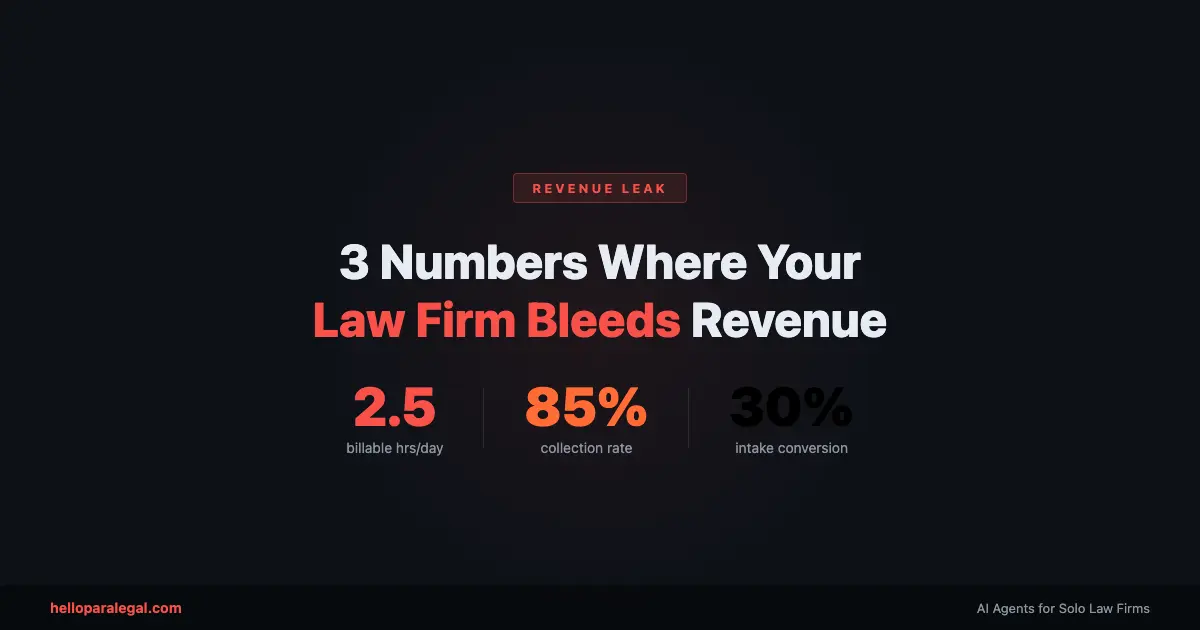
Most solo lawyers think their revenue problem is a marketing problem. They need more clients, more referrals, more visibility. So they spend time on their website, they go to bar association events, they ask for referrals.
Then they look at their P&L at the end of the year and wonder why the numbers don’t match what they expected.
The problem usually isn’t client volume. It’s the three numbers that tell you exactly where money is leaking out of your practice right now. Once you know these numbers, you can see precisely what’s wrong. And once you see what’s wrong, there’s an AI agent for each one.
Number 1: Your Billable Hour Utilization Rate
The Benchmark
The average solo attorney bills approximately 2.5 hours per day. That’s according to Clio’s Legal Trends Report, which surveys thousands of law firms annually and is the most comprehensive benchmark data available for the legal industry.
If you’re billing 2.5 hours on a day you worked 9 or 10, that means 6.5 to 7.5 hours went somewhere else. That’s your utilization rate: the percentage of your working hours that become billable client time.
For most solo lawyers, utilization sits between 25% and 35%. Meaning 65% to 75% of your working hours generate zero direct revenue.
What That Means in Dollars
If your hourly rate is $350 and you bill 2.5 hours per day across 220 working days, your annual billings are $192,500. That sounds acceptable until you realize that at 4 billable hours per day, same rate, same schedule, you’d be billing $308,000. The difference is $115,500 per year, not captured, because your non-billable work is eating your day.
Where the Hours Go
The non-billable time isn’t wasted. It’s real work. It’s answering client emails, scheduling appointments, chasing down unpaid invoices, handling intake calls from prospects who don’t become clients, managing your own billing, drafting engagement letters, and doing administrative tasks that keep the firm running but don’t show up on any invoice.
Clio’s data shows that the average attorney spends about 48% of their day on non-billable administrative work. That’s where your utilization rate is being destroyed.
The Agent That Fixes It: Administrative Automation
An administrative AI agent takes over the work that’s consuming your non-billable hours. Client intake handling. Appointment scheduling. Document preparation and routine correspondence. Status update emails. Invoice generation and billing reminders.
These agents don’t just help you work faster. They remove entire categories of work from your plate. You’re not faster at scheduling. You don’t do scheduling anymore. The agent does it.
Attorneys who deploy administrative agents typically recapture 1.5 to 2 hours of billable time per day. At $350 per hour across 220 working days, that’s $115,500 to $154,000 in additional annual billings. From one agent.
Number 2: Your Collection Rate
The Benchmark
The industry average collection rate for law firms is approximately 85%. That means for every $100 you bill, $15 never gets paid. It’s written off, written down, or just never collected because follow-up fell apart.
For solo practitioners, that number is often lower. Clio data consistently shows solo firms collecting at 79 to 83 cents on the dollar, while firms with systematic billing processes collect at 88 to 92 cents.
What That Means in Dollars
Say you bill $350,000 in a year. At an 82% collection rate, you collect $287,000. At a 91% collection rate, you collect $318,500. That’s a $31,500 difference on the same billings, from the same clients, for the same work. The only variable is how well your collections process works.
At $500,000 in billings, the same spread between 82% and 91% collection rates is $45,000 per year. That’s not a rounding error. That’s a real number that either goes into your pocket or evaporates because invoices sat unanswered.
Why Collection Rates Suffer
Solo attorneys are bad at collections not because they don’t want to get paid, but because follow-up is awkward and time-consuming. The psychology is real: most lawyers hate asking for money. The practical reality is also real: who has time to track every overdue invoice and send a second, third, fourth reminder?
The result is a passive approach. Invoice goes out. If the client pays, great. If not, maybe a reminder goes out a few weeks later, maybe it doesn’t. Eventually the amount gets written off or referred to collections, which costs a percentage of recovery and damages the client relationship.
The Agent That Fixes It: Billing and Collections Agent
A billing agent runs your entire collections cycle systematically. Invoice goes out on the day it’s generated, not when you get around to it. Seven days later, a payment reminder goes out automatically. Fourteen days after the due date, an escalation goes out. Thirty days overdue, the agent flags it for your attention with the full account history ready for review.
The agent doesn’t feel awkward about asking for money. It sends reminders on schedule, every time, without exception. Clients who would have let an invoice lapse simply because you hadn’t followed up pay because the reminder landed in their inbox at the right moment.
The agent also reconciles trust account activity against billing records in real time, flagging discrepancies before they become compliance issues. For attorneys managing client funds, this is as much a risk management tool as a revenue recovery tool.
Firms that shift from passive billing to agent-driven systematic follow-up typically see collection rates move from the low 80s to the high 80s or low 90s within 90 days. On $400,000 in annual billings, that’s $28,000 to $40,000 recovered that was previously being left behind.
Number 3: Your Intake Conversion Rate
The Benchmark
The average solo law firm converts approximately 30% of leads into paying clients. One in three people who reach out and express interest in hiring you actually retain you.
High-performing firms convert 50% to 60% of leads. The gap between average and high-performing isn’t about legal skill or reputation. It’s almost entirely explained by response time and follow-up consistency.
What That Means in Dollars
If 100 leads per month contact your firm, a 30% conversion rate means 30 new clients. At an average matter value of $3,500, that’s $105,000 per month in new client revenue. At a 50% conversion rate on the same 100 leads, you’re generating $175,000 per month. The 20-percentage-point conversion improvement is worth $70,000 per month, $840,000 per year, from the same lead volume.
Most solo attorneys would spend years trying to double their lead flow to get that kind of revenue increase. The better lever is converting the leads you already have.
Why Conversion Rates Are Low
Speed to response is the primary driver of intake conversion rates. A Harvard Business Review study found that leads contacted within 5 minutes of inquiry are 100 times more likely to convert than leads contacted 30 minutes later. Legal intake research shows similar patterns: response within the first hour converts at significantly higher rates than response after 24 hours.
Solo attorneys respond slowly because they’re busy. A potential client calls or fills out a contact form at 2pm on a Tuesday. You’re in a deposition. By the time you see the message, it’s 6pm. By the time you call back, it’s the next morning. In that window, that person may have called two other attorneys and hired one of them.
Even when initial response is fast, follow-up usually isn’t. Most solo lawyers make one or two contact attempts with a prospect and then move on. Research consistently shows that 80% of conversions require five or more follow-up contacts. Solo lawyers don’t have the time or systems to make five follow-up attempts on every lead.
The Agent That Fixes It: Intake Agent
An intake agent responds to every inquiry within 5 minutes, around the clock. A prospect submits a contact form at 11pm on Saturday. The agent responds within minutes, asks qualifying questions, and either schedules a consultation automatically or moves the lead into a follow-up sequence.
The follow-up sequence is systematic and persistent. The agent makes contact attempts on day 1, day 3, day 5, day 8, and day 14. Each attempt is personalized to where the prospect is in the sequence. Each one gives the prospect an easy path to book a consultation. The agent stops when the prospect books or explicitly opts out.
The agent also qualifies leads before they reach you. By the time a prospect gets to their consultation with you, they’ve answered the standard intake questions, they’ve confirmed they fit your practice area, and they’re pre-qualified against your client criteria. You spend 45 minutes with people who are likely to hire you, not 45 minutes discovering in the first 10 minutes that someone has a case you don’t take.
Firms using intake agents typically see conversion rates move from 28-32% to 48-55% within 60 to 90 days of deployment. On the numbers above, that conversion improvement alone is worth hundreds of thousands of dollars annually.
The Combined Impact
Here’s the math when all three agents are running for a solo attorney billing $350 per hour with $400,000 in annual billings and 100 leads per month:
| Metric | Before Agents | After Agents | Annual Impact |
|---|---|---|---|
| Billable hours per day | 2.5 hours | 4.0 hours | +$115,500 in billings |
| Collection rate | 82% | 91% | +$36,000 collected |
| Intake conversion rate | 30% | 50% | +$840,000 in new client revenue potential |
The utilization and collection improvements alone add over $150,000 to your bottom line without acquiring a single new client. The intake improvement is a multiplier on every lead your marketing generates.
Why Software Tools Don’t Move These Numbers
Legal tech companies have been selling billing software, intake forms, and CRM tools to lawyers for 20 years. These tools have been available the entire time the industry data has shown solo attorneys billing 2.5 hours per day, collecting at 82%, and converting 30% of leads.
The tools haven’t moved the numbers because they require the lawyer to use them. You have to log time, generate invoices, remember to follow up, check the CRM, send the reminder. The software creates a better environment for doing tasks. It doesn’t do the tasks.
AI agents are different because they operate autonomously. The intake agent doesn’t wait for you to check your email and decide to respond to a new lead. It responds immediately, every time, without your involvement. The billing agent doesn’t wait for you to open the software on a Tuesday and review outstanding invoices. It runs collections on schedule, automatically.
The distinction matters because the reason these numbers are bad isn’t that solo lawyers lack good software. It’s that solo lawyers don’t have time to use software consistently. An agent removes consistency as a variable. It runs whether you’re in trial, on vacation, or dealing with three emergencies at once.
What Hello Paralegal Does
Hello Paralegal builds AI agents specifically designed to close these gaps for solo law firms. The intake agent, the billing agent, and the administrative agent aren’t three separate products you configure and manage. They’re an integrated system that runs your practice operations while you do the legal work.
The agents connect to your existing practice management system, your billing software, your email, and your calendar. They learn your matter types, your client criteria, your billing rates, and your firm’s communication style. Then they run.
You don’t manage the agents day-to-day. You review their outputs, make decisions on escalations, and adjust their parameters when your practice evolves. Everything else happens without your involvement.
If you’re billing 2.5 hours per day, collecting at 82%, and converting 30% of your leads, you’re not underperforming because you’re a bad lawyer. You’re underperforming because you’re running a practice with no infrastructure. That’s fixable.
Your Three Numbers Benchmarks
| Metric | Poor | Industry Average | With AI Agents |
|---|---|---|---|
| Billable hours per day | Under 2.0 | 2.5 | 3.5 to 4.5 |
| Collection rate | Under 78% | 82-85% | 88-93% |
| Intake conversion rate | Under 25% | 28-35% | 48-58% |
Track your numbers for 30 days. If any of them fall in the average or poor column, you know exactly where the revenue is going and you know exactly which agent fixes it.
Frequently Asked Questions
What is a good billable hour utilization rate for a solo attorney?
The industry average is approximately 2.5 billable hours per day, which represents a 25-30% utilization rate. High-performing solo attorneys hit 3.5 to 4.5 billable hours per day. The gap is explained by how much non-billable administrative work takes up the rest of the day. AI agents that automate administrative tasks typically help attorneys recapture 1.5 to 2 hours of billable time per day.
What is a good collection rate for a law firm?
The industry average collection rate is approximately 85%, though solo practitioners typically collect at 79-83 cents on the dollar. High-performing firms with systematic billing and follow-up processes collect at 88-92%. The difference between an 82% and a 91% collection rate on $400,000 in annual billings is approximately $36,000 per year.
How can I improve my law firm’s intake conversion rate?
The two biggest drivers of intake conversion rate are response speed and follow-up consistency. Leads contacted within 5 minutes convert at dramatically higher rates than leads contacted hours later. Most conversions require 5 or more follow-up contacts, which solo lawyers rarely make manually. An AI intake agent handles both: responding within minutes 24/7 and following up systematically until the prospect books or opts out.
What AI agents help law firms increase revenue?
Three types of AI agents directly impact law firm revenue. An administrative agent automates non-billable tasks, recapturing billable hours. A billing and collections agent runs systematic invoice follow-up, improving collection rates. An intake agent responds to leads immediately and follows up persistently, improving conversion rates. Hello Paralegal builds all three specifically for solo law firms.
How do AI agents differ from legal software tools?
Software tools require the lawyer to use them: log in, run queries, send reminders, check dashboards. AI agents operate autonomously without the lawyer initiating each action. An intake agent responds to leads without the lawyer checking their inbox. A billing agent sends invoice reminders without the lawyer opening a billing dashboard. The autonomous operation is what makes agents effective for solo lawyers who don’t have consistent time to manage software.
How can I improve my law firm’s intake conversion rate?
The two biggest drivers of intake conversion rate are response speed and follow-up consistency. Leads contacted within 5 minutes convert at dramatically higher rates than leads contacted hours later. Most conversions require 5 or more follow-up contacts, which solo lawyers rarely make manually. An AI intake agent handles both: responding within minutes 24/7 and following up systematically until the prospect books or opts out.
What AI agents help law firms increase revenue?
Three types of AI agents directly impact law firm revenue. An administrative agent automates non-billable tasks, recapturing billable hours. A billing and collections agent runs systematic invoice follow-up, improving collection rates. An intake agent responds to leads immediately and follows up persistently, improving conversion rates. Hello Paralegal builds all three specifically for solo law firms.
How do AI agents differ from legal software tools?
Software tools require the lawyer to use them: log in, run queries, send reminders, check dashboards. AI agents operate autonomously without the lawyer initiating each action. An intake agent responds to leads without the lawyer checking their inbox. A billing agent sends invoice reminders without the lawyer opening a billing dashboard. The autonomous operation is what makes agents effective for solo lawyers who don’t have consistent time to manage software.
Most solo lawyers think their revenue problem is a marketing problem. They need more clients, more referrals, more visibility. So they spend time on their website, they go to bar association events, they ask for referrals.
Then they look at their P&L at the end of the year and wonder why the numbers don’t match what they expected.
The problem usually isn’t client volume. It’s the three numbers that tell you exactly where money is leaking out of your practice right now. Once you know these numbers, you can see precisely what’s wrong. And once you see what’s wrong, there’s an AI agent for each one.
Number 1: Your Billable Hour Utilization Rate
The Benchmark
The average solo attorney bills approximately 2.5 hours per day. That’s according to Clio’s Legal Trends Report, which surveys thousands of law firms annually and is the most comprehensive benchmark data available for the legal industry.
If you’re billing 2.5 hours on a day you worked 9 or 10, that means 6.5 to 7.5 hours went somewhere else. That’s your utilization rate: the percentage of your working hours that become billable client time.
For most solo lawyers, utilization sits between 25% and 35%. Meaning 65% to 75% of your working hours generate zero direct revenue.
What That Means in Dollars
If your hourly rate is $350 and you bill 2.5 hours per day across 220 working days, your annual billings are $192,500. That sounds acceptable until you realize that at 4 billable hours per day, same rate, same schedule, you’d be billing $308,000. The difference is $115,500 per year, not captured, because your non-billable work is eating your day.
Where the Hours Go
The non-billable time isn’t wasted. It’s real work. It’s answering client emails, scheduling appointments, chasing down unpaid invoices, handling intake calls from prospects who don’t become clients, managing your own billing, drafting engagement letters, and doing administrative tasks that keep the firm running but don’t show up on any invoice.
Clio’s data shows that the average attorney spends about 48% of their day on non-billable administrative work. That’s where your utilization rate is being destroyed.
The Agent That Fixes It: Administrative Automation
An administrative AI agent takes over the work that’s consuming your non-billable hours. Client intake handling. Appointment scheduling. Document preparation and routine correspondence. Status update emails. Invoice generation and billing reminders.
These agents don’t just help you work faster. They remove entire categories of work from your plate. You’re not faster at scheduling. You don’t do scheduling anymore. The agent does it.
Attorneys who deploy administrative agents typically recapture 1.5 to 2 hours of billable time per day. At $350 per hour across 220 working days, that’s $115,500 to $154,000 in additional annual billings. From one agent.
Number 2: Your Collection Rate
The Benchmark
The industry average collection rate for law firms is approximately 85%. That means for every $100 you bill, $15 never gets paid. It’s written off, written down, or just never collected because follow-up fell apart.
For solo practitioners, that number is often lower. Clio data consistently shows solo firms collecting at 79 to 83 cents on the dollar, while firms with systematic billing processes collect at 88 to 92 cents.
What That Means in Dollars
Say you bill $350,000 in a year. At an 82% collection rate, you collect $287,000. At a 91% collection rate, you collect $318,500. That’s a $31,500 difference on the same billings, from the same clients, for the same work. The only variable is how well your collections process works.
At $500,000 in billings, the same spread between 82% and 91% collection rates is $45,000 per year. That’s not a rounding error. That’s a real number that either goes into your pocket or evaporates because invoices sat unanswered.
Why Collection Rates Suffer
Solo attorneys are bad at collections not because they don’t want to get paid, but because follow-up is awkward and time-consuming. The psychology is real: most lawyers hate asking for money. The practical reality is also real: who has time to track every overdue invoice and send a second, third, fourth reminder?
The result is a passive approach. Invoice goes out. If the client pays, great. If not, maybe a reminder goes out a few weeks later, maybe it doesn’t. Eventually the amount gets written off or referred to collections, which costs a percentage of recovery and damages the client relationship.
The Agent That Fixes It: Billing and Collections Agent
A billing agent runs your entire collections cycle systematically. Invoice goes out on the day it’s generated, not when you get around to it. Seven days later, a payment reminder goes out automatically. Fourteen days after the due date, an escalation goes out. Thirty days overdue, the agent flags it for your attention with the full account history ready for review.
The agent doesn’t feel awkward about asking for money. It sends reminders on schedule, every time, without exception. Clients who would have let an invoice lapse simply because you hadn’t followed up pay because the reminder landed in their inbox at the right moment.
The agent also reconciles trust account activity against billing records in real time, flagging discrepancies before they become compliance issues. For attorneys managing client funds, this is as much a risk management tool as a revenue recovery tool.
Firms that shift from passive billing to agent-driven systematic follow-up typically see collection rates move from the low 80s to the high 80s or low 90s within 90 days. On $400,000 in annual billings, that’s $28,000 to $40,000 recovered that was previously being left behind.
Number 3: Your Intake Conversion Rate
The Benchmark
The average solo law firm converts approximately 30% of leads into paying clients. One in three people who reach out and express interest in hiring you actually retain you.
High-performing firms convert 50% to 60% of leads. The gap between average and high-performing isn’t about legal skill or reputation. It’s almost entirely explained by response time and follow-up consistency.
What That Means in Dollars
If 100 leads per month contact your firm, a 30% conversion rate means 30 new clients. At an average matter value of $3,500, that’s $105,000 per month in new client revenue. At a 50% conversion rate on the same 100 leads, you’re generating $175,000 per month. The 20-percentage-point conversion improvement is worth $70,000 per month, $840,000 per year, from the same lead volume.
Most solo attorneys would spend years trying to double their lead flow to get that kind of revenue increase. The better lever is converting the leads you already have.
Why Conversion Rates Are Low
Speed to response is the primary driver of intake conversion rates. A Harvard Business Review study found that leads contacted within 5 minutes of inquiry are 100 times more likely to convert than leads contacted 30 minutes later. Legal intake research shows similar patterns: response within the first hour converts at significantly higher rates than response after 24 hours.
Solo attorneys respond slowly because they’re busy. A potential client calls or fills out a contact form at 2pm on a Tuesday. You’re in a deposition. By the time you see the message, it’s 6pm. By the time you call back, it’s the next morning. In that window, that person may have called two other attorneys and hired one of them.
Even when initial response is fast, follow-up usually isn’t. Most solo lawyers make one or two contact attempts with a prospect and then move on. Research consistently shows that 80% of conversions require five or more follow-up contacts. Solo lawyers don’t have the time or systems to make five follow-up attempts on every lead.
The Agent That Fixes It: Intake Agent
An intake agent responds to every inquiry within 5 minutes, around the clock. A prospect submits a contact form at 11pm on Saturday. The agent responds within minutes, asks qualifying questions, and either schedules a consultation automatically or moves the lead into a follow-up sequence.
The follow-up sequence is systematic and persistent. The agent makes contact attempts on day 1, day 3, day 5, day 8, and day 14. Each attempt is personalized to where the prospect is in the sequence. Each one gives the prospect an easy path to book a consultation. The agent stops when the prospect books or explicitly opts out.
The agent also qualifies leads before they reach you. By the time a prospect gets to their consultation with you, they’ve answered the standard intake questions, they’ve confirmed they fit your practice area, and they’re pre-qualified against your client criteria. You spend 45 minutes with people who are likely to hire you, not 45 minutes discovering in the first 10 minutes that someone has a case you don’t take.
Firms using intake agents typically see conversion rates move from 28-32% to 48-55% within 60 to 90 days of deployment. On the numbers above, that conversion improvement alone is worth hundreds of thousands of dollars annually.
The Combined Impact
Here’s the math when all three agents are running for a solo attorney billing $350 per hour with $400,000 in annual billings and 100 leads per month:
| Metric | Before Agents | After Agents | Annual Impact |
|---|---|---|---|
| Billable hours per day | 2.5 hours | 4.0 hours | +$115,500 in billings |
| Collection rate | 82% | 91% | +$36,000 collected |
| Intake conversion rate | 30% | 50% | +$840,000 in new client revenue potential |
The utilization and collection improvements alone add over $150,000 to your bottom line without acquiring a single new client. The intake improvement is a multiplier on every lead your marketing generates.
Why Software Tools Don’t Move These Numbers
Legal tech companies have been selling billing software, intake forms, and CRM tools to lawyers for 20 years. These tools have been available the entire time the industry data has shown solo attorneys billing 2.5 hours per day, collecting at 82%, and converting 30% of leads.
The tools haven’t moved the numbers because they require the lawyer to use them. You have to log time, generate invoices, remember to follow up, check the CRM, send the reminder. The software creates a better environment for doing tasks. It doesn’t do the tasks.
AI agents are different because they operate autonomously. The intake agent doesn’t wait for you to check your email and decide to respond to a new lead. It responds immediately, every time, without your involvement. The billing agent doesn’t wait for you to open the software on a Tuesday and review outstanding invoices. It runs collections on schedule, automatically.
The distinction matters because the reason these numbers are bad isn’t that solo lawyers lack good software. It’s that solo lawyers don’t have time to use software consistently. An agent removes consistency as a variable. It runs whether you’re in trial, on vacation, or dealing with three emergencies at once.
What Hello Paralegal Does
Hello Paralegal builds AI agents specifically designed to close these gaps for solo law firms. The intake agent, the billing agent, and the administrative agent aren’t three separate products you configure and manage. They’re an integrated system that runs your practice operations while you do the legal work.
The agents connect to your existing practice management system, your billing software, your email, and your calendar. They learn your matter types, your client criteria, your billing rates, and your firm’s communication style. Then they run.
You don’t manage the agents day-to-day. You review their outputs, make decisions on escalations, and adjust their parameters when your practice evolves. Everything else happens without your involvement.
If you’re billing 2.5 hours per day, collecting at 82%, and converting 30% of your leads, you’re not underperforming because you’re a bad lawyer. You’re underperforming because you’re running a practice with no infrastructure. That’s fixable.
Your Three Numbers Benchmarks
| Metric | Poor | Industry Average | With AI Agents |
|---|---|---|---|
| Billable hours per day | Under 2.0 | 2.5 | 3.5 to 4.5 |
| Collection rate | Under 78% | 82-85% | 88-93% |
| Intake conversion rate | Under 25% | 28-35% | 48-58% |
Track your numbers for 30 days. If any of them fall in the average or poor column, you know exactly where the revenue is going and you know exactly which agent fixes it.
Frequently Asked Questions
What is a good billable hour utilization rate for a solo attorney?
The industry average is approximately 2.5 billable hours per day, which represents a 25-30% utilization rate. High-performing solo attorneys hit 3.5 to 4.5 billable hours per day. The gap is explained by how much non-billable administrative work takes up the rest of the day. AI agents that automate administrative tasks typically help attorneys recapture 1.5 to 2 hours of billable time per day.
What is a good collection rate for a law firm?
The industry average collection rate is approximately 85%, though solo practitioners typically collect at 79-83 cents on the dollar. High-performing firms with systematic billing and follow-up processes collect at 88-92%. The difference between an 82% and a 91% collection rate on $400,000 in annual billings is approximately $36,000 per year.
How can I improve my law firm’s intake conversion rate?
The two biggest drivers of intake conversion rate are response speed and follow-up consistency. Leads contacted within 5 minutes convert at dramatically higher rates than leads contacted hours later. Most conversions require 5 or more follow-up contacts, which solo lawyers rarely make manually. An AI intake agent handles both: responding within minutes 24/7 and following up systematically until the prospect books or opts out.
What AI agents help law firms increase revenue?
Three types of AI agents directly impact law firm revenue. An administrative agent automates non-billable tasks, recapturing billable hours. A billing and collections agent runs systematic invoice follow-up, improving collection rates. An intake agent responds to leads immediately and follows up persistently, improving conversion rates. Hello Paralegal builds all three specifically for solo law firms.
How do AI agents differ from legal software tools?
Software tools require the lawyer to use them: log in, run queries, send reminders, check dashboards. AI agents operate autonomously without the lawyer initiating each action. An intake agent responds to leads without the lawyer checking their inbox. A billing agent sends invoice reminders without the lawyer opening a billing dashboard. The autonomous operation is what makes agents effective for solo lawyers who don’t have consistent time to manage software.
What That Means in Dollars
If 100 leads per month contact your firm, a 30% conversion rate means 30 new clients. At an average matter value of $3,500, that’s $105,000 per month in new client revenue. At a 50% conversion rate on the same 100 leads, you’re generating $175,000 per month. The 20-percentage-point conversion improvement is worth $70,000 per month, $840,000 per year, from the same lead volume.
Most solo attorneys would spend years trying to double their lead flow to get that kind of revenue increase. The better lever is converting the leads you already have.
Why Conversion Rates Are Low
Speed to response is the primary driver of intake conversion rates. A Harvard Business Review study found that leads contacted within 5 minutes of inquiry are 100 times more likely to convert than leads contacted 30 minutes later. Legal intake research shows similar patterns: response within the first hour converts at significantly higher rates than response after 24 hours.
Solo attorneys respond slowly because they’re busy. A potential client calls or fills out a contact form at 2pm on a Tuesday. You’re in a deposition. By the time you see the message, it’s 6pm. By the time you call back, it’s the next morning. In that window, that person may have called two other attorneys and hired one of them.
Even when initial response is fast, follow-up usually isn’t. Most solo lawyers make one or two contact attempts with a prospect and then move on. Research consistently shows that 80% of conversions require five or more follow-up contacts. Solo lawyers don’t have the time or systems to make five follow-up attempts on every lead.
The Agent That Fixes It: Intake Agent
An intake agent responds to every inquiry within 5 minutes, around the clock. A prospect submits a contact form at 11pm on Saturday. The agent responds within minutes, asks qualifying questions, and either schedules a consultation automatically or moves the lead into a follow-up sequence.
The follow-up sequence is systematic and persistent. The agent makes contact attempts on day 1, day 3, day 5, day 8, and day 14. Each attempt is personalized to where the prospect is in the sequence. Each one gives the prospect an easy path to book a consultation. The agent stops when the prospect books or explicitly opts out.
The agent also qualifies leads before they reach you. By the time a prospect gets to their consultation with you, they’ve answered the standard intake questions, they’ve confirmed they fit your practice area, and they’re pre-qualified against your client criteria. You spend 45 minutes with people who are likely to hire you, not 45 minutes discovering in the first 10 minutes that someone has a case you don’t take.
Firms using intake agents typically see conversion rates move from 28-32% to 48-55% within 60 to 90 days of deployment. On the numbers above, that conversion improvement alone is worth hundreds of thousands of dollars annually.
The Combined Impact
Here’s the math when all three agents are running for a solo attorney billing $350 per hour with $400,000 in annual billings and 100 leads per month:
| Metric | Before Agents | After Agents | Annual Impact |
|---|---|---|---|
| Billable hours per day | 2.5 hours | 4.0 hours | +$115,500 in billings |
| Collection rate | 82% | 91% | +$36,000 collected |
| Intake conversion rate | 30% | 50% | +$840,000 in new client revenue potential |
The utilization and collection improvements alone add over $150,000 to your bottom line without acquiring a single new client. The intake improvement is a multiplier on every lead your marketing generates.
Why Software Tools Don’t Move These Numbers
Legal tech companies have been selling billing software, intake forms, and CRM tools to lawyers for 20 years. These tools have been available the entire time the industry data has shown solo attorneys billing 2.5 hours per day, collecting at 82%, and converting 30% of leads.
The tools haven’t moved the numbers because they require the lawyer to use them. You have to log time, generate invoices, remember to follow up, check the CRM, send the reminder. The software creates a better environment for doing tasks. It doesn’t do the tasks.
AI agents are different because they operate autonomously. The intake agent doesn’t wait for you to check your email and decide to respond to a new lead. It responds immediately, every time, without your involvement. The billing agent doesn’t wait for you to open the software on a Tuesday and review outstanding invoices. It runs collections on schedule, automatically.
The distinction matters because the reason these numbers are bad isn’t that solo lawyers lack good software. It’s that solo lawyers don’t have time to use software consistently. An agent removes consistency as a variable. It runs whether you’re in trial, on vacation, or dealing with three emergencies at once.
What Hello Paralegal Does
Hello Paralegal builds AI agents specifically designed to close these gaps for solo law firms. The intake agent, the billing agent, and the administrative agent aren’t three separate products you configure and manage. They’re an integrated system that runs your practice operations while you do the legal work.
The agents connect to your existing practice management system, your billing software, your email, and your calendar. They learn your matter types, your client criteria, your billing rates, and your firm’s communication style. Then they run.
You don’t manage the agents day-to-day. You review their outputs, make decisions on escalations, and adjust their parameters when your practice evolves. Everything else happens without your involvement.
If you’re billing 2.5 hours per day, collecting at 82%, and converting 30% of your leads, you’re not underperforming because you’re a bad lawyer. You’re underperforming because you’re running a practice with no infrastructure. That’s fixable.
Your Three Numbers Benchmarks
| Metric | Poor | Industry Average | With AI Agents |
|---|---|---|---|
| Billable hours per day | Under 2.0 | 2.5 | 3.5 to 4.5 |
| Collection rate | Under 78% | 82-85% | 88-93% |
| Intake conversion rate | Under 25% | 28-35% | 48-58% |
Track your numbers for 30 days. If any of them fall in the average or poor column, you know exactly where the revenue is going and you know exactly which agent fixes it.
Frequently Asked Questions
What is a good billable hour utilization rate for a solo attorney?
The industry average is approximately 2.5 billable hours per day, which represents a 25-30% utilization rate. High-performing solo attorneys hit 3.5 to 4.5 billable hours per day. The gap is explained by how much non-billable administrative work takes up the rest of the day. AI agents that automate administrative tasks typically help attorneys recapture 1.5 to 2 hours of billable time per day.
What is a good collection rate for a law firm?
The industry average collection rate is approximately 85%, though solo practitioners typically collect at 79-83 cents on the dollar. High-performing firms with systematic billing and follow-up processes collect at 88-92%. The difference between an 82% and a 91% collection rate on $400,000 in annual billings is approximately $36,000 per year.
How can I improve my law firm’s intake conversion rate?
The two biggest drivers of intake conversion rate are response speed and follow-up consistency. Leads contacted within 5 minutes convert at dramatically higher rates than leads contacted hours later. Most conversions require 5 or more follow-up contacts, which solo lawyers rarely make manually. An AI intake agent handles both: responding within minutes 24/7 and following up systematically until the prospect books or opts out.
What AI agents help law firms increase revenue?
Three types of AI agents directly impact law firm revenue. An administrative agent automates non-billable tasks, recapturing billable hours. A billing and collections agent runs systematic invoice follow-up, improving collection rates. An intake agent responds to leads immediately and follows up persistently, improving conversion rates. Hello Paralegal builds all three specifically for solo law firms.
How do AI agents differ from legal software tools?
Software tools require the lawyer to use them: log in, run queries, send reminders, check dashboards. AI agents operate autonomously without the lawyer initiating each action. An intake agent responds to leads without the lawyer checking their inbox. A billing agent sends invoice reminders without the lawyer opening a billing dashboard. The autonomous operation is what makes agents effective for solo lawyers who don’t have consistent time to manage software.
Most solo lawyers think their revenue problem is a marketing problem. They need more clients, more referrals, more visibility. So they spend time on their website, they go to bar association events, they ask for referrals.
Then they look at their P&L at the end of the year and wonder why the numbers don’t match what they expected.
The problem usually isn’t client volume. It’s the three numbers that tell you exactly where money is leaking out of your practice right now. Once you know these numbers, you can see precisely what’s wrong. And once you see what’s wrong, there’s an AI agent for each one.
Number 1: Your Billable Hour Utilization Rate
The Benchmark
The average solo attorney bills approximately 2.5 hours per day. That’s according to Clio’s Legal Trends Report, which surveys thousands of law firms annually and is the most comprehensive benchmark data available for the legal industry.
If you’re billing 2.5 hours on a day you worked 9 or 10, that means 6.5 to 7.5 hours went somewhere else. That’s your utilization rate: the percentage of your working hours that become billable client time.
For most solo lawyers, utilization sits between 25% and 35%. Meaning 65% to 75% of your working hours generate zero direct revenue.
What That Means in Dollars
If your hourly rate is $350 and you bill 2.5 hours per day across 220 working days, your annual billings are $192,500. That sounds acceptable until you realize that at 4 billable hours per day, same rate, same schedule, you’d be billing $308,000. The difference is $115,500 per year, not captured, because your non-billable work is eating your day.
Where the Hours Go
The non-billable time isn’t wasted. It’s real work. It’s answering client emails, scheduling appointments, chasing down unpaid invoices, handling intake calls from prospects who don’t become clients, managing your own billing, drafting engagement letters, and doing administrative tasks that keep the firm running but don’t show up on any invoice.
Clio’s data shows that the average attorney spends about 48% of their day on non-billable administrative work. That’s where your utilization rate is being destroyed.
The Agent That Fixes It: Administrative Automation
An administrative AI agent takes over the work that’s consuming your non-billable hours. Client intake handling. Appointment scheduling. Document preparation and routine correspondence. Status update emails. Invoice generation and billing reminders.
These agents don’t just help you work faster. They remove entire categories of work from your plate. You’re not faster at scheduling. You don’t do scheduling anymore. The agent does it.
Attorneys who deploy administrative agents typically recapture 1.5 to 2 hours of billable time per day. At $350 per hour across 220 working days, that’s $115,500 to $154,000 in additional annual billings. From one agent.
Number 2: Your Collection Rate
The Benchmark
The industry average collection rate for law firms is approximately 85%. That means for every $100 you bill, $15 never gets paid. It’s written off, written down, or just never collected because follow-up fell apart.
For solo practitioners, that number is often lower. Clio data consistently shows solo firms collecting at 79 to 83 cents on the dollar, while firms with systematic billing processes collect at 88 to 92 cents.
What That Means in Dollars
Say you bill $350,000 in a year. At an 82% collection rate, you collect $287,000. At a 91% collection rate, you collect $318,500. That’s a $31,500 difference on the same billings, from the same clients, for the same work. The only variable is how well your collections process works.
At $500,000 in billings, the same spread between 82% and 91% collection rates is $45,000 per year. That’s not a rounding error. That’s a real number that either goes into your pocket or evaporates because invoices sat unanswered.
Why Collection Rates Suffer
Solo attorneys are bad at collections not because they don’t want to get paid, but because follow-up is awkward and time-consuming. The psychology is real: most lawyers hate asking for money. The practical reality is also real: who has time to track every overdue invoice and send a second, third, fourth reminder?
The result is a passive approach. Invoice goes out. If the client pays, great. If not, maybe a reminder goes out a few weeks later, maybe it doesn’t. Eventually the amount gets written off or referred to collections, which costs a percentage of recovery and damages the client relationship.
The Agent That Fixes It: Billing and Collections Agent
A billing agent runs your entire collections cycle systematically. Invoice goes out on the day it’s generated, not when you get around to it. Seven days later, a payment reminder goes out automatically. Fourteen days after the due date, an escalation goes out. Thirty days overdue, the agent flags it for your attention with the full account history ready for review.
The agent doesn’t feel awkward about asking for money. It sends reminders on schedule, every time, without exception. Clients who would have let an invoice lapse simply because you hadn’t followed up pay because the reminder landed in their inbox at the right moment.
The agent also reconciles trust account activity against billing records in real time, flagging discrepancies before they become compliance issues. For attorneys managing client funds, this is as much a risk management tool as a revenue recovery tool.
Firms that shift from passive billing to agent-driven systematic follow-up typically see collection rates move from the low 80s to the high 80s or low 90s within 90 days. On $400,000 in annual billings, that’s $28,000 to $40,000 recovered that was previously being left behind.
Number 3: Your Intake Conversion Rate
The Benchmark
The average solo law firm converts approximately 30% of leads into paying clients. One in three people who reach out and express interest in hiring you actually retain you.
High-performing firms convert 50% to 60% of leads. The gap between average and high-performing isn’t about legal skill or reputation. It’s almost entirely explained by response time and follow-up consistency.
What That Means in Dollars
If 100 leads per month contact your firm, a 30% conversion rate means 30 new clients. At an average matter value of $3,500, that’s $105,000 per month in new client revenue. At a 50% conversion rate on the same 100 leads, you’re generating $175,000 per month. The 20-percentage-point conversion improvement is worth $70,000 per month, $840,000 per year, from the same lead volume.
Most solo attorneys would spend years trying to double their lead flow to get that kind of revenue increase. The better lever is converting the leads you already have.
Why Conversion Rates Are Low
Speed to response is the primary driver of intake conversion rates. A Harvard Business Review study found that leads contacted within 5 minutes of inquiry are 100 times more likely to convert than leads contacted 30 minutes later. Legal intake research shows similar patterns: response within the first hour converts at significantly higher rates than response after 24 hours.
Solo attorneys respond slowly because they’re busy. A potential client calls or fills out a contact form at 2pm on a Tuesday. You’re in a deposition. By the time you see the message, it’s 6pm. By the time you call back, it’s the next morning. In that window, that person may have called two other attorneys and hired one of them.
Even when initial response is fast, follow-up usually isn’t. Most solo lawyers make one or two contact attempts with a prospect and then move on. Research consistently shows that 80% of conversions require five or more follow-up contacts. Solo lawyers don’t have the time or systems to make five follow-up attempts on every lead.
The Agent That Fixes It: Intake Agent
An intake agent responds to every inquiry within 5 minutes, around the clock. A prospect submits a contact form at 11pm on Saturday. The agent responds within minutes, asks qualifying questions, and either schedules a consultation automatically or moves the lead into a follow-up sequence.
The follow-up sequence is systematic and persistent. The agent makes contact attempts on day 1, day 3, day 5, day 8, and day 14. Each attempt is personalized to where the prospect is in the sequence. Each one gives the prospect an easy path to book a consultation. The agent stops when the prospect books or explicitly opts out.
The agent also qualifies leads before they reach you. By the time a prospect gets to their consultation with you, they’ve answered the standard intake questions, they’ve confirmed they fit your practice area, and they’re pre-qualified against your client criteria. You spend 45 minutes with people who are likely to hire you, not 45 minutes discovering in the first 10 minutes that someone has a case you don’t take.
Firms using intake agents typically see conversion rates move from 28-32% to 48-55% within 60 to 90 days of deployment. On the numbers above, that conversion improvement alone is worth hundreds of thousands of dollars annually.
The Combined Impact
Here’s the math when all three agents are running for a solo attorney billing $350 per hour with $400,000 in annual billings and 100 leads per month:
| Metric | Before Agents | After Agents | Annual Impact |
|---|---|---|---|
| Billable hours per day | 2.5 hours | 4.0 hours | +$115,500 in billings |
| Collection rate | 82% | 91% | +$36,000 collected |
| Intake conversion rate | 30% | 50% | +$840,000 in new client revenue potential |
The utilization and collection improvements alone add over $150,000 to your bottom line without acquiring a single new client. The intake improvement is a multiplier on every lead your marketing generates.
Why Software Tools Don’t Move These Numbers
Legal tech companies have been selling billing software, intake forms, and CRM tools to lawyers for 20 years. These tools have been available the entire time the industry data has shown solo attorneys billing 2.5 hours per day, collecting at 82%, and converting 30% of leads.
The tools haven’t moved the numbers because they require the lawyer to use them. You have to log time, generate invoices, remember to follow up, check the CRM, send the reminder. The software creates a better environment for doing tasks. It doesn’t do the tasks.
AI agents are different because they operate autonomously. The intake agent doesn’t wait for you to check your email and decide to respond to a new lead. It responds immediately, every time, without your involvement. The billing agent doesn’t wait for you to open the software on a Tuesday and review outstanding invoices. It runs collections on schedule, automatically.
The distinction matters because the reason these numbers are bad isn’t that solo lawyers lack good software. It’s that solo lawyers don’t have time to use software consistently. An agent removes consistency as a variable. It runs whether you’re in trial, on vacation, or dealing with three emergencies at once.
What Hello Paralegal Does
Hello Paralegal builds AI agents specifically designed to close these gaps for solo law firms. The intake agent, the billing agent, and the administrative agent aren’t three separate products you configure and manage. They’re an integrated system that runs your practice operations while you do the legal work.
The agents connect to your existing practice management system, your billing software, your email, and your calendar. They learn your matter types, your client criteria, your billing rates, and your firm’s communication style. Then they run.
You don’t manage the agents day-to-day. You review their outputs, make decisions on escalations, and adjust their parameters when your practice evolves. Everything else happens without your involvement.
If you’re billing 2.5 hours per day, collecting at 82%, and converting 30% of your leads, you’re not underperforming because you’re a bad lawyer. You’re underperforming because you’re running a practice with no infrastructure. That’s fixable.
Your Three Numbers Benchmarks
| Metric | Poor | Industry Average | With AI Agents |
|---|---|---|---|
| Billable hours per day | Under 2.0 | 2.5 | 3.5 to 4.5 |
| Collection rate | Under 78% | 82-85% | 88-93% |
| Intake conversion rate | Under 25% | 28-35% | 48-58% |
Track your numbers for 30 days. If any of them fall in the average or poor column, you know exactly where the revenue is going and you know exactly which agent fixes it.
Frequently Asked Questions
What is a good billable hour utilization rate for a solo attorney?
The industry average is approximately 2.5 billable hours per day, which represents a 25-30% utilization rate. High-performing solo attorneys hit 3.5 to 4.5 billable hours per day. The gap is explained by how much non-billable administrative work takes up the rest of the day. AI agents that automate administrative tasks typically help attorneys recapture 1.5 to 2 hours of billable time per day.
What is a good collection rate for a law firm?
The industry average collection rate is approximately 85%, though solo practitioners typically collect at 79-83 cents on the dollar. High-performing firms with systematic billing and follow-up processes collect at 88-92%. The difference between an 82% and a 91% collection rate on $400,000 in annual billings is approximately $36,000 per year.
How can I improve my law firm’s intake conversion rate?
The two biggest drivers of intake conversion rate are response speed and follow-up consistency. Leads contacted within 5 minutes convert at dramatically higher rates than leads contacted hours later. Most conversions require 5 or more follow-up contacts, which solo lawyers rarely make manually. An AI intake agent handles both: responding within minutes 24/7 and following up systematically until the prospect books or opts out.
What AI agents help law firms increase revenue?
Three types of AI agents directly impact law firm revenue. An administrative agent automates non-billable tasks, recapturing billable hours. A billing and collections agent runs systematic invoice follow-up, improving collection rates. An intake agent responds to leads immediately and follows up persistently, improving conversion rates. Hello Paralegal builds all three specifically for solo law firms.
How do AI agents differ from legal software tools?
Software tools require the lawyer to use them: log in, run queries, send reminders, check dashboards. AI agents operate autonomously without the lawyer initiating each action. An intake agent responds to leads without the lawyer checking their inbox. A billing agent sends invoice reminders without the lawyer opening a billing dashboard. The autonomous operation is what makes agents effective for solo lawyers who don’t have consistent time to manage software.
What That Means in Dollars
Say you bill $350,000 in a year. At an 82% collection rate, you collect $287,000. At a 91% collection rate, you collect $318,500. That’s a $31,500 difference on the same billings, from the same clients, for the same work. The only variable is how well your collections process works.
At $500,000 in billings, the same spread between 82% and 91% collection rates is $45,000 per year. That’s not a rounding error. That’s a real number that either goes into your pocket or evaporates because invoices sat unanswered.
Why Collection Rates Suffer
Solo attorneys are bad at collections not because they don’t want to get paid, but because follow-up is awkward and time-consuming. The psychology is real: most lawyers hate asking for money. The practical reality is also real: who has time to track every overdue invoice and send a second, third, fourth reminder?
The result is a passive approach. Invoice goes out. If the client pays, great. If not, maybe a reminder goes out a few weeks later, maybe it doesn’t. Eventually the amount gets written off or referred to collections, which costs a percentage of recovery and damages the client relationship.
The Agent That Fixes It: Billing and Collections Agent
A billing agent runs your entire collections cycle systematically. Invoice goes out on the day it’s generated, not when you get around to it. Seven days later, a payment reminder goes out automatically. Fourteen days after the due date, an escalation goes out. Thirty days overdue, the agent flags it for your attention with the full account history ready for review.
The agent doesn’t feel awkward about asking for money. It sends reminders on schedule, every time, without exception. Clients who would have let an invoice lapse simply because you hadn’t followed up pay because the reminder landed in their inbox at the right moment.
The agent also reconciles trust account activity against billing records in real time, flagging discrepancies before they become compliance issues. For attorneys managing client funds, this is as much a risk management tool as a revenue recovery tool.
Firms that shift from passive billing to agent-driven systematic follow-up typically see collection rates move from the low 80s to the high 80s or low 90s within 90 days. On $400,000 in annual billings, that’s $28,000 to $40,000 recovered that was previously being left behind.
Number 3: Your Intake Conversion Rate
The Benchmark
The average solo law firm converts approximately 30% of leads into paying clients. One in three people who reach out and express interest in hiring you actually retain you.
High-performing firms convert 50% to 60% of leads. The gap between average and high-performing isn’t about legal skill or reputation. It’s almost entirely explained by response time and follow-up consistency.
What That Means in Dollars
If 100 leads per month contact your firm, a 30% conversion rate means 30 new clients. At an average matter value of $3,500, that’s $105,000 per month in new client revenue. At a 50% conversion rate on the same 100 leads, you’re generating $175,000 per month. The 20-percentage-point conversion improvement is worth $70,000 per month, $840,000 per year, from the same lead volume.
Most solo attorneys would spend years trying to double their lead flow to get that kind of revenue increase. The better lever is converting the leads you already have.
Why Conversion Rates Are Low
Speed to response is the primary driver of intake conversion rates. A Harvard Business Review study found that leads contacted within 5 minutes of inquiry are 100 times more likely to convert than leads contacted 30 minutes later. Legal intake research shows similar patterns: response within the first hour converts at significantly higher rates than response after 24 hours.
Solo attorneys respond slowly because they’re busy. A potential client calls or fills out a contact form at 2pm on a Tuesday. You’re in a deposition. By the time you see the message, it’s 6pm. By the time you call back, it’s the next morning. In that window, that person may have called two other attorneys and hired one of them.
Even when initial response is fast, follow-up usually isn’t. Most solo lawyers make one or two contact attempts with a prospect and then move on. Research consistently shows that 80% of conversions require five or more follow-up contacts. Solo lawyers don’t have the time or systems to make five follow-up attempts on every lead.
The Agent That Fixes It: Intake Agent
An intake agent responds to every inquiry within 5 minutes, around the clock. A prospect submits a contact form at 11pm on Saturday. The agent responds within minutes, asks qualifying questions, and either schedules a consultation automatically or moves the lead into a follow-up sequence.
The follow-up sequence is systematic and persistent. The agent makes contact attempts on day 1, day 3, day 5, day 8, and day 14. Each attempt is personalized to where the prospect is in the sequence. Each one gives the prospect an easy path to book a consultation. The agent stops when the prospect books or explicitly opts out.
The agent also qualifies leads before they reach you. By the time a prospect gets to their consultation with you, they’ve answered the standard intake questions, they’ve confirmed they fit your practice area, and they’re pre-qualified against your client criteria. You spend 45 minutes with people who are likely to hire you, not 45 minutes discovering in the first 10 minutes that someone has a case you don’t take.
Firms using intake agents typically see conversion rates move from 28-32% to 48-55% within 60 to 90 days of deployment. On the numbers above, that conversion improvement alone is worth hundreds of thousands of dollars annually.
The Combined Impact
Here’s the math when all three agents are running for a solo attorney billing $350 per hour with $400,000 in annual billings and 100 leads per month:
| Metric | Before Agents | After Agents | Annual Impact |
|---|---|---|---|
| Billable hours per day | 2.5 hours | 4.0 hours | +$115,500 in billings |
| Collection rate | 82% | 91% | +$36,000 collected |
| Intake conversion rate | 30% | 50% | +$840,000 in new client revenue potential |
The utilization and collection improvements alone add over $150,000 to your bottom line without acquiring a single new client. The intake improvement is a multiplier on every lead your marketing generates.
Why Software Tools Don’t Move These Numbers
Legal tech companies have been selling billing software, intake forms, and CRM tools to lawyers for 20 years. These tools have been available the entire time the industry data has shown solo attorneys billing 2.5 hours per day, collecting at 82%, and converting 30% of leads.
The tools haven’t moved the numbers because they require the lawyer to use them. You have to log time, generate invoices, remember to follow up, check the CRM, send the reminder. The software creates a better environment for doing tasks. It doesn’t do the tasks.
AI agents are different because they operate autonomously. The intake agent doesn’t wait for you to check your email and decide to respond to a new lead. It responds immediately, every time, without your involvement. The billing agent doesn’t wait for you to open the software on a Tuesday and review outstanding invoices. It runs collections on schedule, automatically.
The distinction matters because the reason these numbers are bad isn’t that solo lawyers lack good software. It’s that solo lawyers don’t have time to use software consistently. An agent removes consistency as a variable. It runs whether you’re in trial, on vacation, or dealing with three emergencies at once.
What Hello Paralegal Does
Hello Paralegal builds AI agents specifically designed to close these gaps for solo law firms. The intake agent, the billing agent, and the administrative agent aren’t three separate products you configure and manage. They’re an integrated system that runs your practice operations while you do the legal work.
The agents connect to your existing practice management system, your billing software, your email, and your calendar. They learn your matter types, your client criteria, your billing rates, and your firm’s communication style. Then they run.
You don’t manage the agents day-to-day. You review their outputs, make decisions on escalations, and adjust their parameters when your practice evolves. Everything else happens without your involvement.
If you’re billing 2.5 hours per day, collecting at 82%, and converting 30% of your leads, you’re not underperforming because you’re a bad lawyer. You’re underperforming because you’re running a practice with no infrastructure. That’s fixable.
Your Three Numbers Benchmarks
| Metric | Poor | Industry Average | With AI Agents |
|---|---|---|---|
| Billable hours per day | Under 2.0 | 2.5 | 3.5 to 4.5 |
| Collection rate | Under 78% | 82-85% | 88-93% |
| Intake conversion rate | Under 25% | 28-35% | 48-58% |
Track your numbers for 30 days. If any of them fall in the average or poor column, you know exactly where the revenue is going and you know exactly which agent fixes it.
Frequently Asked Questions
What is a good billable hour utilization rate for a solo attorney?
The industry average is approximately 2.5 billable hours per day, which represents a 25-30% utilization rate. High-performing solo attorneys hit 3.5 to 4.5 billable hours per day. The gap is explained by how much non-billable administrative work takes up the rest of the day. AI agents that automate administrative tasks typically help attorneys recapture 1.5 to 2 hours of billable time per day.
What is a good collection rate for a law firm?
The industry average collection rate is approximately 85%, though solo practitioners typically collect at 79-83 cents on the dollar. High-performing firms with systematic billing and follow-up processes collect at 88-92%. The difference between an 82% and a 91% collection rate on $400,000 in annual billings is approximately $36,000 per year.
How can I improve my law firm’s intake conversion rate?
The two biggest drivers of intake conversion rate are response speed and follow-up consistency. Leads contacted within 5 minutes convert at dramatically higher rates than leads contacted hours later. Most conversions require 5 or more follow-up contacts, which solo lawyers rarely make manually. An AI intake agent handles both: responding within minutes 24/7 and following up systematically until the prospect books or opts out.
What AI agents help law firms increase revenue?
Three types of AI agents directly impact law firm revenue. An administrative agent automates non-billable tasks, recapturing billable hours. A billing and collections agent runs systematic invoice follow-up, improving collection rates. An intake agent responds to leads immediately and follows up persistently, improving conversion rates. Hello Paralegal builds all three specifically for solo law firms.
How do AI agents differ from legal software tools?
Software tools require the lawyer to use them: log in, run queries, send reminders, check dashboards. AI agents operate autonomously without the lawyer initiating each action. An intake agent responds to leads without the lawyer checking their inbox. A billing agent sends invoice reminders without the lawyer opening a billing dashboard. The autonomous operation is what makes agents effective for solo lawyers who don’t have consistent time to manage software.
Most solo lawyers think their revenue problem is a marketing problem. They need more clients, more referrals, more visibility. So they spend time on their website, they go to bar association events, they ask for referrals.
Then they look at their P&L at the end of the year and wonder why the numbers don’t match what they expected.
The problem usually isn’t client volume. It’s the three numbers that tell you exactly where money is leaking out of your practice right now. Once you know these numbers, you can see precisely what’s wrong. And once you see what’s wrong, there’s an AI agent for each one.
Number 1: Your Billable Hour Utilization Rate
The Benchmark
The average solo attorney bills approximately 2.5 hours per day. That’s according to Clio’s Legal Trends Report, which surveys thousands of law firms annually and is the most comprehensive benchmark data available for the legal industry.
If you’re billing 2.5 hours on a day you worked 9 or 10, that means 6.5 to 7.5 hours went somewhere else. That’s your utilization rate: the percentage of your working hours that become billable client time.
For most solo lawyers, utilization sits between 25% and 35%. Meaning 65% to 75% of your working hours generate zero direct revenue.
What That Means in Dollars
If your hourly rate is $350 and you bill 2.5 hours per day across 220 working days, your annual billings are $192,500. That sounds acceptable until you realize that at 4 billable hours per day, same rate, same schedule, you’d be billing $308,000. The difference is $115,500 per year, not captured, because your non-billable work is eating your day.
Where the Hours Go
The non-billable time isn’t wasted. It’s real work. It’s answering client emails, scheduling appointments, chasing down unpaid invoices, handling intake calls from prospects who don’t become clients, managing your own billing, drafting engagement letters, and doing administrative tasks that keep the firm running but don’t show up on any invoice.
Clio’s data shows that the average attorney spends about 48% of their day on non-billable administrative work. That’s where your utilization rate is being destroyed.
The Agent That Fixes It: Administrative Automation
An administrative AI agent takes over the work that’s consuming your non-billable hours. Client intake handling. Appointment scheduling. Document preparation and routine correspondence. Status update emails. Invoice generation and billing reminders.
These agents don’t just help you work faster. They remove entire categories of work from your plate. You’re not faster at scheduling. You don’t do scheduling anymore. The agent does it.
Attorneys who deploy administrative agents typically recapture 1.5 to 2 hours of billable time per day. At $350 per hour across 220 working days, that’s $115,500 to $154,000 in additional annual billings. From one agent.
Number 2: Your Collection Rate
The Benchmark
The industry average collection rate for law firms is approximately 85%. That means for every $100 you bill, $15 never gets paid. It’s written off, written down, or just never collected because follow-up fell apart.
For solo practitioners, that number is often lower. Clio data consistently shows solo firms collecting at 79 to 83 cents on the dollar, while firms with systematic billing processes collect at 88 to 92 cents.
What That Means in Dollars
Say you bill $350,000 in a year. At an 82% collection rate, you collect $287,000. At a 91% collection rate, you collect $318,500. That’s a $31,500 difference on the same billings, from the same clients, for the same work. The only variable is how well your collections process works.
At $500,000 in billings, the same spread between 82% and 91% collection rates is $45,000 per year. That’s not a rounding error. That’s a real number that either goes into your pocket or evaporates because invoices sat unanswered.
Why Collection Rates Suffer
Solo attorneys are bad at collections not because they don’t want to get paid, but because follow-up is awkward and time-consuming. The psychology is real: most lawyers hate asking for money. The practical reality is also real: who has time to track every overdue invoice and send a second, third, fourth reminder?
The result is a passive approach. Invoice goes out. If the client pays, great. If not, maybe a reminder goes out a few weeks later, maybe it doesn’t. Eventually the amount gets written off or referred to collections, which costs a percentage of recovery and damages the client relationship.
The Agent That Fixes It: Billing and Collections Agent
A billing agent runs your entire collections cycle systematically. Invoice goes out on the day it’s generated, not when you get around to it. Seven days later, a payment reminder goes out automatically. Fourteen days after the due date, an escalation goes out. Thirty days overdue, the agent flags it for your attention with the full account history ready for review.
The agent doesn’t feel awkward about asking for money. It sends reminders on schedule, every time, without exception. Clients who would have let an invoice lapse simply because you hadn’t followed up pay because the reminder landed in their inbox at the right moment.
The agent also reconciles trust account activity against billing records in real time, flagging discrepancies before they become compliance issues. For attorneys managing client funds, this is as much a risk management tool as a revenue recovery tool.
Firms that shift from passive billing to agent-driven systematic follow-up typically see collection rates move from the low 80s to the high 80s or low 90s within 90 days. On $400,000 in annual billings, that’s $28,000 to $40,000 recovered that was previously being left behind.
Number 3: Your Intake Conversion Rate
The Benchmark
The average solo law firm converts approximately 30% of leads into paying clients. One in three people who reach out and express interest in hiring you actually retain you.
High-performing firms convert 50% to 60% of leads. The gap between average and high-performing isn’t about legal skill or reputation. It’s almost entirely explained by response time and follow-up consistency.
What That Means in Dollars
If 100 leads per month contact your firm, a 30% conversion rate means 30 new clients. At an average matter value of $3,500, that’s $105,000 per month in new client revenue. At a 50% conversion rate on the same 100 leads, you’re generating $175,000 per month. The 20-percentage-point conversion improvement is worth $70,000 per month, $840,000 per year, from the same lead volume.
Most solo attorneys would spend years trying to double their lead flow to get that kind of revenue increase. The better lever is converting the leads you already have.
Why Conversion Rates Are Low
Speed to response is the primary driver of intake conversion rates. A Harvard Business Review study found that leads contacted within 5 minutes of inquiry are 100 times more likely to convert than leads contacted 30 minutes later. Legal intake research shows similar patterns: response within the first hour converts at significantly higher rates than response after 24 hours.
Solo attorneys respond slowly because they’re busy. A potential client calls or fills out a contact form at 2pm on a Tuesday. You’re in a deposition. By the time you see the message, it’s 6pm. By the time you call back, it’s the next morning. In that window, that person may have called two other attorneys and hired one of them.
Even when initial response is fast, follow-up usually isn’t. Most solo lawyers make one or two contact attempts with a prospect and then move on. Research consistently shows that 80% of conversions require five or more follow-up contacts. Solo lawyers don’t have the time or systems to make five follow-up attempts on every lead.
The Agent That Fixes It: Intake Agent
An intake agent responds to every inquiry within 5 minutes, around the clock. A prospect submits a contact form at 11pm on Saturday. The agent responds within minutes, asks qualifying questions, and either schedules a consultation automatically or moves the lead into a follow-up sequence.
The follow-up sequence is systematic and persistent. The agent makes contact attempts on day 1, day 3, day 5, day 8, and day 14. Each attempt is personalized to where the prospect is in the sequence. Each one gives the prospect an easy path to book a consultation. The agent stops when the prospect books or explicitly opts out.
The agent also qualifies leads before they reach you. By the time a prospect gets to their consultation with you, they’ve answered the standard intake questions, they’ve confirmed they fit your practice area, and they’re pre-qualified against your client criteria. You spend 45 minutes with people who are likely to hire you, not 45 minutes discovering in the first 10 minutes that someone has a case you don’t take.
Firms using intake agents typically see conversion rates move from 28-32% to 48-55% within 60 to 90 days of deployment. On the numbers above, that conversion improvement alone is worth hundreds of thousands of dollars annually.
The Combined Impact
Here’s the math when all three agents are running for a solo attorney billing $350 per hour with $400,000 in annual billings and 100 leads per month:
| Metric | Before Agents | After Agents | Annual Impact |
|---|---|---|---|
| Billable hours per day | 2.5 hours | 4.0 hours | +$115,500 in billings |
| Collection rate | 82% | 91% | +$36,000 collected |
| Intake conversion rate | 30% | 50% | +$840,000 in new client revenue potential |
The utilization and collection improvements alone add over $150,000 to your bottom line without acquiring a single new client. The intake improvement is a multiplier on every lead your marketing generates.
Why Software Tools Don’t Move These Numbers
Legal tech companies have been selling billing software, intake forms, and CRM tools to lawyers for 20 years. These tools have been available the entire time the industry data has shown solo attorneys billing 2.5 hours per day, collecting at 82%, and converting 30% of leads.
The tools haven’t moved the numbers because they require the lawyer to use them. You have to log time, generate invoices, remember to follow up, check the CRM, send the reminder. The software creates a better environment for doing tasks. It doesn’t do the tasks.
AI agents are different because they operate autonomously. The intake agent doesn’t wait for you to check your email and decide to respond to a new lead. It responds immediately, every time, without your involvement. The billing agent doesn’t wait for you to open the software on a Tuesday and review outstanding invoices. It runs collections on schedule, automatically.
The distinction matters because the reason these numbers are bad isn’t that solo lawyers lack good software. It’s that solo lawyers don’t have time to use software consistently. An agent removes consistency as a variable. It runs whether you’re in trial, on vacation, or dealing with three emergencies at once.
What Hello Paralegal Does
Hello Paralegal builds AI agents specifically designed to close these gaps for solo law firms. The intake agent, the billing agent, and the administrative agent aren’t three separate products you configure and manage. They’re an integrated system that runs your practice operations while you do the legal work.
The agents connect to your existing practice management system, your billing software, your email, and your calendar. They learn your matter types, your client criteria, your billing rates, and your firm’s communication style. Then they run.
You don’t manage the agents day-to-day. You review their outputs, make decisions on escalations, and adjust their parameters when your practice evolves. Everything else happens without your involvement.
If you’re billing 2.5 hours per day, collecting at 82%, and converting 30% of your leads, you’re not underperforming because you’re a bad lawyer. You’re underperforming because you’re running a practice with no infrastructure. That’s fixable.
Your Three Numbers Benchmarks
| Metric | Poor | Industry Average | With AI Agents |
|---|---|---|---|
| Billable hours per day | Under 2.0 | 2.5 | 3.5 to 4.5 |
| Collection rate | Under 78% | 82-85% | 88-93% |
| Intake conversion rate | Under 25% | 28-35% | 48-58% |
Track your numbers for 30 days. If any of them fall in the average or poor column, you know exactly where the revenue is going and you know exactly which agent fixes it.
Frequently Asked Questions
What is a good billable hour utilization rate for a solo attorney?
The industry average is approximately 2.5 billable hours per day, which represents a 25-30% utilization rate. High-performing solo attorneys hit 3.5 to 4.5 billable hours per day. The gap is explained by how much non-billable administrative work takes up the rest of the day. AI agents that automate administrative tasks typically help attorneys recapture 1.5 to 2 hours of billable time per day.
What is a good collection rate for a law firm?
The industry average collection rate is approximately 85%, though solo practitioners typically collect at 79-83 cents on the dollar. High-performing firms with systematic billing and follow-up processes collect at 88-92%. The difference between an 82% and a 91% collection rate on $400,000 in annual billings is approximately $36,000 per year.
How can I improve my law firm’s intake conversion rate?
The two biggest drivers of intake conversion rate are response speed and follow-up consistency. Leads contacted within 5 minutes convert at dramatically higher rates than leads contacted hours later. Most conversions require 5 or more follow-up contacts, which solo lawyers rarely make manually. An AI intake agent handles both: responding within minutes 24/7 and following up systematically until the prospect books or opts out.
What AI agents help law firms increase revenue?
Three types of AI agents directly impact law firm revenue. An administrative agent automates non-billable tasks, recapturing billable hours. A billing and collections agent runs systematic invoice follow-up, improving collection rates. An intake agent responds to leads immediately and follows up persistently, improving conversion rates. Hello Paralegal builds all three specifically for solo law firms.
How do AI agents differ from legal software tools?
Software tools require the lawyer to use them: log in, run queries, send reminders, check dashboards. AI agents operate autonomously without the lawyer initiating each action. An intake agent responds to leads without the lawyer checking their inbox. A billing agent sends invoice reminders without the lawyer opening a billing dashboard. The autonomous operation is what makes agents effective for solo lawyers who don’t have consistent time to manage software.
Where the Hours Go
The non-billable time isn’t wasted. It’s real work. It’s answering client emails, scheduling appointments, chasing down unpaid invoices, handling intake calls from prospects who don’t become clients, managing your own billing, drafting engagement letters, and doing administrative tasks that keep the firm running but don’t show up on any invoice.
Clio’s data shows that the average attorney spends about 48% of their day on non-billable administrative work. That’s where your utilization rate is being destroyed.
The Agent That Fixes It: Administrative Automation
An administrative AI agent takes over the work that’s consuming your non-billable hours. Client intake handling. Appointment scheduling. Document preparation and routine correspondence. Status update emails. Invoice generation and billing reminders.
These agents don’t just help you work faster. They remove entire categories of work from your plate. You’re not faster at scheduling. You don’t do scheduling anymore. The agent does it.
Attorneys who deploy administrative agents typically recapture 1.5 to 2 hours of billable time per day. At $350 per hour across 220 working days, that’s $115,500 to $154,000 in additional annual billings. From one agent.
Number 2: Your Collection Rate
The Benchmark
The industry average collection rate for law firms is approximately 85%. That means for every $100 you bill, $15 never gets paid. It’s written off, written down, or just never collected because follow-up fell apart.
For solo practitioners, that number is often lower. Clio data consistently shows solo firms collecting at 79 to 83 cents on the dollar, while firms with systematic billing processes collect at 88 to 92 cents.
What That Means in Dollars
Say you bill $350,000 in a year. At an 82% collection rate, you collect $287,000. At a 91% collection rate, you collect $318,500. That’s a $31,500 difference on the same billings, from the same clients, for the same work. The only variable is how well your collections process works.
At $500,000 in billings, the same spread between 82% and 91% collection rates is $45,000 per year. That’s not a rounding error. That’s a real number that either goes into your pocket or evaporates because invoices sat unanswered.
Why Collection Rates Suffer
Solo attorneys are bad at collections not because they don’t want to get paid, but because follow-up is awkward and time-consuming. The psychology is real: most lawyers hate asking for money. The practical reality is also real: who has time to track every overdue invoice and send a second, third, fourth reminder?
The result is a passive approach. Invoice goes out. If the client pays, great. If not, maybe a reminder goes out a few weeks later, maybe it doesn’t. Eventually the amount gets written off or referred to collections, which costs a percentage of recovery and damages the client relationship.
The Agent That Fixes It: Billing and Collections Agent
A billing agent runs your entire collections cycle systematically. Invoice goes out on the day it’s generated, not when you get around to it. Seven days later, a payment reminder goes out automatically. Fourteen days after the due date, an escalation goes out. Thirty days overdue, the agent flags it for your attention with the full account history ready for review.
The agent doesn’t feel awkward about asking for money. It sends reminders on schedule, every time, without exception. Clients who would have let an invoice lapse simply because you hadn’t followed up pay because the reminder landed in their inbox at the right moment.
The agent also reconciles trust account activity against billing records in real time, flagging discrepancies before they become compliance issues. For attorneys managing client funds, this is as much a risk management tool as a revenue recovery tool.
Firms that shift from passive billing to agent-driven systematic follow-up typically see collection rates move from the low 80s to the high 80s or low 90s within 90 days. On $400,000 in annual billings, that’s $28,000 to $40,000 recovered that was previously being left behind.
Number 3: Your Intake Conversion Rate
The Benchmark
The average solo law firm converts approximately 30% of leads into paying clients. One in three people who reach out and express interest in hiring you actually retain you.
High-performing firms convert 50% to 60% of leads. The gap between average and high-performing isn’t about legal skill or reputation. It’s almost entirely explained by response time and follow-up consistency.
What That Means in Dollars
If 100 leads per month contact your firm, a 30% conversion rate means 30 new clients. At an average matter value of $3,500, that’s $105,000 per month in new client revenue. At a 50% conversion rate on the same 100 leads, you’re generating $175,000 per month. The 20-percentage-point conversion improvement is worth $70,000 per month, $840,000 per year, from the same lead volume.
Most solo attorneys would spend years trying to double their lead flow to get that kind of revenue increase. The better lever is converting the leads you already have.
Why Conversion Rates Are Low
Speed to response is the primary driver of intake conversion rates. A Harvard Business Review study found that leads contacted within 5 minutes of inquiry are 100 times more likely to convert than leads contacted 30 minutes later. Legal intake research shows similar patterns: response within the first hour converts at significantly higher rates than response after 24 hours.
Solo attorneys respond slowly because they’re busy. A potential client calls or fills out a contact form at 2pm on a Tuesday. You’re in a deposition. By the time you see the message, it’s 6pm. By the time you call back, it’s the next morning. In that window, that person may have called two other attorneys and hired one of them.
Even when initial response is fast, follow-up usually isn’t. Most solo lawyers make one or two contact attempts with a prospect and then move on. Research consistently shows that 80% of conversions require five or more follow-up contacts. Solo lawyers don’t have the time or systems to make five follow-up attempts on every lead.
The Agent That Fixes It: Intake Agent
An intake agent responds to every inquiry within 5 minutes, around the clock. A prospect submits a contact form at 11pm on Saturday. The agent responds within minutes, asks qualifying questions, and either schedules a consultation automatically or moves the lead into a follow-up sequence.
The follow-up sequence is systematic and persistent. The agent makes contact attempts on day 1, day 3, day 5, day 8, and day 14. Each attempt is personalized to where the prospect is in the sequence. Each one gives the prospect an easy path to book a consultation. The agent stops when the prospect books or explicitly opts out.
The agent also qualifies leads before they reach you. By the time a prospect gets to their consultation with you, they’ve answered the standard intake questions, they’ve confirmed they fit your practice area, and they’re pre-qualified against your client criteria. You spend 45 minutes with people who are likely to hire you, not 45 minutes discovering in the first 10 minutes that someone has a case you don’t take.
Firms using intake agents typically see conversion rates move from 28-32% to 48-55% within 60 to 90 days of deployment. On the numbers above, that conversion improvement alone is worth hundreds of thousands of dollars annually.
The Combined Impact
Here’s the math when all three agents are running for a solo attorney billing $350 per hour with $400,000 in annual billings and 100 leads per month:
| Metric | Before Agents | After Agents | Annual Impact |
|---|---|---|---|
| Billable hours per day | 2.5 hours | 4.0 hours | +$115,500 in billings |
| Collection rate | 82% | 91% | +$36,000 collected |
| Intake conversion rate | 30% | 50% | +$840,000 in new client revenue potential |
The utilization and collection improvements alone add over $150,000 to your bottom line without acquiring a single new client. The intake improvement is a multiplier on every lead your marketing generates.
Why Software Tools Don’t Move These Numbers
Legal tech companies have been selling billing software, intake forms, and CRM tools to lawyers for 20 years. These tools have been available the entire time the industry data has shown solo attorneys billing 2.5 hours per day, collecting at 82%, and converting 30% of leads.
The tools haven’t moved the numbers because they require the lawyer to use them. You have to log time, generate invoices, remember to follow up, check the CRM, send the reminder. The software creates a better environment for doing tasks. It doesn’t do the tasks.
AI agents are different because they operate autonomously. The intake agent doesn’t wait for you to check your email and decide to respond to a new lead. It responds immediately, every time, without your involvement. The billing agent doesn’t wait for you to open the software on a Tuesday and review outstanding invoices. It runs collections on schedule, automatically.
The distinction matters because the reason these numbers are bad isn’t that solo lawyers lack good software. It’s that solo lawyers don’t have time to use software consistently. An agent removes consistency as a variable. It runs whether you’re in trial, on vacation, or dealing with three emergencies at once.
What Hello Paralegal Does
Hello Paralegal builds AI agents specifically designed to close these gaps for solo law firms. The intake agent, the billing agent, and the administrative agent aren’t three separate products you configure and manage. They’re an integrated system that runs your practice operations while you do the legal work.
The agents connect to your existing practice management system, your billing software, your email, and your calendar. They learn your matter types, your client criteria, your billing rates, and your firm’s communication style. Then they run.
You don’t manage the agents day-to-day. You review their outputs, make decisions on escalations, and adjust their parameters when your practice evolves. Everything else happens without your involvement.
If you’re billing 2.5 hours per day, collecting at 82%, and converting 30% of your leads, you’re not underperforming because you’re a bad lawyer. You’re underperforming because you’re running a practice with no infrastructure. That’s fixable.
Your Three Numbers Benchmarks
| Metric | Poor | Industry Average | With AI Agents |
|---|---|---|---|
| Billable hours per day | Under 2.0 | 2.5 | 3.5 to 4.5 |
| Collection rate | Under 78% | 82-85% | 88-93% |
| Intake conversion rate | Under 25% | 28-35% | 48-58% |
Track your numbers for 30 days. If any of them fall in the average or poor column, you know exactly where the revenue is going and you know exactly which agent fixes it.
Frequently Asked Questions
What is a good billable hour utilization rate for a solo attorney?
The industry average is approximately 2.5 billable hours per day, which represents a 25-30% utilization rate. High-performing solo attorneys hit 3.5 to 4.5 billable hours per day. The gap is explained by how much non-billable administrative work takes up the rest of the day. AI agents that automate administrative tasks typically help attorneys recapture 1.5 to 2 hours of billable time per day.
What is a good collection rate for a law firm?
The industry average collection rate is approximately 85%, though solo practitioners typically collect at 79-83 cents on the dollar. High-performing firms with systematic billing and follow-up processes collect at 88-92%. The difference between an 82% and a 91% collection rate on $400,000 in annual billings is approximately $36,000 per year.
How can I improve my law firm’s intake conversion rate?
The two biggest drivers of intake conversion rate are response speed and follow-up consistency. Leads contacted within 5 minutes convert at dramatically higher rates than leads contacted hours later. Most conversions require 5 or more follow-up contacts, which solo lawyers rarely make manually. An AI intake agent handles both: responding within minutes 24/7 and following up systematically until the prospect books or opts out.
What AI agents help law firms increase revenue?
Three types of AI agents directly impact law firm revenue. An administrative agent automates non-billable tasks, recapturing billable hours. A billing and collections agent runs systematic invoice follow-up, improving collection rates. An intake agent responds to leads immediately and follows up persistently, improving conversion rates. Hello Paralegal builds all three specifically for solo law firms.
How do AI agents differ from legal software tools?
Software tools require the lawyer to use them: log in, run queries, send reminders, check dashboards. AI agents operate autonomously without the lawyer initiating each action. An intake agent responds to leads without the lawyer checking their inbox. A billing agent sends invoice reminders without the lawyer opening a billing dashboard. The autonomous operation is what makes agents effective for solo lawyers who don’t have consistent time to manage software.
Most solo lawyers think their revenue problem is a marketing problem. They need more clients, more referrals, more visibility. So they spend time on their website, they go to bar association events, they ask for referrals.
Then they look at their P&L at the end of the year and wonder why the numbers don’t match what they expected.
The problem usually isn’t client volume. It’s the three numbers that tell you exactly where money is leaking out of your practice right now. Once you know these numbers, you can see precisely what’s wrong. And once you see what’s wrong, there’s an AI agent for each one.
Number 1: Your Billable Hour Utilization Rate
The Benchmark
The average solo attorney bills approximately 2.5 hours per day. That’s according to Clio’s Legal Trends Report, which surveys thousands of law firms annually and is the most comprehensive benchmark data available for the legal industry.
If you’re billing 2.5 hours on a day you worked 9 or 10, that means 6.5 to 7.5 hours went somewhere else. That’s your utilization rate: the percentage of your working hours that become billable client time.
For most solo lawyers, utilization sits between 25% and 35%. Meaning 65% to 75% of your working hours generate zero direct revenue.
What That Means in Dollars
If your hourly rate is $350 and you bill 2.5 hours per day across 220 working days, your annual billings are $192,500. That sounds acceptable until you realize that at 4 billable hours per day, same rate, same schedule, you’d be billing $308,000. The difference is $115,500 per year, not captured, because your non-billable work is eating your day.
Where the Hours Go
The non-billable time isn’t wasted. It’s real work. It’s answering client emails, scheduling appointments, chasing down unpaid invoices, handling intake calls from prospects who don’t become clients, managing your own billing, drafting engagement letters, and doing administrative tasks that keep the firm running but don’t show up on any invoice.
Clio’s data shows that the average attorney spends about 48% of their day on non-billable administrative work. That’s where your utilization rate is being destroyed.
The Agent That Fixes It: Administrative Automation
An administrative AI agent takes over the work that’s consuming your non-billable hours. Client intake handling. Appointment scheduling. Document preparation and routine correspondence. Status update emails. Invoice generation and billing reminders.
These agents don’t just help you work faster. They remove entire categories of work from your plate. You’re not faster at scheduling. You don’t do scheduling anymore. The agent does it.
Attorneys who deploy administrative agents typically recapture 1.5 to 2 hours of billable time per day. At $350 per hour across 220 working days, that’s $115,500 to $154,000 in additional annual billings. From one agent.
Number 2: Your Collection Rate
The Benchmark
The industry average collection rate for law firms is approximately 85%. That means for every $100 you bill, $15 never gets paid. It’s written off, written down, or just never collected because follow-up fell apart.
For solo practitioners, that number is often lower. Clio data consistently shows solo firms collecting at 79 to 83 cents on the dollar, while firms with systematic billing processes collect at 88 to 92 cents.
What That Means in Dollars
Say you bill $350,000 in a year. At an 82% collection rate, you collect $287,000. At a 91% collection rate, you collect $318,500. That’s a $31,500 difference on the same billings, from the same clients, for the same work. The only variable is how well your collections process works.
At $500,000 in billings, the same spread between 82% and 91% collection rates is $45,000 per year. That’s not a rounding error. That’s a real number that either goes into your pocket or evaporates because invoices sat unanswered.
Why Collection Rates Suffer
Solo attorneys are bad at collections not because they don’t want to get paid, but because follow-up is awkward and time-consuming. The psychology is real: most lawyers hate asking for money. The practical reality is also real: who has time to track every overdue invoice and send a second, third, fourth reminder?
The result is a passive approach. Invoice goes out. If the client pays, great. If not, maybe a reminder goes out a few weeks later, maybe it doesn’t. Eventually the amount gets written off or referred to collections, which costs a percentage of recovery and damages the client relationship.
The Agent That Fixes It: Billing and Collections Agent
A billing agent runs your entire collections cycle systematically. Invoice goes out on the day it’s generated, not when you get around to it. Seven days later, a payment reminder goes out automatically. Fourteen days after the due date, an escalation goes out. Thirty days overdue, the agent flags it for your attention with the full account history ready for review.
The agent doesn’t feel awkward about asking for money. It sends reminders on schedule, every time, without exception. Clients who would have let an invoice lapse simply because you hadn’t followed up pay because the reminder landed in their inbox at the right moment.
The agent also reconciles trust account activity against billing records in real time, flagging discrepancies before they become compliance issues. For attorneys managing client funds, this is as much a risk management tool as a revenue recovery tool.
Firms that shift from passive billing to agent-driven systematic follow-up typically see collection rates move from the low 80s to the high 80s or low 90s within 90 days. On $400,000 in annual billings, that’s $28,000 to $40,000 recovered that was previously being left behind.
Number 3: Your Intake Conversion Rate
The Benchmark
The average solo law firm converts approximately 30% of leads into paying clients. One in three people who reach out and express interest in hiring you actually retain you.
High-performing firms convert 50% to 60% of leads. The gap between average and high-performing isn’t about legal skill or reputation. It’s almost entirely explained by response time and follow-up consistency.
What That Means in Dollars
If 100 leads per month contact your firm, a 30% conversion rate means 30 new clients. At an average matter value of $3,500, that’s $105,000 per month in new client revenue. At a 50% conversion rate on the same 100 leads, you’re generating $175,000 per month. The 20-percentage-point conversion improvement is worth $70,000 per month, $840,000 per year, from the same lead volume.
Most solo attorneys would spend years trying to double their lead flow to get that kind of revenue increase. The better lever is converting the leads you already have.
Why Conversion Rates Are Low
Speed to response is the primary driver of intake conversion rates. A Harvard Business Review study found that leads contacted within 5 minutes of inquiry are 100 times more likely to convert than leads contacted 30 minutes later. Legal intake research shows similar patterns: response within the first hour converts at significantly higher rates than response after 24 hours.
Solo attorneys respond slowly because they’re busy. A potential client calls or fills out a contact form at 2pm on a Tuesday. You’re in a deposition. By the time you see the message, it’s 6pm. By the time you call back, it’s the next morning. In that window, that person may have called two other attorneys and hired one of them.
Even when initial response is fast, follow-up usually isn’t. Most solo lawyers make one or two contact attempts with a prospect and then move on. Research consistently shows that 80% of conversions require five or more follow-up contacts. Solo lawyers don’t have the time or systems to make five follow-up attempts on every lead.
The Agent That Fixes It: Intake Agent
An intake agent responds to every inquiry within 5 minutes, around the clock. A prospect submits a contact form at 11pm on Saturday. The agent responds within minutes, asks qualifying questions, and either schedules a consultation automatically or moves the lead into a follow-up sequence.
The follow-up sequence is systematic and persistent. The agent makes contact attempts on day 1, day 3, day 5, day 8, and day 14. Each attempt is personalized to where the prospect is in the sequence. Each one gives the prospect an easy path to book a consultation. The agent stops when the prospect books or explicitly opts out.
The agent also qualifies leads before they reach you. By the time a prospect gets to their consultation with you, they’ve answered the standard intake questions, they’ve confirmed they fit your practice area, and they’re pre-qualified against your client criteria. You spend 45 minutes with people who are likely to hire you, not 45 minutes discovering in the first 10 minutes that someone has a case you don’t take.
Firms using intake agents typically see conversion rates move from 28-32% to 48-55% within 60 to 90 days of deployment. On the numbers above, that conversion improvement alone is worth hundreds of thousands of dollars annually.
The Combined Impact
Here’s the math when all three agents are running for a solo attorney billing $350 per hour with $400,000 in annual billings and 100 leads per month:
| Metric | Before Agents | After Agents | Annual Impact |
|---|---|---|---|
| Billable hours per day | 2.5 hours | 4.0 hours | +$115,500 in billings |
| Collection rate | 82% | 91% | +$36,000 collected |
| Intake conversion rate | 30% | 50% | +$840,000 in new client revenue potential |
The utilization and collection improvements alone add over $150,000 to your bottom line without acquiring a single new client. The intake improvement is a multiplier on every lead your marketing generates.
Why Software Tools Don’t Move These Numbers
Legal tech companies have been selling billing software, intake forms, and CRM tools to lawyers for 20 years. These tools have been available the entire time the industry data has shown solo attorneys billing 2.5 hours per day, collecting at 82%, and converting 30% of leads.
The tools haven’t moved the numbers because they require the lawyer to use them. You have to log time, generate invoices, remember to follow up, check the CRM, send the reminder. The software creates a better environment for doing tasks. It doesn’t do the tasks.
AI agents are different because they operate autonomously. The intake agent doesn’t wait for you to check your email and decide to respond to a new lead. It responds immediately, every time, without your involvement. The billing agent doesn’t wait for you to open the software on a Tuesday and review outstanding invoices. It runs collections on schedule, automatically.
The distinction matters because the reason these numbers are bad isn’t that solo lawyers lack good software. It’s that solo lawyers don’t have time to use software consistently. An agent removes consistency as a variable. It runs whether you’re in trial, on vacation, or dealing with three emergencies at once.
What Hello Paralegal Does
Hello Paralegal builds AI agents specifically designed to close these gaps for solo law firms. The intake agent, the billing agent, and the administrative agent aren’t three separate products you configure and manage. They’re an integrated system that runs your practice operations while you do the legal work.
The agents connect to your existing practice management system, your billing software, your email, and your calendar. They learn your matter types, your client criteria, your billing rates, and your firm’s communication style. Then they run.
You don’t manage the agents day-to-day. You review their outputs, make decisions on escalations, and adjust their parameters when your practice evolves. Everything else happens without your involvement.
If you’re billing 2.5 hours per day, collecting at 82%, and converting 30% of your leads, you’re not underperforming because you’re a bad lawyer. You’re underperforming because you’re running a practice with no infrastructure. That’s fixable.
Your Three Numbers Benchmarks
| Metric | Poor | Industry Average | With AI Agents |
|---|---|---|---|
| Billable hours per day | Under 2.0 | 2.5 | 3.5 to 4.5 |
| Collection rate | Under 78% | 82-85% | 88-93% |
| Intake conversion rate | Under 25% | 28-35% | 48-58% |
Track your numbers for 30 days. If any of them fall in the average or poor column, you know exactly where the revenue is going and you know exactly which agent fixes it.
Frequently Asked Questions
What is a good billable hour utilization rate for a solo attorney?
The industry average is approximately 2.5 billable hours per day, which represents a 25-30% utilization rate. High-performing solo attorneys hit 3.5 to 4.5 billable hours per day. The gap is explained by how much non-billable administrative work takes up the rest of the day. AI agents that automate administrative tasks typically help attorneys recapture 1.5 to 2 hours of billable time per day.
What is a good collection rate for a law firm?
The industry average collection rate is approximately 85%, though solo practitioners typically collect at 79-83 cents on the dollar. High-performing firms with systematic billing and follow-up processes collect at 88-92%. The difference between an 82% and a 91% collection rate on $400,000 in annual billings is approximately $36,000 per year.
How can I improve my law firm’s intake conversion rate?
The two biggest drivers of intake conversion rate are response speed and follow-up consistency. Leads contacted within 5 minutes convert at dramatically higher rates than leads contacted hours later. Most conversions require 5 or more follow-up contacts, which solo lawyers rarely make manually. An AI intake agent handles both: responding within minutes 24/7 and following up systematically until the prospect books or opts out.
What AI agents help law firms increase revenue?
Three types of AI agents directly impact law firm revenue. An administrative agent automates non-billable tasks, recapturing billable hours. A billing and collections agent runs systematic invoice follow-up, improving collection rates. An intake agent responds to leads immediately and follows up persistently, improving conversion rates. Hello Paralegal builds all three specifically for solo law firms.
How do AI agents differ from legal software tools?
Software tools require the lawyer to use them: log in, run queries, send reminders, check dashboards. AI agents operate autonomously without the lawyer initiating each action. An intake agent responds to leads without the lawyer checking their inbox. A billing agent sends invoice reminders without the lawyer opening a billing dashboard. The autonomous operation is what makes agents effective for solo lawyers who don’t have consistent time to manage software.
How can I improve my law firm’s intake conversion rate?
The two biggest drivers of intake conversion rate are response speed and follow-up consistency. Leads contacted within 5 minutes convert at dramatically higher rates than leads contacted hours later. Most conversions require 5 or more follow-up contacts, which solo lawyers rarely make manually. An AI intake agent handles both: responding within minutes 24/7 and following up systematically until the prospect books or opts out.
What AI agents help law firms increase revenue?
Three types of AI agents directly impact law firm revenue. An administrative agent automates non-billable tasks, recapturing billable hours. A billing and collections agent runs systematic invoice follow-up, improving collection rates. An intake agent responds to leads immediately and follows up persistently, improving conversion rates. Hello Paralegal builds all three specifically for solo law firms.
How do AI agents differ from legal software tools?
Software tools require the lawyer to use them: log in, run queries, send reminders, check dashboards. AI agents operate autonomously without the lawyer initiating each action. An intake agent responds to leads without the lawyer checking their inbox. A billing agent sends invoice reminders without the lawyer opening a billing dashboard. The autonomous operation is what makes agents effective for solo lawyers who don’t have consistent time to manage software.
Where the Hours Go
The non-billable time isn’t wasted. It’s real work. It’s answering client emails, scheduling appointments, chasing down unpaid invoices, handling intake calls from prospects who don’t become clients, managing your own billing, drafting engagement letters, and doing administrative tasks that keep the firm running but don’t show up on any invoice.
Clio’s data shows that the average attorney spends about 48% of their day on non-billable administrative work. That’s where your utilization rate is being destroyed.
The Agent That Fixes It: Administrative Automation
An administrative AI agent takes over the work that’s consuming your non-billable hours. Client intake handling. Appointment scheduling. Document preparation and routine correspondence. Status update emails. Invoice generation and billing reminders.
These agents don’t just help you work faster. They remove entire categories of work from your plate. You’re not faster at scheduling. You don’t do scheduling anymore. The agent does it.
Attorneys who deploy administrative agents typically recapture 1.5 to 2 hours of billable time per day. At $350 per hour across 220 working days, that’s $115,500 to $154,000 in additional annual billings. From one agent.
Number 2: Your Collection Rate
The Benchmark
The industry average collection rate for law firms is approximately 85%. That means for every $100 you bill, $15 never gets paid. It’s written off, written down, or just never collected because follow-up fell apart.
For solo practitioners, that number is often lower. Clio data consistently shows solo firms collecting at 79 to 83 cents on the dollar, while firms with systematic billing processes collect at 88 to 92 cents.
What That Means in Dollars
Say you bill $350,000 in a year. At an 82% collection rate, you collect $287,000. At a 91% collection rate, you collect $318,500. That’s a $31,500 difference on the same billings, from the same clients, for the same work. The only variable is how well your collections process works.
At $500,000 in billings, the same spread between 82% and 91% collection rates is $45,000 per year. That’s not a rounding error. That’s a real number that either goes into your pocket or evaporates because invoices sat unanswered.
Why Collection Rates Suffer
Solo attorneys are bad at collections not because they don’t want to get paid, but because follow-up is awkward and time-consuming. The psychology is real: most lawyers hate asking for money. The practical reality is also real: who has time to track every overdue invoice and send a second, third, fourth reminder?
The result is a passive approach. Invoice goes out. If the client pays, great. If not, maybe a reminder goes out a few weeks later, maybe it doesn’t. Eventually the amount gets written off or referred to collections, which costs a percentage of recovery and damages the client relationship.
The Agent That Fixes It: Billing and Collections Agent
A billing agent runs your entire collections cycle systematically. Invoice goes out on the day it’s generated, not when you get around to it. Seven days later, a payment reminder goes out automatically. Fourteen days after the due date, an escalation goes out. Thirty days overdue, the agent flags it for your attention with the full account history ready for review.
The agent doesn’t feel awkward about asking for money. It sends reminders on schedule, every time, without exception. Clients who would have let an invoice lapse simply because you hadn’t followed up pay because the reminder landed in their inbox at the right moment.
The agent also reconciles trust account activity against billing records in real time, flagging discrepancies before they become compliance issues. For attorneys managing client funds, this is as much a risk management tool as a revenue recovery tool.
Firms that shift from passive billing to agent-driven systematic follow-up typically see collection rates move from the low 80s to the high 80s or low 90s within 90 days. On $400,000 in annual billings, that’s $28,000 to $40,000 recovered that was previously being left behind.
Number 3: Your Intake Conversion Rate
The Benchmark
The average solo law firm converts approximately 30% of leads into paying clients. One in three people who reach out and express interest in hiring you actually retain you.
High-performing firms convert 50% to 60% of leads. The gap between average and high-performing isn’t about legal skill or reputation. It’s almost entirely explained by response time and follow-up consistency.
What That Means in Dollars
If 100 leads per month contact your firm, a 30% conversion rate means 30 new clients. At an average matter value of $3,500, that’s $105,000 per month in new client revenue. At a 50% conversion rate on the same 100 leads, you’re generating $175,000 per month. The 20-percentage-point conversion improvement is worth $70,000 per month, $840,000 per year, from the same lead volume.
Most solo attorneys would spend years trying to double their lead flow to get that kind of revenue increase. The better lever is converting the leads you already have.
Why Conversion Rates Are Low
Speed to response is the primary driver of intake conversion rates. A Harvard Business Review study found that leads contacted within 5 minutes of inquiry are 100 times more likely to convert than leads contacted 30 minutes later. Legal intake research shows similar patterns: response within the first hour converts at significantly higher rates than response after 24 hours.
Solo attorneys respond slowly because they’re busy. A potential client calls or fills out a contact form at 2pm on a Tuesday. You’re in a deposition. By the time you see the message, it’s 6pm. By the time you call back, it’s the next morning. In that window, that person may have called two other attorneys and hired one of them.
Even when initial response is fast, follow-up usually isn’t. Most solo lawyers make one or two contact attempts with a prospect and then move on. Research consistently shows that 80% of conversions require five or more follow-up contacts. Solo lawyers don’t have the time or systems to make five follow-up attempts on every lead.
The Agent That Fixes It: Intake Agent
An intake agent responds to every inquiry within 5 minutes, around the clock. A prospect submits a contact form at 11pm on Saturday. The agent responds within minutes, asks qualifying questions, and either schedules a consultation automatically or moves the lead into a follow-up sequence.
The follow-up sequence is systematic and persistent. The agent makes contact attempts on day 1, day 3, day 5, day 8, and day 14. Each attempt is personalized to where the prospect is in the sequence. Each one gives the prospect an easy path to book a consultation. The agent stops when the prospect books or explicitly opts out.
The agent also qualifies leads before they reach you. By the time a prospect gets to their consultation with you, they’ve answered the standard intake questions, they’ve confirmed they fit your practice area, and they’re pre-qualified against your client criteria. You spend 45 minutes with people who are likely to hire you, not 45 minutes discovering in the first 10 minutes that someone has a case you don’t take.
Firms using intake agents typically see conversion rates move from 28-32% to 48-55% within 60 to 90 days of deployment. On the numbers above, that conversion improvement alone is worth hundreds of thousands of dollars annually.
The Combined Impact
Here’s the math when all three agents are running for a solo attorney billing $350 per hour with $400,000 in annual billings and 100 leads per month:
| Metric | Before Agents | After Agents | Annual Impact |
|---|---|---|---|
| Billable hours per day | 2.5 hours | 4.0 hours | +$115,500 in billings |
| Collection rate | 82% | 91% | +$36,000 collected |
| Intake conversion rate | 30% | 50% | +$840,000 in new client revenue potential |
The utilization and collection improvements alone add over $150,000 to your bottom line without acquiring a single new client. The intake improvement is a multiplier on every lead your marketing generates.
Why Software Tools Don’t Move These Numbers
Legal tech companies have been selling billing software, intake forms, and CRM tools to lawyers for 20 years. These tools have been available the entire time the industry data has shown solo attorneys billing 2.5 hours per day, collecting at 82%, and converting 30% of leads.
The tools haven’t moved the numbers because they require the lawyer to use them. You have to log time, generate invoices, remember to follow up, check the CRM, send the reminder. The software creates a better environment for doing tasks. It doesn’t do the tasks.
AI agents are different because they operate autonomously. The intake agent doesn’t wait for you to check your email and decide to respond to a new lead. It responds immediately, every time, without your involvement. The billing agent doesn’t wait for you to open the software on a Tuesday and review outstanding invoices. It runs collections on schedule, automatically.
The distinction matters because the reason these numbers are bad isn’t that solo lawyers lack good software. It’s that solo lawyers don’t have time to use software consistently. An agent removes consistency as a variable. It runs whether you’re in trial, on vacation, or dealing with three emergencies at once.
What Hello Paralegal Does
Hello Paralegal builds AI agents specifically designed to close these gaps for solo law firms. The intake agent, the billing agent, and the administrative agent aren’t three separate products you configure and manage. They’re an integrated system that runs your practice operations while you do the legal work.
The agents connect to your existing practice management system, your billing software, your email, and your calendar. They learn your matter types, your client criteria, your billing rates, and your firm’s communication style. Then they run.
You don’t manage the agents day-to-day. You review their outputs, make decisions on escalations, and adjust their parameters when your practice evolves. Everything else happens without your involvement.
If you’re billing 2.5 hours per day, collecting at 82%, and converting 30% of your leads, you’re not underperforming because you’re a bad lawyer. You’re underperforming because you’re running a practice with no infrastructure. That’s fixable.
Your Three Numbers Benchmarks
| Metric | Poor | Industry Average | With AI Agents |
|---|---|---|---|
| Billable hours per day | Under 2.0 | 2.5 | 3.5 to 4.5 |
| Collection rate | Under 78% | 82-85% | 88-93% |
| Intake conversion rate | Under 25% | 28-35% | 48-58% |
Track your numbers for 30 days. If any of them fall in the average or poor column, you know exactly where the revenue is going and you know exactly which agent fixes it.
Frequently Asked Questions
What is a good billable hour utilization rate for a solo attorney?
The industry average is approximately 2.5 billable hours per day, which represents a 25-30% utilization rate. High-performing solo attorneys hit 3.5 to 4.5 billable hours per day. The gap is explained by how much non-billable administrative work takes up the rest of the day. AI agents that automate administrative tasks typically help attorneys recapture 1.5 to 2 hours of billable time per day.
What is a good collection rate for a law firm?
The industry average collection rate is approximately 85%, though solo practitioners typically collect at 79-83 cents on the dollar. High-performing firms with systematic billing and follow-up processes collect at 88-92%. The difference between an 82% and a 91% collection rate on $400,000 in annual billings is approximately $36,000 per year.
How can I improve my law firm’s intake conversion rate?
The two biggest drivers of intake conversion rate are response speed and follow-up consistency. Leads contacted within 5 minutes convert at dramatically higher rates than leads contacted hours later. Most conversions require 5 or more follow-up contacts, which solo lawyers rarely make manually. An AI intake agent handles both: responding within minutes 24/7 and following up systematically until the prospect books or opts out.
What AI agents help law firms increase revenue?
Three types of AI agents directly impact law firm revenue. An administrative agent automates non-billable tasks, recapturing billable hours. A billing and collections agent runs systematic invoice follow-up, improving collection rates. An intake agent responds to leads immediately and follows up persistently, improving conversion rates. Hello Paralegal builds all three specifically for solo law firms.
How do AI agents differ from legal software tools?
Software tools require the lawyer to use them: log in, run queries, send reminders, check dashboards. AI agents operate autonomously without the lawyer initiating each action. An intake agent responds to leads without the lawyer checking their inbox. A billing agent sends invoice reminders without the lawyer opening a billing dashboard. The autonomous operation is what makes agents effective for solo lawyers who don’t have consistent time to manage software.
Most solo lawyers think their revenue problem is a marketing problem. They need more clients, more referrals, more visibility. So they spend time on their website, they go to bar association events, they ask for referrals.
Then they look at their P&L at the end of the year and wonder why the numbers don’t match what they expected.
The problem usually isn’t client volume. It’s the three numbers that tell you exactly where money is leaking out of your practice right now. Once you know these numbers, you can see precisely what’s wrong. And once you see what’s wrong, there’s an AI agent for each one.
Number 1: Your Billable Hour Utilization Rate
The Benchmark
The average solo attorney bills approximately 2.5 hours per day. That’s according to Clio’s Legal Trends Report, which surveys thousands of law firms annually and is the most comprehensive benchmark data available for the legal industry.
If you’re billing 2.5 hours on a day you worked 9 or 10, that means 6.5 to 7.5 hours went somewhere else. That’s your utilization rate: the percentage of your working hours that become billable client time.
For most solo lawyers, utilization sits between 25% and 35%. Meaning 65% to 75% of your working hours generate zero direct revenue.
What That Means in Dollars
If your hourly rate is $350 and you bill 2.5 hours per day across 220 working days, your annual billings are $192,500. That sounds acceptable until you realize that at 4 billable hours per day, same rate, same schedule, you’d be billing $308,000. The difference is $115,500 per year, not captured, because your non-billable work is eating your day.
Where the Hours Go
The non-billable time isn’t wasted. It’s real work. It’s answering client emails, scheduling appointments, chasing down unpaid invoices, handling intake calls from prospects who don’t become clients, managing your own billing, drafting engagement letters, and doing administrative tasks that keep the firm running but don’t show up on any invoice.
Clio’s data shows that the average attorney spends about 48% of their day on non-billable administrative work. That’s where your utilization rate is being destroyed.
The Agent That Fixes It: Administrative Automation
An administrative AI agent takes over the work that’s consuming your non-billable hours. Client intake handling. Appointment scheduling. Document preparation and routine correspondence. Status update emails. Invoice generation and billing reminders.
These agents don’t just help you work faster. They remove entire categories of work from your plate. You’re not faster at scheduling. You don’t do scheduling anymore. The agent does it.
Attorneys who deploy administrative agents typically recapture 1.5 to 2 hours of billable time per day. At $350 per hour across 220 working days, that’s $115,500 to $154,000 in additional annual billings. From one agent.
Number 2: Your Collection Rate
The Benchmark
The industry average collection rate for law firms is approximately 85%. That means for every $100 you bill, $15 never gets paid. It’s written off, written down, or just never collected because follow-up fell apart.
For solo practitioners, that number is often lower. Clio data consistently shows solo firms collecting at 79 to 83 cents on the dollar, while firms with systematic billing processes collect at 88 to 92 cents.
What That Means in Dollars
Say you bill $350,000 in a year. At an 82% collection rate, you collect $287,000. At a 91% collection rate, you collect $318,500. That’s a $31,500 difference on the same billings, from the same clients, for the same work. The only variable is how well your collections process works.
At $500,000 in billings, the same spread between 82% and 91% collection rates is $45,000 per year. That’s not a rounding error. That’s a real number that either goes into your pocket or evaporates because invoices sat unanswered.
Why Collection Rates Suffer
Solo attorneys are bad at collections not because they don’t want to get paid, but because follow-up is awkward and time-consuming. The psychology is real: most lawyers hate asking for money. The practical reality is also real: who has time to track every overdue invoice and send a second, third, fourth reminder?
The result is a passive approach. Invoice goes out. If the client pays, great. If not, maybe a reminder goes out a few weeks later, maybe it doesn’t. Eventually the amount gets written off or referred to collections, which costs a percentage of recovery and damages the client relationship.
The Agent That Fixes It: Billing and Collections Agent
A billing agent runs your entire collections cycle systematically. Invoice goes out on the day it’s generated, not when you get around to it. Seven days later, a payment reminder goes out automatically. Fourteen days after the due date, an escalation goes out. Thirty days overdue, the agent flags it for your attention with the full account history ready for review.
The agent doesn’t feel awkward about asking for money. It sends reminders on schedule, every time, without exception. Clients who would have let an invoice lapse simply because you hadn’t followed up pay because the reminder landed in their inbox at the right moment.
The agent also reconciles trust account activity against billing records in real time, flagging discrepancies before they become compliance issues. For attorneys managing client funds, this is as much a risk management tool as a revenue recovery tool.
Firms that shift from passive billing to agent-driven systematic follow-up typically see collection rates move from the low 80s to the high 80s or low 90s within 90 days. On $400,000 in annual billings, that’s $28,000 to $40,000 recovered that was previously being left behind.
Number 3: Your Intake Conversion Rate
The Benchmark
The average solo law firm converts approximately 30% of leads into paying clients. One in three people who reach out and express interest in hiring you actually retain you.
High-performing firms convert 50% to 60% of leads. The gap between average and high-performing isn’t about legal skill or reputation. It’s almost entirely explained by response time and follow-up consistency.
What That Means in Dollars
If 100 leads per month contact your firm, a 30% conversion rate means 30 new clients. At an average matter value of $3,500, that’s $105,000 per month in new client revenue. At a 50% conversion rate on the same 100 leads, you’re generating $175,000 per month. The 20-percentage-point conversion improvement is worth $70,000 per month, $840,000 per year, from the same lead volume.
Most solo attorneys would spend years trying to double their lead flow to get that kind of revenue increase. The better lever is converting the leads you already have.
Why Conversion Rates Are Low
Speed to response is the primary driver of intake conversion rates. A Harvard Business Review study found that leads contacted within 5 minutes of inquiry are 100 times more likely to convert than leads contacted 30 minutes later. Legal intake research shows similar patterns: response within the first hour converts at significantly higher rates than response after 24 hours.
Solo attorneys respond slowly because they’re busy. A potential client calls or fills out a contact form at 2pm on a Tuesday. You’re in a deposition. By the time you see the message, it’s 6pm. By the time you call back, it’s the next morning. In that window, that person may have called two other attorneys and hired one of them.
Even when initial response is fast, follow-up usually isn’t. Most solo lawyers make one or two contact attempts with a prospect and then move on. Research consistently shows that 80% of conversions require five or more follow-up contacts. Solo lawyers don’t have the time or systems to make five follow-up attempts on every lead.
The Agent That Fixes It: Intake Agent
An intake agent responds to every inquiry within 5 minutes, around the clock. A prospect submits a contact form at 11pm on Saturday. The agent responds within minutes, asks qualifying questions, and either schedules a consultation automatically or moves the lead into a follow-up sequence.
The follow-up sequence is systematic and persistent. The agent makes contact attempts on day 1, day 3, day 5, day 8, and day 14. Each attempt is personalized to where the prospect is in the sequence. Each one gives the prospect an easy path to book a consultation. The agent stops when the prospect books or explicitly opts out.
The agent also qualifies leads before they reach you. By the time a prospect gets to their consultation with you, they’ve answered the standard intake questions, they’ve confirmed they fit your practice area, and they’re pre-qualified against your client criteria. You spend 45 minutes with people who are likely to hire you, not 45 minutes discovering in the first 10 minutes that someone has a case you don’t take.
Firms using intake agents typically see conversion rates move from 28-32% to 48-55% within 60 to 90 days of deployment. On the numbers above, that conversion improvement alone is worth hundreds of thousands of dollars annually.
The Combined Impact
Here’s the math when all three agents are running for a solo attorney billing $350 per hour with $400,000 in annual billings and 100 leads per month:
| Metric | Before Agents | After Agents | Annual Impact |
|---|---|---|---|
| Billable hours per day | 2.5 hours | 4.0 hours | +$115,500 in billings |
| Collection rate | 82% | 91% | +$36,000 collected |
| Intake conversion rate | 30% | 50% | +$840,000 in new client revenue potential |
The utilization and collection improvements alone add over $150,000 to your bottom line without acquiring a single new client. The intake improvement is a multiplier on every lead your marketing generates.
Why Software Tools Don’t Move These Numbers
Legal tech companies have been selling billing software, intake forms, and CRM tools to lawyers for 20 years. These tools have been available the entire time the industry data has shown solo attorneys billing 2.5 hours per day, collecting at 82%, and converting 30% of leads.
The tools haven’t moved the numbers because they require the lawyer to use them. You have to log time, generate invoices, remember to follow up, check the CRM, send the reminder. The software creates a better environment for doing tasks. It doesn’t do the tasks.
AI agents are different because they operate autonomously. The intake agent doesn’t wait for you to check your email and decide to respond to a new lead. It responds immediately, every time, without your involvement. The billing agent doesn’t wait for you to open the software on a Tuesday and review outstanding invoices. It runs collections on schedule, automatically.
The distinction matters because the reason these numbers are bad isn’t that solo lawyers lack good software. It’s that solo lawyers don’t have time to use software consistently. An agent removes consistency as a variable. It runs whether you’re in trial, on vacation, or dealing with three emergencies at once.
What Hello Paralegal Does
Hello Paralegal builds AI agents specifically designed to close these gaps for solo law firms. The intake agent, the billing agent, and the administrative agent aren’t three separate products you configure and manage. They’re an integrated system that runs your practice operations while you do the legal work.
The agents connect to your existing practice management system, your billing software, your email, and your calendar. They learn your matter types, your client criteria, your billing rates, and your firm’s communication style. Then they run.
You don’t manage the agents day-to-day. You review their outputs, make decisions on escalations, and adjust their parameters when your practice evolves. Everything else happens without your involvement.
If you’re billing 2.5 hours per day, collecting at 82%, and converting 30% of your leads, you’re not underperforming because you’re a bad lawyer. You’re underperforming because you’re running a practice with no infrastructure. That’s fixable.
Your Three Numbers Benchmarks
| Metric | Poor | Industry Average | With AI Agents |
|---|---|---|---|
| Billable hours per day | Under 2.0 | 2.5 | 3.5 to 4.5 |
| Collection rate | Under 78% | 82-85% | 88-93% |
| Intake conversion rate | Under 25% | 28-35% | 48-58% |
Track your numbers for 30 days. If any of them fall in the average or poor column, you know exactly where the revenue is going and you know exactly which agent fixes it.
Frequently Asked Questions
What is a good billable hour utilization rate for a solo attorney?
The industry average is approximately 2.5 billable hours per day, which represents a 25-30% utilization rate. High-performing solo attorneys hit 3.5 to 4.5 billable hours per day. The gap is explained by how much non-billable administrative work takes up the rest of the day. AI agents that automate administrative tasks typically help attorneys recapture 1.5 to 2 hours of billable time per day.
What is a good collection rate for a law firm?
The industry average collection rate is approximately 85%, though solo practitioners typically collect at 79-83 cents on the dollar. High-performing firms with systematic billing and follow-up processes collect at 88-92%. The difference between an 82% and a 91% collection rate on $400,000 in annual billings is approximately $36,000 per year.
How can I improve my law firm’s intake conversion rate?
The two biggest drivers of intake conversion rate are response speed and follow-up consistency. Leads contacted within 5 minutes convert at dramatically higher rates than leads contacted hours later. Most conversions require 5 or more follow-up contacts, which solo lawyers rarely make manually. An AI intake agent handles both: responding within minutes 24/7 and following up systematically until the prospect books or opts out.
What AI agents help law firms increase revenue?
Three types of AI agents directly impact law firm revenue. An administrative agent automates non-billable tasks, recapturing billable hours. A billing and collections agent runs systematic invoice follow-up, improving collection rates. An intake agent responds to leads immediately and follows up persistently, improving conversion rates. Hello Paralegal builds all three specifically for solo law firms.
How do AI agents differ from legal software tools?
Software tools require the lawyer to use them: log in, run queries, send reminders, check dashboards. AI agents operate autonomously without the lawyer initiating each action. An intake agent responds to leads without the lawyer checking their inbox. A billing agent sends invoice reminders without the lawyer opening a billing dashboard. The autonomous operation is what makes agents effective for solo lawyers who don’t have consistent time to manage software.
What That Means in Dollars
If 100 leads per month contact your firm, a 30% conversion rate means 30 new clients. At an average matter value of $3,500, that’s $105,000 per month in new client revenue. At a 50% conversion rate on the same 100 leads, you’re generating $175,000 per month. The 20-percentage-point conversion improvement is worth $70,000 per month, $840,000 per year, from the same lead volume.
Most solo attorneys would spend years trying to double their lead flow to get that kind of revenue increase. The better lever is converting the leads you already have.
Why Conversion Rates Are Low
Speed to response is the primary driver of intake conversion rates. A Harvard Business Review study found that leads contacted within 5 minutes of inquiry are 100 times more likely to convert than leads contacted 30 minutes later. Legal intake research shows similar patterns: response within the first hour converts at significantly higher rates than response after 24 hours.
Solo attorneys respond slowly because they’re busy. A potential client calls or fills out a contact form at 2pm on a Tuesday. You’re in a deposition. By the time you see the message, it’s 6pm. By the time you call back, it’s the next morning. In that window, that person may have called two other attorneys and hired one of them.
Even when initial response is fast, follow-up usually isn’t. Most solo lawyers make one or two contact attempts with a prospect and then move on. Research consistently shows that 80% of conversions require five or more follow-up contacts. Solo lawyers don’t have the time or systems to make five follow-up attempts on every lead.
The Agent That Fixes It: Intake Agent
An intake agent responds to every inquiry within 5 minutes, around the clock. A prospect submits a contact form at 11pm on Saturday. The agent responds within minutes, asks qualifying questions, and either schedules a consultation automatically or moves the lead into a follow-up sequence.
The follow-up sequence is systematic and persistent. The agent makes contact attempts on day 1, day 3, day 5, day 8, and day 14. Each attempt is personalized to where the prospect is in the sequence. Each one gives the prospect an easy path to book a consultation. The agent stops when the prospect books or explicitly opts out.
The agent also qualifies leads before they reach you. By the time a prospect gets to their consultation with you, they’ve answered the standard intake questions, they’ve confirmed they fit your practice area, and they’re pre-qualified against your client criteria. You spend 45 minutes with people who are likely to hire you, not 45 minutes discovering in the first 10 minutes that someone has a case you don’t take.
Firms using intake agents typically see conversion rates move from 28-32% to 48-55% within 60 to 90 days of deployment. On the numbers above, that conversion improvement alone is worth hundreds of thousands of dollars annually.
The Combined Impact
Here’s the math when all three agents are running for a solo attorney billing $350 per hour with $400,000 in annual billings and 100 leads per month:
| Metric | Before Agents | After Agents | Annual Impact |
|---|---|---|---|
| Billable hours per day | 2.5 hours | 4.0 hours | +$115,500 in billings |
| Collection rate | 82% | 91% | +$36,000 collected |
| Intake conversion rate | 30% | 50% | +$840,000 in new client revenue potential |
The utilization and collection improvements alone add over $150,000 to your bottom line without acquiring a single new client. The intake improvement is a multiplier on every lead your marketing generates.
Why Software Tools Don’t Move These Numbers
Legal tech companies have been selling billing software, intake forms, and CRM tools to lawyers for 20 years. These tools have been available the entire time the industry data has shown solo attorneys billing 2.5 hours per day, collecting at 82%, and converting 30% of leads.
The tools haven’t moved the numbers because they require the lawyer to use them. You have to log time, generate invoices, remember to follow up, check the CRM, send the reminder. The software creates a better environment for doing tasks. It doesn’t do the tasks.
AI agents are different because they operate autonomously. The intake agent doesn’t wait for you to check your email and decide to respond to a new lead. It responds immediately, every time, without your involvement. The billing agent doesn’t wait for you to open the software on a Tuesday and review outstanding invoices. It runs collections on schedule, automatically.
The distinction matters because the reason these numbers are bad isn’t that solo lawyers lack good software. It’s that solo lawyers don’t have time to use software consistently. An agent removes consistency as a variable. It runs whether you’re in trial, on vacation, or dealing with three emergencies at once.
What Hello Paralegal Does
Hello Paralegal builds AI agents specifically designed to close these gaps for solo law firms. The intake agent, the billing agent, and the administrative agent aren’t three separate products you configure and manage. They’re an integrated system that runs your practice operations while you do the legal work.
The agents connect to your existing practice management system, your billing software, your email, and your calendar. They learn your matter types, your client criteria, your billing rates, and your firm’s communication style. Then they run.
You don’t manage the agents day-to-day. You review their outputs, make decisions on escalations, and adjust their parameters when your practice evolves. Everything else happens without your involvement.
If you’re billing 2.5 hours per day, collecting at 82%, and converting 30% of your leads, you’re not underperforming because you’re a bad lawyer. You’re underperforming because you’re running a practice with no infrastructure. That’s fixable.
Your Three Numbers Benchmarks
| Metric | Poor | Industry Average | With AI Agents |
|---|---|---|---|
| Billable hours per day | Under 2.0 | 2.5 | 3.5 to 4.5 |
| Collection rate | Under 78% | 82-85% | 88-93% |
| Intake conversion rate | Under 25% | 28-35% | 48-58% |
Track your numbers for 30 days. If any of them fall in the average or poor column, you know exactly where the revenue is going and you know exactly which agent fixes it.
Frequently Asked Questions
What is a good billable hour utilization rate for a solo attorney?
The industry average is approximately 2.5 billable hours per day, which represents a 25-30% utilization rate. High-performing solo attorneys hit 3.5 to 4.5 billable hours per day. The gap is explained by how much non-billable administrative work takes up the rest of the day. AI agents that automate administrative tasks typically help attorneys recapture 1.5 to 2 hours of billable time per day.
What is a good collection rate for a law firm?
The industry average collection rate is approximately 85%, though solo practitioners typically collect at 79-83 cents on the dollar. High-performing firms with systematic billing and follow-up processes collect at 88-92%. The difference between an 82% and a 91% collection rate on $400,000 in annual billings is approximately $36,000 per year.
How can I improve my law firm’s intake conversion rate?
The two biggest drivers of intake conversion rate are response speed and follow-up consistency. Leads contacted within 5 minutes convert at dramatically higher rates than leads contacted hours later. Most conversions require 5 or more follow-up contacts, which solo lawyers rarely make manually. An AI intake agent handles both: responding within minutes 24/7 and following up systematically until the prospect books or opts out.
What AI agents help law firms increase revenue?
Three types of AI agents directly impact law firm revenue. An administrative agent automates non-billable tasks, recapturing billable hours. A billing and collections agent runs systematic invoice follow-up, improving collection rates. An intake agent responds to leads immediately and follows up persistently, improving conversion rates. Hello Paralegal builds all three specifically for solo law firms.
How do AI agents differ from legal software tools?
Software tools require the lawyer to use them: log in, run queries, send reminders, check dashboards. AI agents operate autonomously without the lawyer initiating each action. An intake agent responds to leads without the lawyer checking their inbox. A billing agent sends invoice reminders without the lawyer opening a billing dashboard. The autonomous operation is what makes agents effective for solo lawyers who don’t have consistent time to manage software.
Where the Hours Go
The non-billable time isn’t wasted. It’s real work. It’s answering client emails, scheduling appointments, chasing down unpaid invoices, handling intake calls from prospects who don’t become clients, managing your own billing, drafting engagement letters, and doing administrative tasks that keep the firm running but don’t show up on any invoice.
Clio’s data shows that the average attorney spends about 48% of their day on non-billable administrative work. That’s where your utilization rate is being destroyed.
The Agent That Fixes It: Administrative Automation
An administrative AI agent takes over the work that’s consuming your non-billable hours. Client intake handling. Appointment scheduling. Document preparation and routine correspondence. Status update emails. Invoice generation and billing reminders.
These agents don’t just help you work faster. They remove entire categories of work from your plate. You’re not faster at scheduling. You don’t do scheduling anymore. The agent does it.
Attorneys who deploy administrative agents typically recapture 1.5 to 2 hours of billable time per day. At $350 per hour across 220 working days, that’s $115,500 to $154,000 in additional annual billings. From one agent.
Number 2: Your Collection Rate
The Benchmark
The industry average collection rate for law firms is approximately 85%. That means for every $100 you bill, $15 never gets paid. It’s written off, written down, or just never collected because follow-up fell apart.
For solo practitioners, that number is often lower. Clio data consistently shows solo firms collecting at 79 to 83 cents on the dollar, while firms with systematic billing processes collect at 88 to 92 cents.
What That Means in Dollars
Say you bill $350,000 in a year. At an 82% collection rate, you collect $287,000. At a 91% collection rate, you collect $318,500. That’s a $31,500 difference on the same billings, from the same clients, for the same work. The only variable is how well your collections process works.
At $500,000 in billings, the same spread between 82% and 91% collection rates is $45,000 per year. That’s not a rounding error. That’s a real number that either goes into your pocket or evaporates because invoices sat unanswered.
Why Collection Rates Suffer
Solo attorneys are bad at collections not because they don’t want to get paid, but because follow-up is awkward and time-consuming. The psychology is real: most lawyers hate asking for money. The practical reality is also real: who has time to track every overdue invoice and send a second, third, fourth reminder?
The result is a passive approach. Invoice goes out. If the client pays, great. If not, maybe a reminder goes out a few weeks later, maybe it doesn’t. Eventually the amount gets written off or referred to collections, which costs a percentage of recovery and damages the client relationship.
The Agent That Fixes It: Billing and Collections Agent
A billing agent runs your entire collections cycle systematically. Invoice goes out on the day it’s generated, not when you get around to it. Seven days later, a payment reminder goes out automatically. Fourteen days after the due date, an escalation goes out. Thirty days overdue, the agent flags it for your attention with the full account history ready for review.
The agent doesn’t feel awkward about asking for money. It sends reminders on schedule, every time, without exception. Clients who would have let an invoice lapse simply because you hadn’t followed up pay because the reminder landed in their inbox at the right moment.
The agent also reconciles trust account activity against billing records in real time, flagging discrepancies before they become compliance issues. For attorneys managing client funds, this is as much a risk management tool as a revenue recovery tool.
Firms that shift from passive billing to agent-driven systematic follow-up typically see collection rates move from the low 80s to the high 80s or low 90s within 90 days. On $400,000 in annual billings, that’s $28,000 to $40,000 recovered that was previously being left behind.
Number 3: Your Intake Conversion Rate
The Benchmark
The average solo law firm converts approximately 30% of leads into paying clients. One in three people who reach out and express interest in hiring you actually retain you.
High-performing firms convert 50% to 60% of leads. The gap between average and high-performing isn’t about legal skill or reputation. It’s almost entirely explained by response time and follow-up consistency.
What That Means in Dollars
If 100 leads per month contact your firm, a 30% conversion rate means 30 new clients. At an average matter value of $3,500, that’s $105,000 per month in new client revenue. At a 50% conversion rate on the same 100 leads, you’re generating $175,000 per month. The 20-percentage-point conversion improvement is worth $70,000 per month, $840,000 per year, from the same lead volume.
Most solo attorneys would spend years trying to double their lead flow to get that kind of revenue increase. The better lever is converting the leads you already have.
Why Conversion Rates Are Low
Speed to response is the primary driver of intake conversion rates. A Harvard Business Review study found that leads contacted within 5 minutes of inquiry are 100 times more likely to convert than leads contacted 30 minutes later. Legal intake research shows similar patterns: response within the first hour converts at significantly higher rates than response after 24 hours.
Solo attorneys respond slowly because they’re busy. A potential client calls or fills out a contact form at 2pm on a Tuesday. You’re in a deposition. By the time you see the message, it’s 6pm. By the time you call back, it’s the next morning. In that window, that person may have called two other attorneys and hired one of them.
Even when initial response is fast, follow-up usually isn’t. Most solo lawyers make one or two contact attempts with a prospect and then move on. Research consistently shows that 80% of conversions require five or more follow-up contacts. Solo lawyers don’t have the time or systems to make five follow-up attempts on every lead.
The Agent That Fixes It: Intake Agent
An intake agent responds to every inquiry within 5 minutes, around the clock. A prospect submits a contact form at 11pm on Saturday. The agent responds within minutes, asks qualifying questions, and either schedules a consultation automatically or moves the lead into a follow-up sequence.
The follow-up sequence is systematic and persistent. The agent makes contact attempts on day 1, day 3, day 5, day 8, and day 14. Each attempt is personalized to where the prospect is in the sequence. Each one gives the prospect an easy path to book a consultation. The agent stops when the prospect books or explicitly opts out.
The agent also qualifies leads before they reach you. By the time a prospect gets to their consultation with you, they’ve answered the standard intake questions, they’ve confirmed they fit your practice area, and they’re pre-qualified against your client criteria. You spend 45 minutes with people who are likely to hire you, not 45 minutes discovering in the first 10 minutes that someone has a case you don’t take.
Firms using intake agents typically see conversion rates move from 28-32% to 48-55% within 60 to 90 days of deployment. On the numbers above, that conversion improvement alone is worth hundreds of thousands of dollars annually.
The Combined Impact
Here’s the math when all three agents are running for a solo attorney billing $350 per hour with $400,000 in annual billings and 100 leads per month:
| Metric | Before Agents | After Agents | Annual Impact |
|---|---|---|---|
| Billable hours per day | 2.5 hours | 4.0 hours | +$115,500 in billings |
| Collection rate | 82% | 91% | +$36,000 collected |
| Intake conversion rate | 30% | 50% | +$840,000 in new client revenue potential |
The utilization and collection improvements alone add over $150,000 to your bottom line without acquiring a single new client. The intake improvement is a multiplier on every lead your marketing generates.
Why Software Tools Don’t Move These Numbers
Legal tech companies have been selling billing software, intake forms, and CRM tools to lawyers for 20 years. These tools have been available the entire time the industry data has shown solo attorneys billing 2.5 hours per day, collecting at 82%, and converting 30% of leads.
The tools haven’t moved the numbers because they require the lawyer to use them. You have to log time, generate invoices, remember to follow up, check the CRM, send the reminder. The software creates a better environment for doing tasks. It doesn’t do the tasks.
AI agents are different because they operate autonomously. The intake agent doesn’t wait for you to check your email and decide to respond to a new lead. It responds immediately, every time, without your involvement. The billing agent doesn’t wait for you to open the software on a Tuesday and review outstanding invoices. It runs collections on schedule, automatically.
The distinction matters because the reason these numbers are bad isn’t that solo lawyers lack good software. It’s that solo lawyers don’t have time to use software consistently. An agent removes consistency as a variable. It runs whether you’re in trial, on vacation, or dealing with three emergencies at once.
What Hello Paralegal Does
Hello Paralegal builds AI agents specifically designed to close these gaps for solo law firms. The intake agent, the billing agent, and the administrative agent aren’t three separate products you configure and manage. They’re an integrated system that runs your practice operations while you do the legal work.
The agents connect to your existing practice management system, your billing software, your email, and your calendar. They learn your matter types, your client criteria, your billing rates, and your firm’s communication style. Then they run.
You don’t manage the agents day-to-day. You review their outputs, make decisions on escalations, and adjust their parameters when your practice evolves. Everything else happens without your involvement.
If you’re billing 2.5 hours per day, collecting at 82%, and converting 30% of your leads, you’re not underperforming because you’re a bad lawyer. You’re underperforming because you’re running a practice with no infrastructure. That’s fixable.
Your Three Numbers Benchmarks
| Metric | Poor | Industry Average | With AI Agents |
|---|---|---|---|
| Billable hours per day | Under 2.0 | 2.5 | 3.5 to 4.5 |
| Collection rate | Under 78% | 82-85% | 88-93% |
| Intake conversion rate | Under 25% | 28-35% | 48-58% |
Track your numbers for 30 days. If any of them fall in the average or poor column, you know exactly where the revenue is going and you know exactly which agent fixes it.
Frequently Asked Questions
What is a good billable hour utilization rate for a solo attorney?
The industry average is approximately 2.5 billable hours per day, which represents a 25-30% utilization rate. High-performing solo attorneys hit 3.5 to 4.5 billable hours per day. The gap is explained by how much non-billable administrative work takes up the rest of the day. AI agents that automate administrative tasks typically help attorneys recapture 1.5 to 2 hours of billable time per day.
What is a good collection rate for a law firm?
The industry average collection rate is approximately 85%, though solo practitioners typically collect at 79-83 cents on the dollar. High-performing firms with systematic billing and follow-up processes collect at 88-92%. The difference between an 82% and a 91% collection rate on $400,000 in annual billings is approximately $36,000 per year.
How can I improve my law firm’s intake conversion rate?
The two biggest drivers of intake conversion rate are response speed and follow-up consistency. Leads contacted within 5 minutes convert at dramatically higher rates than leads contacted hours later. Most conversions require 5 or more follow-up contacts, which solo lawyers rarely make manually. An AI intake agent handles both: responding within minutes 24/7 and following up systematically until the prospect books or opts out.
What AI agents help law firms increase revenue?
Three types of AI agents directly impact law firm revenue. An administrative agent automates non-billable tasks, recapturing billable hours. A billing and collections agent runs systematic invoice follow-up, improving collection rates. An intake agent responds to leads immediately and follows up persistently, improving conversion rates. Hello Paralegal builds all three specifically for solo law firms.
How do AI agents differ from legal software tools?
Software tools require the lawyer to use them: log in, run queries, send reminders, check dashboards. AI agents operate autonomously without the lawyer initiating each action. An intake agent responds to leads without the lawyer checking their inbox. A billing agent sends invoice reminders without the lawyer opening a billing dashboard. The autonomous operation is what makes agents effective for solo lawyers who don’t have consistent time to manage software.
Most solo lawyers think their revenue problem is a marketing problem. They need more clients, more referrals, more visibility. So they spend time on their website, they go to bar association events, they ask for referrals.
Then they look at their P&L at the end of the year and wonder why the numbers don’t match what they expected.
The problem usually isn’t client volume. It’s the three numbers that tell you exactly where money is leaking out of your practice right now. Once you know these numbers, you can see precisely what’s wrong. And once you see what’s wrong, there’s an AI agent for each one.
Number 1: Your Billable Hour Utilization Rate
The Benchmark
The average solo attorney bills approximately 2.5 hours per day. That’s according to Clio’s Legal Trends Report, which surveys thousands of law firms annually and is the most comprehensive benchmark data available for the legal industry.
If you’re billing 2.5 hours on a day you worked 9 or 10, that means 6.5 to 7.5 hours went somewhere else. That’s your utilization rate: the percentage of your working hours that become billable client time.
For most solo lawyers, utilization sits between 25% and 35%. Meaning 65% to 75% of your working hours generate zero direct revenue.
What That Means in Dollars
If your hourly rate is $350 and you bill 2.5 hours per day across 220 working days, your annual billings are $192,500. That sounds acceptable until you realize that at 4 billable hours per day, same rate, same schedule, you’d be billing $308,000. The difference is $115,500 per year, not captured, because your non-billable work is eating your day.
Where the Hours Go
The non-billable time isn’t wasted. It’s real work. It’s answering client emails, scheduling appointments, chasing down unpaid invoices, handling intake calls from prospects who don’t become clients, managing your own billing, drafting engagement letters, and doing administrative tasks that keep the firm running but don’t show up on any invoice.
Clio’s data shows that the average attorney spends about 48% of their day on non-billable administrative work. That’s where your utilization rate is being destroyed.
The Agent That Fixes It: Administrative Automation
An administrative AI agent takes over the work that’s consuming your non-billable hours. Client intake handling. Appointment scheduling. Document preparation and routine correspondence. Status update emails. Invoice generation and billing reminders.
These agents don’t just help you work faster. They remove entire categories of work from your plate. You’re not faster at scheduling. You don’t do scheduling anymore. The agent does it.
Attorneys who deploy administrative agents typically recapture 1.5 to 2 hours of billable time per day. At $350 per hour across 220 working days, that’s $115,500 to $154,000 in additional annual billings. From one agent.
Number 2: Your Collection Rate
The Benchmark
The industry average collection rate for law firms is approximately 85%. That means for every $100 you bill, $15 never gets paid. It’s written off, written down, or just never collected because follow-up fell apart.
For solo practitioners, that number is often lower. Clio data consistently shows solo firms collecting at 79 to 83 cents on the dollar, while firms with systematic billing processes collect at 88 to 92 cents.
What That Means in Dollars
Say you bill $350,000 in a year. At an 82% collection rate, you collect $287,000. At a 91% collection rate, you collect $318,500. That’s a $31,500 difference on the same billings, from the same clients, for the same work. The only variable is how well your collections process works.
At $500,000 in billings, the same spread between 82% and 91% collection rates is $45,000 per year. That’s not a rounding error. That’s a real number that either goes into your pocket or evaporates because invoices sat unanswered.
Why Collection Rates Suffer
Solo attorneys are bad at collections not because they don’t want to get paid, but because follow-up is awkward and time-consuming. The psychology is real: most lawyers hate asking for money. The practical reality is also real: who has time to track every overdue invoice and send a second, third, fourth reminder?
The result is a passive approach. Invoice goes out. If the client pays, great. If not, maybe a reminder goes out a few weeks later, maybe it doesn’t. Eventually the amount gets written off or referred to collections, which costs a percentage of recovery and damages the client relationship.
The Agent That Fixes It: Billing and Collections Agent
A billing agent runs your entire collections cycle systematically. Invoice goes out on the day it’s generated, not when you get around to it. Seven days later, a payment reminder goes out automatically. Fourteen days after the due date, an escalation goes out. Thirty days overdue, the agent flags it for your attention with the full account history ready for review.
The agent doesn’t feel awkward about asking for money. It sends reminders on schedule, every time, without exception. Clients who would have let an invoice lapse simply because you hadn’t followed up pay because the reminder landed in their inbox at the right moment.
The agent also reconciles trust account activity against billing records in real time, flagging discrepancies before they become compliance issues. For attorneys managing client funds, this is as much a risk management tool as a revenue recovery tool.
Firms that shift from passive billing to agent-driven systematic follow-up typically see collection rates move from the low 80s to the high 80s or low 90s within 90 days. On $400,000 in annual billings, that’s $28,000 to $40,000 recovered that was previously being left behind.
Number 3: Your Intake Conversion Rate
The Benchmark
The average solo law firm converts approximately 30% of leads into paying clients. One in three people who reach out and express interest in hiring you actually retain you.
High-performing firms convert 50% to 60% of leads. The gap between average and high-performing isn’t about legal skill or reputation. It’s almost entirely explained by response time and follow-up consistency.
What That Means in Dollars
If 100 leads per month contact your firm, a 30% conversion rate means 30 new clients. At an average matter value of $3,500, that’s $105,000 per month in new client revenue. At a 50% conversion rate on the same 100 leads, you’re generating $175,000 per month. The 20-percentage-point conversion improvement is worth $70,000 per month, $840,000 per year, from the same lead volume.
Most solo attorneys would spend years trying to double their lead flow to get that kind of revenue increase. The better lever is converting the leads you already have.
Why Conversion Rates Are Low
Speed to response is the primary driver of intake conversion rates. A Harvard Business Review study found that leads contacted within 5 minutes of inquiry are 100 times more likely to convert than leads contacted 30 minutes later. Legal intake research shows similar patterns: response within the first hour converts at significantly higher rates than response after 24 hours.
Solo attorneys respond slowly because they’re busy. A potential client calls or fills out a contact form at 2pm on a Tuesday. You’re in a deposition. By the time you see the message, it’s 6pm. By the time you call back, it’s the next morning. In that window, that person may have called two other attorneys and hired one of them.
Even when initial response is fast, follow-up usually isn’t. Most solo lawyers make one or two contact attempts with a prospect and then move on. Research consistently shows that 80% of conversions require five or more follow-up contacts. Solo lawyers don’t have the time or systems to make five follow-up attempts on every lead.
The Agent That Fixes It: Intake Agent
An intake agent responds to every inquiry within 5 minutes, around the clock. A prospect submits a contact form at 11pm on Saturday. The agent responds within minutes, asks qualifying questions, and either schedules a consultation automatically or moves the lead into a follow-up sequence.
The follow-up sequence is systematic and persistent. The agent makes contact attempts on day 1, day 3, day 5, day 8, and day 14. Each attempt is personalized to where the prospect is in the sequence. Each one gives the prospect an easy path to book a consultation. The agent stops when the prospect books or explicitly opts out.
The agent also qualifies leads before they reach you. By the time a prospect gets to their consultation with you, they’ve answered the standard intake questions, they’ve confirmed they fit your practice area, and they’re pre-qualified against your client criteria. You spend 45 minutes with people who are likely to hire you, not 45 minutes discovering in the first 10 minutes that someone has a case you don’t take.
Firms using intake agents typically see conversion rates move from 28-32% to 48-55% within 60 to 90 days of deployment. On the numbers above, that conversion improvement alone is worth hundreds of thousands of dollars annually.
The Combined Impact
Here’s the math when all three agents are running for a solo attorney billing $350 per hour with $400,000 in annual billings and 100 leads per month:
| Metric | Before Agents | After Agents | Annual Impact |
|---|---|---|---|
| Billable hours per day | 2.5 hours | 4.0 hours | +$115,500 in billings |
| Collection rate | 82% | 91% | +$36,000 collected |
| Intake conversion rate | 30% | 50% | +$840,000 in new client revenue potential |
The utilization and collection improvements alone add over $150,000 to your bottom line without acquiring a single new client. The intake improvement is a multiplier on every lead your marketing generates.
Why Software Tools Don’t Move These Numbers
Legal tech companies have been selling billing software, intake forms, and CRM tools to lawyers for 20 years. These tools have been available the entire time the industry data has shown solo attorneys billing 2.5 hours per day, collecting at 82%, and converting 30% of leads.
The tools haven’t moved the numbers because they require the lawyer to use them. You have to log time, generate invoices, remember to follow up, check the CRM, send the reminder. The software creates a better environment for doing tasks. It doesn’t do the tasks.
AI agents are different because they operate autonomously. The intake agent doesn’t wait for you to check your email and decide to respond to a new lead. It responds immediately, every time, without your involvement. The billing agent doesn’t wait for you to open the software on a Tuesday and review outstanding invoices. It runs collections on schedule, automatically.
The distinction matters because the reason these numbers are bad isn’t that solo lawyers lack good software. It’s that solo lawyers don’t have time to use software consistently. An agent removes consistency as a variable. It runs whether you’re in trial, on vacation, or dealing with three emergencies at once.
What Hello Paralegal Does
Hello Paralegal builds AI agents specifically designed to close these gaps for solo law firms. The intake agent, the billing agent, and the administrative agent aren’t three separate products you configure and manage. They’re an integrated system that runs your practice operations while you do the legal work.
The agents connect to your existing practice management system, your billing software, your email, and your calendar. They learn your matter types, your client criteria, your billing rates, and your firm’s communication style. Then they run.
You don’t manage the agents day-to-day. You review their outputs, make decisions on escalations, and adjust their parameters when your practice evolves. Everything else happens without your involvement.
If you’re billing 2.5 hours per day, collecting at 82%, and converting 30% of your leads, you’re not underperforming because you’re a bad lawyer. You’re underperforming because you’re running a practice with no infrastructure. That’s fixable.
Your Three Numbers Benchmarks
| Metric | Poor | Industry Average | With AI Agents |
|---|---|---|---|
| Billable hours per day | Under 2.0 | 2.5 | 3.5 to 4.5 |
| Collection rate | Under 78% | 82-85% | 88-93% |
| Intake conversion rate | Under 25% | 28-35% | 48-58% |
Track your numbers for 30 days. If any of them fall in the average or poor column, you know exactly where the revenue is going and you know exactly which agent fixes it.
Frequently Asked Questions
What is a good billable hour utilization rate for a solo attorney?
The industry average is approximately 2.5 billable hours per day, which represents a 25-30% utilization rate. High-performing solo attorneys hit 3.5 to 4.5 billable hours per day. The gap is explained by how much non-billable administrative work takes up the rest of the day. AI agents that automate administrative tasks typically help attorneys recapture 1.5 to 2 hours of billable time per day.
What is a good collection rate for a law firm?
The industry average collection rate is approximately 85%, though solo practitioners typically collect at 79-83 cents on the dollar. High-performing firms with systematic billing and follow-up processes collect at 88-92%. The difference between an 82% and a 91% collection rate on $400,000 in annual billings is approximately $36,000 per year.
How can I improve my law firm’s intake conversion rate?
The two biggest drivers of intake conversion rate are response speed and follow-up consistency. Leads contacted within 5 minutes convert at dramatically higher rates than leads contacted hours later. Most conversions require 5 or more follow-up contacts, which solo lawyers rarely make manually. An AI intake agent handles both: responding within minutes 24/7 and following up systematically until the prospect books or opts out.
What AI agents help law firms increase revenue?
Three types of AI agents directly impact law firm revenue. An administrative agent automates non-billable tasks, recapturing billable hours. A billing and collections agent runs systematic invoice follow-up, improving collection rates. An intake agent responds to leads immediately and follows up persistently, improving conversion rates. Hello Paralegal builds all three specifically for solo law firms.
How do AI agents differ from legal software tools?
Software tools require the lawyer to use them: log in, run queries, send reminders, check dashboards. AI agents operate autonomously without the lawyer initiating each action. An intake agent responds to leads without the lawyer checking their inbox. A billing agent sends invoice reminders without the lawyer opening a billing dashboard. The autonomous operation is what makes agents effective for solo lawyers who don’t have consistent time to manage software.
What That Means in Dollars
Say you bill $350,000 in a year. At an 82% collection rate, you collect $287,000. At a 91% collection rate, you collect $318,500. That’s a $31,500 difference on the same billings, from the same clients, for the same work. The only variable is how well your collections process works.
At $500,000 in billings, the same spread between 82% and 91% collection rates is $45,000 per year. That’s not a rounding error. That’s a real number that either goes into your pocket or evaporates because invoices sat unanswered.
Why Collection Rates Suffer
Solo attorneys are bad at collections not because they don’t want to get paid, but because follow-up is awkward and time-consuming. The psychology is real: most lawyers hate asking for money. The practical reality is also real: who has time to track every overdue invoice and send a second, third, fourth reminder?
The result is a passive approach. Invoice goes out. If the client pays, great. If not, maybe a reminder goes out a few weeks later, maybe it doesn’t. Eventually the amount gets written off or referred to collections, which costs a percentage of recovery and damages the client relationship.
The Agent That Fixes It: Billing and Collections Agent
A billing agent runs your entire collections cycle systematically. Invoice goes out on the day it’s generated, not when you get around to it. Seven days later, a payment reminder goes out automatically. Fourteen days after the due date, an escalation goes out. Thirty days overdue, the agent flags it for your attention with the full account history ready for review.
The agent doesn’t feel awkward about asking for money. It sends reminders on schedule, every time, without exception. Clients who would have let an invoice lapse simply because you hadn’t followed up pay because the reminder landed in their inbox at the right moment.
The agent also reconciles trust account activity against billing records in real time, flagging discrepancies before they become compliance issues. For attorneys managing client funds, this is as much a risk management tool as a revenue recovery tool.
Firms that shift from passive billing to agent-driven systematic follow-up typically see collection rates move from the low 80s to the high 80s or low 90s within 90 days. On $400,000 in annual billings, that’s $28,000 to $40,000 recovered that was previously being left behind.
Number 3: Your Intake Conversion Rate
The Benchmark
The average solo law firm converts approximately 30% of leads into paying clients. One in three people who reach out and express interest in hiring you actually retain you.
High-performing firms convert 50% to 60% of leads. The gap between average and high-performing isn’t about legal skill or reputation. It’s almost entirely explained by response time and follow-up consistency.
What That Means in Dollars
If 100 leads per month contact your firm, a 30% conversion rate means 30 new clients. At an average matter value of $3,500, that’s $105,000 per month in new client revenue. At a 50% conversion rate on the same 100 leads, you’re generating $175,000 per month. The 20-percentage-point conversion improvement is worth $70,000 per month, $840,000 per year, from the same lead volume.
Most solo attorneys would spend years trying to double their lead flow to get that kind of revenue increase. The better lever is converting the leads you already have.
Why Conversion Rates Are Low
Speed to response is the primary driver of intake conversion rates. A Harvard Business Review study found that leads contacted within 5 minutes of inquiry are 100 times more likely to convert than leads contacted 30 minutes later. Legal intake research shows similar patterns: response within the first hour converts at significantly higher rates than response after 24 hours.
Solo attorneys respond slowly because they’re busy. A potential client calls or fills out a contact form at 2pm on a Tuesday. You’re in a deposition. By the time you see the message, it’s 6pm. By the time you call back, it’s the next morning. In that window, that person may have called two other attorneys and hired one of them.
Even when initial response is fast, follow-up usually isn’t. Most solo lawyers make one or two contact attempts with a prospect and then move on. Research consistently shows that 80% of conversions require five or more follow-up contacts. Solo lawyers don’t have the time or systems to make five follow-up attempts on every lead.
The Agent That Fixes It: Intake Agent
An intake agent responds to every inquiry within 5 minutes, around the clock. A prospect submits a contact form at 11pm on Saturday. The agent responds within minutes, asks qualifying questions, and either schedules a consultation automatically or moves the lead into a follow-up sequence.
The follow-up sequence is systematic and persistent. The agent makes contact attempts on day 1, day 3, day 5, day 8, and day 14. Each attempt is personalized to where the prospect is in the sequence. Each one gives the prospect an easy path to book a consultation. The agent stops when the prospect books or explicitly opts out.
The agent also qualifies leads before they reach you. By the time a prospect gets to their consultation with you, they’ve answered the standard intake questions, they’ve confirmed they fit your practice area, and they’re pre-qualified against your client criteria. You spend 45 minutes with people who are likely to hire you, not 45 minutes discovering in the first 10 minutes that someone has a case you don’t take.
Firms using intake agents typically see conversion rates move from 28-32% to 48-55% within 60 to 90 days of deployment. On the numbers above, that conversion improvement alone is worth hundreds of thousands of dollars annually.
The Combined Impact
Here’s the math when all three agents are running for a solo attorney billing $350 per hour with $400,000 in annual billings and 100 leads per month:
| Metric | Before Agents | After Agents | Annual Impact |
|---|---|---|---|
| Billable hours per day | 2.5 hours | 4.0 hours | +$115,500 in billings |
| Collection rate | 82% | 91% | +$36,000 collected |
| Intake conversion rate | 30% | 50% | +$840,000 in new client revenue potential |
The utilization and collection improvements alone add over $150,000 to your bottom line without acquiring a single new client. The intake improvement is a multiplier on every lead your marketing generates.
Why Software Tools Don’t Move These Numbers
Legal tech companies have been selling billing software, intake forms, and CRM tools to lawyers for 20 years. These tools have been available the entire time the industry data has shown solo attorneys billing 2.5 hours per day, collecting at 82%, and converting 30% of leads.
The tools haven’t moved the numbers because they require the lawyer to use them. You have to log time, generate invoices, remember to follow up, check the CRM, send the reminder. The software creates a better environment for doing tasks. It doesn’t do the tasks.
AI agents are different because they operate autonomously. The intake agent doesn’t wait for you to check your email and decide to respond to a new lead. It responds immediately, every time, without your involvement. The billing agent doesn’t wait for you to open the software on a Tuesday and review outstanding invoices. It runs collections on schedule, automatically.
The distinction matters because the reason these numbers are bad isn’t that solo lawyers lack good software. It’s that solo lawyers don’t have time to use software consistently. An agent removes consistency as a variable. It runs whether you’re in trial, on vacation, or dealing with three emergencies at once.
What Hello Paralegal Does
Hello Paralegal builds AI agents specifically designed to close these gaps for solo law firms. The intake agent, the billing agent, and the administrative agent aren’t three separate products you configure and manage. They’re an integrated system that runs your practice operations while you do the legal work.
The agents connect to your existing practice management system, your billing software, your email, and your calendar. They learn your matter types, your client criteria, your billing rates, and your firm’s communication style. Then they run.
You don’t manage the agents day-to-day. You review their outputs, make decisions on escalations, and adjust their parameters when your practice evolves. Everything else happens without your involvement.
If you’re billing 2.5 hours per day, collecting at 82%, and converting 30% of your leads, you’re not underperforming because you’re a bad lawyer. You’re underperforming because you’re running a practice with no infrastructure. That’s fixable.
Your Three Numbers Benchmarks
| Metric | Poor | Industry Average | With AI Agents |
|---|---|---|---|
| Billable hours per day | Under 2.0 | 2.5 | 3.5 to 4.5 |
| Collection rate | Under 78% | 82-85% | 88-93% |
| Intake conversion rate | Under 25% | 28-35% | 48-58% |
Track your numbers for 30 days. If any of them fall in the average or poor column, you know exactly where the revenue is going and you know exactly which agent fixes it.
Frequently Asked Questions
What is a good billable hour utilization rate for a solo attorney?
The industry average is approximately 2.5 billable hours per day, which represents a 25-30% utilization rate. High-performing solo attorneys hit 3.5 to 4.5 billable hours per day. The gap is explained by how much non-billable administrative work takes up the rest of the day. AI agents that automate administrative tasks typically help attorneys recapture 1.5 to 2 hours of billable time per day.
What is a good collection rate for a law firm?
The industry average collection rate is approximately 85%, though solo practitioners typically collect at 79-83 cents on the dollar. High-performing firms with systematic billing and follow-up processes collect at 88-92%. The difference between an 82% and a 91% collection rate on $400,000 in annual billings is approximately $36,000 per year.
How can I improve my law firm’s intake conversion rate?
The two biggest drivers of intake conversion rate are response speed and follow-up consistency. Leads contacted within 5 minutes convert at dramatically higher rates than leads contacted hours later. Most conversions require 5 or more follow-up contacts, which solo lawyers rarely make manually. An AI intake agent handles both: responding within minutes 24/7 and following up systematically until the prospect books or opts out.
What AI agents help law firms increase revenue?
Three types of AI agents directly impact law firm revenue. An administrative agent automates non-billable tasks, recapturing billable hours. A billing and collections agent runs systematic invoice follow-up, improving collection rates. An intake agent responds to leads immediately and follows up persistently, improving conversion rates. Hello Paralegal builds all three specifically for solo law firms.
How do AI agents differ from legal software tools?
Software tools require the lawyer to use them: log in, run queries, send reminders, check dashboards. AI agents operate autonomously without the lawyer initiating each action. An intake agent responds to leads without the lawyer checking their inbox. A billing agent sends invoice reminders without the lawyer opening a billing dashboard. The autonomous operation is what makes agents effective for solo lawyers who don’t have consistent time to manage software.
Where the Hours Go
The non-billable time isn’t wasted. It’s real work. It’s answering client emails, scheduling appointments, chasing down unpaid invoices, handling intake calls from prospects who don’t become clients, managing your own billing, drafting engagement letters, and doing administrative tasks that keep the firm running but don’t show up on any invoice.
Clio’s data shows that the average attorney spends about 48% of their day on non-billable administrative work. That’s where your utilization rate is being destroyed.
The Agent That Fixes It: Administrative Automation
An administrative AI agent takes over the work that’s consuming your non-billable hours. Client intake handling. Appointment scheduling. Document preparation and routine correspondence. Status update emails. Invoice generation and billing reminders.
These agents don’t just help you work faster. They remove entire categories of work from your plate. You’re not faster at scheduling. You don’t do scheduling anymore. The agent does it.
Attorneys who deploy administrative agents typically recapture 1.5 to 2 hours of billable time per day. At $350 per hour across 220 working days, that’s $115,500 to $154,000 in additional annual billings. From one agent.
Number 2: Your Collection Rate
The Benchmark
The industry average collection rate for law firms is approximately 85%. That means for every $100 you bill, $15 never gets paid. It’s written off, written down, or just never collected because follow-up fell apart.
For solo practitioners, that number is often lower. Clio data consistently shows solo firms collecting at 79 to 83 cents on the dollar, while firms with systematic billing processes collect at 88 to 92 cents.
What That Means in Dollars
Say you bill $350,000 in a year. At an 82% collection rate, you collect $287,000. At a 91% collection rate, you collect $318,500. That’s a $31,500 difference on the same billings, from the same clients, for the same work. The only variable is how well your collections process works.
At $500,000 in billings, the same spread between 82% and 91% collection rates is $45,000 per year. That’s not a rounding error. That’s a real number that either goes into your pocket or evaporates because invoices sat unanswered.
Why Collection Rates Suffer
Solo attorneys are bad at collections not because they don’t want to get paid, but because follow-up is awkward and time-consuming. The psychology is real: most lawyers hate asking for money. The practical reality is also real: who has time to track every overdue invoice and send a second, third, fourth reminder?
The result is a passive approach. Invoice goes out. If the client pays, great. If not, maybe a reminder goes out a few weeks later, maybe it doesn’t. Eventually the amount gets written off or referred to collections, which costs a percentage of recovery and damages the client relationship.
The Agent That Fixes It: Billing and Collections Agent
A billing agent runs your entire collections cycle systematically. Invoice goes out on the day it’s generated, not when you get around to it. Seven days later, a payment reminder goes out automatically. Fourteen days after the due date, an escalation goes out. Thirty days overdue, the agent flags it for your attention with the full account history ready for review.
The agent doesn’t feel awkward about asking for money. It sends reminders on schedule, every time, without exception. Clients who would have let an invoice lapse simply because you hadn’t followed up pay because the reminder landed in their inbox at the right moment.
The agent also reconciles trust account activity against billing records in real time, flagging discrepancies before they become compliance issues. For attorneys managing client funds, this is as much a risk management tool as a revenue recovery tool.
Firms that shift from passive billing to agent-driven systematic follow-up typically see collection rates move from the low 80s to the high 80s or low 90s within 90 days. On $400,000 in annual billings, that’s $28,000 to $40,000 recovered that was previously being left behind.
Number 3: Your Intake Conversion Rate
The Benchmark
The average solo law firm converts approximately 30% of leads into paying clients. One in three people who reach out and express interest in hiring you actually retain you.
High-performing firms convert 50% to 60% of leads. The gap between average and high-performing isn’t about legal skill or reputation. It’s almost entirely explained by response time and follow-up consistency.
What That Means in Dollars
If 100 leads per month contact your firm, a 30% conversion rate means 30 new clients. At an average matter value of $3,500, that’s $105,000 per month in new client revenue. At a 50% conversion rate on the same 100 leads, you’re generating $175,000 per month. The 20-percentage-point conversion improvement is worth $70,000 per month, $840,000 per year, from the same lead volume.
Most solo attorneys would spend years trying to double their lead flow to get that kind of revenue increase. The better lever is converting the leads you already have.
Why Conversion Rates Are Low
Speed to response is the primary driver of intake conversion rates. A Harvard Business Review study found that leads contacted within 5 minutes of inquiry are 100 times more likely to convert than leads contacted 30 minutes later. Legal intake research shows similar patterns: response within the first hour converts at significantly higher rates than response after 24 hours.
Solo attorneys respond slowly because they’re busy. A potential client calls or fills out a contact form at 2pm on a Tuesday. You’re in a deposition. By the time you see the message, it’s 6pm. By the time you call back, it’s the next morning. In that window, that person may have called two other attorneys and hired one of them.
Even when initial response is fast, follow-up usually isn’t. Most solo lawyers make one or two contact attempts with a prospect and then move on. Research consistently shows that 80% of conversions require five or more follow-up contacts. Solo lawyers don’t have the time or systems to make five follow-up attempts on every lead.
The Agent That Fixes It: Intake Agent
An intake agent responds to every inquiry within 5 minutes, around the clock. A prospect submits a contact form at 11pm on Saturday. The agent responds within minutes, asks qualifying questions, and either schedules a consultation automatically or moves the lead into a follow-up sequence.
The follow-up sequence is systematic and persistent. The agent makes contact attempts on day 1, day 3, day 5, day 8, and day 14. Each attempt is personalized to where the prospect is in the sequence. Each one gives the prospect an easy path to book a consultation. The agent stops when the prospect books or explicitly opts out.
The agent also qualifies leads before they reach you. By the time a prospect gets to their consultation with you, they’ve answered the standard intake questions, they’ve confirmed they fit your practice area, and they’re pre-qualified against your client criteria. You spend 45 minutes with people who are likely to hire you, not 45 minutes discovering in the first 10 minutes that someone has a case you don’t take.
Firms using intake agents typically see conversion rates move from 28-32% to 48-55% within 60 to 90 days of deployment. On the numbers above, that conversion improvement alone is worth hundreds of thousands of dollars annually.
The Combined Impact
Here’s the math when all three agents are running for a solo attorney billing $350 per hour with $400,000 in annual billings and 100 leads per month:
| Metric | Before Agents | After Agents | Annual Impact |
|---|---|---|---|
| Billable hours per day | 2.5 hours | 4.0 hours | +$115,500 in billings |
| Collection rate | 82% | 91% | +$36,000 collected |
| Intake conversion rate | 30% | 50% | +$840,000 in new client revenue potential |
The utilization and collection improvements alone add over $150,000 to your bottom line without acquiring a single new client. The intake improvement is a multiplier on every lead your marketing generates.
Why Software Tools Don’t Move These Numbers
Legal tech companies have been selling billing software, intake forms, and CRM tools to lawyers for 20 years. These tools have been available the entire time the industry data has shown solo attorneys billing 2.5 hours per day, collecting at 82%, and converting 30% of leads.
The tools haven’t moved the numbers because they require the lawyer to use them. You have to log time, generate invoices, remember to follow up, check the CRM, send the reminder. The software creates a better environment for doing tasks. It doesn’t do the tasks.
AI agents are different because they operate autonomously. The intake agent doesn’t wait for you to check your email and decide to respond to a new lead. It responds immediately, every time, without your involvement. The billing agent doesn’t wait for you to open the software on a Tuesday and review outstanding invoices. It runs collections on schedule, automatically.
The distinction matters because the reason these numbers are bad isn’t that solo lawyers lack good software. It’s that solo lawyers don’t have time to use software consistently. An agent removes consistency as a variable. It runs whether you’re in trial, on vacation, or dealing with three emergencies at once.
What Hello Paralegal Does
Hello Paralegal builds AI agents specifically designed to close these gaps for solo law firms. The intake agent, the billing agent, and the administrative agent aren’t three separate products you configure and manage. They’re an integrated system that runs your practice operations while you do the legal work.
The agents connect to your existing practice management system, your billing software, your email, and your calendar. They learn your matter types, your client criteria, your billing rates, and your firm’s communication style. Then they run.
You don’t manage the agents day-to-day. You review their outputs, make decisions on escalations, and adjust their parameters when your practice evolves. Everything else happens without your involvement.
If you’re billing 2.5 hours per day, collecting at 82%, and converting 30% of your leads, you’re not underperforming because you’re a bad lawyer. You’re underperforming because you’re running a practice with no infrastructure. That’s fixable.
Your Three Numbers Benchmarks
| Metric | Poor | Industry Average | With AI Agents |
|---|---|---|---|
| Billable hours per day | Under 2.0 | 2.5 | 3.5 to 4.5 |
| Collection rate | Under 78% | 82-85% | 88-93% |
| Intake conversion rate | Under 25% | 28-35% | 48-58% |
Track your numbers for 30 days. If any of them fall in the average or poor column, you know exactly where the revenue is going and you know exactly which agent fixes it.
Frequently Asked Questions
What is a good billable hour utilization rate for a solo attorney?
The industry average is approximately 2.5 billable hours per day, which represents a 25-30% utilization rate. High-performing solo attorneys hit 3.5 to 4.5 billable hours per day. The gap is explained by how much non-billable administrative work takes up the rest of the day. AI agents that automate administrative tasks typically help attorneys recapture 1.5 to 2 hours of billable time per day.
What is a good collection rate for a law firm?
The industry average collection rate is approximately 85%, though solo practitioners typically collect at 79-83 cents on the dollar. High-performing firms with systematic billing and follow-up processes collect at 88-92%. The difference between an 82% and a 91% collection rate on $400,000 in annual billings is approximately $36,000 per year.
How can I improve my law firm’s intake conversion rate?
The two biggest drivers of intake conversion rate are response speed and follow-up consistency. Leads contacted within 5 minutes convert at dramatically higher rates than leads contacted hours later. Most conversions require 5 or more follow-up contacts, which solo lawyers rarely make manually. An AI intake agent handles both: responding within minutes 24/7 and following up systematically until the prospect books or opts out.
What AI agents help law firms increase revenue?
Three types of AI agents directly impact law firm revenue. An administrative agent automates non-billable tasks, recapturing billable hours. A billing and collections agent runs systematic invoice follow-up, improving collection rates. An intake agent responds to leads immediately and follows up persistently, improving conversion rates. Hello Paralegal builds all three specifically for solo law firms.
How do AI agents differ from legal software tools?
Software tools require the lawyer to use them: log in, run queries, send reminders, check dashboards. AI agents operate autonomously without the lawyer initiating each action. An intake agent responds to leads without the lawyer checking their inbox. A billing agent sends invoice reminders without the lawyer opening a billing dashboard. The autonomous operation is what makes agents effective for solo lawyers who don’t have consistent time to manage software.
Most solo lawyers think their revenue problem is a marketing problem. They need more clients, more referrals, more visibility. So they spend time on their website, they go to bar association events, they ask for referrals.
Then they look at their P&L at the end of the year and wonder why the numbers don’t match what they expected.
The problem usually isn’t client volume. It’s the three numbers that tell you exactly where money is leaking out of your practice right now. Once you know these numbers, you can see precisely what’s wrong. And once you see what’s wrong, there’s an AI agent for each one.
Number 1: Your Billable Hour Utilization Rate
The Benchmark
The average solo attorney bills approximately 2.5 hours per day. That’s according to Clio’s Legal Trends Report, which surveys thousands of law firms annually and is the most comprehensive benchmark data available for the legal industry.
If you’re billing 2.5 hours on a day you worked 9 or 10, that means 6.5 to 7.5 hours went somewhere else. That’s your utilization rate: the percentage of your working hours that become billable client time.
For most solo lawyers, utilization sits between 25% and 35%. Meaning 65% to 75% of your working hours generate zero direct revenue.
What That Means in Dollars
If your hourly rate is $350 and you bill 2.5 hours per day across 220 working days, your annual billings are $192,500. That sounds acceptable until you realize that at 4 billable hours per day, same rate, same schedule, you’d be billing $308,000. The difference is $115,500 per year, not captured, because your non-billable work is eating your day.
Where the Hours Go
The non-billable time isn’t wasted. It’s real work. It’s answering client emails, scheduling appointments, chasing down unpaid invoices, handling intake calls from prospects who don’t become clients, managing your own billing, drafting engagement letters, and doing administrative tasks that keep the firm running but don’t show up on any invoice.
Clio’s data shows that the average attorney spends about 48% of their day on non-billable administrative work. That’s where your utilization rate is being destroyed.
The Agent That Fixes It: Administrative Automation
An administrative AI agent takes over the work that’s consuming your non-billable hours. Client intake handling. Appointment scheduling. Document preparation and routine correspondence. Status update emails. Invoice generation and billing reminders.
These agents don’t just help you work faster. They remove entire categories of work from your plate. You’re not faster at scheduling. You don’t do scheduling anymore. The agent does it.
Attorneys who deploy administrative agents typically recapture 1.5 to 2 hours of billable time per day. At $350 per hour across 220 working days, that’s $115,500 to $154,000 in additional annual billings. From one agent.
Number 2: Your Collection Rate
The Benchmark
The industry average collection rate for law firms is approximately 85%. That means for every $100 you bill, $15 never gets paid. It’s written off, written down, or just never collected because follow-up fell apart.
For solo practitioners, that number is often lower. Clio data consistently shows solo firms collecting at 79 to 83 cents on the dollar, while firms with systematic billing processes collect at 88 to 92 cents.
What That Means in Dollars
Say you bill $350,000 in a year. At an 82% collection rate, you collect $287,000. At a 91% collection rate, you collect $318,500. That’s a $31,500 difference on the same billings, from the same clients, for the same work. The only variable is how well your collections process works.
At $500,000 in billings, the same spread between 82% and 91% collection rates is $45,000 per year. That’s not a rounding error. That’s a real number that either goes into your pocket or evaporates because invoices sat unanswered.
Why Collection Rates Suffer
Solo attorneys are bad at collections not because they don’t want to get paid, but because follow-up is awkward and time-consuming. The psychology is real: most lawyers hate asking for money. The practical reality is also real: who has time to track every overdue invoice and send a second, third, fourth reminder?
The result is a passive approach. Invoice goes out. If the client pays, great. If not, maybe a reminder goes out a few weeks later, maybe it doesn’t. Eventually the amount gets written off or referred to collections, which costs a percentage of recovery and damages the client relationship.
The Agent That Fixes It: Billing and Collections Agent
A billing agent runs your entire collections cycle systematically. Invoice goes out on the day it’s generated, not when you get around to it. Seven days later, a payment reminder goes out automatically. Fourteen days after the due date, an escalation goes out. Thirty days overdue, the agent flags it for your attention with the full account history ready for review.
The agent doesn’t feel awkward about asking for money. It sends reminders on schedule, every time, without exception. Clients who would have let an invoice lapse simply because you hadn’t followed up pay because the reminder landed in their inbox at the right moment.
The agent also reconciles trust account activity against billing records in real time, flagging discrepancies before they become compliance issues. For attorneys managing client funds, this is as much a risk management tool as a revenue recovery tool.
Firms that shift from passive billing to agent-driven systematic follow-up typically see collection rates move from the low 80s to the high 80s or low 90s within 90 days. On $400,000 in annual billings, that’s $28,000 to $40,000 recovered that was previously being left behind.
Number 3: Your Intake Conversion Rate
The Benchmark
The average solo law firm converts approximately 30% of leads into paying clients. One in three people who reach out and express interest in hiring you actually retain you.
High-performing firms convert 50% to 60% of leads. The gap between average and high-performing isn’t about legal skill or reputation. It’s almost entirely explained by response time and follow-up consistency.
What That Means in Dollars
If 100 leads per month contact your firm, a 30% conversion rate means 30 new clients. At an average matter value of $3,500, that’s $105,000 per month in new client revenue. At a 50% conversion rate on the same 100 leads, you’re generating $175,000 per month. The 20-percentage-point conversion improvement is worth $70,000 per month, $840,000 per year, from the same lead volume.
Most solo attorneys would spend years trying to double their lead flow to get that kind of revenue increase. The better lever is converting the leads you already have.
Why Conversion Rates Are Low
Speed to response is the primary driver of intake conversion rates. A Harvard Business Review study found that leads contacted within 5 minutes of inquiry are 100 times more likely to convert than leads contacted 30 minutes later. Legal intake research shows similar patterns: response within the first hour converts at significantly higher rates than response after 24 hours.
Solo attorneys respond slowly because they’re busy. A potential client calls or fills out a contact form at 2pm on a Tuesday. You’re in a deposition. By the time you see the message, it’s 6pm. By the time you call back, it’s the next morning. In that window, that person may have called two other attorneys and hired one of them.
Even when initial response is fast, follow-up usually isn’t. Most solo lawyers make one or two contact attempts with a prospect and then move on. Research consistently shows that 80% of conversions require five or more follow-up contacts. Solo lawyers don’t have the time or systems to make five follow-up attempts on every lead.
The Agent That Fixes It: Intake Agent
An intake agent responds to every inquiry within 5 minutes, around the clock. A prospect submits a contact form at 11pm on Saturday. The agent responds within minutes, asks qualifying questions, and either schedules a consultation automatically or moves the lead into a follow-up sequence.
The follow-up sequence is systematic and persistent. The agent makes contact attempts on day 1, day 3, day 5, day 8, and day 14. Each attempt is personalized to where the prospect is in the sequence. Each one gives the prospect an easy path to book a consultation. The agent stops when the prospect books or explicitly opts out.
The agent also qualifies leads before they reach you. By the time a prospect gets to their consultation with you, they’ve answered the standard intake questions, they’ve confirmed they fit your practice area, and they’re pre-qualified against your client criteria. You spend 45 minutes with people who are likely to hire you, not 45 minutes discovering in the first 10 minutes that someone has a case you don’t take.
Firms using intake agents typically see conversion rates move from 28-32% to 48-55% within 60 to 90 days of deployment. On the numbers above, that conversion improvement alone is worth hundreds of thousands of dollars annually.
The Combined Impact
Here’s the math when all three agents are running for a solo attorney billing $350 per hour with $400,000 in annual billings and 100 leads per month:
| Metric | Before Agents | After Agents | Annual Impact |
|---|---|---|---|
| Billable hours per day | 2.5 hours | 4.0 hours | +$115,500 in billings |
| Collection rate | 82% | 91% | +$36,000 collected |
| Intake conversion rate | 30% | 50% | +$840,000 in new client revenue potential |
The utilization and collection improvements alone add over $150,000 to your bottom line without acquiring a single new client. The intake improvement is a multiplier on every lead your marketing generates.
Why Software Tools Don’t Move These Numbers
Legal tech companies have been selling billing software, intake forms, and CRM tools to lawyers for 20 years. These tools have been available the entire time the industry data has shown solo attorneys billing 2.5 hours per day, collecting at 82%, and converting 30% of leads.
The tools haven’t moved the numbers because they require the lawyer to use them. You have to log time, generate invoices, remember to follow up, check the CRM, send the reminder. The software creates a better environment for doing tasks. It doesn’t do the tasks.
AI agents are different because they operate autonomously. The intake agent doesn’t wait for you to check your email and decide to respond to a new lead. It responds immediately, every time, without your involvement. The billing agent doesn’t wait for you to open the software on a Tuesday and review outstanding invoices. It runs collections on schedule, automatically.
The distinction matters because the reason these numbers are bad isn’t that solo lawyers lack good software. It’s that solo lawyers don’t have time to use software consistently. An agent removes consistency as a variable. It runs whether you’re in trial, on vacation, or dealing with three emergencies at once.
What Hello Paralegal Does
Hello Paralegal builds AI agents specifically designed to close these gaps for solo law firms. The intake agent, the billing agent, and the administrative agent aren’t three separate products you configure and manage. They’re an integrated system that runs your practice operations while you do the legal work.
The agents connect to your existing practice management system, your billing software, your email, and your calendar. They learn your matter types, your client criteria, your billing rates, and your firm’s communication style. Then they run.
You don’t manage the agents day-to-day. You review their outputs, make decisions on escalations, and adjust their parameters when your practice evolves. Everything else happens without your involvement.
If you’re billing 2.5 hours per day, collecting at 82%, and converting 30% of your leads, you’re not underperforming because you’re a bad lawyer. You’re underperforming because you’re running a practice with no infrastructure. That’s fixable.
Your Three Numbers Benchmarks
| Metric | Poor | Industry Average | With AI Agents |
|---|---|---|---|
| Billable hours per day | Under 2.0 | 2.5 | 3.5 to 4.5 |
| Collection rate | Under 78% | 82-85% | 88-93% |
| Intake conversion rate | Under 25% | 28-35% | 48-58% |
Track your numbers for 30 days. If any of them fall in the average or poor column, you know exactly where the revenue is going and you know exactly which agent fixes it.
Frequently Asked Questions
What is a good billable hour utilization rate for a solo attorney?
The industry average is approximately 2.5 billable hours per day, which represents a 25-30% utilization rate. High-performing solo attorneys hit 3.5 to 4.5 billable hours per day. The gap is explained by how much non-billable administrative work takes up the rest of the day. AI agents that automate administrative tasks typically help attorneys recapture 1.5 to 2 hours of billable time per day.
What is a good collection rate for a law firm?
The industry average collection rate is approximately 85%, though solo practitioners typically collect at 79-83 cents on the dollar. High-performing firms with systematic billing and follow-up processes collect at 88-92%. The difference between an 82% and a 91% collection rate on $400,000 in annual billings is approximately $36,000 per year.
How can I improve my law firm’s intake conversion rate?
The two biggest drivers of intake conversion rate are response speed and follow-up consistency. Leads contacted within 5 minutes convert at dramatically higher rates than leads contacted hours later. Most conversions require 5 or more follow-up contacts, which solo lawyers rarely make manually. An AI intake agent handles both: responding within minutes 24/7 and following up systematically until the prospect books or opts out.
What AI agents help law firms increase revenue?
Three types of AI agents directly impact law firm revenue. An administrative agent automates non-billable tasks, recapturing billable hours. A billing and collections agent runs systematic invoice follow-up, improving collection rates. An intake agent responds to leads immediately and follows up persistently, improving conversion rates. Hello Paralegal builds all three specifically for solo law firms.
How do AI agents differ from legal software tools?
Software tools require the lawyer to use them: log in, run queries, send reminders, check dashboards. AI agents operate autonomously without the lawyer initiating each action. An intake agent responds to leads without the lawyer checking their inbox. A billing agent sends invoice reminders without the lawyer opening a billing dashboard. The autonomous operation is what makes agents effective for solo lawyers who don’t have consistent time to manage software.
How can I improve my law firm’s intake conversion rate?
The two biggest drivers of intake conversion rate are response speed and follow-up consistency. Leads contacted within 5 minutes convert at dramatically higher rates than leads contacted hours later. Most conversions require 5 or more follow-up contacts, which solo lawyers rarely make manually. An AI intake agent handles both: responding within minutes 24/7 and following up systematically until the prospect books or opts out.
What AI agents help law firms increase revenue?
Three types of AI agents directly impact law firm revenue. An administrative agent automates non-billable tasks, recapturing billable hours. A billing and collections agent runs systematic invoice follow-up, improving collection rates. An intake agent responds to leads immediately and follows up persistently, improving conversion rates. Hello Paralegal builds all three specifically for solo law firms.
How do AI agents differ from legal software tools?
Software tools require the lawyer to use them: log in, run queries, send reminders, check dashboards. AI agents operate autonomously without the lawyer initiating each action. An intake agent responds to leads without the lawyer checking their inbox. A billing agent sends invoice reminders without the lawyer opening a billing dashboard. The autonomous operation is what makes agents effective for solo lawyers who don’t have consistent time to manage software.
What That Means in Dollars
Say you bill $350,000 in a year. At an 82% collection rate, you collect $287,000. At a 91% collection rate, you collect $318,500. That’s a $31,500 difference on the same billings, from the same clients, for the same work. The only variable is how well your collections process works.
At $500,000 in billings, the same spread between 82% and 91% collection rates is $45,000 per year. That’s not a rounding error. That’s a real number that either goes into your pocket or evaporates because invoices sat unanswered.
Why Collection Rates Suffer
Solo attorneys are bad at collections not because they don’t want to get paid, but because follow-up is awkward and time-consuming. The psychology is real: most lawyers hate asking for money. The practical reality is also real: who has time to track every overdue invoice and send a second, third, fourth reminder?
The result is a passive approach. Invoice goes out. If the client pays, great. If not, maybe a reminder goes out a few weeks later, maybe it doesn’t. Eventually the amount gets written off or referred to collections, which costs a percentage of recovery and damages the client relationship.
The Agent That Fixes It: Billing and Collections Agent
A billing agent runs your entire collections cycle systematically. Invoice goes out on the day it’s generated, not when you get around to it. Seven days later, a payment reminder goes out automatically. Fourteen days after the due date, an escalation goes out. Thirty days overdue, the agent flags it for your attention with the full account history ready for review.
The agent doesn’t feel awkward about asking for money. It sends reminders on schedule, every time, without exception. Clients who would have let an invoice lapse simply because you hadn’t followed up pay because the reminder landed in their inbox at the right moment.
The agent also reconciles trust account activity against billing records in real time, flagging discrepancies before they become compliance issues. For attorneys managing client funds, this is as much a risk management tool as a revenue recovery tool.
Firms that shift from passive billing to agent-driven systematic follow-up typically see collection rates move from the low 80s to the high 80s or low 90s within 90 days. On $400,000 in annual billings, that’s $28,000 to $40,000 recovered that was previously being left behind.
Number 3: Your Intake Conversion Rate
The Benchmark
The average solo law firm converts approximately 30% of leads into paying clients. One in three people who reach out and express interest in hiring you actually retain you.
High-performing firms convert 50% to 60% of leads. The gap between average and high-performing isn’t about legal skill or reputation. It’s almost entirely explained by response time and follow-up consistency.
What That Means in Dollars
If 100 leads per month contact your firm, a 30% conversion rate means 30 new clients. At an average matter value of $3,500, that’s $105,000 per month in new client revenue. At a 50% conversion rate on the same 100 leads, you’re generating $175,000 per month. The 20-percentage-point conversion improvement is worth $70,000 per month, $840,000 per year, from the same lead volume.
Most solo attorneys would spend years trying to double their lead flow to get that kind of revenue increase. The better lever is converting the leads you already have.
Why Conversion Rates Are Low
Speed to response is the primary driver of intake conversion rates. A Harvard Business Review study found that leads contacted within 5 minutes of inquiry are 100 times more likely to convert than leads contacted 30 minutes later. Legal intake research shows similar patterns: response within the first hour converts at significantly higher rates than response after 24 hours.
Solo attorneys respond slowly because they’re busy. A potential client calls or fills out a contact form at 2pm on a Tuesday. You’re in a deposition. By the time you see the message, it’s 6pm. By the time you call back, it’s the next morning. In that window, that person may have called two other attorneys and hired one of them.
Even when initial response is fast, follow-up usually isn’t. Most solo lawyers make one or two contact attempts with a prospect and then move on. Research consistently shows that 80% of conversions require five or more follow-up contacts. Solo lawyers don’t have the time or systems to make five follow-up attempts on every lead.
The Agent That Fixes It: Intake Agent
An intake agent responds to every inquiry within 5 minutes, around the clock. A prospect submits a contact form at 11pm on Saturday. The agent responds within minutes, asks qualifying questions, and either schedules a consultation automatically or moves the lead into a follow-up sequence.
The follow-up sequence is systematic and persistent. The agent makes contact attempts on day 1, day 3, day 5, day 8, and day 14. Each attempt is personalized to where the prospect is in the sequence. Each one gives the prospect an easy path to book a consultation. The agent stops when the prospect books or explicitly opts out.
The agent also qualifies leads before they reach you. By the time a prospect gets to their consultation with you, they’ve answered the standard intake questions, they’ve confirmed they fit your practice area, and they’re pre-qualified against your client criteria. You spend 45 minutes with people who are likely to hire you, not 45 minutes discovering in the first 10 minutes that someone has a case you don’t take.
Firms using intake agents typically see conversion rates move from 28-32% to 48-55% within 60 to 90 days of deployment. On the numbers above, that conversion improvement alone is worth hundreds of thousands of dollars annually.
The Combined Impact
Here’s the math when all three agents are running for a solo attorney billing $350 per hour with $400,000 in annual billings and 100 leads per month:
| Metric | Before Agents | After Agents | Annual Impact |
|---|---|---|---|
| Billable hours per day | 2.5 hours | 4.0 hours | +$115,500 in billings |
| Collection rate | 82% | 91% | +$36,000 collected |
| Intake conversion rate | 30% | 50% | +$840,000 in new client revenue potential |
The utilization and collection improvements alone add over $150,000 to your bottom line without acquiring a single new client. The intake improvement is a multiplier on every lead your marketing generates.
Why Software Tools Don’t Move These Numbers
Legal tech companies have been selling billing software, intake forms, and CRM tools to lawyers for 20 years. These tools have been available the entire time the industry data has shown solo attorneys billing 2.5 hours per day, collecting at 82%, and converting 30% of leads.
The tools haven’t moved the numbers because they require the lawyer to use them. You have to log time, generate invoices, remember to follow up, check the CRM, send the reminder. The software creates a better environment for doing tasks. It doesn’t do the tasks.
AI agents are different because they operate autonomously. The intake agent doesn’t wait for you to check your email and decide to respond to a new lead. It responds immediately, every time, without your involvement. The billing agent doesn’t wait for you to open the software on a Tuesday and review outstanding invoices. It runs collections on schedule, automatically.
The distinction matters because the reason these numbers are bad isn’t that solo lawyers lack good software. It’s that solo lawyers don’t have time to use software consistently. An agent removes consistency as a variable. It runs whether you’re in trial, on vacation, or dealing with three emergencies at once.
What Hello Paralegal Does
Hello Paralegal builds AI agents specifically designed to close these gaps for solo law firms. The intake agent, the billing agent, and the administrative agent aren’t three separate products you configure and manage. They’re an integrated system that runs your practice operations while you do the legal work.
The agents connect to your existing practice management system, your billing software, your email, and your calendar. They learn your matter types, your client criteria, your billing rates, and your firm’s communication style. Then they run.
You don’t manage the agents day-to-day. You review their outputs, make decisions on escalations, and adjust their parameters when your practice evolves. Everything else happens without your involvement.
If you’re billing 2.5 hours per day, collecting at 82%, and converting 30% of your leads, you’re not underperforming because you’re a bad lawyer. You’re underperforming because you’re running a practice with no infrastructure. That’s fixable.
Your Three Numbers Benchmarks
| Metric | Poor | Industry Average | With AI Agents |
|---|---|---|---|
| Billable hours per day | Under 2.0 | 2.5 | 3.5 to 4.5 |
| Collection rate | Under 78% | 82-85% | 88-93% |
| Intake conversion rate | Under 25% | 28-35% | 48-58% |
Track your numbers for 30 days. If any of them fall in the average or poor column, you know exactly where the revenue is going and you know exactly which agent fixes it.
Frequently Asked Questions
What is a good billable hour utilization rate for a solo attorney?
The industry average is approximately 2.5 billable hours per day, which represents a 25-30% utilization rate. High-performing solo attorneys hit 3.5 to 4.5 billable hours per day. The gap is explained by how much non-billable administrative work takes up the rest of the day. AI agents that automate administrative tasks typically help attorneys recapture 1.5 to 2 hours of billable time per day.
What is a good collection rate for a law firm?
The industry average collection rate is approximately 85%, though solo practitioners typically collect at 79-83 cents on the dollar. High-performing firms with systematic billing and follow-up processes collect at 88-92%. The difference between an 82% and a 91% collection rate on $400,000 in annual billings is approximately $36,000 per year.
How can I improve my law firm’s intake conversion rate?
The two biggest drivers of intake conversion rate are response speed and follow-up consistency. Leads contacted within 5 minutes convert at dramatically higher rates than leads contacted hours later. Most conversions require 5 or more follow-up contacts, which solo lawyers rarely make manually. An AI intake agent handles both: responding within minutes 24/7 and following up systematically until the prospect books or opts out.
What AI agents help law firms increase revenue?
Three types of AI agents directly impact law firm revenue. An administrative agent automates non-billable tasks, recapturing billable hours. A billing and collections agent runs systematic invoice follow-up, improving collection rates. An intake agent responds to leads immediately and follows up persistently, improving conversion rates. Hello Paralegal builds all three specifically for solo law firms.
How do AI agents differ from legal software tools?
Software tools require the lawyer to use them: log in, run queries, send reminders, check dashboards. AI agents operate autonomously without the lawyer initiating each action. An intake agent responds to leads without the lawyer checking their inbox. A billing agent sends invoice reminders without the lawyer opening a billing dashboard. The autonomous operation is what makes agents effective for solo lawyers who don’t have consistent time to manage software.
Where the Hours Go
The non-billable time isn’t wasted. It’s real work. It’s answering client emails, scheduling appointments, chasing down unpaid invoices, handling intake calls from prospects who don’t become clients, managing your own billing, drafting engagement letters, and doing administrative tasks that keep the firm running but don’t show up on any invoice.
Clio’s data shows that the average attorney spends about 48% of their day on non-billable administrative work. That’s where your utilization rate is being destroyed.
The Agent That Fixes It: Administrative Automation
An administrative AI agent takes over the work that’s consuming your non-billable hours. Client intake handling. Appointment scheduling. Document preparation and routine correspondence. Status update emails. Invoice generation and billing reminders.
These agents don’t just help you work faster. They remove entire categories of work from your plate. You’re not faster at scheduling. You don’t do scheduling anymore. The agent does it.
Attorneys who deploy administrative agents typically recapture 1.5 to 2 hours of billable time per day. At $350 per hour across 220 working days, that’s $115,500 to $154,000 in additional annual billings. From one agent.
Number 2: Your Collection Rate
The Benchmark
The industry average collection rate for law firms is approximately 85%. That means for every $100 you bill, $15 never gets paid. It’s written off, written down, or just never collected because follow-up fell apart.
For solo practitioners, that number is often lower. Clio data consistently shows solo firms collecting at 79 to 83 cents on the dollar, while firms with systematic billing processes collect at 88 to 92 cents.
What That Means in Dollars
Say you bill $350,000 in a year. At an 82% collection rate, you collect $287,000. At a 91% collection rate, you collect $318,500. That’s a $31,500 difference on the same billings, from the same clients, for the same work. The only variable is how well your collections process works.
At $500,000 in billings, the same spread between 82% and 91% collection rates is $45,000 per year. That’s not a rounding error. That’s a real number that either goes into your pocket or evaporates because invoices sat unanswered.
Why Collection Rates Suffer
Solo attorneys are bad at collections not because they don’t want to get paid, but because follow-up is awkward and time-consuming. The psychology is real: most lawyers hate asking for money. The practical reality is also real: who has time to track every overdue invoice and send a second, third, fourth reminder?
The result is a passive approach. Invoice goes out. If the client pays, great. If not, maybe a reminder goes out a few weeks later, maybe it doesn’t. Eventually the amount gets written off or referred to collections, which costs a percentage of recovery and damages the client relationship.
The Agent That Fixes It: Billing and Collections Agent
A billing agent runs your entire collections cycle systematically. Invoice goes out on the day it’s generated, not when you get around to it. Seven days later, a payment reminder goes out automatically. Fourteen days after the due date, an escalation goes out. Thirty days overdue, the agent flags it for your attention with the full account history ready for review.
The agent doesn’t feel awkward about asking for money. It sends reminders on schedule, every time, without exception. Clients who would have let an invoice lapse simply because you hadn’t followed up pay because the reminder landed in their inbox at the right moment.
The agent also reconciles trust account activity against billing records in real time, flagging discrepancies before they become compliance issues. For attorneys managing client funds, this is as much a risk management tool as a revenue recovery tool.
Firms that shift from passive billing to agent-driven systematic follow-up typically see collection rates move from the low 80s to the high 80s or low 90s within 90 days. On $400,000 in annual billings, that’s $28,000 to $40,000 recovered that was previously being left behind.
Number 3: Your Intake Conversion Rate
The Benchmark
The average solo law firm converts approximately 30% of leads into paying clients. One in three people who reach out and express interest in hiring you actually retain you.
High-performing firms convert 50% to 60% of leads. The gap between average and high-performing isn’t about legal skill or reputation. It’s almost entirely explained by response time and follow-up consistency.
What That Means in Dollars
If 100 leads per month contact your firm, a 30% conversion rate means 30 new clients. At an average matter value of $3,500, that’s $105,000 per month in new client revenue. At a 50% conversion rate on the same 100 leads, you’re generating $175,000 per month. The 20-percentage-point conversion improvement is worth $70,000 per month, $840,000 per year, from the same lead volume.
Most solo attorneys would spend years trying to double their lead flow to get that kind of revenue increase. The better lever is converting the leads you already have.
Why Conversion Rates Are Low
Speed to response is the primary driver of intake conversion rates. A Harvard Business Review study found that leads contacted within 5 minutes of inquiry are 100 times more likely to convert than leads contacted 30 minutes later. Legal intake research shows similar patterns: response within the first hour converts at significantly higher rates than response after 24 hours.
Solo attorneys respond slowly because they’re busy. A potential client calls or fills out a contact form at 2pm on a Tuesday. You’re in a deposition. By the time you see the message, it’s 6pm. By the time you call back, it’s the next morning. In that window, that person may have called two other attorneys and hired one of them.
Even when initial response is fast, follow-up usually isn’t. Most solo lawyers make one or two contact attempts with a prospect and then move on. Research consistently shows that 80% of conversions require five or more follow-up contacts. Solo lawyers don’t have the time or systems to make five follow-up attempts on every lead.
The Agent That Fixes It: Intake Agent
An intake agent responds to every inquiry within 5 minutes, around the clock. A prospect submits a contact form at 11pm on Saturday. The agent responds within minutes, asks qualifying questions, and either schedules a consultation automatically or moves the lead into a follow-up sequence.
The follow-up sequence is systematic and persistent. The agent makes contact attempts on day 1, day 3, day 5, day 8, and day 14. Each attempt is personalized to where the prospect is in the sequence. Each one gives the prospect an easy path to book a consultation. The agent stops when the prospect books or explicitly opts out.
The agent also qualifies leads before they reach you. By the time a prospect gets to their consultation with you, they’ve answered the standard intake questions, they’ve confirmed they fit your practice area, and they’re pre-qualified against your client criteria. You spend 45 minutes with people who are likely to hire you, not 45 minutes discovering in the first 10 minutes that someone has a case you don’t take.
Firms using intake agents typically see conversion rates move from 28-32% to 48-55% within 60 to 90 days of deployment. On the numbers above, that conversion improvement alone is worth hundreds of thousands of dollars annually.
The Combined Impact
Here’s the math when all three agents are running for a solo attorney billing $350 per hour with $400,000 in annual billings and 100 leads per month:
| Metric | Before Agents | After Agents | Annual Impact |
|---|---|---|---|
| Billable hours per day | 2.5 hours | 4.0 hours | +$115,500 in billings |
| Collection rate | 82% | 91% | +$36,000 collected |
| Intake conversion rate | 30% | 50% | +$840,000 in new client revenue potential |
The utilization and collection improvements alone add over $150,000 to your bottom line without acquiring a single new client. The intake improvement is a multiplier on every lead your marketing generates.
Why Software Tools Don’t Move These Numbers
Legal tech companies have been selling billing software, intake forms, and CRM tools to lawyers for 20 years. These tools have been available the entire time the industry data has shown solo attorneys billing 2.5 hours per day, collecting at 82%, and converting 30% of leads.
The tools haven’t moved the numbers because they require the lawyer to use them. You have to log time, generate invoices, remember to follow up, check the CRM, send the reminder. The software creates a better environment for doing tasks. It doesn’t do the tasks.
AI agents are different because they operate autonomously. The intake agent doesn’t wait for you to check your email and decide to respond to a new lead. It responds immediately, every time, without your involvement. The billing agent doesn’t wait for you to open the software on a Tuesday and review outstanding invoices. It runs collections on schedule, automatically.
The distinction matters because the reason these numbers are bad isn’t that solo lawyers lack good software. It’s that solo lawyers don’t have time to use software consistently. An agent removes consistency as a variable. It runs whether you’re in trial, on vacation, or dealing with three emergencies at once.
What Hello Paralegal Does
Hello Paralegal builds AI agents specifically designed to close these gaps for solo law firms. The intake agent, the billing agent, and the administrative agent aren’t three separate products you configure and manage. They’re an integrated system that runs your practice operations while you do the legal work.
The agents connect to your existing practice management system, your billing software, your email, and your calendar. They learn your matter types, your client criteria, your billing rates, and your firm’s communication style. Then they run.
You don’t manage the agents day-to-day. You review their outputs, make decisions on escalations, and adjust their parameters when your practice evolves. Everything else happens without your involvement.
If you’re billing 2.5 hours per day, collecting at 82%, and converting 30% of your leads, you’re not underperforming because you’re a bad lawyer. You’re underperforming because you’re running a practice with no infrastructure. That’s fixable.
Your Three Numbers Benchmarks
| Metric | Poor | Industry Average | With AI Agents |
|---|---|---|---|
| Billable hours per day | Under 2.0 | 2.5 | 3.5 to 4.5 |
| Collection rate | Under 78% | 82-85% | 88-93% |
| Intake conversion rate | Under 25% | 28-35% | 48-58% |
Track your numbers for 30 days. If any of them fall in the average or poor column, you know exactly where the revenue is going and you know exactly which agent fixes it.
Frequently Asked Questions
What is a good billable hour utilization rate for a solo attorney?
The industry average is approximately 2.5 billable hours per day, which represents a 25-30% utilization rate. High-performing solo attorneys hit 3.5 to 4.5 billable hours per day. The gap is explained by how much non-billable administrative work takes up the rest of the day. AI agents that automate administrative tasks typically help attorneys recapture 1.5 to 2 hours of billable time per day.
What is a good collection rate for a law firm?
The industry average collection rate is approximately 85%, though solo practitioners typically collect at 79-83 cents on the dollar. High-performing firms with systematic billing and follow-up processes collect at 88-92%. The difference between an 82% and a 91% collection rate on $400,000 in annual billings is approximately $36,000 per year.
How can I improve my law firm’s intake conversion rate?
The two biggest drivers of intake conversion rate are response speed and follow-up consistency. Leads contacted within 5 minutes convert at dramatically higher rates than leads contacted hours later. Most conversions require 5 or more follow-up contacts, which solo lawyers rarely make manually. An AI intake agent handles both: responding within minutes 24/7 and following up systematically until the prospect books or opts out.
What AI agents help law firms increase revenue?
Three types of AI agents directly impact law firm revenue. An administrative agent automates non-billable tasks, recapturing billable hours. A billing and collections agent runs systematic invoice follow-up, improving collection rates. An intake agent responds to leads immediately and follows up persistently, improving conversion rates. Hello Paralegal builds all three specifically for solo law firms.
How do AI agents differ from legal software tools?
Software tools require the lawyer to use them: log in, run queries, send reminders, check dashboards. AI agents operate autonomously without the lawyer initiating each action. An intake agent responds to leads without the lawyer checking their inbox. A billing agent sends invoice reminders without the lawyer opening a billing dashboard. The autonomous operation is what makes agents effective for solo lawyers who don’t have consistent time to manage software.
Most solo lawyers think their revenue problem is a marketing problem. They need more clients, more referrals, more visibility. So they spend time on their website, they go to bar association events, they ask for referrals.
Then they look at their P&L at the end of the year and wonder why the numbers don’t match what they expected.
The problem usually isn’t client volume. It’s the three numbers that tell you exactly where money is leaking out of your practice right now. Once you know these numbers, you can see precisely what’s wrong. And once you see what’s wrong, there’s an AI agent for each one.
Number 1: Your Billable Hour Utilization Rate
The Benchmark
The average solo attorney bills approximately 2.5 hours per day. That’s according to Clio’s Legal Trends Report, which surveys thousands of law firms annually and is the most comprehensive benchmark data available for the legal industry.
If you’re billing 2.5 hours on a day you worked 9 or 10, that means 6.5 to 7.5 hours went somewhere else. That’s your utilization rate: the percentage of your working hours that become billable client time.
For most solo lawyers, utilization sits between 25% and 35%. Meaning 65% to 75% of your working hours generate zero direct revenue.
What That Means in Dollars
If your hourly rate is $350 and you bill 2.5 hours per day across 220 working days, your annual billings are $192,500. That sounds acceptable until you realize that at 4 billable hours per day, same rate, same schedule, you’d be billing $308,000. The difference is $115,500 per year, not captured, because your non-billable work is eating your day.
Where the Hours Go
The non-billable time isn’t wasted. It’s real work. It’s answering client emails, scheduling appointments, chasing down unpaid invoices, handling intake calls from prospects who don’t become clients, managing your own billing, drafting engagement letters, and doing administrative tasks that keep the firm running but don’t show up on any invoice.
Clio’s data shows that the average attorney spends about 48% of their day on non-billable administrative work. That’s where your utilization rate is being destroyed.
The Agent That Fixes It: Administrative Automation
An administrative AI agent takes over the work that’s consuming your non-billable hours. Client intake handling. Appointment scheduling. Document preparation and routine correspondence. Status update emails. Invoice generation and billing reminders.
These agents don’t just help you work faster. They remove entire categories of work from your plate. You’re not faster at scheduling. You don’t do scheduling anymore. The agent does it.
Attorneys who deploy administrative agents typically recapture 1.5 to 2 hours of billable time per day. At $350 per hour across 220 working days, that’s $115,500 to $154,000 in additional annual billings. From one agent.
Number 2: Your Collection Rate
The Benchmark
The industry average collection rate for law firms is approximately 85%. That means for every $100 you bill, $15 never gets paid. It’s written off, written down, or just never collected because follow-up fell apart.
For solo practitioners, that number is often lower. Clio data consistently shows solo firms collecting at 79 to 83 cents on the dollar, while firms with systematic billing processes collect at 88 to 92 cents.
What That Means in Dollars
Say you bill $350,000 in a year. At an 82% collection rate, you collect $287,000. At a 91% collection rate, you collect $318,500. That’s a $31,500 difference on the same billings, from the same clients, for the same work. The only variable is how well your collections process works.
At $500,000 in billings, the same spread between 82% and 91% collection rates is $45,000 per year. That’s not a rounding error. That’s a real number that either goes into your pocket or evaporates because invoices sat unanswered.
Why Collection Rates Suffer
Solo attorneys are bad at collections not because they don’t want to get paid, but because follow-up is awkward and time-consuming. The psychology is real: most lawyers hate asking for money. The practical reality is also real: who has time to track every overdue invoice and send a second, third, fourth reminder?
The result is a passive approach. Invoice goes out. If the client pays, great. If not, maybe a reminder goes out a few weeks later, maybe it doesn’t. Eventually the amount gets written off or referred to collections, which costs a percentage of recovery and damages the client relationship.
The Agent That Fixes It: Billing and Collections Agent
A billing agent runs your entire collections cycle systematically. Invoice goes out on the day it’s generated, not when you get around to it. Seven days later, a payment reminder goes out automatically. Fourteen days after the due date, an escalation goes out. Thirty days overdue, the agent flags it for your attention with the full account history ready for review.
The agent doesn’t feel awkward about asking for money. It sends reminders on schedule, every time, without exception. Clients who would have let an invoice lapse simply because you hadn’t followed up pay because the reminder landed in their inbox at the right moment.
The agent also reconciles trust account activity against billing records in real time, flagging discrepancies before they become compliance issues. For attorneys managing client funds, this is as much a risk management tool as a revenue recovery tool.
Firms that shift from passive billing to agent-driven systematic follow-up typically see collection rates move from the low 80s to the high 80s or low 90s within 90 days. On $400,000 in annual billings, that’s $28,000 to $40,000 recovered that was previously being left behind.
Number 3: Your Intake Conversion Rate
The Benchmark
The average solo law firm converts approximately 30% of leads into paying clients. One in three people who reach out and express interest in hiring you actually retain you.
High-performing firms convert 50% to 60% of leads. The gap between average and high-performing isn’t about legal skill or reputation. It’s almost entirely explained by response time and follow-up consistency.
What That Means in Dollars
If 100 leads per month contact your firm, a 30% conversion rate means 30 new clients. At an average matter value of $3,500, that’s $105,000 per month in new client revenue. At a 50% conversion rate on the same 100 leads, you’re generating $175,000 per month. The 20-percentage-point conversion improvement is worth $70,000 per month, $840,000 per year, from the same lead volume.
Most solo attorneys would spend years trying to double their lead flow to get that kind of revenue increase. The better lever is converting the leads you already have.
Why Conversion Rates Are Low
Speed to response is the primary driver of intake conversion rates. A Harvard Business Review study found that leads contacted within 5 minutes of inquiry are 100 times more likely to convert than leads contacted 30 minutes later. Legal intake research shows similar patterns: response within the first hour converts at significantly higher rates than response after 24 hours.
Solo attorneys respond slowly because they’re busy. A potential client calls or fills out a contact form at 2pm on a Tuesday. You’re in a deposition. By the time you see the message, it’s 6pm. By the time you call back, it’s the next morning. In that window, that person may have called two other attorneys and hired one of them.
Even when initial response is fast, follow-up usually isn’t. Most solo lawyers make one or two contact attempts with a prospect and then move on. Research consistently shows that 80% of conversions require five or more follow-up contacts. Solo lawyers don’t have the time or systems to make five follow-up attempts on every lead.
The Agent That Fixes It: Intake Agent
An intake agent responds to every inquiry within 5 minutes, around the clock. A prospect submits a contact form at 11pm on Saturday. The agent responds within minutes, asks qualifying questions, and either schedules a consultation automatically or moves the lead into a follow-up sequence.
The follow-up sequence is systematic and persistent. The agent makes contact attempts on day 1, day 3, day 5, day 8, and day 14. Each attempt is personalized to where the prospect is in the sequence. Each one gives the prospect an easy path to book a consultation. The agent stops when the prospect books or explicitly opts out.
The agent also qualifies leads before they reach you. By the time a prospect gets to their consultation with you, they’ve answered the standard intake questions, they’ve confirmed they fit your practice area, and they’re pre-qualified against your client criteria. You spend 45 minutes with people who are likely to hire you, not 45 minutes discovering in the first 10 minutes that someone has a case you don’t take.
Firms using intake agents typically see conversion rates move from 28-32% to 48-55% within 60 to 90 days of deployment. On the numbers above, that conversion improvement alone is worth hundreds of thousands of dollars annually.
The Combined Impact
Here’s the math when all three agents are running for a solo attorney billing $350 per hour with $400,000 in annual billings and 100 leads per month:
| Metric | Before Agents | After Agents | Annual Impact |
|---|---|---|---|
| Billable hours per day | 2.5 hours | 4.0 hours | +$115,500 in billings |
| Collection rate | 82% | 91% | +$36,000 collected |
| Intake conversion rate | 30% | 50% | +$840,000 in new client revenue potential |
The utilization and collection improvements alone add over $150,000 to your bottom line without acquiring a single new client. The intake improvement is a multiplier on every lead your marketing generates.
Why Software Tools Don’t Move These Numbers
Legal tech companies have been selling billing software, intake forms, and CRM tools to lawyers for 20 years. These tools have been available the entire time the industry data has shown solo attorneys billing 2.5 hours per day, collecting at 82%, and converting 30% of leads.
The tools haven’t moved the numbers because they require the lawyer to use them. You have to log time, generate invoices, remember to follow up, check the CRM, send the reminder. The software creates a better environment for doing tasks. It doesn’t do the tasks.
AI agents are different because they operate autonomously. The intake agent doesn’t wait for you to check your email and decide to respond to a new lead. It responds immediately, every time, without your involvement. The billing agent doesn’t wait for you to open the software on a Tuesday and review outstanding invoices. It runs collections on schedule, automatically.
The distinction matters because the reason these numbers are bad isn’t that solo lawyers lack good software. It’s that solo lawyers don’t have time to use software consistently. An agent removes consistency as a variable. It runs whether you’re in trial, on vacation, or dealing with three emergencies at once.
What Hello Paralegal Does
Hello Paralegal builds AI agents specifically designed to close these gaps for solo law firms. The intake agent, the billing agent, and the administrative agent aren’t three separate products you configure and manage. They’re an integrated system that runs your practice operations while you do the legal work.
The agents connect to your existing practice management system, your billing software, your email, and your calendar. They learn your matter types, your client criteria, your billing rates, and your firm’s communication style. Then they run.
You don’t manage the agents day-to-day. You review their outputs, make decisions on escalations, and adjust their parameters when your practice evolves. Everything else happens without your involvement.
If you’re billing 2.5 hours per day, collecting at 82%, and converting 30% of your leads, you’re not underperforming because you’re a bad lawyer. You’re underperforming because you’re running a practice with no infrastructure. That’s fixable.
Your Three Numbers Benchmarks
| Metric | Poor | Industry Average | With AI Agents |
|---|---|---|---|
| Billable hours per day | Under 2.0 | 2.5 | 3.5 to 4.5 |
| Collection rate | Under 78% | 82-85% | 88-93% |
| Intake conversion rate | Under 25% | 28-35% | 48-58% |
Track your numbers for 30 days. If any of them fall in the average or poor column, you know exactly where the revenue is going and you know exactly which agent fixes it.
Frequently Asked Questions
What is a good billable hour utilization rate for a solo attorney?
The industry average is approximately 2.5 billable hours per day, which represents a 25-30% utilization rate. High-performing solo attorneys hit 3.5 to 4.5 billable hours per day. The gap is explained by how much non-billable administrative work takes up the rest of the day. AI agents that automate administrative tasks typically help attorneys recapture 1.5 to 2 hours of billable time per day.
What is a good collection rate for a law firm?
The industry average collection rate is approximately 85%, though solo practitioners typically collect at 79-83 cents on the dollar. High-performing firms with systematic billing and follow-up processes collect at 88-92%. The difference between an 82% and a 91% collection rate on $400,000 in annual billings is approximately $36,000 per year.
How can I improve my law firm’s intake conversion rate?
The two biggest drivers of intake conversion rate are response speed and follow-up consistency. Leads contacted within 5 minutes convert at dramatically higher rates than leads contacted hours later. Most conversions require 5 or more follow-up contacts, which solo lawyers rarely make manually. An AI intake agent handles both: responding within minutes 24/7 and following up systematically until the prospect books or opts out.
What AI agents help law firms increase revenue?
Three types of AI agents directly impact law firm revenue. An administrative agent automates non-billable tasks, recapturing billable hours. A billing and collections agent runs systematic invoice follow-up, improving collection rates. An intake agent responds to leads immediately and follows up persistently, improving conversion rates. Hello Paralegal builds all three specifically for solo law firms.
How do AI agents differ from legal software tools?
Software tools require the lawyer to use them: log in, run queries, send reminders, check dashboards. AI agents operate autonomously without the lawyer initiating each action. An intake agent responds to leads without the lawyer checking their inbox. A billing agent sends invoice reminders without the lawyer opening a billing dashboard. The autonomous operation is what makes agents effective for solo lawyers who don’t have consistent time to manage software.
What That Means in Dollars
If 100 leads per month contact your firm, a 30% conversion rate means 30 new clients. At an average matter value of $3,500, that’s $105,000 per month in new client revenue. At a 50% conversion rate on the same 100 leads, you’re generating $175,000 per month. The 20-percentage-point conversion improvement is worth $70,000 per month, $840,000 per year, from the same lead volume.
Most solo attorneys would spend years trying to double their lead flow to get that kind of revenue increase. The better lever is converting the leads you already have.
Why Conversion Rates Are Low
Speed to response is the primary driver of intake conversion rates. A Harvard Business Review study found that leads contacted within 5 minutes of inquiry are 100 times more likely to convert than leads contacted 30 minutes later. Legal intake research shows similar patterns: response within the first hour converts at significantly higher rates than response after 24 hours.
Solo attorneys respond slowly because they’re busy. A potential client calls or fills out a contact form at 2pm on a Tuesday. You’re in a deposition. By the time you see the message, it’s 6pm. By the time you call back, it’s the next morning. In that window, that person may have called two other attorneys and hired one of them.
Even when initial response is fast, follow-up usually isn’t. Most solo lawyers make one or two contact attempts with a prospect and then move on. Research consistently shows that 80% of conversions require five or more follow-up contacts. Solo lawyers don’t have the time or systems to make five follow-up attempts on every lead.
The Agent That Fixes It: Intake Agent
An intake agent responds to every inquiry within 5 minutes, around the clock. A prospect submits a contact form at 11pm on Saturday. The agent responds within minutes, asks qualifying questions, and either schedules a consultation automatically or moves the lead into a follow-up sequence.
The follow-up sequence is systematic and persistent. The agent makes contact attempts on day 1, day 3, day 5, day 8, and day 14. Each attempt is personalized to where the prospect is in the sequence. Each one gives the prospect an easy path to book a consultation. The agent stops when the prospect books or explicitly opts out.
The agent also qualifies leads before they reach you. By the time a prospect gets to their consultation with you, they’ve answered the standard intake questions, they’ve confirmed they fit your practice area, and they’re pre-qualified against your client criteria. You spend 45 minutes with people who are likely to hire you, not 45 minutes discovering in the first 10 minutes that someone has a case you don’t take.
Firms using intake agents typically see conversion rates move from 28-32% to 48-55% within 60 to 90 days of deployment. On the numbers above, that conversion improvement alone is worth hundreds of thousands of dollars annually.
The Combined Impact
Here’s the math when all three agents are running for a solo attorney billing $350 per hour with $400,000 in annual billings and 100 leads per month:
| Metric | Before Agents | After Agents | Annual Impact |
|---|---|---|---|
| Billable hours per day | 2.5 hours | 4.0 hours | +$115,500 in billings |
| Collection rate | 82% | 91% | +$36,000 collected |
| Intake conversion rate | 30% | 50% | +$840,000 in new client revenue potential |
The utilization and collection improvements alone add over $150,000 to your bottom line without acquiring a single new client. The intake improvement is a multiplier on every lead your marketing generates.
Why Software Tools Don’t Move These Numbers
Legal tech companies have been selling billing software, intake forms, and CRM tools to lawyers for 20 years. These tools have been available the entire time the industry data has shown solo attorneys billing 2.5 hours per day, collecting at 82%, and converting 30% of leads.
The tools haven’t moved the numbers because they require the lawyer to use them. You have to log time, generate invoices, remember to follow up, check the CRM, send the reminder. The software creates a better environment for doing tasks. It doesn’t do the tasks.
AI agents are different because they operate autonomously. The intake agent doesn’t wait for you to check your email and decide to respond to a new lead. It responds immediately, every time, without your involvement. The billing agent doesn’t wait for you to open the software on a Tuesday and review outstanding invoices. It runs collections on schedule, automatically.
The distinction matters because the reason these numbers are bad isn’t that solo lawyers lack good software. It’s that solo lawyers don’t have time to use software consistently. An agent removes consistency as a variable. It runs whether you’re in trial, on vacation, or dealing with three emergencies at once.
What Hello Paralegal Does
Hello Paralegal builds AI agents specifically designed to close these gaps for solo law firms. The intake agent, the billing agent, and the administrative agent aren’t three separate products you configure and manage. They’re an integrated system that runs your practice operations while you do the legal work.
The agents connect to your existing practice management system, your billing software, your email, and your calendar. They learn your matter types, your client criteria, your billing rates, and your firm’s communication style. Then they run.
You don’t manage the agents day-to-day. You review their outputs, make decisions on escalations, and adjust their parameters when your practice evolves. Everything else happens without your involvement.
If you’re billing 2.5 hours per day, collecting at 82%, and converting 30% of your leads, you’re not underperforming because you’re a bad lawyer. You’re underperforming because you’re running a practice with no infrastructure. That’s fixable.
Your Three Numbers Benchmarks
| Metric | Poor | Industry Average | With AI Agents |
|---|---|---|---|
| Billable hours per day | Under 2.0 | 2.5 | 3.5 to 4.5 |
| Collection rate | Under 78% | 82-85% | 88-93% |
| Intake conversion rate | Under 25% | 28-35% | 48-58% |
Track your numbers for 30 days. If any of them fall in the average or poor column, you know exactly where the revenue is going and you know exactly which agent fixes it.
Frequently Asked Questions
What is a good billable hour utilization rate for a solo attorney?
The industry average is approximately 2.5 billable hours per day, which represents a 25-30% utilization rate. High-performing solo attorneys hit 3.5 to 4.5 billable hours per day. The gap is explained by how much non-billable administrative work takes up the rest of the day. AI agents that automate administrative tasks typically help attorneys recapture 1.5 to 2 hours of billable time per day.
What is a good collection rate for a law firm?
The industry average collection rate is approximately 85%, though solo practitioners typically collect at 79-83 cents on the dollar. High-performing firms with systematic billing and follow-up processes collect at 88-92%. The difference between an 82% and a 91% collection rate on $400,000 in annual billings is approximately $36,000 per year.
How can I improve my law firm’s intake conversion rate?
The two biggest drivers of intake conversion rate are response speed and follow-up consistency. Leads contacted within 5 minutes convert at dramatically higher rates than leads contacted hours later. Most conversions require 5 or more follow-up contacts, which solo lawyers rarely make manually. An AI intake agent handles both: responding within minutes 24/7 and following up systematically until the prospect books or opts out.
What AI agents help law firms increase revenue?
Three types of AI agents directly impact law firm revenue. An administrative agent automates non-billable tasks, recapturing billable hours. A billing and collections agent runs systematic invoice follow-up, improving collection rates. An intake agent responds to leads immediately and follows up persistently, improving conversion rates. Hello Paralegal builds all three specifically for solo law firms.
How do AI agents differ from legal software tools?
Software tools require the lawyer to use them: log in, run queries, send reminders, check dashboards. AI agents operate autonomously without the lawyer initiating each action. An intake agent responds to leads without the lawyer checking their inbox. A billing agent sends invoice reminders without the lawyer opening a billing dashboard. The autonomous operation is what makes agents effective for solo lawyers who don’t have consistent time to manage software.
What That Means in Dollars
Say you bill $350,000 in a year. At an 82% collection rate, you collect $287,000. At a 91% collection rate, you collect $318,500. That’s a $31,500 difference on the same billings, from the same clients, for the same work. The only variable is how well your collections process works.
At $500,000 in billings, the same spread between 82% and 91% collection rates is $45,000 per year. That’s not a rounding error. That’s a real number that either goes into your pocket or evaporates because invoices sat unanswered.
Why Collection Rates Suffer
Solo attorneys are bad at collections not because they don’t want to get paid, but because follow-up is awkward and time-consuming. The psychology is real: most lawyers hate asking for money. The practical reality is also real: who has time to track every overdue invoice and send a second, third, fourth reminder?
The result is a passive approach. Invoice goes out. If the client pays, great. If not, maybe a reminder goes out a few weeks later, maybe it doesn’t. Eventually the amount gets written off or referred to collections, which costs a percentage of recovery and damages the client relationship.
The Agent That Fixes It: Billing and Collections Agent
A billing agent runs your entire collections cycle systematically. Invoice goes out on the day it’s generated, not when you get around to it. Seven days later, a payment reminder goes out automatically. Fourteen days after the due date, an escalation goes out. Thirty days overdue, the agent flags it for your attention with the full account history ready for review.
The agent doesn’t feel awkward about asking for money. It sends reminders on schedule, every time, without exception. Clients who would have let an invoice lapse simply because you hadn’t followed up pay because the reminder landed in their inbox at the right moment.
The agent also reconciles trust account activity against billing records in real time, flagging discrepancies before they become compliance issues. For attorneys managing client funds, this is as much a risk management tool as a revenue recovery tool.
Firms that shift from passive billing to agent-driven systematic follow-up typically see collection rates move from the low 80s to the high 80s or low 90s within 90 days. On $400,000 in annual billings, that’s $28,000 to $40,000 recovered that was previously being left behind.
Number 3: Your Intake Conversion Rate
The Benchmark
The average solo law firm converts approximately 30% of leads into paying clients. One in three people who reach out and express interest in hiring you actually retain you.
High-performing firms convert 50% to 60% of leads. The gap between average and high-performing isn’t about legal skill or reputation. It’s almost entirely explained by response time and follow-up consistency.
What That Means in Dollars
If 100 leads per month contact your firm, a 30% conversion rate means 30 new clients. At an average matter value of $3,500, that’s $105,000 per month in new client revenue. At a 50% conversion rate on the same 100 leads, you’re generating $175,000 per month. The 20-percentage-point conversion improvement is worth $70,000 per month, $840,000 per year, from the same lead volume.
Most solo attorneys would spend years trying to double their lead flow to get that kind of revenue increase. The better lever is converting the leads you already have.
Why Conversion Rates Are Low
Speed to response is the primary driver of intake conversion rates. A Harvard Business Review study found that leads contacted within 5 minutes of inquiry are 100 times more likely to convert than leads contacted 30 minutes later. Legal intake research shows similar patterns: response within the first hour converts at significantly higher rates than response after 24 hours.
Solo attorneys respond slowly because they’re busy. A potential client calls or fills out a contact form at 2pm on a Tuesday. You’re in a deposition. By the time you see the message, it’s 6pm. By the time you call back, it’s the next morning. In that window, that person may have called two other attorneys and hired one of them.
Even when initial response is fast, follow-up usually isn’t. Most solo lawyers make one or two contact attempts with a prospect and then move on. Research consistently shows that 80% of conversions require five or more follow-up contacts. Solo lawyers don’t have the time or systems to make five follow-up attempts on every lead.
The Agent That Fixes It: Intake Agent
An intake agent responds to every inquiry within 5 minutes, around the clock. A prospect submits a contact form at 11pm on Saturday. The agent responds within minutes, asks qualifying questions, and either schedules a consultation automatically or moves the lead into a follow-up sequence.
The follow-up sequence is systematic and persistent. The agent makes contact attempts on day 1, day 3, day 5, day 8, and day 14. Each attempt is personalized to where the prospect is in the sequence. Each one gives the prospect an easy path to book a consultation. The agent stops when the prospect books or explicitly opts out.
The agent also qualifies leads before they reach you. By the time a prospect gets to their consultation with you, they’ve answered the standard intake questions, they’ve confirmed they fit your practice area, and they’re pre-qualified against your client criteria. You spend 45 minutes with people who are likely to hire you, not 45 minutes discovering in the first 10 minutes that someone has a case you don’t take.
Firms using intake agents typically see conversion rates move from 28-32% to 48-55% within 60 to 90 days of deployment. On the numbers above, that conversion improvement alone is worth hundreds of thousands of dollars annually.
The Combined Impact
Here’s the math when all three agents are running for a solo attorney billing $350 per hour with $400,000 in annual billings and 100 leads per month:
| Metric | Before Agents | After Agents | Annual Impact |
|---|---|---|---|
| Billable hours per day | 2.5 hours | 4.0 hours | +$115,500 in billings |
| Collection rate | 82% | 91% | +$36,000 collected |
| Intake conversion rate | 30% | 50% | +$840,000 in new client revenue potential |
The utilization and collection improvements alone add over $150,000 to your bottom line without acquiring a single new client. The intake improvement is a multiplier on every lead your marketing generates.
Why Software Tools Don’t Move These Numbers
Legal tech companies have been selling billing software, intake forms, and CRM tools to lawyers for 20 years. These tools have been available the entire time the industry data has shown solo attorneys billing 2.5 hours per day, collecting at 82%, and converting 30% of leads.
The tools haven’t moved the numbers because they require the lawyer to use them. You have to log time, generate invoices, remember to follow up, check the CRM, send the reminder. The software creates a better environment for doing tasks. It doesn’t do the tasks.
AI agents are different because they operate autonomously. The intake agent doesn’t wait for you to check your email and decide to respond to a new lead. It responds immediately, every time, without your involvement. The billing agent doesn’t wait for you to open the software on a Tuesday and review outstanding invoices. It runs collections on schedule, automatically.
The distinction matters because the reason these numbers are bad isn’t that solo lawyers lack good software. It’s that solo lawyers don’t have time to use software consistently. An agent removes consistency as a variable. It runs whether you’re in trial, on vacation, or dealing with three emergencies at once.
What Hello Paralegal Does
Hello Paralegal builds AI agents specifically designed to close these gaps for solo law firms. The intake agent, the billing agent, and the administrative agent aren’t three separate products you configure and manage. They’re an integrated system that runs your practice operations while you do the legal work.
The agents connect to your existing practice management system, your billing software, your email, and your calendar. They learn your matter types, your client criteria, your billing rates, and your firm’s communication style. Then they run.
You don’t manage the agents day-to-day. You review their outputs, make decisions on escalations, and adjust their parameters when your practice evolves. Everything else happens without your involvement.
If you’re billing 2.5 hours per day, collecting at 82%, and converting 30% of your leads, you’re not underperforming because you’re a bad lawyer. You’re underperforming because you’re running a practice with no infrastructure. That’s fixable.
Your Three Numbers Benchmarks
| Metric | Poor | Industry Average | With AI Agents |
|---|---|---|---|
| Billable hours per day | Under 2.0 | 2.5 | 3.5 to 4.5 |
| Collection rate | Under 78% | 82-85% | 88-93% |
| Intake conversion rate | Under 25% | 28-35% | 48-58% |
Track your numbers for 30 days. If any of them fall in the average or poor column, you know exactly where the revenue is going and you know exactly which agent fixes it.
Frequently Asked Questions
What is a good billable hour utilization rate for a solo attorney?
The industry average is approximately 2.5 billable hours per day, which represents a 25-30% utilization rate. High-performing solo attorneys hit 3.5 to 4.5 billable hours per day. The gap is explained by how much non-billable administrative work takes up the rest of the day. AI agents that automate administrative tasks typically help attorneys recapture 1.5 to 2 hours of billable time per day.
What is a good collection rate for a law firm?
The industry average collection rate is approximately 85%, though solo practitioners typically collect at 79-83 cents on the dollar. High-performing firms with systematic billing and follow-up processes collect at 88-92%. The difference between an 82% and a 91% collection rate on $400,000 in annual billings is approximately $36,000 per year.
How can I improve my law firm’s intake conversion rate?
The two biggest drivers of intake conversion rate are response speed and follow-up consistency. Leads contacted within 5 minutes convert at dramatically higher rates than leads contacted hours later. Most conversions require 5 or more follow-up contacts, which solo lawyers rarely make manually. An AI intake agent handles both: responding within minutes 24/7 and following up systematically until the prospect books or opts out.
What AI agents help law firms increase revenue?
Three types of AI agents directly impact law firm revenue. An administrative agent automates non-billable tasks, recapturing billable hours. A billing and collections agent runs systematic invoice follow-up, improving collection rates. An intake agent responds to leads immediately and follows up persistently, improving conversion rates. Hello Paralegal builds all three specifically for solo law firms.
How do AI agents differ from legal software tools?
Software tools require the lawyer to use them: log in, run queries, send reminders, check dashboards. AI agents operate autonomously without the lawyer initiating each action. An intake agent responds to leads without the lawyer checking their inbox. A billing agent sends invoice reminders without the lawyer opening a billing dashboard. The autonomous operation is what makes agents effective for solo lawyers who don’t have consistent time to manage software.
Where the Hours Go
The non-billable time isn’t wasted. It’s real work. It’s answering client emails, scheduling appointments, chasing down unpaid invoices, handling intake calls from prospects who don’t become clients, managing your own billing, drafting engagement letters, and doing administrative tasks that keep the firm running but don’t show up on any invoice.
Clio’s data shows that the average attorney spends about 48% of their day on non-billable administrative work. That’s where your utilization rate is being destroyed.
The Agent That Fixes It: Administrative Automation
An administrative AI agent takes over the work that’s consuming your non-billable hours. Client intake handling. Appointment scheduling. Document preparation and routine correspondence. Status update emails. Invoice generation and billing reminders.
These agents don’t just help you work faster. They remove entire categories of work from your plate. You’re not faster at scheduling. You don’t do scheduling anymore. The agent does it.
Attorneys who deploy administrative agents typically recapture 1.5 to 2 hours of billable time per day. At $350 per hour across 220 working days, that’s $115,500 to $154,000 in additional annual billings. From one agent.
Number 2: Your Collection Rate
The Benchmark
The industry average collection rate for law firms is approximately 85%. That means for every $100 you bill, $15 never gets paid. It’s written off, written down, or just never collected because follow-up fell apart.
For solo practitioners, that number is often lower. Clio data consistently shows solo firms collecting at 79 to 83 cents on the dollar, while firms with systematic billing processes collect at 88 to 92 cents.
What That Means in Dollars
Say you bill $350,000 in a year. At an 82% collection rate, you collect $287,000. At a 91% collection rate, you collect $318,500. That’s a $31,500 difference on the same billings, from the same clients, for the same work. The only variable is how well your collections process works.
At $500,000 in billings, the same spread between 82% and 91% collection rates is $45,000 per year. That’s not a rounding error. That’s a real number that either goes into your pocket or evaporates because invoices sat unanswered.
Why Collection Rates Suffer
Solo attorneys are bad at collections not because they don’t want to get paid, but because follow-up is awkward and time-consuming. The psychology is real: most lawyers hate asking for money. The practical reality is also real: who has time to track every overdue invoice and send a second, third, fourth reminder?
The result is a passive approach. Invoice goes out. If the client pays, great. If not, maybe a reminder goes out a few weeks later, maybe it doesn’t. Eventually the amount gets written off or referred to collections, which costs a percentage of recovery and damages the client relationship.
The Agent That Fixes It: Billing and Collections Agent
A billing agent runs your entire collections cycle systematically. Invoice goes out on the day it’s generated, not when you get around to it. Seven days later, a payment reminder goes out automatically. Fourteen days after the due date, an escalation goes out. Thirty days overdue, the agent flags it for your attention with the full account history ready for review.
The agent doesn’t feel awkward about asking for money. It sends reminders on schedule, every time, without exception. Clients who would have let an invoice lapse simply because you hadn’t followed up pay because the reminder landed in their inbox at the right moment.
The agent also reconciles trust account activity against billing records in real time, flagging discrepancies before they become compliance issues. For attorneys managing client funds, this is as much a risk management tool as a revenue recovery tool.
Firms that shift from passive billing to agent-driven systematic follow-up typically see collection rates move from the low 80s to the high 80s or low 90s within 90 days. On $400,000 in annual billings, that’s $28,000 to $40,000 recovered that was previously being left behind.
Number 3: Your Intake Conversion Rate
The Benchmark
The average solo law firm converts approximately 30% of leads into paying clients. One in three people who reach out and express interest in hiring you actually retain you.
High-performing firms convert 50% to 60% of leads. The gap between average and high-performing isn’t about legal skill or reputation. It’s almost entirely explained by response time and follow-up consistency.
What That Means in Dollars
If 100 leads per month contact your firm, a 30% conversion rate means 30 new clients. At an average matter value of $3,500, that’s $105,000 per month in new client revenue. At a 50% conversion rate on the same 100 leads, you’re generating $175,000 per month. The 20-percentage-point conversion improvement is worth $70,000 per month, $840,000 per year, from the same lead volume.
Most solo attorneys would spend years trying to double their lead flow to get that kind of revenue increase. The better lever is converting the leads you already have.
Why Conversion Rates Are Low
Speed to response is the primary driver of intake conversion rates. A Harvard Business Review study found that leads contacted within 5 minutes of inquiry are 100 times more likely to convert than leads contacted 30 minutes later. Legal intake research shows similar patterns: response within the first hour converts at significantly higher rates than response after 24 hours.
Solo attorneys respond slowly because they’re busy. A potential client calls or fills out a contact form at 2pm on a Tuesday. You’re in a deposition. By the time you see the message, it’s 6pm. By the time you call back, it’s the next morning. In that window, that person may have called two other attorneys and hired one of them.
Even when initial response is fast, follow-up usually isn’t. Most solo lawyers make one or two contact attempts with a prospect and then move on. Research consistently shows that 80% of conversions require five or more follow-up contacts. Solo lawyers don’t have the time or systems to make five follow-up attempts on every lead.
The Agent That Fixes It: Intake Agent
An intake agent responds to every inquiry within 5 minutes, around the clock. A prospect submits a contact form at 11pm on Saturday. The agent responds within minutes, asks qualifying questions, and either schedules a consultation automatically or moves the lead into a follow-up sequence.
The follow-up sequence is systematic and persistent. The agent makes contact attempts on day 1, day 3, day 5, day 8, and day 14. Each attempt is personalized to where the prospect is in the sequence. Each one gives the prospect an easy path to book a consultation. The agent stops when the prospect books or explicitly opts out.
The agent also qualifies leads before they reach you. By the time a prospect gets to their consultation with you, they’ve answered the standard intake questions, they’ve confirmed they fit your practice area, and they’re pre-qualified against your client criteria. You spend 45 minutes with people who are likely to hire you, not 45 minutes discovering in the first 10 minutes that someone has a case you don’t take.
Firms using intake agents typically see conversion rates move from 28-32% to 48-55% within 60 to 90 days of deployment. On the numbers above, that conversion improvement alone is worth hundreds of thousands of dollars annually.
The Combined Impact
Here’s the math when all three agents are running for a solo attorney billing $350 per hour with $400,000 in annual billings and 100 leads per month:
| Metric | Before Agents | After Agents | Annual Impact |
|---|---|---|---|
| Billable hours per day | 2.5 hours | 4.0 hours | +$115,500 in billings |
| Collection rate | 82% | 91% | +$36,000 collected |
| Intake conversion rate | 30% | 50% | +$840,000 in new client revenue potential |
The utilization and collection improvements alone add over $150,000 to your bottom line without acquiring a single new client. The intake improvement is a multiplier on every lead your marketing generates.
Why Software Tools Don’t Move These Numbers
Legal tech companies have been selling billing software, intake forms, and CRM tools to lawyers for 20 years. These tools have been available the entire time the industry data has shown solo attorneys billing 2.5 hours per day, collecting at 82%, and converting 30% of leads.
The tools haven’t moved the numbers because they require the lawyer to use them. You have to log time, generate invoices, remember to follow up, check the CRM, send the reminder. The software creates a better environment for doing tasks. It doesn’t do the tasks.
AI agents are different because they operate autonomously. The intake agent doesn’t wait for you to check your email and decide to respond to a new lead. It responds immediately, every time, without your involvement. The billing agent doesn’t wait for you to open the software on a Tuesday and review outstanding invoices. It runs collections on schedule, automatically.
The distinction matters because the reason these numbers are bad isn’t that solo lawyers lack good software. It’s that solo lawyers don’t have time to use software consistently. An agent removes consistency as a variable. It runs whether you’re in trial, on vacation, or dealing with three emergencies at once.
What Hello Paralegal Does
Hello Paralegal builds AI agents specifically designed to close these gaps for solo law firms. The intake agent, the billing agent, and the administrative agent aren’t three separate products you configure and manage. They’re an integrated system that runs your practice operations while you do the legal work.
The agents connect to your existing practice management system, your billing software, your email, and your calendar. They learn your matter types, your client criteria, your billing rates, and your firm’s communication style. Then they run.
You don’t manage the agents day-to-day. You review their outputs, make decisions on escalations, and adjust their parameters when your practice evolves. Everything else happens without your involvement.
If you’re billing 2.5 hours per day, collecting at 82%, and converting 30% of your leads, you’re not underperforming because you’re a bad lawyer. You’re underperforming because you’re running a practice with no infrastructure. That’s fixable.
Your Three Numbers Benchmarks
| Metric | Poor | Industry Average | With AI Agents |
|---|---|---|---|
| Billable hours per day | Under 2.0 | 2.5 | 3.5 to 4.5 |
| Collection rate | Under 78% | 82-85% | 88-93% |
| Intake conversion rate | Under 25% | 28-35% | 48-58% |
Track your numbers for 30 days. If any of them fall in the average or poor column, you know exactly where the revenue is going and you know exactly which agent fixes it.
Frequently Asked Questions
What is a good billable hour utilization rate for a solo attorney?
The industry average is approximately 2.5 billable hours per day, which represents a 25-30% utilization rate. High-performing solo attorneys hit 3.5 to 4.5 billable hours per day. The gap is explained by how much non-billable administrative work takes up the rest of the day. AI agents that automate administrative tasks typically help attorneys recapture 1.5 to 2 hours of billable time per day.
What is a good collection rate for a law firm?
The industry average collection rate is approximately 85%, though solo practitioners typically collect at 79-83 cents on the dollar. High-performing firms with systematic billing and follow-up processes collect at 88-92%. The difference between an 82% and a 91% collection rate on $400,000 in annual billings is approximately $36,000 per year.
How can I improve my law firm’s intake conversion rate?
The two biggest drivers of intake conversion rate are response speed and follow-up consistency. Leads contacted within 5 minutes convert at dramatically higher rates than leads contacted hours later. Most conversions require 5 or more follow-up contacts, which solo lawyers rarely make manually. An AI intake agent handles both: responding within minutes 24/7 and following up systematically until the prospect books or opts out.
What AI agents help law firms increase revenue?
Three types of AI agents directly impact law firm revenue. An administrative agent automates non-billable tasks, recapturing billable hours. A billing and collections agent runs systematic invoice follow-up, improving collection rates. An intake agent responds to leads immediately and follows up persistently, improving conversion rates. Hello Paralegal builds all three specifically for solo law firms.
How do AI agents differ from legal software tools?
Software tools require the lawyer to use them: log in, run queries, send reminders, check dashboards. AI agents operate autonomously without the lawyer initiating each action. An intake agent responds to leads without the lawyer checking their inbox. A billing agent sends invoice reminders without the lawyer opening a billing dashboard. The autonomous operation is what makes agents effective for solo lawyers who don’t have consistent time to manage software.
Most solo lawyers think their revenue problem is a marketing problem. They need more clients, more referrals, more visibility. So they spend time on their website, they go to bar association events, they ask for referrals.
Then they look at their P&L at the end of the year and wonder why the numbers don’t match what they expected.
The problem usually isn’t client volume. It’s the three numbers that tell you exactly where money is leaking out of your practice right now. Once you know these numbers, you can see precisely what’s wrong. And once you see what’s wrong, there’s an AI agent for each one.
Number 1: Your Billable Hour Utilization Rate
The Benchmark
The average solo attorney bills approximately 2.5 hours per day. That’s according to Clio’s Legal Trends Report, which surveys thousands of law firms annually and is the most comprehensive benchmark data available for the legal industry.
If you’re billing 2.5 hours on a day you worked 9 or 10, that means 6.5 to 7.5 hours went somewhere else. That’s your utilization rate: the percentage of your working hours that become billable client time.
For most solo lawyers, utilization sits between 25% and 35%. Meaning 65% to 75% of your working hours generate zero direct revenue.
What That Means in Dollars
If your hourly rate is $350 and you bill 2.5 hours per day across 220 working days, your annual billings are $192,500. That sounds acceptable until you realize that at 4 billable hours per day, same rate, same schedule, you’d be billing $308,000. The difference is $115,500 per year, not captured, because your non-billable work is eating your day.
Where the Hours Go
The non-billable time isn’t wasted. It’s real work. It’s answering client emails, scheduling appointments, chasing down unpaid invoices, handling intake calls from prospects who don’t become clients, managing your own billing, drafting engagement letters, and doing administrative tasks that keep the firm running but don’t show up on any invoice.
Clio’s data shows that the average attorney spends about 48% of their day on non-billable administrative work. That’s where your utilization rate is being destroyed.
The Agent That Fixes It: Administrative Automation
An administrative AI agent takes over the work that’s consuming your non-billable hours. Client intake handling. Appointment scheduling. Document preparation and routine correspondence. Status update emails. Invoice generation and billing reminders.
These agents don’t just help you work faster. They remove entire categories of work from your plate. You’re not faster at scheduling. You don’t do scheduling anymore. The agent does it.
Attorneys who deploy administrative agents typically recapture 1.5 to 2 hours of billable time per day. At $350 per hour across 220 working days, that’s $115,500 to $154,000 in additional annual billings. From one agent.
Number 2: Your Collection Rate
The Benchmark
The industry average collection rate for law firms is approximately 85%. That means for every $100 you bill, $15 never gets paid. It’s written off, written down, or just never collected because follow-up fell apart.
For solo practitioners, that number is often lower. Clio data consistently shows solo firms collecting at 79 to 83 cents on the dollar, while firms with systematic billing processes collect at 88 to 92 cents.
What That Means in Dollars
Say you bill $350,000 in a year. At an 82% collection rate, you collect $287,000. At a 91% collection rate, you collect $318,500. That’s a $31,500 difference on the same billings, from the same clients, for the same work. The only variable is how well your collections process works.
At $500,000 in billings, the same spread between 82% and 91% collection rates is $45,000 per year. That’s not a rounding error. That’s a real number that either goes into your pocket or evaporates because invoices sat unanswered.
Why Collection Rates Suffer
Solo attorneys are bad at collections not because they don’t want to get paid, but because follow-up is awkward and time-consuming. The psychology is real: most lawyers hate asking for money. The practical reality is also real: who has time to track every overdue invoice and send a second, third, fourth reminder?
The result is a passive approach. Invoice goes out. If the client pays, great. If not, maybe a reminder goes out a few weeks later, maybe it doesn’t. Eventually the amount gets written off or referred to collections, which costs a percentage of recovery and damages the client relationship.
The Agent That Fixes It: Billing and Collections Agent
A billing agent runs your entire collections cycle systematically. Invoice goes out on the day it’s generated, not when you get around to it. Seven days later, a payment reminder goes out automatically. Fourteen days after the due date, an escalation goes out. Thirty days overdue, the agent flags it for your attention with the full account history ready for review.
The agent doesn’t feel awkward about asking for money. It sends reminders on schedule, every time, without exception. Clients who would have let an invoice lapse simply because you hadn’t followed up pay because the reminder landed in their inbox at the right moment.
The agent also reconciles trust account activity against billing records in real time, flagging discrepancies before they become compliance issues. For attorneys managing client funds, this is as much a risk management tool as a revenue recovery tool.
Firms that shift from passive billing to agent-driven systematic follow-up typically see collection rates move from the low 80s to the high 80s or low 90s within 90 days. On $400,000 in annual billings, that’s $28,000 to $40,000 recovered that was previously being left behind.
Number 3: Your Intake Conversion Rate
The Benchmark
The average solo law firm converts approximately 30% of leads into paying clients. One in three people who reach out and express interest in hiring you actually retain you.
High-performing firms convert 50% to 60% of leads. The gap between average and high-performing isn’t about legal skill or reputation. It’s almost entirely explained by response time and follow-up consistency.
What That Means in Dollars
If 100 leads per month contact your firm, a 30% conversion rate means 30 new clients. At an average matter value of $3,500, that’s $105,000 per month in new client revenue. At a 50% conversion rate on the same 100 leads, you’re generating $175,000 per month. The 20-percentage-point conversion improvement is worth $70,000 per month, $840,000 per year, from the same lead volume.
Most solo attorneys would spend years trying to double their lead flow to get that kind of revenue increase. The better lever is converting the leads you already have.
Why Conversion Rates Are Low
Speed to response is the primary driver of intake conversion rates. A Harvard Business Review study found that leads contacted within 5 minutes of inquiry are 100 times more likely to convert than leads contacted 30 minutes later. Legal intake research shows similar patterns: response within the first hour converts at significantly higher rates than response after 24 hours.
Solo attorneys respond slowly because they’re busy. A potential client calls or fills out a contact form at 2pm on a Tuesday. You’re in a deposition. By the time you see the message, it’s 6pm. By the time you call back, it’s the next morning. In that window, that person may have called two other attorneys and hired one of them.
Even when initial response is fast, follow-up usually isn’t. Most solo lawyers make one or two contact attempts with a prospect and then move on. Research consistently shows that 80% of conversions require five or more follow-up contacts. Solo lawyers don’t have the time or systems to make five follow-up attempts on every lead.
The Agent That Fixes It: Intake Agent
An intake agent responds to every inquiry within 5 minutes, around the clock. A prospect submits a contact form at 11pm on Saturday. The agent responds within minutes, asks qualifying questions, and either schedules a consultation automatically or moves the lead into a follow-up sequence.
The follow-up sequence is systematic and persistent. The agent makes contact attempts on day 1, day 3, day 5, day 8, and day 14. Each attempt is personalized to where the prospect is in the sequence. Each one gives the prospect an easy path to book a consultation. The agent stops when the prospect books or explicitly opts out.
The agent also qualifies leads before they reach you. By the time a prospect gets to their consultation with you, they’ve answered the standard intake questions, they’ve confirmed they fit your practice area, and they’re pre-qualified against your client criteria. You spend 45 minutes with people who are likely to hire you, not 45 minutes discovering in the first 10 minutes that someone has a case you don’t take.
Firms using intake agents typically see conversion rates move from 28-32% to 48-55% within 60 to 90 days of deployment. On the numbers above, that conversion improvement alone is worth hundreds of thousands of dollars annually.
The Combined Impact
Here’s the math when all three agents are running for a solo attorney billing $350 per hour with $400,000 in annual billings and 100 leads per month:
| Metric | Before Agents | After Agents | Annual Impact |
|---|---|---|---|
| Billable hours per day | 2.5 hours | 4.0 hours | +$115,500 in billings |
| Collection rate | 82% | 91% | +$36,000 collected |
| Intake conversion rate | 30% | 50% | +$840,000 in new client revenue potential |
The utilization and collection improvements alone add over $150,000 to your bottom line without acquiring a single new client. The intake improvement is a multiplier on every lead your marketing generates.
Why Software Tools Don’t Move These Numbers
Legal tech companies have been selling billing software, intake forms, and CRM tools to lawyers for 20 years. These tools have been available the entire time the industry data has shown solo attorneys billing 2.5 hours per day, collecting at 82%, and converting 30% of leads.
The tools haven’t moved the numbers because they require the lawyer to use them. You have to log time, generate invoices, remember to follow up, check the CRM, send the reminder. The software creates a better environment for doing tasks. It doesn’t do the tasks.
AI agents are different because they operate autonomously. The intake agent doesn’t wait for you to check your email and decide to respond to a new lead. It responds immediately, every time, without your involvement. The billing agent doesn’t wait for you to open the software on a Tuesday and review outstanding invoices. It runs collections on schedule, automatically.
The distinction matters because the reason these numbers are bad isn’t that solo lawyers lack good software. It’s that solo lawyers don’t have time to use software consistently. An agent removes consistency as a variable. It runs whether you’re in trial, on vacation, or dealing with three emergencies at once.
What Hello Paralegal Does
Hello Paralegal builds AI agents specifically designed to close these gaps for solo law firms. The intake agent, the billing agent, and the administrative agent aren’t three separate products you configure and manage. They’re an integrated system that runs your practice operations while you do the legal work.
The agents connect to your existing practice management system, your billing software, your email, and your calendar. They learn your matter types, your client criteria, your billing rates, and your firm’s communication style. Then they run.
You don’t manage the agents day-to-day. You review their outputs, make decisions on escalations, and adjust their parameters when your practice evolves. Everything else happens without your involvement.
If you’re billing 2.5 hours per day, collecting at 82%, and converting 30% of your leads, you’re not underperforming because you’re a bad lawyer. You’re underperforming because you’re running a practice with no infrastructure. That’s fixable.
Your Three Numbers Benchmarks
| Metric | Poor | Industry Average | With AI Agents |
|---|---|---|---|
| Billable hours per day | Under 2.0 | 2.5 | 3.5 to 4.5 |
| Collection rate | Under 78% | 82-85% | 88-93% |
| Intake conversion rate | Under 25% | 28-35% | 48-58% |
Track your numbers for 30 days. If any of them fall in the average or poor column, you know exactly where the revenue is going and you know exactly which agent fixes it.
Frequently Asked Questions
What is a good billable hour utilization rate for a solo attorney?
The industry average is approximately 2.5 billable hours per day, which represents a 25-30% utilization rate. High-performing solo attorneys hit 3.5 to 4.5 billable hours per day. The gap is explained by how much non-billable administrative work takes up the rest of the day. AI agents that automate administrative tasks typically help attorneys recapture 1.5 to 2 hours of billable time per day.
What is a good collection rate for a law firm?
The industry average collection rate is approximately 85%, though solo practitioners typically collect at 79-83 cents on the dollar. High-performing firms with systematic billing and follow-up processes collect at 88-92%. The difference between an 82% and a 91% collection rate on $400,000 in annual billings is approximately $36,000 per year.
How can I improve my law firm’s intake conversion rate?
The two biggest drivers of intake conversion rate are response speed and follow-up consistency. Leads contacted within 5 minutes convert at dramatically higher rates than leads contacted hours later. Most conversions require 5 or more follow-up contacts, which solo lawyers rarely make manually. An AI intake agent handles both: responding within minutes 24/7 and following up systematically until the prospect books or opts out.
What AI agents help law firms increase revenue?
Three types of AI agents directly impact law firm revenue. An administrative agent automates non-billable tasks, recapturing billable hours. A billing and collections agent runs systematic invoice follow-up, improving collection rates. An intake agent responds to leads immediately and follows up persistently, improving conversion rates. Hello Paralegal builds all three specifically for solo law firms.
How do AI agents differ from legal software tools?
Software tools require the lawyer to use them: log in, run queries, send reminders, check dashboards. AI agents operate autonomously without the lawyer initiating each action. An intake agent responds to leads without the lawyer checking their inbox. A billing agent sends invoice reminders without the lawyer opening a billing dashboard. The autonomous operation is what makes agents effective for solo lawyers who don’t have consistent time to manage software.
How can I improve my law firm’s intake conversion rate?
The two biggest drivers of intake conversion rate are response speed and follow-up consistency. Leads contacted within 5 minutes convert at dramatically higher rates than leads contacted hours later. Most conversions require 5 or more follow-up contacts, which solo lawyers rarely make manually. An AI intake agent handles both: responding within minutes 24/7 and following up systematically until the prospect books or opts out.
What AI agents help law firms increase revenue?
Three types of AI agents directly impact law firm revenue. An administrative agent automates non-billable tasks, recapturing billable hours. A billing and collections agent runs systematic invoice follow-up, improving collection rates. An intake agent responds to leads immediately and follows up persistently, improving conversion rates. Hello Paralegal builds all three specifically for solo law firms.
How do AI agents differ from legal software tools?
Software tools require the lawyer to use them: log in, run queries, send reminders, check dashboards. AI agents operate autonomously without the lawyer initiating each action. An intake agent responds to leads without the lawyer checking their inbox. A billing agent sends invoice reminders without the lawyer opening a billing dashboard. The autonomous operation is what makes agents effective for solo lawyers who don’t have consistent time to manage software.
What That Means in Dollars
If 100 leads per month contact your firm, a 30% conversion rate means 30 new clients. At an average matter value of $3,500, that’s $105,000 per month in new client revenue. At a 50% conversion rate on the same 100 leads, you’re generating $175,000 per month. The 20-percentage-point conversion improvement is worth $70,000 per month, $840,000 per year, from the same lead volume.
Most solo attorneys would spend years trying to double their lead flow to get that kind of revenue increase. The better lever is converting the leads you already have.
Why Conversion Rates Are Low
Speed to response is the primary driver of intake conversion rates. A Harvard Business Review study found that leads contacted within 5 minutes of inquiry are 100 times more likely to convert than leads contacted 30 minutes later. Legal intake research shows similar patterns: response within the first hour converts at significantly higher rates than response after 24 hours.
Solo attorneys respond slowly because they’re busy. A potential client calls or fills out a contact form at 2pm on a Tuesday. You’re in a deposition. By the time you see the message, it’s 6pm. By the time you call back, it’s the next morning. In that window, that person may have called two other attorneys and hired one of them.
Even when initial response is fast, follow-up usually isn’t. Most solo lawyers make one or two contact attempts with a prospect and then move on. Research consistently shows that 80% of conversions require five or more follow-up contacts. Solo lawyers don’t have the time or systems to make five follow-up attempts on every lead.
The Agent That Fixes It: Intake Agent
An intake agent responds to every inquiry within 5 minutes, around the clock. A prospect submits a contact form at 11pm on Saturday. The agent responds within minutes, asks qualifying questions, and either schedules a consultation automatically or moves the lead into a follow-up sequence.
The follow-up sequence is systematic and persistent. The agent makes contact attempts on day 1, day 3, day 5, day 8, and day 14. Each attempt is personalized to where the prospect is in the sequence. Each one gives the prospect an easy path to book a consultation. The agent stops when the prospect books or explicitly opts out.
The agent also qualifies leads before they reach you. By the time a prospect gets to their consultation with you, they’ve answered the standard intake questions, they’ve confirmed they fit your practice area, and they’re pre-qualified against your client criteria. You spend 45 minutes with people who are likely to hire you, not 45 minutes discovering in the first 10 minutes that someone has a case you don’t take.
Firms using intake agents typically see conversion rates move from 28-32% to 48-55% within 60 to 90 days of deployment. On the numbers above, that conversion improvement alone is worth hundreds of thousands of dollars annually.
The Combined Impact
Here’s the math when all three agents are running for a solo attorney billing $350 per hour with $400,000 in annual billings and 100 leads per month:
| Metric | Before Agents | After Agents | Annual Impact |
|---|---|---|---|
| Billable hours per day | 2.5 hours | 4.0 hours | +$115,500 in billings |
| Collection rate | 82% | 91% | +$36,000 collected |
| Intake conversion rate | 30% | 50% | +$840,000 in new client revenue potential |
The utilization and collection improvements alone add over $150,000 to your bottom line without acquiring a single new client. The intake improvement is a multiplier on every lead your marketing generates.
Why Software Tools Don’t Move These Numbers
Legal tech companies have been selling billing software, intake forms, and CRM tools to lawyers for 20 years. These tools have been available the entire time the industry data has shown solo attorneys billing 2.5 hours per day, collecting at 82%, and converting 30% of leads.
The tools haven’t moved the numbers because they require the lawyer to use them. You have to log time, generate invoices, remember to follow up, check the CRM, send the reminder. The software creates a better environment for doing tasks. It doesn’t do the tasks.
AI agents are different because they operate autonomously. The intake agent doesn’t wait for you to check your email and decide to respond to a new lead. It responds immediately, every time, without your involvement. The billing agent doesn’t wait for you to open the software on a Tuesday and review outstanding invoices. It runs collections on schedule, automatically.
The distinction matters because the reason these numbers are bad isn’t that solo lawyers lack good software. It’s that solo lawyers don’t have time to use software consistently. An agent removes consistency as a variable. It runs whether you’re in trial, on vacation, or dealing with three emergencies at once.
What Hello Paralegal Does
Hello Paralegal builds AI agents specifically designed to close these gaps for solo law firms. The intake agent, the billing agent, and the administrative agent aren’t three separate products you configure and manage. They’re an integrated system that runs your practice operations while you do the legal work.
The agents connect to your existing practice management system, your billing software, your email, and your calendar. They learn your matter types, your client criteria, your billing rates, and your firm’s communication style. Then they run.
You don’t manage the agents day-to-day. You review their outputs, make decisions on escalations, and adjust their parameters when your practice evolves. Everything else happens without your involvement.
If you’re billing 2.5 hours per day, collecting at 82%, and converting 30% of your leads, you’re not underperforming because you’re a bad lawyer. You’re underperforming because you’re running a practice with no infrastructure. That’s fixable.
Your Three Numbers Benchmarks
| Metric | Poor | Industry Average | With AI Agents |
|---|---|---|---|
| Billable hours per day | Under 2.0 | 2.5 | 3.5 to 4.5 |
| Collection rate | Under 78% | 82-85% | 88-93% |
| Intake conversion rate | Under 25% | 28-35% | 48-58% |
Track your numbers for 30 days. If any of them fall in the average or poor column, you know exactly where the revenue is going and you know exactly which agent fixes it.
Frequently Asked Questions
What is a good billable hour utilization rate for a solo attorney?
The industry average is approximately 2.5 billable hours per day, which represents a 25-30% utilization rate. High-performing solo attorneys hit 3.5 to 4.5 billable hours per day. The gap is explained by how much non-billable administrative work takes up the rest of the day. AI agents that automate administrative tasks typically help attorneys recapture 1.5 to 2 hours of billable time per day.
What is a good collection rate for a law firm?
The industry average collection rate is approximately 85%, though solo practitioners typically collect at 79-83 cents on the dollar. High-performing firms with systematic billing and follow-up processes collect at 88-92%. The difference between an 82% and a 91% collection rate on $400,000 in annual billings is approximately $36,000 per year.
How can I improve my law firm’s intake conversion rate?
The two biggest drivers of intake conversion rate are response speed and follow-up consistency. Leads contacted within 5 minutes convert at dramatically higher rates than leads contacted hours later. Most conversions require 5 or more follow-up contacts, which solo lawyers rarely make manually. An AI intake agent handles both: responding within minutes 24/7 and following up systematically until the prospect books or opts out.
What AI agents help law firms increase revenue?
Three types of AI agents directly impact law firm revenue. An administrative agent automates non-billable tasks, recapturing billable hours. A billing and collections agent runs systematic invoice follow-up, improving collection rates. An intake agent responds to leads immediately and follows up persistently, improving conversion rates. Hello Paralegal builds all three specifically for solo law firms.
How do AI agents differ from legal software tools?
Software tools require the lawyer to use them: log in, run queries, send reminders, check dashboards. AI agents operate autonomously without the lawyer initiating each action. An intake agent responds to leads without the lawyer checking their inbox. A billing agent sends invoice reminders without the lawyer opening a billing dashboard. The autonomous operation is what makes agents effective for solo lawyers who don’t have consistent time to manage software.
What That Means in Dollars
Say you bill $350,000 in a year. At an 82% collection rate, you collect $287,000. At a 91% collection rate, you collect $318,500. That’s a $31,500 difference on the same billings, from the same clients, for the same work. The only variable is how well your collections process works.
At $500,000 in billings, the same spread between 82% and 91% collection rates is $45,000 per year. That’s not a rounding error. That’s a real number that either goes into your pocket or evaporates because invoices sat unanswered.
Why Collection Rates Suffer
Solo attorneys are bad at collections not because they don’t want to get paid, but because follow-up is awkward and time-consuming. The psychology is real: most lawyers hate asking for money. The practical reality is also real: who has time to track every overdue invoice and send a second, third, fourth reminder?
The result is a passive approach. Invoice goes out. If the client pays, great. If not, maybe a reminder goes out a few weeks later, maybe it doesn’t. Eventually the amount gets written off or referred to collections, which costs a percentage of recovery and damages the client relationship.
The Agent That Fixes It: Billing and Collections Agent
A billing agent runs your entire collections cycle systematically. Invoice goes out on the day it’s generated, not when you get around to it. Seven days later, a payment reminder goes out automatically. Fourteen days after the due date, an escalation goes out. Thirty days overdue, the agent flags it for your attention with the full account history ready for review.
The agent doesn’t feel awkward about asking for money. It sends reminders on schedule, every time, without exception. Clients who would have let an invoice lapse simply because you hadn’t followed up pay because the reminder landed in their inbox at the right moment.
The agent also reconciles trust account activity against billing records in real time, flagging discrepancies before they become compliance issues. For attorneys managing client funds, this is as much a risk management tool as a revenue recovery tool.
Firms that shift from passive billing to agent-driven systematic follow-up typically see collection rates move from the low 80s to the high 80s or low 90s within 90 days. On $400,000 in annual billings, that’s $28,000 to $40,000 recovered that was previously being left behind.
Number 3: Your Intake Conversion Rate
The Benchmark
The average solo law firm converts approximately 30% of leads into paying clients. One in three people who reach out and express interest in hiring you actually retain you.
High-performing firms convert 50% to 60% of leads. The gap between average and high-performing isn’t about legal skill or reputation. It’s almost entirely explained by response time and follow-up consistency.
What That Means in Dollars
If 100 leads per month contact your firm, a 30% conversion rate means 30 new clients. At an average matter value of $3,500, that’s $105,000 per month in new client revenue. At a 50% conversion rate on the same 100 leads, you’re generating $175,000 per month. The 20-percentage-point conversion improvement is worth $70,000 per month, $840,000 per year, from the same lead volume.
Most solo attorneys would spend years trying to double their lead flow to get that kind of revenue increase. The better lever is converting the leads you already have.
Why Conversion Rates Are Low
Speed to response is the primary driver of intake conversion rates. A Harvard Business Review study found that leads contacted within 5 minutes of inquiry are 100 times more likely to convert than leads contacted 30 minutes later. Legal intake research shows similar patterns: response within the first hour converts at significantly higher rates than response after 24 hours.
Solo attorneys respond slowly because they’re busy. A potential client calls or fills out a contact form at 2pm on a Tuesday. You’re in a deposition. By the time you see the message, it’s 6pm. By the time you call back, it’s the next morning. In that window, that person may have called two other attorneys and hired one of them.
Even when initial response is fast, follow-up usually isn’t. Most solo lawyers make one or two contact attempts with a prospect and then move on. Research consistently shows that 80% of conversions require five or more follow-up contacts. Solo lawyers don’t have the time or systems to make five follow-up attempts on every lead.
The Agent That Fixes It: Intake Agent
An intake agent responds to every inquiry within 5 minutes, around the clock. A prospect submits a contact form at 11pm on Saturday. The agent responds within minutes, asks qualifying questions, and either schedules a consultation automatically or moves the lead into a follow-up sequence.
The follow-up sequence is systematic and persistent. The agent makes contact attempts on day 1, day 3, day 5, day 8, and day 14. Each attempt is personalized to where the prospect is in the sequence. Each one gives the prospect an easy path to book a consultation. The agent stops when the prospect books or explicitly opts out.
The agent also qualifies leads before they reach you. By the time a prospect gets to their consultation with you, they’ve answered the standard intake questions, they’ve confirmed they fit your practice area, and they’re pre-qualified against your client criteria. You spend 45 minutes with people who are likely to hire you, not 45 minutes discovering in the first 10 minutes that someone has a case you don’t take.
Firms using intake agents typically see conversion rates move from 28-32% to 48-55% within 60 to 90 days of deployment. On the numbers above, that conversion improvement alone is worth hundreds of thousands of dollars annually.
The Combined Impact
Here’s the math when all three agents are running for a solo attorney billing $350 per hour with $400,000 in annual billings and 100 leads per month:
| Metric | Before Agents | After Agents | Annual Impact |
|---|---|---|---|
| Billable hours per day | 2.5 hours | 4.0 hours | +$115,500 in billings |
| Collection rate | 82% | 91% | +$36,000 collected |
| Intake conversion rate | 30% | 50% | +$840,000 in new client revenue potential |
The utilization and collection improvements alone add over $150,000 to your bottom line without acquiring a single new client. The intake improvement is a multiplier on every lead your marketing generates.
Why Software Tools Don’t Move These Numbers
Legal tech companies have been selling billing software, intake forms, and CRM tools to lawyers for 20 years. These tools have been available the entire time the industry data has shown solo attorneys billing 2.5 hours per day, collecting at 82%, and converting 30% of leads.
The tools haven’t moved the numbers because they require the lawyer to use them. You have to log time, generate invoices, remember to follow up, check the CRM, send the reminder. The software creates a better environment for doing tasks. It doesn’t do the tasks.
AI agents are different because they operate autonomously. The intake agent doesn’t wait for you to check your email and decide to respond to a new lead. It responds immediately, every time, without your involvement. The billing agent doesn’t wait for you to open the software on a Tuesday and review outstanding invoices. It runs collections on schedule, automatically.
The distinction matters because the reason these numbers are bad isn’t that solo lawyers lack good software. It’s that solo lawyers don’t have time to use software consistently. An agent removes consistency as a variable. It runs whether you’re in trial, on vacation, or dealing with three emergencies at once.
What Hello Paralegal Does
Hello Paralegal builds AI agents specifically designed to close these gaps for solo law firms. The intake agent, the billing agent, and the administrative agent aren’t three separate products you configure and manage. They’re an integrated system that runs your practice operations while you do the legal work.
The agents connect to your existing practice management system, your billing software, your email, and your calendar. They learn your matter types, your client criteria, your billing rates, and your firm’s communication style. Then they run.
You don’t manage the agents day-to-day. You review their outputs, make decisions on escalations, and adjust their parameters when your practice evolves. Everything else happens without your involvement.
If you’re billing 2.5 hours per day, collecting at 82%, and converting 30% of your leads, you’re not underperforming because you’re a bad lawyer. You’re underperforming because you’re running a practice with no infrastructure. That’s fixable.
Your Three Numbers Benchmarks
| Metric | Poor | Industry Average | With AI Agents |
|---|---|---|---|
| Billable hours per day | Under 2.0 | 2.5 | 3.5 to 4.5 |
| Collection rate | Under 78% | 82-85% | 88-93% |
| Intake conversion rate | Under 25% | 28-35% | 48-58% |
Track your numbers for 30 days. If any of them fall in the average or poor column, you know exactly where the revenue is going and you know exactly which agent fixes it.
Frequently Asked Questions
What is a good billable hour utilization rate for a solo attorney?
The industry average is approximately 2.5 billable hours per day, which represents a 25-30% utilization rate. High-performing solo attorneys hit 3.5 to 4.5 billable hours per day. The gap is explained by how much non-billable administrative work takes up the rest of the day. AI agents that automate administrative tasks typically help attorneys recapture 1.5 to 2 hours of billable time per day.
What is a good collection rate for a law firm?
The industry average collection rate is approximately 85%, though solo practitioners typically collect at 79-83 cents on the dollar. High-performing firms with systematic billing and follow-up processes collect at 88-92%. The difference between an 82% and a 91% collection rate on $400,000 in annual billings is approximately $36,000 per year.
How can I improve my law firm’s intake conversion rate?
The two biggest drivers of intake conversion rate are response speed and follow-up consistency. Leads contacted within 5 minutes convert at dramatically higher rates than leads contacted hours later. Most conversions require 5 or more follow-up contacts, which solo lawyers rarely make manually. An AI intake agent handles both: responding within minutes 24/7 and following up systematically until the prospect books or opts out.
What AI agents help law firms increase revenue?
Three types of AI agents directly impact law firm revenue. An administrative agent automates non-billable tasks, recapturing billable hours. A billing and collections agent runs systematic invoice follow-up, improving collection rates. An intake agent responds to leads immediately and follows up persistently, improving conversion rates. Hello Paralegal builds all three specifically for solo law firms.
How do AI agents differ from legal software tools?
Software tools require the lawyer to use them: log in, run queries, send reminders, check dashboards. AI agents operate autonomously without the lawyer initiating each action. An intake agent responds to leads without the lawyer checking their inbox. A billing agent sends invoice reminders without the lawyer opening a billing dashboard. The autonomous operation is what makes agents effective for solo lawyers who don’t have consistent time to manage software.
Where the Hours Go
The non-billable time isn’t wasted. It’s real work. It’s answering client emails, scheduling appointments, chasing down unpaid invoices, handling intake calls from prospects who don’t become clients, managing your own billing, drafting engagement letters, and doing administrative tasks that keep the firm running but don’t show up on any invoice.
Clio’s data shows that the average attorney spends about 48% of their day on non-billable administrative work. That’s where your utilization rate is being destroyed.
The Agent That Fixes It: Administrative Automation
An administrative AI agent takes over the work that’s consuming your non-billable hours. Client intake handling. Appointment scheduling. Document preparation and routine correspondence. Status update emails. Invoice generation and billing reminders.
These agents don’t just help you work faster. They remove entire categories of work from your plate. You’re not faster at scheduling. You don’t do scheduling anymore. The agent does it.
Attorneys who deploy administrative agents typically recapture 1.5 to 2 hours of billable time per day. At $350 per hour across 220 working days, that’s $115,500 to $154,000 in additional annual billings. From one agent.
Number 2: Your Collection Rate
The Benchmark
The industry average collection rate for law firms is approximately 85%. That means for every $100 you bill, $15 never gets paid. It’s written off, written down, or just never collected because follow-up fell apart.
For solo practitioners, that number is often lower. Clio data consistently shows solo firms collecting at 79 to 83 cents on the dollar, while firms with systematic billing processes collect at 88 to 92 cents.
What That Means in Dollars
Say you bill $350,000 in a year. At an 82% collection rate, you collect $287,000. At a 91% collection rate, you collect $318,500. That’s a $31,500 difference on the same billings, from the same clients, for the same work. The only variable is how well your collections process works.
At $500,000 in billings, the same spread between 82% and 91% collection rates is $45,000 per year. That’s not a rounding error. That’s a real number that either goes into your pocket or evaporates because invoices sat unanswered.
Why Collection Rates Suffer
Solo attorneys are bad at collections not because they don’t want to get paid, but because follow-up is awkward and time-consuming. The psychology is real: most lawyers hate asking for money. The practical reality is also real: who has time to track every overdue invoice and send a second, third, fourth reminder?
The result is a passive approach. Invoice goes out. If the client pays, great. If not, maybe a reminder goes out a few weeks later, maybe it doesn’t. Eventually the amount gets written off or referred to collections, which costs a percentage of recovery and damages the client relationship.
The Agent That Fixes It: Billing and Collections Agent
A billing agent runs your entire collections cycle systematically. Invoice goes out on the day it’s generated, not when you get around to it. Seven days later, a payment reminder goes out automatically. Fourteen days after the due date, an escalation goes out. Thirty days overdue, the agent flags it for your attention with the full account history ready for review.
The agent doesn’t feel awkward about asking for money. It sends reminders on schedule, every time, without exception. Clients who would have let an invoice lapse simply because you hadn’t followed up pay because the reminder landed in their inbox at the right moment.
The agent also reconciles trust account activity against billing records in real time, flagging discrepancies before they become compliance issues. For attorneys managing client funds, this is as much a risk management tool as a revenue recovery tool.
Firms that shift from passive billing to agent-driven systematic follow-up typically see collection rates move from the low 80s to the high 80s or low 90s within 90 days. On $400,000 in annual billings, that’s $28,000 to $40,000 recovered that was previously being left behind.
Number 3: Your Intake Conversion Rate
The Benchmark
The average solo law firm converts approximately 30% of leads into paying clients. One in three people who reach out and express interest in hiring you actually retain you.
High-performing firms convert 50% to 60% of leads. The gap between average and high-performing isn’t about legal skill or reputation. It’s almost entirely explained by response time and follow-up consistency.
What That Means in Dollars
If 100 leads per month contact your firm, a 30% conversion rate means 30 new clients. At an average matter value of $3,500, that’s $105,000 per month in new client revenue. At a 50% conversion rate on the same 100 leads, you’re generating $175,000 per month. The 20-percentage-point conversion improvement is worth $70,000 per month, $840,000 per year, from the same lead volume.
Most solo attorneys would spend years trying to double their lead flow to get that kind of revenue increase. The better lever is converting the leads you already have.
Why Conversion Rates Are Low
Speed to response is the primary driver of intake conversion rates. A Harvard Business Review study found that leads contacted within 5 minutes of inquiry are 100 times more likely to convert than leads contacted 30 minutes later. Legal intake research shows similar patterns: response within the first hour converts at significantly higher rates than response after 24 hours.
Solo attorneys respond slowly because they’re busy. A potential client calls or fills out a contact form at 2pm on a Tuesday. You’re in a deposition. By the time you see the message, it’s 6pm. By the time you call back, it’s the next morning. In that window, that person may have called two other attorneys and hired one of them.
Even when initial response is fast, follow-up usually isn’t. Most solo lawyers make one or two contact attempts with a prospect and then move on. Research consistently shows that 80% of conversions require five or more follow-up contacts. Solo lawyers don’t have the time or systems to make five follow-up attempts on every lead.
The Agent That Fixes It: Intake Agent
An intake agent responds to every inquiry within 5 minutes, around the clock. A prospect submits a contact form at 11pm on Saturday. The agent responds within minutes, asks qualifying questions, and either schedules a consultation automatically or moves the lead into a follow-up sequence.
The follow-up sequence is systematic and persistent. The agent makes contact attempts on day 1, day 3, day 5, day 8, and day 14. Each attempt is personalized to where the prospect is in the sequence. Each one gives the prospect an easy path to book a consultation. The agent stops when the prospect books or explicitly opts out.
The agent also qualifies leads before they reach you. By the time a prospect gets to their consultation with you, they’ve answered the standard intake questions, they’ve confirmed they fit your practice area, and they’re pre-qualified against your client criteria. You spend 45 minutes with people who are likely to hire you, not 45 minutes discovering in the first 10 minutes that someone has a case you don’t take.
Firms using intake agents typically see conversion rates move from 28-32% to 48-55% within 60 to 90 days of deployment. On the numbers above, that conversion improvement alone is worth hundreds of thousands of dollars annually.
The Combined Impact
Here’s the math when all three agents are running for a solo attorney billing $350 per hour with $400,000 in annual billings and 100 leads per month:
| Metric | Before Agents | After Agents | Annual Impact |
|---|---|---|---|
| Billable hours per day | 2.5 hours | 4.0 hours | +$115,500 in billings |
| Collection rate | 82% | 91% | +$36,000 collected |
| Intake conversion rate | 30% | 50% | +$840,000 in new client revenue potential |
The utilization and collection improvements alone add over $150,000 to your bottom line without acquiring a single new client. The intake improvement is a multiplier on every lead your marketing generates.
Why Software Tools Don’t Move These Numbers
Legal tech companies have been selling billing software, intake forms, and CRM tools to lawyers for 20 years. These tools have been available the entire time the industry data has shown solo attorneys billing 2.5 hours per day, collecting at 82%, and converting 30% of leads.
The tools haven’t moved the numbers because they require the lawyer to use them. You have to log time, generate invoices, remember to follow up, check the CRM, send the reminder. The software creates a better environment for doing tasks. It doesn’t do the tasks.
AI agents are different because they operate autonomously. The intake agent doesn’t wait for you to check your email and decide to respond to a new lead. It responds immediately, every time, without your involvement. The billing agent doesn’t wait for you to open the software on a Tuesday and review outstanding invoices. It runs collections on schedule, automatically.
The distinction matters because the reason these numbers are bad isn’t that solo lawyers lack good software. It’s that solo lawyers don’t have time to use software consistently. An agent removes consistency as a variable. It runs whether you’re in trial, on vacation, or dealing with three emergencies at once.
What Hello Paralegal Does
Hello Paralegal builds AI agents specifically designed to close these gaps for solo law firms. The intake agent, the billing agent, and the administrative agent aren’t three separate products you configure and manage. They’re an integrated system that runs your practice operations while you do the legal work.
The agents connect to your existing practice management system, your billing software, your email, and your calendar. They learn your matter types, your client criteria, your billing rates, and your firm’s communication style. Then they run.
You don’t manage the agents day-to-day. You review their outputs, make decisions on escalations, and adjust their parameters when your practice evolves. Everything else happens without your involvement.
If you’re billing 2.5 hours per day, collecting at 82%, and converting 30% of your leads, you’re not underperforming because you’re a bad lawyer. You’re underperforming because you’re running a practice with no infrastructure. That’s fixable.
Your Three Numbers Benchmarks
| Metric | Poor | Industry Average | With AI Agents |
|---|---|---|---|
| Billable hours per day | Under 2.0 | 2.5 | 3.5 to 4.5 |
| Collection rate | Under 78% | 82-85% | 88-93% |
| Intake conversion rate | Under 25% | 28-35% | 48-58% |
Track your numbers for 30 days. If any of them fall in the average or poor column, you know exactly where the revenue is going and you know exactly which agent fixes it.
Frequently Asked Questions
What is a good billable hour utilization rate for a solo attorney?
The industry average is approximately 2.5 billable hours per day, which represents a 25-30% utilization rate. High-performing solo attorneys hit 3.5 to 4.5 billable hours per day. The gap is explained by how much non-billable administrative work takes up the rest of the day. AI agents that automate administrative tasks typically help attorneys recapture 1.5 to 2 hours of billable time per day.
What is a good collection rate for a law firm?
The industry average collection rate is approximately 85%, though solo practitioners typically collect at 79-83 cents on the dollar. High-performing firms with systematic billing and follow-up processes collect at 88-92%. The difference between an 82% and a 91% collection rate on $400,000 in annual billings is approximately $36,000 per year.
How can I improve my law firm’s intake conversion rate?
The two biggest drivers of intake conversion rate are response speed and follow-up consistency. Leads contacted within 5 minutes convert at dramatically higher rates than leads contacted hours later. Most conversions require 5 or more follow-up contacts, which solo lawyers rarely make manually. An AI intake agent handles both: responding within minutes 24/7 and following up systematically until the prospect books or opts out.
What AI agents help law firms increase revenue?
Three types of AI agents directly impact law firm revenue. An administrative agent automates non-billable tasks, recapturing billable hours. A billing and collections agent runs systematic invoice follow-up, improving collection rates. An intake agent responds to leads immediately and follows up persistently, improving conversion rates. Hello Paralegal builds all three specifically for solo law firms.
How do AI agents differ from legal software tools?
Software tools require the lawyer to use them: log in, run queries, send reminders, check dashboards. AI agents operate autonomously without the lawyer initiating each action. An intake agent responds to leads without the lawyer checking their inbox. A billing agent sends invoice reminders without the lawyer opening a billing dashboard. The autonomous operation is what makes agents effective for solo lawyers who don’t have consistent time to manage software.
Most solo lawyers think their revenue problem is a marketing problem. They need more clients, more referrals, more visibility. So they spend time on their website, they go to bar association events, they ask for referrals.
Then they look at their P&L at the end of the year and wonder why the numbers don’t match what they expected.
The problem usually isn’t client volume. It’s the three numbers that tell you exactly where money is leaking out of your practice right now. Once you know these numbers, you can see precisely what’s wrong. And once you see what’s wrong, there’s an AI agent for each one.
Number 1: Your Billable Hour Utilization Rate
The Benchmark
The average solo attorney bills approximately 2.5 hours per day. That’s according to Clio’s Legal Trends Report, which surveys thousands of law firms annually and is the most comprehensive benchmark data available for the legal industry.
If you’re billing 2.5 hours on a day you worked 9 or 10, that means 6.5 to 7.5 hours went somewhere else. That’s your utilization rate: the percentage of your working hours that become billable client time.
For most solo lawyers, utilization sits between 25% and 35%. Meaning 65% to 75% of your working hours generate zero direct revenue.
What That Means in Dollars
If your hourly rate is $350 and you bill 2.5 hours per day across 220 working days, your annual billings are $192,500. That sounds acceptable until you realize that at 4 billable hours per day, same rate, same schedule, you’d be billing $308,000. The difference is $115,500 per year, not captured, because your non-billable work is eating your day.
Where the Hours Go
The non-billable time isn’t wasted. It’s real work. It’s answering client emails, scheduling appointments, chasing down unpaid invoices, handling intake calls from prospects who don’t become clients, managing your own billing, drafting engagement letters, and doing administrative tasks that keep the firm running but don’t show up on any invoice.
Clio’s data shows that the average attorney spends about 48% of their day on non-billable administrative work. That’s where your utilization rate is being destroyed.
The Agent That Fixes It: Administrative Automation
An administrative AI agent takes over the work that’s consuming your non-billable hours. Client intake handling. Appointment scheduling. Document preparation and routine correspondence. Status update emails. Invoice generation and billing reminders.
These agents don’t just help you work faster. They remove entire categories of work from your plate. You’re not faster at scheduling. You don’t do scheduling anymore. The agent does it.
Attorneys who deploy administrative agents typically recapture 1.5 to 2 hours of billable time per day. At $350 per hour across 220 working days, that’s $115,500 to $154,000 in additional annual billings. From one agent.
Number 2: Your Collection Rate
The Benchmark
The industry average collection rate for law firms is approximately 85%. That means for every $100 you bill, $15 never gets paid. It’s written off, written down, or just never collected because follow-up fell apart.
For solo practitioners, that number is often lower. Clio data consistently shows solo firms collecting at 79 to 83 cents on the dollar, while firms with systematic billing processes collect at 88 to 92 cents.
What That Means in Dollars
Say you bill $350,000 in a year. At an 82% collection rate, you collect $287,000. At a 91% collection rate, you collect $318,500. That’s a $31,500 difference on the same billings, from the same clients, for the same work. The only variable is how well your collections process works.
At $500,000 in billings, the same spread between 82% and 91% collection rates is $45,000 per year. That’s not a rounding error. That’s a real number that either goes into your pocket or evaporates because invoices sat unanswered.
Why Collection Rates Suffer
Solo attorneys are bad at collections not because they don’t want to get paid, but because follow-up is awkward and time-consuming. The psychology is real: most lawyers hate asking for money. The practical reality is also real: who has time to track every overdue invoice and send a second, third, fourth reminder?
The result is a passive approach. Invoice goes out. If the client pays, great. If not, maybe a reminder goes out a few weeks later, maybe it doesn’t. Eventually the amount gets written off or referred to collections, which costs a percentage of recovery and damages the client relationship.
The Agent That Fixes It: Billing and Collections Agent
A billing agent runs your entire collections cycle systematically. Invoice goes out on the day it’s generated, not when you get around to it. Seven days later, a payment reminder goes out automatically. Fourteen days after the due date, an escalation goes out. Thirty days overdue, the agent flags it for your attention with the full account history ready for review.
The agent doesn’t feel awkward about asking for money. It sends reminders on schedule, every time, without exception. Clients who would have let an invoice lapse simply because you hadn’t followed up pay because the reminder landed in their inbox at the right moment.
The agent also reconciles trust account activity against billing records in real time, flagging discrepancies before they become compliance issues. For attorneys managing client funds, this is as much a risk management tool as a revenue recovery tool.
Firms that shift from passive billing to agent-driven systematic follow-up typically see collection rates move from the low 80s to the high 80s or low 90s within 90 days. On $400,000 in annual billings, that’s $28,000 to $40,000 recovered that was previously being left behind.
Number 3: Your Intake Conversion Rate
The Benchmark
The average solo law firm converts approximately 30% of leads into paying clients. One in three people who reach out and express interest in hiring you actually retain you.
High-performing firms convert 50% to 60% of leads. The gap between average and high-performing isn’t about legal skill or reputation. It’s almost entirely explained by response time and follow-up consistency.
What That Means in Dollars
If 100 leads per month contact your firm, a 30% conversion rate means 30 new clients. At an average matter value of $3,500, that’s $105,000 per month in new client revenue. At a 50% conversion rate on the same 100 leads, you’re generating $175,000 per month. The 20-percentage-point conversion improvement is worth $70,000 per month, $840,000 per year, from the same lead volume.
Most solo attorneys would spend years trying to double their lead flow to get that kind of revenue increase. The better lever is converting the leads you already have.
Why Conversion Rates Are Low
Speed to response is the primary driver of intake conversion rates. A Harvard Business Review study found that leads contacted within 5 minutes of inquiry are 100 times more likely to convert than leads contacted 30 minutes later. Legal intake research shows similar patterns: response within the first hour converts at significantly higher rates than response after 24 hours.
Solo attorneys respond slowly because they’re busy. A potential client calls or fills out a contact form at 2pm on a Tuesday. You’re in a deposition. By the time you see the message, it’s 6pm. By the time you call back, it’s the next morning. In that window, that person may have called two other attorneys and hired one of them.
Even when initial response is fast, follow-up usually isn’t. Most solo lawyers make one or two contact attempts with a prospect and then move on. Research consistently shows that 80% of conversions require five or more follow-up contacts. Solo lawyers don’t have the time or systems to make five follow-up attempts on every lead.
The Agent That Fixes It: Intake Agent
An intake agent responds to every inquiry within 5 minutes, around the clock. A prospect submits a contact form at 11pm on Saturday. The agent responds within minutes, asks qualifying questions, and either schedules a consultation automatically or moves the lead into a follow-up sequence.
The follow-up sequence is systematic and persistent. The agent makes contact attempts on day 1, day 3, day 5, day 8, and day 14. Each attempt is personalized to where the prospect is in the sequence. Each one gives the prospect an easy path to book a consultation. The agent stops when the prospect books or explicitly opts out.
The agent also qualifies leads before they reach you. By the time a prospect gets to their consultation with you, they’ve answered the standard intake questions, they’ve confirmed they fit your practice area, and they’re pre-qualified against your client criteria. You spend 45 minutes with people who are likely to hire you, not 45 minutes discovering in the first 10 minutes that someone has a case you don’t take.
Firms using intake agents typically see conversion rates move from 28-32% to 48-55% within 60 to 90 days of deployment. On the numbers above, that conversion improvement alone is worth hundreds of thousands of dollars annually.
The Combined Impact
Here’s the math when all three agents are running for a solo attorney billing $350 per hour with $400,000 in annual billings and 100 leads per month:
| Metric | Before Agents | After Agents | Annual Impact |
|---|---|---|---|
| Billable hours per day | 2.5 hours | 4.0 hours | +$115,500 in billings |
| Collection rate | 82% | 91% | +$36,000 collected |
| Intake conversion rate | 30% | 50% | +$840,000 in new client revenue potential |
The utilization and collection improvements alone add over $150,000 to your bottom line without acquiring a single new client. The intake improvement is a multiplier on every lead your marketing generates.
Why Software Tools Don’t Move These Numbers
Legal tech companies have been selling billing software, intake forms, and CRM tools to lawyers for 20 years. These tools have been available the entire time the industry data has shown solo attorneys billing 2.5 hours per day, collecting at 82%, and converting 30% of leads.
The tools haven’t moved the numbers because they require the lawyer to use them. You have to log time, generate invoices, remember to follow up, check the CRM, send the reminder. The software creates a better environment for doing tasks. It doesn’t do the tasks.
AI agents are different because they operate autonomously. The intake agent doesn’t wait for you to check your email and decide to respond to a new lead. It responds immediately, every time, without your involvement. The billing agent doesn’t wait for you to open the software on a Tuesday and review outstanding invoices. It runs collections on schedule, automatically.
The distinction matters because the reason these numbers are bad isn’t that solo lawyers lack good software. It’s that solo lawyers don’t have time to use software consistently. An agent removes consistency as a variable. It runs whether you’re in trial, on vacation, or dealing with three emergencies at once.
What Hello Paralegal Does
Hello Paralegal builds AI agents specifically designed to close these gaps for solo law firms. The intake agent, the billing agent, and the administrative agent aren’t three separate products you configure and manage. They’re an integrated system that runs your practice operations while you do the legal work.
The agents connect to your existing practice management system, your billing software, your email, and your calendar. They learn your matter types, your client criteria, your billing rates, and your firm’s communication style. Then they run.
You don’t manage the agents day-to-day. You review their outputs, make decisions on escalations, and adjust their parameters when your practice evolves. Everything else happens without your involvement.
If you’re billing 2.5 hours per day, collecting at 82%, and converting 30% of your leads, you’re not underperforming because you’re a bad lawyer. You’re underperforming because you’re running a practice with no infrastructure. That’s fixable.
Your Three Numbers Benchmarks
| Metric | Poor | Industry Average | With AI Agents |
|---|---|---|---|
| Billable hours per day | Under 2.0 | 2.5 | 3.5 to 4.5 |
| Collection rate | Under 78% | 82-85% | 88-93% |
| Intake conversion rate | Under 25% | 28-35% | 48-58% |
Track your numbers for 30 days. If any of them fall in the average or poor column, you know exactly where the revenue is going and you know exactly which agent fixes it.
Frequently Asked Questions
What is a good billable hour utilization rate for a solo attorney?
The industry average is approximately 2.5 billable hours per day, which represents a 25-30% utilization rate. High-performing solo attorneys hit 3.5 to 4.5 billable hours per day. The gap is explained by how much non-billable administrative work takes up the rest of the day. AI agents that automate administrative tasks typically help attorneys recapture 1.5 to 2 hours of billable time per day.
What is a good collection rate for a law firm?
The industry average collection rate is approximately 85%, though solo practitioners typically collect at 79-83 cents on the dollar. High-performing firms with systematic billing and follow-up processes collect at 88-92%. The difference between an 82% and a 91% collection rate on $400,000 in annual billings is approximately $36,000 per year.
How can I improve my law firm’s intake conversion rate?
The two biggest drivers of intake conversion rate are response speed and follow-up consistency. Leads contacted within 5 minutes convert at dramatically higher rates than leads contacted hours later. Most conversions require 5 or more follow-up contacts, which solo lawyers rarely make manually. An AI intake agent handles both: responding within minutes 24/7 and following up systematically until the prospect books or opts out.
What AI agents help law firms increase revenue?
Three types of AI agents directly impact law firm revenue. An administrative agent automates non-billable tasks, recapturing billable hours. A billing and collections agent runs systematic invoice follow-up, improving collection rates. An intake agent responds to leads immediately and follows up persistently, improving conversion rates. Hello Paralegal builds all three specifically for solo law firms.
How do AI agents differ from legal software tools?
Software tools require the lawyer to use them: log in, run queries, send reminders, check dashboards. AI agents operate autonomously without the lawyer initiating each action. An intake agent responds to leads without the lawyer checking their inbox. A billing agent sends invoice reminders without the lawyer opening a billing dashboard. The autonomous operation is what makes agents effective for solo lawyers who don’t have consistent time to manage software.
Leave a Reply