How many Google reviews does a solo law firm need to be competitive?
Is it ethical for lawyers to ask clients for reviews?
Yes, in most jurisdictions. The ABA Model Rules and most state bar ethics opinions permit lawyers to request reviews from current or former clients, provided the solicitation isn’t false or misleading and doesn’t involve impermissible compensation. You cannot pay clients for reviews or incentivize specific content. Asking a satisfied client to share their honest experience is generally permissible. Always check your state bar’s specific guidance on attorney advertising rules.
How many Google reviews does a solo law firm need to be competitive?
It depends on your market. In smaller cities and rural areas, 30 to 50 reviews may put you at or near the top of local results. In major metro areas, you may need 100 to 200 to be competitive with established firms. The key is review velocity as much as total count. Google weighs recent reviews more heavily, so consistent monthly additions matter more than a large count from years ago with nothing recent.
What is a review solicitation agent?
A review solicitation agent is an AI system that automates the entire process of requesting and following up on client reviews. It monitors your case management system for completion events, waits the optimal number of days, sends personalized review requests, sends a single follow-up if needed, and tracks results over time. It runs without the attorney initiating any action, ensuring every closed matter becomes an opportunity for a review.
Do Google reviews actually affect law firm search rankings?
Yes. Google’s local search algorithm treats review signals as significant ranking factors for local map pack results. Review count, review recency, and average rating all contribute to how prominently your Google Business Profile appears in local searches. Attorneys who add reviews consistently over time tend to outrank competitors with fewer and older reviews, all else being equal.
Is it ethical for lawyers to ask clients for reviews?
Yes, in most jurisdictions. The ABA Model Rules and most state bar ethics opinions permit lawyers to request reviews from current or former clients, provided the solicitation isn’t false or misleading and doesn’t involve impermissible compensation. You cannot pay clients for reviews or incentivize specific content. Asking a satisfied client to share their honest experience is generally permissible. Always check your state bar’s specific guidance on attorney advertising rules.
How many Google reviews does a solo law firm need to be competitive?
It depends on your market. In smaller cities and rural areas, 30 to 50 reviews may put you at or near the top of local results. In major metro areas, you may need 100 to 200 to be competitive with established firms. The key is review velocity as much as total count. Google weighs recent reviews more heavily, so consistent monthly additions matter more than a large count from years ago with nothing recent.
What is a review solicitation agent?
A review solicitation agent is an AI system that automates the entire process of requesting and following up on client reviews. It monitors your case management system for completion events, waits the optimal number of days, sends personalized review requests, sends a single follow-up if needed, and tracks results over time. It runs without the attorney initiating any action, ensuring every closed matter becomes an opportunity for a review.
When is the best time to ask a client for a Google review?
Research consistently shows that 3 to 5 days after a positive case milestone or case completion is the optimal window. The client is still close to the experience and the positive emotions are accessible, but the immediate logistics of closing are complete. Asking at case conclusion in person, or many months later, both produce significantly lower conversion rates.
Do Google reviews actually affect law firm search rankings?
Yes. Google’s local search algorithm treats review signals as significant ranking factors for local map pack results. Review count, review recency, and average rating all contribute to how prominently your Google Business Profile appears in local searches. Attorneys who add reviews consistently over time tend to outrank competitors with fewer and older reviews, all else being equal.
Is it ethical for lawyers to ask clients for reviews?
Yes, in most jurisdictions. The ABA Model Rules and most state bar ethics opinions permit lawyers to request reviews from current or former clients, provided the solicitation isn’t false or misleading and doesn’t involve impermissible compensation. You cannot pay clients for reviews or incentivize specific content. Asking a satisfied client to share their honest experience is generally permissible. Always check your state bar’s specific guidance on attorney advertising rules.
How many Google reviews does a solo law firm need to be competitive?
It depends on your market. In smaller cities and rural areas, 30 to 50 reviews may put you at or near the top of local results. In major metro areas, you may need 100 to 200 to be competitive with established firms. The key is review velocity as much as total count. Google weighs recent reviews more heavily, so consistent monthly additions matter more than a large count from years ago with nothing recent.
What is a review solicitation agent?
A review solicitation agent is an AI system that automates the entire process of requesting and following up on client reviews. It monitors your case management system for completion events, waits the optimal number of days, sends personalized review requests, sends a single follow-up if needed, and tracks results over time. It runs without the attorney initiating any action, ensuring every closed matter becomes an opportunity for a review.
Frequently Asked Questions
Why do solo law firms get fewer Google reviews than bigger firms?
Solo attorneys typically get fewer reviews because they don’t have systematic processes for requesting them. Asking clients personally feels awkward, timing is often off, and there’s no follow-up system. Large firms have marketing staff or dedicated intake coordinators who manage review programs. AI agents give solo lawyers the same systematic approach without requiring any additional staff.
When is the best time to ask a client for a Google review?
Research consistently shows that 3 to 5 days after a positive case milestone or case completion is the optimal window. The client is still close to the experience and the positive emotions are accessible, but the immediate logistics of closing are complete. Asking at case conclusion in person, or many months later, both produce significantly lower conversion rates.
Do Google reviews actually affect law firm search rankings?
Yes. Google’s local search algorithm treats review signals as significant ranking factors for local map pack results. Review count, review recency, and average rating all contribute to how prominently your Google Business Profile appears in local searches. Attorneys who add reviews consistently over time tend to outrank competitors with fewer and older reviews, all else being equal.
Is it ethical for lawyers to ask clients for reviews?
Yes, in most jurisdictions. The ABA Model Rules and most state bar ethics opinions permit lawyers to request reviews from current or former clients, provided the solicitation isn’t false or misleading and doesn’t involve impermissible compensation. You cannot pay clients for reviews or incentivize specific content. Asking a satisfied client to share their honest experience is generally permissible. Always check your state bar’s specific guidance on attorney advertising rules.
How many Google reviews does a solo law firm need to be competitive?
It depends on your market. In smaller cities and rural areas, 30 to 50 reviews may put you at or near the top of local results. In major metro areas, you may need 100 to 200 to be competitive with established firms. The key is review velocity as much as total count. Google weighs recent reviews more heavily, so consistent monthly additions matter more than a large count from years ago with nothing recent.
What is a review solicitation agent?
A review solicitation agent is an AI system that automates the entire process of requesting and following up on client reviews. It monitors your case management system for completion events, waits the optimal number of days, sends personalized review requests, sends a single follow-up if needed, and tracks results over time. It runs without the attorney initiating any action, ensuring every closed matter becomes an opportunity for a review.
What to Do With Your Reviews Once You Have Them
More reviews aren’t just a ranking tool. They’re sales assets. Here’s how to use them:
Pull specific quotes from detailed reviews and put them on your website’s homepage, your practice area pages, and your intake intake confirmation emails. A potential client who just submitted a contact form and immediately sees a testimonial from someone with a similar legal issue is more likely to show up to their consultation.
Respond to every review, positive and negative. Responding to positive reviews signals to potential clients that you’re engaged and accessible. Responding professionally to negative reviews signals that you take client concerns seriously. Google also factors response behavior into profile completeness signals.
Use review themes to refine your messaging. If 15 different clients independently mention that you were easy to reach and responsive, that’s the thing your competitors aren’t delivering and the thing you should lead with in your marketing. Real client language, pulled from real reviews, is more persuasive than anything your marketing can invent.
The Compounding Effect
Here’s what makes review agents particularly powerful: the benefits compound. An attorney with 50 reviews today has a baseline. An attorney running a review agent at 10 new reviews per month has 170 reviews in a year. In two years, they have 290. Each new review makes the next potential client slightly more likely to call.
The attorney running the agent passively accumulates social proof without spending a minute on it. The attorney relying on manual requests or hoping satisfied clients leave reviews on their own is standing still.
Most legal markets have one or two attorneys who dominate local search results, not because they’re better lawyers, but because they figured out review velocity before anyone else did. In smaller markets, 50 to 80 reviews with recent additions puts you at the top of the map pack. In larger cities, you may need 150 to 200 to be competitive. Either way, the attorney who started accumulating reviews earlier and more systematically wins the long game.
What Hello Paralegal Builds
Hello Paralegal builds review solicitation agents as part of its broader AI agent platform for solo law firms. The review agent integrates with your practice management system, monitors case completions, manages the timing and personalization of requests, handles follow-ups, and tracks results.
It’s one piece of a larger system designed to run your firm’s operations so you can focus on practicing law. The same platform handles intake, client communication, billing follow-up, and deadline monitoring. The agents share data: the intake agent qualifies leads, the communication agent keeps clients updated, and the review agent closes the loop when cases resolve successfully.
You don’t manage the review process. You check the dashboard when you want to see how the program is performing, and you respond to the reviews that come in. That’s it. The agent handles everything else.
If you have fewer than 30 Google reviews and you’ve been practicing for more than two years, you have satisfied former clients who would have left reviews if asked correctly at the right time. The agent starts fixing that from the first week it’s running.
Frequently Asked Questions
Why do solo law firms get fewer Google reviews than bigger firms?
Solo attorneys typically get fewer reviews because they don’t have systematic processes for requesting them. Asking clients personally feels awkward, timing is often off, and there’s no follow-up system. Large firms have marketing staff or dedicated intake coordinators who manage review programs. AI agents give solo lawyers the same systematic approach without requiring any additional staff.
When is the best time to ask a client for a Google review?
Research consistently shows that 3 to 5 days after a positive case milestone or case completion is the optimal window. The client is still close to the experience and the positive emotions are accessible, but the immediate logistics of closing are complete. Asking at case conclusion in person, or many months later, both produce significantly lower conversion rates.
Do Google reviews actually affect law firm search rankings?
Yes. Google’s local search algorithm treats review signals as significant ranking factors for local map pack results. Review count, review recency, and average rating all contribute to how prominently your Google Business Profile appears in local searches. Attorneys who add reviews consistently over time tend to outrank competitors with fewer and older reviews, all else being equal.
Is it ethical for lawyers to ask clients for reviews?
Yes, in most jurisdictions. The ABA Model Rules and most state bar ethics opinions permit lawyers to request reviews from current or former clients, provided the solicitation isn’t false or misleading and doesn’t involve impermissible compensation. You cannot pay clients for reviews or incentivize specific content. Asking a satisfied client to share their honest experience is generally permissible. Always check your state bar’s specific guidance on attorney advertising rules.
How many Google reviews does a solo law firm need to be competitive?
It depends on your market. In smaller cities and rural areas, 30 to 50 reviews may put you at or near the top of local results. In major metro areas, you may need 100 to 200 to be competitive with established firms. The key is review velocity as much as total count. Google weighs recent reviews more heavily, so consistent monthly additions matter more than a large count from years ago with nothing recent.
What is a review solicitation agent?
A review solicitation agent is an AI system that automates the entire process of requesting and following up on client reviews. It monitors your case management system for completion events, waits the optimal number of days, sends personalized review requests, sends a single follow-up if needed, and tracks results over time. It runs without the attorney initiating any action, ensuring every closed matter becomes an opportunity for a review.
Results Solo Firms Are Seeing
Solo attorneys who deploy review solicitation agents typically see their Google review count grow 4 to 6 times faster than before agent deployment. A firm averaging 2 new reviews per month manually might average 8 to 12 per month with an agent running systematically.
The quality of reviews also tends to improve. Because the request goes out when the client is still close to the experience and because the message references specific elements of the matter, clients write longer and more specific reviews. “They handled my green card case and it all worked out” becomes “After three years of waiting, my green card was approved last week. [Attorney name] explained every step, answered my calls, and never made me feel like I was just another case number.” That second review does more conversion work on your profile than a dozen generic five-star ratings.
On Google rankings, the effects are visible within 90 to 180 days. Attorneys who consistently add 8 to 12 reviews per month, particularly with fresh reviews appearing regularly, tend to see their local map pack rankings improve. That’s not guaranteed since rankings depend on many factors, but review signals are substantial enough that consistent review velocity creates measurable movement.
How This Compares to Manual Approaches
| Approach | Response Rate | Monthly Reviews (50 matters/yr) | Lawyer Time Required |
|---|
| Asking at case closing (verbal) | 4-8% | 0-1 | Awkward 30-second ask per matter |
| One-time email request | 8-12% | 1-2 | Drafting and sending each email |
| Email + one follow-up (manual) | 22-30% | 2-4 | Tracking, drafting follow-ups, managing list |
| AI review solicitation agent | 30-45% | 6-12 | Initial setup, periodic review of results |
The agent doesn’t just improve the conversion rate. It ensures that every closed matter gets a review request. A solo attorney manually managing review requests will ask some clients and forget others, particularly during busy stretches. The agent never misses one. A client who closes their estate planning matter on the same day you have three court appearances still gets their review request 4 days later, on schedule.
What to Do With Your Reviews Once You Have Them
More reviews aren’t just a ranking tool. They’re sales assets. Here’s how to use them:
Pull specific quotes from detailed reviews and put them on your website’s homepage, your practice area pages, and your intake intake confirmation emails. A potential client who just submitted a contact form and immediately sees a testimonial from someone with a similar legal issue is more likely to show up to their consultation.
Respond to every review, positive and negative. Responding to positive reviews signals to potential clients that you’re engaged and accessible. Responding professionally to negative reviews signals that you take client concerns seriously. Google also factors response behavior into profile completeness signals.
Use review themes to refine your messaging. If 15 different clients independently mention that you were easy to reach and responsive, that’s the thing your competitors aren’t delivering and the thing you should lead with in your marketing. Real client language, pulled from real reviews, is more persuasive than anything your marketing can invent.
The Compounding Effect
Here’s what makes review agents particularly powerful: the benefits compound. An attorney with 50 reviews today has a baseline. An attorney running a review agent at 10 new reviews per month has 170 reviews in a year. In two years, they have 290. Each new review makes the next potential client slightly more likely to call.
The attorney running the agent passively accumulates social proof without spending a minute on it. The attorney relying on manual requests or hoping satisfied clients leave reviews on their own is standing still.
Most legal markets have one or two attorneys who dominate local search results, not because they’re better lawyers, but because they figured out review velocity before anyone else did. In smaller markets, 50 to 80 reviews with recent additions puts you at the top of the map pack. In larger cities, you may need 150 to 200 to be competitive. Either way, the attorney who started accumulating reviews earlier and more systematically wins the long game.
What Hello Paralegal Builds
Hello Paralegal builds review solicitation agents as part of its broader AI agent platform for solo law firms. The review agent integrates with your practice management system, monitors case completions, manages the timing and personalization of requests, handles follow-ups, and tracks results.
It’s one piece of a larger system designed to run your firm’s operations so you can focus on practicing law. The same platform handles intake, client communication, billing follow-up, and deadline monitoring. The agents share data: the intake agent qualifies leads, the communication agent keeps clients updated, and the review agent closes the loop when cases resolve successfully.
You don’t manage the review process. You check the dashboard when you want to see how the program is performing, and you respond to the reviews that come in. That’s it. The agent handles everything else.
If you have fewer than 30 Google reviews and you’ve been practicing for more than two years, you have satisfied former clients who would have left reviews if asked correctly at the right time. The agent starts fixing that from the first week it’s running.
Frequently Asked Questions
Why do solo law firms get fewer Google reviews than bigger firms?
Solo attorneys typically get fewer reviews because they don’t have systematic processes for requesting them. Asking clients personally feels awkward, timing is often off, and there’s no follow-up system. Large firms have marketing staff or dedicated intake coordinators who manage review programs. AI agents give solo lawyers the same systematic approach without requiring any additional staff.
When is the best time to ask a client for a Google review?
Research consistently shows that 3 to 5 days after a positive case milestone or case completion is the optimal window. The client is still close to the experience and the positive emotions are accessible, but the immediate logistics of closing are complete. Asking at case conclusion in person, or many months later, both produce significantly lower conversion rates.
Do Google reviews actually affect law firm search rankings?
Yes. Google’s local search algorithm treats review signals as significant ranking factors for local map pack results. Review count, review recency, and average rating all contribute to how prominently your Google Business Profile appears in local searches. Attorneys who add reviews consistently over time tend to outrank competitors with fewer and older reviews, all else being equal.
Is it ethical for lawyers to ask clients for reviews?
Yes, in most jurisdictions. The ABA Model Rules and most state bar ethics opinions permit lawyers to request reviews from current or former clients, provided the solicitation isn’t false or misleading and doesn’t involve impermissible compensation. You cannot pay clients for reviews or incentivize specific content. Asking a satisfied client to share their honest experience is generally permissible. Always check your state bar’s specific guidance on attorney advertising rules.
How many Google reviews does a solo law firm need to be competitive?
It depends on your market. In smaller cities and rural areas, 30 to 50 reviews may put you at or near the top of local results. In major metro areas, you may need 100 to 200 to be competitive with established firms. The key is review velocity as much as total count. Google weighs recent reviews more heavily, so consistent monthly additions matter more than a large count from years ago with nothing recent.
What is a review solicitation agent?
A review solicitation agent is an AI system that automates the entire process of requesting and following up on client reviews. It monitors your case management system for completion events, waits the optimal number of days, sends personalized review requests, sends a single follow-up if needed, and tracks results over time. It runs without the attorney initiating any action, ensuring every closed matter becomes an opportunity for a review.
Step 5: Result Tracking
The agent tracks review acquisition results over time. How many requests sent. How many reviews received. What the conversion rate is. Which matter types generate the most reviews. Which month saw the highest acquisition. You get a dashboard showing your review program performance without manually tracking anything.
Over time, this data lets you refine the process. If estate planning clients leave reviews at a 40% rate but family law clients leave them at only 15%, there may be something about timing or message framing for family law matters that needs adjustment. The agent surfaces this; you decide what to do about it.
Results Solo Firms Are Seeing
Solo attorneys who deploy review solicitation agents typically see their Google review count grow 4 to 6 times faster than before agent deployment. A firm averaging 2 new reviews per month manually might average 8 to 12 per month with an agent running systematically.
The quality of reviews also tends to improve. Because the request goes out when the client is still close to the experience and because the message references specific elements of the matter, clients write longer and more specific reviews. “They handled my green card case and it all worked out” becomes “After three years of waiting, my green card was approved last week. [Attorney name] explained every step, answered my calls, and never made me feel like I was just another case number.” That second review does more conversion work on your profile than a dozen generic five-star ratings.
On Google rankings, the effects are visible within 90 to 180 days. Attorneys who consistently add 8 to 12 reviews per month, particularly with fresh reviews appearing regularly, tend to see their local map pack rankings improve. That’s not guaranteed since rankings depend on many factors, but review signals are substantial enough that consistent review velocity creates measurable movement.
How This Compares to Manual Approaches
| Approach | Response Rate | Monthly Reviews (50 matters/yr) | Lawyer Time Required |
|---|
| Asking at case closing (verbal) | 4-8% | 0-1 | Awkward 30-second ask per matter |
| One-time email request | 8-12% | 1-2 | Drafting and sending each email |
| Email + one follow-up (manual) | 22-30% | 2-4 | Tracking, drafting follow-ups, managing list |
| AI review solicitation agent | 30-45% | 6-12 | Initial setup, periodic review of results |
The agent doesn’t just improve the conversion rate. It ensures that every closed matter gets a review request. A solo attorney manually managing review requests will ask some clients and forget others, particularly during busy stretches. The agent never misses one. A client who closes their estate planning matter on the same day you have three court appearances still gets their review request 4 days later, on schedule.
What to Do With Your Reviews Once You Have Them
More reviews aren’t just a ranking tool. They’re sales assets. Here’s how to use them:
Pull specific quotes from detailed reviews and put them on your website’s homepage, your practice area pages, and your intake intake confirmation emails. A potential client who just submitted a contact form and immediately sees a testimonial from someone with a similar legal issue is more likely to show up to their consultation.
Respond to every review, positive and negative. Responding to positive reviews signals to potential clients that you’re engaged and accessible. Responding professionally to negative reviews signals that you take client concerns seriously. Google also factors response behavior into profile completeness signals.
Use review themes to refine your messaging. If 15 different clients independently mention that you were easy to reach and responsive, that’s the thing your competitors aren’t delivering and the thing you should lead with in your marketing. Real client language, pulled from real reviews, is more persuasive than anything your marketing can invent.
The Compounding Effect
Here’s what makes review agents particularly powerful: the benefits compound. An attorney with 50 reviews today has a baseline. An attorney running a review agent at 10 new reviews per month has 170 reviews in a year. In two years, they have 290. Each new review makes the next potential client slightly more likely to call.
The attorney running the agent passively accumulates social proof without spending a minute on it. The attorney relying on manual requests or hoping satisfied clients leave reviews on their own is standing still.
Most legal markets have one or two attorneys who dominate local search results, not because they’re better lawyers, but because they figured out review velocity before anyone else did. In smaller markets, 50 to 80 reviews with recent additions puts you at the top of the map pack. In larger cities, you may need 150 to 200 to be competitive. Either way, the attorney who started accumulating reviews earlier and more systematically wins the long game.
What Hello Paralegal Builds
Hello Paralegal builds review solicitation agents as part of its broader AI agent platform for solo law firms. The review agent integrates with your practice management system, monitors case completions, manages the timing and personalization of requests, handles follow-ups, and tracks results.
It’s one piece of a larger system designed to run your firm’s operations so you can focus on practicing law. The same platform handles intake, client communication, billing follow-up, and deadline monitoring. The agents share data: the intake agent qualifies leads, the communication agent keeps clients updated, and the review agent closes the loop when cases resolve successfully.
You don’t manage the review process. You check the dashboard when you want to see how the program is performing, and you respond to the reviews that come in. That’s it. The agent handles everything else.
If you have fewer than 30 Google reviews and you’ve been practicing for more than two years, you have satisfied former clients who would have left reviews if asked correctly at the right time. The agent starts fixing that from the first week it’s running.
Frequently Asked Questions
Why do solo law firms get fewer Google reviews than bigger firms?
Solo attorneys typically get fewer reviews because they don’t have systematic processes for requesting them. Asking clients personally feels awkward, timing is often off, and there’s no follow-up system. Large firms have marketing staff or dedicated intake coordinators who manage review programs. AI agents give solo lawyers the same systematic approach without requiring any additional staff.
When is the best time to ask a client for a Google review?
Research consistently shows that 3 to 5 days after a positive case milestone or case completion is the optimal window. The client is still close to the experience and the positive emotions are accessible, but the immediate logistics of closing are complete. Asking at case conclusion in person, or many months later, both produce significantly lower conversion rates.
Do Google reviews actually affect law firm search rankings?
Yes. Google’s local search algorithm treats review signals as significant ranking factors for local map pack results. Review count, review recency, and average rating all contribute to how prominently your Google Business Profile appears in local searches. Attorneys who add reviews consistently over time tend to outrank competitors with fewer and older reviews, all else being equal.
Is it ethical for lawyers to ask clients for reviews?
Yes, in most jurisdictions. The ABA Model Rules and most state bar ethics opinions permit lawyers to request reviews from current or former clients, provided the solicitation isn’t false or misleading and doesn’t involve impermissible compensation. You cannot pay clients for reviews or incentivize specific content. Asking a satisfied client to share their honest experience is generally permissible. Always check your state bar’s specific guidance on attorney advertising rules.
How many Google reviews does a solo law firm need to be competitive?
It depends on your market. In smaller cities and rural areas, 30 to 50 reviews may put you at or near the top of local results. In major metro areas, you may need 100 to 200 to be competitive with established firms. The key is review velocity as much as total count. Google weighs recent reviews more heavily, so consistent monthly additions matter more than a large count from years ago with nothing recent.
What is a review solicitation agent?
A review solicitation agent is an AI system that automates the entire process of requesting and following up on client reviews. It monitors your case management system for completion events, waits the optimal number of days, sends personalized review requests, sends a single follow-up if needed, and tracks results over time. It runs without the attorney initiating any action, ensuring every closed matter becomes an opportunity for a review.
Step 3: Personalized Request
The agent sends a personalized review request that references the specific matter. Not a generic “please review us” blast, but a message that acknowledges what the client went through, expresses genuine appreciation for trusting you with it, and makes leaving a review as easy as one click.
The message comes from your email address or your firm’s email, in your voice. It includes a direct link to your Google Business Profile review form. The client doesn’t have to search for where to leave a review. They click the link and they’re already there.
Personalization matters. Generic review requests get ignored. Messages that reference the actual experience feel genuine. Clients who feel like they’re being personally thanked, not blasted with a form email, are far more likely to take the 3 minutes to write a review.
Step 4: One Follow-Up
If the client doesn’t leave a review within 5 to 7 days, the agent sends a single follow-up. Just one. The follow-up is shorter and warmer than the initial request. Something like: “I know you’re busy, I just wanted to make sure you saw my note. Your feedback means a lot to the firm.” It includes the review link again.
The agent tracks who has been asked, who has responded, and who received the follow-up. It never sends a second follow-up. It never asks a client who already left a review. It doesn’t bother clients who said they’re not interested.
Step 5: Result Tracking
The agent tracks review acquisition results over time. How many requests sent. How many reviews received. What the conversion rate is. Which matter types generate the most reviews. Which month saw the highest acquisition. You get a dashboard showing your review program performance without manually tracking anything.
Over time, this data lets you refine the process. If estate planning clients leave reviews at a 40% rate but family law clients leave them at only 15%, there may be something about timing or message framing for family law matters that needs adjustment. The agent surfaces this; you decide what to do about it.
Results Solo Firms Are Seeing
Solo attorneys who deploy review solicitation agents typically see their Google review count grow 4 to 6 times faster than before agent deployment. A firm averaging 2 new reviews per month manually might average 8 to 12 per month with an agent running systematically.
The quality of reviews also tends to improve. Because the request goes out when the client is still close to the experience and because the message references specific elements of the matter, clients write longer and more specific reviews. “They handled my green card case and it all worked out” becomes “After three years of waiting, my green card was approved last week. [Attorney name] explained every step, answered my calls, and never made me feel like I was just another case number.” That second review does more conversion work on your profile than a dozen generic five-star ratings.
On Google rankings, the effects are visible within 90 to 180 days. Attorneys who consistently add 8 to 12 reviews per month, particularly with fresh reviews appearing regularly, tend to see their local map pack rankings improve. That’s not guaranteed since rankings depend on many factors, but review signals are substantial enough that consistent review velocity creates measurable movement.
How This Compares to Manual Approaches
| Approach | Response Rate | Monthly Reviews (50 matters/yr) | Lawyer Time Required |
|---|
| Asking at case closing (verbal) | 4-8% | 0-1 | Awkward 30-second ask per matter |
| One-time email request | 8-12% | 1-2 | Drafting and sending each email |
| Email + one follow-up (manual) | 22-30% | 2-4 | Tracking, drafting follow-ups, managing list |
| AI review solicitation agent | 30-45% | 6-12 | Initial setup, periodic review of results |
The agent doesn’t just improve the conversion rate. It ensures that every closed matter gets a review request. A solo attorney manually managing review requests will ask some clients and forget others, particularly during busy stretches. The agent never misses one. A client who closes their estate planning matter on the same day you have three court appearances still gets their review request 4 days later, on schedule.
What to Do With Your Reviews Once You Have Them
More reviews aren’t just a ranking tool. They’re sales assets. Here’s how to use them:
Pull specific quotes from detailed reviews and put them on your website’s homepage, your practice area pages, and your intake intake confirmation emails. A potential client who just submitted a contact form and immediately sees a testimonial from someone with a similar legal issue is more likely to show up to their consultation.
Respond to every review, positive and negative. Responding to positive reviews signals to potential clients that you’re engaged and accessible. Responding professionally to negative reviews signals that you take client concerns seriously. Google also factors response behavior into profile completeness signals.
Use review themes to refine your messaging. If 15 different clients independently mention that you were easy to reach and responsive, that’s the thing your competitors aren’t delivering and the thing you should lead with in your marketing. Real client language, pulled from real reviews, is more persuasive than anything your marketing can invent.
The Compounding Effect
Here’s what makes review agents particularly powerful: the benefits compound. An attorney with 50 reviews today has a baseline. An attorney running a review agent at 10 new reviews per month has 170 reviews in a year. In two years, they have 290. Each new review makes the next potential client slightly more likely to call.
The attorney running the agent passively accumulates social proof without spending a minute on it. The attorney relying on manual requests or hoping satisfied clients leave reviews on their own is standing still.
Most legal markets have one or two attorneys who dominate local search results, not because they’re better lawyers, but because they figured out review velocity before anyone else did. In smaller markets, 50 to 80 reviews with recent additions puts you at the top of the map pack. In larger cities, you may need 150 to 200 to be competitive. Either way, the attorney who started accumulating reviews earlier and more systematically wins the long game.
What Hello Paralegal Builds
Hello Paralegal builds review solicitation agents as part of its broader AI agent platform for solo law firms. The review agent integrates with your practice management system, monitors case completions, manages the timing and personalization of requests, handles follow-ups, and tracks results.
It’s one piece of a larger system designed to run your firm’s operations so you can focus on practicing law. The same platform handles intake, client communication, billing follow-up, and deadline monitoring. The agents share data: the intake agent qualifies leads, the communication agent keeps clients updated, and the review agent closes the loop when cases resolve successfully.
You don’t manage the review process. You check the dashboard when you want to see how the program is performing, and you respond to the reviews that come in. That’s it. The agent handles everything else.
If you have fewer than 30 Google reviews and you’ve been practicing for more than two years, you have satisfied former clients who would have left reviews if asked correctly at the right time. The agent starts fixing that from the first week it’s running.
Frequently Asked Questions
Why do solo law firms get fewer Google reviews than bigger firms?
Solo attorneys typically get fewer reviews because they don’t have systematic processes for requesting them. Asking clients personally feels awkward, timing is often off, and there’s no follow-up system. Large firms have marketing staff or dedicated intake coordinators who manage review programs. AI agents give solo lawyers the same systematic approach without requiring any additional staff.
When is the best time to ask a client for a Google review?
Research consistently shows that 3 to 5 days after a positive case milestone or case completion is the optimal window. The client is still close to the experience and the positive emotions are accessible, but the immediate logistics of closing are complete. Asking at case conclusion in person, or many months later, both produce significantly lower conversion rates.
Do Google reviews actually affect law firm search rankings?
Yes. Google’s local search algorithm treats review signals as significant ranking factors for local map pack results. Review count, review recency, and average rating all contribute to how prominently your Google Business Profile appears in local searches. Attorneys who add reviews consistently over time tend to outrank competitors with fewer and older reviews, all else being equal.
Is it ethical for lawyers to ask clients for reviews?
Yes, in most jurisdictions. The ABA Model Rules and most state bar ethics opinions permit lawyers to request reviews from current or former clients, provided the solicitation isn’t false or misleading and doesn’t involve impermissible compensation. You cannot pay clients for reviews or incentivize specific content. Asking a satisfied client to share their honest experience is generally permissible. Always check your state bar’s specific guidance on attorney advertising rules.
How many Google reviews does a solo law firm need to be competitive?
It depends on your market. In smaller cities and rural areas, 30 to 50 reviews may put you at or near the top of local results. In major metro areas, you may need 100 to 200 to be competitive with established firms. The key is review velocity as much as total count. Google weighs recent reviews more heavily, so consistent monthly additions matter more than a large count from years ago with nothing recent.
What is a review solicitation agent?
A review solicitation agent is an AI system that automates the entire process of requesting and following up on client reviews. It monitors your case management system for completion events, waits the optimal number of days, sends personalized review requests, sends a single follow-up if needed, and tracks results over time. It runs without the attorney initiating any action, ensuring every closed matter becomes an opportunity for a review.
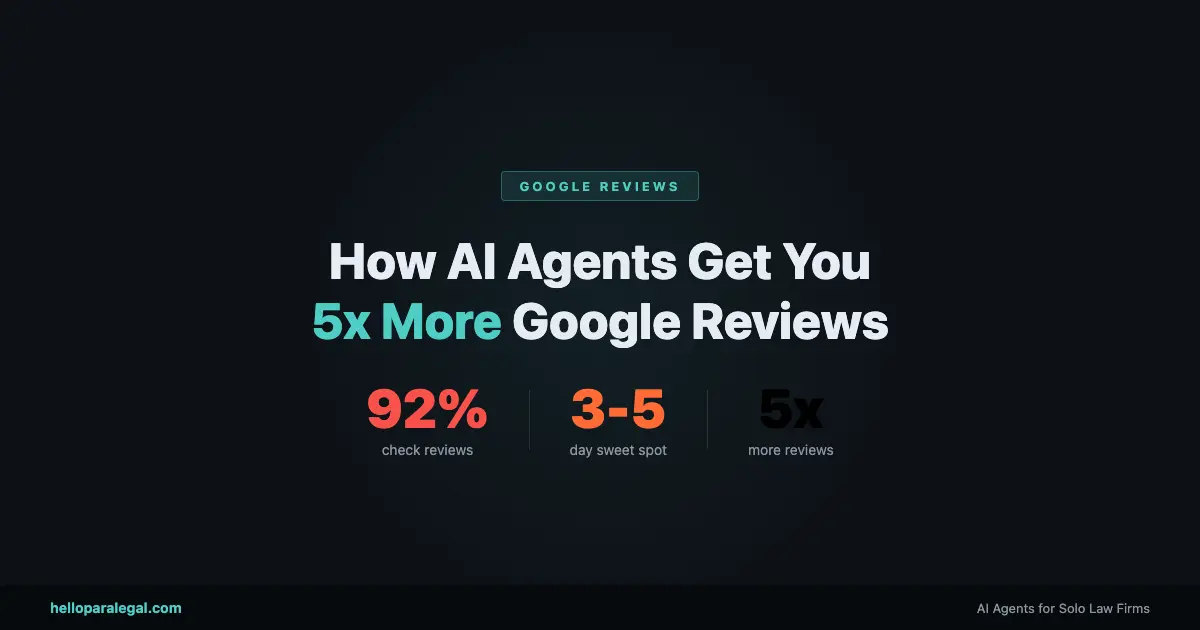
92% of people check online reviews before hiring a lawyer. That number is from a 2023 Thomson Reuters survey of legal consumers, and it should make every solo attorney stop and look at their Google Business Profile right now.
If you have 8 reviews and a competitor has 47, a potential client who found you both through a Google search is going to call the other firm first. Possibly only the other firm. You may never find out that person exists.
The good news is that review counts are highly solvable. Most solo lawyers have satisfied clients who would happily leave a review if asked at the right moment in the right way. The problem is that asking feels uncomfortable, timing is off, and follow-up never happens. An AI agent removes all three friction points and runs the process without the lawyer touching it.
Why Reviews Matter More for Solo Firms Than Anyone Else
Large firms have brand recognition. When someone Googles “divorce lawyer Chicago,” they might recognize a firm name from a billboard or a referral. That brand recognition carries weight even if the reviews are mediocre.
Solo attorneys don’t have that. Your brand is your reputation, and in digital search, your reputation is your reviews. When someone finds your listing for the first time, they know nothing about you except what Google shows them: your review count, your average rating, and the text of recent reviews.
Reviews also directly affect your Google ranking. Google’s local search algorithm treats review count, review recency, and overall rating as significant ranking signals. A solo attorney with 45 reviews will consistently outrank a competitor with 12 reviews in local map pack results, all else being equal.
Consider what this means in practice. If your Google Business Profile ranks in the top 3 map pack results for “estate planning attorney [your city],” you’re visible to every person who searches that term. If you rank in positions 4 through 10 because a competitor has 3 times as many reviews as you, you’re essentially invisible. Most searchers never scroll past the map pack.
The Whitespark Local Search Ranking Factors survey, which polls SEO professionals on local ranking factors annually, consistently shows review signals (quantity, velocity, diversity) as among the top 5 factors in local map pack rankings. You can have a beautiful website and a perfect Google Business Profile and still lose the ranking battle to a competitor who simply asked for more reviews.
Why Solo Attorneys Don’t Get Enough Reviews
It’s not that clients don’t want to leave reviews. Satisfied clients, especially in areas like estate planning, family law, or immigration where the attorney guided them through something difficult and personal, often have genuine appreciation they’d express if prompted.
The problem is three-fold.
1. Asking Feels Awkward
Lawyers are trained to be measured and professional. Walking a client through the closing of their mother’s estate and then saying “by the way, could you leave me a Google review?” feels crass. A lot of solo attorneys simply don’t ask, or ask so tentatively that clients forget about it within an hour.
2. Timing Is Usually Wrong
When lawyers do ask, they often do it at the wrong moment. Asking at the conclusion of a meeting, when the client is thinking about next steps and logistics, is not optimal. Asking months later, after the matter has closed and the client has mentally moved on, gets even lower conversion.
Research on review timing shows a consistent sweet spot: 3 to 5 days after a positive milestone or case conclusion. The client is still in the emotional aftermath of resolution. The experience is fresh. The gratitude is accessible. They haven’t yet moved on to the next thing in their life.
3. Nobody Follows Up
Most clients who intend to leave a review don’t do it the first time they see a request. They mean to. They just forget. Studies on review conversion rates show that a single request converts at around 8 to 12%. A single request followed by one follow-up converts at 25 to 35%. That’s a 2 to 3x improvement from one additional touch.
Solo lawyers almost never follow up on review requests. They’re too busy, it feels like more awkward asking, and there’s no system tracking who was asked and whether they responded.
How a Review Solicitation Agent Works
A review solicitation agent runs the entire review acquisition process end-to-end without attorney involvement. Here’s exactly what it does:
Step 1: Case Completion Detection
The agent integrates with your practice management system and monitors case status. When a matter closes, a hearing concludes successfully, a settlement is reached, documents are executed, or whatever completion event is appropriate for your practice area, the agent detects it and starts a clock.
You define what “completion” means for each matter type. In estate planning, it might be when final documents are executed. In family law, it might be when a settlement agreement is signed. In immigration, it might be when a visa is approved. The agent watches for those signals and acts on them automatically.
Step 2: The 3-to-5 Day Wait
The agent doesn’t send the review request immediately. It waits the optimal 3 to 5 days, letting the client settle into the positive outcome before reaching out. This timing isn’t arbitrary. It’s based on what the research shows about when clients are most likely to act on a review request.
If a matter closes on a Wednesday, the review request goes out Friday or Monday. The client is past the immediate post-closing logistics but still close enough to the experience to remember it vividly and feel good about it.
Step 3: Personalized Request
The agent sends a personalized review request that references the specific matter. Not a generic “please review us” blast, but a message that acknowledges what the client went through, expresses genuine appreciation for trusting you with it, and makes leaving a review as easy as one click.
The message comes from your email address or your firm’s email, in your voice. It includes a direct link to your Google Business Profile review form. The client doesn’t have to search for where to leave a review. They click the link and they’re already there.
Personalization matters. Generic review requests get ignored. Messages that reference the actual experience feel genuine. Clients who feel like they’re being personally thanked, not blasted with a form email, are far more likely to take the 3 minutes to write a review.
Step 4: One Follow-Up
If the client doesn’t leave a review within 5 to 7 days, the agent sends a single follow-up. Just one. The follow-up is shorter and warmer than the initial request. Something like: “I know you’re busy, I just wanted to make sure you saw my note. Your feedback means a lot to the firm.” It includes the review link again.
The agent tracks who has been asked, who has responded, and who received the follow-up. It never sends a second follow-up. It never asks a client who already left a review. It doesn’t bother clients who said they’re not interested.
Step 5: Result Tracking
The agent tracks review acquisition results over time. How many requests sent. How many reviews received. What the conversion rate is. Which matter types generate the most reviews. Which month saw the highest acquisition. You get a dashboard showing your review program performance without manually tracking anything.
Over time, this data lets you refine the process. If estate planning clients leave reviews at a 40% rate but family law clients leave them at only 15%, there may be something about timing or message framing for family law matters that needs adjustment. The agent surfaces this; you decide what to do about it.
Results Solo Firms Are Seeing
Solo attorneys who deploy review solicitation agents typically see their Google review count grow 4 to 6 times faster than before agent deployment. A firm averaging 2 new reviews per month manually might average 8 to 12 per month with an agent running systematically.
The quality of reviews also tends to improve. Because the request goes out when the client is still close to the experience and because the message references specific elements of the matter, clients write longer and more specific reviews. “They handled my green card case and it all worked out” becomes “After three years of waiting, my green card was approved last week. [Attorney name] explained every step, answered my calls, and never made me feel like I was just another case number.” That second review does more conversion work on your profile than a dozen generic five-star ratings.
On Google rankings, the effects are visible within 90 to 180 days. Attorneys who consistently add 8 to 12 reviews per month, particularly with fresh reviews appearing regularly, tend to see their local map pack rankings improve. That’s not guaranteed since rankings depend on many factors, but review signals are substantial enough that consistent review velocity creates measurable movement.
How This Compares to Manual Approaches
| Approach | Response Rate | Monthly Reviews (50 matters/yr) | Lawyer Time Required |
|---|
| Asking at case closing (verbal) | 4-8% | 0-1 | Awkward 30-second ask per matter |
| One-time email request | 8-12% | 1-2 | Drafting and sending each email |
| Email + one follow-up (manual) | 22-30% | 2-4 | Tracking, drafting follow-ups, managing list |
| AI review solicitation agent | 30-45% | 6-12 | Initial setup, periodic review of results |
The agent doesn’t just improve the conversion rate. It ensures that every closed matter gets a review request. A solo attorney manually managing review requests will ask some clients and forget others, particularly during busy stretches. The agent never misses one. A client who closes their estate planning matter on the same day you have three court appearances still gets their review request 4 days later, on schedule.
What to Do With Your Reviews Once You Have Them
More reviews aren’t just a ranking tool. They’re sales assets. Here’s how to use them:
Pull specific quotes from detailed reviews and put them on your website’s homepage, your practice area pages, and your intake intake confirmation emails. A potential client who just submitted a contact form and immediately sees a testimonial from someone with a similar legal issue is more likely to show up to their consultation.
Respond to every review, positive and negative. Responding to positive reviews signals to potential clients that you’re engaged and accessible. Responding professionally to negative reviews signals that you take client concerns seriously. Google also factors response behavior into profile completeness signals.
Use review themes to refine your messaging. If 15 different clients independently mention that you were easy to reach and responsive, that’s the thing your competitors aren’t delivering and the thing you should lead with in your marketing. Real client language, pulled from real reviews, is more persuasive than anything your marketing can invent.
The Compounding Effect
Here’s what makes review agents particularly powerful: the benefits compound. An attorney with 50 reviews today has a baseline. An attorney running a review agent at 10 new reviews per month has 170 reviews in a year. In two years, they have 290. Each new review makes the next potential client slightly more likely to call.
The attorney running the agent passively accumulates social proof without spending a minute on it. The attorney relying on manual requests or hoping satisfied clients leave reviews on their own is standing still.
Most legal markets have one or two attorneys who dominate local search results, not because they’re better lawyers, but because they figured out review velocity before anyone else did. In smaller markets, 50 to 80 reviews with recent additions puts you at the top of the map pack. In larger cities, you may need 150 to 200 to be competitive. Either way, the attorney who started accumulating reviews earlier and more systematically wins the long game.
What Hello Paralegal Builds
Hello Paralegal builds review solicitation agents as part of its broader AI agent platform for solo law firms. The review agent integrates with your practice management system, monitors case completions, manages the timing and personalization of requests, handles follow-ups, and tracks results.
It’s one piece of a larger system designed to run your firm’s operations so you can focus on practicing law. The same platform handles intake, client communication, billing follow-up, and deadline monitoring. The agents share data: the intake agent qualifies leads, the communication agent keeps clients updated, and the review agent closes the loop when cases resolve successfully.
You don’t manage the review process. You check the dashboard when you want to see how the program is performing, and you respond to the reviews that come in. That’s it. The agent handles everything else.
If you have fewer than 30 Google reviews and you’ve been practicing for more than two years, you have satisfied former clients who would have left reviews if asked correctly at the right time. The agent starts fixing that from the first week it’s running.
Frequently Asked Questions
Why do solo law firms get fewer Google reviews than bigger firms?
Solo attorneys typically get fewer reviews because they don’t have systematic processes for requesting them. Asking clients personally feels awkward, timing is often off, and there’s no follow-up system. Large firms have marketing staff or dedicated intake coordinators who manage review programs. AI agents give solo lawyers the same systematic approach without requiring any additional staff.
When is the best time to ask a client for a Google review?
Research consistently shows that 3 to 5 days after a positive case milestone or case completion is the optimal window. The client is still close to the experience and the positive emotions are accessible, but the immediate logistics of closing are complete. Asking at case conclusion in person, or many months later, both produce significantly lower conversion rates.
Do Google reviews actually affect law firm search rankings?
Yes. Google’s local search algorithm treats review signals as significant ranking factors for local map pack results. Review count, review recency, and average rating all contribute to how prominently your Google Business Profile appears in local searches. Attorneys who add reviews consistently over time tend to outrank competitors with fewer and older reviews, all else being equal.
Is it ethical for lawyers to ask clients for reviews?
Yes, in most jurisdictions. The ABA Model Rules and most state bar ethics opinions permit lawyers to request reviews from current or former clients, provided the solicitation isn’t false or misleading and doesn’t involve impermissible compensation. You cannot pay clients for reviews or incentivize specific content. Asking a satisfied client to share their honest experience is generally permissible. Always check your state bar’s specific guidance on attorney advertising rules.
How many Google reviews does a solo law firm need to be competitive?
It depends on your market. In smaller cities and rural areas, 30 to 50 reviews may put you at or near the top of local results. In major metro areas, you may need 100 to 200 to be competitive with established firms. The key is review velocity as much as total count. Google weighs recent reviews more heavily, so consistent monthly additions matter more than a large count from years ago with nothing recent.
What is a review solicitation agent?
A review solicitation agent is an AI system that automates the entire process of requesting and following up on client reviews. It monitors your case management system for completion events, waits the optimal number of days, sends personalized review requests, sends a single follow-up if needed, and tracks results over time. It runs without the attorney initiating any action, ensuring every closed matter becomes an opportunity for a review.
Is it ethical for lawyers to ask clients for reviews?
Yes, in most jurisdictions. The ABA Model Rules and most state bar ethics opinions permit lawyers to request reviews from current or former clients, provided the solicitation isn’t false or misleading and doesn’t involve impermissible compensation. You cannot pay clients for reviews or incentivize specific content. Asking a satisfied client to share their honest experience is generally permissible. Always check your state bar’s specific guidance on attorney advertising rules.
How many Google reviews does a solo law firm need to be competitive?
It depends on your market. In smaller cities and rural areas, 30 to 50 reviews may put you at or near the top of local results. In major metro areas, you may need 100 to 200 to be competitive with established firms. The key is review velocity as much as total count. Google weighs recent reviews more heavily, so consistent monthly additions matter more than a large count from years ago with nothing recent.
What is a review solicitation agent?
A review solicitation agent is an AI system that automates the entire process of requesting and following up on client reviews. It monitors your case management system for completion events, waits the optimal number of days, sends personalized review requests, sends a single follow-up if needed, and tracks results over time. It runs without the attorney initiating any action, ensuring every closed matter becomes an opportunity for a review.
92% of people check online reviews before hiring a lawyer. That number is from a 2023 Thomson Reuters survey of legal consumers, and it should make every solo attorney stop and look at their Google Business Profile right now.
If you have 8 reviews and a competitor has 47, a potential client who found you both through a Google search is going to call the other firm first. Possibly only the other firm. You may never find out that person exists.
The good news is that review counts are highly solvable. Most solo lawyers have satisfied clients who would happily leave a review if asked at the right moment in the right way. The problem is that asking feels uncomfortable, timing is off, and follow-up never happens. An AI agent removes all three friction points and runs the process without the lawyer touching it.
Why Reviews Matter More for Solo Firms Than Anyone Else
Large firms have brand recognition. When someone Googles “divorce lawyer Chicago,” they might recognize a firm name from a billboard or a referral. That brand recognition carries weight even if the reviews are mediocre.
Solo attorneys don’t have that. Your brand is your reputation, and in digital search, your reputation is your reviews. When someone finds your listing for the first time, they know nothing about you except what Google shows them: your review count, your average rating, and the text of recent reviews.
Reviews also directly affect your Google ranking. Google’s local search algorithm treats review count, review recency, and overall rating as significant ranking signals. A solo attorney with 45 reviews will consistently outrank a competitor with 12 reviews in local map pack results, all else being equal.
Consider what this means in practice. If your Google Business Profile ranks in the top 3 map pack results for “estate planning attorney [your city],” you’re visible to every person who searches that term. If you rank in positions 4 through 10 because a competitor has 3 times as many reviews as you, you’re essentially invisible. Most searchers never scroll past the map pack.
The Whitespark Local Search Ranking Factors survey, which polls SEO professionals on local ranking factors annually, consistently shows review signals (quantity, velocity, diversity) as among the top 5 factors in local map pack rankings. You can have a beautiful website and a perfect Google Business Profile and still lose the ranking battle to a competitor who simply asked for more reviews.
Why Solo Attorneys Don’t Get Enough Reviews
It’s not that clients don’t want to leave reviews. Satisfied clients, especially in areas like estate planning, family law, or immigration where the attorney guided them through something difficult and personal, often have genuine appreciation they’d express if prompted.
The problem is three-fold.
1. Asking Feels Awkward
Lawyers are trained to be measured and professional. Walking a client through the closing of their mother’s estate and then saying “by the way, could you leave me a Google review?” feels crass. A lot of solo attorneys simply don’t ask, or ask so tentatively that clients forget about it within an hour.
2. Timing Is Usually Wrong
When lawyers do ask, they often do it at the wrong moment. Asking at the conclusion of a meeting, when the client is thinking about next steps and logistics, is not optimal. Asking months later, after the matter has closed and the client has mentally moved on, gets even lower conversion.
Research on review timing shows a consistent sweet spot: 3 to 5 days after a positive milestone or case conclusion. The client is still in the emotional aftermath of resolution. The experience is fresh. The gratitude is accessible. They haven’t yet moved on to the next thing in their life.
3. Nobody Follows Up
Most clients who intend to leave a review don’t do it the first time they see a request. They mean to. They just forget. Studies on review conversion rates show that a single request converts at around 8 to 12%. A single request followed by one follow-up converts at 25 to 35%. That’s a 2 to 3x improvement from one additional touch.
Solo lawyers almost never follow up on review requests. They’re too busy, it feels like more awkward asking, and there’s no system tracking who was asked and whether they responded.
How a Review Solicitation Agent Works
A review solicitation agent runs the entire review acquisition process end-to-end without attorney involvement. Here’s exactly what it does:
Step 1: Case Completion Detection
The agent integrates with your practice management system and monitors case status. When a matter closes, a hearing concludes successfully, a settlement is reached, documents are executed, or whatever completion event is appropriate for your practice area, the agent detects it and starts a clock.
You define what “completion” means for each matter type. In estate planning, it might be when final documents are executed. In family law, it might be when a settlement agreement is signed. In immigration, it might be when a visa is approved. The agent watches for those signals and acts on them automatically.
Step 2: The 3-to-5 Day Wait
The agent doesn’t send the review request immediately. It waits the optimal 3 to 5 days, letting the client settle into the positive outcome before reaching out. This timing isn’t arbitrary. It’s based on what the research shows about when clients are most likely to act on a review request.
If a matter closes on a Wednesday, the review request goes out Friday or Monday. The client is past the immediate post-closing logistics but still close enough to the experience to remember it vividly and feel good about it.
Step 3: Personalized Request
The agent sends a personalized review request that references the specific matter. Not a generic “please review us” blast, but a message that acknowledges what the client went through, expresses genuine appreciation for trusting you with it, and makes leaving a review as easy as one click.
The message comes from your email address or your firm’s email, in your voice. It includes a direct link to your Google Business Profile review form. The client doesn’t have to search for where to leave a review. They click the link and they’re already there.
Personalization matters. Generic review requests get ignored. Messages that reference the actual experience feel genuine. Clients who feel like they’re being personally thanked, not blasted with a form email, are far more likely to take the 3 minutes to write a review.
Step 4: One Follow-Up
If the client doesn’t leave a review within 5 to 7 days, the agent sends a single follow-up. Just one. The follow-up is shorter and warmer than the initial request. Something like: “I know you’re busy, I just wanted to make sure you saw my note. Your feedback means a lot to the firm.” It includes the review link again.
The agent tracks who has been asked, who has responded, and who received the follow-up. It never sends a second follow-up. It never asks a client who already left a review. It doesn’t bother clients who said they’re not interested.
Step 5: Result Tracking
The agent tracks review acquisition results over time. How many requests sent. How many reviews received. What the conversion rate is. Which matter types generate the most reviews. Which month saw the highest acquisition. You get a dashboard showing your review program performance without manually tracking anything.
Over time, this data lets you refine the process. If estate planning clients leave reviews at a 40% rate but family law clients leave them at only 15%, there may be something about timing or message framing for family law matters that needs adjustment. The agent surfaces this; you decide what to do about it.
Results Solo Firms Are Seeing
Solo attorneys who deploy review solicitation agents typically see their Google review count grow 4 to 6 times faster than before agent deployment. A firm averaging 2 new reviews per month manually might average 8 to 12 per month with an agent running systematically.
The quality of reviews also tends to improve. Because the request goes out when the client is still close to the experience and because the message references specific elements of the matter, clients write longer and more specific reviews. “They handled my green card case and it all worked out” becomes “After three years of waiting, my green card was approved last week. [Attorney name] explained every step, answered my calls, and never made me feel like I was just another case number.” That second review does more conversion work on your profile than a dozen generic five-star ratings.
On Google rankings, the effects are visible within 90 to 180 days. Attorneys who consistently add 8 to 12 reviews per month, particularly with fresh reviews appearing regularly, tend to see their local map pack rankings improve. That’s not guaranteed since rankings depend on many factors, but review signals are substantial enough that consistent review velocity creates measurable movement.
How This Compares to Manual Approaches
| Approach | Response Rate | Monthly Reviews (50 matters/yr) | Lawyer Time Required |
|---|
| Asking at case closing (verbal) | 4-8% | 0-1 | Awkward 30-second ask per matter |
| One-time email request | 8-12% | 1-2 | Drafting and sending each email |
| Email + one follow-up (manual) | 22-30% | 2-4 | Tracking, drafting follow-ups, managing list |
| AI review solicitation agent | 30-45% | 6-12 | Initial setup, periodic review of results |
The agent doesn’t just improve the conversion rate. It ensures that every closed matter gets a review request. A solo attorney manually managing review requests will ask some clients and forget others, particularly during busy stretches. The agent never misses one. A client who closes their estate planning matter on the same day you have three court appearances still gets their review request 4 days later, on schedule.
What to Do With Your Reviews Once You Have Them
More reviews aren’t just a ranking tool. They’re sales assets. Here’s how to use them:
Pull specific quotes from detailed reviews and put them on your website’s homepage, your practice area pages, and your intake intake confirmation emails. A potential client who just submitted a contact form and immediately sees a testimonial from someone with a similar legal issue is more likely to show up to their consultation.
Respond to every review, positive and negative. Responding to positive reviews signals to potential clients that you’re engaged and accessible. Responding professionally to negative reviews signals that you take client concerns seriously. Google also factors response behavior into profile completeness signals.
Use review themes to refine your messaging. If 15 different clients independently mention that you were easy to reach and responsive, that’s the thing your competitors aren’t delivering and the thing you should lead with in your marketing. Real client language, pulled from real reviews, is more persuasive than anything your marketing can invent.
The Compounding Effect
Here’s what makes review agents particularly powerful: the benefits compound. An attorney with 50 reviews today has a baseline. An attorney running a review agent at 10 new reviews per month has 170 reviews in a year. In two years, they have 290. Each new review makes the next potential client slightly more likely to call.
The attorney running the agent passively accumulates social proof without spending a minute on it. The attorney relying on manual requests or hoping satisfied clients leave reviews on their own is standing still.
Most legal markets have one or two attorneys who dominate local search results, not because they’re better lawyers, but because they figured out review velocity before anyone else did. In smaller markets, 50 to 80 reviews with recent additions puts you at the top of the map pack. In larger cities, you may need 150 to 200 to be competitive. Either way, the attorney who started accumulating reviews earlier and more systematically wins the long game.
What Hello Paralegal Builds
Hello Paralegal builds review solicitation agents as part of its broader AI agent platform for solo law firms. The review agent integrates with your practice management system, monitors case completions, manages the timing and personalization of requests, handles follow-ups, and tracks results.
It’s one piece of a larger system designed to run your firm’s operations so you can focus on practicing law. The same platform handles intake, client communication, billing follow-up, and deadline monitoring. The agents share data: the intake agent qualifies leads, the communication agent keeps clients updated, and the review agent closes the loop when cases resolve successfully.
You don’t manage the review process. You check the dashboard when you want to see how the program is performing, and you respond to the reviews that come in. That’s it. The agent handles everything else.
If you have fewer than 30 Google reviews and you’ve been practicing for more than two years, you have satisfied former clients who would have left reviews if asked correctly at the right time. The agent starts fixing that from the first week it’s running.
Frequently Asked Questions
Why do solo law firms get fewer Google reviews than bigger firms?
Solo attorneys typically get fewer reviews because they don’t have systematic processes for requesting them. Asking clients personally feels awkward, timing is often off, and there’s no follow-up system. Large firms have marketing staff or dedicated intake coordinators who manage review programs. AI agents give solo lawyers the same systematic approach without requiring any additional staff.
When is the best time to ask a client for a Google review?
Research consistently shows that 3 to 5 days after a positive case milestone or case completion is the optimal window. The client is still close to the experience and the positive emotions are accessible, but the immediate logistics of closing are complete. Asking at case conclusion in person, or many months later, both produce significantly lower conversion rates.
Do Google reviews actually affect law firm search rankings?
Yes. Google’s local search algorithm treats review signals as significant ranking factors for local map pack results. Review count, review recency, and average rating all contribute to how prominently your Google Business Profile appears in local searches. Attorneys who add reviews consistently over time tend to outrank competitors with fewer and older reviews, all else being equal.
Is it ethical for lawyers to ask clients for reviews?
Yes, in most jurisdictions. The ABA Model Rules and most state bar ethics opinions permit lawyers to request reviews from current or former clients, provided the solicitation isn’t false or misleading and doesn’t involve impermissible compensation. You cannot pay clients for reviews or incentivize specific content. Asking a satisfied client to share their honest experience is generally permissible. Always check your state bar’s specific guidance on attorney advertising rules.
How many Google reviews does a solo law firm need to be competitive?
It depends on your market. In smaller cities and rural areas, 30 to 50 reviews may put you at or near the top of local results. In major metro areas, you may need 100 to 200 to be competitive with established firms. The key is review velocity as much as total count. Google weighs recent reviews more heavily, so consistent monthly additions matter more than a large count from years ago with nothing recent.
What is a review solicitation agent?
A review solicitation agent is an AI system that automates the entire process of requesting and following up on client reviews. It monitors your case management system for completion events, waits the optimal number of days, sends personalized review requests, sends a single follow-up if needed, and tracks results over time. It runs without the attorney initiating any action, ensuring every closed matter becomes an opportunity for a review.
Do Google reviews actually affect law firm search rankings?
Yes. Google’s local search algorithm treats review signals as significant ranking factors for local map pack results. Review count, review recency, and average rating all contribute to how prominently your Google Business Profile appears in local searches. Attorneys who add reviews consistently over time tend to outrank competitors with fewer and older reviews, all else being equal.
Is it ethical for lawyers to ask clients for reviews?
Yes, in most jurisdictions. The ABA Model Rules and most state bar ethics opinions permit lawyers to request reviews from current or former clients, provided the solicitation isn’t false or misleading and doesn’t involve impermissible compensation. You cannot pay clients for reviews or incentivize specific content. Asking a satisfied client to share their honest experience is generally permissible. Always check your state bar’s specific guidance on attorney advertising rules.
How many Google reviews does a solo law firm need to be competitive?
It depends on your market. In smaller cities and rural areas, 30 to 50 reviews may put you at or near the top of local results. In major metro areas, you may need 100 to 200 to be competitive with established firms. The key is review velocity as much as total count. Google weighs recent reviews more heavily, so consistent monthly additions matter more than a large count from years ago with nothing recent.
What is a review solicitation agent?
A review solicitation agent is an AI system that automates the entire process of requesting and following up on client reviews. It monitors your case management system for completion events, waits the optimal number of days, sends personalized review requests, sends a single follow-up if needed, and tracks results over time. It runs without the attorney initiating any action, ensuring every closed matter becomes an opportunity for a review.
92% of people check online reviews before hiring a lawyer. That number is from a 2023 Thomson Reuters survey of legal consumers, and it should make every solo attorney stop and look at their Google Business Profile right now.
If you have 8 reviews and a competitor has 47, a potential client who found you both through a Google search is going to call the other firm first. Possibly only the other firm. You may never find out that person exists.
The good news is that review counts are highly solvable. Most solo lawyers have satisfied clients who would happily leave a review if asked at the right moment in the right way. The problem is that asking feels uncomfortable, timing is off, and follow-up never happens. An AI agent removes all three friction points and runs the process without the lawyer touching it.
Why Reviews Matter More for Solo Firms Than Anyone Else
Large firms have brand recognition. When someone Googles “divorce lawyer Chicago,” they might recognize a firm name from a billboard or a referral. That brand recognition carries weight even if the reviews are mediocre.
Solo attorneys don’t have that. Your brand is your reputation, and in digital search, your reputation is your reviews. When someone finds your listing for the first time, they know nothing about you except what Google shows them: your review count, your average rating, and the text of recent reviews.
Reviews also directly affect your Google ranking. Google’s local search algorithm treats review count, review recency, and overall rating as significant ranking signals. A solo attorney with 45 reviews will consistently outrank a competitor with 12 reviews in local map pack results, all else being equal.
Consider what this means in practice. If your Google Business Profile ranks in the top 3 map pack results for “estate planning attorney [your city],” you’re visible to every person who searches that term. If you rank in positions 4 through 10 because a competitor has 3 times as many reviews as you, you’re essentially invisible. Most searchers never scroll past the map pack.
The Whitespark Local Search Ranking Factors survey, which polls SEO professionals on local ranking factors annually, consistently shows review signals (quantity, velocity, diversity) as among the top 5 factors in local map pack rankings. You can have a beautiful website and a perfect Google Business Profile and still lose the ranking battle to a competitor who simply asked for more reviews.
Why Solo Attorneys Don’t Get Enough Reviews
It’s not that clients don’t want to leave reviews. Satisfied clients, especially in areas like estate planning, family law, or immigration where the attorney guided them through something difficult and personal, often have genuine appreciation they’d express if prompted.
The problem is three-fold.
1. Asking Feels Awkward
Lawyers are trained to be measured and professional. Walking a client through the closing of their mother’s estate and then saying “by the way, could you leave me a Google review?” feels crass. A lot of solo attorneys simply don’t ask, or ask so tentatively that clients forget about it within an hour.
2. Timing Is Usually Wrong
When lawyers do ask, they often do it at the wrong moment. Asking at the conclusion of a meeting, when the client is thinking about next steps and logistics, is not optimal. Asking months later, after the matter has closed and the client has mentally moved on, gets even lower conversion.
Research on review timing shows a consistent sweet spot: 3 to 5 days after a positive milestone or case conclusion. The client is still in the emotional aftermath of resolution. The experience is fresh. The gratitude is accessible. They haven’t yet moved on to the next thing in their life.
3. Nobody Follows Up
Most clients who intend to leave a review don’t do it the first time they see a request. They mean to. They just forget. Studies on review conversion rates show that a single request converts at around 8 to 12%. A single request followed by one follow-up converts at 25 to 35%. That’s a 2 to 3x improvement from one additional touch.
Solo lawyers almost never follow up on review requests. They’re too busy, it feels like more awkward asking, and there’s no system tracking who was asked and whether they responded.
How a Review Solicitation Agent Works
A review solicitation agent runs the entire review acquisition process end-to-end without attorney involvement. Here’s exactly what it does:
Step 1: Case Completion Detection
The agent integrates with your practice management system and monitors case status. When a matter closes, a hearing concludes successfully, a settlement is reached, documents are executed, or whatever completion event is appropriate for your practice area, the agent detects it and starts a clock.
You define what “completion” means for each matter type. In estate planning, it might be when final documents are executed. In family law, it might be when a settlement agreement is signed. In immigration, it might be when a visa is approved. The agent watches for those signals and acts on them automatically.
Step 2: The 3-to-5 Day Wait
The agent doesn’t send the review request immediately. It waits the optimal 3 to 5 days, letting the client settle into the positive outcome before reaching out. This timing isn’t arbitrary. It’s based on what the research shows about when clients are most likely to act on a review request.
If a matter closes on a Wednesday, the review request goes out Friday or Monday. The client is past the immediate post-closing logistics but still close enough to the experience to remember it vividly and feel good about it.
Step 3: Personalized Request
The agent sends a personalized review request that references the specific matter. Not a generic “please review us” blast, but a message that acknowledges what the client went through, expresses genuine appreciation for trusting you with it, and makes leaving a review as easy as one click.
The message comes from your email address or your firm’s email, in your voice. It includes a direct link to your Google Business Profile review form. The client doesn’t have to search for where to leave a review. They click the link and they’re already there.
Personalization matters. Generic review requests get ignored. Messages that reference the actual experience feel genuine. Clients who feel like they’re being personally thanked, not blasted with a form email, are far more likely to take the 3 minutes to write a review.
Step 4: One Follow-Up
If the client doesn’t leave a review within 5 to 7 days, the agent sends a single follow-up. Just one. The follow-up is shorter and warmer than the initial request. Something like: “I know you’re busy, I just wanted to make sure you saw my note. Your feedback means a lot to the firm.” It includes the review link again.
The agent tracks who has been asked, who has responded, and who received the follow-up. It never sends a second follow-up. It never asks a client who already left a review. It doesn’t bother clients who said they’re not interested.
Step 5: Result Tracking
The agent tracks review acquisition results over time. How many requests sent. How many reviews received. What the conversion rate is. Which matter types generate the most reviews. Which month saw the highest acquisition. You get a dashboard showing your review program performance without manually tracking anything.
Over time, this data lets you refine the process. If estate planning clients leave reviews at a 40% rate but family law clients leave them at only 15%, there may be something about timing or message framing for family law matters that needs adjustment. The agent surfaces this; you decide what to do about it.
Results Solo Firms Are Seeing
Solo attorneys who deploy review solicitation agents typically see their Google review count grow 4 to 6 times faster than before agent deployment. A firm averaging 2 new reviews per month manually might average 8 to 12 per month with an agent running systematically.
The quality of reviews also tends to improve. Because the request goes out when the client is still close to the experience and because the message references specific elements of the matter, clients write longer and more specific reviews. “They handled my green card case and it all worked out” becomes “After three years of waiting, my green card was approved last week. [Attorney name] explained every step, answered my calls, and never made me feel like I was just another case number.” That second review does more conversion work on your profile than a dozen generic five-star ratings.
On Google rankings, the effects are visible within 90 to 180 days. Attorneys who consistently add 8 to 12 reviews per month, particularly with fresh reviews appearing regularly, tend to see their local map pack rankings improve. That’s not guaranteed since rankings depend on many factors, but review signals are substantial enough that consistent review velocity creates measurable movement.
How This Compares to Manual Approaches
| Approach | Response Rate | Monthly Reviews (50 matters/yr) | Lawyer Time Required |
|---|
| Asking at case closing (verbal) | 4-8% | 0-1 | Awkward 30-second ask per matter |
| One-time email request | 8-12% | 1-2 | Drafting and sending each email |
| Email + one follow-up (manual) | 22-30% | 2-4 | Tracking, drafting follow-ups, managing list |
| AI review solicitation agent | 30-45% | 6-12 | Initial setup, periodic review of results |
The agent doesn’t just improve the conversion rate. It ensures that every closed matter gets a review request. A solo attorney manually managing review requests will ask some clients and forget others, particularly during busy stretches. The agent never misses one. A client who closes their estate planning matter on the same day you have three court appearances still gets their review request 4 days later, on schedule.
What to Do With Your Reviews Once You Have Them
More reviews aren’t just a ranking tool. They’re sales assets. Here’s how to use them:
Pull specific quotes from detailed reviews and put them on your website’s homepage, your practice area pages, and your intake intake confirmation emails. A potential client who just submitted a contact form and immediately sees a testimonial from someone with a similar legal issue is more likely to show up to their consultation.
Respond to every review, positive and negative. Responding to positive reviews signals to potential clients that you’re engaged and accessible. Responding professionally to negative reviews signals that you take client concerns seriously. Google also factors response behavior into profile completeness signals.
Use review themes to refine your messaging. If 15 different clients independently mention that you were easy to reach and responsive, that’s the thing your competitors aren’t delivering and the thing you should lead with in your marketing. Real client language, pulled from real reviews, is more persuasive than anything your marketing can invent.
The Compounding Effect
Here’s what makes review agents particularly powerful: the benefits compound. An attorney with 50 reviews today has a baseline. An attorney running a review agent at 10 new reviews per month has 170 reviews in a year. In two years, they have 290. Each new review makes the next potential client slightly more likely to call.
The attorney running the agent passively accumulates social proof without spending a minute on it. The attorney relying on manual requests or hoping satisfied clients leave reviews on their own is standing still.
Most legal markets have one or two attorneys who dominate local search results, not because they’re better lawyers, but because they figured out review velocity before anyone else did. In smaller markets, 50 to 80 reviews with recent additions puts you at the top of the map pack. In larger cities, you may need 150 to 200 to be competitive. Either way, the attorney who started accumulating reviews earlier and more systematically wins the long game.
What Hello Paralegal Builds
Hello Paralegal builds review solicitation agents as part of its broader AI agent platform for solo law firms. The review agent integrates with your practice management system, monitors case completions, manages the timing and personalization of requests, handles follow-ups, and tracks results.
It’s one piece of a larger system designed to run your firm’s operations so you can focus on practicing law. The same platform handles intake, client communication, billing follow-up, and deadline monitoring. The agents share data: the intake agent qualifies leads, the communication agent keeps clients updated, and the review agent closes the loop when cases resolve successfully.
You don’t manage the review process. You check the dashboard when you want to see how the program is performing, and you respond to the reviews that come in. That’s it. The agent handles everything else.
If you have fewer than 30 Google reviews and you’ve been practicing for more than two years, you have satisfied former clients who would have left reviews if asked correctly at the right time. The agent starts fixing that from the first week it’s running.
Frequently Asked Questions
Why do solo law firms get fewer Google reviews than bigger firms?
Solo attorneys typically get fewer reviews because they don’t have systematic processes for requesting them. Asking clients personally feels awkward, timing is often off, and there’s no follow-up system. Large firms have marketing staff or dedicated intake coordinators who manage review programs. AI agents give solo lawyers the same systematic approach without requiring any additional staff.
When is the best time to ask a client for a Google review?
Research consistently shows that 3 to 5 days after a positive case milestone or case completion is the optimal window. The client is still close to the experience and the positive emotions are accessible, but the immediate logistics of closing are complete. Asking at case conclusion in person, or many months later, both produce significantly lower conversion rates.
Do Google reviews actually affect law firm search rankings?
Yes. Google’s local search algorithm treats review signals as significant ranking factors for local map pack results. Review count, review recency, and average rating all contribute to how prominently your Google Business Profile appears in local searches. Attorneys who add reviews consistently over time tend to outrank competitors with fewer and older reviews, all else being equal.
Is it ethical for lawyers to ask clients for reviews?
Yes, in most jurisdictions. The ABA Model Rules and most state bar ethics opinions permit lawyers to request reviews from current or former clients, provided the solicitation isn’t false or misleading and doesn’t involve impermissible compensation. You cannot pay clients for reviews or incentivize specific content. Asking a satisfied client to share their honest experience is generally permissible. Always check your state bar’s specific guidance on attorney advertising rules.
How many Google reviews does a solo law firm need to be competitive?
It depends on your market. In smaller cities and rural areas, 30 to 50 reviews may put you at or near the top of local results. In major metro areas, you may need 100 to 200 to be competitive with established firms. The key is review velocity as much as total count. Google weighs recent reviews more heavily, so consistent monthly additions matter more than a large count from years ago with nothing recent.
What is a review solicitation agent?
A review solicitation agent is an AI system that automates the entire process of requesting and following up on client reviews. It monitors your case management system for completion events, waits the optimal number of days, sends personalized review requests, sends a single follow-up if needed, and tracks results over time. It runs without the attorney initiating any action, ensuring every closed matter becomes an opportunity for a review.
When is the best time to ask a client for a Google review?
Research consistently shows that 3 to 5 days after a positive case milestone or case completion is the optimal window. The client is still close to the experience and the positive emotions are accessible, but the immediate logistics of closing are complete. Asking at case conclusion in person, or many months later, both produce significantly lower conversion rates.
Do Google reviews actually affect law firm search rankings?
Yes. Google’s local search algorithm treats review signals as significant ranking factors for local map pack results. Review count, review recency, and average rating all contribute to how prominently your Google Business Profile appears in local searches. Attorneys who add reviews consistently over time tend to outrank competitors with fewer and older reviews, all else being equal.
Is it ethical for lawyers to ask clients for reviews?
Yes, in most jurisdictions. The ABA Model Rules and most state bar ethics opinions permit lawyers to request reviews from current or former clients, provided the solicitation isn’t false or misleading and doesn’t involve impermissible compensation. You cannot pay clients for reviews or incentivize specific content. Asking a satisfied client to share their honest experience is generally permissible. Always check your state bar’s specific guidance on attorney advertising rules.
How many Google reviews does a solo law firm need to be competitive?
It depends on your market. In smaller cities and rural areas, 30 to 50 reviews may put you at or near the top of local results. In major metro areas, you may need 100 to 200 to be competitive with established firms. The key is review velocity as much as total count. Google weighs recent reviews more heavily, so consistent monthly additions matter more than a large count from years ago with nothing recent.
What is a review solicitation agent?
A review solicitation agent is an AI system that automates the entire process of requesting and following up on client reviews. It monitors your case management system for completion events, waits the optimal number of days, sends personalized review requests, sends a single follow-up if needed, and tracks results over time. It runs without the attorney initiating any action, ensuring every closed matter becomes an opportunity for a review.
92% of people check online reviews before hiring a lawyer. That number is from a 2023 Thomson Reuters survey of legal consumers, and it should make every solo attorney stop and look at their Google Business Profile right now.
If you have 8 reviews and a competitor has 47, a potential client who found you both through a Google search is going to call the other firm first. Possibly only the other firm. You may never find out that person exists.
The good news is that review counts are highly solvable. Most solo lawyers have satisfied clients who would happily leave a review if asked at the right moment in the right way. The problem is that asking feels uncomfortable, timing is off, and follow-up never happens. An AI agent removes all three friction points and runs the process without the lawyer touching it.
Why Reviews Matter More for Solo Firms Than Anyone Else
Large firms have brand recognition. When someone Googles “divorce lawyer Chicago,” they might recognize a firm name from a billboard or a referral. That brand recognition carries weight even if the reviews are mediocre.
Solo attorneys don’t have that. Your brand is your reputation, and in digital search, your reputation is your reviews. When someone finds your listing for the first time, they know nothing about you except what Google shows them: your review count, your average rating, and the text of recent reviews.
Reviews also directly affect your Google ranking. Google’s local search algorithm treats review count, review recency, and overall rating as significant ranking signals. A solo attorney with 45 reviews will consistently outrank a competitor with 12 reviews in local map pack results, all else being equal.
Consider what this means in practice. If your Google Business Profile ranks in the top 3 map pack results for “estate planning attorney [your city],” you’re visible to every person who searches that term. If you rank in positions 4 through 10 because a competitor has 3 times as many reviews as you, you’re essentially invisible. Most searchers never scroll past the map pack.
The Whitespark Local Search Ranking Factors survey, which polls SEO professionals on local ranking factors annually, consistently shows review signals (quantity, velocity, diversity) as among the top 5 factors in local map pack rankings. You can have a beautiful website and a perfect Google Business Profile and still lose the ranking battle to a competitor who simply asked for more reviews.
Why Solo Attorneys Don’t Get Enough Reviews
It’s not that clients don’t want to leave reviews. Satisfied clients, especially in areas like estate planning, family law, or immigration where the attorney guided them through something difficult and personal, often have genuine appreciation they’d express if prompted.
The problem is three-fold.
1. Asking Feels Awkward
Lawyers are trained to be measured and professional. Walking a client through the closing of their mother’s estate and then saying “by the way, could you leave me a Google review?” feels crass. A lot of solo attorneys simply don’t ask, or ask so tentatively that clients forget about it within an hour.
2. Timing Is Usually Wrong
When lawyers do ask, they often do it at the wrong moment. Asking at the conclusion of a meeting, when the client is thinking about next steps and logistics, is not optimal. Asking months later, after the matter has closed and the client has mentally moved on, gets even lower conversion.
Research on review timing shows a consistent sweet spot: 3 to 5 days after a positive milestone or case conclusion. The client is still in the emotional aftermath of resolution. The experience is fresh. The gratitude is accessible. They haven’t yet moved on to the next thing in their life.
3. Nobody Follows Up
Most clients who intend to leave a review don’t do it the first time they see a request. They mean to. They just forget. Studies on review conversion rates show that a single request converts at around 8 to 12%. A single request followed by one follow-up converts at 25 to 35%. That’s a 2 to 3x improvement from one additional touch.
Solo lawyers almost never follow up on review requests. They’re too busy, it feels like more awkward asking, and there’s no system tracking who was asked and whether they responded.
How a Review Solicitation Agent Works
A review solicitation agent runs the entire review acquisition process end-to-end without attorney involvement. Here’s exactly what it does:
Step 1: Case Completion Detection
The agent integrates with your practice management system and monitors case status. When a matter closes, a hearing concludes successfully, a settlement is reached, documents are executed, or whatever completion event is appropriate for your practice area, the agent detects it and starts a clock.
You define what “completion” means for each matter type. In estate planning, it might be when final documents are executed. In family law, it might be when a settlement agreement is signed. In immigration, it might be when a visa is approved. The agent watches for those signals and acts on them automatically.
Step 2: The 3-to-5 Day Wait
The agent doesn’t send the review request immediately. It waits the optimal 3 to 5 days, letting the client settle into the positive outcome before reaching out. This timing isn’t arbitrary. It’s based on what the research shows about when clients are most likely to act on a review request.
If a matter closes on a Wednesday, the review request goes out Friday or Monday. The client is past the immediate post-closing logistics but still close enough to the experience to remember it vividly and feel good about it.
Step 3: Personalized Request
The agent sends a personalized review request that references the specific matter. Not a generic “please review us” blast, but a message that acknowledges what the client went through, expresses genuine appreciation for trusting you with it, and makes leaving a review as easy as one click.
The message comes from your email address or your firm’s email, in your voice. It includes a direct link to your Google Business Profile review form. The client doesn’t have to search for where to leave a review. They click the link and they’re already there.
Personalization matters. Generic review requests get ignored. Messages that reference the actual experience feel genuine. Clients who feel like they’re being personally thanked, not blasted with a form email, are far more likely to take the 3 minutes to write a review.
Step 4: One Follow-Up
If the client doesn’t leave a review within 5 to 7 days, the agent sends a single follow-up. Just one. The follow-up is shorter and warmer than the initial request. Something like: “I know you’re busy, I just wanted to make sure you saw my note. Your feedback means a lot to the firm.” It includes the review link again.
The agent tracks who has been asked, who has responded, and who received the follow-up. It never sends a second follow-up. It never asks a client who already left a review. It doesn’t bother clients who said they’re not interested.
Step 5: Result Tracking
The agent tracks review acquisition results over time. How many requests sent. How many reviews received. What the conversion rate is. Which matter types generate the most reviews. Which month saw the highest acquisition. You get a dashboard showing your review program performance without manually tracking anything.
Over time, this data lets you refine the process. If estate planning clients leave reviews at a 40% rate but family law clients leave them at only 15%, there may be something about timing or message framing for family law matters that needs adjustment. The agent surfaces this; you decide what to do about it.
Results Solo Firms Are Seeing
Solo attorneys who deploy review solicitation agents typically see their Google review count grow 4 to 6 times faster than before agent deployment. A firm averaging 2 new reviews per month manually might average 8 to 12 per month with an agent running systematically.
The quality of reviews also tends to improve. Because the request goes out when the client is still close to the experience and because the message references specific elements of the matter, clients write longer and more specific reviews. “They handled my green card case and it all worked out” becomes “After three years of waiting, my green card was approved last week. [Attorney name] explained every step, answered my calls, and never made me feel like I was just another case number.” That second review does more conversion work on your profile than a dozen generic five-star ratings.
On Google rankings, the effects are visible within 90 to 180 days. Attorneys who consistently add 8 to 12 reviews per month, particularly with fresh reviews appearing regularly, tend to see their local map pack rankings improve. That’s not guaranteed since rankings depend on many factors, but review signals are substantial enough that consistent review velocity creates measurable movement.
How This Compares to Manual Approaches
| Approach | Response Rate | Monthly Reviews (50 matters/yr) | Lawyer Time Required |
|---|
| Asking at case closing (verbal) | 4-8% | 0-1 | Awkward 30-second ask per matter |
| One-time email request | 8-12% | 1-2 | Drafting and sending each email |
| Email + one follow-up (manual) | 22-30% | 2-4 | Tracking, drafting follow-ups, managing list |
| AI review solicitation agent | 30-45% | 6-12 | Initial setup, periodic review of results |
The agent doesn’t just improve the conversion rate. It ensures that every closed matter gets a review request. A solo attorney manually managing review requests will ask some clients and forget others, particularly during busy stretches. The agent never misses one. A client who closes their estate planning matter on the same day you have three court appearances still gets their review request 4 days later, on schedule.
What to Do With Your Reviews Once You Have Them
More reviews aren’t just a ranking tool. They’re sales assets. Here’s how to use them:
Pull specific quotes from detailed reviews and put them on your website’s homepage, your practice area pages, and your intake intake confirmation emails. A potential client who just submitted a contact form and immediately sees a testimonial from someone with a similar legal issue is more likely to show up to their consultation.
Respond to every review, positive and negative. Responding to positive reviews signals to potential clients that you’re engaged and accessible. Responding professionally to negative reviews signals that you take client concerns seriously. Google also factors response behavior into profile completeness signals.
Use review themes to refine your messaging. If 15 different clients independently mention that you were easy to reach and responsive, that’s the thing your competitors aren’t delivering and the thing you should lead with in your marketing. Real client language, pulled from real reviews, is more persuasive than anything your marketing can invent.
The Compounding Effect
Here’s what makes review agents particularly powerful: the benefits compound. An attorney with 50 reviews today has a baseline. An attorney running a review agent at 10 new reviews per month has 170 reviews in a year. In two years, they have 290. Each new review makes the next potential client slightly more likely to call.
The attorney running the agent passively accumulates social proof without spending a minute on it. The attorney relying on manual requests or hoping satisfied clients leave reviews on their own is standing still.
Most legal markets have one or two attorneys who dominate local search results, not because they’re better lawyers, but because they figured out review velocity before anyone else did. In smaller markets, 50 to 80 reviews with recent additions puts you at the top of the map pack. In larger cities, you may need 150 to 200 to be competitive. Either way, the attorney who started accumulating reviews earlier and more systematically wins the long game.
What Hello Paralegal Builds
Hello Paralegal builds review solicitation agents as part of its broader AI agent platform for solo law firms. The review agent integrates with your practice management system, monitors case completions, manages the timing and personalization of requests, handles follow-ups, and tracks results.
It’s one piece of a larger system designed to run your firm’s operations so you can focus on practicing law. The same platform handles intake, client communication, billing follow-up, and deadline monitoring. The agents share data: the intake agent qualifies leads, the communication agent keeps clients updated, and the review agent closes the loop when cases resolve successfully.
You don’t manage the review process. You check the dashboard when you want to see how the program is performing, and you respond to the reviews that come in. That’s it. The agent handles everything else.
If you have fewer than 30 Google reviews and you’ve been practicing for more than two years, you have satisfied former clients who would have left reviews if asked correctly at the right time. The agent starts fixing that from the first week it’s running.
Frequently Asked Questions
Why do solo law firms get fewer Google reviews than bigger firms?
Solo attorneys typically get fewer reviews because they don’t have systematic processes for requesting them. Asking clients personally feels awkward, timing is often off, and there’s no follow-up system. Large firms have marketing staff or dedicated intake coordinators who manage review programs. AI agents give solo lawyers the same systematic approach without requiring any additional staff.
When is the best time to ask a client for a Google review?
Research consistently shows that 3 to 5 days after a positive case milestone or case completion is the optimal window. The client is still close to the experience and the positive emotions are accessible, but the immediate logistics of closing are complete. Asking at case conclusion in person, or many months later, both produce significantly lower conversion rates.
Do Google reviews actually affect law firm search rankings?
Yes. Google’s local search algorithm treats review signals as significant ranking factors for local map pack results. Review count, review recency, and average rating all contribute to how prominently your Google Business Profile appears in local searches. Attorneys who add reviews consistently over time tend to outrank competitors with fewer and older reviews, all else being equal.
Is it ethical for lawyers to ask clients for reviews?
Yes, in most jurisdictions. The ABA Model Rules and most state bar ethics opinions permit lawyers to request reviews from current or former clients, provided the solicitation isn’t false or misleading and doesn’t involve impermissible compensation. You cannot pay clients for reviews or incentivize specific content. Asking a satisfied client to share their honest experience is generally permissible. Always check your state bar’s specific guidance on attorney advertising rules.
How many Google reviews does a solo law firm need to be competitive?
It depends on your market. In smaller cities and rural areas, 30 to 50 reviews may put you at or near the top of local results. In major metro areas, you may need 100 to 200 to be competitive with established firms. The key is review velocity as much as total count. Google weighs recent reviews more heavily, so consistent monthly additions matter more than a large count from years ago with nothing recent.
What is a review solicitation agent?
A review solicitation agent is an AI system that automates the entire process of requesting and following up on client reviews. It monitors your case management system for completion events, waits the optimal number of days, sends personalized review requests, sends a single follow-up if needed, and tracks results over time. It runs without the attorney initiating any action, ensuring every closed matter becomes an opportunity for a review.
Frequently Asked Questions
Why do solo law firms get fewer Google reviews than bigger firms?
Solo attorneys typically get fewer reviews because they don’t have systematic processes for requesting them. Asking clients personally feels awkward, timing is often off, and there’s no follow-up system. Large firms have marketing staff or dedicated intake coordinators who manage review programs. AI agents give solo lawyers the same systematic approach without requiring any additional staff.
When is the best time to ask a client for a Google review?
Research consistently shows that 3 to 5 days after a positive case milestone or case completion is the optimal window. The client is still close to the experience and the positive emotions are accessible, but the immediate logistics of closing are complete. Asking at case conclusion in person, or many months later, both produce significantly lower conversion rates.
Do Google reviews actually affect law firm search rankings?
Yes. Google’s local search algorithm treats review signals as significant ranking factors for local map pack results. Review count, review recency, and average rating all contribute to how prominently your Google Business Profile appears in local searches. Attorneys who add reviews consistently over time tend to outrank competitors with fewer and older reviews, all else being equal.
Is it ethical for lawyers to ask clients for reviews?
Yes, in most jurisdictions. The ABA Model Rules and most state bar ethics opinions permit lawyers to request reviews from current or former clients, provided the solicitation isn’t false or misleading and doesn’t involve impermissible compensation. You cannot pay clients for reviews or incentivize specific content. Asking a satisfied client to share their honest experience is generally permissible. Always check your state bar’s specific guidance on attorney advertising rules.
How many Google reviews does a solo law firm need to be competitive?
It depends on your market. In smaller cities and rural areas, 30 to 50 reviews may put you at or near the top of local results. In major metro areas, you may need 100 to 200 to be competitive with established firms. The key is review velocity as much as total count. Google weighs recent reviews more heavily, so consistent monthly additions matter more than a large count from years ago with nothing recent.
What is a review solicitation agent?
A review solicitation agent is an AI system that automates the entire process of requesting and following up on client reviews. It monitors your case management system for completion events, waits the optimal number of days, sends personalized review requests, sends a single follow-up if needed, and tracks results over time. It runs without the attorney initiating any action, ensuring every closed matter becomes an opportunity for a review.
92% of people check online reviews before hiring a lawyer. That number is from a 2023 Thomson Reuters survey of legal consumers, and it should make every solo attorney stop and look at their Google Business Profile right now.
If you have 8 reviews and a competitor has 47, a potential client who found you both through a Google search is going to call the other firm first. Possibly only the other firm. You may never find out that person exists.
The good news is that review counts are highly solvable. Most solo lawyers have satisfied clients who would happily leave a review if asked at the right moment in the right way. The problem is that asking feels uncomfortable, timing is off, and follow-up never happens. An AI agent removes all three friction points and runs the process without the lawyer touching it.
Why Reviews Matter More for Solo Firms Than Anyone Else
Large firms have brand recognition. When someone Googles “divorce lawyer Chicago,” they might recognize a firm name from a billboard or a referral. That brand recognition carries weight even if the reviews are mediocre.
Solo attorneys don’t have that. Your brand is your reputation, and in digital search, your reputation is your reviews. When someone finds your listing for the first time, they know nothing about you except what Google shows them: your review count, your average rating, and the text of recent reviews.
Reviews also directly affect your Google ranking. Google’s local search algorithm treats review count, review recency, and overall rating as significant ranking signals. A solo attorney with 45 reviews will consistently outrank a competitor with 12 reviews in local map pack results, all else being equal.
Consider what this means in practice. If your Google Business Profile ranks in the top 3 map pack results for “estate planning attorney [your city],” you’re visible to every person who searches that term. If you rank in positions 4 through 10 because a competitor has 3 times as many reviews as you, you’re essentially invisible. Most searchers never scroll past the map pack.
The Whitespark Local Search Ranking Factors survey, which polls SEO professionals on local ranking factors annually, consistently shows review signals (quantity, velocity, diversity) as among the top 5 factors in local map pack rankings. You can have a beautiful website and a perfect Google Business Profile and still lose the ranking battle to a competitor who simply asked for more reviews.
Why Solo Attorneys Don’t Get Enough Reviews
It’s not that clients don’t want to leave reviews. Satisfied clients, especially in areas like estate planning, family law, or immigration where the attorney guided them through something difficult and personal, often have genuine appreciation they’d express if prompted.
The problem is three-fold.
1. Asking Feels Awkward
Lawyers are trained to be measured and professional. Walking a client through the closing of their mother’s estate and then saying “by the way, could you leave me a Google review?” feels crass. A lot of solo attorneys simply don’t ask, or ask so tentatively that clients forget about it within an hour.
2. Timing Is Usually Wrong
When lawyers do ask, they often do it at the wrong moment. Asking at the conclusion of a meeting, when the client is thinking about next steps and logistics, is not optimal. Asking months later, after the matter has closed and the client has mentally moved on, gets even lower conversion.
Research on review timing shows a consistent sweet spot: 3 to 5 days after a positive milestone or case conclusion. The client is still in the emotional aftermath of resolution. The experience is fresh. The gratitude is accessible. They haven’t yet moved on to the next thing in their life.
3. Nobody Follows Up
Most clients who intend to leave a review don’t do it the first time they see a request. They mean to. They just forget. Studies on review conversion rates show that a single request converts at around 8 to 12%. A single request followed by one follow-up converts at 25 to 35%. That’s a 2 to 3x improvement from one additional touch.
Solo lawyers almost never follow up on review requests. They’re too busy, it feels like more awkward asking, and there’s no system tracking who was asked and whether they responded.
How a Review Solicitation Agent Works
A review solicitation agent runs the entire review acquisition process end-to-end without attorney involvement. Here’s exactly what it does:
Step 1: Case Completion Detection
The agent integrates with your practice management system and monitors case status. When a matter closes, a hearing concludes successfully, a settlement is reached, documents are executed, or whatever completion event is appropriate for your practice area, the agent detects it and starts a clock.
You define what “completion” means for each matter type. In estate planning, it might be when final documents are executed. In family law, it might be when a settlement agreement is signed. In immigration, it might be when a visa is approved. The agent watches for those signals and acts on them automatically.
Step 2: The 3-to-5 Day Wait
The agent doesn’t send the review request immediately. It waits the optimal 3 to 5 days, letting the client settle into the positive outcome before reaching out. This timing isn’t arbitrary. It’s based on what the research shows about when clients are most likely to act on a review request.
If a matter closes on a Wednesday, the review request goes out Friday or Monday. The client is past the immediate post-closing logistics but still close enough to the experience to remember it vividly and feel good about it.
Step 3: Personalized Request
The agent sends a personalized review request that references the specific matter. Not a generic “please review us” blast, but a message that acknowledges what the client went through, expresses genuine appreciation for trusting you with it, and makes leaving a review as easy as one click.
The message comes from your email address or your firm’s email, in your voice. It includes a direct link to your Google Business Profile review form. The client doesn’t have to search for where to leave a review. They click the link and they’re already there.
Personalization matters. Generic review requests get ignored. Messages that reference the actual experience feel genuine. Clients who feel like they’re being personally thanked, not blasted with a form email, are far more likely to take the 3 minutes to write a review.
Step 4: One Follow-Up
If the client doesn’t leave a review within 5 to 7 days, the agent sends a single follow-up. Just one. The follow-up is shorter and warmer than the initial request. Something like: “I know you’re busy, I just wanted to make sure you saw my note. Your feedback means a lot to the firm.” It includes the review link again.
The agent tracks who has been asked, who has responded, and who received the follow-up. It never sends a second follow-up. It never asks a client who already left a review. It doesn’t bother clients who said they’re not interested.
Step 5: Result Tracking
The agent tracks review acquisition results over time. How many requests sent. How many reviews received. What the conversion rate is. Which matter types generate the most reviews. Which month saw the highest acquisition. You get a dashboard showing your review program performance without manually tracking anything.
Over time, this data lets you refine the process. If estate planning clients leave reviews at a 40% rate but family law clients leave them at only 15%, there may be something about timing or message framing for family law matters that needs adjustment. The agent surfaces this; you decide what to do about it.
Results Solo Firms Are Seeing
Solo attorneys who deploy review solicitation agents typically see their Google review count grow 4 to 6 times faster than before agent deployment. A firm averaging 2 new reviews per month manually might average 8 to 12 per month with an agent running systematically.
The quality of reviews also tends to improve. Because the request goes out when the client is still close to the experience and because the message references specific elements of the matter, clients write longer and more specific reviews. “They handled my green card case and it all worked out” becomes “After three years of waiting, my green card was approved last week. [Attorney name] explained every step, answered my calls, and never made me feel like I was just another case number.” That second review does more conversion work on your profile than a dozen generic five-star ratings.
On Google rankings, the effects are visible within 90 to 180 days. Attorneys who consistently add 8 to 12 reviews per month, particularly with fresh reviews appearing regularly, tend to see their local map pack rankings improve. That’s not guaranteed since rankings depend on many factors, but review signals are substantial enough that consistent review velocity creates measurable movement.
How This Compares to Manual Approaches
| Approach | Response Rate | Monthly Reviews (50 matters/yr) | Lawyer Time Required |
|---|
| Asking at case closing (verbal) | 4-8% | 0-1 | Awkward 30-second ask per matter |
| One-time email request | 8-12% | 1-2 | Drafting and sending each email |
| Email + one follow-up (manual) | 22-30% | 2-4 | Tracking, drafting follow-ups, managing list |
| AI review solicitation agent | 30-45% | 6-12 | Initial setup, periodic review of results |
The agent doesn’t just improve the conversion rate. It ensures that every closed matter gets a review request. A solo attorney manually managing review requests will ask some clients and forget others, particularly during busy stretches. The agent never misses one. A client who closes their estate planning matter on the same day you have three court appearances still gets their review request 4 days later, on schedule.
What to Do With Your Reviews Once You Have Them
More reviews aren’t just a ranking tool. They’re sales assets. Here’s how to use them:
Pull specific quotes from detailed reviews and put them on your website’s homepage, your practice area pages, and your intake intake confirmation emails. A potential client who just submitted a contact form and immediately sees a testimonial from someone with a similar legal issue is more likely to show up to their consultation.
Respond to every review, positive and negative. Responding to positive reviews signals to potential clients that you’re engaged and accessible. Responding professionally to negative reviews signals that you take client concerns seriously. Google also factors response behavior into profile completeness signals.
Use review themes to refine your messaging. If 15 different clients independently mention that you were easy to reach and responsive, that’s the thing your competitors aren’t delivering and the thing you should lead with in your marketing. Real client language, pulled from real reviews, is more persuasive than anything your marketing can invent.
The Compounding Effect
Here’s what makes review agents particularly powerful: the benefits compound. An attorney with 50 reviews today has a baseline. An attorney running a review agent at 10 new reviews per month has 170 reviews in a year. In two years, they have 290. Each new review makes the next potential client slightly more likely to call.
The attorney running the agent passively accumulates social proof without spending a minute on it. The attorney relying on manual requests or hoping satisfied clients leave reviews on their own is standing still.
Most legal markets have one or two attorneys who dominate local search results, not because they’re better lawyers, but because they figured out review velocity before anyone else did. In smaller markets, 50 to 80 reviews with recent additions puts you at the top of the map pack. In larger cities, you may need 150 to 200 to be competitive. Either way, the attorney who started accumulating reviews earlier and more systematically wins the long game.
What Hello Paralegal Builds
Hello Paralegal builds review solicitation agents as part of its broader AI agent platform for solo law firms. The review agent integrates with your practice management system, monitors case completions, manages the timing and personalization of requests, handles follow-ups, and tracks results.
It’s one piece of a larger system designed to run your firm’s operations so you can focus on practicing law. The same platform handles intake, client communication, billing follow-up, and deadline monitoring. The agents share data: the intake agent qualifies leads, the communication agent keeps clients updated, and the review agent closes the loop when cases resolve successfully.
You don’t manage the review process. You check the dashboard when you want to see how the program is performing, and you respond to the reviews that come in. That’s it. The agent handles everything else.
If you have fewer than 30 Google reviews and you’ve been practicing for more than two years, you have satisfied former clients who would have left reviews if asked correctly at the right time. The agent starts fixing that from the first week it’s running.
Frequently Asked Questions
Why do solo law firms get fewer Google reviews than bigger firms?
Solo attorneys typically get fewer reviews because they don’t have systematic processes for requesting them. Asking clients personally feels awkward, timing is often off, and there’s no follow-up system. Large firms have marketing staff or dedicated intake coordinators who manage review programs. AI agents give solo lawyers the same systematic approach without requiring any additional staff.
When is the best time to ask a client for a Google review?
Research consistently shows that 3 to 5 days after a positive case milestone or case completion is the optimal window. The client is still close to the experience and the positive emotions are accessible, but the immediate logistics of closing are complete. Asking at case conclusion in person, or many months later, both produce significantly lower conversion rates.
Do Google reviews actually affect law firm search rankings?
Yes. Google’s local search algorithm treats review signals as significant ranking factors for local map pack results. Review count, review recency, and average rating all contribute to how prominently your Google Business Profile appears in local searches. Attorneys who add reviews consistently over time tend to outrank competitors with fewer and older reviews, all else being equal.
Is it ethical for lawyers to ask clients for reviews?
Yes, in most jurisdictions. The ABA Model Rules and most state bar ethics opinions permit lawyers to request reviews from current or former clients, provided the solicitation isn’t false or misleading and doesn’t involve impermissible compensation. You cannot pay clients for reviews or incentivize specific content. Asking a satisfied client to share their honest experience is generally permissible. Always check your state bar’s specific guidance on attorney advertising rules.
How many Google reviews does a solo law firm need to be competitive?
It depends on your market. In smaller cities and rural areas, 30 to 50 reviews may put you at or near the top of local results. In major metro areas, you may need 100 to 200 to be competitive with established firms. The key is review velocity as much as total count. Google weighs recent reviews more heavily, so consistent monthly additions matter more than a large count from years ago with nothing recent.
What is a review solicitation agent?
A review solicitation agent is an AI system that automates the entire process of requesting and following up on client reviews. It monitors your case management system for completion events, waits the optimal number of days, sends personalized review requests, sends a single follow-up if needed, and tracks results over time. It runs without the attorney initiating any action, ensuring every closed matter becomes an opportunity for a review.
What to Do With Your Reviews Once You Have Them
More reviews aren’t just a ranking tool. They’re sales assets. Here’s how to use them:
Pull specific quotes from detailed reviews and put them on your website’s homepage, your practice area pages, and your intake intake confirmation emails. A potential client who just submitted a contact form and immediately sees a testimonial from someone with a similar legal issue is more likely to show up to their consultation.
Respond to every review, positive and negative. Responding to positive reviews signals to potential clients that you’re engaged and accessible. Responding professionally to negative reviews signals that you take client concerns seriously. Google also factors response behavior into profile completeness signals.
Use review themes to refine your messaging. If 15 different clients independently mention that you were easy to reach and responsive, that’s the thing your competitors aren’t delivering and the thing you should lead with in your marketing. Real client language, pulled from real reviews, is more persuasive than anything your marketing can invent.
The Compounding Effect
Here’s what makes review agents particularly powerful: the benefits compound. An attorney with 50 reviews today has a baseline. An attorney running a review agent at 10 new reviews per month has 170 reviews in a year. In two years, they have 290. Each new review makes the next potential client slightly more likely to call.
The attorney running the agent passively accumulates social proof without spending a minute on it. The attorney relying on manual requests or hoping satisfied clients leave reviews on their own is standing still.
Most legal markets have one or two attorneys who dominate local search results, not because they’re better lawyers, but because they figured out review velocity before anyone else did. In smaller markets, 50 to 80 reviews with recent additions puts you at the top of the map pack. In larger cities, you may need 150 to 200 to be competitive. Either way, the attorney who started accumulating reviews earlier and more systematically wins the long game.
What Hello Paralegal Builds
Hello Paralegal builds review solicitation agents as part of its broader AI agent platform for solo law firms. The review agent integrates with your practice management system, monitors case completions, manages the timing and personalization of requests, handles follow-ups, and tracks results.
It’s one piece of a larger system designed to run your firm’s operations so you can focus on practicing law. The same platform handles intake, client communication, billing follow-up, and deadline monitoring. The agents share data: the intake agent qualifies leads, the communication agent keeps clients updated, and the review agent closes the loop when cases resolve successfully.
You don’t manage the review process. You check the dashboard when you want to see how the program is performing, and you respond to the reviews that come in. That’s it. The agent handles everything else.
If you have fewer than 30 Google reviews and you’ve been practicing for more than two years, you have satisfied former clients who would have left reviews if asked correctly at the right time. The agent starts fixing that from the first week it’s running.
Frequently Asked Questions
Why do solo law firms get fewer Google reviews than bigger firms?
Solo attorneys typically get fewer reviews because they don’t have systematic processes for requesting them. Asking clients personally feels awkward, timing is often off, and there’s no follow-up system. Large firms have marketing staff or dedicated intake coordinators who manage review programs. AI agents give solo lawyers the same systematic approach without requiring any additional staff.
When is the best time to ask a client for a Google review?
Research consistently shows that 3 to 5 days after a positive case milestone or case completion is the optimal window. The client is still close to the experience and the positive emotions are accessible, but the immediate logistics of closing are complete. Asking at case conclusion in person, or many months later, both produce significantly lower conversion rates.
Do Google reviews actually affect law firm search rankings?
Yes. Google’s local search algorithm treats review signals as significant ranking factors for local map pack results. Review count, review recency, and average rating all contribute to how prominently your Google Business Profile appears in local searches. Attorneys who add reviews consistently over time tend to outrank competitors with fewer and older reviews, all else being equal.
Is it ethical for lawyers to ask clients for reviews?
Yes, in most jurisdictions. The ABA Model Rules and most state bar ethics opinions permit lawyers to request reviews from current or former clients, provided the solicitation isn’t false or misleading and doesn’t involve impermissible compensation. You cannot pay clients for reviews or incentivize specific content. Asking a satisfied client to share their honest experience is generally permissible. Always check your state bar’s specific guidance on attorney advertising rules.
How many Google reviews does a solo law firm need to be competitive?
It depends on your market. In smaller cities and rural areas, 30 to 50 reviews may put you at or near the top of local results. In major metro areas, you may need 100 to 200 to be competitive with established firms. The key is review velocity as much as total count. Google weighs recent reviews more heavily, so consistent monthly additions matter more than a large count from years ago with nothing recent.
What is a review solicitation agent?
A review solicitation agent is an AI system that automates the entire process of requesting and following up on client reviews. It monitors your case management system for completion events, waits the optimal number of days, sends personalized review requests, sends a single follow-up if needed, and tracks results over time. It runs without the attorney initiating any action, ensuring every closed matter becomes an opportunity for a review.
92% of people check online reviews before hiring a lawyer. That number is from a 2023 Thomson Reuters survey of legal consumers, and it should make every solo attorney stop and look at their Google Business Profile right now.
If you have 8 reviews and a competitor has 47, a potential client who found you both through a Google search is going to call the other firm first. Possibly only the other firm. You may never find out that person exists.
The good news is that review counts are highly solvable. Most solo lawyers have satisfied clients who would happily leave a review if asked at the right moment in the right way. The problem is that asking feels uncomfortable, timing is off, and follow-up never happens. An AI agent removes all three friction points and runs the process without the lawyer touching it.
Why Reviews Matter More for Solo Firms Than Anyone Else
Large firms have brand recognition. When someone Googles “divorce lawyer Chicago,” they might recognize a firm name from a billboard or a referral. That brand recognition carries weight even if the reviews are mediocre.
Solo attorneys don’t have that. Your brand is your reputation, and in digital search, your reputation is your reviews. When someone finds your listing for the first time, they know nothing about you except what Google shows them: your review count, your average rating, and the text of recent reviews.
Reviews also directly affect your Google ranking. Google’s local search algorithm treats review count, review recency, and overall rating as significant ranking signals. A solo attorney with 45 reviews will consistently outrank a competitor with 12 reviews in local map pack results, all else being equal.
Consider what this means in practice. If your Google Business Profile ranks in the top 3 map pack results for “estate planning attorney [your city],” you’re visible to every person who searches that term. If you rank in positions 4 through 10 because a competitor has 3 times as many reviews as you, you’re essentially invisible. Most searchers never scroll past the map pack.
The Whitespark Local Search Ranking Factors survey, which polls SEO professionals on local ranking factors annually, consistently shows review signals (quantity, velocity, diversity) as among the top 5 factors in local map pack rankings. You can have a beautiful website and a perfect Google Business Profile and still lose the ranking battle to a competitor who simply asked for more reviews.
Why Solo Attorneys Don’t Get Enough Reviews
It’s not that clients don’t want to leave reviews. Satisfied clients, especially in areas like estate planning, family law, or immigration where the attorney guided them through something difficult and personal, often have genuine appreciation they’d express if prompted.
The problem is three-fold.
1. Asking Feels Awkward
Lawyers are trained to be measured and professional. Walking a client through the closing of their mother’s estate and then saying “by the way, could you leave me a Google review?” feels crass. A lot of solo attorneys simply don’t ask, or ask so tentatively that clients forget about it within an hour.
2. Timing Is Usually Wrong
When lawyers do ask, they often do it at the wrong moment. Asking at the conclusion of a meeting, when the client is thinking about next steps and logistics, is not optimal. Asking months later, after the matter has closed and the client has mentally moved on, gets even lower conversion.
Research on review timing shows a consistent sweet spot: 3 to 5 days after a positive milestone or case conclusion. The client is still in the emotional aftermath of resolution. The experience is fresh. The gratitude is accessible. They haven’t yet moved on to the next thing in their life.
3. Nobody Follows Up
Most clients who intend to leave a review don’t do it the first time they see a request. They mean to. They just forget. Studies on review conversion rates show that a single request converts at around 8 to 12%. A single request followed by one follow-up converts at 25 to 35%. That’s a 2 to 3x improvement from one additional touch.
Solo lawyers almost never follow up on review requests. They’re too busy, it feels like more awkward asking, and there’s no system tracking who was asked and whether they responded.
How a Review Solicitation Agent Works
A review solicitation agent runs the entire review acquisition process end-to-end without attorney involvement. Here’s exactly what it does:
Step 1: Case Completion Detection
The agent integrates with your practice management system and monitors case status. When a matter closes, a hearing concludes successfully, a settlement is reached, documents are executed, or whatever completion event is appropriate for your practice area, the agent detects it and starts a clock.
You define what “completion” means for each matter type. In estate planning, it might be when final documents are executed. In family law, it might be when a settlement agreement is signed. In immigration, it might be when a visa is approved. The agent watches for those signals and acts on them automatically.
Step 2: The 3-to-5 Day Wait
The agent doesn’t send the review request immediately. It waits the optimal 3 to 5 days, letting the client settle into the positive outcome before reaching out. This timing isn’t arbitrary. It’s based on what the research shows about when clients are most likely to act on a review request.
If a matter closes on a Wednesday, the review request goes out Friday or Monday. The client is past the immediate post-closing logistics but still close enough to the experience to remember it vividly and feel good about it.
Step 3: Personalized Request
The agent sends a personalized review request that references the specific matter. Not a generic “please review us” blast, but a message that acknowledges what the client went through, expresses genuine appreciation for trusting you with it, and makes leaving a review as easy as one click.
The message comes from your email address or your firm’s email, in your voice. It includes a direct link to your Google Business Profile review form. The client doesn’t have to search for where to leave a review. They click the link and they’re already there.
Personalization matters. Generic review requests get ignored. Messages that reference the actual experience feel genuine. Clients who feel like they’re being personally thanked, not blasted with a form email, are far more likely to take the 3 minutes to write a review.
Step 4: One Follow-Up
If the client doesn’t leave a review within 5 to 7 days, the agent sends a single follow-up. Just one. The follow-up is shorter and warmer than the initial request. Something like: “I know you’re busy, I just wanted to make sure you saw my note. Your feedback means a lot to the firm.” It includes the review link again.
The agent tracks who has been asked, who has responded, and who received the follow-up. It never sends a second follow-up. It never asks a client who already left a review. It doesn’t bother clients who said they’re not interested.
Step 5: Result Tracking
The agent tracks review acquisition results over time. How many requests sent. How many reviews received. What the conversion rate is. Which matter types generate the most reviews. Which month saw the highest acquisition. You get a dashboard showing your review program performance without manually tracking anything.
Over time, this data lets you refine the process. If estate planning clients leave reviews at a 40% rate but family law clients leave them at only 15%, there may be something about timing or message framing for family law matters that needs adjustment. The agent surfaces this; you decide what to do about it.
Results Solo Firms Are Seeing
Solo attorneys who deploy review solicitation agents typically see their Google review count grow 4 to 6 times faster than before agent deployment. A firm averaging 2 new reviews per month manually might average 8 to 12 per month with an agent running systematically.
The quality of reviews also tends to improve. Because the request goes out when the client is still close to the experience and because the message references specific elements of the matter, clients write longer and more specific reviews. “They handled my green card case and it all worked out” becomes “After three years of waiting, my green card was approved last week. [Attorney name] explained every step, answered my calls, and never made me feel like I was just another case number.” That second review does more conversion work on your profile than a dozen generic five-star ratings.
On Google rankings, the effects are visible within 90 to 180 days. Attorneys who consistently add 8 to 12 reviews per month, particularly with fresh reviews appearing regularly, tend to see their local map pack rankings improve. That’s not guaranteed since rankings depend on many factors, but review signals are substantial enough that consistent review velocity creates measurable movement.
How This Compares to Manual Approaches
| Approach | Response Rate | Monthly Reviews (50 matters/yr) | Lawyer Time Required |
|---|
| Asking at case closing (verbal) | 4-8% | 0-1 | Awkward 30-second ask per matter |
| One-time email request | 8-12% | 1-2 | Drafting and sending each email |
| Email + one follow-up (manual) | 22-30% | 2-4 | Tracking, drafting follow-ups, managing list |
| AI review solicitation agent | 30-45% | 6-12 | Initial setup, periodic review of results |
The agent doesn’t just improve the conversion rate. It ensures that every closed matter gets a review request. A solo attorney manually managing review requests will ask some clients and forget others, particularly during busy stretches. The agent never misses one. A client who closes their estate planning matter on the same day you have three court appearances still gets their review request 4 days later, on schedule.
What to Do With Your Reviews Once You Have Them
More reviews aren’t just a ranking tool. They’re sales assets. Here’s how to use them:
Pull specific quotes from detailed reviews and put them on your website’s homepage, your practice area pages, and your intake intake confirmation emails. A potential client who just submitted a contact form and immediately sees a testimonial from someone with a similar legal issue is more likely to show up to their consultation.
Respond to every review, positive and negative. Responding to positive reviews signals to potential clients that you’re engaged and accessible. Responding professionally to negative reviews signals that you take client concerns seriously. Google also factors response behavior into profile completeness signals.
Use review themes to refine your messaging. If 15 different clients independently mention that you were easy to reach and responsive, that’s the thing your competitors aren’t delivering and the thing you should lead with in your marketing. Real client language, pulled from real reviews, is more persuasive than anything your marketing can invent.
The Compounding Effect
Here’s what makes review agents particularly powerful: the benefits compound. An attorney with 50 reviews today has a baseline. An attorney running a review agent at 10 new reviews per month has 170 reviews in a year. In two years, they have 290. Each new review makes the next potential client slightly more likely to call.
The attorney running the agent passively accumulates social proof without spending a minute on it. The attorney relying on manual requests or hoping satisfied clients leave reviews on their own is standing still.
Most legal markets have one or two attorneys who dominate local search results, not because they’re better lawyers, but because they figured out review velocity before anyone else did. In smaller markets, 50 to 80 reviews with recent additions puts you at the top of the map pack. In larger cities, you may need 150 to 200 to be competitive. Either way, the attorney who started accumulating reviews earlier and more systematically wins the long game.
What Hello Paralegal Builds
Hello Paralegal builds review solicitation agents as part of its broader AI agent platform for solo law firms. The review agent integrates with your practice management system, monitors case completions, manages the timing and personalization of requests, handles follow-ups, and tracks results.
It’s one piece of a larger system designed to run your firm’s operations so you can focus on practicing law. The same platform handles intake, client communication, billing follow-up, and deadline monitoring. The agents share data: the intake agent qualifies leads, the communication agent keeps clients updated, and the review agent closes the loop when cases resolve successfully.
You don’t manage the review process. You check the dashboard when you want to see how the program is performing, and you respond to the reviews that come in. That’s it. The agent handles everything else.
If you have fewer than 30 Google reviews and you’ve been practicing for more than two years, you have satisfied former clients who would have left reviews if asked correctly at the right time. The agent starts fixing that from the first week it’s running.
Frequently Asked Questions
Why do solo law firms get fewer Google reviews than bigger firms?
Solo attorneys typically get fewer reviews because they don’t have systematic processes for requesting them. Asking clients personally feels awkward, timing is often off, and there’s no follow-up system. Large firms have marketing staff or dedicated intake coordinators who manage review programs. AI agents give solo lawyers the same systematic approach without requiring any additional staff.
When is the best time to ask a client for a Google review?
Research consistently shows that 3 to 5 days after a positive case milestone or case completion is the optimal window. The client is still close to the experience and the positive emotions are accessible, but the immediate logistics of closing are complete. Asking at case conclusion in person, or many months later, both produce significantly lower conversion rates.
Do Google reviews actually affect law firm search rankings?
Yes. Google’s local search algorithm treats review signals as significant ranking factors for local map pack results. Review count, review recency, and average rating all contribute to how prominently your Google Business Profile appears in local searches. Attorneys who add reviews consistently over time tend to outrank competitors with fewer and older reviews, all else being equal.
Is it ethical for lawyers to ask clients for reviews?
Yes, in most jurisdictions. The ABA Model Rules and most state bar ethics opinions permit lawyers to request reviews from current or former clients, provided the solicitation isn’t false or misleading and doesn’t involve impermissible compensation. You cannot pay clients for reviews or incentivize specific content. Asking a satisfied client to share their honest experience is generally permissible. Always check your state bar’s specific guidance on attorney advertising rules.
How many Google reviews does a solo law firm need to be competitive?
It depends on your market. In smaller cities and rural areas, 30 to 50 reviews may put you at or near the top of local results. In major metro areas, you may need 100 to 200 to be competitive with established firms. The key is review velocity as much as total count. Google weighs recent reviews more heavily, so consistent monthly additions matter more than a large count from years ago with nothing recent.
What is a review solicitation agent?
A review solicitation agent is an AI system that automates the entire process of requesting and following up on client reviews. It monitors your case management system for completion events, waits the optimal number of days, sends personalized review requests, sends a single follow-up if needed, and tracks results over time. It runs without the attorney initiating any action, ensuring every closed matter becomes an opportunity for a review.
Results Solo Firms Are Seeing
Solo attorneys who deploy review solicitation agents typically see their Google review count grow 4 to 6 times faster than before agent deployment. A firm averaging 2 new reviews per month manually might average 8 to 12 per month with an agent running systematically.
The quality of reviews also tends to improve. Because the request goes out when the client is still close to the experience and because the message references specific elements of the matter, clients write longer and more specific reviews. “They handled my green card case and it all worked out” becomes “After three years of waiting, my green card was approved last week. [Attorney name] explained every step, answered my calls, and never made me feel like I was just another case number.” That second review does more conversion work on your profile than a dozen generic five-star ratings.
On Google rankings, the effects are visible within 90 to 180 days. Attorneys who consistently add 8 to 12 reviews per month, particularly with fresh reviews appearing regularly, tend to see their local map pack rankings improve. That’s not guaranteed since rankings depend on many factors, but review signals are substantial enough that consistent review velocity creates measurable movement.
How This Compares to Manual Approaches
| Approach | Response Rate | Monthly Reviews (50 matters/yr) | Lawyer Time Required |
|---|
| Asking at case closing (verbal) | 4-8% | 0-1 | Awkward 30-second ask per matter |
| One-time email request | 8-12% | 1-2 | Drafting and sending each email |
| Email + one follow-up (manual) | 22-30% | 2-4 | Tracking, drafting follow-ups, managing list |
| AI review solicitation agent | 30-45% | 6-12 | Initial setup, periodic review of results |
The agent doesn’t just improve the conversion rate. It ensures that every closed matter gets a review request. A solo attorney manually managing review requests will ask some clients and forget others, particularly during busy stretches. The agent never misses one. A client who closes their estate planning matter on the same day you have three court appearances still gets their review request 4 days later, on schedule.
What to Do With Your Reviews Once You Have Them
More reviews aren’t just a ranking tool. They’re sales assets. Here’s how to use them:
Pull specific quotes from detailed reviews and put them on your website’s homepage, your practice area pages, and your intake intake confirmation emails. A potential client who just submitted a contact form and immediately sees a testimonial from someone with a similar legal issue is more likely to show up to their consultation.
Respond to every review, positive and negative. Responding to positive reviews signals to potential clients that you’re engaged and accessible. Responding professionally to negative reviews signals that you take client concerns seriously. Google also factors response behavior into profile completeness signals.
Use review themes to refine your messaging. If 15 different clients independently mention that you were easy to reach and responsive, that’s the thing your competitors aren’t delivering and the thing you should lead with in your marketing. Real client language, pulled from real reviews, is more persuasive than anything your marketing can invent.
The Compounding Effect
Here’s what makes review agents particularly powerful: the benefits compound. An attorney with 50 reviews today has a baseline. An attorney running a review agent at 10 new reviews per month has 170 reviews in a year. In two years, they have 290. Each new review makes the next potential client slightly more likely to call.
The attorney running the agent passively accumulates social proof without spending a minute on it. The attorney relying on manual requests or hoping satisfied clients leave reviews on their own is standing still.
Most legal markets have one or two attorneys who dominate local search results, not because they’re better lawyers, but because they figured out review velocity before anyone else did. In smaller markets, 50 to 80 reviews with recent additions puts you at the top of the map pack. In larger cities, you may need 150 to 200 to be competitive. Either way, the attorney who started accumulating reviews earlier and more systematically wins the long game.
What Hello Paralegal Builds
Hello Paralegal builds review solicitation agents as part of its broader AI agent platform for solo law firms. The review agent integrates with your practice management system, monitors case completions, manages the timing and personalization of requests, handles follow-ups, and tracks results.
It’s one piece of a larger system designed to run your firm’s operations so you can focus on practicing law. The same platform handles intake, client communication, billing follow-up, and deadline monitoring. The agents share data: the intake agent qualifies leads, the communication agent keeps clients updated, and the review agent closes the loop when cases resolve successfully.
You don’t manage the review process. You check the dashboard when you want to see how the program is performing, and you respond to the reviews that come in. That’s it. The agent handles everything else.
If you have fewer than 30 Google reviews and you’ve been practicing for more than two years, you have satisfied former clients who would have left reviews if asked correctly at the right time. The agent starts fixing that from the first week it’s running.
Frequently Asked Questions
Why do solo law firms get fewer Google reviews than bigger firms?
Solo attorneys typically get fewer reviews because they don’t have systematic processes for requesting them. Asking clients personally feels awkward, timing is often off, and there’s no follow-up system. Large firms have marketing staff or dedicated intake coordinators who manage review programs. AI agents give solo lawyers the same systematic approach without requiring any additional staff.
When is the best time to ask a client for a Google review?
Research consistently shows that 3 to 5 days after a positive case milestone or case completion is the optimal window. The client is still close to the experience and the positive emotions are accessible, but the immediate logistics of closing are complete. Asking at case conclusion in person, or many months later, both produce significantly lower conversion rates.
Do Google reviews actually affect law firm search rankings?
Yes. Google’s local search algorithm treats review signals as significant ranking factors for local map pack results. Review count, review recency, and average rating all contribute to how prominently your Google Business Profile appears in local searches. Attorneys who add reviews consistently over time tend to outrank competitors with fewer and older reviews, all else being equal.
Is it ethical for lawyers to ask clients for reviews?
Yes, in most jurisdictions. The ABA Model Rules and most state bar ethics opinions permit lawyers to request reviews from current or former clients, provided the solicitation isn’t false or misleading and doesn’t involve impermissible compensation. You cannot pay clients for reviews or incentivize specific content. Asking a satisfied client to share their honest experience is generally permissible. Always check your state bar’s specific guidance on attorney advertising rules.
How many Google reviews does a solo law firm need to be competitive?
It depends on your market. In smaller cities and rural areas, 30 to 50 reviews may put you at or near the top of local results. In major metro areas, you may need 100 to 200 to be competitive with established firms. The key is review velocity as much as total count. Google weighs recent reviews more heavily, so consistent monthly additions matter more than a large count from years ago with nothing recent.
What is a review solicitation agent?
A review solicitation agent is an AI system that automates the entire process of requesting and following up on client reviews. It monitors your case management system for completion events, waits the optimal number of days, sends personalized review requests, sends a single follow-up if needed, and tracks results over time. It runs without the attorney initiating any action, ensuring every closed matter becomes an opportunity for a review.
92% of people check online reviews before hiring a lawyer. That number is from a 2023 Thomson Reuters survey of legal consumers, and it should make every solo attorney stop and look at their Google Business Profile right now.
If you have 8 reviews and a competitor has 47, a potential client who found you both through a Google search is going to call the other firm first. Possibly only the other firm. You may never find out that person exists.
The good news is that review counts are highly solvable. Most solo lawyers have satisfied clients who would happily leave a review if asked at the right moment in the right way. The problem is that asking feels uncomfortable, timing is off, and follow-up never happens. An AI agent removes all three friction points and runs the process without the lawyer touching it.
Why Reviews Matter More for Solo Firms Than Anyone Else
Large firms have brand recognition. When someone Googles “divorce lawyer Chicago,” they might recognize a firm name from a billboard or a referral. That brand recognition carries weight even if the reviews are mediocre.
Solo attorneys don’t have that. Your brand is your reputation, and in digital search, your reputation is your reviews. When someone finds your listing for the first time, they know nothing about you except what Google shows them: your review count, your average rating, and the text of recent reviews.
Reviews also directly affect your Google ranking. Google’s local search algorithm treats review count, review recency, and overall rating as significant ranking signals. A solo attorney with 45 reviews will consistently outrank a competitor with 12 reviews in local map pack results, all else being equal.
Consider what this means in practice. If your Google Business Profile ranks in the top 3 map pack results for “estate planning attorney [your city],” you’re visible to every person who searches that term. If you rank in positions 4 through 10 because a competitor has 3 times as many reviews as you, you’re essentially invisible. Most searchers never scroll past the map pack.
The Whitespark Local Search Ranking Factors survey, which polls SEO professionals on local ranking factors annually, consistently shows review signals (quantity, velocity, diversity) as among the top 5 factors in local map pack rankings. You can have a beautiful website and a perfect Google Business Profile and still lose the ranking battle to a competitor who simply asked for more reviews.
Why Solo Attorneys Don’t Get Enough Reviews
It’s not that clients don’t want to leave reviews. Satisfied clients, especially in areas like estate planning, family law, or immigration where the attorney guided them through something difficult and personal, often have genuine appreciation they’d express if prompted.
The problem is three-fold.
1. Asking Feels Awkward
Lawyers are trained to be measured and professional. Walking a client through the closing of their mother’s estate and then saying “by the way, could you leave me a Google review?” feels crass. A lot of solo attorneys simply don’t ask, or ask so tentatively that clients forget about it within an hour.
2. Timing Is Usually Wrong
When lawyers do ask, they often do it at the wrong moment. Asking at the conclusion of a meeting, when the client is thinking about next steps and logistics, is not optimal. Asking months later, after the matter has closed and the client has mentally moved on, gets even lower conversion.
Research on review timing shows a consistent sweet spot: 3 to 5 days after a positive milestone or case conclusion. The client is still in the emotional aftermath of resolution. The experience is fresh. The gratitude is accessible. They haven’t yet moved on to the next thing in their life.
3. Nobody Follows Up
Most clients who intend to leave a review don’t do it the first time they see a request. They mean to. They just forget. Studies on review conversion rates show that a single request converts at around 8 to 12%. A single request followed by one follow-up converts at 25 to 35%. That’s a 2 to 3x improvement from one additional touch.
Solo lawyers almost never follow up on review requests. They’re too busy, it feels like more awkward asking, and there’s no system tracking who was asked and whether they responded.
How a Review Solicitation Agent Works
A review solicitation agent runs the entire review acquisition process end-to-end without attorney involvement. Here’s exactly what it does:
Step 1: Case Completion Detection
The agent integrates with your practice management system and monitors case status. When a matter closes, a hearing concludes successfully, a settlement is reached, documents are executed, or whatever completion event is appropriate for your practice area, the agent detects it and starts a clock.
You define what “completion” means for each matter type. In estate planning, it might be when final documents are executed. In family law, it might be when a settlement agreement is signed. In immigration, it might be when a visa is approved. The agent watches for those signals and acts on them automatically.
Step 2: The 3-to-5 Day Wait
The agent doesn’t send the review request immediately. It waits the optimal 3 to 5 days, letting the client settle into the positive outcome before reaching out. This timing isn’t arbitrary. It’s based on what the research shows about when clients are most likely to act on a review request.
If a matter closes on a Wednesday, the review request goes out Friday or Monday. The client is past the immediate post-closing logistics but still close enough to the experience to remember it vividly and feel good about it.
Step 3: Personalized Request
The agent sends a personalized review request that references the specific matter. Not a generic “please review us” blast, but a message that acknowledges what the client went through, expresses genuine appreciation for trusting you with it, and makes leaving a review as easy as one click.
The message comes from your email address or your firm’s email, in your voice. It includes a direct link to your Google Business Profile review form. The client doesn’t have to search for where to leave a review. They click the link and they’re already there.
Personalization matters. Generic review requests get ignored. Messages that reference the actual experience feel genuine. Clients who feel like they’re being personally thanked, not blasted with a form email, are far more likely to take the 3 minutes to write a review.
Step 4: One Follow-Up
If the client doesn’t leave a review within 5 to 7 days, the agent sends a single follow-up. Just one. The follow-up is shorter and warmer than the initial request. Something like: “I know you’re busy, I just wanted to make sure you saw my note. Your feedback means a lot to the firm.” It includes the review link again.
The agent tracks who has been asked, who has responded, and who received the follow-up. It never sends a second follow-up. It never asks a client who already left a review. It doesn’t bother clients who said they’re not interested.
Step 5: Result Tracking
The agent tracks review acquisition results over time. How many requests sent. How many reviews received. What the conversion rate is. Which matter types generate the most reviews. Which month saw the highest acquisition. You get a dashboard showing your review program performance without manually tracking anything.
Over time, this data lets you refine the process. If estate planning clients leave reviews at a 40% rate but family law clients leave them at only 15%, there may be something about timing or message framing for family law matters that needs adjustment. The agent surfaces this; you decide what to do about it.
Results Solo Firms Are Seeing
Solo attorneys who deploy review solicitation agents typically see their Google review count grow 4 to 6 times faster than before agent deployment. A firm averaging 2 new reviews per month manually might average 8 to 12 per month with an agent running systematically.
The quality of reviews also tends to improve. Because the request goes out when the client is still close to the experience and because the message references specific elements of the matter, clients write longer and more specific reviews. “They handled my green card case and it all worked out” becomes “After three years of waiting, my green card was approved last week. [Attorney name] explained every step, answered my calls, and never made me feel like I was just another case number.” That second review does more conversion work on your profile than a dozen generic five-star ratings.
On Google rankings, the effects are visible within 90 to 180 days. Attorneys who consistently add 8 to 12 reviews per month, particularly with fresh reviews appearing regularly, tend to see their local map pack rankings improve. That’s not guaranteed since rankings depend on many factors, but review signals are substantial enough that consistent review velocity creates measurable movement.
How This Compares to Manual Approaches
| Approach | Response Rate | Monthly Reviews (50 matters/yr) | Lawyer Time Required |
|---|
| Asking at case closing (verbal) | 4-8% | 0-1 | Awkward 30-second ask per matter |
| One-time email request | 8-12% | 1-2 | Drafting and sending each email |
| Email + one follow-up (manual) | 22-30% | 2-4 | Tracking, drafting follow-ups, managing list |
| AI review solicitation agent | 30-45% | 6-12 | Initial setup, periodic review of results |
The agent doesn’t just improve the conversion rate. It ensures that every closed matter gets a review request. A solo attorney manually managing review requests will ask some clients and forget others, particularly during busy stretches. The agent never misses one. A client who closes their estate planning matter on the same day you have three court appearances still gets their review request 4 days later, on schedule.
What to Do With Your Reviews Once You Have Them
More reviews aren’t just a ranking tool. They’re sales assets. Here’s how to use them:
Pull specific quotes from detailed reviews and put them on your website’s homepage, your practice area pages, and your intake intake confirmation emails. A potential client who just submitted a contact form and immediately sees a testimonial from someone with a similar legal issue is more likely to show up to their consultation.
Respond to every review, positive and negative. Responding to positive reviews signals to potential clients that you’re engaged and accessible. Responding professionally to negative reviews signals that you take client concerns seriously. Google also factors response behavior into profile completeness signals.
Use review themes to refine your messaging. If 15 different clients independently mention that you were easy to reach and responsive, that’s the thing your competitors aren’t delivering and the thing you should lead with in your marketing. Real client language, pulled from real reviews, is more persuasive than anything your marketing can invent.
The Compounding Effect
Here’s what makes review agents particularly powerful: the benefits compound. An attorney with 50 reviews today has a baseline. An attorney running a review agent at 10 new reviews per month has 170 reviews in a year. In two years, they have 290. Each new review makes the next potential client slightly more likely to call.
The attorney running the agent passively accumulates social proof without spending a minute on it. The attorney relying on manual requests or hoping satisfied clients leave reviews on their own is standing still.
Most legal markets have one or two attorneys who dominate local search results, not because they’re better lawyers, but because they figured out review velocity before anyone else did. In smaller markets, 50 to 80 reviews with recent additions puts you at the top of the map pack. In larger cities, you may need 150 to 200 to be competitive. Either way, the attorney who started accumulating reviews earlier and more systematically wins the long game.
What Hello Paralegal Builds
Hello Paralegal builds review solicitation agents as part of its broader AI agent platform for solo law firms. The review agent integrates with your practice management system, monitors case completions, manages the timing and personalization of requests, handles follow-ups, and tracks results.
It’s one piece of a larger system designed to run your firm’s operations so you can focus on practicing law. The same platform handles intake, client communication, billing follow-up, and deadline monitoring. The agents share data: the intake agent qualifies leads, the communication agent keeps clients updated, and the review agent closes the loop when cases resolve successfully.
You don’t manage the review process. You check the dashboard when you want to see how the program is performing, and you respond to the reviews that come in. That’s it. The agent handles everything else.
If you have fewer than 30 Google reviews and you’ve been practicing for more than two years, you have satisfied former clients who would have left reviews if asked correctly at the right time. The agent starts fixing that from the first week it’s running.
Frequently Asked Questions
Why do solo law firms get fewer Google reviews than bigger firms?
Solo attorneys typically get fewer reviews because they don’t have systematic processes for requesting them. Asking clients personally feels awkward, timing is often off, and there’s no follow-up system. Large firms have marketing staff or dedicated intake coordinators who manage review programs. AI agents give solo lawyers the same systematic approach without requiring any additional staff.
When is the best time to ask a client for a Google review?
Research consistently shows that 3 to 5 days after a positive case milestone or case completion is the optimal window. The client is still close to the experience and the positive emotions are accessible, but the immediate logistics of closing are complete. Asking at case conclusion in person, or many months later, both produce significantly lower conversion rates.
Do Google reviews actually affect law firm search rankings?
Yes. Google’s local search algorithm treats review signals as significant ranking factors for local map pack results. Review count, review recency, and average rating all contribute to how prominently your Google Business Profile appears in local searches. Attorneys who add reviews consistently over time tend to outrank competitors with fewer and older reviews, all else being equal.
Is it ethical for lawyers to ask clients for reviews?
Yes, in most jurisdictions. The ABA Model Rules and most state bar ethics opinions permit lawyers to request reviews from current or former clients, provided the solicitation isn’t false or misleading and doesn’t involve impermissible compensation. You cannot pay clients for reviews or incentivize specific content. Asking a satisfied client to share their honest experience is generally permissible. Always check your state bar’s specific guidance on attorney advertising rules.
How many Google reviews does a solo law firm need to be competitive?
It depends on your market. In smaller cities and rural areas, 30 to 50 reviews may put you at or near the top of local results. In major metro areas, you may need 100 to 200 to be competitive with established firms. The key is review velocity as much as total count. Google weighs recent reviews more heavily, so consistent monthly additions matter more than a large count from years ago with nothing recent.
What is a review solicitation agent?
A review solicitation agent is an AI system that automates the entire process of requesting and following up on client reviews. It monitors your case management system for completion events, waits the optimal number of days, sends personalized review requests, sends a single follow-up if needed, and tracks results over time. It runs without the attorney initiating any action, ensuring every closed matter becomes an opportunity for a review.
Step 5: Result Tracking
The agent tracks review acquisition results over time. How many requests sent. How many reviews received. What the conversion rate is. Which matter types generate the most reviews. Which month saw the highest acquisition. You get a dashboard showing your review program performance without manually tracking anything.
Over time, this data lets you refine the process. If estate planning clients leave reviews at a 40% rate but family law clients leave them at only 15%, there may be something about timing or message framing for family law matters that needs adjustment. The agent surfaces this; you decide what to do about it.
Results Solo Firms Are Seeing
Solo attorneys who deploy review solicitation agents typically see their Google review count grow 4 to 6 times faster than before agent deployment. A firm averaging 2 new reviews per month manually might average 8 to 12 per month with an agent running systematically.
The quality of reviews also tends to improve. Because the request goes out when the client is still close to the experience and because the message references specific elements of the matter, clients write longer and more specific reviews. “They handled my green card case and it all worked out” becomes “After three years of waiting, my green card was approved last week. [Attorney name] explained every step, answered my calls, and never made me feel like I was just another case number.” That second review does more conversion work on your profile than a dozen generic five-star ratings.
On Google rankings, the effects are visible within 90 to 180 days. Attorneys who consistently add 8 to 12 reviews per month, particularly with fresh reviews appearing regularly, tend to see their local map pack rankings improve. That’s not guaranteed since rankings depend on many factors, but review signals are substantial enough that consistent review velocity creates measurable movement.
How This Compares to Manual Approaches
| Approach | Response Rate | Monthly Reviews (50 matters/yr) | Lawyer Time Required |
|---|
| Asking at case closing (verbal) | 4-8% | 0-1 | Awkward 30-second ask per matter |
| One-time email request | 8-12% | 1-2 | Drafting and sending each email |
| Email + one follow-up (manual) | 22-30% | 2-4 | Tracking, drafting follow-ups, managing list |
| AI review solicitation agent | 30-45% | 6-12 | Initial setup, periodic review of results |
The agent doesn’t just improve the conversion rate. It ensures that every closed matter gets a review request. A solo attorney manually managing review requests will ask some clients and forget others, particularly during busy stretches. The agent never misses one. A client who closes their estate planning matter on the same day you have three court appearances still gets their review request 4 days later, on schedule.
What to Do With Your Reviews Once You Have Them
More reviews aren’t just a ranking tool. They’re sales assets. Here’s how to use them:
Pull specific quotes from detailed reviews and put them on your website’s homepage, your practice area pages, and your intake intake confirmation emails. A potential client who just submitted a contact form and immediately sees a testimonial from someone with a similar legal issue is more likely to show up to their consultation.
Respond to every review, positive and negative. Responding to positive reviews signals to potential clients that you’re engaged and accessible. Responding professionally to negative reviews signals that you take client concerns seriously. Google also factors response behavior into profile completeness signals.
Use review themes to refine your messaging. If 15 different clients independently mention that you were easy to reach and responsive, that’s the thing your competitors aren’t delivering and the thing you should lead with in your marketing. Real client language, pulled from real reviews, is more persuasive than anything your marketing can invent.
The Compounding Effect
Here’s what makes review agents particularly powerful: the benefits compound. An attorney with 50 reviews today has a baseline. An attorney running a review agent at 10 new reviews per month has 170 reviews in a year. In two years, they have 290. Each new review makes the next potential client slightly more likely to call.
The attorney running the agent passively accumulates social proof without spending a minute on it. The attorney relying on manual requests or hoping satisfied clients leave reviews on their own is standing still.
Most legal markets have one or two attorneys who dominate local search results, not because they’re better lawyers, but because they figured out review velocity before anyone else did. In smaller markets, 50 to 80 reviews with recent additions puts you at the top of the map pack. In larger cities, you may need 150 to 200 to be competitive. Either way, the attorney who started accumulating reviews earlier and more systematically wins the long game.
What Hello Paralegal Builds
Hello Paralegal builds review solicitation agents as part of its broader AI agent platform for solo law firms. The review agent integrates with your practice management system, monitors case completions, manages the timing and personalization of requests, handles follow-ups, and tracks results.
It’s one piece of a larger system designed to run your firm’s operations so you can focus on practicing law. The same platform handles intake, client communication, billing follow-up, and deadline monitoring. The agents share data: the intake agent qualifies leads, the communication agent keeps clients updated, and the review agent closes the loop when cases resolve successfully.
You don’t manage the review process. You check the dashboard when you want to see how the program is performing, and you respond to the reviews that come in. That’s it. The agent handles everything else.
If you have fewer than 30 Google reviews and you’ve been practicing for more than two years, you have satisfied former clients who would have left reviews if asked correctly at the right time. The agent starts fixing that from the first week it’s running.
Frequently Asked Questions
Why do solo law firms get fewer Google reviews than bigger firms?
Solo attorneys typically get fewer reviews because they don’t have systematic processes for requesting them. Asking clients personally feels awkward, timing is often off, and there’s no follow-up system. Large firms have marketing staff or dedicated intake coordinators who manage review programs. AI agents give solo lawyers the same systematic approach without requiring any additional staff.
When is the best time to ask a client for a Google review?
Research consistently shows that 3 to 5 days after a positive case milestone or case completion is the optimal window. The client is still close to the experience and the positive emotions are accessible, but the immediate logistics of closing are complete. Asking at case conclusion in person, or many months later, both produce significantly lower conversion rates.
Do Google reviews actually affect law firm search rankings?
Yes. Google’s local search algorithm treats review signals as significant ranking factors for local map pack results. Review count, review recency, and average rating all contribute to how prominently your Google Business Profile appears in local searches. Attorneys who add reviews consistently over time tend to outrank competitors with fewer and older reviews, all else being equal.
Is it ethical for lawyers to ask clients for reviews?
Yes, in most jurisdictions. The ABA Model Rules and most state bar ethics opinions permit lawyers to request reviews from current or former clients, provided the solicitation isn’t false or misleading and doesn’t involve impermissible compensation. You cannot pay clients for reviews or incentivize specific content. Asking a satisfied client to share their honest experience is generally permissible. Always check your state bar’s specific guidance on attorney advertising rules.
How many Google reviews does a solo law firm need to be competitive?
It depends on your market. In smaller cities and rural areas, 30 to 50 reviews may put you at or near the top of local results. In major metro areas, you may need 100 to 200 to be competitive with established firms. The key is review velocity as much as total count. Google weighs recent reviews more heavily, so consistent monthly additions matter more than a large count from years ago with nothing recent.
What is a review solicitation agent?
A review solicitation agent is an AI system that automates the entire process of requesting and following up on client reviews. It monitors your case management system for completion events, waits the optimal number of days, sends personalized review requests, sends a single follow-up if needed, and tracks results over time. It runs without the attorney initiating any action, ensuring every closed matter becomes an opportunity for a review.
92% of people check online reviews before hiring a lawyer. That number is from a 2023 Thomson Reuters survey of legal consumers, and it should make every solo attorney stop and look at their Google Business Profile right now.
If you have 8 reviews and a competitor has 47, a potential client who found you both through a Google search is going to call the other firm first. Possibly only the other firm. You may never find out that person exists.
The good news is that review counts are highly solvable. Most solo lawyers have satisfied clients who would happily leave a review if asked at the right moment in the right way. The problem is that asking feels uncomfortable, timing is off, and follow-up never happens. An AI agent removes all three friction points and runs the process without the lawyer touching it.
Why Reviews Matter More for Solo Firms Than Anyone Else
Large firms have brand recognition. When someone Googles “divorce lawyer Chicago,” they might recognize a firm name from a billboard or a referral. That brand recognition carries weight even if the reviews are mediocre.
Solo attorneys don’t have that. Your brand is your reputation, and in digital search, your reputation is your reviews. When someone finds your listing for the first time, they know nothing about you except what Google shows them: your review count, your average rating, and the text of recent reviews.
Reviews also directly affect your Google ranking. Google’s local search algorithm treats review count, review recency, and overall rating as significant ranking signals. A solo attorney with 45 reviews will consistently outrank a competitor with 12 reviews in local map pack results, all else being equal.
Consider what this means in practice. If your Google Business Profile ranks in the top 3 map pack results for “estate planning attorney [your city],” you’re visible to every person who searches that term. If you rank in positions 4 through 10 because a competitor has 3 times as many reviews as you, you’re essentially invisible. Most searchers never scroll past the map pack.
The Whitespark Local Search Ranking Factors survey, which polls SEO professionals on local ranking factors annually, consistently shows review signals (quantity, velocity, diversity) as among the top 5 factors in local map pack rankings. You can have a beautiful website and a perfect Google Business Profile and still lose the ranking battle to a competitor who simply asked for more reviews.
Why Solo Attorneys Don’t Get Enough Reviews
It’s not that clients don’t want to leave reviews. Satisfied clients, especially in areas like estate planning, family law, or immigration where the attorney guided them through something difficult and personal, often have genuine appreciation they’d express if prompted.
The problem is three-fold.
1. Asking Feels Awkward
Lawyers are trained to be measured and professional. Walking a client through the closing of their mother’s estate and then saying “by the way, could you leave me a Google review?” feels crass. A lot of solo attorneys simply don’t ask, or ask so tentatively that clients forget about it within an hour.
2. Timing Is Usually Wrong
When lawyers do ask, they often do it at the wrong moment. Asking at the conclusion of a meeting, when the client is thinking about next steps and logistics, is not optimal. Asking months later, after the matter has closed and the client has mentally moved on, gets even lower conversion.
Research on review timing shows a consistent sweet spot: 3 to 5 days after a positive milestone or case conclusion. The client is still in the emotional aftermath of resolution. The experience is fresh. The gratitude is accessible. They haven’t yet moved on to the next thing in their life.
3. Nobody Follows Up
Most clients who intend to leave a review don’t do it the first time they see a request. They mean to. They just forget. Studies on review conversion rates show that a single request converts at around 8 to 12%. A single request followed by one follow-up converts at 25 to 35%. That’s a 2 to 3x improvement from one additional touch.
Solo lawyers almost never follow up on review requests. They’re too busy, it feels like more awkward asking, and there’s no system tracking who was asked and whether they responded.
How a Review Solicitation Agent Works
A review solicitation agent runs the entire review acquisition process end-to-end without attorney involvement. Here’s exactly what it does:
Step 1: Case Completion Detection
The agent integrates with your practice management system and monitors case status. When a matter closes, a hearing concludes successfully, a settlement is reached, documents are executed, or whatever completion event is appropriate for your practice area, the agent detects it and starts a clock.
You define what “completion” means for each matter type. In estate planning, it might be when final documents are executed. In family law, it might be when a settlement agreement is signed. In immigration, it might be when a visa is approved. The agent watches for those signals and acts on them automatically.
Step 2: The 3-to-5 Day Wait
The agent doesn’t send the review request immediately. It waits the optimal 3 to 5 days, letting the client settle into the positive outcome before reaching out. This timing isn’t arbitrary. It’s based on what the research shows about when clients are most likely to act on a review request.
If a matter closes on a Wednesday, the review request goes out Friday or Monday. The client is past the immediate post-closing logistics but still close enough to the experience to remember it vividly and feel good about it.
Step 3: Personalized Request
The agent sends a personalized review request that references the specific matter. Not a generic “please review us” blast, but a message that acknowledges what the client went through, expresses genuine appreciation for trusting you with it, and makes leaving a review as easy as one click.
The message comes from your email address or your firm’s email, in your voice. It includes a direct link to your Google Business Profile review form. The client doesn’t have to search for where to leave a review. They click the link and they’re already there.
Personalization matters. Generic review requests get ignored. Messages that reference the actual experience feel genuine. Clients who feel like they’re being personally thanked, not blasted with a form email, are far more likely to take the 3 minutes to write a review.
Step 4: One Follow-Up
If the client doesn’t leave a review within 5 to 7 days, the agent sends a single follow-up. Just one. The follow-up is shorter and warmer than the initial request. Something like: “I know you’re busy, I just wanted to make sure you saw my note. Your feedback means a lot to the firm.” It includes the review link again.
The agent tracks who has been asked, who has responded, and who received the follow-up. It never sends a second follow-up. It never asks a client who already left a review. It doesn’t bother clients who said they’re not interested.
Step 5: Result Tracking
The agent tracks review acquisition results over time. How many requests sent. How many reviews received. What the conversion rate is. Which matter types generate the most reviews. Which month saw the highest acquisition. You get a dashboard showing your review program performance without manually tracking anything.
Over time, this data lets you refine the process. If estate planning clients leave reviews at a 40% rate but family law clients leave them at only 15%, there may be something about timing or message framing for family law matters that needs adjustment. The agent surfaces this; you decide what to do about it.
Results Solo Firms Are Seeing
Solo attorneys who deploy review solicitation agents typically see their Google review count grow 4 to 6 times faster than before agent deployment. A firm averaging 2 new reviews per month manually might average 8 to 12 per month with an agent running systematically.
The quality of reviews also tends to improve. Because the request goes out when the client is still close to the experience and because the message references specific elements of the matter, clients write longer and more specific reviews. “They handled my green card case and it all worked out” becomes “After three years of waiting, my green card was approved last week. [Attorney name] explained every step, answered my calls, and never made me feel like I was just another case number.” That second review does more conversion work on your profile than a dozen generic five-star ratings.
On Google rankings, the effects are visible within 90 to 180 days. Attorneys who consistently add 8 to 12 reviews per month, particularly with fresh reviews appearing regularly, tend to see their local map pack rankings improve. That’s not guaranteed since rankings depend on many factors, but review signals are substantial enough that consistent review velocity creates measurable movement.
How This Compares to Manual Approaches
| Approach | Response Rate | Monthly Reviews (50 matters/yr) | Lawyer Time Required |
|---|
| Asking at case closing (verbal) | 4-8% | 0-1 | Awkward 30-second ask per matter |
| One-time email request | 8-12% | 1-2 | Drafting and sending each email |
| Email + one follow-up (manual) | 22-30% | 2-4 | Tracking, drafting follow-ups, managing list |
| AI review solicitation agent | 30-45% | 6-12 | Initial setup, periodic review of results |
The agent doesn’t just improve the conversion rate. It ensures that every closed matter gets a review request. A solo attorney manually managing review requests will ask some clients and forget others, particularly during busy stretches. The agent never misses one. A client who closes their estate planning matter on the same day you have three court appearances still gets their review request 4 days later, on schedule.
What to Do With Your Reviews Once You Have Them
More reviews aren’t just a ranking tool. They’re sales assets. Here’s how to use them:
Pull specific quotes from detailed reviews and put them on your website’s homepage, your practice area pages, and your intake intake confirmation emails. A potential client who just submitted a contact form and immediately sees a testimonial from someone with a similar legal issue is more likely to show up to their consultation.
Respond to every review, positive and negative. Responding to positive reviews signals to potential clients that you’re engaged and accessible. Responding professionally to negative reviews signals that you take client concerns seriously. Google also factors response behavior into profile completeness signals.
Use review themes to refine your messaging. If 15 different clients independently mention that you were easy to reach and responsive, that’s the thing your competitors aren’t delivering and the thing you should lead with in your marketing. Real client language, pulled from real reviews, is more persuasive than anything your marketing can invent.
The Compounding Effect
Here’s what makes review agents particularly powerful: the benefits compound. An attorney with 50 reviews today has a baseline. An attorney running a review agent at 10 new reviews per month has 170 reviews in a year. In two years, they have 290. Each new review makes the next potential client slightly more likely to call.
The attorney running the agent passively accumulates social proof without spending a minute on it. The attorney relying on manual requests or hoping satisfied clients leave reviews on their own is standing still.
Most legal markets have one or two attorneys who dominate local search results, not because they’re better lawyers, but because they figured out review velocity before anyone else did. In smaller markets, 50 to 80 reviews with recent additions puts you at the top of the map pack. In larger cities, you may need 150 to 200 to be competitive. Either way, the attorney who started accumulating reviews earlier and more systematically wins the long game.
What Hello Paralegal Builds
Hello Paralegal builds review solicitation agents as part of its broader AI agent platform for solo law firms. The review agent integrates with your practice management system, monitors case completions, manages the timing and personalization of requests, handles follow-ups, and tracks results.
It’s one piece of a larger system designed to run your firm’s operations so you can focus on practicing law. The same platform handles intake, client communication, billing follow-up, and deadline monitoring. The agents share data: the intake agent qualifies leads, the communication agent keeps clients updated, and the review agent closes the loop when cases resolve successfully.
You don’t manage the review process. You check the dashboard when you want to see how the program is performing, and you respond to the reviews that come in. That’s it. The agent handles everything else.
If you have fewer than 30 Google reviews and you’ve been practicing for more than two years, you have satisfied former clients who would have left reviews if asked correctly at the right time. The agent starts fixing that from the first week it’s running.
Frequently Asked Questions
Why do solo law firms get fewer Google reviews than bigger firms?
Solo attorneys typically get fewer reviews because they don’t have systematic processes for requesting them. Asking clients personally feels awkward, timing is often off, and there’s no follow-up system. Large firms have marketing staff or dedicated intake coordinators who manage review programs. AI agents give solo lawyers the same systematic approach without requiring any additional staff.
When is the best time to ask a client for a Google review?
Research consistently shows that 3 to 5 days after a positive case milestone or case completion is the optimal window. The client is still close to the experience and the positive emotions are accessible, but the immediate logistics of closing are complete. Asking at case conclusion in person, or many months later, both produce significantly lower conversion rates.
Do Google reviews actually affect law firm search rankings?
Yes. Google’s local search algorithm treats review signals as significant ranking factors for local map pack results. Review count, review recency, and average rating all contribute to how prominently your Google Business Profile appears in local searches. Attorneys who add reviews consistently over time tend to outrank competitors with fewer and older reviews, all else being equal.
Is it ethical for lawyers to ask clients for reviews?
Yes, in most jurisdictions. The ABA Model Rules and most state bar ethics opinions permit lawyers to request reviews from current or former clients, provided the solicitation isn’t false or misleading and doesn’t involve impermissible compensation. You cannot pay clients for reviews or incentivize specific content. Asking a satisfied client to share their honest experience is generally permissible. Always check your state bar’s specific guidance on attorney advertising rules.
How many Google reviews does a solo law firm need to be competitive?
It depends on your market. In smaller cities and rural areas, 30 to 50 reviews may put you at or near the top of local results. In major metro areas, you may need 100 to 200 to be competitive with established firms. The key is review velocity as much as total count. Google weighs recent reviews more heavily, so consistent monthly additions matter more than a large count from years ago with nothing recent.
What is a review solicitation agent?
A review solicitation agent is an AI system that automates the entire process of requesting and following up on client reviews. It monitors your case management system for completion events, waits the optimal number of days, sends personalized review requests, sends a single follow-up if needed, and tracks results over time. It runs without the attorney initiating any action, ensuring every closed matter becomes an opportunity for a review.
Step 3: Personalized Request
The agent sends a personalized review request that references the specific matter. Not a generic “please review us” blast, but a message that acknowledges what the client went through, expresses genuine appreciation for trusting you with it, and makes leaving a review as easy as one click.
The message comes from your email address or your firm’s email, in your voice. It includes a direct link to your Google Business Profile review form. The client doesn’t have to search for where to leave a review. They click the link and they’re already there.
Personalization matters. Generic review requests get ignored. Messages that reference the actual experience feel genuine. Clients who feel like they’re being personally thanked, not blasted with a form email, are far more likely to take the 3 minutes to write a review.
Step 4: One Follow-Up
If the client doesn’t leave a review within 5 to 7 days, the agent sends a single follow-up. Just one. The follow-up is shorter and warmer than the initial request. Something like: “I know you’re busy, I just wanted to make sure you saw my note. Your feedback means a lot to the firm.” It includes the review link again.
The agent tracks who has been asked, who has responded, and who received the follow-up. It never sends a second follow-up. It never asks a client who already left a review. It doesn’t bother clients who said they’re not interested.
Step 5: Result Tracking
The agent tracks review acquisition results over time. How many requests sent. How many reviews received. What the conversion rate is. Which matter types generate the most reviews. Which month saw the highest acquisition. You get a dashboard showing your review program performance without manually tracking anything.
Over time, this data lets you refine the process. If estate planning clients leave reviews at a 40% rate but family law clients leave them at only 15%, there may be something about timing or message framing for family law matters that needs adjustment. The agent surfaces this; you decide what to do about it.
Results Solo Firms Are Seeing
Solo attorneys who deploy review solicitation agents typically see their Google review count grow 4 to 6 times faster than before agent deployment. A firm averaging 2 new reviews per month manually might average 8 to 12 per month with an agent running systematically.
The quality of reviews also tends to improve. Because the request goes out when the client is still close to the experience and because the message references specific elements of the matter, clients write longer and more specific reviews. “They handled my green card case and it all worked out” becomes “After three years of waiting, my green card was approved last week. [Attorney name] explained every step, answered my calls, and never made me feel like I was just another case number.” That second review does more conversion work on your profile than a dozen generic five-star ratings.
On Google rankings, the effects are visible within 90 to 180 days. Attorneys who consistently add 8 to 12 reviews per month, particularly with fresh reviews appearing regularly, tend to see their local map pack rankings improve. That’s not guaranteed since rankings depend on many factors, but review signals are substantial enough that consistent review velocity creates measurable movement.
How This Compares to Manual Approaches
| Approach | Response Rate | Monthly Reviews (50 matters/yr) | Lawyer Time Required |
|---|
| Asking at case closing (verbal) | 4-8% | 0-1 | Awkward 30-second ask per matter |
| One-time email request | 8-12% | 1-2 | Drafting and sending each email |
| Email + one follow-up (manual) | 22-30% | 2-4 | Tracking, drafting follow-ups, managing list |
| AI review solicitation agent | 30-45% | 6-12 | Initial setup, periodic review of results |
The agent doesn’t just improve the conversion rate. It ensures that every closed matter gets a review request. A solo attorney manually managing review requests will ask some clients and forget others, particularly during busy stretches. The agent never misses one. A client who closes their estate planning matter on the same day you have three court appearances still gets their review request 4 days later, on schedule.
What to Do With Your Reviews Once You Have Them
More reviews aren’t just a ranking tool. They’re sales assets. Here’s how to use them:
Pull specific quotes from detailed reviews and put them on your website’s homepage, your practice area pages, and your intake intake confirmation emails. A potential client who just submitted a contact form and immediately sees a testimonial from someone with a similar legal issue is more likely to show up to their consultation.
Respond to every review, positive and negative. Responding to positive reviews signals to potential clients that you’re engaged and accessible. Responding professionally to negative reviews signals that you take client concerns seriously. Google also factors response behavior into profile completeness signals.
Use review themes to refine your messaging. If 15 different clients independently mention that you were easy to reach and responsive, that’s the thing your competitors aren’t delivering and the thing you should lead with in your marketing. Real client language, pulled from real reviews, is more persuasive than anything your marketing can invent.
The Compounding Effect
Here’s what makes review agents particularly powerful: the benefits compound. An attorney with 50 reviews today has a baseline. An attorney running a review agent at 10 new reviews per month has 170 reviews in a year. In two years, they have 290. Each new review makes the next potential client slightly more likely to call.
The attorney running the agent passively accumulates social proof without spending a minute on it. The attorney relying on manual requests or hoping satisfied clients leave reviews on their own is standing still.
Most legal markets have one or two attorneys who dominate local search results, not because they’re better lawyers, but because they figured out review velocity before anyone else did. In smaller markets, 50 to 80 reviews with recent additions puts you at the top of the map pack. In larger cities, you may need 150 to 200 to be competitive. Either way, the attorney who started accumulating reviews earlier and more systematically wins the long game.
What Hello Paralegal Builds
Hello Paralegal builds review solicitation agents as part of its broader AI agent platform for solo law firms. The review agent integrates with your practice management system, monitors case completions, manages the timing and personalization of requests, handles follow-ups, and tracks results.
It’s one piece of a larger system designed to run your firm’s operations so you can focus on practicing law. The same platform handles intake, client communication, billing follow-up, and deadline monitoring. The agents share data: the intake agent qualifies leads, the communication agent keeps clients updated, and the review agent closes the loop when cases resolve successfully.
You don’t manage the review process. You check the dashboard when you want to see how the program is performing, and you respond to the reviews that come in. That’s it. The agent handles everything else.
If you have fewer than 30 Google reviews and you’ve been practicing for more than two years, you have satisfied former clients who would have left reviews if asked correctly at the right time. The agent starts fixing that from the first week it’s running.
Frequently Asked Questions
Why do solo law firms get fewer Google reviews than bigger firms?
Solo attorneys typically get fewer reviews because they don’t have systematic processes for requesting them. Asking clients personally feels awkward, timing is often off, and there’s no follow-up system. Large firms have marketing staff or dedicated intake coordinators who manage review programs. AI agents give solo lawyers the same systematic approach without requiring any additional staff.
When is the best time to ask a client for a Google review?
Research consistently shows that 3 to 5 days after a positive case milestone or case completion is the optimal window. The client is still close to the experience and the positive emotions are accessible, but the immediate logistics of closing are complete. Asking at case conclusion in person, or many months later, both produce significantly lower conversion rates.
Do Google reviews actually affect law firm search rankings?
Yes. Google’s local search algorithm treats review signals as significant ranking factors for local map pack results. Review count, review recency, and average rating all contribute to how prominently your Google Business Profile appears in local searches. Attorneys who add reviews consistently over time tend to outrank competitors with fewer and older reviews, all else being equal.
Is it ethical for lawyers to ask clients for reviews?
Yes, in most jurisdictions. The ABA Model Rules and most state bar ethics opinions permit lawyers to request reviews from current or former clients, provided the solicitation isn’t false or misleading and doesn’t involve impermissible compensation. You cannot pay clients for reviews or incentivize specific content. Asking a satisfied client to share their honest experience is generally permissible. Always check your state bar’s specific guidance on attorney advertising rules.
How many Google reviews does a solo law firm need to be competitive?
It depends on your market. In smaller cities and rural areas, 30 to 50 reviews may put you at or near the top of local results. In major metro areas, you may need 100 to 200 to be competitive with established firms. The key is review velocity as much as total count. Google weighs recent reviews more heavily, so consistent monthly additions matter more than a large count from years ago with nothing recent.
What is a review solicitation agent?
A review solicitation agent is an AI system that automates the entire process of requesting and following up on client reviews. It monitors your case management system for completion events, waits the optimal number of days, sends personalized review requests, sends a single follow-up if needed, and tracks results over time. It runs without the attorney initiating any action, ensuring every closed matter becomes an opportunity for a review.
92% of people check online reviews before hiring a lawyer. That number is from a 2023 Thomson Reuters survey of legal consumers, and it should make every solo attorney stop and look at their Google Business Profile right now.
If you have 8 reviews and a competitor has 47, a potential client who found you both through a Google search is going to call the other firm first. Possibly only the other firm. You may never find out that person exists.
The good news is that review counts are highly solvable. Most solo lawyers have satisfied clients who would happily leave a review if asked at the right moment in the right way. The problem is that asking feels uncomfortable, timing is off, and follow-up never happens. An AI agent removes all three friction points and runs the process without the lawyer touching it.
Why Reviews Matter More for Solo Firms Than Anyone Else
Large firms have brand recognition. When someone Googles “divorce lawyer Chicago,” they might recognize a firm name from a billboard or a referral. That brand recognition carries weight even if the reviews are mediocre.
Solo attorneys don’t have that. Your brand is your reputation, and in digital search, your reputation is your reviews. When someone finds your listing for the first time, they know nothing about you except what Google shows them: your review count, your average rating, and the text of recent reviews.
Reviews also directly affect your Google ranking. Google’s local search algorithm treats review count, review recency, and overall rating as significant ranking signals. A solo attorney with 45 reviews will consistently outrank a competitor with 12 reviews in local map pack results, all else being equal.
Consider what this means in practice. If your Google Business Profile ranks in the top 3 map pack results for “estate planning attorney [your city],” you’re visible to every person who searches that term. If you rank in positions 4 through 10 because a competitor has 3 times as many reviews as you, you’re essentially invisible. Most searchers never scroll past the map pack.
The Whitespark Local Search Ranking Factors survey, which polls SEO professionals on local ranking factors annually, consistently shows review signals (quantity, velocity, diversity) as among the top 5 factors in local map pack rankings. You can have a beautiful website and a perfect Google Business Profile and still lose the ranking battle to a competitor who simply asked for more reviews.
Why Solo Attorneys Don’t Get Enough Reviews
It’s not that clients don’t want to leave reviews. Satisfied clients, especially in areas like estate planning, family law, or immigration where the attorney guided them through something difficult and personal, often have genuine appreciation they’d express if prompted.
The problem is three-fold.
1. Asking Feels Awkward
Lawyers are trained to be measured and professional. Walking a client through the closing of their mother’s estate and then saying “by the way, could you leave me a Google review?” feels crass. A lot of solo attorneys simply don’t ask, or ask so tentatively that clients forget about it within an hour.
2. Timing Is Usually Wrong
When lawyers do ask, they often do it at the wrong moment. Asking at the conclusion of a meeting, when the client is thinking about next steps and logistics, is not optimal. Asking months later, after the matter has closed and the client has mentally moved on, gets even lower conversion.
Research on review timing shows a consistent sweet spot: 3 to 5 days after a positive milestone or case conclusion. The client is still in the emotional aftermath of resolution. The experience is fresh. The gratitude is accessible. They haven’t yet moved on to the next thing in their life.
3. Nobody Follows Up
Most clients who intend to leave a review don’t do it the first time they see a request. They mean to. They just forget. Studies on review conversion rates show that a single request converts at around 8 to 12%. A single request followed by one follow-up converts at 25 to 35%. That’s a 2 to 3x improvement from one additional touch.
Solo lawyers almost never follow up on review requests. They’re too busy, it feels like more awkward asking, and there’s no system tracking who was asked and whether they responded.
How a Review Solicitation Agent Works
A review solicitation agent runs the entire review acquisition process end-to-end without attorney involvement. Here’s exactly what it does:
Step 1: Case Completion Detection
The agent integrates with your practice management system and monitors case status. When a matter closes, a hearing concludes successfully, a settlement is reached, documents are executed, or whatever completion event is appropriate for your practice area, the agent detects it and starts a clock.
You define what “completion” means for each matter type. In estate planning, it might be when final documents are executed. In family law, it might be when a settlement agreement is signed. In immigration, it might be when a visa is approved. The agent watches for those signals and acts on them automatically.
Step 2: The 3-to-5 Day Wait
The agent doesn’t send the review request immediately. It waits the optimal 3 to 5 days, letting the client settle into the positive outcome before reaching out. This timing isn’t arbitrary. It’s based on what the research shows about when clients are most likely to act on a review request.
If a matter closes on a Wednesday, the review request goes out Friday or Monday. The client is past the immediate post-closing logistics but still close enough to the experience to remember it vividly and feel good about it.
Step 3: Personalized Request
The agent sends a personalized review request that references the specific matter. Not a generic “please review us” blast, but a message that acknowledges what the client went through, expresses genuine appreciation for trusting you with it, and makes leaving a review as easy as one click.
The message comes from your email address or your firm’s email, in your voice. It includes a direct link to your Google Business Profile review form. The client doesn’t have to search for where to leave a review. They click the link and they’re already there.
Personalization matters. Generic review requests get ignored. Messages that reference the actual experience feel genuine. Clients who feel like they’re being personally thanked, not blasted with a form email, are far more likely to take the 3 minutes to write a review.
Step 4: One Follow-Up
If the client doesn’t leave a review within 5 to 7 days, the agent sends a single follow-up. Just one. The follow-up is shorter and warmer than the initial request. Something like: “I know you’re busy, I just wanted to make sure you saw my note. Your feedback means a lot to the firm.” It includes the review link again.
The agent tracks who has been asked, who has responded, and who received the follow-up. It never sends a second follow-up. It never asks a client who already left a review. It doesn’t bother clients who said they’re not interested.
Step 5: Result Tracking
The agent tracks review acquisition results over time. How many requests sent. How many reviews received. What the conversion rate is. Which matter types generate the most reviews. Which month saw the highest acquisition. You get a dashboard showing your review program performance without manually tracking anything.
Over time, this data lets you refine the process. If estate planning clients leave reviews at a 40% rate but family law clients leave them at only 15%, there may be something about timing or message framing for family law matters that needs adjustment. The agent surfaces this; you decide what to do about it.
Results Solo Firms Are Seeing
Solo attorneys who deploy review solicitation agents typically see their Google review count grow 4 to 6 times faster than before agent deployment. A firm averaging 2 new reviews per month manually might average 8 to 12 per month with an agent running systematically.
The quality of reviews also tends to improve. Because the request goes out when the client is still close to the experience and because the message references specific elements of the matter, clients write longer and more specific reviews. “They handled my green card case and it all worked out” becomes “After three years of waiting, my green card was approved last week. [Attorney name] explained every step, answered my calls, and never made me feel like I was just another case number.” That second review does more conversion work on your profile than a dozen generic five-star ratings.
On Google rankings, the effects are visible within 90 to 180 days. Attorneys who consistently add 8 to 12 reviews per month, particularly with fresh reviews appearing regularly, tend to see their local map pack rankings improve. That’s not guaranteed since rankings depend on many factors, but review signals are substantial enough that consistent review velocity creates measurable movement.
How This Compares to Manual Approaches
| Approach | Response Rate | Monthly Reviews (50 matters/yr) | Lawyer Time Required |
|---|
| Asking at case closing (verbal) | 4-8% | 0-1 | Awkward 30-second ask per matter |
| One-time email request | 8-12% | 1-2 | Drafting and sending each email |
| Email + one follow-up (manual) | 22-30% | 2-4 | Tracking, drafting follow-ups, managing list |
| AI review solicitation agent | 30-45% | 6-12 | Initial setup, periodic review of results |
The agent doesn’t just improve the conversion rate. It ensures that every closed matter gets a review request. A solo attorney manually managing review requests will ask some clients and forget others, particularly during busy stretches. The agent never misses one. A client who closes their estate planning matter on the same day you have three court appearances still gets their review request 4 days later, on schedule.
What to Do With Your Reviews Once You Have Them
More reviews aren’t just a ranking tool. They’re sales assets. Here’s how to use them:
Pull specific quotes from detailed reviews and put them on your website’s homepage, your practice area pages, and your intake intake confirmation emails. A potential client who just submitted a contact form and immediately sees a testimonial from someone with a similar legal issue is more likely to show up to their consultation.
Respond to every review, positive and negative. Responding to positive reviews signals to potential clients that you’re engaged and accessible. Responding professionally to negative reviews signals that you take client concerns seriously. Google also factors response behavior into profile completeness signals.
Use review themes to refine your messaging. If 15 different clients independently mention that you were easy to reach and responsive, that’s the thing your competitors aren’t delivering and the thing you should lead with in your marketing. Real client language, pulled from real reviews, is more persuasive than anything your marketing can invent.
The Compounding Effect
Here’s what makes review agents particularly powerful: the benefits compound. An attorney with 50 reviews today has a baseline. An attorney running a review agent at 10 new reviews per month has 170 reviews in a year. In two years, they have 290. Each new review makes the next potential client slightly more likely to call.
The attorney running the agent passively accumulates social proof without spending a minute on it. The attorney relying on manual requests or hoping satisfied clients leave reviews on their own is standing still.
Most legal markets have one or two attorneys who dominate local search results, not because they’re better lawyers, but because they figured out review velocity before anyone else did. In smaller markets, 50 to 80 reviews with recent additions puts you at the top of the map pack. In larger cities, you may need 150 to 200 to be competitive. Either way, the attorney who started accumulating reviews earlier and more systematically wins the long game.
What Hello Paralegal Builds
Hello Paralegal builds review solicitation agents as part of its broader AI agent platform for solo law firms. The review agent integrates with your practice management system, monitors case completions, manages the timing and personalization of requests, handles follow-ups, and tracks results.
It’s one piece of a larger system designed to run your firm’s operations so you can focus on practicing law. The same platform handles intake, client communication, billing follow-up, and deadline monitoring. The agents share data: the intake agent qualifies leads, the communication agent keeps clients updated, and the review agent closes the loop when cases resolve successfully.
You don’t manage the review process. You check the dashboard when you want to see how the program is performing, and you respond to the reviews that come in. That’s it. The agent handles everything else.
If you have fewer than 30 Google reviews and you’ve been practicing for more than two years, you have satisfied former clients who would have left reviews if asked correctly at the right time. The agent starts fixing that from the first week it’s running.
Frequently Asked Questions
Why do solo law firms get fewer Google reviews than bigger firms?
Solo attorneys typically get fewer reviews because they don’t have systematic processes for requesting them. Asking clients personally feels awkward, timing is often off, and there’s no follow-up system. Large firms have marketing staff or dedicated intake coordinators who manage review programs. AI agents give solo lawyers the same systematic approach without requiring any additional staff.
When is the best time to ask a client for a Google review?
Research consistently shows that 3 to 5 days after a positive case milestone or case completion is the optimal window. The client is still close to the experience and the positive emotions are accessible, but the immediate logistics of closing are complete. Asking at case conclusion in person, or many months later, both produce significantly lower conversion rates.
Do Google reviews actually affect law firm search rankings?
Yes. Google’s local search algorithm treats review signals as significant ranking factors for local map pack results. Review count, review recency, and average rating all contribute to how prominently your Google Business Profile appears in local searches. Attorneys who add reviews consistently over time tend to outrank competitors with fewer and older reviews, all else being equal.
Is it ethical for lawyers to ask clients for reviews?
Yes, in most jurisdictions. The ABA Model Rules and most state bar ethics opinions permit lawyers to request reviews from current or former clients, provided the solicitation isn’t false or misleading and doesn’t involve impermissible compensation. You cannot pay clients for reviews or incentivize specific content. Asking a satisfied client to share their honest experience is generally permissible. Always check your state bar’s specific guidance on attorney advertising rules.
How many Google reviews does a solo law firm need to be competitive?
It depends on your market. In smaller cities and rural areas, 30 to 50 reviews may put you at or near the top of local results. In major metro areas, you may need 100 to 200 to be competitive with established firms. The key is review velocity as much as total count. Google weighs recent reviews more heavily, so consistent monthly additions matter more than a large count from years ago with nothing recent.
What is a review solicitation agent?
A review solicitation agent is an AI system that automates the entire process of requesting and following up on client reviews. It monitors your case management system for completion events, waits the optimal number of days, sends personalized review requests, sends a single follow-up if needed, and tracks results over time. It runs without the attorney initiating any action, ensuring every closed matter becomes an opportunity for a review.
Is it ethical for lawyers to ask clients for reviews?
Yes, in most jurisdictions. The ABA Model Rules and most state bar ethics opinions permit lawyers to request reviews from current or former clients, provided the solicitation isn’t false or misleading and doesn’t involve impermissible compensation. You cannot pay clients for reviews or incentivize specific content. Asking a satisfied client to share their honest experience is generally permissible. Always check your state bar’s specific guidance on attorney advertising rules.
How many Google reviews does a solo law firm need to be competitive?
It depends on your market. In smaller cities and rural areas, 30 to 50 reviews may put you at or near the top of local results. In major metro areas, you may need 100 to 200 to be competitive with established firms. The key is review velocity as much as total count. Google weighs recent reviews more heavily, so consistent monthly additions matter more than a large count from years ago with nothing recent.
What is a review solicitation agent?
A review solicitation agent is an AI system that automates the entire process of requesting and following up on client reviews. It monitors your case management system for completion events, waits the optimal number of days, sends personalized review requests, sends a single follow-up if needed, and tracks results over time. It runs without the attorney initiating any action, ensuring every closed matter becomes an opportunity for a review.
Step 3: Personalized Request
The agent sends a personalized review request that references the specific matter. Not a generic “please review us” blast, but a message that acknowledges what the client went through, expresses genuine appreciation for trusting you with it, and makes leaving a review as easy as one click.
The message comes from your email address or your firm’s email, in your voice. It includes a direct link to your Google Business Profile review form. The client doesn’t have to search for where to leave a review. They click the link and they’re already there.
Personalization matters. Generic review requests get ignored. Messages that reference the actual experience feel genuine. Clients who feel like they’re being personally thanked, not blasted with a form email, are far more likely to take the 3 minutes to write a review.
Step 4: One Follow-Up
If the client doesn’t leave a review within 5 to 7 days, the agent sends a single follow-up. Just one. The follow-up is shorter and warmer than the initial request. Something like: “I know you’re busy, I just wanted to make sure you saw my note. Your feedback means a lot to the firm.” It includes the review link again.
The agent tracks who has been asked, who has responded, and who received the follow-up. It never sends a second follow-up. It never asks a client who already left a review. It doesn’t bother clients who said they’re not interested.
Step 5: Result Tracking
The agent tracks review acquisition results over time. How many requests sent. How many reviews received. What the conversion rate is. Which matter types generate the most reviews. Which month saw the highest acquisition. You get a dashboard showing your review program performance without manually tracking anything.
Over time, this data lets you refine the process. If estate planning clients leave reviews at a 40% rate but family law clients leave them at only 15%, there may be something about timing or message framing for family law matters that needs adjustment. The agent surfaces this; you decide what to do about it.
Results Solo Firms Are Seeing
Solo attorneys who deploy review solicitation agents typically see their Google review count grow 4 to 6 times faster than before agent deployment. A firm averaging 2 new reviews per month manually might average 8 to 12 per month with an agent running systematically.
The quality of reviews also tends to improve. Because the request goes out when the client is still close to the experience and because the message references specific elements of the matter, clients write longer and more specific reviews. “They handled my green card case and it all worked out” becomes “After three years of waiting, my green card was approved last week. [Attorney name] explained every step, answered my calls, and never made me feel like I was just another case number.” That second review does more conversion work on your profile than a dozen generic five-star ratings.
On Google rankings, the effects are visible within 90 to 180 days. Attorneys who consistently add 8 to 12 reviews per month, particularly with fresh reviews appearing regularly, tend to see their local map pack rankings improve. That’s not guaranteed since rankings depend on many factors, but review signals are substantial enough that consistent review velocity creates measurable movement.
How This Compares to Manual Approaches
| Approach | Response Rate | Monthly Reviews (50 matters/yr) | Lawyer Time Required |
|---|
| Asking at case closing (verbal) | 4-8% | 0-1 | Awkward 30-second ask per matter |
| One-time email request | 8-12% | 1-2 | Drafting and sending each email |
| Email + one follow-up (manual) | 22-30% | 2-4 | Tracking, drafting follow-ups, managing list |
| AI review solicitation agent | 30-45% | 6-12 | Initial setup, periodic review of results |
The agent doesn’t just improve the conversion rate. It ensures that every closed matter gets a review request. A solo attorney manually managing review requests will ask some clients and forget others, particularly during busy stretches. The agent never misses one. A client who closes their estate planning matter on the same day you have three court appearances still gets their review request 4 days later, on schedule.
What to Do With Your Reviews Once You Have Them
More reviews aren’t just a ranking tool. They’re sales assets. Here’s how to use them:
Pull specific quotes from detailed reviews and put them on your website’s homepage, your practice area pages, and your intake intake confirmation emails. A potential client who just submitted a contact form and immediately sees a testimonial from someone with a similar legal issue is more likely to show up to their consultation.
Respond to every review, positive and negative. Responding to positive reviews signals to potential clients that you’re engaged and accessible. Responding professionally to negative reviews signals that you take client concerns seriously. Google also factors response behavior into profile completeness signals.
Use review themes to refine your messaging. If 15 different clients independently mention that you were easy to reach and responsive, that’s the thing your competitors aren’t delivering and the thing you should lead with in your marketing. Real client language, pulled from real reviews, is more persuasive than anything your marketing can invent.
The Compounding Effect
Here’s what makes review agents particularly powerful: the benefits compound. An attorney with 50 reviews today has a baseline. An attorney running a review agent at 10 new reviews per month has 170 reviews in a year. In two years, they have 290. Each new review makes the next potential client slightly more likely to call.
The attorney running the agent passively accumulates social proof without spending a minute on it. The attorney relying on manual requests or hoping satisfied clients leave reviews on their own is standing still.
Most legal markets have one or two attorneys who dominate local search results, not because they’re better lawyers, but because they figured out review velocity before anyone else did. In smaller markets, 50 to 80 reviews with recent additions puts you at the top of the map pack. In larger cities, you may need 150 to 200 to be competitive. Either way, the attorney who started accumulating reviews earlier and more systematically wins the long game.
What Hello Paralegal Builds
Hello Paralegal builds review solicitation agents as part of its broader AI agent platform for solo law firms. The review agent integrates with your practice management system, monitors case completions, manages the timing and personalization of requests, handles follow-ups, and tracks results.
It’s one piece of a larger system designed to run your firm’s operations so you can focus on practicing law. The same platform handles intake, client communication, billing follow-up, and deadline monitoring. The agents share data: the intake agent qualifies leads, the communication agent keeps clients updated, and the review agent closes the loop when cases resolve successfully.
You don’t manage the review process. You check the dashboard when you want to see how the program is performing, and you respond to the reviews that come in. That’s it. The agent handles everything else.
If you have fewer than 30 Google reviews and you’ve been practicing for more than two years, you have satisfied former clients who would have left reviews if asked correctly at the right time. The agent starts fixing that from the first week it’s running.
Frequently Asked Questions
Why do solo law firms get fewer Google reviews than bigger firms?
Solo attorneys typically get fewer reviews because they don’t have systematic processes for requesting them. Asking clients personally feels awkward, timing is often off, and there’s no follow-up system. Large firms have marketing staff or dedicated intake coordinators who manage review programs. AI agents give solo lawyers the same systematic approach without requiring any additional staff.
When is the best time to ask a client for a Google review?
Research consistently shows that 3 to 5 days after a positive case milestone or case completion is the optimal window. The client is still close to the experience and the positive emotions are accessible, but the immediate logistics of closing are complete. Asking at case conclusion in person, or many months later, both produce significantly lower conversion rates.
Do Google reviews actually affect law firm search rankings?
Yes. Google’s local search algorithm treats review signals as significant ranking factors for local map pack results. Review count, review recency, and average rating all contribute to how prominently your Google Business Profile appears in local searches. Attorneys who add reviews consistently over time tend to outrank competitors with fewer and older reviews, all else being equal.
Is it ethical for lawyers to ask clients for reviews?
Yes, in most jurisdictions. The ABA Model Rules and most state bar ethics opinions permit lawyers to request reviews from current or former clients, provided the solicitation isn’t false or misleading and doesn’t involve impermissible compensation. You cannot pay clients for reviews or incentivize specific content. Asking a satisfied client to share their honest experience is generally permissible. Always check your state bar’s specific guidance on attorney advertising rules.
How many Google reviews does a solo law firm need to be competitive?
It depends on your market. In smaller cities and rural areas, 30 to 50 reviews may put you at or near the top of local results. In major metro areas, you may need 100 to 200 to be competitive with established firms. The key is review velocity as much as total count. Google weighs recent reviews more heavily, so consistent monthly additions matter more than a large count from years ago with nothing recent.
What is a review solicitation agent?
A review solicitation agent is an AI system that automates the entire process of requesting and following up on client reviews. It monitors your case management system for completion events, waits the optimal number of days, sends personalized review requests, sends a single follow-up if needed, and tracks results over time. It runs without the attorney initiating any action, ensuring every closed matter becomes an opportunity for a review.
92% of people check online reviews before hiring a lawyer. That number is from a 2023 Thomson Reuters survey of legal consumers, and it should make every solo attorney stop and look at their Google Business Profile right now.
If you have 8 reviews and a competitor has 47, a potential client who found you both through a Google search is going to call the other firm first. Possibly only the other firm. You may never find out that person exists.
The good news is that review counts are highly solvable. Most solo lawyers have satisfied clients who would happily leave a review if asked at the right moment in the right way. The problem is that asking feels uncomfortable, timing is off, and follow-up never happens. An AI agent removes all three friction points and runs the process without the lawyer touching it.
Why Reviews Matter More for Solo Firms Than Anyone Else
Large firms have brand recognition. When someone Googles “divorce lawyer Chicago,” they might recognize a firm name from a billboard or a referral. That brand recognition carries weight even if the reviews are mediocre.
Solo attorneys don’t have that. Your brand is your reputation, and in digital search, your reputation is your reviews. When someone finds your listing for the first time, they know nothing about you except what Google shows them: your review count, your average rating, and the text of recent reviews.
Reviews also directly affect your Google ranking. Google’s local search algorithm treats review count, review recency, and overall rating as significant ranking signals. A solo attorney with 45 reviews will consistently outrank a competitor with 12 reviews in local map pack results, all else being equal.
Consider what this means in practice. If your Google Business Profile ranks in the top 3 map pack results for “estate planning attorney [your city],” you’re visible to every person who searches that term. If you rank in positions 4 through 10 because a competitor has 3 times as many reviews as you, you’re essentially invisible. Most searchers never scroll past the map pack.
The Whitespark Local Search Ranking Factors survey, which polls SEO professionals on local ranking factors annually, consistently shows review signals (quantity, velocity, diversity) as among the top 5 factors in local map pack rankings. You can have a beautiful website and a perfect Google Business Profile and still lose the ranking battle to a competitor who simply asked for more reviews.
Why Solo Attorneys Don’t Get Enough Reviews
It’s not that clients don’t want to leave reviews. Satisfied clients, especially in areas like estate planning, family law, or immigration where the attorney guided them through something difficult and personal, often have genuine appreciation they’d express if prompted.
The problem is three-fold.
1. Asking Feels Awkward
Lawyers are trained to be measured and professional. Walking a client through the closing of their mother’s estate and then saying “by the way, could you leave me a Google review?” feels crass. A lot of solo attorneys simply don’t ask, or ask so tentatively that clients forget about it within an hour.
2. Timing Is Usually Wrong
When lawyers do ask, they often do it at the wrong moment. Asking at the conclusion of a meeting, when the client is thinking about next steps and logistics, is not optimal. Asking months later, after the matter has closed and the client has mentally moved on, gets even lower conversion.
Research on review timing shows a consistent sweet spot: 3 to 5 days after a positive milestone or case conclusion. The client is still in the emotional aftermath of resolution. The experience is fresh. The gratitude is accessible. They haven’t yet moved on to the next thing in their life.
3. Nobody Follows Up
Most clients who intend to leave a review don’t do it the first time they see a request. They mean to. They just forget. Studies on review conversion rates show that a single request converts at around 8 to 12%. A single request followed by one follow-up converts at 25 to 35%. That’s a 2 to 3x improvement from one additional touch.
Solo lawyers almost never follow up on review requests. They’re too busy, it feels like more awkward asking, and there’s no system tracking who was asked and whether they responded.
How a Review Solicitation Agent Works
A review solicitation agent runs the entire review acquisition process end-to-end without attorney involvement. Here’s exactly what it does:
Step 1: Case Completion Detection
The agent integrates with your practice management system and monitors case status. When a matter closes, a hearing concludes successfully, a settlement is reached, documents are executed, or whatever completion event is appropriate for your practice area, the agent detects it and starts a clock.
You define what “completion” means for each matter type. In estate planning, it might be when final documents are executed. In family law, it might be when a settlement agreement is signed. In immigration, it might be when a visa is approved. The agent watches for those signals and acts on them automatically.
Step 2: The 3-to-5 Day Wait
The agent doesn’t send the review request immediately. It waits the optimal 3 to 5 days, letting the client settle into the positive outcome before reaching out. This timing isn’t arbitrary. It’s based on what the research shows about when clients are most likely to act on a review request.
If a matter closes on a Wednesday, the review request goes out Friday or Monday. The client is past the immediate post-closing logistics but still close enough to the experience to remember it vividly and feel good about it.
Step 3: Personalized Request
The agent sends a personalized review request that references the specific matter. Not a generic “please review us” blast, but a message that acknowledges what the client went through, expresses genuine appreciation for trusting you with it, and makes leaving a review as easy as one click.
The message comes from your email address or your firm’s email, in your voice. It includes a direct link to your Google Business Profile review form. The client doesn’t have to search for where to leave a review. They click the link and they’re already there.
Personalization matters. Generic review requests get ignored. Messages that reference the actual experience feel genuine. Clients who feel like they’re being personally thanked, not blasted with a form email, are far more likely to take the 3 minutes to write a review.
Step 4: One Follow-Up
If the client doesn’t leave a review within 5 to 7 days, the agent sends a single follow-up. Just one. The follow-up is shorter and warmer than the initial request. Something like: “I know you’re busy, I just wanted to make sure you saw my note. Your feedback means a lot to the firm.” It includes the review link again.
The agent tracks who has been asked, who has responded, and who received the follow-up. It never sends a second follow-up. It never asks a client who already left a review. It doesn’t bother clients who said they’re not interested.
Step 5: Result Tracking
The agent tracks review acquisition results over time. How many requests sent. How many reviews received. What the conversion rate is. Which matter types generate the most reviews. Which month saw the highest acquisition. You get a dashboard showing your review program performance without manually tracking anything.
Over time, this data lets you refine the process. If estate planning clients leave reviews at a 40% rate but family law clients leave them at only 15%, there may be something about timing or message framing for family law matters that needs adjustment. The agent surfaces this; you decide what to do about it.
Results Solo Firms Are Seeing
Solo attorneys who deploy review solicitation agents typically see their Google review count grow 4 to 6 times faster than before agent deployment. A firm averaging 2 new reviews per month manually might average 8 to 12 per month with an agent running systematically.
The quality of reviews also tends to improve. Because the request goes out when the client is still close to the experience and because the message references specific elements of the matter, clients write longer and more specific reviews. “They handled my green card case and it all worked out” becomes “After three years of waiting, my green card was approved last week. [Attorney name] explained every step, answered my calls, and never made me feel like I was just another case number.” That second review does more conversion work on your profile than a dozen generic five-star ratings.
On Google rankings, the effects are visible within 90 to 180 days. Attorneys who consistently add 8 to 12 reviews per month, particularly with fresh reviews appearing regularly, tend to see their local map pack rankings improve. That’s not guaranteed since rankings depend on many factors, but review signals are substantial enough that consistent review velocity creates measurable movement.
How This Compares to Manual Approaches
| Approach | Response Rate | Monthly Reviews (50 matters/yr) | Lawyer Time Required |
|---|
| Asking at case closing (verbal) | 4-8% | 0-1 | Awkward 30-second ask per matter |
| One-time email request | 8-12% | 1-2 | Drafting and sending each email |
| Email + one follow-up (manual) | 22-30% | 2-4 | Tracking, drafting follow-ups, managing list |
| AI review solicitation agent | 30-45% | 6-12 | Initial setup, periodic review of results |
The agent doesn’t just improve the conversion rate. It ensures that every closed matter gets a review request. A solo attorney manually managing review requests will ask some clients and forget others, particularly during busy stretches. The agent never misses one. A client who closes their estate planning matter on the same day you have three court appearances still gets their review request 4 days later, on schedule.
What to Do With Your Reviews Once You Have Them
More reviews aren’t just a ranking tool. They’re sales assets. Here’s how to use them:
Pull specific quotes from detailed reviews and put them on your website’s homepage, your practice area pages, and your intake intake confirmation emails. A potential client who just submitted a contact form and immediately sees a testimonial from someone with a similar legal issue is more likely to show up to their consultation.
Respond to every review, positive and negative. Responding to positive reviews signals to potential clients that you’re engaged and accessible. Responding professionally to negative reviews signals that you take client concerns seriously. Google also factors response behavior into profile completeness signals.
Use review themes to refine your messaging. If 15 different clients independently mention that you were easy to reach and responsive, that’s the thing your competitors aren’t delivering and the thing you should lead with in your marketing. Real client language, pulled from real reviews, is more persuasive than anything your marketing can invent.
The Compounding Effect
Here’s what makes review agents particularly powerful: the benefits compound. An attorney with 50 reviews today has a baseline. An attorney running a review agent at 10 new reviews per month has 170 reviews in a year. In two years, they have 290. Each new review makes the next potential client slightly more likely to call.
The attorney running the agent passively accumulates social proof without spending a minute on it. The attorney relying on manual requests or hoping satisfied clients leave reviews on their own is standing still.
Most legal markets have one or two attorneys who dominate local search results, not because they’re better lawyers, but because they figured out review velocity before anyone else did. In smaller markets, 50 to 80 reviews with recent additions puts you at the top of the map pack. In larger cities, you may need 150 to 200 to be competitive. Either way, the attorney who started accumulating reviews earlier and more systematically wins the long game.
What Hello Paralegal Builds
Hello Paralegal builds review solicitation agents as part of its broader AI agent platform for solo law firms. The review agent integrates with your practice management system, monitors case completions, manages the timing and personalization of requests, handles follow-ups, and tracks results.
It’s one piece of a larger system designed to run your firm’s operations so you can focus on practicing law. The same platform handles intake, client communication, billing follow-up, and deadline monitoring. The agents share data: the intake agent qualifies leads, the communication agent keeps clients updated, and the review agent closes the loop when cases resolve successfully.
You don’t manage the review process. You check the dashboard when you want to see how the program is performing, and you respond to the reviews that come in. That’s it. The agent handles everything else.
If you have fewer than 30 Google reviews and you’ve been practicing for more than two years, you have satisfied former clients who would have left reviews if asked correctly at the right time. The agent starts fixing that from the first week it’s running.
Frequently Asked Questions
Why do solo law firms get fewer Google reviews than bigger firms?
Solo attorneys typically get fewer reviews because they don’t have systematic processes for requesting them. Asking clients personally feels awkward, timing is often off, and there’s no follow-up system. Large firms have marketing staff or dedicated intake coordinators who manage review programs. AI agents give solo lawyers the same systematic approach without requiring any additional staff.
When is the best time to ask a client for a Google review?
Research consistently shows that 3 to 5 days after a positive case milestone or case completion is the optimal window. The client is still close to the experience and the positive emotions are accessible, but the immediate logistics of closing are complete. Asking at case conclusion in person, or many months later, both produce significantly lower conversion rates.
Do Google reviews actually affect law firm search rankings?
Yes. Google’s local search algorithm treats review signals as significant ranking factors for local map pack results. Review count, review recency, and average rating all contribute to how prominently your Google Business Profile appears in local searches. Attorneys who add reviews consistently over time tend to outrank competitors with fewer and older reviews, all else being equal.
Is it ethical for lawyers to ask clients for reviews?
Yes, in most jurisdictions. The ABA Model Rules and most state bar ethics opinions permit lawyers to request reviews from current or former clients, provided the solicitation isn’t false or misleading and doesn’t involve impermissible compensation. You cannot pay clients for reviews or incentivize specific content. Asking a satisfied client to share their honest experience is generally permissible. Always check your state bar’s specific guidance on attorney advertising rules.
How many Google reviews does a solo law firm need to be competitive?
It depends on your market. In smaller cities and rural areas, 30 to 50 reviews may put you at or near the top of local results. In major metro areas, you may need 100 to 200 to be competitive with established firms. The key is review velocity as much as total count. Google weighs recent reviews more heavily, so consistent monthly additions matter more than a large count from years ago with nothing recent.
What is a review solicitation agent?
A review solicitation agent is an AI system that automates the entire process of requesting and following up on client reviews. It monitors your case management system for completion events, waits the optimal number of days, sends personalized review requests, sends a single follow-up if needed, and tracks results over time. It runs without the attorney initiating any action, ensuring every closed matter becomes an opportunity for a review.
Do Google reviews actually affect law firm search rankings?
Yes. Google’s local search algorithm treats review signals as significant ranking factors for local map pack results. Review count, review recency, and average rating all contribute to how prominently your Google Business Profile appears in local searches. Attorneys who add reviews consistently over time tend to outrank competitors with fewer and older reviews, all else being equal.
Is it ethical for lawyers to ask clients for reviews?
Yes, in most jurisdictions. The ABA Model Rules and most state bar ethics opinions permit lawyers to request reviews from current or former clients, provided the solicitation isn’t false or misleading and doesn’t involve impermissible compensation. You cannot pay clients for reviews or incentivize specific content. Asking a satisfied client to share their honest experience is generally permissible. Always check your state bar’s specific guidance on attorney advertising rules.
How many Google reviews does a solo law firm need to be competitive?
It depends on your market. In smaller cities and rural areas, 30 to 50 reviews may put you at or near the top of local results. In major metro areas, you may need 100 to 200 to be competitive with established firms. The key is review velocity as much as total count. Google weighs recent reviews more heavily, so consistent monthly additions matter more than a large count from years ago with nothing recent.
What is a review solicitation agent?
A review solicitation agent is an AI system that automates the entire process of requesting and following up on client reviews. It monitors your case management system for completion events, waits the optimal number of days, sends personalized review requests, sends a single follow-up if needed, and tracks results over time. It runs without the attorney initiating any action, ensuring every closed matter becomes an opportunity for a review.
Step 3: Personalized Request
The agent sends a personalized review request that references the specific matter. Not a generic “please review us” blast, but a message that acknowledges what the client went through, expresses genuine appreciation for trusting you with it, and makes leaving a review as easy as one click.
The message comes from your email address or your firm’s email, in your voice. It includes a direct link to your Google Business Profile review form. The client doesn’t have to search for where to leave a review. They click the link and they’re already there.
Personalization matters. Generic review requests get ignored. Messages that reference the actual experience feel genuine. Clients who feel like they’re being personally thanked, not blasted with a form email, are far more likely to take the 3 minutes to write a review.
Step 4: One Follow-Up
If the client doesn’t leave a review within 5 to 7 days, the agent sends a single follow-up. Just one. The follow-up is shorter and warmer than the initial request. Something like: “I know you’re busy, I just wanted to make sure you saw my note. Your feedback means a lot to the firm.” It includes the review link again.
The agent tracks who has been asked, who has responded, and who received the follow-up. It never sends a second follow-up. It never asks a client who already left a review. It doesn’t bother clients who said they’re not interested.
Step 5: Result Tracking
The agent tracks review acquisition results over time. How many requests sent. How many reviews received. What the conversion rate is. Which matter types generate the most reviews. Which month saw the highest acquisition. You get a dashboard showing your review program performance without manually tracking anything.
Over time, this data lets you refine the process. If estate planning clients leave reviews at a 40% rate but family law clients leave them at only 15%, there may be something about timing or message framing for family law matters that needs adjustment. The agent surfaces this; you decide what to do about it.
Results Solo Firms Are Seeing
Solo attorneys who deploy review solicitation agents typically see their Google review count grow 4 to 6 times faster than before agent deployment. A firm averaging 2 new reviews per month manually might average 8 to 12 per month with an agent running systematically.
The quality of reviews also tends to improve. Because the request goes out when the client is still close to the experience and because the message references specific elements of the matter, clients write longer and more specific reviews. “They handled my green card case and it all worked out” becomes “After three years of waiting, my green card was approved last week. [Attorney name] explained every step, answered my calls, and never made me feel like I was just another case number.” That second review does more conversion work on your profile than a dozen generic five-star ratings.
On Google rankings, the effects are visible within 90 to 180 days. Attorneys who consistently add 8 to 12 reviews per month, particularly with fresh reviews appearing regularly, tend to see their local map pack rankings improve. That’s not guaranteed since rankings depend on many factors, but review signals are substantial enough that consistent review velocity creates measurable movement.
How This Compares to Manual Approaches
| Approach | Response Rate | Monthly Reviews (50 matters/yr) | Lawyer Time Required |
|---|
| Asking at case closing (verbal) | 4-8% | 0-1 | Awkward 30-second ask per matter |
| One-time email request | 8-12% | 1-2 | Drafting and sending each email |
| Email + one follow-up (manual) | 22-30% | 2-4 | Tracking, drafting follow-ups, managing list |
| AI review solicitation agent | 30-45% | 6-12 | Initial setup, periodic review of results |
The agent doesn’t just improve the conversion rate. It ensures that every closed matter gets a review request. A solo attorney manually managing review requests will ask some clients and forget others, particularly during busy stretches. The agent never misses one. A client who closes their estate planning matter on the same day you have three court appearances still gets their review request 4 days later, on schedule.
What to Do With Your Reviews Once You Have Them
More reviews aren’t just a ranking tool. They’re sales assets. Here’s how to use them:
Pull specific quotes from detailed reviews and put them on your website’s homepage, your practice area pages, and your intake intake confirmation emails. A potential client who just submitted a contact form and immediately sees a testimonial from someone with a similar legal issue is more likely to show up to their consultation.
Respond to every review, positive and negative. Responding to positive reviews signals to potential clients that you’re engaged and accessible. Responding professionally to negative reviews signals that you take client concerns seriously. Google also factors response behavior into profile completeness signals.
Use review themes to refine your messaging. If 15 different clients independently mention that you were easy to reach and responsive, that’s the thing your competitors aren’t delivering and the thing you should lead with in your marketing. Real client language, pulled from real reviews, is more persuasive than anything your marketing can invent.
The Compounding Effect
Here’s what makes review agents particularly powerful: the benefits compound. An attorney with 50 reviews today has a baseline. An attorney running a review agent at 10 new reviews per month has 170 reviews in a year. In two years, they have 290. Each new review makes the next potential client slightly more likely to call.
The attorney running the agent passively accumulates social proof without spending a minute on it. The attorney relying on manual requests or hoping satisfied clients leave reviews on their own is standing still.
Most legal markets have one or two attorneys who dominate local search results, not because they’re better lawyers, but because they figured out review velocity before anyone else did. In smaller markets, 50 to 80 reviews with recent additions puts you at the top of the map pack. In larger cities, you may need 150 to 200 to be competitive. Either way, the attorney who started accumulating reviews earlier and more systematically wins the long game.
What Hello Paralegal Builds
Hello Paralegal builds review solicitation agents as part of its broader AI agent platform for solo law firms. The review agent integrates with your practice management system, monitors case completions, manages the timing and personalization of requests, handles follow-ups, and tracks results.
It’s one piece of a larger system designed to run your firm’s operations so you can focus on practicing law. The same platform handles intake, client communication, billing follow-up, and deadline monitoring. The agents share data: the intake agent qualifies leads, the communication agent keeps clients updated, and the review agent closes the loop when cases resolve successfully.
You don’t manage the review process. You check the dashboard when you want to see how the program is performing, and you respond to the reviews that come in. That’s it. The agent handles everything else.
If you have fewer than 30 Google reviews and you’ve been practicing for more than two years, you have satisfied former clients who would have left reviews if asked correctly at the right time. The agent starts fixing that from the first week it’s running.
Frequently Asked Questions
Why do solo law firms get fewer Google reviews than bigger firms?
Solo attorneys typically get fewer reviews because they don’t have systematic processes for requesting them. Asking clients personally feels awkward, timing is often off, and there’s no follow-up system. Large firms have marketing staff or dedicated intake coordinators who manage review programs. AI agents give solo lawyers the same systematic approach without requiring any additional staff.
When is the best time to ask a client for a Google review?
Research consistently shows that 3 to 5 days after a positive case milestone or case completion is the optimal window. The client is still close to the experience and the positive emotions are accessible, but the immediate logistics of closing are complete. Asking at case conclusion in person, or many months later, both produce significantly lower conversion rates.
Do Google reviews actually affect law firm search rankings?
Yes. Google’s local search algorithm treats review signals as significant ranking factors for local map pack results. Review count, review recency, and average rating all contribute to how prominently your Google Business Profile appears in local searches. Attorneys who add reviews consistently over time tend to outrank competitors with fewer and older reviews, all else being equal.
Is it ethical for lawyers to ask clients for reviews?
Yes, in most jurisdictions. The ABA Model Rules and most state bar ethics opinions permit lawyers to request reviews from current or former clients, provided the solicitation isn’t false or misleading and doesn’t involve impermissible compensation. You cannot pay clients for reviews or incentivize specific content. Asking a satisfied client to share their honest experience is generally permissible. Always check your state bar’s specific guidance on attorney advertising rules.
How many Google reviews does a solo law firm need to be competitive?
It depends on your market. In smaller cities and rural areas, 30 to 50 reviews may put you at or near the top of local results. In major metro areas, you may need 100 to 200 to be competitive with established firms. The key is review velocity as much as total count. Google weighs recent reviews more heavily, so consistent monthly additions matter more than a large count from years ago with nothing recent.
What is a review solicitation agent?
A review solicitation agent is an AI system that automates the entire process of requesting and following up on client reviews. It monitors your case management system for completion events, waits the optimal number of days, sends personalized review requests, sends a single follow-up if needed, and tracks results over time. It runs without the attorney initiating any action, ensuring every closed matter becomes an opportunity for a review.
92% of people check online reviews before hiring a lawyer. That number is from a 2023 Thomson Reuters survey of legal consumers, and it should make every solo attorney stop and look at their Google Business Profile right now.
If you have 8 reviews and a competitor has 47, a potential client who found you both through a Google search is going to call the other firm first. Possibly only the other firm. You may never find out that person exists.
The good news is that review counts are highly solvable. Most solo lawyers have satisfied clients who would happily leave a review if asked at the right moment in the right way. The problem is that asking feels uncomfortable, timing is off, and follow-up never happens. An AI agent removes all three friction points and runs the process without the lawyer touching it.
Why Reviews Matter More for Solo Firms Than Anyone Else
Large firms have brand recognition. When someone Googles “divorce lawyer Chicago,” they might recognize a firm name from a billboard or a referral. That brand recognition carries weight even if the reviews are mediocre.
Solo attorneys don’t have that. Your brand is your reputation, and in digital search, your reputation is your reviews. When someone finds your listing for the first time, they know nothing about you except what Google shows them: your review count, your average rating, and the text of recent reviews.
Reviews also directly affect your Google ranking. Google’s local search algorithm treats review count, review recency, and overall rating as significant ranking signals. A solo attorney with 45 reviews will consistently outrank a competitor with 12 reviews in local map pack results, all else being equal.
Consider what this means in practice. If your Google Business Profile ranks in the top 3 map pack results for “estate planning attorney [your city],” you’re visible to every person who searches that term. If you rank in positions 4 through 10 because a competitor has 3 times as many reviews as you, you’re essentially invisible. Most searchers never scroll past the map pack.
The Whitespark Local Search Ranking Factors survey, which polls SEO professionals on local ranking factors annually, consistently shows review signals (quantity, velocity, diversity) as among the top 5 factors in local map pack rankings. You can have a beautiful website and a perfect Google Business Profile and still lose the ranking battle to a competitor who simply asked for more reviews.
Why Solo Attorneys Don’t Get Enough Reviews
It’s not that clients don’t want to leave reviews. Satisfied clients, especially in areas like estate planning, family law, or immigration where the attorney guided them through something difficult and personal, often have genuine appreciation they’d express if prompted.
The problem is three-fold.
1. Asking Feels Awkward
Lawyers are trained to be measured and professional. Walking a client through the closing of their mother’s estate and then saying “by the way, could you leave me a Google review?” feels crass. A lot of solo attorneys simply don’t ask, or ask so tentatively that clients forget about it within an hour.
2. Timing Is Usually Wrong
When lawyers do ask, they often do it at the wrong moment. Asking at the conclusion of a meeting, when the client is thinking about next steps and logistics, is not optimal. Asking months later, after the matter has closed and the client has mentally moved on, gets even lower conversion.
Research on review timing shows a consistent sweet spot: 3 to 5 days after a positive milestone or case conclusion. The client is still in the emotional aftermath of resolution. The experience is fresh. The gratitude is accessible. They haven’t yet moved on to the next thing in their life.
3. Nobody Follows Up
Most clients who intend to leave a review don’t do it the first time they see a request. They mean to. They just forget. Studies on review conversion rates show that a single request converts at around 8 to 12%. A single request followed by one follow-up converts at 25 to 35%. That’s a 2 to 3x improvement from one additional touch.
Solo lawyers almost never follow up on review requests. They’re too busy, it feels like more awkward asking, and there’s no system tracking who was asked and whether they responded.
How a Review Solicitation Agent Works
A review solicitation agent runs the entire review acquisition process end-to-end without attorney involvement. Here’s exactly what it does:
Step 1: Case Completion Detection
The agent integrates with your practice management system and monitors case status. When a matter closes, a hearing concludes successfully, a settlement is reached, documents are executed, or whatever completion event is appropriate for your practice area, the agent detects it and starts a clock.
You define what “completion” means for each matter type. In estate planning, it might be when final documents are executed. In family law, it might be when a settlement agreement is signed. In immigration, it might be when a visa is approved. The agent watches for those signals and acts on them automatically.
Step 2: The 3-to-5 Day Wait
The agent doesn’t send the review request immediately. It waits the optimal 3 to 5 days, letting the client settle into the positive outcome before reaching out. This timing isn’t arbitrary. It’s based on what the research shows about when clients are most likely to act on a review request.
If a matter closes on a Wednesday, the review request goes out Friday or Monday. The client is past the immediate post-closing logistics but still close enough to the experience to remember it vividly and feel good about it.
Step 3: Personalized Request
The agent sends a personalized review request that references the specific matter. Not a generic “please review us” blast, but a message that acknowledges what the client went through, expresses genuine appreciation for trusting you with it, and makes leaving a review as easy as one click.
The message comes from your email address or your firm’s email, in your voice. It includes a direct link to your Google Business Profile review form. The client doesn’t have to search for where to leave a review. They click the link and they’re already there.
Personalization matters. Generic review requests get ignored. Messages that reference the actual experience feel genuine. Clients who feel like they’re being personally thanked, not blasted with a form email, are far more likely to take the 3 minutes to write a review.
Step 4: One Follow-Up
If the client doesn’t leave a review within 5 to 7 days, the agent sends a single follow-up. Just one. The follow-up is shorter and warmer than the initial request. Something like: “I know you’re busy, I just wanted to make sure you saw my note. Your feedback means a lot to the firm.” It includes the review link again.
The agent tracks who has been asked, who has responded, and who received the follow-up. It never sends a second follow-up. It never asks a client who already left a review. It doesn’t bother clients who said they’re not interested.
Step 5: Result Tracking
The agent tracks review acquisition results over time. How many requests sent. How many reviews received. What the conversion rate is. Which matter types generate the most reviews. Which month saw the highest acquisition. You get a dashboard showing your review program performance without manually tracking anything.
Over time, this data lets you refine the process. If estate planning clients leave reviews at a 40% rate but family law clients leave them at only 15%, there may be something about timing or message framing for family law matters that needs adjustment. The agent surfaces this; you decide what to do about it.
Results Solo Firms Are Seeing
Solo attorneys who deploy review solicitation agents typically see their Google review count grow 4 to 6 times faster than before agent deployment. A firm averaging 2 new reviews per month manually might average 8 to 12 per month with an agent running systematically.
The quality of reviews also tends to improve. Because the request goes out when the client is still close to the experience and because the message references specific elements of the matter, clients write longer and more specific reviews. “They handled my green card case and it all worked out” becomes “After three years of waiting, my green card was approved last week. [Attorney name] explained every step, answered my calls, and never made me feel like I was just another case number.” That second review does more conversion work on your profile than a dozen generic five-star ratings.
On Google rankings, the effects are visible within 90 to 180 days. Attorneys who consistently add 8 to 12 reviews per month, particularly with fresh reviews appearing regularly, tend to see their local map pack rankings improve. That’s not guaranteed since rankings depend on many factors, but review signals are substantial enough that consistent review velocity creates measurable movement.
How This Compares to Manual Approaches
| Approach | Response Rate | Monthly Reviews (50 matters/yr) | Lawyer Time Required |
|---|
| Asking at case closing (verbal) | 4-8% | 0-1 | Awkward 30-second ask per matter |
| One-time email request | 8-12% | 1-2 | Drafting and sending each email |
| Email + one follow-up (manual) | 22-30% | 2-4 | Tracking, drafting follow-ups, managing list |
| AI review solicitation agent | 30-45% | 6-12 | Initial setup, periodic review of results |
The agent doesn’t just improve the conversion rate. It ensures that every closed matter gets a review request. A solo attorney manually managing review requests will ask some clients and forget others, particularly during busy stretches. The agent never misses one. A client who closes their estate planning matter on the same day you have three court appearances still gets their review request 4 days later, on schedule.
What to Do With Your Reviews Once You Have Them
More reviews aren’t just a ranking tool. They’re sales assets. Here’s how to use them:
Pull specific quotes from detailed reviews and put them on your website’s homepage, your practice area pages, and your intake intake confirmation emails. A potential client who just submitted a contact form and immediately sees a testimonial from someone with a similar legal issue is more likely to show up to their consultation.
Respond to every review, positive and negative. Responding to positive reviews signals to potential clients that you’re engaged and accessible. Responding professionally to negative reviews signals that you take client concerns seriously. Google also factors response behavior into profile completeness signals.
Use review themes to refine your messaging. If 15 different clients independently mention that you were easy to reach and responsive, that’s the thing your competitors aren’t delivering and the thing you should lead with in your marketing. Real client language, pulled from real reviews, is more persuasive than anything your marketing can invent.
The Compounding Effect
Here’s what makes review agents particularly powerful: the benefits compound. An attorney with 50 reviews today has a baseline. An attorney running a review agent at 10 new reviews per month has 170 reviews in a year. In two years, they have 290. Each new review makes the next potential client slightly more likely to call.
The attorney running the agent passively accumulates social proof without spending a minute on it. The attorney relying on manual requests or hoping satisfied clients leave reviews on their own is standing still.
Most legal markets have one or two attorneys who dominate local search results, not because they’re better lawyers, but because they figured out review velocity before anyone else did. In smaller markets, 50 to 80 reviews with recent additions puts you at the top of the map pack. In larger cities, you may need 150 to 200 to be competitive. Either way, the attorney who started accumulating reviews earlier and more systematically wins the long game.
What Hello Paralegal Builds
Hello Paralegal builds review solicitation agents as part of its broader AI agent platform for solo law firms. The review agent integrates with your practice management system, monitors case completions, manages the timing and personalization of requests, handles follow-ups, and tracks results.
It’s one piece of a larger system designed to run your firm’s operations so you can focus on practicing law. The same platform handles intake, client communication, billing follow-up, and deadline monitoring. The agents share data: the intake agent qualifies leads, the communication agent keeps clients updated, and the review agent closes the loop when cases resolve successfully.
You don’t manage the review process. You check the dashboard when you want to see how the program is performing, and you respond to the reviews that come in. That’s it. The agent handles everything else.
If you have fewer than 30 Google reviews and you’ve been practicing for more than two years, you have satisfied former clients who would have left reviews if asked correctly at the right time. The agent starts fixing that from the first week it’s running.
Frequently Asked Questions
Why do solo law firms get fewer Google reviews than bigger firms?
Solo attorneys typically get fewer reviews because they don’t have systematic processes for requesting them. Asking clients personally feels awkward, timing is often off, and there’s no follow-up system. Large firms have marketing staff or dedicated intake coordinators who manage review programs. AI agents give solo lawyers the same systematic approach without requiring any additional staff.
When is the best time to ask a client for a Google review?
Research consistently shows that 3 to 5 days after a positive case milestone or case completion is the optimal window. The client is still close to the experience and the positive emotions are accessible, but the immediate logistics of closing are complete. Asking at case conclusion in person, or many months later, both produce significantly lower conversion rates.
Do Google reviews actually affect law firm search rankings?
Yes. Google’s local search algorithm treats review signals as significant ranking factors for local map pack results. Review count, review recency, and average rating all contribute to how prominently your Google Business Profile appears in local searches. Attorneys who add reviews consistently over time tend to outrank competitors with fewer and older reviews, all else being equal.
Is it ethical for lawyers to ask clients for reviews?
Yes, in most jurisdictions. The ABA Model Rules and most state bar ethics opinions permit lawyers to request reviews from current or former clients, provided the solicitation isn’t false or misleading and doesn’t involve impermissible compensation. You cannot pay clients for reviews or incentivize specific content. Asking a satisfied client to share their honest experience is generally permissible. Always check your state bar’s specific guidance on attorney advertising rules.
How many Google reviews does a solo law firm need to be competitive?
It depends on your market. In smaller cities and rural areas, 30 to 50 reviews may put you at or near the top of local results. In major metro areas, you may need 100 to 200 to be competitive with established firms. The key is review velocity as much as total count. Google weighs recent reviews more heavily, so consistent monthly additions matter more than a large count from years ago with nothing recent.
What is a review solicitation agent?
A review solicitation agent is an AI system that automates the entire process of requesting and following up on client reviews. It monitors your case management system for completion events, waits the optimal number of days, sends personalized review requests, sends a single follow-up if needed, and tracks results over time. It runs without the attorney initiating any action, ensuring every closed matter becomes an opportunity for a review.
When is the best time to ask a client for a Google review?
Research consistently shows that 3 to 5 days after a positive case milestone or case completion is the optimal window. The client is still close to the experience and the positive emotions are accessible, but the immediate logistics of closing are complete. Asking at case conclusion in person, or many months later, both produce significantly lower conversion rates.
Do Google reviews actually affect law firm search rankings?
Yes. Google’s local search algorithm treats review signals as significant ranking factors for local map pack results. Review count, review recency, and average rating all contribute to how prominently your Google Business Profile appears in local searches. Attorneys who add reviews consistently over time tend to outrank competitors with fewer and older reviews, all else being equal.
Is it ethical for lawyers to ask clients for reviews?
Yes, in most jurisdictions. The ABA Model Rules and most state bar ethics opinions permit lawyers to request reviews from current or former clients, provided the solicitation isn’t false or misleading and doesn’t involve impermissible compensation. You cannot pay clients for reviews or incentivize specific content. Asking a satisfied client to share their honest experience is generally permissible. Always check your state bar’s specific guidance on attorney advertising rules.
How many Google reviews does a solo law firm need to be competitive?
It depends on your market. In smaller cities and rural areas, 30 to 50 reviews may put you at or near the top of local results. In major metro areas, you may need 100 to 200 to be competitive with established firms. The key is review velocity as much as total count. Google weighs recent reviews more heavily, so consistent monthly additions matter more than a large count from years ago with nothing recent.
What is a review solicitation agent?
A review solicitation agent is an AI system that automates the entire process of requesting and following up on client reviews. It monitors your case management system for completion events, waits the optimal number of days, sends personalized review requests, sends a single follow-up if needed, and tracks results over time. It runs without the attorney initiating any action, ensuring every closed matter becomes an opportunity for a review.
Step 3: Personalized Request
The agent sends a personalized review request that references the specific matter. Not a generic “please review us” blast, but a message that acknowledges what the client went through, expresses genuine appreciation for trusting you with it, and makes leaving a review as easy as one click.
The message comes from your email address or your firm’s email, in your voice. It includes a direct link to your Google Business Profile review form. The client doesn’t have to search for where to leave a review. They click the link and they’re already there.
Personalization matters. Generic review requests get ignored. Messages that reference the actual experience feel genuine. Clients who feel like they’re being personally thanked, not blasted with a form email, are far more likely to take the 3 minutes to write a review.
Step 4: One Follow-Up
If the client doesn’t leave a review within 5 to 7 days, the agent sends a single follow-up. Just one. The follow-up is shorter and warmer than the initial request. Something like: “I know you’re busy, I just wanted to make sure you saw my note. Your feedback means a lot to the firm.” It includes the review link again.
The agent tracks who has been asked, who has responded, and who received the follow-up. It never sends a second follow-up. It never asks a client who already left a review. It doesn’t bother clients who said they’re not interested.
Step 5: Result Tracking
The agent tracks review acquisition results over time. How many requests sent. How many reviews received. What the conversion rate is. Which matter types generate the most reviews. Which month saw the highest acquisition. You get a dashboard showing your review program performance without manually tracking anything.
Over time, this data lets you refine the process. If estate planning clients leave reviews at a 40% rate but family law clients leave them at only 15%, there may be something about timing or message framing for family law matters that needs adjustment. The agent surfaces this; you decide what to do about it.
Results Solo Firms Are Seeing
Solo attorneys who deploy review solicitation agents typically see their Google review count grow 4 to 6 times faster than before agent deployment. A firm averaging 2 new reviews per month manually might average 8 to 12 per month with an agent running systematically.
The quality of reviews also tends to improve. Because the request goes out when the client is still close to the experience and because the message references specific elements of the matter, clients write longer and more specific reviews. “They handled my green card case and it all worked out” becomes “After three years of waiting, my green card was approved last week. [Attorney name] explained every step, answered my calls, and never made me feel like I was just another case number.” That second review does more conversion work on your profile than a dozen generic five-star ratings.
On Google rankings, the effects are visible within 90 to 180 days. Attorneys who consistently add 8 to 12 reviews per month, particularly with fresh reviews appearing regularly, tend to see their local map pack rankings improve. That’s not guaranteed since rankings depend on many factors, but review signals are substantial enough that consistent review velocity creates measurable movement.
How This Compares to Manual Approaches
| Approach | Response Rate | Monthly Reviews (50 matters/yr) | Lawyer Time Required |
|---|
| Asking at case closing (verbal) | 4-8% | 0-1 | Awkward 30-second ask per matter |
| One-time email request | 8-12% | 1-2 | Drafting and sending each email |
| Email + one follow-up (manual) | 22-30% | 2-4 | Tracking, drafting follow-ups, managing list |
| AI review solicitation agent | 30-45% | 6-12 | Initial setup, periodic review of results |
The agent doesn’t just improve the conversion rate. It ensures that every closed matter gets a review request. A solo attorney manually managing review requests will ask some clients and forget others, particularly during busy stretches. The agent never misses one. A client who closes their estate planning matter on the same day you have three court appearances still gets their review request 4 days later, on schedule.
What to Do With Your Reviews Once You Have Them
More reviews aren’t just a ranking tool. They’re sales assets. Here’s how to use them:
Pull specific quotes from detailed reviews and put them on your website’s homepage, your practice area pages, and your intake intake confirmation emails. A potential client who just submitted a contact form and immediately sees a testimonial from someone with a similar legal issue is more likely to show up to their consultation.
Respond to every review, positive and negative. Responding to positive reviews signals to potential clients that you’re engaged and accessible. Responding professionally to negative reviews signals that you take client concerns seriously. Google also factors response behavior into profile completeness signals.
Use review themes to refine your messaging. If 15 different clients independently mention that you were easy to reach and responsive, that’s the thing your competitors aren’t delivering and the thing you should lead with in your marketing. Real client language, pulled from real reviews, is more persuasive than anything your marketing can invent.
The Compounding Effect
Here’s what makes review agents particularly powerful: the benefits compound. An attorney with 50 reviews today has a baseline. An attorney running a review agent at 10 new reviews per month has 170 reviews in a year. In two years, they have 290. Each new review makes the next potential client slightly more likely to call.
The attorney running the agent passively accumulates social proof without spending a minute on it. The attorney relying on manual requests or hoping satisfied clients leave reviews on their own is standing still.
Most legal markets have one or two attorneys who dominate local search results, not because they’re better lawyers, but because they figured out review velocity before anyone else did. In smaller markets, 50 to 80 reviews with recent additions puts you at the top of the map pack. In larger cities, you may need 150 to 200 to be competitive. Either way, the attorney who started accumulating reviews earlier and more systematically wins the long game.
What Hello Paralegal Builds
Hello Paralegal builds review solicitation agents as part of its broader AI agent platform for solo law firms. The review agent integrates with your practice management system, monitors case completions, manages the timing and personalization of requests, handles follow-ups, and tracks results.
It’s one piece of a larger system designed to run your firm’s operations so you can focus on practicing law. The same platform handles intake, client communication, billing follow-up, and deadline monitoring. The agents share data: the intake agent qualifies leads, the communication agent keeps clients updated, and the review agent closes the loop when cases resolve successfully.
You don’t manage the review process. You check the dashboard when you want to see how the program is performing, and you respond to the reviews that come in. That’s it. The agent handles everything else.
If you have fewer than 30 Google reviews and you’ve been practicing for more than two years, you have satisfied former clients who would have left reviews if asked correctly at the right time. The agent starts fixing that from the first week it’s running.
Frequently Asked Questions
Why do solo law firms get fewer Google reviews than bigger firms?
Solo attorneys typically get fewer reviews because they don’t have systematic processes for requesting them. Asking clients personally feels awkward, timing is often off, and there’s no follow-up system. Large firms have marketing staff or dedicated intake coordinators who manage review programs. AI agents give solo lawyers the same systematic approach without requiring any additional staff.
When is the best time to ask a client for a Google review?
Research consistently shows that 3 to 5 days after a positive case milestone or case completion is the optimal window. The client is still close to the experience and the positive emotions are accessible, but the immediate logistics of closing are complete. Asking at case conclusion in person, or many months later, both produce significantly lower conversion rates.
Do Google reviews actually affect law firm search rankings?
Yes. Google’s local search algorithm treats review signals as significant ranking factors for local map pack results. Review count, review recency, and average rating all contribute to how prominently your Google Business Profile appears in local searches. Attorneys who add reviews consistently over time tend to outrank competitors with fewer and older reviews, all else being equal.
Is it ethical for lawyers to ask clients for reviews?
Yes, in most jurisdictions. The ABA Model Rules and most state bar ethics opinions permit lawyers to request reviews from current or former clients, provided the solicitation isn’t false or misleading and doesn’t involve impermissible compensation. You cannot pay clients for reviews or incentivize specific content. Asking a satisfied client to share their honest experience is generally permissible. Always check your state bar’s specific guidance on attorney advertising rules.
How many Google reviews does a solo law firm need to be competitive?
It depends on your market. In smaller cities and rural areas, 30 to 50 reviews may put you at or near the top of local results. In major metro areas, you may need 100 to 200 to be competitive with established firms. The key is review velocity as much as total count. Google weighs recent reviews more heavily, so consistent monthly additions matter more than a large count from years ago with nothing recent.
What is a review solicitation agent?
A review solicitation agent is an AI system that automates the entire process of requesting and following up on client reviews. It monitors your case management system for completion events, waits the optimal number of days, sends personalized review requests, sends a single follow-up if needed, and tracks results over time. It runs without the attorney initiating any action, ensuring every closed matter becomes an opportunity for a review.
92% of people check online reviews before hiring a lawyer. That number is from a 2023 Thomson Reuters survey of legal consumers, and it should make every solo attorney stop and look at their Google Business Profile right now.
If you have 8 reviews and a competitor has 47, a potential client who found you both through a Google search is going to call the other firm first. Possibly only the other firm. You may never find out that person exists.
The good news is that review counts are highly solvable. Most solo lawyers have satisfied clients who would happily leave a review if asked at the right moment in the right way. The problem is that asking feels uncomfortable, timing is off, and follow-up never happens. An AI agent removes all three friction points and runs the process without the lawyer touching it.
Why Reviews Matter More for Solo Firms Than Anyone Else
Large firms have brand recognition. When someone Googles “divorce lawyer Chicago,” they might recognize a firm name from a billboard or a referral. That brand recognition carries weight even if the reviews are mediocre.
Solo attorneys don’t have that. Your brand is your reputation, and in digital search, your reputation is your reviews. When someone finds your listing for the first time, they know nothing about you except what Google shows them: your review count, your average rating, and the text of recent reviews.
Reviews also directly affect your Google ranking. Google’s local search algorithm treats review count, review recency, and overall rating as significant ranking signals. A solo attorney with 45 reviews will consistently outrank a competitor with 12 reviews in local map pack results, all else being equal.
Consider what this means in practice. If your Google Business Profile ranks in the top 3 map pack results for “estate planning attorney [your city],” you’re visible to every person who searches that term. If you rank in positions 4 through 10 because a competitor has 3 times as many reviews as you, you’re essentially invisible. Most searchers never scroll past the map pack.
The Whitespark Local Search Ranking Factors survey, which polls SEO professionals on local ranking factors annually, consistently shows review signals (quantity, velocity, diversity) as among the top 5 factors in local map pack rankings. You can have a beautiful website and a perfect Google Business Profile and still lose the ranking battle to a competitor who simply asked for more reviews.
Why Solo Attorneys Don’t Get Enough Reviews
It’s not that clients don’t want to leave reviews. Satisfied clients, especially in areas like estate planning, family law, or immigration where the attorney guided them through something difficult and personal, often have genuine appreciation they’d express if prompted.
The problem is three-fold.
1. Asking Feels Awkward
Lawyers are trained to be measured and professional. Walking a client through the closing of their mother’s estate and then saying “by the way, could you leave me a Google review?” feels crass. A lot of solo attorneys simply don’t ask, or ask so tentatively that clients forget about it within an hour.
2. Timing Is Usually Wrong
When lawyers do ask, they often do it at the wrong moment. Asking at the conclusion of a meeting, when the client is thinking about next steps and logistics, is not optimal. Asking months later, after the matter has closed and the client has mentally moved on, gets even lower conversion.
Research on review timing shows a consistent sweet spot: 3 to 5 days after a positive milestone or case conclusion. The client is still in the emotional aftermath of resolution. The experience is fresh. The gratitude is accessible. They haven’t yet moved on to the next thing in their life.
3. Nobody Follows Up
Most clients who intend to leave a review don’t do it the first time they see a request. They mean to. They just forget. Studies on review conversion rates show that a single request converts at around 8 to 12%. A single request followed by one follow-up converts at 25 to 35%. That’s a 2 to 3x improvement from one additional touch.
Solo lawyers almost never follow up on review requests. They’re too busy, it feels like more awkward asking, and there’s no system tracking who was asked and whether they responded.
How a Review Solicitation Agent Works
A review solicitation agent runs the entire review acquisition process end-to-end without attorney involvement. Here’s exactly what it does:
Step 1: Case Completion Detection
The agent integrates with your practice management system and monitors case status. When a matter closes, a hearing concludes successfully, a settlement is reached, documents are executed, or whatever completion event is appropriate for your practice area, the agent detects it and starts a clock.
You define what “completion” means for each matter type. In estate planning, it might be when final documents are executed. In family law, it might be when a settlement agreement is signed. In immigration, it might be when a visa is approved. The agent watches for those signals and acts on them automatically.
Step 2: The 3-to-5 Day Wait
The agent doesn’t send the review request immediately. It waits the optimal 3 to 5 days, letting the client settle into the positive outcome before reaching out. This timing isn’t arbitrary. It’s based on what the research shows about when clients are most likely to act on a review request.
If a matter closes on a Wednesday, the review request goes out Friday or Monday. The client is past the immediate post-closing logistics but still close enough to the experience to remember it vividly and feel good about it.
Step 3: Personalized Request
The agent sends a personalized review request that references the specific matter. Not a generic “please review us” blast, but a message that acknowledges what the client went through, expresses genuine appreciation for trusting you with it, and makes leaving a review as easy as one click.
The message comes from your email address or your firm’s email, in your voice. It includes a direct link to your Google Business Profile review form. The client doesn’t have to search for where to leave a review. They click the link and they’re already there.
Personalization matters. Generic review requests get ignored. Messages that reference the actual experience feel genuine. Clients who feel like they’re being personally thanked, not blasted with a form email, are far more likely to take the 3 minutes to write a review.
Step 4: One Follow-Up
If the client doesn’t leave a review within 5 to 7 days, the agent sends a single follow-up. Just one. The follow-up is shorter and warmer than the initial request. Something like: “I know you’re busy, I just wanted to make sure you saw my note. Your feedback means a lot to the firm.” It includes the review link again.
The agent tracks who has been asked, who has responded, and who received the follow-up. It never sends a second follow-up. It never asks a client who already left a review. It doesn’t bother clients who said they’re not interested.
Step 5: Result Tracking
The agent tracks review acquisition results over time. How many requests sent. How many reviews received. What the conversion rate is. Which matter types generate the most reviews. Which month saw the highest acquisition. You get a dashboard showing your review program performance without manually tracking anything.
Over time, this data lets you refine the process. If estate planning clients leave reviews at a 40% rate but family law clients leave them at only 15%, there may be something about timing or message framing for family law matters that needs adjustment. The agent surfaces this; you decide what to do about it.
Results Solo Firms Are Seeing
Solo attorneys who deploy review solicitation agents typically see their Google review count grow 4 to 6 times faster than before agent deployment. A firm averaging 2 new reviews per month manually might average 8 to 12 per month with an agent running systematically.
The quality of reviews also tends to improve. Because the request goes out when the client is still close to the experience and because the message references specific elements of the matter, clients write longer and more specific reviews. “They handled my green card case and it all worked out” becomes “After three years of waiting, my green card was approved last week. [Attorney name] explained every step, answered my calls, and never made me feel like I was just another case number.” That second review does more conversion work on your profile than a dozen generic five-star ratings.
On Google rankings, the effects are visible within 90 to 180 days. Attorneys who consistently add 8 to 12 reviews per month, particularly with fresh reviews appearing regularly, tend to see their local map pack rankings improve. That’s not guaranteed since rankings depend on many factors, but review signals are substantial enough that consistent review velocity creates measurable movement.
How This Compares to Manual Approaches
| Approach | Response Rate | Monthly Reviews (50 matters/yr) | Lawyer Time Required |
|---|
| Asking at case closing (verbal) | 4-8% | 0-1 | Awkward 30-second ask per matter |
| One-time email request | 8-12% | 1-2 | Drafting and sending each email |
| Email + one follow-up (manual) | 22-30% | 2-4 | Tracking, drafting follow-ups, managing list |
| AI review solicitation agent | 30-45% | 6-12 | Initial setup, periodic review of results |
The agent doesn’t just improve the conversion rate. It ensures that every closed matter gets a review request. A solo attorney manually managing review requests will ask some clients and forget others, particularly during busy stretches. The agent never misses one. A client who closes their estate planning matter on the same day you have three court appearances still gets their review request 4 days later, on schedule.
What to Do With Your Reviews Once You Have Them
More reviews aren’t just a ranking tool. They’re sales assets. Here’s how to use them:
Pull specific quotes from detailed reviews and put them on your website’s homepage, your practice area pages, and your intake intake confirmation emails. A potential client who just submitted a contact form and immediately sees a testimonial from someone with a similar legal issue is more likely to show up to their consultation.
Respond to every review, positive and negative. Responding to positive reviews signals to potential clients that you’re engaged and accessible. Responding professionally to negative reviews signals that you take client concerns seriously. Google also factors response behavior into profile completeness signals.
Use review themes to refine your messaging. If 15 different clients independently mention that you were easy to reach and responsive, that’s the thing your competitors aren’t delivering and the thing you should lead with in your marketing. Real client language, pulled from real reviews, is more persuasive than anything your marketing can invent.
The Compounding Effect
Here’s what makes review agents particularly powerful: the benefits compound. An attorney with 50 reviews today has a baseline. An attorney running a review agent at 10 new reviews per month has 170 reviews in a year. In two years, they have 290. Each new review makes the next potential client slightly more likely to call.
The attorney running the agent passively accumulates social proof without spending a minute on it. The attorney relying on manual requests or hoping satisfied clients leave reviews on their own is standing still.
Most legal markets have one or two attorneys who dominate local search results, not because they’re better lawyers, but because they figured out review velocity before anyone else did. In smaller markets, 50 to 80 reviews with recent additions puts you at the top of the map pack. In larger cities, you may need 150 to 200 to be competitive. Either way, the attorney who started accumulating reviews earlier and more systematically wins the long game.
What Hello Paralegal Builds
Hello Paralegal builds review solicitation agents as part of its broader AI agent platform for solo law firms. The review agent integrates with your practice management system, monitors case completions, manages the timing and personalization of requests, handles follow-ups, and tracks results.
It’s one piece of a larger system designed to run your firm’s operations so you can focus on practicing law. The same platform handles intake, client communication, billing follow-up, and deadline monitoring. The agents share data: the intake agent qualifies leads, the communication agent keeps clients updated, and the review agent closes the loop when cases resolve successfully.
You don’t manage the review process. You check the dashboard when you want to see how the program is performing, and you respond to the reviews that come in. That’s it. The agent handles everything else.
If you have fewer than 30 Google reviews and you’ve been practicing for more than two years, you have satisfied former clients who would have left reviews if asked correctly at the right time. The agent starts fixing that from the first week it’s running.
Frequently Asked Questions
Why do solo law firms get fewer Google reviews than bigger firms?
Solo attorneys typically get fewer reviews because they don’t have systematic processes for requesting them. Asking clients personally feels awkward, timing is often off, and there’s no follow-up system. Large firms have marketing staff or dedicated intake coordinators who manage review programs. AI agents give solo lawyers the same systematic approach without requiring any additional staff.
When is the best time to ask a client for a Google review?
Research consistently shows that 3 to 5 days after a positive case milestone or case completion is the optimal window. The client is still close to the experience and the positive emotions are accessible, but the immediate logistics of closing are complete. Asking at case conclusion in person, or many months later, both produce significantly lower conversion rates.
Do Google reviews actually affect law firm search rankings?
Yes. Google’s local search algorithm treats review signals as significant ranking factors for local map pack results. Review count, review recency, and average rating all contribute to how prominently your Google Business Profile appears in local searches. Attorneys who add reviews consistently over time tend to outrank competitors with fewer and older reviews, all else being equal.
Is it ethical for lawyers to ask clients for reviews?
Yes, in most jurisdictions. The ABA Model Rules and most state bar ethics opinions permit lawyers to request reviews from current or former clients, provided the solicitation isn’t false or misleading and doesn’t involve impermissible compensation. You cannot pay clients for reviews or incentivize specific content. Asking a satisfied client to share their honest experience is generally permissible. Always check your state bar’s specific guidance on attorney advertising rules.
How many Google reviews does a solo law firm need to be competitive?
It depends on your market. In smaller cities and rural areas, 30 to 50 reviews may put you at or near the top of local results. In major metro areas, you may need 100 to 200 to be competitive with established firms. The key is review velocity as much as total count. Google weighs recent reviews more heavily, so consistent monthly additions matter more than a large count from years ago with nothing recent.
What is a review solicitation agent?
A review solicitation agent is an AI system that automates the entire process of requesting and following up on client reviews. It monitors your case management system for completion events, waits the optimal number of days, sends personalized review requests, sends a single follow-up if needed, and tracks results over time. It runs without the attorney initiating any action, ensuring every closed matter becomes an opportunity for a review.
Frequently Asked Questions
Why do solo law firms get fewer Google reviews than bigger firms?
Solo attorneys typically get fewer reviews because they don’t have systematic processes for requesting them. Asking clients personally feels awkward, timing is often off, and there’s no follow-up system. Large firms have marketing staff or dedicated intake coordinators who manage review programs. AI agents give solo lawyers the same systematic approach without requiring any additional staff.
When is the best time to ask a client for a Google review?
Research consistently shows that 3 to 5 days after a positive case milestone or case completion is the optimal window. The client is still close to the experience and the positive emotions are accessible, but the immediate logistics of closing are complete. Asking at case conclusion in person, or many months later, both produce significantly lower conversion rates.
Do Google reviews actually affect law firm search rankings?
Yes. Google’s local search algorithm treats review signals as significant ranking factors for local map pack results. Review count, review recency, and average rating all contribute to how prominently your Google Business Profile appears in local searches. Attorneys who add reviews consistently over time tend to outrank competitors with fewer and older reviews, all else being equal.
Is it ethical for lawyers to ask clients for reviews?
Yes, in most jurisdictions. The ABA Model Rules and most state bar ethics opinions permit lawyers to request reviews from current or former clients, provided the solicitation isn’t false or misleading and doesn’t involve impermissible compensation. You cannot pay clients for reviews or incentivize specific content. Asking a satisfied client to share their honest experience is generally permissible. Always check your state bar’s specific guidance on attorney advertising rules.
How many Google reviews does a solo law firm need to be competitive?
It depends on your market. In smaller cities and rural areas, 30 to 50 reviews may put you at or near the top of local results. In major metro areas, you may need 100 to 200 to be competitive with established firms. The key is review velocity as much as total count. Google weighs recent reviews more heavily, so consistent monthly additions matter more than a large count from years ago with nothing recent.
What is a review solicitation agent?
A review solicitation agent is an AI system that automates the entire process of requesting and following up on client reviews. It monitors your case management system for completion events, waits the optimal number of days, sends personalized review requests, sends a single follow-up if needed, and tracks results over time. It runs without the attorney initiating any action, ensuring every closed matter becomes an opportunity for a review.
Step 3: Personalized Request
The agent sends a personalized review request that references the specific matter. Not a generic “please review us” blast, but a message that acknowledges what the client went through, expresses genuine appreciation for trusting you with it, and makes leaving a review as easy as one click.
The message comes from your email address or your firm’s email, in your voice. It includes a direct link to your Google Business Profile review form. The client doesn’t have to search for where to leave a review. They click the link and they’re already there.
Personalization matters. Generic review requests get ignored. Messages that reference the actual experience feel genuine. Clients who feel like they’re being personally thanked, not blasted with a form email, are far more likely to take the 3 minutes to write a review.
Step 4: One Follow-Up
If the client doesn’t leave a review within 5 to 7 days, the agent sends a single follow-up. Just one. The follow-up is shorter and warmer than the initial request. Something like: “I know you’re busy, I just wanted to make sure you saw my note. Your feedback means a lot to the firm.” It includes the review link again.
The agent tracks who has been asked, who has responded, and who received the follow-up. It never sends a second follow-up. It never asks a client who already left a review. It doesn’t bother clients who said they’re not interested.
Step 5: Result Tracking
The agent tracks review acquisition results over time. How many requests sent. How many reviews received. What the conversion rate is. Which matter types generate the most reviews. Which month saw the highest acquisition. You get a dashboard showing your review program performance without manually tracking anything.
Over time, this data lets you refine the process. If estate planning clients leave reviews at a 40% rate but family law clients leave them at only 15%, there may be something about timing or message framing for family law matters that needs adjustment. The agent surfaces this; you decide what to do about it.
Results Solo Firms Are Seeing
Solo attorneys who deploy review solicitation agents typically see their Google review count grow 4 to 6 times faster than before agent deployment. A firm averaging 2 new reviews per month manually might average 8 to 12 per month with an agent running systematically.
The quality of reviews also tends to improve. Because the request goes out when the client is still close to the experience and because the message references specific elements of the matter, clients write longer and more specific reviews. “They handled my green card case and it all worked out” becomes “After three years of waiting, my green card was approved last week. [Attorney name] explained every step, answered my calls, and never made me feel like I was just another case number.” That second review does more conversion work on your profile than a dozen generic five-star ratings.
On Google rankings, the effects are visible within 90 to 180 days. Attorneys who consistently add 8 to 12 reviews per month, particularly with fresh reviews appearing regularly, tend to see their local map pack rankings improve. That’s not guaranteed since rankings depend on many factors, but review signals are substantial enough that consistent review velocity creates measurable movement.
How This Compares to Manual Approaches
| Approach | Response Rate | Monthly Reviews (50 matters/yr) | Lawyer Time Required |
|---|
| Asking at case closing (verbal) | 4-8% | 0-1 | Awkward 30-second ask per matter |
| One-time email request | 8-12% | 1-2 | Drafting and sending each email |
| Email + one follow-up (manual) | 22-30% | 2-4 | Tracking, drafting follow-ups, managing list |
| AI review solicitation agent | 30-45% | 6-12 | Initial setup, periodic review of results |
The agent doesn’t just improve the conversion rate. It ensures that every closed matter gets a review request. A solo attorney manually managing review requests will ask some clients and forget others, particularly during busy stretches. The agent never misses one. A client who closes their estate planning matter on the same day you have three court appearances still gets their review request 4 days later, on schedule.
What to Do With Your Reviews Once You Have Them
More reviews aren’t just a ranking tool. They’re sales assets. Here’s how to use them:
Pull specific quotes from detailed reviews and put them on your website’s homepage, your practice area pages, and your intake intake confirmation emails. A potential client who just submitted a contact form and immediately sees a testimonial from someone with a similar legal issue is more likely to show up to their consultation.
Respond to every review, positive and negative. Responding to positive reviews signals to potential clients that you’re engaged and accessible. Responding professionally to negative reviews signals that you take client concerns seriously. Google also factors response behavior into profile completeness signals.
Use review themes to refine your messaging. If 15 different clients independently mention that you were easy to reach and responsive, that’s the thing your competitors aren’t delivering and the thing you should lead with in your marketing. Real client language, pulled from real reviews, is more persuasive than anything your marketing can invent.
The Compounding Effect
Here’s what makes review agents particularly powerful: the benefits compound. An attorney with 50 reviews today has a baseline. An attorney running a review agent at 10 new reviews per month has 170 reviews in a year. In two years, they have 290. Each new review makes the next potential client slightly more likely to call.
The attorney running the agent passively accumulates social proof without spending a minute on it. The attorney relying on manual requests or hoping satisfied clients leave reviews on their own is standing still.
Most legal markets have one or two attorneys who dominate local search results, not because they’re better lawyers, but because they figured out review velocity before anyone else did. In smaller markets, 50 to 80 reviews with recent additions puts you at the top of the map pack. In larger cities, you may need 150 to 200 to be competitive. Either way, the attorney who started accumulating reviews earlier and more systematically wins the long game.
What Hello Paralegal Builds
Hello Paralegal builds review solicitation agents as part of its broader AI agent platform for solo law firms. The review agent integrates with your practice management system, monitors case completions, manages the timing and personalization of requests, handles follow-ups, and tracks results.
It’s one piece of a larger system designed to run your firm’s operations so you can focus on practicing law. The same platform handles intake, client communication, billing follow-up, and deadline monitoring. The agents share data: the intake agent qualifies leads, the communication agent keeps clients updated, and the review agent closes the loop when cases resolve successfully.
You don’t manage the review process. You check the dashboard when you want to see how the program is performing, and you respond to the reviews that come in. That’s it. The agent handles everything else.
If you have fewer than 30 Google reviews and you’ve been practicing for more than two years, you have satisfied former clients who would have left reviews if asked correctly at the right time. The agent starts fixing that from the first week it’s running.
Frequently Asked Questions
Why do solo law firms get fewer Google reviews than bigger firms?
Solo attorneys typically get fewer reviews because they don’t have systematic processes for requesting them. Asking clients personally feels awkward, timing is often off, and there’s no follow-up system. Large firms have marketing staff or dedicated intake coordinators who manage review programs. AI agents give solo lawyers the same systematic approach without requiring any additional staff.
When is the best time to ask a client for a Google review?
Research consistently shows that 3 to 5 days after a positive case milestone or case completion is the optimal window. The client is still close to the experience and the positive emotions are accessible, but the immediate logistics of closing are complete. Asking at case conclusion in person, or many months later, both produce significantly lower conversion rates.
Do Google reviews actually affect law firm search rankings?
Yes. Google’s local search algorithm treats review signals as significant ranking factors for local map pack results. Review count, review recency, and average rating all contribute to how prominently your Google Business Profile appears in local searches. Attorneys who add reviews consistently over time tend to outrank competitors with fewer and older reviews, all else being equal.
Is it ethical for lawyers to ask clients for reviews?
Yes, in most jurisdictions. The ABA Model Rules and most state bar ethics opinions permit lawyers to request reviews from current or former clients, provided the solicitation isn’t false or misleading and doesn’t involve impermissible compensation. You cannot pay clients for reviews or incentivize specific content. Asking a satisfied client to share their honest experience is generally permissible. Always check your state bar’s specific guidance on attorney advertising rules.
How many Google reviews does a solo law firm need to be competitive?
It depends on your market. In smaller cities and rural areas, 30 to 50 reviews may put you at or near the top of local results. In major metro areas, you may need 100 to 200 to be competitive with established firms. The key is review velocity as much as total count. Google weighs recent reviews more heavily, so consistent monthly additions matter more than a large count from years ago with nothing recent.
What is a review solicitation agent?
A review solicitation agent is an AI system that automates the entire process of requesting and following up on client reviews. It monitors your case management system for completion events, waits the optimal number of days, sends personalized review requests, sends a single follow-up if needed, and tracks results over time. It runs without the attorney initiating any action, ensuring every closed matter becomes an opportunity for a review.
92% of people check online reviews before hiring a lawyer. That number is from a 2023 Thomson Reuters survey of legal consumers, and it should make every solo attorney stop and look at their Google Business Profile right now.
If you have 8 reviews and a competitor has 47, a potential client who found you both through a Google search is going to call the other firm first. Possibly only the other firm. You may never find out that person exists.
The good news is that review counts are highly solvable. Most solo lawyers have satisfied clients who would happily leave a review if asked at the right moment in the right way. The problem is that asking feels uncomfortable, timing is off, and follow-up never happens. An AI agent removes all three friction points and runs the process without the lawyer touching it.
Why Reviews Matter More for Solo Firms Than Anyone Else
Large firms have brand recognition. When someone Googles “divorce lawyer Chicago,” they might recognize a firm name from a billboard or a referral. That brand recognition carries weight even if the reviews are mediocre.
Solo attorneys don’t have that. Your brand is your reputation, and in digital search, your reputation is your reviews. When someone finds your listing for the first time, they know nothing about you except what Google shows them: your review count, your average rating, and the text of recent reviews.
Reviews also directly affect your Google ranking. Google’s local search algorithm treats review count, review recency, and overall rating as significant ranking signals. A solo attorney with 45 reviews will consistently outrank a competitor with 12 reviews in local map pack results, all else being equal.
Consider what this means in practice. If your Google Business Profile ranks in the top 3 map pack results for “estate planning attorney [your city],” you’re visible to every person who searches that term. If you rank in positions 4 through 10 because a competitor has 3 times as many reviews as you, you’re essentially invisible. Most searchers never scroll past the map pack.
The Whitespark Local Search Ranking Factors survey, which polls SEO professionals on local ranking factors annually, consistently shows review signals (quantity, velocity, diversity) as among the top 5 factors in local map pack rankings. You can have a beautiful website and a perfect Google Business Profile and still lose the ranking battle to a competitor who simply asked for more reviews.
Why Solo Attorneys Don’t Get Enough Reviews
It’s not that clients don’t want to leave reviews. Satisfied clients, especially in areas like estate planning, family law, or immigration where the attorney guided them through something difficult and personal, often have genuine appreciation they’d express if prompted.
The problem is three-fold.
1. Asking Feels Awkward
Lawyers are trained to be measured and professional. Walking a client through the closing of their mother’s estate and then saying “by the way, could you leave me a Google review?” feels crass. A lot of solo attorneys simply don’t ask, or ask so tentatively that clients forget about it within an hour.
2. Timing Is Usually Wrong
When lawyers do ask, they often do it at the wrong moment. Asking at the conclusion of a meeting, when the client is thinking about next steps and logistics, is not optimal. Asking months later, after the matter has closed and the client has mentally moved on, gets even lower conversion.
Research on review timing shows a consistent sweet spot: 3 to 5 days after a positive milestone or case conclusion. The client is still in the emotional aftermath of resolution. The experience is fresh. The gratitude is accessible. They haven’t yet moved on to the next thing in their life.
3. Nobody Follows Up
Most clients who intend to leave a review don’t do it the first time they see a request. They mean to. They just forget. Studies on review conversion rates show that a single request converts at around 8 to 12%. A single request followed by one follow-up converts at 25 to 35%. That’s a 2 to 3x improvement from one additional touch.
Solo lawyers almost never follow up on review requests. They’re too busy, it feels like more awkward asking, and there’s no system tracking who was asked and whether they responded.
How a Review Solicitation Agent Works
A review solicitation agent runs the entire review acquisition process end-to-end without attorney involvement. Here’s exactly what it does:
Step 1: Case Completion Detection
The agent integrates with your practice management system and monitors case status. When a matter closes, a hearing concludes successfully, a settlement is reached, documents are executed, or whatever completion event is appropriate for your practice area, the agent detects it and starts a clock.
You define what “completion” means for each matter type. In estate planning, it might be when final documents are executed. In family law, it might be when a settlement agreement is signed. In immigration, it might be when a visa is approved. The agent watches for those signals and acts on them automatically.
Step 2: The 3-to-5 Day Wait
The agent doesn’t send the review request immediately. It waits the optimal 3 to 5 days, letting the client settle into the positive outcome before reaching out. This timing isn’t arbitrary. It’s based on what the research shows about when clients are most likely to act on a review request.
If a matter closes on a Wednesday, the review request goes out Friday or Monday. The client is past the immediate post-closing logistics but still close enough to the experience to remember it vividly and feel good about it.
Step 3: Personalized Request
The agent sends a personalized review request that references the specific matter. Not a generic “please review us” blast, but a message that acknowledges what the client went through, expresses genuine appreciation for trusting you with it, and makes leaving a review as easy as one click.
The message comes from your email address or your firm’s email, in your voice. It includes a direct link to your Google Business Profile review form. The client doesn’t have to search for where to leave a review. They click the link and they’re already there.
Personalization matters. Generic review requests get ignored. Messages that reference the actual experience feel genuine. Clients who feel like they’re being personally thanked, not blasted with a form email, are far more likely to take the 3 minutes to write a review.
Step 4: One Follow-Up
If the client doesn’t leave a review within 5 to 7 days, the agent sends a single follow-up. Just one. The follow-up is shorter and warmer than the initial request. Something like: “I know you’re busy, I just wanted to make sure you saw my note. Your feedback means a lot to the firm.” It includes the review link again.
The agent tracks who has been asked, who has responded, and who received the follow-up. It never sends a second follow-up. It never asks a client who already left a review. It doesn’t bother clients who said they’re not interested.
Step 5: Result Tracking
The agent tracks review acquisition results over time. How many requests sent. How many reviews received. What the conversion rate is. Which matter types generate the most reviews. Which month saw the highest acquisition. You get a dashboard showing your review program performance without manually tracking anything.
Over time, this data lets you refine the process. If estate planning clients leave reviews at a 40% rate but family law clients leave them at only 15%, there may be something about timing or message framing for family law matters that needs adjustment. The agent surfaces this; you decide what to do about it.
Results Solo Firms Are Seeing
Solo attorneys who deploy review solicitation agents typically see their Google review count grow 4 to 6 times faster than before agent deployment. A firm averaging 2 new reviews per month manually might average 8 to 12 per month with an agent running systematically.
The quality of reviews also tends to improve. Because the request goes out when the client is still close to the experience and because the message references specific elements of the matter, clients write longer and more specific reviews. “They handled my green card case and it all worked out” becomes “After three years of waiting, my green card was approved last week. [Attorney name] explained every step, answered my calls, and never made me feel like I was just another case number.” That second review does more conversion work on your profile than a dozen generic five-star ratings.
On Google rankings, the effects are visible within 90 to 180 days. Attorneys who consistently add 8 to 12 reviews per month, particularly with fresh reviews appearing regularly, tend to see their local map pack rankings improve. That’s not guaranteed since rankings depend on many factors, but review signals are substantial enough that consistent review velocity creates measurable movement.
How This Compares to Manual Approaches
| Approach | Response Rate | Monthly Reviews (50 matters/yr) | Lawyer Time Required |
|---|
| Asking at case closing (verbal) | 4-8% | 0-1 | Awkward 30-second ask per matter |
| One-time email request | 8-12% | 1-2 | Drafting and sending each email |
| Email + one follow-up (manual) | 22-30% | 2-4 | Tracking, drafting follow-ups, managing list |
| AI review solicitation agent | 30-45% | 6-12 | Initial setup, periodic review of results |
The agent doesn’t just improve the conversion rate. It ensures that every closed matter gets a review request. A solo attorney manually managing review requests will ask some clients and forget others, particularly during busy stretches. The agent never misses one. A client who closes their estate planning matter on the same day you have three court appearances still gets their review request 4 days later, on schedule.
What to Do With Your Reviews Once You Have Them
More reviews aren’t just a ranking tool. They’re sales assets. Here’s how to use them:
Pull specific quotes from detailed reviews and put them on your website’s homepage, your practice area pages, and your intake intake confirmation emails. A potential client who just submitted a contact form and immediately sees a testimonial from someone with a similar legal issue is more likely to show up to their consultation.
Respond to every review, positive and negative. Responding to positive reviews signals to potential clients that you’re engaged and accessible. Responding professionally to negative reviews signals that you take client concerns seriously. Google also factors response behavior into profile completeness signals.
Use review themes to refine your messaging. If 15 different clients independently mention that you were easy to reach and responsive, that’s the thing your competitors aren’t delivering and the thing you should lead with in your marketing. Real client language, pulled from real reviews, is more persuasive than anything your marketing can invent.
The Compounding Effect
Here’s what makes review agents particularly powerful: the benefits compound. An attorney with 50 reviews today has a baseline. An attorney running a review agent at 10 new reviews per month has 170 reviews in a year. In two years, they have 290. Each new review makes the next potential client slightly more likely to call.
The attorney running the agent passively accumulates social proof without spending a minute on it. The attorney relying on manual requests or hoping satisfied clients leave reviews on their own is standing still.
Most legal markets have one or two attorneys who dominate local search results, not because they’re better lawyers, but because they figured out review velocity before anyone else did. In smaller markets, 50 to 80 reviews with recent additions puts you at the top of the map pack. In larger cities, you may need 150 to 200 to be competitive. Either way, the attorney who started accumulating reviews earlier and more systematically wins the long game.
What Hello Paralegal Builds
Hello Paralegal builds review solicitation agents as part of its broader AI agent platform for solo law firms. The review agent integrates with your practice management system, monitors case completions, manages the timing and personalization of requests, handles follow-ups, and tracks results.
It’s one piece of a larger system designed to run your firm’s operations so you can focus on practicing law. The same platform handles intake, client communication, billing follow-up, and deadline monitoring. The agents share data: the intake agent qualifies leads, the communication agent keeps clients updated, and the review agent closes the loop when cases resolve successfully.
You don’t manage the review process. You check the dashboard when you want to see how the program is performing, and you respond to the reviews that come in. That’s it. The agent handles everything else.
If you have fewer than 30 Google reviews and you’ve been practicing for more than two years, you have satisfied former clients who would have left reviews if asked correctly at the right time. The agent starts fixing that from the first week it’s running.
Frequently Asked Questions
Why do solo law firms get fewer Google reviews than bigger firms?
Solo attorneys typically get fewer reviews because they don’t have systematic processes for requesting them. Asking clients personally feels awkward, timing is often off, and there’s no follow-up system. Large firms have marketing staff or dedicated intake coordinators who manage review programs. AI agents give solo lawyers the same systematic approach without requiring any additional staff.
When is the best time to ask a client for a Google review?
Research consistently shows that 3 to 5 days after a positive case milestone or case completion is the optimal window. The client is still close to the experience and the positive emotions are accessible, but the immediate logistics of closing are complete. Asking at case conclusion in person, or many months later, both produce significantly lower conversion rates.
Do Google reviews actually affect law firm search rankings?
Yes. Google’s local search algorithm treats review signals as significant ranking factors for local map pack results. Review count, review recency, and average rating all contribute to how prominently your Google Business Profile appears in local searches. Attorneys who add reviews consistently over time tend to outrank competitors with fewer and older reviews, all else being equal.
Is it ethical for lawyers to ask clients for reviews?
Yes, in most jurisdictions. The ABA Model Rules and most state bar ethics opinions permit lawyers to request reviews from current or former clients, provided the solicitation isn’t false or misleading and doesn’t involve impermissible compensation. You cannot pay clients for reviews or incentivize specific content. Asking a satisfied client to share their honest experience is generally permissible. Always check your state bar’s specific guidance on attorney advertising rules.
How many Google reviews does a solo law firm need to be competitive?
It depends on your market. In smaller cities and rural areas, 30 to 50 reviews may put you at or near the top of local results. In major metro areas, you may need 100 to 200 to be competitive with established firms. The key is review velocity as much as total count. Google weighs recent reviews more heavily, so consistent monthly additions matter more than a large count from years ago with nothing recent.
What is a review solicitation agent?
A review solicitation agent is an AI system that automates the entire process of requesting and following up on client reviews. It monitors your case management system for completion events, waits the optimal number of days, sends personalized review requests, sends a single follow-up if needed, and tracks results over time. It runs without the attorney initiating any action, ensuring every closed matter becomes an opportunity for a review.
What to Do With Your Reviews Once You Have Them
More reviews aren’t just a ranking tool. They’re sales assets. Here’s how to use them:
Pull specific quotes from detailed reviews and put them on your website’s homepage, your practice area pages, and your intake intake confirmation emails. A potential client who just submitted a contact form and immediately sees a testimonial from someone with a similar legal issue is more likely to show up to their consultation.
Respond to every review, positive and negative. Responding to positive reviews signals to potential clients that you’re engaged and accessible. Responding professionally to negative reviews signals that you take client concerns seriously. Google also factors response behavior into profile completeness signals.
Use review themes to refine your messaging. If 15 different clients independently mention that you were easy to reach and responsive, that’s the thing your competitors aren’t delivering and the thing you should lead with in your marketing. Real client language, pulled from real reviews, is more persuasive than anything your marketing can invent.
The Compounding Effect
Here’s what makes review agents particularly powerful: the benefits compound. An attorney with 50 reviews today has a baseline. An attorney running a review agent at 10 new reviews per month has 170 reviews in a year. In two years, they have 290. Each new review makes the next potential client slightly more likely to call.
The attorney running the agent passively accumulates social proof without spending a minute on it. The attorney relying on manual requests or hoping satisfied clients leave reviews on their own is standing still.
Most legal markets have one or two attorneys who dominate local search results, not because they’re better lawyers, but because they figured out review velocity before anyone else did. In smaller markets, 50 to 80 reviews with recent additions puts you at the top of the map pack. In larger cities, you may need 150 to 200 to be competitive. Either way, the attorney who started accumulating reviews earlier and more systematically wins the long game.
What Hello Paralegal Builds
Hello Paralegal builds review solicitation agents as part of its broader AI agent platform for solo law firms. The review agent integrates with your practice management system, monitors case completions, manages the timing and personalization of requests, handles follow-ups, and tracks results.
It’s one piece of a larger system designed to run your firm’s operations so you can focus on practicing law. The same platform handles intake, client communication, billing follow-up, and deadline monitoring. The agents share data: the intake agent qualifies leads, the communication agent keeps clients updated, and the review agent closes the loop when cases resolve successfully.
You don’t manage the review process. You check the dashboard when you want to see how the program is performing, and you respond to the reviews that come in. That’s it. The agent handles everything else.
If you have fewer than 30 Google reviews and you’ve been practicing for more than two years, you have satisfied former clients who would have left reviews if asked correctly at the right time. The agent starts fixing that from the first week it’s running.
Frequently Asked Questions
Why do solo law firms get fewer Google reviews than bigger firms?
Solo attorneys typically get fewer reviews because they don’t have systematic processes for requesting them. Asking clients personally feels awkward, timing is often off, and there’s no follow-up system. Large firms have marketing staff or dedicated intake coordinators who manage review programs. AI agents give solo lawyers the same systematic approach without requiring any additional staff.
When is the best time to ask a client for a Google review?
Research consistently shows that 3 to 5 days after a positive case milestone or case completion is the optimal window. The client is still close to the experience and the positive emotions are accessible, but the immediate logistics of closing are complete. Asking at case conclusion in person, or many months later, both produce significantly lower conversion rates.
Do Google reviews actually affect law firm search rankings?
Yes. Google’s local search algorithm treats review signals as significant ranking factors for local map pack results. Review count, review recency, and average rating all contribute to how prominently your Google Business Profile appears in local searches. Attorneys who add reviews consistently over time tend to outrank competitors with fewer and older reviews, all else being equal.
Is it ethical for lawyers to ask clients for reviews?
Yes, in most jurisdictions. The ABA Model Rules and most state bar ethics opinions permit lawyers to request reviews from current or former clients, provided the solicitation isn’t false or misleading and doesn’t involve impermissible compensation. You cannot pay clients for reviews or incentivize specific content. Asking a satisfied client to share their honest experience is generally permissible. Always check your state bar’s specific guidance on attorney advertising rules.
How many Google reviews does a solo law firm need to be competitive?
It depends on your market. In smaller cities and rural areas, 30 to 50 reviews may put you at or near the top of local results. In major metro areas, you may need 100 to 200 to be competitive with established firms. The key is review velocity as much as total count. Google weighs recent reviews more heavily, so consistent monthly additions matter more than a large count from years ago with nothing recent.
What is a review solicitation agent?
A review solicitation agent is an AI system that automates the entire process of requesting and following up on client reviews. It monitors your case management system for completion events, waits the optimal number of days, sends personalized review requests, sends a single follow-up if needed, and tracks results over time. It runs without the attorney initiating any action, ensuring every closed matter becomes an opportunity for a review.
Step 3: Personalized Request
The agent sends a personalized review request that references the specific matter. Not a generic “please review us” blast, but a message that acknowledges what the client went through, expresses genuine appreciation for trusting you with it, and makes leaving a review as easy as one click.
The message comes from your email address or your firm’s email, in your voice. It includes a direct link to your Google Business Profile review form. The client doesn’t have to search for where to leave a review. They click the link and they’re already there.
Personalization matters. Generic review requests get ignored. Messages that reference the actual experience feel genuine. Clients who feel like they’re being personally thanked, not blasted with a form email, are far more likely to take the 3 minutes to write a review.
Step 4: One Follow-Up
If the client doesn’t leave a review within 5 to 7 days, the agent sends a single follow-up. Just one. The follow-up is shorter and warmer than the initial request. Something like: “I know you’re busy, I just wanted to make sure you saw my note. Your feedback means a lot to the firm.” It includes the review link again.
The agent tracks who has been asked, who has responded, and who received the follow-up. It never sends a second follow-up. It never asks a client who already left a review. It doesn’t bother clients who said they’re not interested.
Step 5: Result Tracking
The agent tracks review acquisition results over time. How many requests sent. How many reviews received. What the conversion rate is. Which matter types generate the most reviews. Which month saw the highest acquisition. You get a dashboard showing your review program performance without manually tracking anything.
Over time, this data lets you refine the process. If estate planning clients leave reviews at a 40% rate but family law clients leave them at only 15%, there may be something about timing or message framing for family law matters that needs adjustment. The agent surfaces this; you decide what to do about it.
Results Solo Firms Are Seeing
Solo attorneys who deploy review solicitation agents typically see their Google review count grow 4 to 6 times faster than before agent deployment. A firm averaging 2 new reviews per month manually might average 8 to 12 per month with an agent running systematically.
The quality of reviews also tends to improve. Because the request goes out when the client is still close to the experience and because the message references specific elements of the matter, clients write longer and more specific reviews. “They handled my green card case and it all worked out” becomes “After three years of waiting, my green card was approved last week. [Attorney name] explained every step, answered my calls, and never made me feel like I was just another case number.” That second review does more conversion work on your profile than a dozen generic five-star ratings.
On Google rankings, the effects are visible within 90 to 180 days. Attorneys who consistently add 8 to 12 reviews per month, particularly with fresh reviews appearing regularly, tend to see their local map pack rankings improve. That’s not guaranteed since rankings depend on many factors, but review signals are substantial enough that consistent review velocity creates measurable movement.
How This Compares to Manual Approaches
| Approach | Response Rate | Monthly Reviews (50 matters/yr) | Lawyer Time Required |
|---|
| Asking at case closing (verbal) | 4-8% | 0-1 | Awkward 30-second ask per matter |
| One-time email request | 8-12% | 1-2 | Drafting and sending each email |
| Email + one follow-up (manual) | 22-30% | 2-4 | Tracking, drafting follow-ups, managing list |
| AI review solicitation agent | 30-45% | 6-12 | Initial setup, periodic review of results |
The agent doesn’t just improve the conversion rate. It ensures that every closed matter gets a review request. A solo attorney manually managing review requests will ask some clients and forget others, particularly during busy stretches. The agent never misses one. A client who closes their estate planning matter on the same day you have three court appearances still gets their review request 4 days later, on schedule.
What to Do With Your Reviews Once You Have Them
More reviews aren’t just a ranking tool. They’re sales assets. Here’s how to use them:
Pull specific quotes from detailed reviews and put them on your website’s homepage, your practice area pages, and your intake intake confirmation emails. A potential client who just submitted a contact form and immediately sees a testimonial from someone with a similar legal issue is more likely to show up to their consultation.
Respond to every review, positive and negative. Responding to positive reviews signals to potential clients that you’re engaged and accessible. Responding professionally to negative reviews signals that you take client concerns seriously. Google also factors response behavior into profile completeness signals.
Use review themes to refine your messaging. If 15 different clients independently mention that you were easy to reach and responsive, that’s the thing your competitors aren’t delivering and the thing you should lead with in your marketing. Real client language, pulled from real reviews, is more persuasive than anything your marketing can invent.
The Compounding Effect
Here’s what makes review agents particularly powerful: the benefits compound. An attorney with 50 reviews today has a baseline. An attorney running a review agent at 10 new reviews per month has 170 reviews in a year. In two years, they have 290. Each new review makes the next potential client slightly more likely to call.
The attorney running the agent passively accumulates social proof without spending a minute on it. The attorney relying on manual requests or hoping satisfied clients leave reviews on their own is standing still.
Most legal markets have one or two attorneys who dominate local search results, not because they’re better lawyers, but because they figured out review velocity before anyone else did. In smaller markets, 50 to 80 reviews with recent additions puts you at the top of the map pack. In larger cities, you may need 150 to 200 to be competitive. Either way, the attorney who started accumulating reviews earlier and more systematically wins the long game.
What Hello Paralegal Builds
Hello Paralegal builds review solicitation agents as part of its broader AI agent platform for solo law firms. The review agent integrates with your practice management system, monitors case completions, manages the timing and personalization of requests, handles follow-ups, and tracks results.
It’s one piece of a larger system designed to run your firm’s operations so you can focus on practicing law. The same platform handles intake, client communication, billing follow-up, and deadline monitoring. The agents share data: the intake agent qualifies leads, the communication agent keeps clients updated, and the review agent closes the loop when cases resolve successfully.
You don’t manage the review process. You check the dashboard when you want to see how the program is performing, and you respond to the reviews that come in. That’s it. The agent handles everything else.
If you have fewer than 30 Google reviews and you’ve been practicing for more than two years, you have satisfied former clients who would have left reviews if asked correctly at the right time. The agent starts fixing that from the first week it’s running.
Frequently Asked Questions
Why do solo law firms get fewer Google reviews than bigger firms?
Solo attorneys typically get fewer reviews because they don’t have systematic processes for requesting them. Asking clients personally feels awkward, timing is often off, and there’s no follow-up system. Large firms have marketing staff or dedicated intake coordinators who manage review programs. AI agents give solo lawyers the same systematic approach without requiring any additional staff.
When is the best time to ask a client for a Google review?
Research consistently shows that 3 to 5 days after a positive case milestone or case completion is the optimal window. The client is still close to the experience and the positive emotions are accessible, but the immediate logistics of closing are complete. Asking at case conclusion in person, or many months later, both produce significantly lower conversion rates.
Do Google reviews actually affect law firm search rankings?
Yes. Google’s local search algorithm treats review signals as significant ranking factors for local map pack results. Review count, review recency, and average rating all contribute to how prominently your Google Business Profile appears in local searches. Attorneys who add reviews consistently over time tend to outrank competitors with fewer and older reviews, all else being equal.
Is it ethical for lawyers to ask clients for reviews?
Yes, in most jurisdictions. The ABA Model Rules and most state bar ethics opinions permit lawyers to request reviews from current or former clients, provided the solicitation isn’t false or misleading and doesn’t involve impermissible compensation. You cannot pay clients for reviews or incentivize specific content. Asking a satisfied client to share their honest experience is generally permissible. Always check your state bar’s specific guidance on attorney advertising rules.
How many Google reviews does a solo law firm need to be competitive?
It depends on your market. In smaller cities and rural areas, 30 to 50 reviews may put you at or near the top of local results. In major metro areas, you may need 100 to 200 to be competitive with established firms. The key is review velocity as much as total count. Google weighs recent reviews more heavily, so consistent monthly additions matter more than a large count from years ago with nothing recent.
What is a review solicitation agent?
A review solicitation agent is an AI system that automates the entire process of requesting and following up on client reviews. It monitors your case management system for completion events, waits the optimal number of days, sends personalized review requests, sends a single follow-up if needed, and tracks results over time. It runs without the attorney initiating any action, ensuring every closed matter becomes an opportunity for a review.
92% of people check online reviews before hiring a lawyer. That number is from a 2023 Thomson Reuters survey of legal consumers, and it should make every solo attorney stop and look at their Google Business Profile right now.
If you have 8 reviews and a competitor has 47, a potential client who found you both through a Google search is going to call the other firm first. Possibly only the other firm. You may never find out that person exists.
The good news is that review counts are highly solvable. Most solo lawyers have satisfied clients who would happily leave a review if asked at the right moment in the right way. The problem is that asking feels uncomfortable, timing is off, and follow-up never happens. An AI agent removes all three friction points and runs the process without the lawyer touching it.
Why Reviews Matter More for Solo Firms Than Anyone Else
Large firms have brand recognition. When someone Googles “divorce lawyer Chicago,” they might recognize a firm name from a billboard or a referral. That brand recognition carries weight even if the reviews are mediocre.
Solo attorneys don’t have that. Your brand is your reputation, and in digital search, your reputation is your reviews. When someone finds your listing for the first time, they know nothing about you except what Google shows them: your review count, your average rating, and the text of recent reviews.
Reviews also directly affect your Google ranking. Google’s local search algorithm treats review count, review recency, and overall rating as significant ranking signals. A solo attorney with 45 reviews will consistently outrank a competitor with 12 reviews in local map pack results, all else being equal.
Consider what this means in practice. If your Google Business Profile ranks in the top 3 map pack results for “estate planning attorney [your city],” you’re visible to every person who searches that term. If you rank in positions 4 through 10 because a competitor has 3 times as many reviews as you, you’re essentially invisible. Most searchers never scroll past the map pack.
The Whitespark Local Search Ranking Factors survey, which polls SEO professionals on local ranking factors annually, consistently shows review signals (quantity, velocity, diversity) as among the top 5 factors in local map pack rankings. You can have a beautiful website and a perfect Google Business Profile and still lose the ranking battle to a competitor who simply asked for more reviews.
Why Solo Attorneys Don’t Get Enough Reviews
It’s not that clients don’t want to leave reviews. Satisfied clients, especially in areas like estate planning, family law, or immigration where the attorney guided them through something difficult and personal, often have genuine appreciation they’d express if prompted.
The problem is three-fold.
1. Asking Feels Awkward
Lawyers are trained to be measured and professional. Walking a client through the closing of their mother’s estate and then saying “by the way, could you leave me a Google review?” feels crass. A lot of solo attorneys simply don’t ask, or ask so tentatively that clients forget about it within an hour.
2. Timing Is Usually Wrong
When lawyers do ask, they often do it at the wrong moment. Asking at the conclusion of a meeting, when the client is thinking about next steps and logistics, is not optimal. Asking months later, after the matter has closed and the client has mentally moved on, gets even lower conversion.
Research on review timing shows a consistent sweet spot: 3 to 5 days after a positive milestone or case conclusion. The client is still in the emotional aftermath of resolution. The experience is fresh. The gratitude is accessible. They haven’t yet moved on to the next thing in their life.
3. Nobody Follows Up
Most clients who intend to leave a review don’t do it the first time they see a request. They mean to. They just forget. Studies on review conversion rates show that a single request converts at around 8 to 12%. A single request followed by one follow-up converts at 25 to 35%. That’s a 2 to 3x improvement from one additional touch.
Solo lawyers almost never follow up on review requests. They’re too busy, it feels like more awkward asking, and there’s no system tracking who was asked and whether they responded.
How a Review Solicitation Agent Works
A review solicitation agent runs the entire review acquisition process end-to-end without attorney involvement. Here’s exactly what it does:
Step 1: Case Completion Detection
The agent integrates with your practice management system and monitors case status. When a matter closes, a hearing concludes successfully, a settlement is reached, documents are executed, or whatever completion event is appropriate for your practice area, the agent detects it and starts a clock.
You define what “completion” means for each matter type. In estate planning, it might be when final documents are executed. In family law, it might be when a settlement agreement is signed. In immigration, it might be when a visa is approved. The agent watches for those signals and acts on them automatically.
Step 2: The 3-to-5 Day Wait
The agent doesn’t send the review request immediately. It waits the optimal 3 to 5 days, letting the client settle into the positive outcome before reaching out. This timing isn’t arbitrary. It’s based on what the research shows about when clients are most likely to act on a review request.
If a matter closes on a Wednesday, the review request goes out Friday or Monday. The client is past the immediate post-closing logistics but still close enough to the experience to remember it vividly and feel good about it.
Step 3: Personalized Request
The agent sends a personalized review request that references the specific matter. Not a generic “please review us” blast, but a message that acknowledges what the client went through, expresses genuine appreciation for trusting you with it, and makes leaving a review as easy as one click.
The message comes from your email address or your firm’s email, in your voice. It includes a direct link to your Google Business Profile review form. The client doesn’t have to search for where to leave a review. They click the link and they’re already there.
Personalization matters. Generic review requests get ignored. Messages that reference the actual experience feel genuine. Clients who feel like they’re being personally thanked, not blasted with a form email, are far more likely to take the 3 minutes to write a review.
Step 4: One Follow-Up
If the client doesn’t leave a review within 5 to 7 days, the agent sends a single follow-up. Just one. The follow-up is shorter and warmer than the initial request. Something like: “I know you’re busy, I just wanted to make sure you saw my note. Your feedback means a lot to the firm.” It includes the review link again.
The agent tracks who has been asked, who has responded, and who received the follow-up. It never sends a second follow-up. It never asks a client who already left a review. It doesn’t bother clients who said they’re not interested.
Step 5: Result Tracking
The agent tracks review acquisition results over time. How many requests sent. How many reviews received. What the conversion rate is. Which matter types generate the most reviews. Which month saw the highest acquisition. You get a dashboard showing your review program performance without manually tracking anything.
Over time, this data lets you refine the process. If estate planning clients leave reviews at a 40% rate but family law clients leave them at only 15%, there may be something about timing or message framing for family law matters that needs adjustment. The agent surfaces this; you decide what to do about it.
Results Solo Firms Are Seeing
Solo attorneys who deploy review solicitation agents typically see their Google review count grow 4 to 6 times faster than before agent deployment. A firm averaging 2 new reviews per month manually might average 8 to 12 per month with an agent running systematically.
The quality of reviews also tends to improve. Because the request goes out when the client is still close to the experience and because the message references specific elements of the matter, clients write longer and more specific reviews. “They handled my green card case and it all worked out” becomes “After three years of waiting, my green card was approved last week. [Attorney name] explained every step, answered my calls, and never made me feel like I was just another case number.” That second review does more conversion work on your profile than a dozen generic five-star ratings.
On Google rankings, the effects are visible within 90 to 180 days. Attorneys who consistently add 8 to 12 reviews per month, particularly with fresh reviews appearing regularly, tend to see their local map pack rankings improve. That’s not guaranteed since rankings depend on many factors, but review signals are substantial enough that consistent review velocity creates measurable movement.
How This Compares to Manual Approaches
| Approach | Response Rate | Monthly Reviews (50 matters/yr) | Lawyer Time Required |
|---|
| Asking at case closing (verbal) | 4-8% | 0-1 | Awkward 30-second ask per matter |
| One-time email request | 8-12% | 1-2 | Drafting and sending each email |
| Email + one follow-up (manual) | 22-30% | 2-4 | Tracking, drafting follow-ups, managing list |
| AI review solicitation agent | 30-45% | 6-12 | Initial setup, periodic review of results |
The agent doesn’t just improve the conversion rate. It ensures that every closed matter gets a review request. A solo attorney manually managing review requests will ask some clients and forget others, particularly during busy stretches. The agent never misses one. A client who closes their estate planning matter on the same day you have three court appearances still gets their review request 4 days later, on schedule.
What to Do With Your Reviews Once You Have Them
More reviews aren’t just a ranking tool. They’re sales assets. Here’s how to use them:
Pull specific quotes from detailed reviews and put them on your website’s homepage, your practice area pages, and your intake intake confirmation emails. A potential client who just submitted a contact form and immediately sees a testimonial from someone with a similar legal issue is more likely to show up to their consultation.
Respond to every review, positive and negative. Responding to positive reviews signals to potential clients that you’re engaged and accessible. Responding professionally to negative reviews signals that you take client concerns seriously. Google also factors response behavior into profile completeness signals.
Use review themes to refine your messaging. If 15 different clients independently mention that you were easy to reach and responsive, that’s the thing your competitors aren’t delivering and the thing you should lead with in your marketing. Real client language, pulled from real reviews, is more persuasive than anything your marketing can invent.
The Compounding Effect
Here’s what makes review agents particularly powerful: the benefits compound. An attorney with 50 reviews today has a baseline. An attorney running a review agent at 10 new reviews per month has 170 reviews in a year. In two years, they have 290. Each new review makes the next potential client slightly more likely to call.
The attorney running the agent passively accumulates social proof without spending a minute on it. The attorney relying on manual requests or hoping satisfied clients leave reviews on their own is standing still.
Most legal markets have one or two attorneys who dominate local search results, not because they’re better lawyers, but because they figured out review velocity before anyone else did. In smaller markets, 50 to 80 reviews with recent additions puts you at the top of the map pack. In larger cities, you may need 150 to 200 to be competitive. Either way, the attorney who started accumulating reviews earlier and more systematically wins the long game.
What Hello Paralegal Builds
Hello Paralegal builds review solicitation agents as part of its broader AI agent platform for solo law firms. The review agent integrates with your practice management system, monitors case completions, manages the timing and personalization of requests, handles follow-ups, and tracks results.
It’s one piece of a larger system designed to run your firm’s operations so you can focus on practicing law. The same platform handles intake, client communication, billing follow-up, and deadline monitoring. The agents share data: the intake agent qualifies leads, the communication agent keeps clients updated, and the review agent closes the loop when cases resolve successfully.
You don’t manage the review process. You check the dashboard when you want to see how the program is performing, and you respond to the reviews that come in. That’s it. The agent handles everything else.
If you have fewer than 30 Google reviews and you’ve been practicing for more than two years, you have satisfied former clients who would have left reviews if asked correctly at the right time. The agent starts fixing that from the first week it’s running.
Frequently Asked Questions
Why do solo law firms get fewer Google reviews than bigger firms?
Solo attorneys typically get fewer reviews because they don’t have systematic processes for requesting them. Asking clients personally feels awkward, timing is often off, and there’s no follow-up system. Large firms have marketing staff or dedicated intake coordinators who manage review programs. AI agents give solo lawyers the same systematic approach without requiring any additional staff.
When is the best time to ask a client for a Google review?
Research consistently shows that 3 to 5 days after a positive case milestone or case completion is the optimal window. The client is still close to the experience and the positive emotions are accessible, but the immediate logistics of closing are complete. Asking at case conclusion in person, or many months later, both produce significantly lower conversion rates.
Do Google reviews actually affect law firm search rankings?
Yes. Google’s local search algorithm treats review signals as significant ranking factors for local map pack results. Review count, review recency, and average rating all contribute to how prominently your Google Business Profile appears in local searches. Attorneys who add reviews consistently over time tend to outrank competitors with fewer and older reviews, all else being equal.
Is it ethical for lawyers to ask clients for reviews?
Yes, in most jurisdictions. The ABA Model Rules and most state bar ethics opinions permit lawyers to request reviews from current or former clients, provided the solicitation isn’t false or misleading and doesn’t involve impermissible compensation. You cannot pay clients for reviews or incentivize specific content. Asking a satisfied client to share their honest experience is generally permissible. Always check your state bar’s specific guidance on attorney advertising rules.
How many Google reviews does a solo law firm need to be competitive?
It depends on your market. In smaller cities and rural areas, 30 to 50 reviews may put you at or near the top of local results. In major metro areas, you may need 100 to 200 to be competitive with established firms. The key is review velocity as much as total count. Google weighs recent reviews more heavily, so consistent monthly additions matter more than a large count from years ago with nothing recent.
What is a review solicitation agent?
A review solicitation agent is an AI system that automates the entire process of requesting and following up on client reviews. It monitors your case management system for completion events, waits the optimal number of days, sends personalized review requests, sends a single follow-up if needed, and tracks results over time. It runs without the attorney initiating any action, ensuring every closed matter becomes an opportunity for a review.
Results Solo Firms Are Seeing
Solo attorneys who deploy review solicitation agents typically see their Google review count grow 4 to 6 times faster than before agent deployment. A firm averaging 2 new reviews per month manually might average 8 to 12 per month with an agent running systematically.
The quality of reviews also tends to improve. Because the request goes out when the client is still close to the experience and because the message references specific elements of the matter, clients write longer and more specific reviews. “They handled my green card case and it all worked out” becomes “After three years of waiting, my green card was approved last week. [Attorney name] explained every step, answered my calls, and never made me feel like I was just another case number.” That second review does more conversion work on your profile than a dozen generic five-star ratings.
On Google rankings, the effects are visible within 90 to 180 days. Attorneys who consistently add 8 to 12 reviews per month, particularly with fresh reviews appearing regularly, tend to see their local map pack rankings improve. That’s not guaranteed since rankings depend on many factors, but review signals are substantial enough that consistent review velocity creates measurable movement.
How This Compares to Manual Approaches
| Approach | Response Rate | Monthly Reviews (50 matters/yr) | Lawyer Time Required |
|---|
| Asking at case closing (verbal) | 4-8% | 0-1 | Awkward 30-second ask per matter |
| One-time email request | 8-12% | 1-2 | Drafting and sending each email |
| Email + one follow-up (manual) | 22-30% | 2-4 | Tracking, drafting follow-ups, managing list |
| AI review solicitation agent | 30-45% | 6-12 | Initial setup, periodic review of results |
The agent doesn’t just improve the conversion rate. It ensures that every closed matter gets a review request. A solo attorney manually managing review requests will ask some clients and forget others, particularly during busy stretches. The agent never misses one. A client who closes their estate planning matter on the same day you have three court appearances still gets their review request 4 days later, on schedule.
What to Do With Your Reviews Once You Have Them
More reviews aren’t just a ranking tool. They’re sales assets. Here’s how to use them:
Pull specific quotes from detailed reviews and put them on your website’s homepage, your practice area pages, and your intake intake confirmation emails. A potential client who just submitted a contact form and immediately sees a testimonial from someone with a similar legal issue is more likely to show up to their consultation.
Respond to every review, positive and negative. Responding to positive reviews signals to potential clients that you’re engaged and accessible. Responding professionally to negative reviews signals that you take client concerns seriously. Google also factors response behavior into profile completeness signals.
Use review themes to refine your messaging. If 15 different clients independently mention that you were easy to reach and responsive, that’s the thing your competitors aren’t delivering and the thing you should lead with in your marketing. Real client language, pulled from real reviews, is more persuasive than anything your marketing can invent.
The Compounding Effect
Here’s what makes review agents particularly powerful: the benefits compound. An attorney with 50 reviews today has a baseline. An attorney running a review agent at 10 new reviews per month has 170 reviews in a year. In two years, they have 290. Each new review makes the next potential client slightly more likely to call.
The attorney running the agent passively accumulates social proof without spending a minute on it. The attorney relying on manual requests or hoping satisfied clients leave reviews on their own is standing still.
Most legal markets have one or two attorneys who dominate local search results, not because they’re better lawyers, but because they figured out review velocity before anyone else did. In smaller markets, 50 to 80 reviews with recent additions puts you at the top of the map pack. In larger cities, you may need 150 to 200 to be competitive. Either way, the attorney who started accumulating reviews earlier and more systematically wins the long game.
What Hello Paralegal Builds
Hello Paralegal builds review solicitation agents as part of its broader AI agent platform for solo law firms. The review agent integrates with your practice management system, monitors case completions, manages the timing and personalization of requests, handles follow-ups, and tracks results.
It’s one piece of a larger system designed to run your firm’s operations so you can focus on practicing law. The same platform handles intake, client communication, billing follow-up, and deadline monitoring. The agents share data: the intake agent qualifies leads, the communication agent keeps clients updated, and the review agent closes the loop when cases resolve successfully.
You don’t manage the review process. You check the dashboard when you want to see how the program is performing, and you respond to the reviews that come in. That’s it. The agent handles everything else.
If you have fewer than 30 Google reviews and you’ve been practicing for more than two years, you have satisfied former clients who would have left reviews if asked correctly at the right time. The agent starts fixing that from the first week it’s running.
Frequently Asked Questions
Why do solo law firms get fewer Google reviews than bigger firms?
Solo attorneys typically get fewer reviews because they don’t have systematic processes for requesting them. Asking clients personally feels awkward, timing is often off, and there’s no follow-up system. Large firms have marketing staff or dedicated intake coordinators who manage review programs. AI agents give solo lawyers the same systematic approach without requiring any additional staff.
When is the best time to ask a client for a Google review?
Research consistently shows that 3 to 5 days after a positive case milestone or case completion is the optimal window. The client is still close to the experience and the positive emotions are accessible, but the immediate logistics of closing are complete. Asking at case conclusion in person, or many months later, both produce significantly lower conversion rates.
Do Google reviews actually affect law firm search rankings?
Yes. Google’s local search algorithm treats review signals as significant ranking factors for local map pack results. Review count, review recency, and average rating all contribute to how prominently your Google Business Profile appears in local searches. Attorneys who add reviews consistently over time tend to outrank competitors with fewer and older reviews, all else being equal.
Is it ethical for lawyers to ask clients for reviews?
Yes, in most jurisdictions. The ABA Model Rules and most state bar ethics opinions permit lawyers to request reviews from current or former clients, provided the solicitation isn’t false or misleading and doesn’t involve impermissible compensation. You cannot pay clients for reviews or incentivize specific content. Asking a satisfied client to share their honest experience is generally permissible. Always check your state bar’s specific guidance on attorney advertising rules.
How many Google reviews does a solo law firm need to be competitive?
It depends on your market. In smaller cities and rural areas, 30 to 50 reviews may put you at or near the top of local results. In major metro areas, you may need 100 to 200 to be competitive with established firms. The key is review velocity as much as total count. Google weighs recent reviews more heavily, so consistent monthly additions matter more than a large count from years ago with nothing recent.
What is a review solicitation agent?
A review solicitation agent is an AI system that automates the entire process of requesting and following up on client reviews. It monitors your case management system for completion events, waits the optimal number of days, sends personalized review requests, sends a single follow-up if needed, and tracks results over time. It runs without the attorney initiating any action, ensuring every closed matter becomes an opportunity for a review.
Step 3: Personalized Request
The agent sends a personalized review request that references the specific matter. Not a generic “please review us” blast, but a message that acknowledges what the client went through, expresses genuine appreciation for trusting you with it, and makes leaving a review as easy as one click.
The message comes from your email address or your firm’s email, in your voice. It includes a direct link to your Google Business Profile review form. The client doesn’t have to search for where to leave a review. They click the link and they’re already there.
Personalization matters. Generic review requests get ignored. Messages that reference the actual experience feel genuine. Clients who feel like they’re being personally thanked, not blasted with a form email, are far more likely to take the 3 minutes to write a review.
Step 4: One Follow-Up
If the client doesn’t leave a review within 5 to 7 days, the agent sends a single follow-up. Just one. The follow-up is shorter and warmer than the initial request. Something like: “I know you’re busy, I just wanted to make sure you saw my note. Your feedback means a lot to the firm.” It includes the review link again.
The agent tracks who has been asked, who has responded, and who received the follow-up. It never sends a second follow-up. It never asks a client who already left a review. It doesn’t bother clients who said they’re not interested.
Step 5: Result Tracking
The agent tracks review acquisition results over time. How many requests sent. How many reviews received. What the conversion rate is. Which matter types generate the most reviews. Which month saw the highest acquisition. You get a dashboard showing your review program performance without manually tracking anything.
Over time, this data lets you refine the process. If estate planning clients leave reviews at a 40% rate but family law clients leave them at only 15%, there may be something about timing or message framing for family law matters that needs adjustment. The agent surfaces this; you decide what to do about it.
Results Solo Firms Are Seeing
Solo attorneys who deploy review solicitation agents typically see their Google review count grow 4 to 6 times faster than before agent deployment. A firm averaging 2 new reviews per month manually might average 8 to 12 per month with an agent running systematically.
The quality of reviews also tends to improve. Because the request goes out when the client is still close to the experience and because the message references specific elements of the matter, clients write longer and more specific reviews. “They handled my green card case and it all worked out” becomes “After three years of waiting, my green card was approved last week. [Attorney name] explained every step, answered my calls, and never made me feel like I was just another case number.” That second review does more conversion work on your profile than a dozen generic five-star ratings.
On Google rankings, the effects are visible within 90 to 180 days. Attorneys who consistently add 8 to 12 reviews per month, particularly with fresh reviews appearing regularly, tend to see their local map pack rankings improve. That’s not guaranteed since rankings depend on many factors, but review signals are substantial enough that consistent review velocity creates measurable movement.
How This Compares to Manual Approaches
| Approach | Response Rate | Monthly Reviews (50 matters/yr) | Lawyer Time Required |
|---|
| Asking at case closing (verbal) | 4-8% | 0-1 | Awkward 30-second ask per matter |
| One-time email request | 8-12% | 1-2 | Drafting and sending each email |
| Email + one follow-up (manual) | 22-30% | 2-4 | Tracking, drafting follow-ups, managing list |
| AI review solicitation agent | 30-45% | 6-12 | Initial setup, periodic review of results |
The agent doesn’t just improve the conversion rate. It ensures that every closed matter gets a review request. A solo attorney manually managing review requests will ask some clients and forget others, particularly during busy stretches. The agent never misses one. A client who closes their estate planning matter on the same day you have three court appearances still gets their review request 4 days later, on schedule.
What to Do With Your Reviews Once You Have Them
More reviews aren’t just a ranking tool. They’re sales assets. Here’s how to use them:
Pull specific quotes from detailed reviews and put them on your website’s homepage, your practice area pages, and your intake intake confirmation emails. A potential client who just submitted a contact form and immediately sees a testimonial from someone with a similar legal issue is more likely to show up to their consultation.
Respond to every review, positive and negative. Responding to positive reviews signals to potential clients that you’re engaged and accessible. Responding professionally to negative reviews signals that you take client concerns seriously. Google also factors response behavior into profile completeness signals.
Use review themes to refine your messaging. If 15 different clients independently mention that you were easy to reach and responsive, that’s the thing your competitors aren’t delivering and the thing you should lead with in your marketing. Real client language, pulled from real reviews, is more persuasive than anything your marketing can invent.
The Compounding Effect
Here’s what makes review agents particularly powerful: the benefits compound. An attorney with 50 reviews today has a baseline. An attorney running a review agent at 10 new reviews per month has 170 reviews in a year. In two years, they have 290. Each new review makes the next potential client slightly more likely to call.
The attorney running the agent passively accumulates social proof without spending a minute on it. The attorney relying on manual requests or hoping satisfied clients leave reviews on their own is standing still.
Most legal markets have one or two attorneys who dominate local search results, not because they’re better lawyers, but because they figured out review velocity before anyone else did. In smaller markets, 50 to 80 reviews with recent additions puts you at the top of the map pack. In larger cities, you may need 150 to 200 to be competitive. Either way, the attorney who started accumulating reviews earlier and more systematically wins the long game.
What Hello Paralegal Builds
Hello Paralegal builds review solicitation agents as part of its broader AI agent platform for solo law firms. The review agent integrates with your practice management system, monitors case completions, manages the timing and personalization of requests, handles follow-ups, and tracks results.
It’s one piece of a larger system designed to run your firm’s operations so you can focus on practicing law. The same platform handles intake, client communication, billing follow-up, and deadline monitoring. The agents share data: the intake agent qualifies leads, the communication agent keeps clients updated, and the review agent closes the loop when cases resolve successfully.
You don’t manage the review process. You check the dashboard when you want to see how the program is performing, and you respond to the reviews that come in. That’s it. The agent handles everything else.
If you have fewer than 30 Google reviews and you’ve been practicing for more than two years, you have satisfied former clients who would have left reviews if asked correctly at the right time. The agent starts fixing that from the first week it’s running.
Frequently Asked Questions
Why do solo law firms get fewer Google reviews than bigger firms?
Solo attorneys typically get fewer reviews because they don’t have systematic processes for requesting them. Asking clients personally feels awkward, timing is often off, and there’s no follow-up system. Large firms have marketing staff or dedicated intake coordinators who manage review programs. AI agents give solo lawyers the same systematic approach without requiring any additional staff.
When is the best time to ask a client for a Google review?
Research consistently shows that 3 to 5 days after a positive case milestone or case completion is the optimal window. The client is still close to the experience and the positive emotions are accessible, but the immediate logistics of closing are complete. Asking at case conclusion in person, or many months later, both produce significantly lower conversion rates.
Do Google reviews actually affect law firm search rankings?
Yes. Google’s local search algorithm treats review signals as significant ranking factors for local map pack results. Review count, review recency, and average rating all contribute to how prominently your Google Business Profile appears in local searches. Attorneys who add reviews consistently over time tend to outrank competitors with fewer and older reviews, all else being equal.
Is it ethical for lawyers to ask clients for reviews?
Yes, in most jurisdictions. The ABA Model Rules and most state bar ethics opinions permit lawyers to request reviews from current or former clients, provided the solicitation isn’t false or misleading and doesn’t involve impermissible compensation. You cannot pay clients for reviews or incentivize specific content. Asking a satisfied client to share their honest experience is generally permissible. Always check your state bar’s specific guidance on attorney advertising rules.
How many Google reviews does a solo law firm need to be competitive?
It depends on your market. In smaller cities and rural areas, 30 to 50 reviews may put you at or near the top of local results. In major metro areas, you may need 100 to 200 to be competitive with established firms. The key is review velocity as much as total count. Google weighs recent reviews more heavily, so consistent monthly additions matter more than a large count from years ago with nothing recent.
What is a review solicitation agent?
A review solicitation agent is an AI system that automates the entire process of requesting and following up on client reviews. It monitors your case management system for completion events, waits the optimal number of days, sends personalized review requests, sends a single follow-up if needed, and tracks results over time. It runs without the attorney initiating any action, ensuring every closed matter becomes an opportunity for a review.
92% of people check online reviews before hiring a lawyer. That number is from a 2023 Thomson Reuters survey of legal consumers, and it should make every solo attorney stop and look at their Google Business Profile right now.
If you have 8 reviews and a competitor has 47, a potential client who found you both through a Google search is going to call the other firm first. Possibly only the other firm. You may never find out that person exists.
The good news is that review counts are highly solvable. Most solo lawyers have satisfied clients who would happily leave a review if asked at the right moment in the right way. The problem is that asking feels uncomfortable, timing is off, and follow-up never happens. An AI agent removes all three friction points and runs the process without the lawyer touching it.
Why Reviews Matter More for Solo Firms Than Anyone Else
Large firms have brand recognition. When someone Googles “divorce lawyer Chicago,” they might recognize a firm name from a billboard or a referral. That brand recognition carries weight even if the reviews are mediocre.
Solo attorneys don’t have that. Your brand is your reputation, and in digital search, your reputation is your reviews. When someone finds your listing for the first time, they know nothing about you except what Google shows them: your review count, your average rating, and the text of recent reviews.
Reviews also directly affect your Google ranking. Google’s local search algorithm treats review count, review recency, and overall rating as significant ranking signals. A solo attorney with 45 reviews will consistently outrank a competitor with 12 reviews in local map pack results, all else being equal.
Consider what this means in practice. If your Google Business Profile ranks in the top 3 map pack results for “estate planning attorney [your city],” you’re visible to every person who searches that term. If you rank in positions 4 through 10 because a competitor has 3 times as many reviews as you, you’re essentially invisible. Most searchers never scroll past the map pack.
The Whitespark Local Search Ranking Factors survey, which polls SEO professionals on local ranking factors annually, consistently shows review signals (quantity, velocity, diversity) as among the top 5 factors in local map pack rankings. You can have a beautiful website and a perfect Google Business Profile and still lose the ranking battle to a competitor who simply asked for more reviews.
Why Solo Attorneys Don’t Get Enough Reviews
It’s not that clients don’t want to leave reviews. Satisfied clients, especially in areas like estate planning, family law, or immigration where the attorney guided them through something difficult and personal, often have genuine appreciation they’d express if prompted.
The problem is three-fold.
1. Asking Feels Awkward
Lawyers are trained to be measured and professional. Walking a client through the closing of their mother’s estate and then saying “by the way, could you leave me a Google review?” feels crass. A lot of solo attorneys simply don’t ask, or ask so tentatively that clients forget about it within an hour.
2. Timing Is Usually Wrong
When lawyers do ask, they often do it at the wrong moment. Asking at the conclusion of a meeting, when the client is thinking about next steps and logistics, is not optimal. Asking months later, after the matter has closed and the client has mentally moved on, gets even lower conversion.
Research on review timing shows a consistent sweet spot: 3 to 5 days after a positive milestone or case conclusion. The client is still in the emotional aftermath of resolution. The experience is fresh. The gratitude is accessible. They haven’t yet moved on to the next thing in their life.
3. Nobody Follows Up
Most clients who intend to leave a review don’t do it the first time they see a request. They mean to. They just forget. Studies on review conversion rates show that a single request converts at around 8 to 12%. A single request followed by one follow-up converts at 25 to 35%. That’s a 2 to 3x improvement from one additional touch.
Solo lawyers almost never follow up on review requests. They’re too busy, it feels like more awkward asking, and there’s no system tracking who was asked and whether they responded.
How a Review Solicitation Agent Works
A review solicitation agent runs the entire review acquisition process end-to-end without attorney involvement. Here’s exactly what it does:
Step 1: Case Completion Detection
The agent integrates with your practice management system and monitors case status. When a matter closes, a hearing concludes successfully, a settlement is reached, documents are executed, or whatever completion event is appropriate for your practice area, the agent detects it and starts a clock.
You define what “completion” means for each matter type. In estate planning, it might be when final documents are executed. In family law, it might be when a settlement agreement is signed. In immigration, it might be when a visa is approved. The agent watches for those signals and acts on them automatically.
Step 2: The 3-to-5 Day Wait
The agent doesn’t send the review request immediately. It waits the optimal 3 to 5 days, letting the client settle into the positive outcome before reaching out. This timing isn’t arbitrary. It’s based on what the research shows about when clients are most likely to act on a review request.
If a matter closes on a Wednesday, the review request goes out Friday or Monday. The client is past the immediate post-closing logistics but still close enough to the experience to remember it vividly and feel good about it.
Step 3: Personalized Request
The agent sends a personalized review request that references the specific matter. Not a generic “please review us” blast, but a message that acknowledges what the client went through, expresses genuine appreciation for trusting you with it, and makes leaving a review as easy as one click.
The message comes from your email address or your firm’s email, in your voice. It includes a direct link to your Google Business Profile review form. The client doesn’t have to search for where to leave a review. They click the link and they’re already there.
Personalization matters. Generic review requests get ignored. Messages that reference the actual experience feel genuine. Clients who feel like they’re being personally thanked, not blasted with a form email, are far more likely to take the 3 minutes to write a review.
Step 4: One Follow-Up
If the client doesn’t leave a review within 5 to 7 days, the agent sends a single follow-up. Just one. The follow-up is shorter and warmer than the initial request. Something like: “I know you’re busy, I just wanted to make sure you saw my note. Your feedback means a lot to the firm.” It includes the review link again.
The agent tracks who has been asked, who has responded, and who received the follow-up. It never sends a second follow-up. It never asks a client who already left a review. It doesn’t bother clients who said they’re not interested.
Step 5: Result Tracking
The agent tracks review acquisition results over time. How many requests sent. How many reviews received. What the conversion rate is. Which matter types generate the most reviews. Which month saw the highest acquisition. You get a dashboard showing your review program performance without manually tracking anything.
Over time, this data lets you refine the process. If estate planning clients leave reviews at a 40% rate but family law clients leave them at only 15%, there may be something about timing or message framing for family law matters that needs adjustment. The agent surfaces this; you decide what to do about it.
Results Solo Firms Are Seeing
Solo attorneys who deploy review solicitation agents typically see their Google review count grow 4 to 6 times faster than before agent deployment. A firm averaging 2 new reviews per month manually might average 8 to 12 per month with an agent running systematically.
The quality of reviews also tends to improve. Because the request goes out when the client is still close to the experience and because the message references specific elements of the matter, clients write longer and more specific reviews. “They handled my green card case and it all worked out” becomes “After three years of waiting, my green card was approved last week. [Attorney name] explained every step, answered my calls, and never made me feel like I was just another case number.” That second review does more conversion work on your profile than a dozen generic five-star ratings.
On Google rankings, the effects are visible within 90 to 180 days. Attorneys who consistently add 8 to 12 reviews per month, particularly with fresh reviews appearing regularly, tend to see their local map pack rankings improve. That’s not guaranteed since rankings depend on many factors, but review signals are substantial enough that consistent review velocity creates measurable movement.
How This Compares to Manual Approaches
| Approach | Response Rate | Monthly Reviews (50 matters/yr) | Lawyer Time Required |
|---|
| Asking at case closing (verbal) | 4-8% | 0-1 | Awkward 30-second ask per matter |
| One-time email request | 8-12% | 1-2 | Drafting and sending each email |
| Email + one follow-up (manual) | 22-30% | 2-4 | Tracking, drafting follow-ups, managing list |
| AI review solicitation agent | 30-45% | 6-12 | Initial setup, periodic review of results |
The agent doesn’t just improve the conversion rate. It ensures that every closed matter gets a review request. A solo attorney manually managing review requests will ask some clients and forget others, particularly during busy stretches. The agent never misses one. A client who closes their estate planning matter on the same day you have three court appearances still gets their review request 4 days later, on schedule.
What to Do With Your Reviews Once You Have Them
More reviews aren’t just a ranking tool. They’re sales assets. Here’s how to use them:
Pull specific quotes from detailed reviews and put them on your website’s homepage, your practice area pages, and your intake intake confirmation emails. A potential client who just submitted a contact form and immediately sees a testimonial from someone with a similar legal issue is more likely to show up to their consultation.
Respond to every review, positive and negative. Responding to positive reviews signals to potential clients that you’re engaged and accessible. Responding professionally to negative reviews signals that you take client concerns seriously. Google also factors response behavior into profile completeness signals.
Use review themes to refine your messaging. If 15 different clients independently mention that you were easy to reach and responsive, that’s the thing your competitors aren’t delivering and the thing you should lead with in your marketing. Real client language, pulled from real reviews, is more persuasive than anything your marketing can invent.
The Compounding Effect
Here’s what makes review agents particularly powerful: the benefits compound. An attorney with 50 reviews today has a baseline. An attorney running a review agent at 10 new reviews per month has 170 reviews in a year. In two years, they have 290. Each new review makes the next potential client slightly more likely to call.
The attorney running the agent passively accumulates social proof without spending a minute on it. The attorney relying on manual requests or hoping satisfied clients leave reviews on their own is standing still.
Most legal markets have one or two attorneys who dominate local search results, not because they’re better lawyers, but because they figured out review velocity before anyone else did. In smaller markets, 50 to 80 reviews with recent additions puts you at the top of the map pack. In larger cities, you may need 150 to 200 to be competitive. Either way, the attorney who started accumulating reviews earlier and more systematically wins the long game.
What Hello Paralegal Builds
Hello Paralegal builds review solicitation agents as part of its broader AI agent platform for solo law firms. The review agent integrates with your practice management system, monitors case completions, manages the timing and personalization of requests, handles follow-ups, and tracks results.
It’s one piece of a larger system designed to run your firm’s operations so you can focus on practicing law. The same platform handles intake, client communication, billing follow-up, and deadline monitoring. The agents share data: the intake agent qualifies leads, the communication agent keeps clients updated, and the review agent closes the loop when cases resolve successfully.
You don’t manage the review process. You check the dashboard when you want to see how the program is performing, and you respond to the reviews that come in. That’s it. The agent handles everything else.
If you have fewer than 30 Google reviews and you’ve been practicing for more than two years, you have satisfied former clients who would have left reviews if asked correctly at the right time. The agent starts fixing that from the first week it’s running.
Frequently Asked Questions
Why do solo law firms get fewer Google reviews than bigger firms?
Solo attorneys typically get fewer reviews because they don’t have systematic processes for requesting them. Asking clients personally feels awkward, timing is often off, and there’s no follow-up system. Large firms have marketing staff or dedicated intake coordinators who manage review programs. AI agents give solo lawyers the same systematic approach without requiring any additional staff.
When is the best time to ask a client for a Google review?
Research consistently shows that 3 to 5 days after a positive case milestone or case completion is the optimal window. The client is still close to the experience and the positive emotions are accessible, but the immediate logistics of closing are complete. Asking at case conclusion in person, or many months later, both produce significantly lower conversion rates.
Do Google reviews actually affect law firm search rankings?
Yes. Google’s local search algorithm treats review signals as significant ranking factors for local map pack results. Review count, review recency, and average rating all contribute to how prominently your Google Business Profile appears in local searches. Attorneys who add reviews consistently over time tend to outrank competitors with fewer and older reviews, all else being equal.
Is it ethical for lawyers to ask clients for reviews?
Yes, in most jurisdictions. The ABA Model Rules and most state bar ethics opinions permit lawyers to request reviews from current or former clients, provided the solicitation isn’t false or misleading and doesn’t involve impermissible compensation. You cannot pay clients for reviews or incentivize specific content. Asking a satisfied client to share their honest experience is generally permissible. Always check your state bar’s specific guidance on attorney advertising rules.
How many Google reviews does a solo law firm need to be competitive?
It depends on your market. In smaller cities and rural areas, 30 to 50 reviews may put you at or near the top of local results. In major metro areas, you may need 100 to 200 to be competitive with established firms. The key is review velocity as much as total count. Google weighs recent reviews more heavily, so consistent monthly additions matter more than a large count from years ago with nothing recent.
What is a review solicitation agent?
A review solicitation agent is an AI system that automates the entire process of requesting and following up on client reviews. It monitors your case management system for completion events, waits the optimal number of days, sends personalized review requests, sends a single follow-up if needed, and tracks results over time. It runs without the attorney initiating any action, ensuring every closed matter becomes an opportunity for a review.
Step 5: Result Tracking
The agent tracks review acquisition results over time. How many requests sent. How many reviews received. What the conversion rate is. Which matter types generate the most reviews. Which month saw the highest acquisition. You get a dashboard showing your review program performance without manually tracking anything.
Over time, this data lets you refine the process. If estate planning clients leave reviews at a 40% rate but family law clients leave them at only 15%, there may be something about timing or message framing for family law matters that needs adjustment. The agent surfaces this; you decide what to do about it.
Results Solo Firms Are Seeing
Solo attorneys who deploy review solicitation agents typically see their Google review count grow 4 to 6 times faster than before agent deployment. A firm averaging 2 new reviews per month manually might average 8 to 12 per month with an agent running systematically.
The quality of reviews also tends to improve. Because the request goes out when the client is still close to the experience and because the message references specific elements of the matter, clients write longer and more specific reviews. “They handled my green card case and it all worked out” becomes “After three years of waiting, my green card was approved last week. [Attorney name] explained every step, answered my calls, and never made me feel like I was just another case number.” That second review does more conversion work on your profile than a dozen generic five-star ratings.
On Google rankings, the effects are visible within 90 to 180 days. Attorneys who consistently add 8 to 12 reviews per month, particularly with fresh reviews appearing regularly, tend to see their local map pack rankings improve. That’s not guaranteed since rankings depend on many factors, but review signals are substantial enough that consistent review velocity creates measurable movement.
How This Compares to Manual Approaches
| Approach | Response Rate | Monthly Reviews (50 matters/yr) | Lawyer Time Required |
|---|
| Asking at case closing (verbal) | 4-8% | 0-1 | Awkward 30-second ask per matter |
| One-time email request | 8-12% | 1-2 | Drafting and sending each email |
| Email + one follow-up (manual) | 22-30% | 2-4 | Tracking, drafting follow-ups, managing list |
| AI review solicitation agent | 30-45% | 6-12 | Initial setup, periodic review of results |
The agent doesn’t just improve the conversion rate. It ensures that every closed matter gets a review request. A solo attorney manually managing review requests will ask some clients and forget others, particularly during busy stretches. The agent never misses one. A client who closes their estate planning matter on the same day you have three court appearances still gets their review request 4 days later, on schedule.
What to Do With Your Reviews Once You Have Them
More reviews aren’t just a ranking tool. They’re sales assets. Here’s how to use them:
Pull specific quotes from detailed reviews and put them on your website’s homepage, your practice area pages, and your intake intake confirmation emails. A potential client who just submitted a contact form and immediately sees a testimonial from someone with a similar legal issue is more likely to show up to their consultation.
Respond to every review, positive and negative. Responding to positive reviews signals to potential clients that you’re engaged and accessible. Responding professionally to negative reviews signals that you take client concerns seriously. Google also factors response behavior into profile completeness signals.
Use review themes to refine your messaging. If 15 different clients independently mention that you were easy to reach and responsive, that’s the thing your competitors aren’t delivering and the thing you should lead with in your marketing. Real client language, pulled from real reviews, is more persuasive than anything your marketing can invent.
The Compounding Effect
Here’s what makes review agents particularly powerful: the benefits compound. An attorney with 50 reviews today has a baseline. An attorney running a review agent at 10 new reviews per month has 170 reviews in a year. In two years, they have 290. Each new review makes the next potential client slightly more likely to call.
The attorney running the agent passively accumulates social proof without spending a minute on it. The attorney relying on manual requests or hoping satisfied clients leave reviews on their own is standing still.
Most legal markets have one or two attorneys who dominate local search results, not because they’re better lawyers, but because they figured out review velocity before anyone else did. In smaller markets, 50 to 80 reviews with recent additions puts you at the top of the map pack. In larger cities, you may need 150 to 200 to be competitive. Either way, the attorney who started accumulating reviews earlier and more systematically wins the long game.
What Hello Paralegal Builds
Hello Paralegal builds review solicitation agents as part of its broader AI agent platform for solo law firms. The review agent integrates with your practice management system, monitors case completions, manages the timing and personalization of requests, handles follow-ups, and tracks results.
It’s one piece of a larger system designed to run your firm’s operations so you can focus on practicing law. The same platform handles intake, client communication, billing follow-up, and deadline monitoring. The agents share data: the intake agent qualifies leads, the communication agent keeps clients updated, and the review agent closes the loop when cases resolve successfully.
You don’t manage the review process. You check the dashboard when you want to see how the program is performing, and you respond to the reviews that come in. That’s it. The agent handles everything else.
If you have fewer than 30 Google reviews and you’ve been practicing for more than two years, you have satisfied former clients who would have left reviews if asked correctly at the right time. The agent starts fixing that from the first week it’s running.
Frequently Asked Questions
Why do solo law firms get fewer Google reviews than bigger firms?
Solo attorneys typically get fewer reviews because they don’t have systematic processes for requesting them. Asking clients personally feels awkward, timing is often off, and there’s no follow-up system. Large firms have marketing staff or dedicated intake coordinators who manage review programs. AI agents give solo lawyers the same systematic approach without requiring any additional staff.
When is the best time to ask a client for a Google review?
Research consistently shows that 3 to 5 days after a positive case milestone or case completion is the optimal window. The client is still close to the experience and the positive emotions are accessible, but the immediate logistics of closing are complete. Asking at case conclusion in person, or many months later, both produce significantly lower conversion rates.
Do Google reviews actually affect law firm search rankings?
Yes. Google’s local search algorithm treats review signals as significant ranking factors for local map pack results. Review count, review recency, and average rating all contribute to how prominently your Google Business Profile appears in local searches. Attorneys who add reviews consistently over time tend to outrank competitors with fewer and older reviews, all else being equal.
Is it ethical for lawyers to ask clients for reviews?
Yes, in most jurisdictions. The ABA Model Rules and most state bar ethics opinions permit lawyers to request reviews from current or former clients, provided the solicitation isn’t false or misleading and doesn’t involve impermissible compensation. You cannot pay clients for reviews or incentivize specific content. Asking a satisfied client to share their honest experience is generally permissible. Always check your state bar’s specific guidance on attorney advertising rules.
How many Google reviews does a solo law firm need to be competitive?
It depends on your market. In smaller cities and rural areas, 30 to 50 reviews may put you at or near the top of local results. In major metro areas, you may need 100 to 200 to be competitive with established firms. The key is review velocity as much as total count. Google weighs recent reviews more heavily, so consistent monthly additions matter more than a large count from years ago with nothing recent.
What is a review solicitation agent?
A review solicitation agent is an AI system that automates the entire process of requesting and following up on client reviews. It monitors your case management system for completion events, waits the optimal number of days, sends personalized review requests, sends a single follow-up if needed, and tracks results over time. It runs without the attorney initiating any action, ensuring every closed matter becomes an opportunity for a review.
Step 3: Personalized Request
The agent sends a personalized review request that references the specific matter. Not a generic “please review us” blast, but a message that acknowledges what the client went through, expresses genuine appreciation for trusting you with it, and makes leaving a review as easy as one click.
The message comes from your email address or your firm’s email, in your voice. It includes a direct link to your Google Business Profile review form. The client doesn’t have to search for where to leave a review. They click the link and they’re already there.
Personalization matters. Generic review requests get ignored. Messages that reference the actual experience feel genuine. Clients who feel like they’re being personally thanked, not blasted with a form email, are far more likely to take the 3 minutes to write a review.
Step 4: One Follow-Up
If the client doesn’t leave a review within 5 to 7 days, the agent sends a single follow-up. Just one. The follow-up is shorter and warmer than the initial request. Something like: “I know you’re busy, I just wanted to make sure you saw my note. Your feedback means a lot to the firm.” It includes the review link again.
The agent tracks who has been asked, who has responded, and who received the follow-up. It never sends a second follow-up. It never asks a client who already left a review. It doesn’t bother clients who said they’re not interested.
Step 5: Result Tracking
The agent tracks review acquisition results over time. How many requests sent. How many reviews received. What the conversion rate is. Which matter types generate the most reviews. Which month saw the highest acquisition. You get a dashboard showing your review program performance without manually tracking anything.
Over time, this data lets you refine the process. If estate planning clients leave reviews at a 40% rate but family law clients leave them at only 15%, there may be something about timing or message framing for family law matters that needs adjustment. The agent surfaces this; you decide what to do about it.
Results Solo Firms Are Seeing
Solo attorneys who deploy review solicitation agents typically see their Google review count grow 4 to 6 times faster than before agent deployment. A firm averaging 2 new reviews per month manually might average 8 to 12 per month with an agent running systematically.
The quality of reviews also tends to improve. Because the request goes out when the client is still close to the experience and because the message references specific elements of the matter, clients write longer and more specific reviews. “They handled my green card case and it all worked out” becomes “After three years of waiting, my green card was approved last week. [Attorney name] explained every step, answered my calls, and never made me feel like I was just another case number.” That second review does more conversion work on your profile than a dozen generic five-star ratings.
On Google rankings, the effects are visible within 90 to 180 days. Attorneys who consistently add 8 to 12 reviews per month, particularly with fresh reviews appearing regularly, tend to see their local map pack rankings improve. That’s not guaranteed since rankings depend on many factors, but review signals are substantial enough that consistent review velocity creates measurable movement.
How This Compares to Manual Approaches
| Approach | Response Rate | Monthly Reviews (50 matters/yr) | Lawyer Time Required |
|---|
| Asking at case closing (verbal) | 4-8% | 0-1 | Awkward 30-second ask per matter |
| One-time email request | 8-12% | 1-2 | Drafting and sending each email |
| Email + one follow-up (manual) | 22-30% | 2-4 | Tracking, drafting follow-ups, managing list |
| AI review solicitation agent | 30-45% | 6-12 | Initial setup, periodic review of results |
The agent doesn’t just improve the conversion rate. It ensures that every closed matter gets a review request. A solo attorney manually managing review requests will ask some clients and forget others, particularly during busy stretches. The agent never misses one. A client who closes their estate planning matter on the same day you have three court appearances still gets their review request 4 days later, on schedule.
What to Do With Your Reviews Once You Have Them
More reviews aren’t just a ranking tool. They’re sales assets. Here’s how to use them:
Pull specific quotes from detailed reviews and put them on your website’s homepage, your practice area pages, and your intake intake confirmation emails. A potential client who just submitted a contact form and immediately sees a testimonial from someone with a similar legal issue is more likely to show up to their consultation.
Respond to every review, positive and negative. Responding to positive reviews signals to potential clients that you’re engaged and accessible. Responding professionally to negative reviews signals that you take client concerns seriously. Google also factors response behavior into profile completeness signals.
Use review themes to refine your messaging. If 15 different clients independently mention that you were easy to reach and responsive, that’s the thing your competitors aren’t delivering and the thing you should lead with in your marketing. Real client language, pulled from real reviews, is more persuasive than anything your marketing can invent.
The Compounding Effect
Here’s what makes review agents particularly powerful: the benefits compound. An attorney with 50 reviews today has a baseline. An attorney running a review agent at 10 new reviews per month has 170 reviews in a year. In two years, they have 290. Each new review makes the next potential client slightly more likely to call.
The attorney running the agent passively accumulates social proof without spending a minute on it. The attorney relying on manual requests or hoping satisfied clients leave reviews on their own is standing still.
Most legal markets have one or two attorneys who dominate local search results, not because they’re better lawyers, but because they figured out review velocity before anyone else did. In smaller markets, 50 to 80 reviews with recent additions puts you at the top of the map pack. In larger cities, you may need 150 to 200 to be competitive. Either way, the attorney who started accumulating reviews earlier and more systematically wins the long game.
What Hello Paralegal Builds
Hello Paralegal builds review solicitation agents as part of its broader AI agent platform for solo law firms. The review agent integrates with your practice management system, monitors case completions, manages the timing and personalization of requests, handles follow-ups, and tracks results.
It’s one piece of a larger system designed to run your firm’s operations so you can focus on practicing law. The same platform handles intake, client communication, billing follow-up, and deadline monitoring. The agents share data: the intake agent qualifies leads, the communication agent keeps clients updated, and the review agent closes the loop when cases resolve successfully.
You don’t manage the review process. You check the dashboard when you want to see how the program is performing, and you respond to the reviews that come in. That’s it. The agent handles everything else.
If you have fewer than 30 Google reviews and you’ve been practicing for more than two years, you have satisfied former clients who would have left reviews if asked correctly at the right time. The agent starts fixing that from the first week it’s running.
Frequently Asked Questions
Why do solo law firms get fewer Google reviews than bigger firms?
Solo attorneys typically get fewer reviews because they don’t have systematic processes for requesting them. Asking clients personally feels awkward, timing is often off, and there’s no follow-up system. Large firms have marketing staff or dedicated intake coordinators who manage review programs. AI agents give solo lawyers the same systematic approach without requiring any additional staff.
When is the best time to ask a client for a Google review?
Research consistently shows that 3 to 5 days after a positive case milestone or case completion is the optimal window. The client is still close to the experience and the positive emotions are accessible, but the immediate logistics of closing are complete. Asking at case conclusion in person, or many months later, both produce significantly lower conversion rates.
Do Google reviews actually affect law firm search rankings?
Yes. Google’s local search algorithm treats review signals as significant ranking factors for local map pack results. Review count, review recency, and average rating all contribute to how prominently your Google Business Profile appears in local searches. Attorneys who add reviews consistently over time tend to outrank competitors with fewer and older reviews, all else being equal.
Is it ethical for lawyers to ask clients for reviews?
Yes, in most jurisdictions. The ABA Model Rules and most state bar ethics opinions permit lawyers to request reviews from current or former clients, provided the solicitation isn’t false or misleading and doesn’t involve impermissible compensation. You cannot pay clients for reviews or incentivize specific content. Asking a satisfied client to share their honest experience is generally permissible. Always check your state bar’s specific guidance on attorney advertising rules.
How many Google reviews does a solo law firm need to be competitive?
It depends on your market. In smaller cities and rural areas, 30 to 50 reviews may put you at or near the top of local results. In major metro areas, you may need 100 to 200 to be competitive with established firms. The key is review velocity as much as total count. Google weighs recent reviews more heavily, so consistent monthly additions matter more than a large count from years ago with nothing recent.
What is a review solicitation agent?
A review solicitation agent is an AI system that automates the entire process of requesting and following up on client reviews. It monitors your case management system for completion events, waits the optimal number of days, sends personalized review requests, sends a single follow-up if needed, and tracks results over time. It runs without the attorney initiating any action, ensuring every closed matter becomes an opportunity for a review.
92% of people check online reviews before hiring a lawyer. That number is from a 2023 Thomson Reuters survey of legal consumers, and it should make every solo attorney stop and look at their Google Business Profile right now.
If you have 8 reviews and a competitor has 47, a potential client who found you both through a Google search is going to call the other firm first. Possibly only the other firm. You may never find out that person exists.
The good news is that review counts are highly solvable. Most solo lawyers have satisfied clients who would happily leave a review if asked at the right moment in the right way. The problem is that asking feels uncomfortable, timing is off, and follow-up never happens. An AI agent removes all three friction points and runs the process without the lawyer touching it.
Why Reviews Matter More for Solo Firms Than Anyone Else
Large firms have brand recognition. When someone Googles “divorce lawyer Chicago,” they might recognize a firm name from a billboard or a referral. That brand recognition carries weight even if the reviews are mediocre.
Solo attorneys don’t have that. Your brand is your reputation, and in digital search, your reputation is your reviews. When someone finds your listing for the first time, they know nothing about you except what Google shows them: your review count, your average rating, and the text of recent reviews.
Reviews also directly affect your Google ranking. Google’s local search algorithm treats review count, review recency, and overall rating as significant ranking signals. A solo attorney with 45 reviews will consistently outrank a competitor with 12 reviews in local map pack results, all else being equal.
Consider what this means in practice. If your Google Business Profile ranks in the top 3 map pack results for “estate planning attorney [your city],” you’re visible to every person who searches that term. If you rank in positions 4 through 10 because a competitor has 3 times as many reviews as you, you’re essentially invisible. Most searchers never scroll past the map pack.
The Whitespark Local Search Ranking Factors survey, which polls SEO professionals on local ranking factors annually, consistently shows review signals (quantity, velocity, diversity) as among the top 5 factors in local map pack rankings. You can have a beautiful website and a perfect Google Business Profile and still lose the ranking battle to a competitor who simply asked for more reviews.
Why Solo Attorneys Don’t Get Enough Reviews
It’s not that clients don’t want to leave reviews. Satisfied clients, especially in areas like estate planning, family law, or immigration where the attorney guided them through something difficult and personal, often have genuine appreciation they’d express if prompted.
The problem is three-fold.
1. Asking Feels Awkward
Lawyers are trained to be measured and professional. Walking a client through the closing of their mother’s estate and then saying “by the way, could you leave me a Google review?” feels crass. A lot of solo attorneys simply don’t ask, or ask so tentatively that clients forget about it within an hour.
2. Timing Is Usually Wrong
When lawyers do ask, they often do it at the wrong moment. Asking at the conclusion of a meeting, when the client is thinking about next steps and logistics, is not optimal. Asking months later, after the matter has closed and the client has mentally moved on, gets even lower conversion.
Research on review timing shows a consistent sweet spot: 3 to 5 days after a positive milestone or case conclusion. The client is still in the emotional aftermath of resolution. The experience is fresh. The gratitude is accessible. They haven’t yet moved on to the next thing in their life.
3. Nobody Follows Up
Most clients who intend to leave a review don’t do it the first time they see a request. They mean to. They just forget. Studies on review conversion rates show that a single request converts at around 8 to 12%. A single request followed by one follow-up converts at 25 to 35%. That’s a 2 to 3x improvement from one additional touch.
Solo lawyers almost never follow up on review requests. They’re too busy, it feels like more awkward asking, and there’s no system tracking who was asked and whether they responded.
How a Review Solicitation Agent Works
A review solicitation agent runs the entire review acquisition process end-to-end without attorney involvement. Here’s exactly what it does:
Step 1: Case Completion Detection
The agent integrates with your practice management system and monitors case status. When a matter closes, a hearing concludes successfully, a settlement is reached, documents are executed, or whatever completion event is appropriate for your practice area, the agent detects it and starts a clock.
You define what “completion” means for each matter type. In estate planning, it might be when final documents are executed. In family law, it might be when a settlement agreement is signed. In immigration, it might be when a visa is approved. The agent watches for those signals and acts on them automatically.
Step 2: The 3-to-5 Day Wait
The agent doesn’t send the review request immediately. It waits the optimal 3 to 5 days, letting the client settle into the positive outcome before reaching out. This timing isn’t arbitrary. It’s based on what the research shows about when clients are most likely to act on a review request.
If a matter closes on a Wednesday, the review request goes out Friday or Monday. The client is past the immediate post-closing logistics but still close enough to the experience to remember it vividly and feel good about it.
Step 3: Personalized Request
The agent sends a personalized review request that references the specific matter. Not a generic “please review us” blast, but a message that acknowledges what the client went through, expresses genuine appreciation for trusting you with it, and makes leaving a review as easy as one click.
The message comes from your email address or your firm’s email, in your voice. It includes a direct link to your Google Business Profile review form. The client doesn’t have to search for where to leave a review. They click the link and they’re already there.
Personalization matters. Generic review requests get ignored. Messages that reference the actual experience feel genuine. Clients who feel like they’re being personally thanked, not blasted with a form email, are far more likely to take the 3 minutes to write a review.
Step 4: One Follow-Up
If the client doesn’t leave a review within 5 to 7 days, the agent sends a single follow-up. Just one. The follow-up is shorter and warmer than the initial request. Something like: “I know you’re busy, I just wanted to make sure you saw my note. Your feedback means a lot to the firm.” It includes the review link again.
The agent tracks who has been asked, who has responded, and who received the follow-up. It never sends a second follow-up. It never asks a client who already left a review. It doesn’t bother clients who said they’re not interested.
Step 5: Result Tracking
The agent tracks review acquisition results over time. How many requests sent. How many reviews received. What the conversion rate is. Which matter types generate the most reviews. Which month saw the highest acquisition. You get a dashboard showing your review program performance without manually tracking anything.
Over time, this data lets you refine the process. If estate planning clients leave reviews at a 40% rate but family law clients leave them at only 15%, there may be something about timing or message framing for family law matters that needs adjustment. The agent surfaces this; you decide what to do about it.
Results Solo Firms Are Seeing
Solo attorneys who deploy review solicitation agents typically see their Google review count grow 4 to 6 times faster than before agent deployment. A firm averaging 2 new reviews per month manually might average 8 to 12 per month with an agent running systematically.
The quality of reviews also tends to improve. Because the request goes out when the client is still close to the experience and because the message references specific elements of the matter, clients write longer and more specific reviews. “They handled my green card case and it all worked out” becomes “After three years of waiting, my green card was approved last week. [Attorney name] explained every step, answered my calls, and never made me feel like I was just another case number.” That second review does more conversion work on your profile than a dozen generic five-star ratings.
On Google rankings, the effects are visible within 90 to 180 days. Attorneys who consistently add 8 to 12 reviews per month, particularly with fresh reviews appearing regularly, tend to see their local map pack rankings improve. That’s not guaranteed since rankings depend on many factors, but review signals are substantial enough that consistent review velocity creates measurable movement.
How This Compares to Manual Approaches
| Approach | Response Rate | Monthly Reviews (50 matters/yr) | Lawyer Time Required |
|---|
| Asking at case closing (verbal) | 4-8% | 0-1 | Awkward 30-second ask per matter |
| One-time email request | 8-12% | 1-2 | Drafting and sending each email |
| Email + one follow-up (manual) | 22-30% | 2-4 | Tracking, drafting follow-ups, managing list |
| AI review solicitation agent | 30-45% | 6-12 | Initial setup, periodic review of results |
The agent doesn’t just improve the conversion rate. It ensures that every closed matter gets a review request. A solo attorney manually managing review requests will ask some clients and forget others, particularly during busy stretches. The agent never misses one. A client who closes their estate planning matter on the same day you have three court appearances still gets their review request 4 days later, on schedule.
What to Do With Your Reviews Once You Have Them
More reviews aren’t just a ranking tool. They’re sales assets. Here’s how to use them:
Pull specific quotes from detailed reviews and put them on your website’s homepage, your practice area pages, and your intake intake confirmation emails. A potential client who just submitted a contact form and immediately sees a testimonial from someone with a similar legal issue is more likely to show up to their consultation.
Respond to every review, positive and negative. Responding to positive reviews signals to potential clients that you’re engaged and accessible. Responding professionally to negative reviews signals that you take client concerns seriously. Google also factors response behavior into profile completeness signals.
Use review themes to refine your messaging. If 15 different clients independently mention that you were easy to reach and responsive, that’s the thing your competitors aren’t delivering and the thing you should lead with in your marketing. Real client language, pulled from real reviews, is more persuasive than anything your marketing can invent.
The Compounding Effect
Here’s what makes review agents particularly powerful: the benefits compound. An attorney with 50 reviews today has a baseline. An attorney running a review agent at 10 new reviews per month has 170 reviews in a year. In two years, they have 290. Each new review makes the next potential client slightly more likely to call.
The attorney running the agent passively accumulates social proof without spending a minute on it. The attorney relying on manual requests or hoping satisfied clients leave reviews on their own is standing still.
Most legal markets have one or two attorneys who dominate local search results, not because they’re better lawyers, but because they figured out review velocity before anyone else did. In smaller markets, 50 to 80 reviews with recent additions puts you at the top of the map pack. In larger cities, you may need 150 to 200 to be competitive. Either way, the attorney who started accumulating reviews earlier and more systematically wins the long game.
What Hello Paralegal Builds
Hello Paralegal builds review solicitation agents as part of its broader AI agent platform for solo law firms. The review agent integrates with your practice management system, monitors case completions, manages the timing and personalization of requests, handles follow-ups, and tracks results.
It’s one piece of a larger system designed to run your firm’s operations so you can focus on practicing law. The same platform handles intake, client communication, billing follow-up, and deadline monitoring. The agents share data: the intake agent qualifies leads, the communication agent keeps clients updated, and the review agent closes the loop when cases resolve successfully.
You don’t manage the review process. You check the dashboard when you want to see how the program is performing, and you respond to the reviews that come in. That’s it. The agent handles everything else.
If you have fewer than 30 Google reviews and you’ve been practicing for more than two years, you have satisfied former clients who would have left reviews if asked correctly at the right time. The agent starts fixing that from the first week it’s running.
Frequently Asked Questions
Why do solo law firms get fewer Google reviews than bigger firms?
Solo attorneys typically get fewer reviews because they don’t have systematic processes for requesting them. Asking clients personally feels awkward, timing is often off, and there’s no follow-up system. Large firms have marketing staff or dedicated intake coordinators who manage review programs. AI agents give solo lawyers the same systematic approach without requiring any additional staff.
When is the best time to ask a client for a Google review?
Research consistently shows that 3 to 5 days after a positive case milestone or case completion is the optimal window. The client is still close to the experience and the positive emotions are accessible, but the immediate logistics of closing are complete. Asking at case conclusion in person, or many months later, both produce significantly lower conversion rates.
Do Google reviews actually affect law firm search rankings?
Yes. Google’s local search algorithm treats review signals as significant ranking factors for local map pack results. Review count, review recency, and average rating all contribute to how prominently your Google Business Profile appears in local searches. Attorneys who add reviews consistently over time tend to outrank competitors with fewer and older reviews, all else being equal.
Is it ethical for lawyers to ask clients for reviews?
Yes, in most jurisdictions. The ABA Model Rules and most state bar ethics opinions permit lawyers to request reviews from current or former clients, provided the solicitation isn’t false or misleading and doesn’t involve impermissible compensation. You cannot pay clients for reviews or incentivize specific content. Asking a satisfied client to share their honest experience is generally permissible. Always check your state bar’s specific guidance on attorney advertising rules.
How many Google reviews does a solo law firm need to be competitive?
It depends on your market. In smaller cities and rural areas, 30 to 50 reviews may put you at or near the top of local results. In major metro areas, you may need 100 to 200 to be competitive with established firms. The key is review velocity as much as total count. Google weighs recent reviews more heavily, so consistent monthly additions matter more than a large count from years ago with nothing recent.
What is a review solicitation agent?
A review solicitation agent is an AI system that automates the entire process of requesting and following up on client reviews. It monitors your case management system for completion events, waits the optimal number of days, sends personalized review requests, sends a single follow-up if needed, and tracks results over time. It runs without the attorney initiating any action, ensuring every closed matter becomes an opportunity for a review.
Is it ethical for lawyers to ask clients for reviews?
Yes, in most jurisdictions. The ABA Model Rules and most state bar ethics opinions permit lawyers to request reviews from current or former clients, provided the solicitation isn’t false or misleading and doesn’t involve impermissible compensation. You cannot pay clients for reviews or incentivize specific content. Asking a satisfied client to share their honest experience is generally permissible. Always check your state bar’s specific guidance on attorney advertising rules.
How many Google reviews does a solo law firm need to be competitive?
It depends on your market. In smaller cities and rural areas, 30 to 50 reviews may put you at or near the top of local results. In major metro areas, you may need 100 to 200 to be competitive with established firms. The key is review velocity as much as total count. Google weighs recent reviews more heavily, so consistent monthly additions matter more than a large count from years ago with nothing recent.
What is a review solicitation agent?
A review solicitation agent is an AI system that automates the entire process of requesting and following up on client reviews. It monitors your case management system for completion events, waits the optimal number of days, sends personalized review requests, sends a single follow-up if needed, and tracks results over time. It runs without the attorney initiating any action, ensuring every closed matter becomes an opportunity for a review.
Step 5: Result Tracking
The agent tracks review acquisition results over time. How many requests sent. How many reviews received. What the conversion rate is. Which matter types generate the most reviews. Which month saw the highest acquisition. You get a dashboard showing your review program performance without manually tracking anything.
Over time, this data lets you refine the process. If estate planning clients leave reviews at a 40% rate but family law clients leave them at only 15%, there may be something about timing or message framing for family law matters that needs adjustment. The agent surfaces this; you decide what to do about it.
Results Solo Firms Are Seeing
Solo attorneys who deploy review solicitation agents typically see their Google review count grow 4 to 6 times faster than before agent deployment. A firm averaging 2 new reviews per month manually might average 8 to 12 per month with an agent running systematically.
The quality of reviews also tends to improve. Because the request goes out when the client is still close to the experience and because the message references specific elements of the matter, clients write longer and more specific reviews. “They handled my green card case and it all worked out” becomes “After three years of waiting, my green card was approved last week. [Attorney name] explained every step, answered my calls, and never made me feel like I was just another case number.” That second review does more conversion work on your profile than a dozen generic five-star ratings.
On Google rankings, the effects are visible within 90 to 180 days. Attorneys who consistently add 8 to 12 reviews per month, particularly with fresh reviews appearing regularly, tend to see their local map pack rankings improve. That’s not guaranteed since rankings depend on many factors, but review signals are substantial enough that consistent review velocity creates measurable movement.
How This Compares to Manual Approaches
| Approach | Response Rate | Monthly Reviews (50 matters/yr) | Lawyer Time Required |
|---|
| Asking at case closing (verbal) | 4-8% | 0-1 | Awkward 30-second ask per matter |
| One-time email request | 8-12% | 1-2 | Drafting and sending each email |
| Email + one follow-up (manual) | 22-30% | 2-4 | Tracking, drafting follow-ups, managing list |
| AI review solicitation agent | 30-45% | 6-12 | Initial setup, periodic review of results |
The agent doesn’t just improve the conversion rate. It ensures that every closed matter gets a review request. A solo attorney manually managing review requests will ask some clients and forget others, particularly during busy stretches. The agent never misses one. A client who closes their estate planning matter on the same day you have three court appearances still gets their review request 4 days later, on schedule.
What to Do With Your Reviews Once You Have Them
More reviews aren’t just a ranking tool. They’re sales assets. Here’s how to use them:
Pull specific quotes from detailed reviews and put them on your website’s homepage, your practice area pages, and your intake intake confirmation emails. A potential client who just submitted a contact form and immediately sees a testimonial from someone with a similar legal issue is more likely to show up to their consultation.
Respond to every review, positive and negative. Responding to positive reviews signals to potential clients that you’re engaged and accessible. Responding professionally to negative reviews signals that you take client concerns seriously. Google also factors response behavior into profile completeness signals.
Use review themes to refine your messaging. If 15 different clients independently mention that you were easy to reach and responsive, that’s the thing your competitors aren’t delivering and the thing you should lead with in your marketing. Real client language, pulled from real reviews, is more persuasive than anything your marketing can invent.
The Compounding Effect
Here’s what makes review agents particularly powerful: the benefits compound. An attorney with 50 reviews today has a baseline. An attorney running a review agent at 10 new reviews per month has 170 reviews in a year. In two years, they have 290. Each new review makes the next potential client slightly more likely to call.
The attorney running the agent passively accumulates social proof without spending a minute on it. The attorney relying on manual requests or hoping satisfied clients leave reviews on their own is standing still.
Most legal markets have one or two attorneys who dominate local search results, not because they’re better lawyers, but because they figured out review velocity before anyone else did. In smaller markets, 50 to 80 reviews with recent additions puts you at the top of the map pack. In larger cities, you may need 150 to 200 to be competitive. Either way, the attorney who started accumulating reviews earlier and more systematically wins the long game.
What Hello Paralegal Builds
Hello Paralegal builds review solicitation agents as part of its broader AI agent platform for solo law firms. The review agent integrates with your practice management system, monitors case completions, manages the timing and personalization of requests, handles follow-ups, and tracks results.
It’s one piece of a larger system designed to run your firm’s operations so you can focus on practicing law. The same platform handles intake, client communication, billing follow-up, and deadline monitoring. The agents share data: the intake agent qualifies leads, the communication agent keeps clients updated, and the review agent closes the loop when cases resolve successfully.
You don’t manage the review process. You check the dashboard when you want to see how the program is performing, and you respond to the reviews that come in. That’s it. The agent handles everything else.
If you have fewer than 30 Google reviews and you’ve been practicing for more than two years, you have satisfied former clients who would have left reviews if asked correctly at the right time. The agent starts fixing that from the first week it’s running.
Frequently Asked Questions
Why do solo law firms get fewer Google reviews than bigger firms?
Solo attorneys typically get fewer reviews because they don’t have systematic processes for requesting them. Asking clients personally feels awkward, timing is often off, and there’s no follow-up system. Large firms have marketing staff or dedicated intake coordinators who manage review programs. AI agents give solo lawyers the same systematic approach without requiring any additional staff.
When is the best time to ask a client for a Google review?
Research consistently shows that 3 to 5 days after a positive case milestone or case completion is the optimal window. The client is still close to the experience and the positive emotions are accessible, but the immediate logistics of closing are complete. Asking at case conclusion in person, or many months later, both produce significantly lower conversion rates.
Do Google reviews actually affect law firm search rankings?
Yes. Google’s local search algorithm treats review signals as significant ranking factors for local map pack results. Review count, review recency, and average rating all contribute to how prominently your Google Business Profile appears in local searches. Attorneys who add reviews consistently over time tend to outrank competitors with fewer and older reviews, all else being equal.
Is it ethical for lawyers to ask clients for reviews?
Yes, in most jurisdictions. The ABA Model Rules and most state bar ethics opinions permit lawyers to request reviews from current or former clients, provided the solicitation isn’t false or misleading and doesn’t involve impermissible compensation. You cannot pay clients for reviews or incentivize specific content. Asking a satisfied client to share their honest experience is generally permissible. Always check your state bar’s specific guidance on attorney advertising rules.
How many Google reviews does a solo law firm need to be competitive?
It depends on your market. In smaller cities and rural areas, 30 to 50 reviews may put you at or near the top of local results. In major metro areas, you may need 100 to 200 to be competitive with established firms. The key is review velocity as much as total count. Google weighs recent reviews more heavily, so consistent monthly additions matter more than a large count from years ago with nothing recent.
What is a review solicitation agent?
A review solicitation agent is an AI system that automates the entire process of requesting and following up on client reviews. It monitors your case management system for completion events, waits the optimal number of days, sends personalized review requests, sends a single follow-up if needed, and tracks results over time. It runs without the attorney initiating any action, ensuring every closed matter becomes an opportunity for a review.
Step 3: Personalized Request
The agent sends a personalized review request that references the specific matter. Not a generic “please review us” blast, but a message that acknowledges what the client went through, expresses genuine appreciation for trusting you with it, and makes leaving a review as easy as one click.
The message comes from your email address or your firm’s email, in your voice. It includes a direct link to your Google Business Profile review form. The client doesn’t have to search for where to leave a review. They click the link and they’re already there.
Personalization matters. Generic review requests get ignored. Messages that reference the actual experience feel genuine. Clients who feel like they’re being personally thanked, not blasted with a form email, are far more likely to take the 3 minutes to write a review.
Step 4: One Follow-Up
If the client doesn’t leave a review within 5 to 7 days, the agent sends a single follow-up. Just one. The follow-up is shorter and warmer than the initial request. Something like: “I know you’re busy, I just wanted to make sure you saw my note. Your feedback means a lot to the firm.” It includes the review link again.
The agent tracks who has been asked, who has responded, and who received the follow-up. It never sends a second follow-up. It never asks a client who already left a review. It doesn’t bother clients who said they’re not interested.
Step 5: Result Tracking
The agent tracks review acquisition results over time. How many requests sent. How many reviews received. What the conversion rate is. Which matter types generate the most reviews. Which month saw the highest acquisition. You get a dashboard showing your review program performance without manually tracking anything.
Over time, this data lets you refine the process. If estate planning clients leave reviews at a 40% rate but family law clients leave them at only 15%, there may be something about timing or message framing for family law matters that needs adjustment. The agent surfaces this; you decide what to do about it.
Results Solo Firms Are Seeing
Solo attorneys who deploy review solicitation agents typically see their Google review count grow 4 to 6 times faster than before agent deployment. A firm averaging 2 new reviews per month manually might average 8 to 12 per month with an agent running systematically.
The quality of reviews also tends to improve. Because the request goes out when the client is still close to the experience and because the message references specific elements of the matter, clients write longer and more specific reviews. “They handled my green card case and it all worked out” becomes “After three years of waiting, my green card was approved last week. [Attorney name] explained every step, answered my calls, and never made me feel like I was just another case number.” That second review does more conversion work on your profile than a dozen generic five-star ratings.
On Google rankings, the effects are visible within 90 to 180 days. Attorneys who consistently add 8 to 12 reviews per month, particularly with fresh reviews appearing regularly, tend to see their local map pack rankings improve. That’s not guaranteed since rankings depend on many factors, but review signals are substantial enough that consistent review velocity creates measurable movement.
How This Compares to Manual Approaches
| Approach | Response Rate | Monthly Reviews (50 matters/yr) | Lawyer Time Required |
|---|
| Asking at case closing (verbal) | 4-8% | 0-1 | Awkward 30-second ask per matter |
| One-time email request | 8-12% | 1-2 | Drafting and sending each email |
| Email + one follow-up (manual) | 22-30% | 2-4 | Tracking, drafting follow-ups, managing list |
| AI review solicitation agent | 30-45% | 6-12 | Initial setup, periodic review of results |
The agent doesn’t just improve the conversion rate. It ensures that every closed matter gets a review request. A solo attorney manually managing review requests will ask some clients and forget others, particularly during busy stretches. The agent never misses one. A client who closes their estate planning matter on the same day you have three court appearances still gets their review request 4 days later, on schedule.
What to Do With Your Reviews Once You Have Them
More reviews aren’t just a ranking tool. They’re sales assets. Here’s how to use them:
Pull specific quotes from detailed reviews and put them on your website’s homepage, your practice area pages, and your intake intake confirmation emails. A potential client who just submitted a contact form and immediately sees a testimonial from someone with a similar legal issue is more likely to show up to their consultation.
Respond to every review, positive and negative. Responding to positive reviews signals to potential clients that you’re engaged and accessible. Responding professionally to negative reviews signals that you take client concerns seriously. Google also factors response behavior into profile completeness signals.
Use review themes to refine your messaging. If 15 different clients independently mention that you were easy to reach and responsive, that’s the thing your competitors aren’t delivering and the thing you should lead with in your marketing. Real client language, pulled from real reviews, is more persuasive than anything your marketing can invent.
The Compounding Effect
Here’s what makes review agents particularly powerful: the benefits compound. An attorney with 50 reviews today has a baseline. An attorney running a review agent at 10 new reviews per month has 170 reviews in a year. In two years, they have 290. Each new review makes the next potential client slightly more likely to call.
The attorney running the agent passively accumulates social proof without spending a minute on it. The attorney relying on manual requests or hoping satisfied clients leave reviews on their own is standing still.
Most legal markets have one or two attorneys who dominate local search results, not because they’re better lawyers, but because they figured out review velocity before anyone else did. In smaller markets, 50 to 80 reviews with recent additions puts you at the top of the map pack. In larger cities, you may need 150 to 200 to be competitive. Either way, the attorney who started accumulating reviews earlier and more systematically wins the long game.
What Hello Paralegal Builds
Hello Paralegal builds review solicitation agents as part of its broader AI agent platform for solo law firms. The review agent integrates with your practice management system, monitors case completions, manages the timing and personalization of requests, handles follow-ups, and tracks results.
It’s one piece of a larger system designed to run your firm’s operations so you can focus on practicing law. The same platform handles intake, client communication, billing follow-up, and deadline monitoring. The agents share data: the intake agent qualifies leads, the communication agent keeps clients updated, and the review agent closes the loop when cases resolve successfully.
You don’t manage the review process. You check the dashboard when you want to see how the program is performing, and you respond to the reviews that come in. That’s it. The agent handles everything else.
If you have fewer than 30 Google reviews and you’ve been practicing for more than two years, you have satisfied former clients who would have left reviews if asked correctly at the right time. The agent starts fixing that from the first week it’s running.
Frequently Asked Questions
Why do solo law firms get fewer Google reviews than bigger firms?
Solo attorneys typically get fewer reviews because they don’t have systematic processes for requesting them. Asking clients personally feels awkward, timing is often off, and there’s no follow-up system. Large firms have marketing staff or dedicated intake coordinators who manage review programs. AI agents give solo lawyers the same systematic approach without requiring any additional staff.
When is the best time to ask a client for a Google review?
Research consistently shows that 3 to 5 days after a positive case milestone or case completion is the optimal window. The client is still close to the experience and the positive emotions are accessible, but the immediate logistics of closing are complete. Asking at case conclusion in person, or many months later, both produce significantly lower conversion rates.
Do Google reviews actually affect law firm search rankings?
Yes. Google’s local search algorithm treats review signals as significant ranking factors for local map pack results. Review count, review recency, and average rating all contribute to how prominently your Google Business Profile appears in local searches. Attorneys who add reviews consistently over time tend to outrank competitors with fewer and older reviews, all else being equal.
Is it ethical for lawyers to ask clients for reviews?
Yes, in most jurisdictions. The ABA Model Rules and most state bar ethics opinions permit lawyers to request reviews from current or former clients, provided the solicitation isn’t false or misleading and doesn’t involve impermissible compensation. You cannot pay clients for reviews or incentivize specific content. Asking a satisfied client to share their honest experience is generally permissible. Always check your state bar’s specific guidance on attorney advertising rules.
How many Google reviews does a solo law firm need to be competitive?
It depends on your market. In smaller cities and rural areas, 30 to 50 reviews may put you at or near the top of local results. In major metro areas, you may need 100 to 200 to be competitive with established firms. The key is review velocity as much as total count. Google weighs recent reviews more heavily, so consistent monthly additions matter more than a large count from years ago with nothing recent.
What is a review solicitation agent?
A review solicitation agent is an AI system that automates the entire process of requesting and following up on client reviews. It monitors your case management system for completion events, waits the optimal number of days, sends personalized review requests, sends a single follow-up if needed, and tracks results over time. It runs without the attorney initiating any action, ensuring every closed matter becomes an opportunity for a review.
92% of people check online reviews before hiring a lawyer. That number is from a 2023 Thomson Reuters survey of legal consumers, and it should make every solo attorney stop and look at their Google Business Profile right now.
If you have 8 reviews and a competitor has 47, a potential client who found you both through a Google search is going to call the other firm first. Possibly only the other firm. You may never find out that person exists.
The good news is that review counts are highly solvable. Most solo lawyers have satisfied clients who would happily leave a review if asked at the right moment in the right way. The problem is that asking feels uncomfortable, timing is off, and follow-up never happens. An AI agent removes all three friction points and runs the process without the lawyer touching it.
Why Reviews Matter More for Solo Firms Than Anyone Else
Large firms have brand recognition. When someone Googles “divorce lawyer Chicago,” they might recognize a firm name from a billboard or a referral. That brand recognition carries weight even if the reviews are mediocre.
Solo attorneys don’t have that. Your brand is your reputation, and in digital search, your reputation is your reviews. When someone finds your listing for the first time, they know nothing about you except what Google shows them: your review count, your average rating, and the text of recent reviews.
Reviews also directly affect your Google ranking. Google’s local search algorithm treats review count, review recency, and overall rating as significant ranking signals. A solo attorney with 45 reviews will consistently outrank a competitor with 12 reviews in local map pack results, all else being equal.
Consider what this means in practice. If your Google Business Profile ranks in the top 3 map pack results for “estate planning attorney [your city],” you’re visible to every person who searches that term. If you rank in positions 4 through 10 because a competitor has 3 times as many reviews as you, you’re essentially invisible. Most searchers never scroll past the map pack.
The Whitespark Local Search Ranking Factors survey, which polls SEO professionals on local ranking factors annually, consistently shows review signals (quantity, velocity, diversity) as among the top 5 factors in local map pack rankings. You can have a beautiful website and a perfect Google Business Profile and still lose the ranking battle to a competitor who simply asked for more reviews.
Why Solo Attorneys Don’t Get Enough Reviews
It’s not that clients don’t want to leave reviews. Satisfied clients, especially in areas like estate planning, family law, or immigration where the attorney guided them through something difficult and personal, often have genuine appreciation they’d express if prompted.
The problem is three-fold.
1. Asking Feels Awkward
Lawyers are trained to be measured and professional. Walking a client through the closing of their mother’s estate and then saying “by the way, could you leave me a Google review?” feels crass. A lot of solo attorneys simply don’t ask, or ask so tentatively that clients forget about it within an hour.
2. Timing Is Usually Wrong
When lawyers do ask, they often do it at the wrong moment. Asking at the conclusion of a meeting, when the client is thinking about next steps and logistics, is not optimal. Asking months later, after the matter has closed and the client has mentally moved on, gets even lower conversion.
Research on review timing shows a consistent sweet spot: 3 to 5 days after a positive milestone or case conclusion. The client is still in the emotional aftermath of resolution. The experience is fresh. The gratitude is accessible. They haven’t yet moved on to the next thing in their life.
3. Nobody Follows Up
Most clients who intend to leave a review don’t do it the first time they see a request. They mean to. They just forget. Studies on review conversion rates show that a single request converts at around 8 to 12%. A single request followed by one follow-up converts at 25 to 35%. That’s a 2 to 3x improvement from one additional touch.
Solo lawyers almost never follow up on review requests. They’re too busy, it feels like more awkward asking, and there’s no system tracking who was asked and whether they responded.
How a Review Solicitation Agent Works
A review solicitation agent runs the entire review acquisition process end-to-end without attorney involvement. Here’s exactly what it does:
Step 1: Case Completion Detection
The agent integrates with your practice management system and monitors case status. When a matter closes, a hearing concludes successfully, a settlement is reached, documents are executed, or whatever completion event is appropriate for your practice area, the agent detects it and starts a clock.
You define what “completion” means for each matter type. In estate planning, it might be when final documents are executed. In family law, it might be when a settlement agreement is signed. In immigration, it might be when a visa is approved. The agent watches for those signals and acts on them automatically.
Step 2: The 3-to-5 Day Wait
The agent doesn’t send the review request immediately. It waits the optimal 3 to 5 days, letting the client settle into the positive outcome before reaching out. This timing isn’t arbitrary. It’s based on what the research shows about when clients are most likely to act on a review request.
If a matter closes on a Wednesday, the review request goes out Friday or Monday. The client is past the immediate post-closing logistics but still close enough to the experience to remember it vividly and feel good about it.
Step 3: Personalized Request
The agent sends a personalized review request that references the specific matter. Not a generic “please review us” blast, but a message that acknowledges what the client went through, expresses genuine appreciation for trusting you with it, and makes leaving a review as easy as one click.
The message comes from your email address or your firm’s email, in your voice. It includes a direct link to your Google Business Profile review form. The client doesn’t have to search for where to leave a review. They click the link and they’re already there.
Personalization matters. Generic review requests get ignored. Messages that reference the actual experience feel genuine. Clients who feel like they’re being personally thanked, not blasted with a form email, are far more likely to take the 3 minutes to write a review.
Step 4: One Follow-Up
If the client doesn’t leave a review within 5 to 7 days, the agent sends a single follow-up. Just one. The follow-up is shorter and warmer than the initial request. Something like: “I know you’re busy, I just wanted to make sure you saw my note. Your feedback means a lot to the firm.” It includes the review link again.
The agent tracks who has been asked, who has responded, and who received the follow-up. It never sends a second follow-up. It never asks a client who already left a review. It doesn’t bother clients who said they’re not interested.
Step 5: Result Tracking
The agent tracks review acquisition results over time. How many requests sent. How many reviews received. What the conversion rate is. Which matter types generate the most reviews. Which month saw the highest acquisition. You get a dashboard showing your review program performance without manually tracking anything.
Over time, this data lets you refine the process. If estate planning clients leave reviews at a 40% rate but family law clients leave them at only 15%, there may be something about timing or message framing for family law matters that needs adjustment. The agent surfaces this; you decide what to do about it.
Results Solo Firms Are Seeing
Solo attorneys who deploy review solicitation agents typically see their Google review count grow 4 to 6 times faster than before agent deployment. A firm averaging 2 new reviews per month manually might average 8 to 12 per month with an agent running systematically.
The quality of reviews also tends to improve. Because the request goes out when the client is still close to the experience and because the message references specific elements of the matter, clients write longer and more specific reviews. “They handled my green card case and it all worked out” becomes “After three years of waiting, my green card was approved last week. [Attorney name] explained every step, answered my calls, and never made me feel like I was just another case number.” That second review does more conversion work on your profile than a dozen generic five-star ratings.
On Google rankings, the effects are visible within 90 to 180 days. Attorneys who consistently add 8 to 12 reviews per month, particularly with fresh reviews appearing regularly, tend to see their local map pack rankings improve. That’s not guaranteed since rankings depend on many factors, but review signals are substantial enough that consistent review velocity creates measurable movement.
How This Compares to Manual Approaches
| Approach | Response Rate | Monthly Reviews (50 matters/yr) | Lawyer Time Required |
|---|
| Asking at case closing (verbal) | 4-8% | 0-1 | Awkward 30-second ask per matter |
| One-time email request | 8-12% | 1-2 | Drafting and sending each email |
| Email + one follow-up (manual) | 22-30% | 2-4 | Tracking, drafting follow-ups, managing list |
| AI review solicitation agent | 30-45% | 6-12 | Initial setup, periodic review of results |
The agent doesn’t just improve the conversion rate. It ensures that every closed matter gets a review request. A solo attorney manually managing review requests will ask some clients and forget others, particularly during busy stretches. The agent never misses one. A client who closes their estate planning matter on the same day you have three court appearances still gets their review request 4 days later, on schedule.
What to Do With Your Reviews Once You Have Them
More reviews aren’t just a ranking tool. They’re sales assets. Here’s how to use them:
Pull specific quotes from detailed reviews and put them on your website’s homepage, your practice area pages, and your intake intake confirmation emails. A potential client who just submitted a contact form and immediately sees a testimonial from someone with a similar legal issue is more likely to show up to their consultation.
Respond to every review, positive and negative. Responding to positive reviews signals to potential clients that you’re engaged and accessible. Responding professionally to negative reviews signals that you take client concerns seriously. Google also factors response behavior into profile completeness signals.
Use review themes to refine your messaging. If 15 different clients independently mention that you were easy to reach and responsive, that’s the thing your competitors aren’t delivering and the thing you should lead with in your marketing. Real client language, pulled from real reviews, is more persuasive than anything your marketing can invent.
The Compounding Effect
Here’s what makes review agents particularly powerful: the benefits compound. An attorney with 50 reviews today has a baseline. An attorney running a review agent at 10 new reviews per month has 170 reviews in a year. In two years, they have 290. Each new review makes the next potential client slightly more likely to call.
The attorney running the agent passively accumulates social proof without spending a minute on it. The attorney relying on manual requests or hoping satisfied clients leave reviews on their own is standing still.
Most legal markets have one or two attorneys who dominate local search results, not because they’re better lawyers, but because they figured out review velocity before anyone else did. In smaller markets, 50 to 80 reviews with recent additions puts you at the top of the map pack. In larger cities, you may need 150 to 200 to be competitive. Either way, the attorney who started accumulating reviews earlier and more systematically wins the long game.
What Hello Paralegal Builds
Hello Paralegal builds review solicitation agents as part of its broader AI agent platform for solo law firms. The review agent integrates with your practice management system, monitors case completions, manages the timing and personalization of requests, handles follow-ups, and tracks results.
It’s one piece of a larger system designed to run your firm’s operations so you can focus on practicing law. The same platform handles intake, client communication, billing follow-up, and deadline monitoring. The agents share data: the intake agent qualifies leads, the communication agent keeps clients updated, and the review agent closes the loop when cases resolve successfully.
You don’t manage the review process. You check the dashboard when you want to see how the program is performing, and you respond to the reviews that come in. That’s it. The agent handles everything else.
If you have fewer than 30 Google reviews and you’ve been practicing for more than two years, you have satisfied former clients who would have left reviews if asked correctly at the right time. The agent starts fixing that from the first week it’s running.
Frequently Asked Questions
Why do solo law firms get fewer Google reviews than bigger firms?
Solo attorneys typically get fewer reviews because they don’t have systematic processes for requesting them. Asking clients personally feels awkward, timing is often off, and there’s no follow-up system. Large firms have marketing staff or dedicated intake coordinators who manage review programs. AI agents give solo lawyers the same systematic approach without requiring any additional staff.
When is the best time to ask a client for a Google review?
Research consistently shows that 3 to 5 days after a positive case milestone or case completion is the optimal window. The client is still close to the experience and the positive emotions are accessible, but the immediate logistics of closing are complete. Asking at case conclusion in person, or many months later, both produce significantly lower conversion rates.
Do Google reviews actually affect law firm search rankings?
Yes. Google’s local search algorithm treats review signals as significant ranking factors for local map pack results. Review count, review recency, and average rating all contribute to how prominently your Google Business Profile appears in local searches. Attorneys who add reviews consistently over time tend to outrank competitors with fewer and older reviews, all else being equal.
Is it ethical for lawyers to ask clients for reviews?
Yes, in most jurisdictions. The ABA Model Rules and most state bar ethics opinions permit lawyers to request reviews from current or former clients, provided the solicitation isn’t false or misleading and doesn’t involve impermissible compensation. You cannot pay clients for reviews or incentivize specific content. Asking a satisfied client to share their honest experience is generally permissible. Always check your state bar’s specific guidance on attorney advertising rules.
How many Google reviews does a solo law firm need to be competitive?
It depends on your market. In smaller cities and rural areas, 30 to 50 reviews may put you at or near the top of local results. In major metro areas, you may need 100 to 200 to be competitive with established firms. The key is review velocity as much as total count. Google weighs recent reviews more heavily, so consistent monthly additions matter more than a large count from years ago with nothing recent.
What is a review solicitation agent?
A review solicitation agent is an AI system that automates the entire process of requesting and following up on client reviews. It monitors your case management system for completion events, waits the optimal number of days, sends personalized review requests, sends a single follow-up if needed, and tracks results over time. It runs without the attorney initiating any action, ensuring every closed matter becomes an opportunity for a review.
Do Google reviews actually affect law firm search rankings?
Yes. Google’s local search algorithm treats review signals as significant ranking factors for local map pack results. Review count, review recency, and average rating all contribute to how prominently your Google Business Profile appears in local searches. Attorneys who add reviews consistently over time tend to outrank competitors with fewer and older reviews, all else being equal.
Is it ethical for lawyers to ask clients for reviews?
Yes, in most jurisdictions. The ABA Model Rules and most state bar ethics opinions permit lawyers to request reviews from current or former clients, provided the solicitation isn’t false or misleading and doesn’t involve impermissible compensation. You cannot pay clients for reviews or incentivize specific content. Asking a satisfied client to share their honest experience is generally permissible. Always check your state bar’s specific guidance on attorney advertising rules.
How many Google reviews does a solo law firm need to be competitive?
It depends on your market. In smaller cities and rural areas, 30 to 50 reviews may put you at or near the top of local results. In major metro areas, you may need 100 to 200 to be competitive with established firms. The key is review velocity as much as total count. Google weighs recent reviews more heavily, so consistent monthly additions matter more than a large count from years ago with nothing recent.
What is a review solicitation agent?
A review solicitation agent is an AI system that automates the entire process of requesting and following up on client reviews. It monitors your case management system for completion events, waits the optimal number of days, sends personalized review requests, sends a single follow-up if needed, and tracks results over time. It runs without the attorney initiating any action, ensuring every closed matter becomes an opportunity for a review.
Step 5: Result Tracking
The agent tracks review acquisition results over time. How many requests sent. How many reviews received. What the conversion rate is. Which matter types generate the most reviews. Which month saw the highest acquisition. You get a dashboard showing your review program performance without manually tracking anything.
Over time, this data lets you refine the process. If estate planning clients leave reviews at a 40% rate but family law clients leave them at only 15%, there may be something about timing or message framing for family law matters that needs adjustment. The agent surfaces this; you decide what to do about it.
Results Solo Firms Are Seeing
Solo attorneys who deploy review solicitation agents typically see their Google review count grow 4 to 6 times faster than before agent deployment. A firm averaging 2 new reviews per month manually might average 8 to 12 per month with an agent running systematically.
The quality of reviews also tends to improve. Because the request goes out when the client is still close to the experience and because the message references specific elements of the matter, clients write longer and more specific reviews. “They handled my green card case and it all worked out” becomes “After three years of waiting, my green card was approved last week. [Attorney name] explained every step, answered my calls, and never made me feel like I was just another case number.” That second review does more conversion work on your profile than a dozen generic five-star ratings.
On Google rankings, the effects are visible within 90 to 180 days. Attorneys who consistently add 8 to 12 reviews per month, particularly with fresh reviews appearing regularly, tend to see their local map pack rankings improve. That’s not guaranteed since rankings depend on many factors, but review signals are substantial enough that consistent review velocity creates measurable movement.
How This Compares to Manual Approaches
| Approach | Response Rate | Monthly Reviews (50 matters/yr) | Lawyer Time Required |
|---|
| Asking at case closing (verbal) | 4-8% | 0-1 | Awkward 30-second ask per matter |
| One-time email request | 8-12% | 1-2 | Drafting and sending each email |
| Email + one follow-up (manual) | 22-30% | 2-4 | Tracking, drafting follow-ups, managing list |
| AI review solicitation agent | 30-45% | 6-12 | Initial setup, periodic review of results |
The agent doesn’t just improve the conversion rate. It ensures that every closed matter gets a review request. A solo attorney manually managing review requests will ask some clients and forget others, particularly during busy stretches. The agent never misses one. A client who closes their estate planning matter on the same day you have three court appearances still gets their review request 4 days later, on schedule.
What to Do With Your Reviews Once You Have Them
More reviews aren’t just a ranking tool. They’re sales assets. Here’s how to use them:
Pull specific quotes from detailed reviews and put them on your website’s homepage, your practice area pages, and your intake intake confirmation emails. A potential client who just submitted a contact form and immediately sees a testimonial from someone with a similar legal issue is more likely to show up to their consultation.
Respond to every review, positive and negative. Responding to positive reviews signals to potential clients that you’re engaged and accessible. Responding professionally to negative reviews signals that you take client concerns seriously. Google also factors response behavior into profile completeness signals.
Use review themes to refine your messaging. If 15 different clients independently mention that you were easy to reach and responsive, that’s the thing your competitors aren’t delivering and the thing you should lead with in your marketing. Real client language, pulled from real reviews, is more persuasive than anything your marketing can invent.
The Compounding Effect
Here’s what makes review agents particularly powerful: the benefits compound. An attorney with 50 reviews today has a baseline. An attorney running a review agent at 10 new reviews per month has 170 reviews in a year. In two years, they have 290. Each new review makes the next potential client slightly more likely to call.
The attorney running the agent passively accumulates social proof without spending a minute on it. The attorney relying on manual requests or hoping satisfied clients leave reviews on their own is standing still.
Most legal markets have one or two attorneys who dominate local search results, not because they’re better lawyers, but because they figured out review velocity before anyone else did. In smaller markets, 50 to 80 reviews with recent additions puts you at the top of the map pack. In larger cities, you may need 150 to 200 to be competitive. Either way, the attorney who started accumulating reviews earlier and more systematically wins the long game.
What Hello Paralegal Builds
Hello Paralegal builds review solicitation agents as part of its broader AI agent platform for solo law firms. The review agent integrates with your practice management system, monitors case completions, manages the timing and personalization of requests, handles follow-ups, and tracks results.
It’s one piece of a larger system designed to run your firm’s operations so you can focus on practicing law. The same platform handles intake, client communication, billing follow-up, and deadline monitoring. The agents share data: the intake agent qualifies leads, the communication agent keeps clients updated, and the review agent closes the loop when cases resolve successfully.
You don’t manage the review process. You check the dashboard when you want to see how the program is performing, and you respond to the reviews that come in. That’s it. The agent handles everything else.
If you have fewer than 30 Google reviews and you’ve been practicing for more than two years, you have satisfied former clients who would have left reviews if asked correctly at the right time. The agent starts fixing that from the first week it’s running.
Frequently Asked Questions
Why do solo law firms get fewer Google reviews than bigger firms?
Solo attorneys typically get fewer reviews because they don’t have systematic processes for requesting them. Asking clients personally feels awkward, timing is often off, and there’s no follow-up system. Large firms have marketing staff or dedicated intake coordinators who manage review programs. AI agents give solo lawyers the same systematic approach without requiring any additional staff.
When is the best time to ask a client for a Google review?
Research consistently shows that 3 to 5 days after a positive case milestone or case completion is the optimal window. The client is still close to the experience and the positive emotions are accessible, but the immediate logistics of closing are complete. Asking at case conclusion in person, or many months later, both produce significantly lower conversion rates.
Do Google reviews actually affect law firm search rankings?
Yes. Google’s local search algorithm treats review signals as significant ranking factors for local map pack results. Review count, review recency, and average rating all contribute to how prominently your Google Business Profile appears in local searches. Attorneys who add reviews consistently over time tend to outrank competitors with fewer and older reviews, all else being equal.
Is it ethical for lawyers to ask clients for reviews?
Yes, in most jurisdictions. The ABA Model Rules and most state bar ethics opinions permit lawyers to request reviews from current or former clients, provided the solicitation isn’t false or misleading and doesn’t involve impermissible compensation. You cannot pay clients for reviews or incentivize specific content. Asking a satisfied client to share their honest experience is generally permissible. Always check your state bar’s specific guidance on attorney advertising rules.
How many Google reviews does a solo law firm need to be competitive?
It depends on your market. In smaller cities and rural areas, 30 to 50 reviews may put you at or near the top of local results. In major metro areas, you may need 100 to 200 to be competitive with established firms. The key is review velocity as much as total count. Google weighs recent reviews more heavily, so consistent monthly additions matter more than a large count from years ago with nothing recent.
What is a review solicitation agent?
A review solicitation agent is an AI system that automates the entire process of requesting and following up on client reviews. It monitors your case management system for completion events, waits the optimal number of days, sends personalized review requests, sends a single follow-up if needed, and tracks results over time. It runs without the attorney initiating any action, ensuring every closed matter becomes an opportunity for a review.
Step 3: Personalized Request
The agent sends a personalized review request that references the specific matter. Not a generic “please review us” blast, but a message that acknowledges what the client went through, expresses genuine appreciation for trusting you with it, and makes leaving a review as easy as one click.
The message comes from your email address or your firm’s email, in your voice. It includes a direct link to your Google Business Profile review form. The client doesn’t have to search for where to leave a review. They click the link and they’re already there.
Personalization matters. Generic review requests get ignored. Messages that reference the actual experience feel genuine. Clients who feel like they’re being personally thanked, not blasted with a form email, are far more likely to take the 3 minutes to write a review.
Step 4: One Follow-Up
If the client doesn’t leave a review within 5 to 7 days, the agent sends a single follow-up. Just one. The follow-up is shorter and warmer than the initial request. Something like: “I know you’re busy, I just wanted to make sure you saw my note. Your feedback means a lot to the firm.” It includes the review link again.
The agent tracks who has been asked, who has responded, and who received the follow-up. It never sends a second follow-up. It never asks a client who already left a review. It doesn’t bother clients who said they’re not interested.
Step 5: Result Tracking
The agent tracks review acquisition results over time. How many requests sent. How many reviews received. What the conversion rate is. Which matter types generate the most reviews. Which month saw the highest acquisition. You get a dashboard showing your review program performance without manually tracking anything.
Over time, this data lets you refine the process. If estate planning clients leave reviews at a 40% rate but family law clients leave them at only 15%, there may be something about timing or message framing for family law matters that needs adjustment. The agent surfaces this; you decide what to do about it.
Results Solo Firms Are Seeing
Solo attorneys who deploy review solicitation agents typically see their Google review count grow 4 to 6 times faster than before agent deployment. A firm averaging 2 new reviews per month manually might average 8 to 12 per month with an agent running systematically.
The quality of reviews also tends to improve. Because the request goes out when the client is still close to the experience and because the message references specific elements of the matter, clients write longer and more specific reviews. “They handled my green card case and it all worked out” becomes “After three years of waiting, my green card was approved last week. [Attorney name] explained every step, answered my calls, and never made me feel like I was just another case number.” That second review does more conversion work on your profile than a dozen generic five-star ratings.
On Google rankings, the effects are visible within 90 to 180 days. Attorneys who consistently add 8 to 12 reviews per month, particularly with fresh reviews appearing regularly, tend to see their local map pack rankings improve. That’s not guaranteed since rankings depend on many factors, but review signals are substantial enough that consistent review velocity creates measurable movement.
How This Compares to Manual Approaches
| Approach | Response Rate | Monthly Reviews (50 matters/yr) | Lawyer Time Required |
|---|
| Asking at case closing (verbal) | 4-8% | 0-1 | Awkward 30-second ask per matter |
| One-time email request | 8-12% | 1-2 | Drafting and sending each email |
| Email + one follow-up (manual) | 22-30% | 2-4 | Tracking, drafting follow-ups, managing list |
| AI review solicitation agent | 30-45% | 6-12 | Initial setup, periodic review of results |
The agent doesn’t just improve the conversion rate. It ensures that every closed matter gets a review request. A solo attorney manually managing review requests will ask some clients and forget others, particularly during busy stretches. The agent never misses one. A client who closes their estate planning matter on the same day you have three court appearances still gets their review request 4 days later, on schedule.
What to Do With Your Reviews Once You Have Them
More reviews aren’t just a ranking tool. They’re sales assets. Here’s how to use them:
Pull specific quotes from detailed reviews and put them on your website’s homepage, your practice area pages, and your intake intake confirmation emails. A potential client who just submitted a contact form and immediately sees a testimonial from someone with a similar legal issue is more likely to show up to their consultation.
Respond to every review, positive and negative. Responding to positive reviews signals to potential clients that you’re engaged and accessible. Responding professionally to negative reviews signals that you take client concerns seriously. Google also factors response behavior into profile completeness signals.
Use review themes to refine your messaging. If 15 different clients independently mention that you were easy to reach and responsive, that’s the thing your competitors aren’t delivering and the thing you should lead with in your marketing. Real client language, pulled from real reviews, is more persuasive than anything your marketing can invent.
The Compounding Effect
Here’s what makes review agents particularly powerful: the benefits compound. An attorney with 50 reviews today has a baseline. An attorney running a review agent at 10 new reviews per month has 170 reviews in a year. In two years, they have 290. Each new review makes the next potential client slightly more likely to call.
The attorney running the agent passively accumulates social proof without spending a minute on it. The attorney relying on manual requests or hoping satisfied clients leave reviews on their own is standing still.
Most legal markets have one or two attorneys who dominate local search results, not because they’re better lawyers, but because they figured out review velocity before anyone else did. In smaller markets, 50 to 80 reviews with recent additions puts you at the top of the map pack. In larger cities, you may need 150 to 200 to be competitive. Either way, the attorney who started accumulating reviews earlier and more systematically wins the long game.
What Hello Paralegal Builds
Hello Paralegal builds review solicitation agents as part of its broader AI agent platform for solo law firms. The review agent integrates with your practice management system, monitors case completions, manages the timing and personalization of requests, handles follow-ups, and tracks results.
It’s one piece of a larger system designed to run your firm’s operations so you can focus on practicing law. The same platform handles intake, client communication, billing follow-up, and deadline monitoring. The agents share data: the intake agent qualifies leads, the communication agent keeps clients updated, and the review agent closes the loop when cases resolve successfully.
You don’t manage the review process. You check the dashboard when you want to see how the program is performing, and you respond to the reviews that come in. That’s it. The agent handles everything else.
If you have fewer than 30 Google reviews and you’ve been practicing for more than two years, you have satisfied former clients who would have left reviews if asked correctly at the right time. The agent starts fixing that from the first week it’s running.
Frequently Asked Questions
Why do solo law firms get fewer Google reviews than bigger firms?
Solo attorneys typically get fewer reviews because they don’t have systematic processes for requesting them. Asking clients personally feels awkward, timing is often off, and there’s no follow-up system. Large firms have marketing staff or dedicated intake coordinators who manage review programs. AI agents give solo lawyers the same systematic approach without requiring any additional staff.
When is the best time to ask a client for a Google review?
Research consistently shows that 3 to 5 days after a positive case milestone or case completion is the optimal window. The client is still close to the experience and the positive emotions are accessible, but the immediate logistics of closing are complete. Asking at case conclusion in person, or many months later, both produce significantly lower conversion rates.
Do Google reviews actually affect law firm search rankings?
Yes. Google’s local search algorithm treats review signals as significant ranking factors for local map pack results. Review count, review recency, and average rating all contribute to how prominently your Google Business Profile appears in local searches. Attorneys who add reviews consistently over time tend to outrank competitors with fewer and older reviews, all else being equal.
Is it ethical for lawyers to ask clients for reviews?
Yes, in most jurisdictions. The ABA Model Rules and most state bar ethics opinions permit lawyers to request reviews from current or former clients, provided the solicitation isn’t false or misleading and doesn’t involve impermissible compensation. You cannot pay clients for reviews or incentivize specific content. Asking a satisfied client to share their honest experience is generally permissible. Always check your state bar’s specific guidance on attorney advertising rules.
How many Google reviews does a solo law firm need to be competitive?
It depends on your market. In smaller cities and rural areas, 30 to 50 reviews may put you at or near the top of local results. In major metro areas, you may need 100 to 200 to be competitive with established firms. The key is review velocity as much as total count. Google weighs recent reviews more heavily, so consistent monthly additions matter more than a large count from years ago with nothing recent.
What is a review solicitation agent?
A review solicitation agent is an AI system that automates the entire process of requesting and following up on client reviews. It monitors your case management system for completion events, waits the optimal number of days, sends personalized review requests, sends a single follow-up if needed, and tracks results over time. It runs without the attorney initiating any action, ensuring every closed matter becomes an opportunity for a review.
92% of people check online reviews before hiring a lawyer. That number is from a 2023 Thomson Reuters survey of legal consumers, and it should make every solo attorney stop and look at their Google Business Profile right now.
If you have 8 reviews and a competitor has 47, a potential client who found you both through a Google search is going to call the other firm first. Possibly only the other firm. You may never find out that person exists.
The good news is that review counts are highly solvable. Most solo lawyers have satisfied clients who would happily leave a review if asked at the right moment in the right way. The problem is that asking feels uncomfortable, timing is off, and follow-up never happens. An AI agent removes all three friction points and runs the process without the lawyer touching it.
Why Reviews Matter More for Solo Firms Than Anyone Else
Large firms have brand recognition. When someone Googles “divorce lawyer Chicago,” they might recognize a firm name from a billboard or a referral. That brand recognition carries weight even if the reviews are mediocre.
Solo attorneys don’t have that. Your brand is your reputation, and in digital search, your reputation is your reviews. When someone finds your listing for the first time, they know nothing about you except what Google shows them: your review count, your average rating, and the text of recent reviews.
Reviews also directly affect your Google ranking. Google’s local search algorithm treats review count, review recency, and overall rating as significant ranking signals. A solo attorney with 45 reviews will consistently outrank a competitor with 12 reviews in local map pack results, all else being equal.
Consider what this means in practice. If your Google Business Profile ranks in the top 3 map pack results for “estate planning attorney [your city],” you’re visible to every person who searches that term. If you rank in positions 4 through 10 because a competitor has 3 times as many reviews as you, you’re essentially invisible. Most searchers never scroll past the map pack.
The Whitespark Local Search Ranking Factors survey, which polls SEO professionals on local ranking factors annually, consistently shows review signals (quantity, velocity, diversity) as among the top 5 factors in local map pack rankings. You can have a beautiful website and a perfect Google Business Profile and still lose the ranking battle to a competitor who simply asked for more reviews.
Why Solo Attorneys Don’t Get Enough Reviews
It’s not that clients don’t want to leave reviews. Satisfied clients, especially in areas like estate planning, family law, or immigration where the attorney guided them through something difficult and personal, often have genuine appreciation they’d express if prompted.
The problem is three-fold.
1. Asking Feels Awkward
Lawyers are trained to be measured and professional. Walking a client through the closing of their mother’s estate and then saying “by the way, could you leave me a Google review?” feels crass. A lot of solo attorneys simply don’t ask, or ask so tentatively that clients forget about it within an hour.
2. Timing Is Usually Wrong
When lawyers do ask, they often do it at the wrong moment. Asking at the conclusion of a meeting, when the client is thinking about next steps and logistics, is not optimal. Asking months later, after the matter has closed and the client has mentally moved on, gets even lower conversion.
Research on review timing shows a consistent sweet spot: 3 to 5 days after a positive milestone or case conclusion. The client is still in the emotional aftermath of resolution. The experience is fresh. The gratitude is accessible. They haven’t yet moved on to the next thing in their life.
3. Nobody Follows Up
Most clients who intend to leave a review don’t do it the first time they see a request. They mean to. They just forget. Studies on review conversion rates show that a single request converts at around 8 to 12%. A single request followed by one follow-up converts at 25 to 35%. That’s a 2 to 3x improvement from one additional touch.
Solo lawyers almost never follow up on review requests. They’re too busy, it feels like more awkward asking, and there’s no system tracking who was asked and whether they responded.
How a Review Solicitation Agent Works
A review solicitation agent runs the entire review acquisition process end-to-end without attorney involvement. Here’s exactly what it does:
Step 1: Case Completion Detection
The agent integrates with your practice management system and monitors case status. When a matter closes, a hearing concludes successfully, a settlement is reached, documents are executed, or whatever completion event is appropriate for your practice area, the agent detects it and starts a clock.
You define what “completion” means for each matter type. In estate planning, it might be when final documents are executed. In family law, it might be when a settlement agreement is signed. In immigration, it might be when a visa is approved. The agent watches for those signals and acts on them automatically.
Step 2: The 3-to-5 Day Wait
The agent doesn’t send the review request immediately. It waits the optimal 3 to 5 days, letting the client settle into the positive outcome before reaching out. This timing isn’t arbitrary. It’s based on what the research shows about when clients are most likely to act on a review request.
If a matter closes on a Wednesday, the review request goes out Friday or Monday. The client is past the immediate post-closing logistics but still close enough to the experience to remember it vividly and feel good about it.
Step 3: Personalized Request
The agent sends a personalized review request that references the specific matter. Not a generic “please review us” blast, but a message that acknowledges what the client went through, expresses genuine appreciation for trusting you with it, and makes leaving a review as easy as one click.
The message comes from your email address or your firm’s email, in your voice. It includes a direct link to your Google Business Profile review form. The client doesn’t have to search for where to leave a review. They click the link and they’re already there.
Personalization matters. Generic review requests get ignored. Messages that reference the actual experience feel genuine. Clients who feel like they’re being personally thanked, not blasted with a form email, are far more likely to take the 3 minutes to write a review.
Step 4: One Follow-Up
If the client doesn’t leave a review within 5 to 7 days, the agent sends a single follow-up. Just one. The follow-up is shorter and warmer than the initial request. Something like: “I know you’re busy, I just wanted to make sure you saw my note. Your feedback means a lot to the firm.” It includes the review link again.
The agent tracks who has been asked, who has responded, and who received the follow-up. It never sends a second follow-up. It never asks a client who already left a review. It doesn’t bother clients who said they’re not interested.
Step 5: Result Tracking
The agent tracks review acquisition results over time. How many requests sent. How many reviews received. What the conversion rate is. Which matter types generate the most reviews. Which month saw the highest acquisition. You get a dashboard showing your review program performance without manually tracking anything.
Over time, this data lets you refine the process. If estate planning clients leave reviews at a 40% rate but family law clients leave them at only 15%, there may be something about timing or message framing for family law matters that needs adjustment. The agent surfaces this; you decide what to do about it.
Results Solo Firms Are Seeing
Solo attorneys who deploy review solicitation agents typically see their Google review count grow 4 to 6 times faster than before agent deployment. A firm averaging 2 new reviews per month manually might average 8 to 12 per month with an agent running systematically.
The quality of reviews also tends to improve. Because the request goes out when the client is still close to the experience and because the message references specific elements of the matter, clients write longer and more specific reviews. “They handled my green card case and it all worked out” becomes “After three years of waiting, my green card was approved last week. [Attorney name] explained every step, answered my calls, and never made me feel like I was just another case number.” That second review does more conversion work on your profile than a dozen generic five-star ratings.
On Google rankings, the effects are visible within 90 to 180 days. Attorneys who consistently add 8 to 12 reviews per month, particularly with fresh reviews appearing regularly, tend to see their local map pack rankings improve. That’s not guaranteed since rankings depend on many factors, but review signals are substantial enough that consistent review velocity creates measurable movement.
How This Compares to Manual Approaches
| Approach | Response Rate | Monthly Reviews (50 matters/yr) | Lawyer Time Required |
|---|
| Asking at case closing (verbal) | 4-8% | 0-1 | Awkward 30-second ask per matter |
| One-time email request | 8-12% | 1-2 | Drafting and sending each email |
| Email + one follow-up (manual) | 22-30% | 2-4 | Tracking, drafting follow-ups, managing list |
| AI review solicitation agent | 30-45% | 6-12 | Initial setup, periodic review of results |
The agent doesn’t just improve the conversion rate. It ensures that every closed matter gets a review request. A solo attorney manually managing review requests will ask some clients and forget others, particularly during busy stretches. The agent never misses one. A client who closes their estate planning matter on the same day you have three court appearances still gets their review request 4 days later, on schedule.
What to Do With Your Reviews Once You Have Them
More reviews aren’t just a ranking tool. They’re sales assets. Here’s how to use them:
Pull specific quotes from detailed reviews and put them on your website’s homepage, your practice area pages, and your intake intake confirmation emails. A potential client who just submitted a contact form and immediately sees a testimonial from someone with a similar legal issue is more likely to show up to their consultation.
Respond to every review, positive and negative. Responding to positive reviews signals to potential clients that you’re engaged and accessible. Responding professionally to negative reviews signals that you take client concerns seriously. Google also factors response behavior into profile completeness signals.
Use review themes to refine your messaging. If 15 different clients independently mention that you were easy to reach and responsive, that’s the thing your competitors aren’t delivering and the thing you should lead with in your marketing. Real client language, pulled from real reviews, is more persuasive than anything your marketing can invent.
The Compounding Effect
Here’s what makes review agents particularly powerful: the benefits compound. An attorney with 50 reviews today has a baseline. An attorney running a review agent at 10 new reviews per month has 170 reviews in a year. In two years, they have 290. Each new review makes the next potential client slightly more likely to call.
The attorney running the agent passively accumulates social proof without spending a minute on it. The attorney relying on manual requests or hoping satisfied clients leave reviews on their own is standing still.
Most legal markets have one or two attorneys who dominate local search results, not because they’re better lawyers, but because they figured out review velocity before anyone else did. In smaller markets, 50 to 80 reviews with recent additions puts you at the top of the map pack. In larger cities, you may need 150 to 200 to be competitive. Either way, the attorney who started accumulating reviews earlier and more systematically wins the long game.
What Hello Paralegal Builds
Hello Paralegal builds review solicitation agents as part of its broader AI agent platform for solo law firms. The review agent integrates with your practice management system, monitors case completions, manages the timing and personalization of requests, handles follow-ups, and tracks results.
It’s one piece of a larger system designed to run your firm’s operations so you can focus on practicing law. The same platform handles intake, client communication, billing follow-up, and deadline monitoring. The agents share data: the intake agent qualifies leads, the communication agent keeps clients updated, and the review agent closes the loop when cases resolve successfully.
You don’t manage the review process. You check the dashboard when you want to see how the program is performing, and you respond to the reviews that come in. That’s it. The agent handles everything else.
If you have fewer than 30 Google reviews and you’ve been practicing for more than two years, you have satisfied former clients who would have left reviews if asked correctly at the right time. The agent starts fixing that from the first week it’s running.
Frequently Asked Questions
Why do solo law firms get fewer Google reviews than bigger firms?
Solo attorneys typically get fewer reviews because they don’t have systematic processes for requesting them. Asking clients personally feels awkward, timing is often off, and there’s no follow-up system. Large firms have marketing staff or dedicated intake coordinators who manage review programs. AI agents give solo lawyers the same systematic approach without requiring any additional staff.
When is the best time to ask a client for a Google review?
Research consistently shows that 3 to 5 days after a positive case milestone or case completion is the optimal window. The client is still close to the experience and the positive emotions are accessible, but the immediate logistics of closing are complete. Asking at case conclusion in person, or many months later, both produce significantly lower conversion rates.
Do Google reviews actually affect law firm search rankings?
Yes. Google’s local search algorithm treats review signals as significant ranking factors for local map pack results. Review count, review recency, and average rating all contribute to how prominently your Google Business Profile appears in local searches. Attorneys who add reviews consistently over time tend to outrank competitors with fewer and older reviews, all else being equal.
Is it ethical for lawyers to ask clients for reviews?
Yes, in most jurisdictions. The ABA Model Rules and most state bar ethics opinions permit lawyers to request reviews from current or former clients, provided the solicitation isn’t false or misleading and doesn’t involve impermissible compensation. You cannot pay clients for reviews or incentivize specific content. Asking a satisfied client to share their honest experience is generally permissible. Always check your state bar’s specific guidance on attorney advertising rules.
How many Google reviews does a solo law firm need to be competitive?
It depends on your market. In smaller cities and rural areas, 30 to 50 reviews may put you at or near the top of local results. In major metro areas, you may need 100 to 200 to be competitive with established firms. The key is review velocity as much as total count. Google weighs recent reviews more heavily, so consistent monthly additions matter more than a large count from years ago with nothing recent.
What is a review solicitation agent?
A review solicitation agent is an AI system that automates the entire process of requesting and following up on client reviews. It monitors your case management system for completion events, waits the optimal number of days, sends personalized review requests, sends a single follow-up if needed, and tracks results over time. It runs without the attorney initiating any action, ensuring every closed matter becomes an opportunity for a review.
When is the best time to ask a client for a Google review?
Research consistently shows that 3 to 5 days after a positive case milestone or case completion is the optimal window. The client is still close to the experience and the positive emotions are accessible, but the immediate logistics of closing are complete. Asking at case conclusion in person, or many months later, both produce significantly lower conversion rates.
Do Google reviews actually affect law firm search rankings?
Yes. Google’s local search algorithm treats review signals as significant ranking factors for local map pack results. Review count, review recency, and average rating all contribute to how prominently your Google Business Profile appears in local searches. Attorneys who add reviews consistently over time tend to outrank competitors with fewer and older reviews, all else being equal.
Is it ethical for lawyers to ask clients for reviews?
Yes, in most jurisdictions. The ABA Model Rules and most state bar ethics opinions permit lawyers to request reviews from current or former clients, provided the solicitation isn’t false or misleading and doesn’t involve impermissible compensation. You cannot pay clients for reviews or incentivize specific content. Asking a satisfied client to share their honest experience is generally permissible. Always check your state bar’s specific guidance on attorney advertising rules.
How many Google reviews does a solo law firm need to be competitive?
It depends on your market. In smaller cities and rural areas, 30 to 50 reviews may put you at or near the top of local results. In major metro areas, you may need 100 to 200 to be competitive with established firms. The key is review velocity as much as total count. Google weighs recent reviews more heavily, so consistent monthly additions matter more than a large count from years ago with nothing recent.
What is a review solicitation agent?
A review solicitation agent is an AI system that automates the entire process of requesting and following up on client reviews. It monitors your case management system for completion events, waits the optimal number of days, sends personalized review requests, sends a single follow-up if needed, and tracks results over time. It runs without the attorney initiating any action, ensuring every closed matter becomes an opportunity for a review.
Step 5: Result Tracking
The agent tracks review acquisition results over time. How many requests sent. How many reviews received. What the conversion rate is. Which matter types generate the most reviews. Which month saw the highest acquisition. You get a dashboard showing your review program performance without manually tracking anything.
Over time, this data lets you refine the process. If estate planning clients leave reviews at a 40% rate but family law clients leave them at only 15%, there may be something about timing or message framing for family law matters that needs adjustment. The agent surfaces this; you decide what to do about it.
Results Solo Firms Are Seeing
Solo attorneys who deploy review solicitation agents typically see their Google review count grow 4 to 6 times faster than before agent deployment. A firm averaging 2 new reviews per month manually might average 8 to 12 per month with an agent running systematically.
The quality of reviews also tends to improve. Because the request goes out when the client is still close to the experience and because the message references specific elements of the matter, clients write longer and more specific reviews. “They handled my green card case and it all worked out” becomes “After three years of waiting, my green card was approved last week. [Attorney name] explained every step, answered my calls, and never made me feel like I was just another case number.” That second review does more conversion work on your profile than a dozen generic five-star ratings.
On Google rankings, the effects are visible within 90 to 180 days. Attorneys who consistently add 8 to 12 reviews per month, particularly with fresh reviews appearing regularly, tend to see their local map pack rankings improve. That’s not guaranteed since rankings depend on many factors, but review signals are substantial enough that consistent review velocity creates measurable movement.
How This Compares to Manual Approaches
| Approach | Response Rate | Monthly Reviews (50 matters/yr) | Lawyer Time Required |
|---|
| Asking at case closing (verbal) | 4-8% | 0-1 | Awkward 30-second ask per matter |
| One-time email request | 8-12% | 1-2 | Drafting and sending each email |
| Email + one follow-up (manual) | 22-30% | 2-4 | Tracking, drafting follow-ups, managing list |
| AI review solicitation agent | 30-45% | 6-12 | Initial setup, periodic review of results |
The agent doesn’t just improve the conversion rate. It ensures that every closed matter gets a review request. A solo attorney manually managing review requests will ask some clients and forget others, particularly during busy stretches. The agent never misses one. A client who closes their estate planning matter on the same day you have three court appearances still gets their review request 4 days later, on schedule.
What to Do With Your Reviews Once You Have Them
More reviews aren’t just a ranking tool. They’re sales assets. Here’s how to use them:
Pull specific quotes from detailed reviews and put them on your website’s homepage, your practice area pages, and your intake intake confirmation emails. A potential client who just submitted a contact form and immediately sees a testimonial from someone with a similar legal issue is more likely to show up to their consultation.
Respond to every review, positive and negative. Responding to positive reviews signals to potential clients that you’re engaged and accessible. Responding professionally to negative reviews signals that you take client concerns seriously. Google also factors response behavior into profile completeness signals.
Use review themes to refine your messaging. If 15 different clients independently mention that you were easy to reach and responsive, that’s the thing your competitors aren’t delivering and the thing you should lead with in your marketing. Real client language, pulled from real reviews, is more persuasive than anything your marketing can invent.
The Compounding Effect
Here’s what makes review agents particularly powerful: the benefits compound. An attorney with 50 reviews today has a baseline. An attorney running a review agent at 10 new reviews per month has 170 reviews in a year. In two years, they have 290. Each new review makes the next potential client slightly more likely to call.
The attorney running the agent passively accumulates social proof without spending a minute on it. The attorney relying on manual requests or hoping satisfied clients leave reviews on their own is standing still.
Most legal markets have one or two attorneys who dominate local search results, not because they’re better lawyers, but because they figured out review velocity before anyone else did. In smaller markets, 50 to 80 reviews with recent additions puts you at the top of the map pack. In larger cities, you may need 150 to 200 to be competitive. Either way, the attorney who started accumulating reviews earlier and more systematically wins the long game.
What Hello Paralegal Builds
Hello Paralegal builds review solicitation agents as part of its broader AI agent platform for solo law firms. The review agent integrates with your practice management system, monitors case completions, manages the timing and personalization of requests, handles follow-ups, and tracks results.
It’s one piece of a larger system designed to run your firm’s operations so you can focus on practicing law. The same platform handles intake, client communication, billing follow-up, and deadline monitoring. The agents share data: the intake agent qualifies leads, the communication agent keeps clients updated, and the review agent closes the loop when cases resolve successfully.
You don’t manage the review process. You check the dashboard when you want to see how the program is performing, and you respond to the reviews that come in. That’s it. The agent handles everything else.
If you have fewer than 30 Google reviews and you’ve been practicing for more than two years, you have satisfied former clients who would have left reviews if asked correctly at the right time. The agent starts fixing that from the first week it’s running.
Frequently Asked Questions
Why do solo law firms get fewer Google reviews than bigger firms?
Solo attorneys typically get fewer reviews because they don’t have systematic processes for requesting them. Asking clients personally feels awkward, timing is often off, and there’s no follow-up system. Large firms have marketing staff or dedicated intake coordinators who manage review programs. AI agents give solo lawyers the same systematic approach without requiring any additional staff.
When is the best time to ask a client for a Google review?
Research consistently shows that 3 to 5 days after a positive case milestone or case completion is the optimal window. The client is still close to the experience and the positive emotions are accessible, but the immediate logistics of closing are complete. Asking at case conclusion in person, or many months later, both produce significantly lower conversion rates.
Do Google reviews actually affect law firm search rankings?
Yes. Google’s local search algorithm treats review signals as significant ranking factors for local map pack results. Review count, review recency, and average rating all contribute to how prominently your Google Business Profile appears in local searches. Attorneys who add reviews consistently over time tend to outrank competitors with fewer and older reviews, all else being equal.
Is it ethical for lawyers to ask clients for reviews?
Yes, in most jurisdictions. The ABA Model Rules and most state bar ethics opinions permit lawyers to request reviews from current or former clients, provided the solicitation isn’t false or misleading and doesn’t involve impermissible compensation. You cannot pay clients for reviews or incentivize specific content. Asking a satisfied client to share their honest experience is generally permissible. Always check your state bar’s specific guidance on attorney advertising rules.
How many Google reviews does a solo law firm need to be competitive?
It depends on your market. In smaller cities and rural areas, 30 to 50 reviews may put you at or near the top of local results. In major metro areas, you may need 100 to 200 to be competitive with established firms. The key is review velocity as much as total count. Google weighs recent reviews more heavily, so consistent monthly additions matter more than a large count from years ago with nothing recent.
What is a review solicitation agent?
A review solicitation agent is an AI system that automates the entire process of requesting and following up on client reviews. It monitors your case management system for completion events, waits the optimal number of days, sends personalized review requests, sends a single follow-up if needed, and tracks results over time. It runs without the attorney initiating any action, ensuring every closed matter becomes an opportunity for a review.
Step 3: Personalized Request
The agent sends a personalized review request that references the specific matter. Not a generic “please review us” blast, but a message that acknowledges what the client went through, expresses genuine appreciation for trusting you with it, and makes leaving a review as easy as one click.
The message comes from your email address or your firm’s email, in your voice. It includes a direct link to your Google Business Profile review form. The client doesn’t have to search for where to leave a review. They click the link and they’re already there.
Personalization matters. Generic review requests get ignored. Messages that reference the actual experience feel genuine. Clients who feel like they’re being personally thanked, not blasted with a form email, are far more likely to take the 3 minutes to write a review.
Step 4: One Follow-Up
If the client doesn’t leave a review within 5 to 7 days, the agent sends a single follow-up. Just one. The follow-up is shorter and warmer than the initial request. Something like: “I know you’re busy, I just wanted to make sure you saw my note. Your feedback means a lot to the firm.” It includes the review link again.
The agent tracks who has been asked, who has responded, and who received the follow-up. It never sends a second follow-up. It never asks a client who already left a review. It doesn’t bother clients who said they’re not interested.
Step 5: Result Tracking
The agent tracks review acquisition results over time. How many requests sent. How many reviews received. What the conversion rate is. Which matter types generate the most reviews. Which month saw the highest acquisition. You get a dashboard showing your review program performance without manually tracking anything.
Over time, this data lets you refine the process. If estate planning clients leave reviews at a 40% rate but family law clients leave them at only 15%, there may be something about timing or message framing for family law matters that needs adjustment. The agent surfaces this; you decide what to do about it.
Results Solo Firms Are Seeing
Solo attorneys who deploy review solicitation agents typically see their Google review count grow 4 to 6 times faster than before agent deployment. A firm averaging 2 new reviews per month manually might average 8 to 12 per month with an agent running systematically.
The quality of reviews also tends to improve. Because the request goes out when the client is still close to the experience and because the message references specific elements of the matter, clients write longer and more specific reviews. “They handled my green card case and it all worked out” becomes “After three years of waiting, my green card was approved last week. [Attorney name] explained every step, answered my calls, and never made me feel like I was just another case number.” That second review does more conversion work on your profile than a dozen generic five-star ratings.
On Google rankings, the effects are visible within 90 to 180 days. Attorneys who consistently add 8 to 12 reviews per month, particularly with fresh reviews appearing regularly, tend to see their local map pack rankings improve. That’s not guaranteed since rankings depend on many factors, but review signals are substantial enough that consistent review velocity creates measurable movement.
How This Compares to Manual Approaches
| Approach | Response Rate | Monthly Reviews (50 matters/yr) | Lawyer Time Required |
|---|
| Asking at case closing (verbal) | 4-8% | 0-1 | Awkward 30-second ask per matter |
| One-time email request | 8-12% | 1-2 | Drafting and sending each email |
| Email + one follow-up (manual) | 22-30% | 2-4 | Tracking, drafting follow-ups, managing list |
| AI review solicitation agent | 30-45% | 6-12 | Initial setup, periodic review of results |
The agent doesn’t just improve the conversion rate. It ensures that every closed matter gets a review request. A solo attorney manually managing review requests will ask some clients and forget others, particularly during busy stretches. The agent never misses one. A client who closes their estate planning matter on the same day you have three court appearances still gets their review request 4 days later, on schedule.
What to Do With Your Reviews Once You Have Them
More reviews aren’t just a ranking tool. They’re sales assets. Here’s how to use them:
Pull specific quotes from detailed reviews and put them on your website’s homepage, your practice area pages, and your intake intake confirmation emails. A potential client who just submitted a contact form and immediately sees a testimonial from someone with a similar legal issue is more likely to show up to their consultation.
Respond to every review, positive and negative. Responding to positive reviews signals to potential clients that you’re engaged and accessible. Responding professionally to negative reviews signals that you take client concerns seriously. Google also factors response behavior into profile completeness signals.
Use review themes to refine your messaging. If 15 different clients independently mention that you were easy to reach and responsive, that’s the thing your competitors aren’t delivering and the thing you should lead with in your marketing. Real client language, pulled from real reviews, is more persuasive than anything your marketing can invent.
The Compounding Effect
Here’s what makes review agents particularly powerful: the benefits compound. An attorney with 50 reviews today has a baseline. An attorney running a review agent at 10 new reviews per month has 170 reviews in a year. In two years, they have 290. Each new review makes the next potential client slightly more likely to call.
The attorney running the agent passively accumulates social proof without spending a minute on it. The attorney relying on manual requests or hoping satisfied clients leave reviews on their own is standing still.
Most legal markets have one or two attorneys who dominate local search results, not because they’re better lawyers, but because they figured out review velocity before anyone else did. In smaller markets, 50 to 80 reviews with recent additions puts you at the top of the map pack. In larger cities, you may need 150 to 200 to be competitive. Either way, the attorney who started accumulating reviews earlier and more systematically wins the long game.
What Hello Paralegal Builds
Hello Paralegal builds review solicitation agents as part of its broader AI agent platform for solo law firms. The review agent integrates with your practice management system, monitors case completions, manages the timing and personalization of requests, handles follow-ups, and tracks results.
It’s one piece of a larger system designed to run your firm’s operations so you can focus on practicing law. The same platform handles intake, client communication, billing follow-up, and deadline monitoring. The agents share data: the intake agent qualifies leads, the communication agent keeps clients updated, and the review agent closes the loop when cases resolve successfully.
You don’t manage the review process. You check the dashboard when you want to see how the program is performing, and you respond to the reviews that come in. That’s it. The agent handles everything else.
If you have fewer than 30 Google reviews and you’ve been practicing for more than two years, you have satisfied former clients who would have left reviews if asked correctly at the right time. The agent starts fixing that from the first week it’s running.
Frequently Asked Questions
Why do solo law firms get fewer Google reviews than bigger firms?
Solo attorneys typically get fewer reviews because they don’t have systematic processes for requesting them. Asking clients personally feels awkward, timing is often off, and there’s no follow-up system. Large firms have marketing staff or dedicated intake coordinators who manage review programs. AI agents give solo lawyers the same systematic approach without requiring any additional staff.
When is the best time to ask a client for a Google review?
Research consistently shows that 3 to 5 days after a positive case milestone or case completion is the optimal window. The client is still close to the experience and the positive emotions are accessible, but the immediate logistics of closing are complete. Asking at case conclusion in person, or many months later, both produce significantly lower conversion rates.
Do Google reviews actually affect law firm search rankings?
Yes. Google’s local search algorithm treats review signals as significant ranking factors for local map pack results. Review count, review recency, and average rating all contribute to how prominently your Google Business Profile appears in local searches. Attorneys who add reviews consistently over time tend to outrank competitors with fewer and older reviews, all else being equal.
Is it ethical for lawyers to ask clients for reviews?
Yes, in most jurisdictions. The ABA Model Rules and most state bar ethics opinions permit lawyers to request reviews from current or former clients, provided the solicitation isn’t false or misleading and doesn’t involve impermissible compensation. You cannot pay clients for reviews or incentivize specific content. Asking a satisfied client to share their honest experience is generally permissible. Always check your state bar’s specific guidance on attorney advertising rules.
How many Google reviews does a solo law firm need to be competitive?
It depends on your market. In smaller cities and rural areas, 30 to 50 reviews may put you at or near the top of local results. In major metro areas, you may need 100 to 200 to be competitive with established firms. The key is review velocity as much as total count. Google weighs recent reviews more heavily, so consistent monthly additions matter more than a large count from years ago with nothing recent.
What is a review solicitation agent?
A review solicitation agent is an AI system that automates the entire process of requesting and following up on client reviews. It monitors your case management system for completion events, waits the optimal number of days, sends personalized review requests, sends a single follow-up if needed, and tracks results over time. It runs without the attorney initiating any action, ensuring every closed matter becomes an opportunity for a review.
92% of people check online reviews before hiring a lawyer. That number is from a 2023 Thomson Reuters survey of legal consumers, and it should make every solo attorney stop and look at their Google Business Profile right now.
If you have 8 reviews and a competitor has 47, a potential client who found you both through a Google search is going to call the other firm first. Possibly only the other firm. You may never find out that person exists.
The good news is that review counts are highly solvable. Most solo lawyers have satisfied clients who would happily leave a review if asked at the right moment in the right way. The problem is that asking feels uncomfortable, timing is off, and follow-up never happens. An AI agent removes all three friction points and runs the process without the lawyer touching it.
Why Reviews Matter More for Solo Firms Than Anyone Else
Large firms have brand recognition. When someone Googles “divorce lawyer Chicago,” they might recognize a firm name from a billboard or a referral. That brand recognition carries weight even if the reviews are mediocre.
Solo attorneys don’t have that. Your brand is your reputation, and in digital search, your reputation is your reviews. When someone finds your listing for the first time, they know nothing about you except what Google shows them: your review count, your average rating, and the text of recent reviews.
Reviews also directly affect your Google ranking. Google’s local search algorithm treats review count, review recency, and overall rating as significant ranking signals. A solo attorney with 45 reviews will consistently outrank a competitor with 12 reviews in local map pack results, all else being equal.
Consider what this means in practice. If your Google Business Profile ranks in the top 3 map pack results for “estate planning attorney [your city],” you’re visible to every person who searches that term. If you rank in positions 4 through 10 because a competitor has 3 times as many reviews as you, you’re essentially invisible. Most searchers never scroll past the map pack.
The Whitespark Local Search Ranking Factors survey, which polls SEO professionals on local ranking factors annually, consistently shows review signals (quantity, velocity, diversity) as among the top 5 factors in local map pack rankings. You can have a beautiful website and a perfect Google Business Profile and still lose the ranking battle to a competitor who simply asked for more reviews.
Why Solo Attorneys Don’t Get Enough Reviews
It’s not that clients don’t want to leave reviews. Satisfied clients, especially in areas like estate planning, family law, or immigration where the attorney guided them through something difficult and personal, often have genuine appreciation they’d express if prompted.
The problem is three-fold.
1. Asking Feels Awkward
Lawyers are trained to be measured and professional. Walking a client through the closing of their mother’s estate and then saying “by the way, could you leave me a Google review?” feels crass. A lot of solo attorneys simply don’t ask, or ask so tentatively that clients forget about it within an hour.
2. Timing Is Usually Wrong
When lawyers do ask, they often do it at the wrong moment. Asking at the conclusion of a meeting, when the client is thinking about next steps and logistics, is not optimal. Asking months later, after the matter has closed and the client has mentally moved on, gets even lower conversion.
Research on review timing shows a consistent sweet spot: 3 to 5 days after a positive milestone or case conclusion. The client is still in the emotional aftermath of resolution. The experience is fresh. The gratitude is accessible. They haven’t yet moved on to the next thing in their life.
3. Nobody Follows Up
Most clients who intend to leave a review don’t do it the first time they see a request. They mean to. They just forget. Studies on review conversion rates show that a single request converts at around 8 to 12%. A single request followed by one follow-up converts at 25 to 35%. That’s a 2 to 3x improvement from one additional touch.
Solo lawyers almost never follow up on review requests. They’re too busy, it feels like more awkward asking, and there’s no system tracking who was asked and whether they responded.
How a Review Solicitation Agent Works
A review solicitation agent runs the entire review acquisition process end-to-end without attorney involvement. Here’s exactly what it does:
Step 1: Case Completion Detection
The agent integrates with your practice management system and monitors case status. When a matter closes, a hearing concludes successfully, a settlement is reached, documents are executed, or whatever completion event is appropriate for your practice area, the agent detects it and starts a clock.
You define what “completion” means for each matter type. In estate planning, it might be when final documents are executed. In family law, it might be when a settlement agreement is signed. In immigration, it might be when a visa is approved. The agent watches for those signals and acts on them automatically.
Step 2: The 3-to-5 Day Wait
The agent doesn’t send the review request immediately. It waits the optimal 3 to 5 days, letting the client settle into the positive outcome before reaching out. This timing isn’t arbitrary. It’s based on what the research shows about when clients are most likely to act on a review request.
If a matter closes on a Wednesday, the review request goes out Friday or Monday. The client is past the immediate post-closing logistics but still close enough to the experience to remember it vividly and feel good about it.
Step 3: Personalized Request
The agent sends a personalized review request that references the specific matter. Not a generic “please review us” blast, but a message that acknowledges what the client went through, expresses genuine appreciation for trusting you with it, and makes leaving a review as easy as one click.
The message comes from your email address or your firm’s email, in your voice. It includes a direct link to your Google Business Profile review form. The client doesn’t have to search for where to leave a review. They click the link and they’re already there.
Personalization matters. Generic review requests get ignored. Messages that reference the actual experience feel genuine. Clients who feel like they’re being personally thanked, not blasted with a form email, are far more likely to take the 3 minutes to write a review.
Step 4: One Follow-Up
If the client doesn’t leave a review within 5 to 7 days, the agent sends a single follow-up. Just one. The follow-up is shorter and warmer than the initial request. Something like: “I know you’re busy, I just wanted to make sure you saw my note. Your feedback means a lot to the firm.” It includes the review link again.
The agent tracks who has been asked, who has responded, and who received the follow-up. It never sends a second follow-up. It never asks a client who already left a review. It doesn’t bother clients who said they’re not interested.
Step 5: Result Tracking
The agent tracks review acquisition results over time. How many requests sent. How many reviews received. What the conversion rate is. Which matter types generate the most reviews. Which month saw the highest acquisition. You get a dashboard showing your review program performance without manually tracking anything.
Over time, this data lets you refine the process. If estate planning clients leave reviews at a 40% rate but family law clients leave them at only 15%, there may be something about timing or message framing for family law matters that needs adjustment. The agent surfaces this; you decide what to do about it.
Results Solo Firms Are Seeing
Solo attorneys who deploy review solicitation agents typically see their Google review count grow 4 to 6 times faster than before agent deployment. A firm averaging 2 new reviews per month manually might average 8 to 12 per month with an agent running systematically.
The quality of reviews also tends to improve. Because the request goes out when the client is still close to the experience and because the message references specific elements of the matter, clients write longer and more specific reviews. “They handled my green card case and it all worked out” becomes “After three years of waiting, my green card was approved last week. [Attorney name] explained every step, answered my calls, and never made me feel like I was just another case number.” That second review does more conversion work on your profile than a dozen generic five-star ratings.
On Google rankings, the effects are visible within 90 to 180 days. Attorneys who consistently add 8 to 12 reviews per month, particularly with fresh reviews appearing regularly, tend to see their local map pack rankings improve. That’s not guaranteed since rankings depend on many factors, but review signals are substantial enough that consistent review velocity creates measurable movement.
How This Compares to Manual Approaches
| Approach | Response Rate | Monthly Reviews (50 matters/yr) | Lawyer Time Required |
|---|
| Asking at case closing (verbal) | 4-8% | 0-1 | Awkward 30-second ask per matter |
| One-time email request | 8-12% | 1-2 | Drafting and sending each email |
| Email + one follow-up (manual) | 22-30% | 2-4 | Tracking, drafting follow-ups, managing list |
| AI review solicitation agent | 30-45% | 6-12 | Initial setup, periodic review of results |
The agent doesn’t just improve the conversion rate. It ensures that every closed matter gets a review request. A solo attorney manually managing review requests will ask some clients and forget others, particularly during busy stretches. The agent never misses one. A client who closes their estate planning matter on the same day you have three court appearances still gets their review request 4 days later, on schedule.
What to Do With Your Reviews Once You Have Them
More reviews aren’t just a ranking tool. They’re sales assets. Here’s how to use them:
Pull specific quotes from detailed reviews and put them on your website’s homepage, your practice area pages, and your intake intake confirmation emails. A potential client who just submitted a contact form and immediately sees a testimonial from someone with a similar legal issue is more likely to show up to their consultation.
Respond to every review, positive and negative. Responding to positive reviews signals to potential clients that you’re engaged and accessible. Responding professionally to negative reviews signals that you take client concerns seriously. Google also factors response behavior into profile completeness signals.
Use review themes to refine your messaging. If 15 different clients independently mention that you were easy to reach and responsive, that’s the thing your competitors aren’t delivering and the thing you should lead with in your marketing. Real client language, pulled from real reviews, is more persuasive than anything your marketing can invent.
The Compounding Effect
Here’s what makes review agents particularly powerful: the benefits compound. An attorney with 50 reviews today has a baseline. An attorney running a review agent at 10 new reviews per month has 170 reviews in a year. In two years, they have 290. Each new review makes the next potential client slightly more likely to call.
The attorney running the agent passively accumulates social proof without spending a minute on it. The attorney relying on manual requests or hoping satisfied clients leave reviews on their own is standing still.
Most legal markets have one or two attorneys who dominate local search results, not because they’re better lawyers, but because they figured out review velocity before anyone else did. In smaller markets, 50 to 80 reviews with recent additions puts you at the top of the map pack. In larger cities, you may need 150 to 200 to be competitive. Either way, the attorney who started accumulating reviews earlier and more systematically wins the long game.
What Hello Paralegal Builds
Hello Paralegal builds review solicitation agents as part of its broader AI agent platform for solo law firms. The review agent integrates with your practice management system, monitors case completions, manages the timing and personalization of requests, handles follow-ups, and tracks results.
It’s one piece of a larger system designed to run your firm’s operations so you can focus on practicing law. The same platform handles intake, client communication, billing follow-up, and deadline monitoring. The agents share data: the intake agent qualifies leads, the communication agent keeps clients updated, and the review agent closes the loop when cases resolve successfully.
You don’t manage the review process. You check the dashboard when you want to see how the program is performing, and you respond to the reviews that come in. That’s it. The agent handles everything else.
If you have fewer than 30 Google reviews and you’ve been practicing for more than two years, you have satisfied former clients who would have left reviews if asked correctly at the right time. The agent starts fixing that from the first week it’s running.
Frequently Asked Questions
Why do solo law firms get fewer Google reviews than bigger firms?
Solo attorneys typically get fewer reviews because they don’t have systematic processes for requesting them. Asking clients personally feels awkward, timing is often off, and there’s no follow-up system. Large firms have marketing staff or dedicated intake coordinators who manage review programs. AI agents give solo lawyers the same systematic approach without requiring any additional staff.
When is the best time to ask a client for a Google review?
Research consistently shows that 3 to 5 days after a positive case milestone or case completion is the optimal window. The client is still close to the experience and the positive emotions are accessible, but the immediate logistics of closing are complete. Asking at case conclusion in person, or many months later, both produce significantly lower conversion rates.
Do Google reviews actually affect law firm search rankings?
Yes. Google’s local search algorithm treats review signals as significant ranking factors for local map pack results. Review count, review recency, and average rating all contribute to how prominently your Google Business Profile appears in local searches. Attorneys who add reviews consistently over time tend to outrank competitors with fewer and older reviews, all else being equal.
Is it ethical for lawyers to ask clients for reviews?
Yes, in most jurisdictions. The ABA Model Rules and most state bar ethics opinions permit lawyers to request reviews from current or former clients, provided the solicitation isn’t false or misleading and doesn’t involve impermissible compensation. You cannot pay clients for reviews or incentivize specific content. Asking a satisfied client to share their honest experience is generally permissible. Always check your state bar’s specific guidance on attorney advertising rules.
How many Google reviews does a solo law firm need to be competitive?
It depends on your market. In smaller cities and rural areas, 30 to 50 reviews may put you at or near the top of local results. In major metro areas, you may need 100 to 200 to be competitive with established firms. The key is review velocity as much as total count. Google weighs recent reviews more heavily, so consistent monthly additions matter more than a large count from years ago with nothing recent.
What is a review solicitation agent?
A review solicitation agent is an AI system that automates the entire process of requesting and following up on client reviews. It monitors your case management system for completion events, waits the optimal number of days, sends personalized review requests, sends a single follow-up if needed, and tracks results over time. It runs without the attorney initiating any action, ensuring every closed matter becomes an opportunity for a review.
Frequently Asked Questions
Why do solo law firms get fewer Google reviews than bigger firms?
Solo attorneys typically get fewer reviews because they don’t have systematic processes for requesting them. Asking clients personally feels awkward, timing is often off, and there’s no follow-up system. Large firms have marketing staff or dedicated intake coordinators who manage review programs. AI agents give solo lawyers the same systematic approach without requiring any additional staff.
When is the best time to ask a client for a Google review?
Research consistently shows that 3 to 5 days after a positive case milestone or case completion is the optimal window. The client is still close to the experience and the positive emotions are accessible, but the immediate logistics of closing are complete. Asking at case conclusion in person, or many months later, both produce significantly lower conversion rates.
Do Google reviews actually affect law firm search rankings?
Yes. Google’s local search algorithm treats review signals as significant ranking factors for local map pack results. Review count, review recency, and average rating all contribute to how prominently your Google Business Profile appears in local searches. Attorneys who add reviews consistently over time tend to outrank competitors with fewer and older reviews, all else being equal.
Is it ethical for lawyers to ask clients for reviews?
Yes, in most jurisdictions. The ABA Model Rules and most state bar ethics opinions permit lawyers to request reviews from current or former clients, provided the solicitation isn’t false or misleading and doesn’t involve impermissible compensation. You cannot pay clients for reviews or incentivize specific content. Asking a satisfied client to share their honest experience is generally permissible. Always check your state bar’s specific guidance on attorney advertising rules.
How many Google reviews does a solo law firm need to be competitive?
It depends on your market. In smaller cities and rural areas, 30 to 50 reviews may put you at or near the top of local results. In major metro areas, you may need 100 to 200 to be competitive with established firms. The key is review velocity as much as total count. Google weighs recent reviews more heavily, so consistent monthly additions matter more than a large count from years ago with nothing recent.
What is a review solicitation agent?
A review solicitation agent is an AI system that automates the entire process of requesting and following up on client reviews. It monitors your case management system for completion events, waits the optimal number of days, sends personalized review requests, sends a single follow-up if needed, and tracks results over time. It runs without the attorney initiating any action, ensuring every closed matter becomes an opportunity for a review.
Step 5: Result Tracking
The agent tracks review acquisition results over time. How many requests sent. How many reviews received. What the conversion rate is. Which matter types generate the most reviews. Which month saw the highest acquisition. You get a dashboard showing your review program performance without manually tracking anything.
Over time, this data lets you refine the process. If estate planning clients leave reviews at a 40% rate but family law clients leave them at only 15%, there may be something about timing or message framing for family law matters that needs adjustment. The agent surfaces this; you decide what to do about it.
Results Solo Firms Are Seeing
Solo attorneys who deploy review solicitation agents typically see their Google review count grow 4 to 6 times faster than before agent deployment. A firm averaging 2 new reviews per month manually might average 8 to 12 per month with an agent running systematically.
The quality of reviews also tends to improve. Because the request goes out when the client is still close to the experience and because the message references specific elements of the matter, clients write longer and more specific reviews. “They handled my green card case and it all worked out” becomes “After three years of waiting, my green card was approved last week. [Attorney name] explained every step, answered my calls, and never made me feel like I was just another case number.” That second review does more conversion work on your profile than a dozen generic five-star ratings.
On Google rankings, the effects are visible within 90 to 180 days. Attorneys who consistently add 8 to 12 reviews per month, particularly with fresh reviews appearing regularly, tend to see their local map pack rankings improve. That’s not guaranteed since rankings depend on many factors, but review signals are substantial enough that consistent review velocity creates measurable movement.
How This Compares to Manual Approaches
| Approach | Response Rate | Monthly Reviews (50 matters/yr) | Lawyer Time Required |
|---|
| Asking at case closing (verbal) | 4-8% | 0-1 | Awkward 30-second ask per matter |
| One-time email request | 8-12% | 1-2 | Drafting and sending each email |
| Email + one follow-up (manual) | 22-30% | 2-4 | Tracking, drafting follow-ups, managing list |
| AI review solicitation agent | 30-45% | 6-12 | Initial setup, periodic review of results |
The agent doesn’t just improve the conversion rate. It ensures that every closed matter gets a review request. A solo attorney manually managing review requests will ask some clients and forget others, particularly during busy stretches. The agent never misses one. A client who closes their estate planning matter on the same day you have three court appearances still gets their review request 4 days later, on schedule.
What to Do With Your Reviews Once You Have Them
More reviews aren’t just a ranking tool. They’re sales assets. Here’s how to use them:
Pull specific quotes from detailed reviews and put them on your website’s homepage, your practice area pages, and your intake intake confirmation emails. A potential client who just submitted a contact form and immediately sees a testimonial from someone with a similar legal issue is more likely to show up to their consultation.
Respond to every review, positive and negative. Responding to positive reviews signals to potential clients that you’re engaged and accessible. Responding professionally to negative reviews signals that you take client concerns seriously. Google also factors response behavior into profile completeness signals.
Use review themes to refine your messaging. If 15 different clients independently mention that you were easy to reach and responsive, that’s the thing your competitors aren’t delivering and the thing you should lead with in your marketing. Real client language, pulled from real reviews, is more persuasive than anything your marketing can invent.
The Compounding Effect
Here’s what makes review agents particularly powerful: the benefits compound. An attorney with 50 reviews today has a baseline. An attorney running a review agent at 10 new reviews per month has 170 reviews in a year. In two years, they have 290. Each new review makes the next potential client slightly more likely to call.
The attorney running the agent passively accumulates social proof without spending a minute on it. The attorney relying on manual requests or hoping satisfied clients leave reviews on their own is standing still.
Most legal markets have one or two attorneys who dominate local search results, not because they’re better lawyers, but because they figured out review velocity before anyone else did. In smaller markets, 50 to 80 reviews with recent additions puts you at the top of the map pack. In larger cities, you may need 150 to 200 to be competitive. Either way, the attorney who started accumulating reviews earlier and more systematically wins the long game.
What Hello Paralegal Builds
Hello Paralegal builds review solicitation agents as part of its broader AI agent platform for solo law firms. The review agent integrates with your practice management system, monitors case completions, manages the timing and personalization of requests, handles follow-ups, and tracks results.
It’s one piece of a larger system designed to run your firm’s operations so you can focus on practicing law. The same platform handles intake, client communication, billing follow-up, and deadline monitoring. The agents share data: the intake agent qualifies leads, the communication agent keeps clients updated, and the review agent closes the loop when cases resolve successfully.
You don’t manage the review process. You check the dashboard when you want to see how the program is performing, and you respond to the reviews that come in. That’s it. The agent handles everything else.
If you have fewer than 30 Google reviews and you’ve been practicing for more than two years, you have satisfied former clients who would have left reviews if asked correctly at the right time. The agent starts fixing that from the first week it’s running.
Frequently Asked Questions
Why do solo law firms get fewer Google reviews than bigger firms?
Solo attorneys typically get fewer reviews because they don’t have systematic processes for requesting them. Asking clients personally feels awkward, timing is often off, and there’s no follow-up system. Large firms have marketing staff or dedicated intake coordinators who manage review programs. AI agents give solo lawyers the same systematic approach without requiring any additional staff.
When is the best time to ask a client for a Google review?
Research consistently shows that 3 to 5 days after a positive case milestone or case completion is the optimal window. The client is still close to the experience and the positive emotions are accessible, but the immediate logistics of closing are complete. Asking at case conclusion in person, or many months later, both produce significantly lower conversion rates.
Do Google reviews actually affect law firm search rankings?
Yes. Google’s local search algorithm treats review signals as significant ranking factors for local map pack results. Review count, review recency, and average rating all contribute to how prominently your Google Business Profile appears in local searches. Attorneys who add reviews consistently over time tend to outrank competitors with fewer and older reviews, all else being equal.
Is it ethical for lawyers to ask clients for reviews?
Yes, in most jurisdictions. The ABA Model Rules and most state bar ethics opinions permit lawyers to request reviews from current or former clients, provided the solicitation isn’t false or misleading and doesn’t involve impermissible compensation. You cannot pay clients for reviews or incentivize specific content. Asking a satisfied client to share their honest experience is generally permissible. Always check your state bar’s specific guidance on attorney advertising rules.
How many Google reviews does a solo law firm need to be competitive?
It depends on your market. In smaller cities and rural areas, 30 to 50 reviews may put you at or near the top of local results. In major metro areas, you may need 100 to 200 to be competitive with established firms. The key is review velocity as much as total count. Google weighs recent reviews more heavily, so consistent monthly additions matter more than a large count from years ago with nothing recent.
What is a review solicitation agent?
A review solicitation agent is an AI system that automates the entire process of requesting and following up on client reviews. It monitors your case management system for completion events, waits the optimal number of days, sends personalized review requests, sends a single follow-up if needed, and tracks results over time. It runs without the attorney initiating any action, ensuring every closed matter becomes an opportunity for a review.
Step 3: Personalized Request
The agent sends a personalized review request that references the specific matter. Not a generic “please review us” blast, but a message that acknowledges what the client went through, expresses genuine appreciation for trusting you with it, and makes leaving a review as easy as one click.
The message comes from your email address or your firm’s email, in your voice. It includes a direct link to your Google Business Profile review form. The client doesn’t have to search for where to leave a review. They click the link and they’re already there.
Personalization matters. Generic review requests get ignored. Messages that reference the actual experience feel genuine. Clients who feel like they’re being personally thanked, not blasted with a form email, are far more likely to take the 3 minutes to write a review.
Step 4: One Follow-Up
If the client doesn’t leave a review within 5 to 7 days, the agent sends a single follow-up. Just one. The follow-up is shorter and warmer than the initial request. Something like: “I know you’re busy, I just wanted to make sure you saw my note. Your feedback means a lot to the firm.” It includes the review link again.
The agent tracks who has been asked, who has responded, and who received the follow-up. It never sends a second follow-up. It never asks a client who already left a review. It doesn’t bother clients who said they’re not interested.
Step 5: Result Tracking
The agent tracks review acquisition results over time. How many requests sent. How many reviews received. What the conversion rate is. Which matter types generate the most reviews. Which month saw the highest acquisition. You get a dashboard showing your review program performance without manually tracking anything.
Over time, this data lets you refine the process. If estate planning clients leave reviews at a 40% rate but family law clients leave them at only 15%, there may be something about timing or message framing for family law matters that needs adjustment. The agent surfaces this; you decide what to do about it.
Results Solo Firms Are Seeing
Solo attorneys who deploy review solicitation agents typically see their Google review count grow 4 to 6 times faster than before agent deployment. A firm averaging 2 new reviews per month manually might average 8 to 12 per month with an agent running systematically.
The quality of reviews also tends to improve. Because the request goes out when the client is still close to the experience and because the message references specific elements of the matter, clients write longer and more specific reviews. “They handled my green card case and it all worked out” becomes “After three years of waiting, my green card was approved last week. [Attorney name] explained every step, answered my calls, and never made me feel like I was just another case number.” That second review does more conversion work on your profile than a dozen generic five-star ratings.
On Google rankings, the effects are visible within 90 to 180 days. Attorneys who consistently add 8 to 12 reviews per month, particularly with fresh reviews appearing regularly, tend to see their local map pack rankings improve. That’s not guaranteed since rankings depend on many factors, but review signals are substantial enough that consistent review velocity creates measurable movement.
How This Compares to Manual Approaches
| Approach | Response Rate | Monthly Reviews (50 matters/yr) | Lawyer Time Required |
|---|
| Asking at case closing (verbal) | 4-8% | 0-1 | Awkward 30-second ask per matter |
| One-time email request | 8-12% | 1-2 | Drafting and sending each email |
| Email + one follow-up (manual) | 22-30% | 2-4 | Tracking, drafting follow-ups, managing list |
| AI review solicitation agent | 30-45% | 6-12 | Initial setup, periodic review of results |
The agent doesn’t just improve the conversion rate. It ensures that every closed matter gets a review request. A solo attorney manually managing review requests will ask some clients and forget others, particularly during busy stretches. The agent never misses one. A client who closes their estate planning matter on the same day you have three court appearances still gets their review request 4 days later, on schedule.
What to Do With Your Reviews Once You Have Them
More reviews aren’t just a ranking tool. They’re sales assets. Here’s how to use them:
Pull specific quotes from detailed reviews and put them on your website’s homepage, your practice area pages, and your intake intake confirmation emails. A potential client who just submitted a contact form and immediately sees a testimonial from someone with a similar legal issue is more likely to show up to their consultation.
Respond to every review, positive and negative. Responding to positive reviews signals to potential clients that you’re engaged and accessible. Responding professionally to negative reviews signals that you take client concerns seriously. Google also factors response behavior into profile completeness signals.
Use review themes to refine your messaging. If 15 different clients independently mention that you were easy to reach and responsive, that’s the thing your competitors aren’t delivering and the thing you should lead with in your marketing. Real client language, pulled from real reviews, is more persuasive than anything your marketing can invent.
The Compounding Effect
Here’s what makes review agents particularly powerful: the benefits compound. An attorney with 50 reviews today has a baseline. An attorney running a review agent at 10 new reviews per month has 170 reviews in a year. In two years, they have 290. Each new review makes the next potential client slightly more likely to call.
The attorney running the agent passively accumulates social proof without spending a minute on it. The attorney relying on manual requests or hoping satisfied clients leave reviews on their own is standing still.
Most legal markets have one or two attorneys who dominate local search results, not because they’re better lawyers, but because they figured out review velocity before anyone else did. In smaller markets, 50 to 80 reviews with recent additions puts you at the top of the map pack. In larger cities, you may need 150 to 200 to be competitive. Either way, the attorney who started accumulating reviews earlier and more systematically wins the long game.
What Hello Paralegal Builds
Hello Paralegal builds review solicitation agents as part of its broader AI agent platform for solo law firms. The review agent integrates with your practice management system, monitors case completions, manages the timing and personalization of requests, handles follow-ups, and tracks results.
It’s one piece of a larger system designed to run your firm’s operations so you can focus on practicing law. The same platform handles intake, client communication, billing follow-up, and deadline monitoring. The agents share data: the intake agent qualifies leads, the communication agent keeps clients updated, and the review agent closes the loop when cases resolve successfully.
You don’t manage the review process. You check the dashboard when you want to see how the program is performing, and you respond to the reviews that come in. That’s it. The agent handles everything else.
If you have fewer than 30 Google reviews and you’ve been practicing for more than two years, you have satisfied former clients who would have left reviews if asked correctly at the right time. The agent starts fixing that from the first week it’s running.
Frequently Asked Questions
Why do solo law firms get fewer Google reviews than bigger firms?
Solo attorneys typically get fewer reviews because they don’t have systematic processes for requesting them. Asking clients personally feels awkward, timing is often off, and there’s no follow-up system. Large firms have marketing staff or dedicated intake coordinators who manage review programs. AI agents give solo lawyers the same systematic approach without requiring any additional staff.
When is the best time to ask a client for a Google review?
Research consistently shows that 3 to 5 days after a positive case milestone or case completion is the optimal window. The client is still close to the experience and the positive emotions are accessible, but the immediate logistics of closing are complete. Asking at case conclusion in person, or many months later, both produce significantly lower conversion rates.
Do Google reviews actually affect law firm search rankings?
Yes. Google’s local search algorithm treats review signals as significant ranking factors for local map pack results. Review count, review recency, and average rating all contribute to how prominently your Google Business Profile appears in local searches. Attorneys who add reviews consistently over time tend to outrank competitors with fewer and older reviews, all else being equal.
Is it ethical for lawyers to ask clients for reviews?
Yes, in most jurisdictions. The ABA Model Rules and most state bar ethics opinions permit lawyers to request reviews from current or former clients, provided the solicitation isn’t false or misleading and doesn’t involve impermissible compensation. You cannot pay clients for reviews or incentivize specific content. Asking a satisfied client to share their honest experience is generally permissible. Always check your state bar’s specific guidance on attorney advertising rules.
How many Google reviews does a solo law firm need to be competitive?
It depends on your market. In smaller cities and rural areas, 30 to 50 reviews may put you at or near the top of local results. In major metro areas, you may need 100 to 200 to be competitive with established firms. The key is review velocity as much as total count. Google weighs recent reviews more heavily, so consistent monthly additions matter more than a large count from years ago with nothing recent.
What is a review solicitation agent?
A review solicitation agent is an AI system that automates the entire process of requesting and following up on client reviews. It monitors your case management system for completion events, waits the optimal number of days, sends personalized review requests, sends a single follow-up if needed, and tracks results over time. It runs without the attorney initiating any action, ensuring every closed matter becomes an opportunity for a review.
92% of people check online reviews before hiring a lawyer. That number is from a 2023 Thomson Reuters survey of legal consumers, and it should make every solo attorney stop and look at their Google Business Profile right now.
If you have 8 reviews and a competitor has 47, a potential client who found you both through a Google search is going to call the other firm first. Possibly only the other firm. You may never find out that person exists.
The good news is that review counts are highly solvable. Most solo lawyers have satisfied clients who would happily leave a review if asked at the right moment in the right way. The problem is that asking feels uncomfortable, timing is off, and follow-up never happens. An AI agent removes all three friction points and runs the process without the lawyer touching it.
Why Reviews Matter More for Solo Firms Than Anyone Else
Large firms have brand recognition. When someone Googles “divorce lawyer Chicago,” they might recognize a firm name from a billboard or a referral. That brand recognition carries weight even if the reviews are mediocre.
Solo attorneys don’t have that. Your brand is your reputation, and in digital search, your reputation is your reviews. When someone finds your listing for the first time, they know nothing about you except what Google shows them: your review count, your average rating, and the text of recent reviews.
Reviews also directly affect your Google ranking. Google’s local search algorithm treats review count, review recency, and overall rating as significant ranking signals. A solo attorney with 45 reviews will consistently outrank a competitor with 12 reviews in local map pack results, all else being equal.
Consider what this means in practice. If your Google Business Profile ranks in the top 3 map pack results for “estate planning attorney [your city],” you’re visible to every person who searches that term. If you rank in positions 4 through 10 because a competitor has 3 times as many reviews as you, you’re essentially invisible. Most searchers never scroll past the map pack.
The Whitespark Local Search Ranking Factors survey, which polls SEO professionals on local ranking factors annually, consistently shows review signals (quantity, velocity, diversity) as among the top 5 factors in local map pack rankings. You can have a beautiful website and a perfect Google Business Profile and still lose the ranking battle to a competitor who simply asked for more reviews.
Why Solo Attorneys Don’t Get Enough Reviews
It’s not that clients don’t want to leave reviews. Satisfied clients, especially in areas like estate planning, family law, or immigration where the attorney guided them through something difficult and personal, often have genuine appreciation they’d express if prompted.
The problem is three-fold.
1. Asking Feels Awkward
Lawyers are trained to be measured and professional. Walking a client through the closing of their mother’s estate and then saying “by the way, could you leave me a Google review?” feels crass. A lot of solo attorneys simply don’t ask, or ask so tentatively that clients forget about it within an hour.
2. Timing Is Usually Wrong
When lawyers do ask, they often do it at the wrong moment. Asking at the conclusion of a meeting, when the client is thinking about next steps and logistics, is not optimal. Asking months later, after the matter has closed and the client has mentally moved on, gets even lower conversion.
Research on review timing shows a consistent sweet spot: 3 to 5 days after a positive milestone or case conclusion. The client is still in the emotional aftermath of resolution. The experience is fresh. The gratitude is accessible. They haven’t yet moved on to the next thing in their life.
3. Nobody Follows Up
Most clients who intend to leave a review don’t do it the first time they see a request. They mean to. They just forget. Studies on review conversion rates show that a single request converts at around 8 to 12%. A single request followed by one follow-up converts at 25 to 35%. That’s a 2 to 3x improvement from one additional touch.
Solo lawyers almost never follow up on review requests. They’re too busy, it feels like more awkward asking, and there’s no system tracking who was asked and whether they responded.
How a Review Solicitation Agent Works
A review solicitation agent runs the entire review acquisition process end-to-end without attorney involvement. Here’s exactly what it does:
Step 1: Case Completion Detection
The agent integrates with your practice management system and monitors case status. When a matter closes, a hearing concludes successfully, a settlement is reached, documents are executed, or whatever completion event is appropriate for your practice area, the agent detects it and starts a clock.
You define what “completion” means for each matter type. In estate planning, it might be when final documents are executed. In family law, it might be when a settlement agreement is signed. In immigration, it might be when a visa is approved. The agent watches for those signals and acts on them automatically.
Step 2: The 3-to-5 Day Wait
The agent doesn’t send the review request immediately. It waits the optimal 3 to 5 days, letting the client settle into the positive outcome before reaching out. This timing isn’t arbitrary. It’s based on what the research shows about when clients are most likely to act on a review request.
If a matter closes on a Wednesday, the review request goes out Friday or Monday. The client is past the immediate post-closing logistics but still close enough to the experience to remember it vividly and feel good about it.
Step 3: Personalized Request
The agent sends a personalized review request that references the specific matter. Not a generic “please review us” blast, but a message that acknowledges what the client went through, expresses genuine appreciation for trusting you with it, and makes leaving a review as easy as one click.
The message comes from your email address or your firm’s email, in your voice. It includes a direct link to your Google Business Profile review form. The client doesn’t have to search for where to leave a review. They click the link and they’re already there.
Personalization matters. Generic review requests get ignored. Messages that reference the actual experience feel genuine. Clients who feel like they’re being personally thanked, not blasted with a form email, are far more likely to take the 3 minutes to write a review.
Step 4: One Follow-Up
If the client doesn’t leave a review within 5 to 7 days, the agent sends a single follow-up. Just one. The follow-up is shorter and warmer than the initial request. Something like: “I know you’re busy, I just wanted to make sure you saw my note. Your feedback means a lot to the firm.” It includes the review link again.
The agent tracks who has been asked, who has responded, and who received the follow-up. It never sends a second follow-up. It never asks a client who already left a review. It doesn’t bother clients who said they’re not interested.
Step 5: Result Tracking
The agent tracks review acquisition results over time. How many requests sent. How many reviews received. What the conversion rate is. Which matter types generate the most reviews. Which month saw the highest acquisition. You get a dashboard showing your review program performance without manually tracking anything.
Over time, this data lets you refine the process. If estate planning clients leave reviews at a 40% rate but family law clients leave them at only 15%, there may be something about timing or message framing for family law matters that needs adjustment. The agent surfaces this; you decide what to do about it.
Results Solo Firms Are Seeing
Solo attorneys who deploy review solicitation agents typically see their Google review count grow 4 to 6 times faster than before agent deployment. A firm averaging 2 new reviews per month manually might average 8 to 12 per month with an agent running systematically.
The quality of reviews also tends to improve. Because the request goes out when the client is still close to the experience and because the message references specific elements of the matter, clients write longer and more specific reviews. “They handled my green card case and it all worked out” becomes “After three years of waiting, my green card was approved last week. [Attorney name] explained every step, answered my calls, and never made me feel like I was just another case number.” That second review does more conversion work on your profile than a dozen generic five-star ratings.
On Google rankings, the effects are visible within 90 to 180 days. Attorneys who consistently add 8 to 12 reviews per month, particularly with fresh reviews appearing regularly, tend to see their local map pack rankings improve. That’s not guaranteed since rankings depend on many factors, but review signals are substantial enough that consistent review velocity creates measurable movement.
How This Compares to Manual Approaches
| Approach | Response Rate | Monthly Reviews (50 matters/yr) | Lawyer Time Required |
|---|
| Asking at case closing (verbal) | 4-8% | 0-1 | Awkward 30-second ask per matter |
| One-time email request | 8-12% | 1-2 | Drafting and sending each email |
| Email + one follow-up (manual) | 22-30% | 2-4 | Tracking, drafting follow-ups, managing list |
| AI review solicitation agent | 30-45% | 6-12 | Initial setup, periodic review of results |
The agent doesn’t just improve the conversion rate. It ensures that every closed matter gets a review request. A solo attorney manually managing review requests will ask some clients and forget others, particularly during busy stretches. The agent never misses one. A client who closes their estate planning matter on the same day you have three court appearances still gets their review request 4 days later, on schedule.
What to Do With Your Reviews Once You Have Them
More reviews aren’t just a ranking tool. They’re sales assets. Here’s how to use them:
Pull specific quotes from detailed reviews and put them on your website’s homepage, your practice area pages, and your intake intake confirmation emails. A potential client who just submitted a contact form and immediately sees a testimonial from someone with a similar legal issue is more likely to show up to their consultation.
Respond to every review, positive and negative. Responding to positive reviews signals to potential clients that you’re engaged and accessible. Responding professionally to negative reviews signals that you take client concerns seriously. Google also factors response behavior into profile completeness signals.
Use review themes to refine your messaging. If 15 different clients independently mention that you were easy to reach and responsive, that’s the thing your competitors aren’t delivering and the thing you should lead with in your marketing. Real client language, pulled from real reviews, is more persuasive than anything your marketing can invent.
The Compounding Effect
Here’s what makes review agents particularly powerful: the benefits compound. An attorney with 50 reviews today has a baseline. An attorney running a review agent at 10 new reviews per month has 170 reviews in a year. In two years, they have 290. Each new review makes the next potential client slightly more likely to call.
The attorney running the agent passively accumulates social proof without spending a minute on it. The attorney relying on manual requests or hoping satisfied clients leave reviews on their own is standing still.
Most legal markets have one or two attorneys who dominate local search results, not because they’re better lawyers, but because they figured out review velocity before anyone else did. In smaller markets, 50 to 80 reviews with recent additions puts you at the top of the map pack. In larger cities, you may need 150 to 200 to be competitive. Either way, the attorney who started accumulating reviews earlier and more systematically wins the long game.
What Hello Paralegal Builds
Hello Paralegal builds review solicitation agents as part of its broader AI agent platform for solo law firms. The review agent integrates with your practice management system, monitors case completions, manages the timing and personalization of requests, handles follow-ups, and tracks results.
It’s one piece of a larger system designed to run your firm’s operations so you can focus on practicing law. The same platform handles intake, client communication, billing follow-up, and deadline monitoring. The agents share data: the intake agent qualifies leads, the communication agent keeps clients updated, and the review agent closes the loop when cases resolve successfully.
You don’t manage the review process. You check the dashboard when you want to see how the program is performing, and you respond to the reviews that come in. That’s it. The agent handles everything else.
If you have fewer than 30 Google reviews and you’ve been practicing for more than two years, you have satisfied former clients who would have left reviews if asked correctly at the right time. The agent starts fixing that from the first week it’s running.
Frequently Asked Questions
Why do solo law firms get fewer Google reviews than bigger firms?
Solo attorneys typically get fewer reviews because they don’t have systematic processes for requesting them. Asking clients personally feels awkward, timing is often off, and there’s no follow-up system. Large firms have marketing staff or dedicated intake coordinators who manage review programs. AI agents give solo lawyers the same systematic approach without requiring any additional staff.
When is the best time to ask a client for a Google review?
Research consistently shows that 3 to 5 days after a positive case milestone or case completion is the optimal window. The client is still close to the experience and the positive emotions are accessible, but the immediate logistics of closing are complete. Asking at case conclusion in person, or many months later, both produce significantly lower conversion rates.
Do Google reviews actually affect law firm search rankings?
Yes. Google’s local search algorithm treats review signals as significant ranking factors for local map pack results. Review count, review recency, and average rating all contribute to how prominently your Google Business Profile appears in local searches. Attorneys who add reviews consistently over time tend to outrank competitors with fewer and older reviews, all else being equal.
Is it ethical for lawyers to ask clients for reviews?
Yes, in most jurisdictions. The ABA Model Rules and most state bar ethics opinions permit lawyers to request reviews from current or former clients, provided the solicitation isn’t false or misleading and doesn’t involve impermissible compensation. You cannot pay clients for reviews or incentivize specific content. Asking a satisfied client to share their honest experience is generally permissible. Always check your state bar’s specific guidance on attorney advertising rules.
How many Google reviews does a solo law firm need to be competitive?
It depends on your market. In smaller cities and rural areas, 30 to 50 reviews may put you at or near the top of local results. In major metro areas, you may need 100 to 200 to be competitive with established firms. The key is review velocity as much as total count. Google weighs recent reviews more heavily, so consistent monthly additions matter more than a large count from years ago with nothing recent.
What is a review solicitation agent?
A review solicitation agent is an AI system that automates the entire process of requesting and following up on client reviews. It monitors your case management system for completion events, waits the optimal number of days, sends personalized review requests, sends a single follow-up if needed, and tracks results over time. It runs without the attorney initiating any action, ensuring every closed matter becomes an opportunity for a review.
What to Do With Your Reviews Once You Have Them
More reviews aren’t just a ranking tool. They’re sales assets. Here’s how to use them:
Pull specific quotes from detailed reviews and put them on your website’s homepage, your practice area pages, and your intake intake confirmation emails. A potential client who just submitted a contact form and immediately sees a testimonial from someone with a similar legal issue is more likely to show up to their consultation.
Respond to every review, positive and negative. Responding to positive reviews signals to potential clients that you’re engaged and accessible. Responding professionally to negative reviews signals that you take client concerns seriously. Google also factors response behavior into profile completeness signals.
Use review themes to refine your messaging. If 15 different clients independently mention that you were easy to reach and responsive, that’s the thing your competitors aren’t delivering and the thing you should lead with in your marketing. Real client language, pulled from real reviews, is more persuasive than anything your marketing can invent.
The Compounding Effect
Here’s what makes review agents particularly powerful: the benefits compound. An attorney with 50 reviews today has a baseline. An attorney running a review agent at 10 new reviews per month has 170 reviews in a year. In two years, they have 290. Each new review makes the next potential client slightly more likely to call.
The attorney running the agent passively accumulates social proof without spending a minute on it. The attorney relying on manual requests or hoping satisfied clients leave reviews on their own is standing still.
Most legal markets have one or two attorneys who dominate local search results, not because they’re better lawyers, but because they figured out review velocity before anyone else did. In smaller markets, 50 to 80 reviews with recent additions puts you at the top of the map pack. In larger cities, you may need 150 to 200 to be competitive. Either way, the attorney who started accumulating reviews earlier and more systematically wins the long game.
What Hello Paralegal Builds
Hello Paralegal builds review solicitation agents as part of its broader AI agent platform for solo law firms. The review agent integrates with your practice management system, monitors case completions, manages the timing and personalization of requests, handles follow-ups, and tracks results.
It’s one piece of a larger system designed to run your firm’s operations so you can focus on practicing law. The same platform handles intake, client communication, billing follow-up, and deadline monitoring. The agents share data: the intake agent qualifies leads, the communication agent keeps clients updated, and the review agent closes the loop when cases resolve successfully.
You don’t manage the review process. You check the dashboard when you want to see how the program is performing, and you respond to the reviews that come in. That’s it. The agent handles everything else.
If you have fewer than 30 Google reviews and you’ve been practicing for more than two years, you have satisfied former clients who would have left reviews if asked correctly at the right time. The agent starts fixing that from the first week it’s running.
Frequently Asked Questions
Why do solo law firms get fewer Google reviews than bigger firms?
Solo attorneys typically get fewer reviews because they don’t have systematic processes for requesting them. Asking clients personally feels awkward, timing is often off, and there’s no follow-up system. Large firms have marketing staff or dedicated intake coordinators who manage review programs. AI agents give solo lawyers the same systematic approach without requiring any additional staff.
When is the best time to ask a client for a Google review?
Research consistently shows that 3 to 5 days after a positive case milestone or case completion is the optimal window. The client is still close to the experience and the positive emotions are accessible, but the immediate logistics of closing are complete. Asking at case conclusion in person, or many months later, both produce significantly lower conversion rates.
Do Google reviews actually affect law firm search rankings?
Yes. Google’s local search algorithm treats review signals as significant ranking factors for local map pack results. Review count, review recency, and average rating all contribute to how prominently your Google Business Profile appears in local searches. Attorneys who add reviews consistently over time tend to outrank competitors with fewer and older reviews, all else being equal.
Is it ethical for lawyers to ask clients for reviews?
Yes, in most jurisdictions. The ABA Model Rules and most state bar ethics opinions permit lawyers to request reviews from current or former clients, provided the solicitation isn’t false or misleading and doesn’t involve impermissible compensation. You cannot pay clients for reviews or incentivize specific content. Asking a satisfied client to share their honest experience is generally permissible. Always check your state bar’s specific guidance on attorney advertising rules.
How many Google reviews does a solo law firm need to be competitive?
It depends on your market. In smaller cities and rural areas, 30 to 50 reviews may put you at or near the top of local results. In major metro areas, you may need 100 to 200 to be competitive with established firms. The key is review velocity as much as total count. Google weighs recent reviews more heavily, so consistent monthly additions matter more than a large count from years ago with nothing recent.
What is a review solicitation agent?
A review solicitation agent is an AI system that automates the entire process of requesting and following up on client reviews. It monitors your case management system for completion events, waits the optimal number of days, sends personalized review requests, sends a single follow-up if needed, and tracks results over time. It runs without the attorney initiating any action, ensuring every closed matter becomes an opportunity for a review.
Step 5: Result Tracking
The agent tracks review acquisition results over time. How many requests sent. How many reviews received. What the conversion rate is. Which matter types generate the most reviews. Which month saw the highest acquisition. You get a dashboard showing your review program performance without manually tracking anything.
Over time, this data lets you refine the process. If estate planning clients leave reviews at a 40% rate but family law clients leave them at only 15%, there may be something about timing or message framing for family law matters that needs adjustment. The agent surfaces this; you decide what to do about it.
Results Solo Firms Are Seeing
Solo attorneys who deploy review solicitation agents typically see their Google review count grow 4 to 6 times faster than before agent deployment. A firm averaging 2 new reviews per month manually might average 8 to 12 per month with an agent running systematically.
The quality of reviews also tends to improve. Because the request goes out when the client is still close to the experience and because the message references specific elements of the matter, clients write longer and more specific reviews. “They handled my green card case and it all worked out” becomes “After three years of waiting, my green card was approved last week. [Attorney name] explained every step, answered my calls, and never made me feel like I was just another case number.” That second review does more conversion work on your profile than a dozen generic five-star ratings.
On Google rankings, the effects are visible within 90 to 180 days. Attorneys who consistently add 8 to 12 reviews per month, particularly with fresh reviews appearing regularly, tend to see their local map pack rankings improve. That’s not guaranteed since rankings depend on many factors, but review signals are substantial enough that consistent review velocity creates measurable movement.
How This Compares to Manual Approaches
| Approach | Response Rate | Monthly Reviews (50 matters/yr) | Lawyer Time Required |
|---|
| Asking at case closing (verbal) | 4-8% | 0-1 | Awkward 30-second ask per matter |
| One-time email request | 8-12% | 1-2 | Drafting and sending each email |
| Email + one follow-up (manual) | 22-30% | 2-4 | Tracking, drafting follow-ups, managing list |
| AI review solicitation agent | 30-45% | 6-12 | Initial setup, periodic review of results |
The agent doesn’t just improve the conversion rate. It ensures that every closed matter gets a review request. A solo attorney manually managing review requests will ask some clients and forget others, particularly during busy stretches. The agent never misses one. A client who closes their estate planning matter on the same day you have three court appearances still gets their review request 4 days later, on schedule.
What to Do With Your Reviews Once You Have Them
More reviews aren’t just a ranking tool. They’re sales assets. Here’s how to use them:
Pull specific quotes from detailed reviews and put them on your website’s homepage, your practice area pages, and your intake intake confirmation emails. A potential client who just submitted a contact form and immediately sees a testimonial from someone with a similar legal issue is more likely to show up to their consultation.
Respond to every review, positive and negative. Responding to positive reviews signals to potential clients that you’re engaged and accessible. Responding professionally to negative reviews signals that you take client concerns seriously. Google also factors response behavior into profile completeness signals.
Use review themes to refine your messaging. If 15 different clients independently mention that you were easy to reach and responsive, that’s the thing your competitors aren’t delivering and the thing you should lead with in your marketing. Real client language, pulled from real reviews, is more persuasive than anything your marketing can invent.
The Compounding Effect
Here’s what makes review agents particularly powerful: the benefits compound. An attorney with 50 reviews today has a baseline. An attorney running a review agent at 10 new reviews per month has 170 reviews in a year. In two years, they have 290. Each new review makes the next potential client slightly more likely to call.
The attorney running the agent passively accumulates social proof without spending a minute on it. The attorney relying on manual requests or hoping satisfied clients leave reviews on their own is standing still.
Most legal markets have one or two attorneys who dominate local search results, not because they’re better lawyers, but because they figured out review velocity before anyone else did. In smaller markets, 50 to 80 reviews with recent additions puts you at the top of the map pack. In larger cities, you may need 150 to 200 to be competitive. Either way, the attorney who started accumulating reviews earlier and more systematically wins the long game.
What Hello Paralegal Builds
Hello Paralegal builds review solicitation agents as part of its broader AI agent platform for solo law firms. The review agent integrates with your practice management system, monitors case completions, manages the timing and personalization of requests, handles follow-ups, and tracks results.
It’s one piece of a larger system designed to run your firm’s operations so you can focus on practicing law. The same platform handles intake, client communication, billing follow-up, and deadline monitoring. The agents share data: the intake agent qualifies leads, the communication agent keeps clients updated, and the review agent closes the loop when cases resolve successfully.
You don’t manage the review process. You check the dashboard when you want to see how the program is performing, and you respond to the reviews that come in. That’s it. The agent handles everything else.
If you have fewer than 30 Google reviews and you’ve been practicing for more than two years, you have satisfied former clients who would have left reviews if asked correctly at the right time. The agent starts fixing that from the first week it’s running.
Frequently Asked Questions
Why do solo law firms get fewer Google reviews than bigger firms?
Solo attorneys typically get fewer reviews because they don’t have systematic processes for requesting them. Asking clients personally feels awkward, timing is often off, and there’s no follow-up system. Large firms have marketing staff or dedicated intake coordinators who manage review programs. AI agents give solo lawyers the same systematic approach without requiring any additional staff.
When is the best time to ask a client for a Google review?
Research consistently shows that 3 to 5 days after a positive case milestone or case completion is the optimal window. The client is still close to the experience and the positive emotions are accessible, but the immediate logistics of closing are complete. Asking at case conclusion in person, or many months later, both produce significantly lower conversion rates.
Do Google reviews actually affect law firm search rankings?
Yes. Google’s local search algorithm treats review signals as significant ranking factors for local map pack results. Review count, review recency, and average rating all contribute to how prominently your Google Business Profile appears in local searches. Attorneys who add reviews consistently over time tend to outrank competitors with fewer and older reviews, all else being equal.
Is it ethical for lawyers to ask clients for reviews?
Yes, in most jurisdictions. The ABA Model Rules and most state bar ethics opinions permit lawyers to request reviews from current or former clients, provided the solicitation isn’t false or misleading and doesn’t involve impermissible compensation. You cannot pay clients for reviews or incentivize specific content. Asking a satisfied client to share their honest experience is generally permissible. Always check your state bar’s specific guidance on attorney advertising rules.
How many Google reviews does a solo law firm need to be competitive?
It depends on your market. In smaller cities and rural areas, 30 to 50 reviews may put you at or near the top of local results. In major metro areas, you may need 100 to 200 to be competitive with established firms. The key is review velocity as much as total count. Google weighs recent reviews more heavily, so consistent monthly additions matter more than a large count from years ago with nothing recent.
What is a review solicitation agent?
A review solicitation agent is an AI system that automates the entire process of requesting and following up on client reviews. It monitors your case management system for completion events, waits the optimal number of days, sends personalized review requests, sends a single follow-up if needed, and tracks results over time. It runs without the attorney initiating any action, ensuring every closed matter becomes an opportunity for a review.
Step 3: Personalized Request
The agent sends a personalized review request that references the specific matter. Not a generic “please review us” blast, but a message that acknowledges what the client went through, expresses genuine appreciation for trusting you with it, and makes leaving a review as easy as one click.
The message comes from your email address or your firm’s email, in your voice. It includes a direct link to your Google Business Profile review form. The client doesn’t have to search for where to leave a review. They click the link and they’re already there.
Personalization matters. Generic review requests get ignored. Messages that reference the actual experience feel genuine. Clients who feel like they’re being personally thanked, not blasted with a form email, are far more likely to take the 3 minutes to write a review.
Step 4: One Follow-Up
If the client doesn’t leave a review within 5 to 7 days, the agent sends a single follow-up. Just one. The follow-up is shorter and warmer than the initial request. Something like: “I know you’re busy, I just wanted to make sure you saw my note. Your feedback means a lot to the firm.” It includes the review link again.
The agent tracks who has been asked, who has responded, and who received the follow-up. It never sends a second follow-up. It never asks a client who already left a review. It doesn’t bother clients who said they’re not interested.
Step 5: Result Tracking
The agent tracks review acquisition results over time. How many requests sent. How many reviews received. What the conversion rate is. Which matter types generate the most reviews. Which month saw the highest acquisition. You get a dashboard showing your review program performance without manually tracking anything.
Over time, this data lets you refine the process. If estate planning clients leave reviews at a 40% rate but family law clients leave them at only 15%, there may be something about timing or message framing for family law matters that needs adjustment. The agent surfaces this; you decide what to do about it.
Results Solo Firms Are Seeing
Solo attorneys who deploy review solicitation agents typically see their Google review count grow 4 to 6 times faster than before agent deployment. A firm averaging 2 new reviews per month manually might average 8 to 12 per month with an agent running systematically.
The quality of reviews also tends to improve. Because the request goes out when the client is still close to the experience and because the message references specific elements of the matter, clients write longer and more specific reviews. “They handled my green card case and it all worked out” becomes “After three years of waiting, my green card was approved last week. [Attorney name] explained every step, answered my calls, and never made me feel like I was just another case number.” That second review does more conversion work on your profile than a dozen generic five-star ratings.
On Google rankings, the effects are visible within 90 to 180 days. Attorneys who consistently add 8 to 12 reviews per month, particularly with fresh reviews appearing regularly, tend to see their local map pack rankings improve. That’s not guaranteed since rankings depend on many factors, but review signals are substantial enough that consistent review velocity creates measurable movement.
How This Compares to Manual Approaches
| Approach | Response Rate | Monthly Reviews (50 matters/yr) | Lawyer Time Required |
|---|
| Asking at case closing (verbal) | 4-8% | 0-1 | Awkward 30-second ask per matter |
| One-time email request | 8-12% | 1-2 | Drafting and sending each email |
| Email + one follow-up (manual) | 22-30% | 2-4 | Tracking, drafting follow-ups, managing list |
| AI review solicitation agent | 30-45% | 6-12 | Initial setup, periodic review of results |
The agent doesn’t just improve the conversion rate. It ensures that every closed matter gets a review request. A solo attorney manually managing review requests will ask some clients and forget others, particularly during busy stretches. The agent never misses one. A client who closes their estate planning matter on the same day you have three court appearances still gets their review request 4 days later, on schedule.
What to Do With Your Reviews Once You Have Them
More reviews aren’t just a ranking tool. They’re sales assets. Here’s how to use them:
Pull specific quotes from detailed reviews and put them on your website’s homepage, your practice area pages, and your intake intake confirmation emails. A potential client who just submitted a contact form and immediately sees a testimonial from someone with a similar legal issue is more likely to show up to their consultation.
Respond to every review, positive and negative. Responding to positive reviews signals to potential clients that you’re engaged and accessible. Responding professionally to negative reviews signals that you take client concerns seriously. Google also factors response behavior into profile completeness signals.
Use review themes to refine your messaging. If 15 different clients independently mention that you were easy to reach and responsive, that’s the thing your competitors aren’t delivering and the thing you should lead with in your marketing. Real client language, pulled from real reviews, is more persuasive than anything your marketing can invent.
The Compounding Effect
Here’s what makes review agents particularly powerful: the benefits compound. An attorney with 50 reviews today has a baseline. An attorney running a review agent at 10 new reviews per month has 170 reviews in a year. In two years, they have 290. Each new review makes the next potential client slightly more likely to call.
The attorney running the agent passively accumulates social proof without spending a minute on it. The attorney relying on manual requests or hoping satisfied clients leave reviews on their own is standing still.
Most legal markets have one or two attorneys who dominate local search results, not because they’re better lawyers, but because they figured out review velocity before anyone else did. In smaller markets, 50 to 80 reviews with recent additions puts you at the top of the map pack. In larger cities, you may need 150 to 200 to be competitive. Either way, the attorney who started accumulating reviews earlier and more systematically wins the long game.
What Hello Paralegal Builds
Hello Paralegal builds review solicitation agents as part of its broader AI agent platform for solo law firms. The review agent integrates with your practice management system, monitors case completions, manages the timing and personalization of requests, handles follow-ups, and tracks results.
It’s one piece of a larger system designed to run your firm’s operations so you can focus on practicing law. The same platform handles intake, client communication, billing follow-up, and deadline monitoring. The agents share data: the intake agent qualifies leads, the communication agent keeps clients updated, and the review agent closes the loop when cases resolve successfully.
You don’t manage the review process. You check the dashboard when you want to see how the program is performing, and you respond to the reviews that come in. That’s it. The agent handles everything else.
If you have fewer than 30 Google reviews and you’ve been practicing for more than two years, you have satisfied former clients who would have left reviews if asked correctly at the right time. The agent starts fixing that from the first week it’s running.
Frequently Asked Questions
Why do solo law firms get fewer Google reviews than bigger firms?
Solo attorneys typically get fewer reviews because they don’t have systematic processes for requesting them. Asking clients personally feels awkward, timing is often off, and there’s no follow-up system. Large firms have marketing staff or dedicated intake coordinators who manage review programs. AI agents give solo lawyers the same systematic approach without requiring any additional staff.
When is the best time to ask a client for a Google review?
Research consistently shows that 3 to 5 days after a positive case milestone or case completion is the optimal window. The client is still close to the experience and the positive emotions are accessible, but the immediate logistics of closing are complete. Asking at case conclusion in person, or many months later, both produce significantly lower conversion rates.
Do Google reviews actually affect law firm search rankings?
Yes. Google’s local search algorithm treats review signals as significant ranking factors for local map pack results. Review count, review recency, and average rating all contribute to how prominently your Google Business Profile appears in local searches. Attorneys who add reviews consistently over time tend to outrank competitors with fewer and older reviews, all else being equal.
Is it ethical for lawyers to ask clients for reviews?
Yes, in most jurisdictions. The ABA Model Rules and most state bar ethics opinions permit lawyers to request reviews from current or former clients, provided the solicitation isn’t false or misleading and doesn’t involve impermissible compensation. You cannot pay clients for reviews or incentivize specific content. Asking a satisfied client to share their honest experience is generally permissible. Always check your state bar’s specific guidance on attorney advertising rules.
How many Google reviews does a solo law firm need to be competitive?
It depends on your market. In smaller cities and rural areas, 30 to 50 reviews may put you at or near the top of local results. In major metro areas, you may need 100 to 200 to be competitive with established firms. The key is review velocity as much as total count. Google weighs recent reviews more heavily, so consistent monthly additions matter more than a large count from years ago with nothing recent.
What is a review solicitation agent?
A review solicitation agent is an AI system that automates the entire process of requesting and following up on client reviews. It monitors your case management system for completion events, waits the optimal number of days, sends personalized review requests, sends a single follow-up if needed, and tracks results over time. It runs without the attorney initiating any action, ensuring every closed matter becomes an opportunity for a review.
92% of people check online reviews before hiring a lawyer. That number is from a 2023 Thomson Reuters survey of legal consumers, and it should make every solo attorney stop and look at their Google Business Profile right now.
If you have 8 reviews and a competitor has 47, a potential client who found you both through a Google search is going to call the other firm first. Possibly only the other firm. You may never find out that person exists.
The good news is that review counts are highly solvable. Most solo lawyers have satisfied clients who would happily leave a review if asked at the right moment in the right way. The problem is that asking feels uncomfortable, timing is off, and follow-up never happens. An AI agent removes all three friction points and runs the process without the lawyer touching it.
Why Reviews Matter More for Solo Firms Than Anyone Else
Large firms have brand recognition. When someone Googles “divorce lawyer Chicago,” they might recognize a firm name from a billboard or a referral. That brand recognition carries weight even if the reviews are mediocre.
Solo attorneys don’t have that. Your brand is your reputation, and in digital search, your reputation is your reviews. When someone finds your listing for the first time, they know nothing about you except what Google shows them: your review count, your average rating, and the text of recent reviews.
Reviews also directly affect your Google ranking. Google’s local search algorithm treats review count, review recency, and overall rating as significant ranking signals. A solo attorney with 45 reviews will consistently outrank a competitor with 12 reviews in local map pack results, all else being equal.
Consider what this means in practice. If your Google Business Profile ranks in the top 3 map pack results for “estate planning attorney [your city],” you’re visible to every person who searches that term. If you rank in positions 4 through 10 because a competitor has 3 times as many reviews as you, you’re essentially invisible. Most searchers never scroll past the map pack.
The Whitespark Local Search Ranking Factors survey, which polls SEO professionals on local ranking factors annually, consistently shows review signals (quantity, velocity, diversity) as among the top 5 factors in local map pack rankings. You can have a beautiful website and a perfect Google Business Profile and still lose the ranking battle to a competitor who simply asked for more reviews.
Why Solo Attorneys Don’t Get Enough Reviews
It’s not that clients don’t want to leave reviews. Satisfied clients, especially in areas like estate planning, family law, or immigration where the attorney guided them through something difficult and personal, often have genuine appreciation they’d express if prompted.
The problem is three-fold.
1. Asking Feels Awkward
Lawyers are trained to be measured and professional. Walking a client through the closing of their mother’s estate and then saying “by the way, could you leave me a Google review?” feels crass. A lot of solo attorneys simply don’t ask, or ask so tentatively that clients forget about it within an hour.
2. Timing Is Usually Wrong
When lawyers do ask, they often do it at the wrong moment. Asking at the conclusion of a meeting, when the client is thinking about next steps and logistics, is not optimal. Asking months later, after the matter has closed and the client has mentally moved on, gets even lower conversion.
Research on review timing shows a consistent sweet spot: 3 to 5 days after a positive milestone or case conclusion. The client is still in the emotional aftermath of resolution. The experience is fresh. The gratitude is accessible. They haven’t yet moved on to the next thing in their life.
3. Nobody Follows Up
Most clients who intend to leave a review don’t do it the first time they see a request. They mean to. They just forget. Studies on review conversion rates show that a single request converts at around 8 to 12%. A single request followed by one follow-up converts at 25 to 35%. That’s a 2 to 3x improvement from one additional touch.
Solo lawyers almost never follow up on review requests. They’re too busy, it feels like more awkward asking, and there’s no system tracking who was asked and whether they responded.
How a Review Solicitation Agent Works
A review solicitation agent runs the entire review acquisition process end-to-end without attorney involvement. Here’s exactly what it does:
Step 1: Case Completion Detection
The agent integrates with your practice management system and monitors case status. When a matter closes, a hearing concludes successfully, a settlement is reached, documents are executed, or whatever completion event is appropriate for your practice area, the agent detects it and starts a clock.
You define what “completion” means for each matter type. In estate planning, it might be when final documents are executed. In family law, it might be when a settlement agreement is signed. In immigration, it might be when a visa is approved. The agent watches for those signals and acts on them automatically.
Step 2: The 3-to-5 Day Wait
The agent doesn’t send the review request immediately. It waits the optimal 3 to 5 days, letting the client settle into the positive outcome before reaching out. This timing isn’t arbitrary. It’s based on what the research shows about when clients are most likely to act on a review request.
If a matter closes on a Wednesday, the review request goes out Friday or Monday. The client is past the immediate post-closing logistics but still close enough to the experience to remember it vividly and feel good about it.
Step 3: Personalized Request
The agent sends a personalized review request that references the specific matter. Not a generic “please review us” blast, but a message that acknowledges what the client went through, expresses genuine appreciation for trusting you with it, and makes leaving a review as easy as one click.
The message comes from your email address or your firm’s email, in your voice. It includes a direct link to your Google Business Profile review form. The client doesn’t have to search for where to leave a review. They click the link and they’re already there.
Personalization matters. Generic review requests get ignored. Messages that reference the actual experience feel genuine. Clients who feel like they’re being personally thanked, not blasted with a form email, are far more likely to take the 3 minutes to write a review.
Step 4: One Follow-Up
If the client doesn’t leave a review within 5 to 7 days, the agent sends a single follow-up. Just one. The follow-up is shorter and warmer than the initial request. Something like: “I know you’re busy, I just wanted to make sure you saw my note. Your feedback means a lot to the firm.” It includes the review link again.
The agent tracks who has been asked, who has responded, and who received the follow-up. It never sends a second follow-up. It never asks a client who already left a review. It doesn’t bother clients who said they’re not interested.
Step 5: Result Tracking
The agent tracks review acquisition results over time. How many requests sent. How many reviews received. What the conversion rate is. Which matter types generate the most reviews. Which month saw the highest acquisition. You get a dashboard showing your review program performance without manually tracking anything.
Over time, this data lets you refine the process. If estate planning clients leave reviews at a 40% rate but family law clients leave them at only 15%, there may be something about timing or message framing for family law matters that needs adjustment. The agent surfaces this; you decide what to do about it.
Results Solo Firms Are Seeing
Solo attorneys who deploy review solicitation agents typically see their Google review count grow 4 to 6 times faster than before agent deployment. A firm averaging 2 new reviews per month manually might average 8 to 12 per month with an agent running systematically.
The quality of reviews also tends to improve. Because the request goes out when the client is still close to the experience and because the message references specific elements of the matter, clients write longer and more specific reviews. “They handled my green card case and it all worked out” becomes “After three years of waiting, my green card was approved last week. [Attorney name] explained every step, answered my calls, and never made me feel like I was just another case number.” That second review does more conversion work on your profile than a dozen generic five-star ratings.
On Google rankings, the effects are visible within 90 to 180 days. Attorneys who consistently add 8 to 12 reviews per month, particularly with fresh reviews appearing regularly, tend to see their local map pack rankings improve. That’s not guaranteed since rankings depend on many factors, but review signals are substantial enough that consistent review velocity creates measurable movement.
How This Compares to Manual Approaches
| Approach | Response Rate | Monthly Reviews (50 matters/yr) | Lawyer Time Required |
|---|
| Asking at case closing (verbal) | 4-8% | 0-1 | Awkward 30-second ask per matter |
| One-time email request | 8-12% | 1-2 | Drafting and sending each email |
| Email + one follow-up (manual) | 22-30% | 2-4 | Tracking, drafting follow-ups, managing list |
| AI review solicitation agent | 30-45% | 6-12 | Initial setup, periodic review of results |
The agent doesn’t just improve the conversion rate. It ensures that every closed matter gets a review request. A solo attorney manually managing review requests will ask some clients and forget others, particularly during busy stretches. The agent never misses one. A client who closes their estate planning matter on the same day you have three court appearances still gets their review request 4 days later, on schedule.
What to Do With Your Reviews Once You Have Them
More reviews aren’t just a ranking tool. They’re sales assets. Here’s how to use them:
Pull specific quotes from detailed reviews and put them on your website’s homepage, your practice area pages, and your intake intake confirmation emails. A potential client who just submitted a contact form and immediately sees a testimonial from someone with a similar legal issue is more likely to show up to their consultation.
Respond to every review, positive and negative. Responding to positive reviews signals to potential clients that you’re engaged and accessible. Responding professionally to negative reviews signals that you take client concerns seriously. Google also factors response behavior into profile completeness signals.
Use review themes to refine your messaging. If 15 different clients independently mention that you were easy to reach and responsive, that’s the thing your competitors aren’t delivering and the thing you should lead with in your marketing. Real client language, pulled from real reviews, is more persuasive than anything your marketing can invent.
The Compounding Effect
Here’s what makes review agents particularly powerful: the benefits compound. An attorney with 50 reviews today has a baseline. An attorney running a review agent at 10 new reviews per month has 170 reviews in a year. In two years, they have 290. Each new review makes the next potential client slightly more likely to call.
The attorney running the agent passively accumulates social proof without spending a minute on it. The attorney relying on manual requests or hoping satisfied clients leave reviews on their own is standing still.
Most legal markets have one or two attorneys who dominate local search results, not because they’re better lawyers, but because they figured out review velocity before anyone else did. In smaller markets, 50 to 80 reviews with recent additions puts you at the top of the map pack. In larger cities, you may need 150 to 200 to be competitive. Either way, the attorney who started accumulating reviews earlier and more systematically wins the long game.
What Hello Paralegal Builds
Hello Paralegal builds review solicitation agents as part of its broader AI agent platform for solo law firms. The review agent integrates with your practice management system, monitors case completions, manages the timing and personalization of requests, handles follow-ups, and tracks results.
It’s one piece of a larger system designed to run your firm’s operations so you can focus on practicing law. The same platform handles intake, client communication, billing follow-up, and deadline monitoring. The agents share data: the intake agent qualifies leads, the communication agent keeps clients updated, and the review agent closes the loop when cases resolve successfully.
You don’t manage the review process. You check the dashboard when you want to see how the program is performing, and you respond to the reviews that come in. That’s it. The agent handles everything else.
If you have fewer than 30 Google reviews and you’ve been practicing for more than two years, you have satisfied former clients who would have left reviews if asked correctly at the right time. The agent starts fixing that from the first week it’s running.
Frequently Asked Questions
Why do solo law firms get fewer Google reviews than bigger firms?
Solo attorneys typically get fewer reviews because they don’t have systematic processes for requesting them. Asking clients personally feels awkward, timing is often off, and there’s no follow-up system. Large firms have marketing staff or dedicated intake coordinators who manage review programs. AI agents give solo lawyers the same systematic approach without requiring any additional staff.
When is the best time to ask a client for a Google review?
Research consistently shows that 3 to 5 days after a positive case milestone or case completion is the optimal window. The client is still close to the experience and the positive emotions are accessible, but the immediate logistics of closing are complete. Asking at case conclusion in person, or many months later, both produce significantly lower conversion rates.
Do Google reviews actually affect law firm search rankings?
Yes. Google’s local search algorithm treats review signals as significant ranking factors for local map pack results. Review count, review recency, and average rating all contribute to how prominently your Google Business Profile appears in local searches. Attorneys who add reviews consistently over time tend to outrank competitors with fewer and older reviews, all else being equal.
Is it ethical for lawyers to ask clients for reviews?
Yes, in most jurisdictions. The ABA Model Rules and most state bar ethics opinions permit lawyers to request reviews from current or former clients, provided the solicitation isn’t false or misleading and doesn’t involve impermissible compensation. You cannot pay clients for reviews or incentivize specific content. Asking a satisfied client to share their honest experience is generally permissible. Always check your state bar’s specific guidance on attorney advertising rules.
How many Google reviews does a solo law firm need to be competitive?
It depends on your market. In smaller cities and rural areas, 30 to 50 reviews may put you at or near the top of local results. In major metro areas, you may need 100 to 200 to be competitive with established firms. The key is review velocity as much as total count. Google weighs recent reviews more heavily, so consistent monthly additions matter more than a large count from years ago with nothing recent.
What is a review solicitation agent?
A review solicitation agent is an AI system that automates the entire process of requesting and following up on client reviews. It monitors your case management system for completion events, waits the optimal number of days, sends personalized review requests, sends a single follow-up if needed, and tracks results over time. It runs without the attorney initiating any action, ensuring every closed matter becomes an opportunity for a review.
Results Solo Firms Are Seeing
Solo attorneys who deploy review solicitation agents typically see their Google review count grow 4 to 6 times faster than before agent deployment. A firm averaging 2 new reviews per month manually might average 8 to 12 per month with an agent running systematically.
The quality of reviews also tends to improve. Because the request goes out when the client is still close to the experience and because the message references specific elements of the matter, clients write longer and more specific reviews. “They handled my green card case and it all worked out” becomes “After three years of waiting, my green card was approved last week. [Attorney name] explained every step, answered my calls, and never made me feel like I was just another case number.” That second review does more conversion work on your profile than a dozen generic five-star ratings.
On Google rankings, the effects are visible within 90 to 180 days. Attorneys who consistently add 8 to 12 reviews per month, particularly with fresh reviews appearing regularly, tend to see their local map pack rankings improve. That’s not guaranteed since rankings depend on many factors, but review signals are substantial enough that consistent review velocity creates measurable movement.
How This Compares to Manual Approaches
| Approach | Response Rate | Monthly Reviews (50 matters/yr) | Lawyer Time Required |
|---|
| Asking at case closing (verbal) | 4-8% | 0-1 | Awkward 30-second ask per matter |
| One-time email request | 8-12% | 1-2 | Drafting and sending each email |
| Email + one follow-up (manual) | 22-30% | 2-4 | Tracking, drafting follow-ups, managing list |
| AI review solicitation agent | 30-45% | 6-12 | Initial setup, periodic review of results |
The agent doesn’t just improve the conversion rate. It ensures that every closed matter gets a review request. A solo attorney manually managing review requests will ask some clients and forget others, particularly during busy stretches. The agent never misses one. A client who closes their estate planning matter on the same day you have three court appearances still gets their review request 4 days later, on schedule.
What to Do With Your Reviews Once You Have Them
More reviews aren’t just a ranking tool. They’re sales assets. Here’s how to use them:
Pull specific quotes from detailed reviews and put them on your website’s homepage, your practice area pages, and your intake intake confirmation emails. A potential client who just submitted a contact form and immediately sees a testimonial from someone with a similar legal issue is more likely to show up to their consultation.
Respond to every review, positive and negative. Responding to positive reviews signals to potential clients that you’re engaged and accessible. Responding professionally to negative reviews signals that you take client concerns seriously. Google also factors response behavior into profile completeness signals.
Use review themes to refine your messaging. If 15 different clients independently mention that you were easy to reach and responsive, that’s the thing your competitors aren’t delivering and the thing you should lead with in your marketing. Real client language, pulled from real reviews, is more persuasive than anything your marketing can invent.
The Compounding Effect
Here’s what makes review agents particularly powerful: the benefits compound. An attorney with 50 reviews today has a baseline. An attorney running a review agent at 10 new reviews per month has 170 reviews in a year. In two years, they have 290. Each new review makes the next potential client slightly more likely to call.
The attorney running the agent passively accumulates social proof without spending a minute on it. The attorney relying on manual requests or hoping satisfied clients leave reviews on their own is standing still.
Most legal markets have one or two attorneys who dominate local search results, not because they’re better lawyers, but because they figured out review velocity before anyone else did. In smaller markets, 50 to 80 reviews with recent additions puts you at the top of the map pack. In larger cities, you may need 150 to 200 to be competitive. Either way, the attorney who started accumulating reviews earlier and more systematically wins the long game.
What Hello Paralegal Builds
Hello Paralegal builds review solicitation agents as part of its broader AI agent platform for solo law firms. The review agent integrates with your practice management system, monitors case completions, manages the timing and personalization of requests, handles follow-ups, and tracks results.
It’s one piece of a larger system designed to run your firm’s operations so you can focus on practicing law. The same platform handles intake, client communication, billing follow-up, and deadline monitoring. The agents share data: the intake agent qualifies leads, the communication agent keeps clients updated, and the review agent closes the loop when cases resolve successfully.
You don’t manage the review process. You check the dashboard when you want to see how the program is performing, and you respond to the reviews that come in. That’s it. The agent handles everything else.
If you have fewer than 30 Google reviews and you’ve been practicing for more than two years, you have satisfied former clients who would have left reviews if asked correctly at the right time. The agent starts fixing that from the first week it’s running.
Frequently Asked Questions
Why do solo law firms get fewer Google reviews than bigger firms?
Solo attorneys typically get fewer reviews because they don’t have systematic processes for requesting them. Asking clients personally feels awkward, timing is often off, and there’s no follow-up system. Large firms have marketing staff or dedicated intake coordinators who manage review programs. AI agents give solo lawyers the same systematic approach without requiring any additional staff.
When is the best time to ask a client for a Google review?
Research consistently shows that 3 to 5 days after a positive case milestone or case completion is the optimal window. The client is still close to the experience and the positive emotions are accessible, but the immediate logistics of closing are complete. Asking at case conclusion in person, or many months later, both produce significantly lower conversion rates.
Do Google reviews actually affect law firm search rankings?
Yes. Google’s local search algorithm treats review signals as significant ranking factors for local map pack results. Review count, review recency, and average rating all contribute to how prominently your Google Business Profile appears in local searches. Attorneys who add reviews consistently over time tend to outrank competitors with fewer and older reviews, all else being equal.
Is it ethical for lawyers to ask clients for reviews?
Yes, in most jurisdictions. The ABA Model Rules and most state bar ethics opinions permit lawyers to request reviews from current or former clients, provided the solicitation isn’t false or misleading and doesn’t involve impermissible compensation. You cannot pay clients for reviews or incentivize specific content. Asking a satisfied client to share their honest experience is generally permissible. Always check your state bar’s specific guidance on attorney advertising rules.
How many Google reviews does a solo law firm need to be competitive?
It depends on your market. In smaller cities and rural areas, 30 to 50 reviews may put you at or near the top of local results. In major metro areas, you may need 100 to 200 to be competitive with established firms. The key is review velocity as much as total count. Google weighs recent reviews more heavily, so consistent monthly additions matter more than a large count from years ago with nothing recent.
What is a review solicitation agent?
A review solicitation agent is an AI system that automates the entire process of requesting and following up on client reviews. It monitors your case management system for completion events, waits the optimal number of days, sends personalized review requests, sends a single follow-up if needed, and tracks results over time. It runs without the attorney initiating any action, ensuring every closed matter becomes an opportunity for a review.
Step 5: Result Tracking
The agent tracks review acquisition results over time. How many requests sent. How many reviews received. What the conversion rate is. Which matter types generate the most reviews. Which month saw the highest acquisition. You get a dashboard showing your review program performance without manually tracking anything.
Over time, this data lets you refine the process. If estate planning clients leave reviews at a 40% rate but family law clients leave them at only 15%, there may be something about timing or message framing for family law matters that needs adjustment. The agent surfaces this; you decide what to do about it.
Results Solo Firms Are Seeing
Solo attorneys who deploy review solicitation agents typically see their Google review count grow 4 to 6 times faster than before agent deployment. A firm averaging 2 new reviews per month manually might average 8 to 12 per month with an agent running systematically.
The quality of reviews also tends to improve. Because the request goes out when the client is still close to the experience and because the message references specific elements of the matter, clients write longer and more specific reviews. “They handled my green card case and it all worked out” becomes “After three years of waiting, my green card was approved last week. [Attorney name] explained every step, answered my calls, and never made me feel like I was just another case number.” That second review does more conversion work on your profile than a dozen generic five-star ratings.
On Google rankings, the effects are visible within 90 to 180 days. Attorneys who consistently add 8 to 12 reviews per month, particularly with fresh reviews appearing regularly, tend to see their local map pack rankings improve. That’s not guaranteed since rankings depend on many factors, but review signals are substantial enough that consistent review velocity creates measurable movement.
How This Compares to Manual Approaches
| Approach | Response Rate | Monthly Reviews (50 matters/yr) | Lawyer Time Required |
|---|
| Asking at case closing (verbal) | 4-8% | 0-1 | Awkward 30-second ask per matter |
| One-time email request | 8-12% | 1-2 | Drafting and sending each email |
| Email + one follow-up (manual) | 22-30% | 2-4 | Tracking, drafting follow-ups, managing list |
| AI review solicitation agent | 30-45% | 6-12 | Initial setup, periodic review of results |
The agent doesn’t just improve the conversion rate. It ensures that every closed matter gets a review request. A solo attorney manually managing review requests will ask some clients and forget others, particularly during busy stretches. The agent never misses one. A client who closes their estate planning matter on the same day you have three court appearances still gets their review request 4 days later, on schedule.
What to Do With Your Reviews Once You Have Them
More reviews aren’t just a ranking tool. They’re sales assets. Here’s how to use them:
Pull specific quotes from detailed reviews and put them on your website’s homepage, your practice area pages, and your intake intake confirmation emails. A potential client who just submitted a contact form and immediately sees a testimonial from someone with a similar legal issue is more likely to show up to their consultation.
Respond to every review, positive and negative. Responding to positive reviews signals to potential clients that you’re engaged and accessible. Responding professionally to negative reviews signals that you take client concerns seriously. Google also factors response behavior into profile completeness signals.
Use review themes to refine your messaging. If 15 different clients independently mention that you were easy to reach and responsive, that’s the thing your competitors aren’t delivering and the thing you should lead with in your marketing. Real client language, pulled from real reviews, is more persuasive than anything your marketing can invent.
The Compounding Effect
Here’s what makes review agents particularly powerful: the benefits compound. An attorney with 50 reviews today has a baseline. An attorney running a review agent at 10 new reviews per month has 170 reviews in a year. In two years, they have 290. Each new review makes the next potential client slightly more likely to call.
The attorney running the agent passively accumulates social proof without spending a minute on it. The attorney relying on manual requests or hoping satisfied clients leave reviews on their own is standing still.
Most legal markets have one or two attorneys who dominate local search results, not because they’re better lawyers, but because they figured out review velocity before anyone else did. In smaller markets, 50 to 80 reviews with recent additions puts you at the top of the map pack. In larger cities, you may need 150 to 200 to be competitive. Either way, the attorney who started accumulating reviews earlier and more systematically wins the long game.
What Hello Paralegal Builds
Hello Paralegal builds review solicitation agents as part of its broader AI agent platform for solo law firms. The review agent integrates with your practice management system, monitors case completions, manages the timing and personalization of requests, handles follow-ups, and tracks results.
It’s one piece of a larger system designed to run your firm’s operations so you can focus on practicing law. The same platform handles intake, client communication, billing follow-up, and deadline monitoring. The agents share data: the intake agent qualifies leads, the communication agent keeps clients updated, and the review agent closes the loop when cases resolve successfully.
You don’t manage the review process. You check the dashboard when you want to see how the program is performing, and you respond to the reviews that come in. That’s it. The agent handles everything else.
If you have fewer than 30 Google reviews and you’ve been practicing for more than two years, you have satisfied former clients who would have left reviews if asked correctly at the right time. The agent starts fixing that from the first week it’s running.
Frequently Asked Questions
Why do solo law firms get fewer Google reviews than bigger firms?
Solo attorneys typically get fewer reviews because they don’t have systematic processes for requesting them. Asking clients personally feels awkward, timing is often off, and there’s no follow-up system. Large firms have marketing staff or dedicated intake coordinators who manage review programs. AI agents give solo lawyers the same systematic approach without requiring any additional staff.
When is the best time to ask a client for a Google review?
Research consistently shows that 3 to 5 days after a positive case milestone or case completion is the optimal window. The client is still close to the experience and the positive emotions are accessible, but the immediate logistics of closing are complete. Asking at case conclusion in person, or many months later, both produce significantly lower conversion rates.
Do Google reviews actually affect law firm search rankings?
Yes. Google’s local search algorithm treats review signals as significant ranking factors for local map pack results. Review count, review recency, and average rating all contribute to how prominently your Google Business Profile appears in local searches. Attorneys who add reviews consistently over time tend to outrank competitors with fewer and older reviews, all else being equal.
Is it ethical for lawyers to ask clients for reviews?
Yes, in most jurisdictions. The ABA Model Rules and most state bar ethics opinions permit lawyers to request reviews from current or former clients, provided the solicitation isn’t false or misleading and doesn’t involve impermissible compensation. You cannot pay clients for reviews or incentivize specific content. Asking a satisfied client to share their honest experience is generally permissible. Always check your state bar’s specific guidance on attorney advertising rules.
How many Google reviews does a solo law firm need to be competitive?
It depends on your market. In smaller cities and rural areas, 30 to 50 reviews may put you at or near the top of local results. In major metro areas, you may need 100 to 200 to be competitive with established firms. The key is review velocity as much as total count. Google weighs recent reviews more heavily, so consistent monthly additions matter more than a large count from years ago with nothing recent.
What is a review solicitation agent?
A review solicitation agent is an AI system that automates the entire process of requesting and following up on client reviews. It monitors your case management system for completion events, waits the optimal number of days, sends personalized review requests, sends a single follow-up if needed, and tracks results over time. It runs without the attorney initiating any action, ensuring every closed matter becomes an opportunity for a review.
Step 3: Personalized Request
The agent sends a personalized review request that references the specific matter. Not a generic “please review us” blast, but a message that acknowledges what the client went through, expresses genuine appreciation for trusting you with it, and makes leaving a review as easy as one click.
The message comes from your email address or your firm’s email, in your voice. It includes a direct link to your Google Business Profile review form. The client doesn’t have to search for where to leave a review. They click the link and they’re already there.
Personalization matters. Generic review requests get ignored. Messages that reference the actual experience feel genuine. Clients who feel like they’re being personally thanked, not blasted with a form email, are far more likely to take the 3 minutes to write a review.
Step 4: One Follow-Up
If the client doesn’t leave a review within 5 to 7 days, the agent sends a single follow-up. Just one. The follow-up is shorter and warmer than the initial request. Something like: “I know you’re busy, I just wanted to make sure you saw my note. Your feedback means a lot to the firm.” It includes the review link again.
The agent tracks who has been asked, who has responded, and who received the follow-up. It never sends a second follow-up. It never asks a client who already left a review. It doesn’t bother clients who said they’re not interested.
Step 5: Result Tracking
The agent tracks review acquisition results over time. How many requests sent. How many reviews received. What the conversion rate is. Which matter types generate the most reviews. Which month saw the highest acquisition. You get a dashboard showing your review program performance without manually tracking anything.
Over time, this data lets you refine the process. If estate planning clients leave reviews at a 40% rate but family law clients leave them at only 15%, there may be something about timing or message framing for family law matters that needs adjustment. The agent surfaces this; you decide what to do about it.
Results Solo Firms Are Seeing
Solo attorneys who deploy review solicitation agents typically see their Google review count grow 4 to 6 times faster than before agent deployment. A firm averaging 2 new reviews per month manually might average 8 to 12 per month with an agent running systematically.
The quality of reviews also tends to improve. Because the request goes out when the client is still close to the experience and because the message references specific elements of the matter, clients write longer and more specific reviews. “They handled my green card case and it all worked out” becomes “After three years of waiting, my green card was approved last week. [Attorney name] explained every step, answered my calls, and never made me feel like I was just another case number.” That second review does more conversion work on your profile than a dozen generic five-star ratings.
On Google rankings, the effects are visible within 90 to 180 days. Attorneys who consistently add 8 to 12 reviews per month, particularly with fresh reviews appearing regularly, tend to see their local map pack rankings improve. That’s not guaranteed since rankings depend on many factors, but review signals are substantial enough that consistent review velocity creates measurable movement.
How This Compares to Manual Approaches
| Approach | Response Rate | Monthly Reviews (50 matters/yr) | Lawyer Time Required |
|---|
| Asking at case closing (verbal) | 4-8% | 0-1 | Awkward 30-second ask per matter |
| One-time email request | 8-12% | 1-2 | Drafting and sending each email |
| Email + one follow-up (manual) | 22-30% | 2-4 | Tracking, drafting follow-ups, managing list |
| AI review solicitation agent | 30-45% | 6-12 | Initial setup, periodic review of results |
The agent doesn’t just improve the conversion rate. It ensures that every closed matter gets a review request. A solo attorney manually managing review requests will ask some clients and forget others, particularly during busy stretches. The agent never misses one. A client who closes their estate planning matter on the same day you have three court appearances still gets their review request 4 days later, on schedule.
What to Do With Your Reviews Once You Have Them
More reviews aren’t just a ranking tool. They’re sales assets. Here’s how to use them:
Pull specific quotes from detailed reviews and put them on your website’s homepage, your practice area pages, and your intake intake confirmation emails. A potential client who just submitted a contact form and immediately sees a testimonial from someone with a similar legal issue is more likely to show up to their consultation.
Respond to every review, positive and negative. Responding to positive reviews signals to potential clients that you’re engaged and accessible. Responding professionally to negative reviews signals that you take client concerns seriously. Google also factors response behavior into profile completeness signals.
Use review themes to refine your messaging. If 15 different clients independently mention that you were easy to reach and responsive, that’s the thing your competitors aren’t delivering and the thing you should lead with in your marketing. Real client language, pulled from real reviews, is more persuasive than anything your marketing can invent.
The Compounding Effect
Here’s what makes review agents particularly powerful: the benefits compound. An attorney with 50 reviews today has a baseline. An attorney running a review agent at 10 new reviews per month has 170 reviews in a year. In two years, they have 290. Each new review makes the next potential client slightly more likely to call.
The attorney running the agent passively accumulates social proof without spending a minute on it. The attorney relying on manual requests or hoping satisfied clients leave reviews on their own is standing still.
Most legal markets have one or two attorneys who dominate local search results, not because they’re better lawyers, but because they figured out review velocity before anyone else did. In smaller markets, 50 to 80 reviews with recent additions puts you at the top of the map pack. In larger cities, you may need 150 to 200 to be competitive. Either way, the attorney who started accumulating reviews earlier and more systematically wins the long game.
What Hello Paralegal Builds
Hello Paralegal builds review solicitation agents as part of its broader AI agent platform for solo law firms. The review agent integrates with your practice management system, monitors case completions, manages the timing and personalization of requests, handles follow-ups, and tracks results.
It’s one piece of a larger system designed to run your firm’s operations so you can focus on practicing law. The same platform handles intake, client communication, billing follow-up, and deadline monitoring. The agents share data: the intake agent qualifies leads, the communication agent keeps clients updated, and the review agent closes the loop when cases resolve successfully.
You don’t manage the review process. You check the dashboard when you want to see how the program is performing, and you respond to the reviews that come in. That’s it. The agent handles everything else.
If you have fewer than 30 Google reviews and you’ve been practicing for more than two years, you have satisfied former clients who would have left reviews if asked correctly at the right time. The agent starts fixing that from the first week it’s running.
Frequently Asked Questions
Why do solo law firms get fewer Google reviews than bigger firms?
Solo attorneys typically get fewer reviews because they don’t have systematic processes for requesting them. Asking clients personally feels awkward, timing is often off, and there’s no follow-up system. Large firms have marketing staff or dedicated intake coordinators who manage review programs. AI agents give solo lawyers the same systematic approach without requiring any additional staff.
When is the best time to ask a client for a Google review?
Research consistently shows that 3 to 5 days after a positive case milestone or case completion is the optimal window. The client is still close to the experience and the positive emotions are accessible, but the immediate logistics of closing are complete. Asking at case conclusion in person, or many months later, both produce significantly lower conversion rates.
Do Google reviews actually affect law firm search rankings?
Yes. Google’s local search algorithm treats review signals as significant ranking factors for local map pack results. Review count, review recency, and average rating all contribute to how prominently your Google Business Profile appears in local searches. Attorneys who add reviews consistently over time tend to outrank competitors with fewer and older reviews, all else being equal.
Is it ethical for lawyers to ask clients for reviews?
Yes, in most jurisdictions. The ABA Model Rules and most state bar ethics opinions permit lawyers to request reviews from current or former clients, provided the solicitation isn’t false or misleading and doesn’t involve impermissible compensation. You cannot pay clients for reviews or incentivize specific content. Asking a satisfied client to share their honest experience is generally permissible. Always check your state bar’s specific guidance on attorney advertising rules.
How many Google reviews does a solo law firm need to be competitive?
It depends on your market. In smaller cities and rural areas, 30 to 50 reviews may put you at or near the top of local results. In major metro areas, you may need 100 to 200 to be competitive with established firms. The key is review velocity as much as total count. Google weighs recent reviews more heavily, so consistent monthly additions matter more than a large count from years ago with nothing recent.
What is a review solicitation agent?
A review solicitation agent is an AI system that automates the entire process of requesting and following up on client reviews. It monitors your case management system for completion events, waits the optimal number of days, sends personalized review requests, sends a single follow-up if needed, and tracks results over time. It runs without the attorney initiating any action, ensuring every closed matter becomes an opportunity for a review.
92% of people check online reviews before hiring a lawyer. That number is from a 2023 Thomson Reuters survey of legal consumers, and it should make every solo attorney stop and look at their Google Business Profile right now.
If you have 8 reviews and a competitor has 47, a potential client who found you both through a Google search is going to call the other firm first. Possibly only the other firm. You may never find out that person exists.
The good news is that review counts are highly solvable. Most solo lawyers have satisfied clients who would happily leave a review if asked at the right moment in the right way. The problem is that asking feels uncomfortable, timing is off, and follow-up never happens. An AI agent removes all three friction points and runs the process without the lawyer touching it.
Why Reviews Matter More for Solo Firms Than Anyone Else
Large firms have brand recognition. When someone Googles “divorce lawyer Chicago,” they might recognize a firm name from a billboard or a referral. That brand recognition carries weight even if the reviews are mediocre.
Solo attorneys don’t have that. Your brand is your reputation, and in digital search, your reputation is your reviews. When someone finds your listing for the first time, they know nothing about you except what Google shows them: your review count, your average rating, and the text of recent reviews.
Reviews also directly affect your Google ranking. Google’s local search algorithm treats review count, review recency, and overall rating as significant ranking signals. A solo attorney with 45 reviews will consistently outrank a competitor with 12 reviews in local map pack results, all else being equal.
Consider what this means in practice. If your Google Business Profile ranks in the top 3 map pack results for “estate planning attorney [your city],” you’re visible to every person who searches that term. If you rank in positions 4 through 10 because a competitor has 3 times as many reviews as you, you’re essentially invisible. Most searchers never scroll past the map pack.
The Whitespark Local Search Ranking Factors survey, which polls SEO professionals on local ranking factors annually, consistently shows review signals (quantity, velocity, diversity) as among the top 5 factors in local map pack rankings. You can have a beautiful website and a perfect Google Business Profile and still lose the ranking battle to a competitor who simply asked for more reviews.
Why Solo Attorneys Don’t Get Enough Reviews
It’s not that clients don’t want to leave reviews. Satisfied clients, especially in areas like estate planning, family law, or immigration where the attorney guided them through something difficult and personal, often have genuine appreciation they’d express if prompted.
The problem is three-fold.
1. Asking Feels Awkward
Lawyers are trained to be measured and professional. Walking a client through the closing of their mother’s estate and then saying “by the way, could you leave me a Google review?” feels crass. A lot of solo attorneys simply don’t ask, or ask so tentatively that clients forget about it within an hour.
2. Timing Is Usually Wrong
When lawyers do ask, they often do it at the wrong moment. Asking at the conclusion of a meeting, when the client is thinking about next steps and logistics, is not optimal. Asking months later, after the matter has closed and the client has mentally moved on, gets even lower conversion.
Research on review timing shows a consistent sweet spot: 3 to 5 days after a positive milestone or case conclusion. The client is still in the emotional aftermath of resolution. The experience is fresh. The gratitude is accessible. They haven’t yet moved on to the next thing in their life.
3. Nobody Follows Up
Most clients who intend to leave a review don’t do it the first time they see a request. They mean to. They just forget. Studies on review conversion rates show that a single request converts at around 8 to 12%. A single request followed by one follow-up converts at 25 to 35%. That’s a 2 to 3x improvement from one additional touch.
Solo lawyers almost never follow up on review requests. They’re too busy, it feels like more awkward asking, and there’s no system tracking who was asked and whether they responded.
How a Review Solicitation Agent Works
A review solicitation agent runs the entire review acquisition process end-to-end without attorney involvement. Here’s exactly what it does:
Step 1: Case Completion Detection
The agent integrates with your practice management system and monitors case status. When a matter closes, a hearing concludes successfully, a settlement is reached, documents are executed, or whatever completion event is appropriate for your practice area, the agent detects it and starts a clock.
You define what “completion” means for each matter type. In estate planning, it might be when final documents are executed. In family law, it might be when a settlement agreement is signed. In immigration, it might be when a visa is approved. The agent watches for those signals and acts on them automatically.
Step 2: The 3-to-5 Day Wait
The agent doesn’t send the review request immediately. It waits the optimal 3 to 5 days, letting the client settle into the positive outcome before reaching out. This timing isn’t arbitrary. It’s based on what the research shows about when clients are most likely to act on a review request.
If a matter closes on a Wednesday, the review request goes out Friday or Monday. The client is past the immediate post-closing logistics but still close enough to the experience to remember it vividly and feel good about it.
Step 3: Personalized Request
The agent sends a personalized review request that references the specific matter. Not a generic “please review us” blast, but a message that acknowledges what the client went through, expresses genuine appreciation for trusting you with it, and makes leaving a review as easy as one click.
The message comes from your email address or your firm’s email, in your voice. It includes a direct link to your Google Business Profile review form. The client doesn’t have to search for where to leave a review. They click the link and they’re already there.
Personalization matters. Generic review requests get ignored. Messages that reference the actual experience feel genuine. Clients who feel like they’re being personally thanked, not blasted with a form email, are far more likely to take the 3 minutes to write a review.
Step 4: One Follow-Up
If the client doesn’t leave a review within 5 to 7 days, the agent sends a single follow-up. Just one. The follow-up is shorter and warmer than the initial request. Something like: “I know you’re busy, I just wanted to make sure you saw my note. Your feedback means a lot to the firm.” It includes the review link again.
The agent tracks who has been asked, who has responded, and who received the follow-up. It never sends a second follow-up. It never asks a client who already left a review. It doesn’t bother clients who said they’re not interested.
Step 5: Result Tracking
The agent tracks review acquisition results over time. How many requests sent. How many reviews received. What the conversion rate is. Which matter types generate the most reviews. Which month saw the highest acquisition. You get a dashboard showing your review program performance without manually tracking anything.
Over time, this data lets you refine the process. If estate planning clients leave reviews at a 40% rate but family law clients leave them at only 15%, there may be something about timing or message framing for family law matters that needs adjustment. The agent surfaces this; you decide what to do about it.
Results Solo Firms Are Seeing
Solo attorneys who deploy review solicitation agents typically see their Google review count grow 4 to 6 times faster than before agent deployment. A firm averaging 2 new reviews per month manually might average 8 to 12 per month with an agent running systematically.
The quality of reviews also tends to improve. Because the request goes out when the client is still close to the experience and because the message references specific elements of the matter, clients write longer and more specific reviews. “They handled my green card case and it all worked out” becomes “After three years of waiting, my green card was approved last week. [Attorney name] explained every step, answered my calls, and never made me feel like I was just another case number.” That second review does more conversion work on your profile than a dozen generic five-star ratings.
On Google rankings, the effects are visible within 90 to 180 days. Attorneys who consistently add 8 to 12 reviews per month, particularly with fresh reviews appearing regularly, tend to see their local map pack rankings improve. That’s not guaranteed since rankings depend on many factors, but review signals are substantial enough that consistent review velocity creates measurable movement.
How This Compares to Manual Approaches
| Approach | Response Rate | Monthly Reviews (50 matters/yr) | Lawyer Time Required |
|---|
| Asking at case closing (verbal) | 4-8% | 0-1 | Awkward 30-second ask per matter |
| One-time email request | 8-12% | 1-2 | Drafting and sending each email |
| Email + one follow-up (manual) | 22-30% | 2-4 | Tracking, drafting follow-ups, managing list |
| AI review solicitation agent | 30-45% | 6-12 | Initial setup, periodic review of results |
The agent doesn’t just improve the conversion rate. It ensures that every closed matter gets a review request. A solo attorney manually managing review requests will ask some clients and forget others, particularly during busy stretches. The agent never misses one. A client who closes their estate planning matter on the same day you have three court appearances still gets their review request 4 days later, on schedule.
What to Do With Your Reviews Once You Have Them
More reviews aren’t just a ranking tool. They’re sales assets. Here’s how to use them:
Pull specific quotes from detailed reviews and put them on your website’s homepage, your practice area pages, and your intake intake confirmation emails. A potential client who just submitted a contact form and immediately sees a testimonial from someone with a similar legal issue is more likely to show up to their consultation.
Respond to every review, positive and negative. Responding to positive reviews signals to potential clients that you’re engaged and accessible. Responding professionally to negative reviews signals that you take client concerns seriously. Google also factors response behavior into profile completeness signals.
Use review themes to refine your messaging. If 15 different clients independently mention that you were easy to reach and responsive, that’s the thing your competitors aren’t delivering and the thing you should lead with in your marketing. Real client language, pulled from real reviews, is more persuasive than anything your marketing can invent.
The Compounding Effect
Here’s what makes review agents particularly powerful: the benefits compound. An attorney with 50 reviews today has a baseline. An attorney running a review agent at 10 new reviews per month has 170 reviews in a year. In two years, they have 290. Each new review makes the next potential client slightly more likely to call.
The attorney running the agent passively accumulates social proof without spending a minute on it. The attorney relying on manual requests or hoping satisfied clients leave reviews on their own is standing still.
Most legal markets have one or two attorneys who dominate local search results, not because they’re better lawyers, but because they figured out review velocity before anyone else did. In smaller markets, 50 to 80 reviews with recent additions puts you at the top of the map pack. In larger cities, you may need 150 to 200 to be competitive. Either way, the attorney who started accumulating reviews earlier and more systematically wins the long game.
What Hello Paralegal Builds
Hello Paralegal builds review solicitation agents as part of its broader AI agent platform for solo law firms. The review agent integrates with your practice management system, monitors case completions, manages the timing and personalization of requests, handles follow-ups, and tracks results.
It’s one piece of a larger system designed to run your firm’s operations so you can focus on practicing law. The same platform handles intake, client communication, billing follow-up, and deadline monitoring. The agents share data: the intake agent qualifies leads, the communication agent keeps clients updated, and the review agent closes the loop when cases resolve successfully.
You don’t manage the review process. You check the dashboard when you want to see how the program is performing, and you respond to the reviews that come in. That’s it. The agent handles everything else.
If you have fewer than 30 Google reviews and you’ve been practicing for more than two years, you have satisfied former clients who would have left reviews if asked correctly at the right time. The agent starts fixing that from the first week it’s running.
Frequently Asked Questions
Why do solo law firms get fewer Google reviews than bigger firms?
Solo attorneys typically get fewer reviews because they don’t have systematic processes for requesting them. Asking clients personally feels awkward, timing is often off, and there’s no follow-up system. Large firms have marketing staff or dedicated intake coordinators who manage review programs. AI agents give solo lawyers the same systematic approach without requiring any additional staff.
When is the best time to ask a client for a Google review?
Research consistently shows that 3 to 5 days after a positive case milestone or case completion is the optimal window. The client is still close to the experience and the positive emotions are accessible, but the immediate logistics of closing are complete. Asking at case conclusion in person, or many months later, both produce significantly lower conversion rates.
Do Google reviews actually affect law firm search rankings?
Yes. Google’s local search algorithm treats review signals as significant ranking factors for local map pack results. Review count, review recency, and average rating all contribute to how prominently your Google Business Profile appears in local searches. Attorneys who add reviews consistently over time tend to outrank competitors with fewer and older reviews, all else being equal.
Is it ethical for lawyers to ask clients for reviews?
Yes, in most jurisdictions. The ABA Model Rules and most state bar ethics opinions permit lawyers to request reviews from current or former clients, provided the solicitation isn’t false or misleading and doesn’t involve impermissible compensation. You cannot pay clients for reviews or incentivize specific content. Asking a satisfied client to share their honest experience is generally permissible. Always check your state bar’s specific guidance on attorney advertising rules.
How many Google reviews does a solo law firm need to be competitive?
It depends on your market. In smaller cities and rural areas, 30 to 50 reviews may put you at or near the top of local results. In major metro areas, you may need 100 to 200 to be competitive with established firms. The key is review velocity as much as total count. Google weighs recent reviews more heavily, so consistent monthly additions matter more than a large count from years ago with nothing recent.
What is a review solicitation agent?
A review solicitation agent is an AI system that automates the entire process of requesting and following up on client reviews. It monitors your case management system for completion events, waits the optimal number of days, sends personalized review requests, sends a single follow-up if needed, and tracks results over time. It runs without the attorney initiating any action, ensuring every closed matter becomes an opportunity for a review.
Is it ethical for lawyers to ask clients for reviews?
Yes, in most jurisdictions. The ABA Model Rules and most state bar ethics opinions permit lawyers to request reviews from current or former clients, provided the solicitation isn’t false or misleading and doesn’t involve impermissible compensation. You cannot pay clients for reviews or incentivize specific content. Asking a satisfied client to share their honest experience is generally permissible. Always check your state bar’s specific guidance on attorney advertising rules.
How many Google reviews does a solo law firm need to be competitive?
It depends on your market. In smaller cities and rural areas, 30 to 50 reviews may put you at or near the top of local results. In major metro areas, you may need 100 to 200 to be competitive with established firms. The key is review velocity as much as total count. Google weighs recent reviews more heavily, so consistent monthly additions matter more than a large count from years ago with nothing recent.
What is a review solicitation agent?
A review solicitation agent is an AI system that automates the entire process of requesting and following up on client reviews. It monitors your case management system for completion events, waits the optimal number of days, sends personalized review requests, sends a single follow-up if needed, and tracks results over time. It runs without the attorney initiating any action, ensuring every closed matter becomes an opportunity for a review.
Results Solo Firms Are Seeing
Solo attorneys who deploy review solicitation agents typically see their Google review count grow 4 to 6 times faster than before agent deployment. A firm averaging 2 new reviews per month manually might average 8 to 12 per month with an agent running systematically.
The quality of reviews also tends to improve. Because the request goes out when the client is still close to the experience and because the message references specific elements of the matter, clients write longer and more specific reviews. “They handled my green card case and it all worked out” becomes “After three years of waiting, my green card was approved last week. [Attorney name] explained every step, answered my calls, and never made me feel like I was just another case number.” That second review does more conversion work on your profile than a dozen generic five-star ratings.
On Google rankings, the effects are visible within 90 to 180 days. Attorneys who consistently add 8 to 12 reviews per month, particularly with fresh reviews appearing regularly, tend to see their local map pack rankings improve. That’s not guaranteed since rankings depend on many factors, but review signals are substantial enough that consistent review velocity creates measurable movement.
How This Compares to Manual Approaches
| Approach | Response Rate | Monthly Reviews (50 matters/yr) | Lawyer Time Required |
|---|
| Asking at case closing (verbal) | 4-8% | 0-1 | Awkward 30-second ask per matter |
| One-time email request | 8-12% | 1-2 | Drafting and sending each email |
| Email + one follow-up (manual) | 22-30% | 2-4 | Tracking, drafting follow-ups, managing list |
| AI review solicitation agent | 30-45% | 6-12 | Initial setup, periodic review of results |
The agent doesn’t just improve the conversion rate. It ensures that every closed matter gets a review request. A solo attorney manually managing review requests will ask some clients and forget others, particularly during busy stretches. The agent never misses one. A client who closes their estate planning matter on the same day you have three court appearances still gets their review request 4 days later, on schedule.
What to Do With Your Reviews Once You Have Them
More reviews aren’t just a ranking tool. They’re sales assets. Here’s how to use them:
Pull specific quotes from detailed reviews and put them on your website’s homepage, your practice area pages, and your intake intake confirmation emails. A potential client who just submitted a contact form and immediately sees a testimonial from someone with a similar legal issue is more likely to show up to their consultation.
Respond to every review, positive and negative. Responding to positive reviews signals to potential clients that you’re engaged and accessible. Responding professionally to negative reviews signals that you take client concerns seriously. Google also factors response behavior into profile completeness signals.
Use review themes to refine your messaging. If 15 different clients independently mention that you were easy to reach and responsive, that’s the thing your competitors aren’t delivering and the thing you should lead with in your marketing. Real client language, pulled from real reviews, is more persuasive than anything your marketing can invent.
The Compounding Effect
Here’s what makes review agents particularly powerful: the benefits compound. An attorney with 50 reviews today has a baseline. An attorney running a review agent at 10 new reviews per month has 170 reviews in a year. In two years, they have 290. Each new review makes the next potential client slightly more likely to call.
The attorney running the agent passively accumulates social proof without spending a minute on it. The attorney relying on manual requests or hoping satisfied clients leave reviews on their own is standing still.
Most legal markets have one or two attorneys who dominate local search results, not because they’re better lawyers, but because they figured out review velocity before anyone else did. In smaller markets, 50 to 80 reviews with recent additions puts you at the top of the map pack. In larger cities, you may need 150 to 200 to be competitive. Either way, the attorney who started accumulating reviews earlier and more systematically wins the long game.
What Hello Paralegal Builds
Hello Paralegal builds review solicitation agents as part of its broader AI agent platform for solo law firms. The review agent integrates with your practice management system, monitors case completions, manages the timing and personalization of requests, handles follow-ups, and tracks results.
It’s one piece of a larger system designed to run your firm’s operations so you can focus on practicing law. The same platform handles intake, client communication, billing follow-up, and deadline monitoring. The agents share data: the intake agent qualifies leads, the communication agent keeps clients updated, and the review agent closes the loop when cases resolve successfully.
You don’t manage the review process. You check the dashboard when you want to see how the program is performing, and you respond to the reviews that come in. That’s it. The agent handles everything else.
If you have fewer than 30 Google reviews and you’ve been practicing for more than two years, you have satisfied former clients who would have left reviews if asked correctly at the right time. The agent starts fixing that from the first week it’s running.
Frequently Asked Questions
Why do solo law firms get fewer Google reviews than bigger firms?
Solo attorneys typically get fewer reviews because they don’t have systematic processes for requesting them. Asking clients personally feels awkward, timing is often off, and there’s no follow-up system. Large firms have marketing staff or dedicated intake coordinators who manage review programs. AI agents give solo lawyers the same systematic approach without requiring any additional staff.
When is the best time to ask a client for a Google review?
Research consistently shows that 3 to 5 days after a positive case milestone or case completion is the optimal window. The client is still close to the experience and the positive emotions are accessible, but the immediate logistics of closing are complete. Asking at case conclusion in person, or many months later, both produce significantly lower conversion rates.
Do Google reviews actually affect law firm search rankings?
Yes. Google’s local search algorithm treats review signals as significant ranking factors for local map pack results. Review count, review recency, and average rating all contribute to how prominently your Google Business Profile appears in local searches. Attorneys who add reviews consistently over time tend to outrank competitors with fewer and older reviews, all else being equal.
Is it ethical for lawyers to ask clients for reviews?
Yes, in most jurisdictions. The ABA Model Rules and most state bar ethics opinions permit lawyers to request reviews from current or former clients, provided the solicitation isn’t false or misleading and doesn’t involve impermissible compensation. You cannot pay clients for reviews or incentivize specific content. Asking a satisfied client to share their honest experience is generally permissible. Always check your state bar’s specific guidance on attorney advertising rules.
How many Google reviews does a solo law firm need to be competitive?
It depends on your market. In smaller cities and rural areas, 30 to 50 reviews may put you at or near the top of local results. In major metro areas, you may need 100 to 200 to be competitive with established firms. The key is review velocity as much as total count. Google weighs recent reviews more heavily, so consistent monthly additions matter more than a large count from years ago with nothing recent.
What is a review solicitation agent?
A review solicitation agent is an AI system that automates the entire process of requesting and following up on client reviews. It monitors your case management system for completion events, waits the optimal number of days, sends personalized review requests, sends a single follow-up if needed, and tracks results over time. It runs without the attorney initiating any action, ensuring every closed matter becomes an opportunity for a review.
Step 5: Result Tracking
The agent tracks review acquisition results over time. How many requests sent. How many reviews received. What the conversion rate is. Which matter types generate the most reviews. Which month saw the highest acquisition. You get a dashboard showing your review program performance without manually tracking anything.
Over time, this data lets you refine the process. If estate planning clients leave reviews at a 40% rate but family law clients leave them at only 15%, there may be something about timing or message framing for family law matters that needs adjustment. The agent surfaces this; you decide what to do about it.
Results Solo Firms Are Seeing
Solo attorneys who deploy review solicitation agents typically see their Google review count grow 4 to 6 times faster than before agent deployment. A firm averaging 2 new reviews per month manually might average 8 to 12 per month with an agent running systematically.
The quality of reviews also tends to improve. Because the request goes out when the client is still close to the experience and because the message references specific elements of the matter, clients write longer and more specific reviews. “They handled my green card case and it all worked out” becomes “After three years of waiting, my green card was approved last week. [Attorney name] explained every step, answered my calls, and never made me feel like I was just another case number.” That second review does more conversion work on your profile than a dozen generic five-star ratings.
On Google rankings, the effects are visible within 90 to 180 days. Attorneys who consistently add 8 to 12 reviews per month, particularly with fresh reviews appearing regularly, tend to see their local map pack rankings improve. That’s not guaranteed since rankings depend on many factors, but review signals are substantial enough that consistent review velocity creates measurable movement.
How This Compares to Manual Approaches
| Approach | Response Rate | Monthly Reviews (50 matters/yr) | Lawyer Time Required |
|---|
| Asking at case closing (verbal) | 4-8% | 0-1 | Awkward 30-second ask per matter |
| One-time email request | 8-12% | 1-2 | Drafting and sending each email |
| Email + one follow-up (manual) | 22-30% | 2-4 | Tracking, drafting follow-ups, managing list |
| AI review solicitation agent | 30-45% | 6-12 | Initial setup, periodic review of results |
The agent doesn’t just improve the conversion rate. It ensures that every closed matter gets a review request. A solo attorney manually managing review requests will ask some clients and forget others, particularly during busy stretches. The agent never misses one. A client who closes their estate planning matter on the same day you have three court appearances still gets their review request 4 days later, on schedule.
What to Do With Your Reviews Once You Have Them
More reviews aren’t just a ranking tool. They’re sales assets. Here’s how to use them:
Pull specific quotes from detailed reviews and put them on your website’s homepage, your practice area pages, and your intake intake confirmation emails. A potential client who just submitted a contact form and immediately sees a testimonial from someone with a similar legal issue is more likely to show up to their consultation.
Respond to every review, positive and negative. Responding to positive reviews signals to potential clients that you’re engaged and accessible. Responding professionally to negative reviews signals that you take client concerns seriously. Google also factors response behavior into profile completeness signals.
Use review themes to refine your messaging. If 15 different clients independently mention that you were easy to reach and responsive, that’s the thing your competitors aren’t delivering and the thing you should lead with in your marketing. Real client language, pulled from real reviews, is more persuasive than anything your marketing can invent.
The Compounding Effect
Here’s what makes review agents particularly powerful: the benefits compound. An attorney with 50 reviews today has a baseline. An attorney running a review agent at 10 new reviews per month has 170 reviews in a year. In two years, they have 290. Each new review makes the next potential client slightly more likely to call.
The attorney running the agent passively accumulates social proof without spending a minute on it. The attorney relying on manual requests or hoping satisfied clients leave reviews on their own is standing still.
Most legal markets have one or two attorneys who dominate local search results, not because they’re better lawyers, but because they figured out review velocity before anyone else did. In smaller markets, 50 to 80 reviews with recent additions puts you at the top of the map pack. In larger cities, you may need 150 to 200 to be competitive. Either way, the attorney who started accumulating reviews earlier and more systematically wins the long game.
What Hello Paralegal Builds
Hello Paralegal builds review solicitation agents as part of its broader AI agent platform for solo law firms. The review agent integrates with your practice management system, monitors case completions, manages the timing and personalization of requests, handles follow-ups, and tracks results.
It’s one piece of a larger system designed to run your firm’s operations so you can focus on practicing law. The same platform handles intake, client communication, billing follow-up, and deadline monitoring. The agents share data: the intake agent qualifies leads, the communication agent keeps clients updated, and the review agent closes the loop when cases resolve successfully.
You don’t manage the review process. You check the dashboard when you want to see how the program is performing, and you respond to the reviews that come in. That’s it. The agent handles everything else.
If you have fewer than 30 Google reviews and you’ve been practicing for more than two years, you have satisfied former clients who would have left reviews if asked correctly at the right time. The agent starts fixing that from the first week it’s running.
Frequently Asked Questions
Why do solo law firms get fewer Google reviews than bigger firms?
Solo attorneys typically get fewer reviews because they don’t have systematic processes for requesting them. Asking clients personally feels awkward, timing is often off, and there’s no follow-up system. Large firms have marketing staff or dedicated intake coordinators who manage review programs. AI agents give solo lawyers the same systematic approach without requiring any additional staff.
When is the best time to ask a client for a Google review?
Research consistently shows that 3 to 5 days after a positive case milestone or case completion is the optimal window. The client is still close to the experience and the positive emotions are accessible, but the immediate logistics of closing are complete. Asking at case conclusion in person, or many months later, both produce significantly lower conversion rates.
Do Google reviews actually affect law firm search rankings?
Yes. Google’s local search algorithm treats review signals as significant ranking factors for local map pack results. Review count, review recency, and average rating all contribute to how prominently your Google Business Profile appears in local searches. Attorneys who add reviews consistently over time tend to outrank competitors with fewer and older reviews, all else being equal.
Is it ethical for lawyers to ask clients for reviews?
Yes, in most jurisdictions. The ABA Model Rules and most state bar ethics opinions permit lawyers to request reviews from current or former clients, provided the solicitation isn’t false or misleading and doesn’t involve impermissible compensation. You cannot pay clients for reviews or incentivize specific content. Asking a satisfied client to share their honest experience is generally permissible. Always check your state bar’s specific guidance on attorney advertising rules.
How many Google reviews does a solo law firm need to be competitive?
It depends on your market. In smaller cities and rural areas, 30 to 50 reviews may put you at or near the top of local results. In major metro areas, you may need 100 to 200 to be competitive with established firms. The key is review velocity as much as total count. Google weighs recent reviews more heavily, so consistent monthly additions matter more than a large count from years ago with nothing recent.
What is a review solicitation agent?
A review solicitation agent is an AI system that automates the entire process of requesting and following up on client reviews. It monitors your case management system for completion events, waits the optimal number of days, sends personalized review requests, sends a single follow-up if needed, and tracks results over time. It runs without the attorney initiating any action, ensuring every closed matter becomes an opportunity for a review.
Step 3: Personalized Request
The agent sends a personalized review request that references the specific matter. Not a generic “please review us” blast, but a message that acknowledges what the client went through, expresses genuine appreciation for trusting you with it, and makes leaving a review as easy as one click.
The message comes from your email address or your firm’s email, in your voice. It includes a direct link to your Google Business Profile review form. The client doesn’t have to search for where to leave a review. They click the link and they’re already there.
Personalization matters. Generic review requests get ignored. Messages that reference the actual experience feel genuine. Clients who feel like they’re being personally thanked, not blasted with a form email, are far more likely to take the 3 minutes to write a review.
Step 4: One Follow-Up
If the client doesn’t leave a review within 5 to 7 days, the agent sends a single follow-up. Just one. The follow-up is shorter and warmer than the initial request. Something like: “I know you’re busy, I just wanted to make sure you saw my note. Your feedback means a lot to the firm.” It includes the review link again.
The agent tracks who has been asked, who has responded, and who received the follow-up. It never sends a second follow-up. It never asks a client who already left a review. It doesn’t bother clients who said they’re not interested.
Step 5: Result Tracking
The agent tracks review acquisition results over time. How many requests sent. How many reviews received. What the conversion rate is. Which matter types generate the most reviews. Which month saw the highest acquisition. You get a dashboard showing your review program performance without manually tracking anything.
Over time, this data lets you refine the process. If estate planning clients leave reviews at a 40% rate but family law clients leave them at only 15%, there may be something about timing or message framing for family law matters that needs adjustment. The agent surfaces this; you decide what to do about it.
Results Solo Firms Are Seeing
Solo attorneys who deploy review solicitation agents typically see their Google review count grow 4 to 6 times faster than before agent deployment. A firm averaging 2 new reviews per month manually might average 8 to 12 per month with an agent running systematically.
The quality of reviews also tends to improve. Because the request goes out when the client is still close to the experience and because the message references specific elements of the matter, clients write longer and more specific reviews. “They handled my green card case and it all worked out” becomes “After three years of waiting, my green card was approved last week. [Attorney name] explained every step, answered my calls, and never made me feel like I was just another case number.” That second review does more conversion work on your profile than a dozen generic five-star ratings.
On Google rankings, the effects are visible within 90 to 180 days. Attorneys who consistently add 8 to 12 reviews per month, particularly with fresh reviews appearing regularly, tend to see their local map pack rankings improve. That’s not guaranteed since rankings depend on many factors, but review signals are substantial enough that consistent review velocity creates measurable movement.
How This Compares to Manual Approaches
| Approach | Response Rate | Monthly Reviews (50 matters/yr) | Lawyer Time Required |
|---|
| Asking at case closing (verbal) | 4-8% | 0-1 | Awkward 30-second ask per matter |
| One-time email request | 8-12% | 1-2 | Drafting and sending each email |
| Email + one follow-up (manual) | 22-30% | 2-4 | Tracking, drafting follow-ups, managing list |
| AI review solicitation agent | 30-45% | 6-12 | Initial setup, periodic review of results |
The agent doesn’t just improve the conversion rate. It ensures that every closed matter gets a review request. A solo attorney manually managing review requests will ask some clients and forget others, particularly during busy stretches. The agent never misses one. A client who closes their estate planning matter on the same day you have three court appearances still gets their review request 4 days later, on schedule.
What to Do With Your Reviews Once You Have Them
More reviews aren’t just a ranking tool. They’re sales assets. Here’s how to use them:
Pull specific quotes from detailed reviews and put them on your website’s homepage, your practice area pages, and your intake intake confirmation emails. A potential client who just submitted a contact form and immediately sees a testimonial from someone with a similar legal issue is more likely to show up to their consultation.
Respond to every review, positive and negative. Responding to positive reviews signals to potential clients that you’re engaged and accessible. Responding professionally to negative reviews signals that you take client concerns seriously. Google also factors response behavior into profile completeness signals.
Use review themes to refine your messaging. If 15 different clients independently mention that you were easy to reach and responsive, that’s the thing your competitors aren’t delivering and the thing you should lead with in your marketing. Real client language, pulled from real reviews, is more persuasive than anything your marketing can invent.
The Compounding Effect
Here’s what makes review agents particularly powerful: the benefits compound. An attorney with 50 reviews today has a baseline. An attorney running a review agent at 10 new reviews per month has 170 reviews in a year. In two years, they have 290. Each new review makes the next potential client slightly more likely to call.
The attorney running the agent passively accumulates social proof without spending a minute on it. The attorney relying on manual requests or hoping satisfied clients leave reviews on their own is standing still.
Most legal markets have one or two attorneys who dominate local search results, not because they’re better lawyers, but because they figured out review velocity before anyone else did. In smaller markets, 50 to 80 reviews with recent additions puts you at the top of the map pack. In larger cities, you may need 150 to 200 to be competitive. Either way, the attorney who started accumulating reviews earlier and more systematically wins the long game.
What Hello Paralegal Builds
Hello Paralegal builds review solicitation agents as part of its broader AI agent platform for solo law firms. The review agent integrates with your practice management system, monitors case completions, manages the timing and personalization of requests, handles follow-ups, and tracks results.
It’s one piece of a larger system designed to run your firm’s operations so you can focus on practicing law. The same platform handles intake, client communication, billing follow-up, and deadline monitoring. The agents share data: the intake agent qualifies leads, the communication agent keeps clients updated, and the review agent closes the loop when cases resolve successfully.
You don’t manage the review process. You check the dashboard when you want to see how the program is performing, and you respond to the reviews that come in. That’s it. The agent handles everything else.
If you have fewer than 30 Google reviews and you’ve been practicing for more than two years, you have satisfied former clients who would have left reviews if asked correctly at the right time. The agent starts fixing that from the first week it’s running.
Frequently Asked Questions
Why do solo law firms get fewer Google reviews than bigger firms?
Solo attorneys typically get fewer reviews because they don’t have systematic processes for requesting them. Asking clients personally feels awkward, timing is often off, and there’s no follow-up system. Large firms have marketing staff or dedicated intake coordinators who manage review programs. AI agents give solo lawyers the same systematic approach without requiring any additional staff.
When is the best time to ask a client for a Google review?
Research consistently shows that 3 to 5 days after a positive case milestone or case completion is the optimal window. The client is still close to the experience and the positive emotions are accessible, but the immediate logistics of closing are complete. Asking at case conclusion in person, or many months later, both produce significantly lower conversion rates.
Do Google reviews actually affect law firm search rankings?
Yes. Google’s local search algorithm treats review signals as significant ranking factors for local map pack results. Review count, review recency, and average rating all contribute to how prominently your Google Business Profile appears in local searches. Attorneys who add reviews consistently over time tend to outrank competitors with fewer and older reviews, all else being equal.
Is it ethical for lawyers to ask clients for reviews?
Yes, in most jurisdictions. The ABA Model Rules and most state bar ethics opinions permit lawyers to request reviews from current or former clients, provided the solicitation isn’t false or misleading and doesn’t involve impermissible compensation. You cannot pay clients for reviews or incentivize specific content. Asking a satisfied client to share their honest experience is generally permissible. Always check your state bar’s specific guidance on attorney advertising rules.
How many Google reviews does a solo law firm need to be competitive?
It depends on your market. In smaller cities and rural areas, 30 to 50 reviews may put you at or near the top of local results. In major metro areas, you may need 100 to 200 to be competitive with established firms. The key is review velocity as much as total count. Google weighs recent reviews more heavily, so consistent monthly additions matter more than a large count from years ago with nothing recent.
What is a review solicitation agent?
A review solicitation agent is an AI system that automates the entire process of requesting and following up on client reviews. It monitors your case management system for completion events, waits the optimal number of days, sends personalized review requests, sends a single follow-up if needed, and tracks results over time. It runs without the attorney initiating any action, ensuring every closed matter becomes an opportunity for a review.
92% of people check online reviews before hiring a lawyer. That number is from a 2023 Thomson Reuters survey of legal consumers, and it should make every solo attorney stop and look at their Google Business Profile right now.
If you have 8 reviews and a competitor has 47, a potential client who found you both through a Google search is going to call the other firm first. Possibly only the other firm. You may never find out that person exists.
The good news is that review counts are highly solvable. Most solo lawyers have satisfied clients who would happily leave a review if asked at the right moment in the right way. The problem is that asking feels uncomfortable, timing is off, and follow-up never happens. An AI agent removes all three friction points and runs the process without the lawyer touching it.
Why Reviews Matter More for Solo Firms Than Anyone Else
Large firms have brand recognition. When someone Googles “divorce lawyer Chicago,” they might recognize a firm name from a billboard or a referral. That brand recognition carries weight even if the reviews are mediocre.
Solo attorneys don’t have that. Your brand is your reputation, and in digital search, your reputation is your reviews. When someone finds your listing for the first time, they know nothing about you except what Google shows them: your review count, your average rating, and the text of recent reviews.
Reviews also directly affect your Google ranking. Google’s local search algorithm treats review count, review recency, and overall rating as significant ranking signals. A solo attorney with 45 reviews will consistently outrank a competitor with 12 reviews in local map pack results, all else being equal.
Consider what this means in practice. If your Google Business Profile ranks in the top 3 map pack results for “estate planning attorney [your city],” you’re visible to every person who searches that term. If you rank in positions 4 through 10 because a competitor has 3 times as many reviews as you, you’re essentially invisible. Most searchers never scroll past the map pack.
The Whitespark Local Search Ranking Factors survey, which polls SEO professionals on local ranking factors annually, consistently shows review signals (quantity, velocity, diversity) as among the top 5 factors in local map pack rankings. You can have a beautiful website and a perfect Google Business Profile and still lose the ranking battle to a competitor who simply asked for more reviews.
Why Solo Attorneys Don’t Get Enough Reviews
It’s not that clients don’t want to leave reviews. Satisfied clients, especially in areas like estate planning, family law, or immigration where the attorney guided them through something difficult and personal, often have genuine appreciation they’d express if prompted.
The problem is three-fold.
1. Asking Feels Awkward
Lawyers are trained to be measured and professional. Walking a client through the closing of their mother’s estate and then saying “by the way, could you leave me a Google review?” feels crass. A lot of solo attorneys simply don’t ask, or ask so tentatively that clients forget about it within an hour.
2. Timing Is Usually Wrong
When lawyers do ask, they often do it at the wrong moment. Asking at the conclusion of a meeting, when the client is thinking about next steps and logistics, is not optimal. Asking months later, after the matter has closed and the client has mentally moved on, gets even lower conversion.
Research on review timing shows a consistent sweet spot: 3 to 5 days after a positive milestone or case conclusion. The client is still in the emotional aftermath of resolution. The experience is fresh. The gratitude is accessible. They haven’t yet moved on to the next thing in their life.
3. Nobody Follows Up
Most clients who intend to leave a review don’t do it the first time they see a request. They mean to. They just forget. Studies on review conversion rates show that a single request converts at around 8 to 12%. A single request followed by one follow-up converts at 25 to 35%. That’s a 2 to 3x improvement from one additional touch.
Solo lawyers almost never follow up on review requests. They’re too busy, it feels like more awkward asking, and there’s no system tracking who was asked and whether they responded.
How a Review Solicitation Agent Works
A review solicitation agent runs the entire review acquisition process end-to-end without attorney involvement. Here’s exactly what it does:
Step 1: Case Completion Detection
The agent integrates with your practice management system and monitors case status. When a matter closes, a hearing concludes successfully, a settlement is reached, documents are executed, or whatever completion event is appropriate for your practice area, the agent detects it and starts a clock.
You define what “completion” means for each matter type. In estate planning, it might be when final documents are executed. In family law, it might be when a settlement agreement is signed. In immigration, it might be when a visa is approved. The agent watches for those signals and acts on them automatically.
Step 2: The 3-to-5 Day Wait
The agent doesn’t send the review request immediately. It waits the optimal 3 to 5 days, letting the client settle into the positive outcome before reaching out. This timing isn’t arbitrary. It’s based on what the research shows about when clients are most likely to act on a review request.
If a matter closes on a Wednesday, the review request goes out Friday or Monday. The client is past the immediate post-closing logistics but still close enough to the experience to remember it vividly and feel good about it.
Step 3: Personalized Request
The agent sends a personalized review request that references the specific matter. Not a generic “please review us” blast, but a message that acknowledges what the client went through, expresses genuine appreciation for trusting you with it, and makes leaving a review as easy as one click.
The message comes from your email address or your firm’s email, in your voice. It includes a direct link to your Google Business Profile review form. The client doesn’t have to search for where to leave a review. They click the link and they’re already there.
Personalization matters. Generic review requests get ignored. Messages that reference the actual experience feel genuine. Clients who feel like they’re being personally thanked, not blasted with a form email, are far more likely to take the 3 minutes to write a review.
Step 4: One Follow-Up
If the client doesn’t leave a review within 5 to 7 days, the agent sends a single follow-up. Just one. The follow-up is shorter and warmer than the initial request. Something like: “I know you’re busy, I just wanted to make sure you saw my note. Your feedback means a lot to the firm.” It includes the review link again.
The agent tracks who has been asked, who has responded, and who received the follow-up. It never sends a second follow-up. It never asks a client who already left a review. It doesn’t bother clients who said they’re not interested.
Step 5: Result Tracking
The agent tracks review acquisition results over time. How many requests sent. How many reviews received. What the conversion rate is. Which matter types generate the most reviews. Which month saw the highest acquisition. You get a dashboard showing your review program performance without manually tracking anything.
Over time, this data lets you refine the process. If estate planning clients leave reviews at a 40% rate but family law clients leave them at only 15%, there may be something about timing or message framing for family law matters that needs adjustment. The agent surfaces this; you decide what to do about it.
Results Solo Firms Are Seeing
Solo attorneys who deploy review solicitation agents typically see their Google review count grow 4 to 6 times faster than before agent deployment. A firm averaging 2 new reviews per month manually might average 8 to 12 per month with an agent running systematically.
The quality of reviews also tends to improve. Because the request goes out when the client is still close to the experience and because the message references specific elements of the matter, clients write longer and more specific reviews. “They handled my green card case and it all worked out” becomes “After three years of waiting, my green card was approved last week. [Attorney name] explained every step, answered my calls, and never made me feel like I was just another case number.” That second review does more conversion work on your profile than a dozen generic five-star ratings.
On Google rankings, the effects are visible within 90 to 180 days. Attorneys who consistently add 8 to 12 reviews per month, particularly with fresh reviews appearing regularly, tend to see their local map pack rankings improve. That’s not guaranteed since rankings depend on many factors, but review signals are substantial enough that consistent review velocity creates measurable movement.
How This Compares to Manual Approaches
| Approach | Response Rate | Monthly Reviews (50 matters/yr) | Lawyer Time Required |
|---|
| Asking at case closing (verbal) | 4-8% | 0-1 | Awkward 30-second ask per matter |
| One-time email request | 8-12% | 1-2 | Drafting and sending each email |
| Email + one follow-up (manual) | 22-30% | 2-4 | Tracking, drafting follow-ups, managing list |
| AI review solicitation agent | 30-45% | 6-12 | Initial setup, periodic review of results |
The agent doesn’t just improve the conversion rate. It ensures that every closed matter gets a review request. A solo attorney manually managing review requests will ask some clients and forget others, particularly during busy stretches. The agent never misses one. A client who closes their estate planning matter on the same day you have three court appearances still gets their review request 4 days later, on schedule.
What to Do With Your Reviews Once You Have Them
More reviews aren’t just a ranking tool. They’re sales assets. Here’s how to use them:
Pull specific quotes from detailed reviews and put them on your website’s homepage, your practice area pages, and your intake intake confirmation emails. A potential client who just submitted a contact form and immediately sees a testimonial from someone with a similar legal issue is more likely to show up to their consultation.
Respond to every review, positive and negative. Responding to positive reviews signals to potential clients that you’re engaged and accessible. Responding professionally to negative reviews signals that you take client concerns seriously. Google also factors response behavior into profile completeness signals.
Use review themes to refine your messaging. If 15 different clients independently mention that you were easy to reach and responsive, that’s the thing your competitors aren’t delivering and the thing you should lead with in your marketing. Real client language, pulled from real reviews, is more persuasive than anything your marketing can invent.
The Compounding Effect
Here’s what makes review agents particularly powerful: the benefits compound. An attorney with 50 reviews today has a baseline. An attorney running a review agent at 10 new reviews per month has 170 reviews in a year. In two years, they have 290. Each new review makes the next potential client slightly more likely to call.
The attorney running the agent passively accumulates social proof without spending a minute on it. The attorney relying on manual requests or hoping satisfied clients leave reviews on their own is standing still.
Most legal markets have one or two attorneys who dominate local search results, not because they’re better lawyers, but because they figured out review velocity before anyone else did. In smaller markets, 50 to 80 reviews with recent additions puts you at the top of the map pack. In larger cities, you may need 150 to 200 to be competitive. Either way, the attorney who started accumulating reviews earlier and more systematically wins the long game.
What Hello Paralegal Builds
Hello Paralegal builds review solicitation agents as part of its broader AI agent platform for solo law firms. The review agent integrates with your practice management system, monitors case completions, manages the timing and personalization of requests, handles follow-ups, and tracks results.
It’s one piece of a larger system designed to run your firm’s operations so you can focus on practicing law. The same platform handles intake, client communication, billing follow-up, and deadline monitoring. The agents share data: the intake agent qualifies leads, the communication agent keeps clients updated, and the review agent closes the loop when cases resolve successfully.
You don’t manage the review process. You check the dashboard when you want to see how the program is performing, and you respond to the reviews that come in. That’s it. The agent handles everything else.
If you have fewer than 30 Google reviews and you’ve been practicing for more than two years, you have satisfied former clients who would have left reviews if asked correctly at the right time. The agent starts fixing that from the first week it’s running.
Frequently Asked Questions
Why do solo law firms get fewer Google reviews than bigger firms?
Solo attorneys typically get fewer reviews because they don’t have systematic processes for requesting them. Asking clients personally feels awkward, timing is often off, and there’s no follow-up system. Large firms have marketing staff or dedicated intake coordinators who manage review programs. AI agents give solo lawyers the same systematic approach without requiring any additional staff.
When is the best time to ask a client for a Google review?
Research consistently shows that 3 to 5 days after a positive case milestone or case completion is the optimal window. The client is still close to the experience and the positive emotions are accessible, but the immediate logistics of closing are complete. Asking at case conclusion in person, or many months later, both produce significantly lower conversion rates.
Do Google reviews actually affect law firm search rankings?
Yes. Google’s local search algorithm treats review signals as significant ranking factors for local map pack results. Review count, review recency, and average rating all contribute to how prominently your Google Business Profile appears in local searches. Attorneys who add reviews consistently over time tend to outrank competitors with fewer and older reviews, all else being equal.
Is it ethical for lawyers to ask clients for reviews?
Yes, in most jurisdictions. The ABA Model Rules and most state bar ethics opinions permit lawyers to request reviews from current or former clients, provided the solicitation isn’t false or misleading and doesn’t involve impermissible compensation. You cannot pay clients for reviews or incentivize specific content. Asking a satisfied client to share their honest experience is generally permissible. Always check your state bar’s specific guidance on attorney advertising rules.
How many Google reviews does a solo law firm need to be competitive?
It depends on your market. In smaller cities and rural areas, 30 to 50 reviews may put you at or near the top of local results. In major metro areas, you may need 100 to 200 to be competitive with established firms. The key is review velocity as much as total count. Google weighs recent reviews more heavily, so consistent monthly additions matter more than a large count from years ago with nothing recent.
What is a review solicitation agent?
A review solicitation agent is an AI system that automates the entire process of requesting and following up on client reviews. It monitors your case management system for completion events, waits the optimal number of days, sends personalized review requests, sends a single follow-up if needed, and tracks results over time. It runs without the attorney initiating any action, ensuring every closed matter becomes an opportunity for a review.
Do Google reviews actually affect law firm search rankings?
Yes. Google’s local search algorithm treats review signals as significant ranking factors for local map pack results. Review count, review recency, and average rating all contribute to how prominently your Google Business Profile appears in local searches. Attorneys who add reviews consistently over time tend to outrank competitors with fewer and older reviews, all else being equal.
Is it ethical for lawyers to ask clients for reviews?
Yes, in most jurisdictions. The ABA Model Rules and most state bar ethics opinions permit lawyers to request reviews from current or former clients, provided the solicitation isn’t false or misleading and doesn’t involve impermissible compensation. You cannot pay clients for reviews or incentivize specific content. Asking a satisfied client to share their honest experience is generally permissible. Always check your state bar’s specific guidance on attorney advertising rules.
How many Google reviews does a solo law firm need to be competitive?
It depends on your market. In smaller cities and rural areas, 30 to 50 reviews may put you at or near the top of local results. In major metro areas, you may need 100 to 200 to be competitive with established firms. The key is review velocity as much as total count. Google weighs recent reviews more heavily, so consistent monthly additions matter more than a large count from years ago with nothing recent.
What is a review solicitation agent?
A review solicitation agent is an AI system that automates the entire process of requesting and following up on client reviews. It monitors your case management system for completion events, waits the optimal number of days, sends personalized review requests, sends a single follow-up if needed, and tracks results over time. It runs without the attorney initiating any action, ensuring every closed matter becomes an opportunity for a review.
Results Solo Firms Are Seeing
Solo attorneys who deploy review solicitation agents typically see their Google review count grow 4 to 6 times faster than before agent deployment. A firm averaging 2 new reviews per month manually might average 8 to 12 per month with an agent running systematically.
The quality of reviews also tends to improve. Because the request goes out when the client is still close to the experience and because the message references specific elements of the matter, clients write longer and more specific reviews. “They handled my green card case and it all worked out” becomes “After three years of waiting, my green card was approved last week. [Attorney name] explained every step, answered my calls, and never made me feel like I was just another case number.” That second review does more conversion work on your profile than a dozen generic five-star ratings.
On Google rankings, the effects are visible within 90 to 180 days. Attorneys who consistently add 8 to 12 reviews per month, particularly with fresh reviews appearing regularly, tend to see their local map pack rankings improve. That’s not guaranteed since rankings depend on many factors, but review signals are substantial enough that consistent review velocity creates measurable movement.
How This Compares to Manual Approaches
| Approach | Response Rate | Monthly Reviews (50 matters/yr) | Lawyer Time Required |
|---|
| Asking at case closing (verbal) | 4-8% | 0-1 | Awkward 30-second ask per matter |
| One-time email request | 8-12% | 1-2 | Drafting and sending each email |
| Email + one follow-up (manual) | 22-30% | 2-4 | Tracking, drafting follow-ups, managing list |
| AI review solicitation agent | 30-45% | 6-12 | Initial setup, periodic review of results |
The agent doesn’t just improve the conversion rate. It ensures that every closed matter gets a review request. A solo attorney manually managing review requests will ask some clients and forget others, particularly during busy stretches. The agent never misses one. A client who closes their estate planning matter on the same day you have three court appearances still gets their review request 4 days later, on schedule.
What to Do With Your Reviews Once You Have Them
More reviews aren’t just a ranking tool. They’re sales assets. Here’s how to use them:
Pull specific quotes from detailed reviews and put them on your website’s homepage, your practice area pages, and your intake intake confirmation emails. A potential client who just submitted a contact form and immediately sees a testimonial from someone with a similar legal issue is more likely to show up to their consultation.
Respond to every review, positive and negative. Responding to positive reviews signals to potential clients that you’re engaged and accessible. Responding professionally to negative reviews signals that you take client concerns seriously. Google also factors response behavior into profile completeness signals.
Use review themes to refine your messaging. If 15 different clients independently mention that you were easy to reach and responsive, that’s the thing your competitors aren’t delivering and the thing you should lead with in your marketing. Real client language, pulled from real reviews, is more persuasive than anything your marketing can invent.
The Compounding Effect
Here’s what makes review agents particularly powerful: the benefits compound. An attorney with 50 reviews today has a baseline. An attorney running a review agent at 10 new reviews per month has 170 reviews in a year. In two years, they have 290. Each new review makes the next potential client slightly more likely to call.
The attorney running the agent passively accumulates social proof without spending a minute on it. The attorney relying on manual requests or hoping satisfied clients leave reviews on their own is standing still.
Most legal markets have one or two attorneys who dominate local search results, not because they’re better lawyers, but because they figured out review velocity before anyone else did. In smaller markets, 50 to 80 reviews with recent additions puts you at the top of the map pack. In larger cities, you may need 150 to 200 to be competitive. Either way, the attorney who started accumulating reviews earlier and more systematically wins the long game.
What Hello Paralegal Builds
Hello Paralegal builds review solicitation agents as part of its broader AI agent platform for solo law firms. The review agent integrates with your practice management system, monitors case completions, manages the timing and personalization of requests, handles follow-ups, and tracks results.
It’s one piece of a larger system designed to run your firm’s operations so you can focus on practicing law. The same platform handles intake, client communication, billing follow-up, and deadline monitoring. The agents share data: the intake agent qualifies leads, the communication agent keeps clients updated, and the review agent closes the loop when cases resolve successfully.
You don’t manage the review process. You check the dashboard when you want to see how the program is performing, and you respond to the reviews that come in. That’s it. The agent handles everything else.
If you have fewer than 30 Google reviews and you’ve been practicing for more than two years, you have satisfied former clients who would have left reviews if asked correctly at the right time. The agent starts fixing that from the first week it’s running.
Frequently Asked Questions
Why do solo law firms get fewer Google reviews than bigger firms?
Solo attorneys typically get fewer reviews because they don’t have systematic processes for requesting them. Asking clients personally feels awkward, timing is often off, and there’s no follow-up system. Large firms have marketing staff or dedicated intake coordinators who manage review programs. AI agents give solo lawyers the same systematic approach without requiring any additional staff.
When is the best time to ask a client for a Google review?
Research consistently shows that 3 to 5 days after a positive case milestone or case completion is the optimal window. The client is still close to the experience and the positive emotions are accessible, but the immediate logistics of closing are complete. Asking at case conclusion in person, or many months later, both produce significantly lower conversion rates.
Do Google reviews actually affect law firm search rankings?
Yes. Google’s local search algorithm treats review signals as significant ranking factors for local map pack results. Review count, review recency, and average rating all contribute to how prominently your Google Business Profile appears in local searches. Attorneys who add reviews consistently over time tend to outrank competitors with fewer and older reviews, all else being equal.
Is it ethical for lawyers to ask clients for reviews?
Yes, in most jurisdictions. The ABA Model Rules and most state bar ethics opinions permit lawyers to request reviews from current or former clients, provided the solicitation isn’t false or misleading and doesn’t involve impermissible compensation. You cannot pay clients for reviews or incentivize specific content. Asking a satisfied client to share their honest experience is generally permissible. Always check your state bar’s specific guidance on attorney advertising rules.
How many Google reviews does a solo law firm need to be competitive?
It depends on your market. In smaller cities and rural areas, 30 to 50 reviews may put you at or near the top of local results. In major metro areas, you may need 100 to 200 to be competitive with established firms. The key is review velocity as much as total count. Google weighs recent reviews more heavily, so consistent monthly additions matter more than a large count from years ago with nothing recent.
What is a review solicitation agent?
A review solicitation agent is an AI system that automates the entire process of requesting and following up on client reviews. It monitors your case management system for completion events, waits the optimal number of days, sends personalized review requests, sends a single follow-up if needed, and tracks results over time. It runs without the attorney initiating any action, ensuring every closed matter becomes an opportunity for a review.
Step 5: Result Tracking
The agent tracks review acquisition results over time. How many requests sent. How many reviews received. What the conversion rate is. Which matter types generate the most reviews. Which month saw the highest acquisition. You get a dashboard showing your review program performance without manually tracking anything.
Over time, this data lets you refine the process. If estate planning clients leave reviews at a 40% rate but family law clients leave them at only 15%, there may be something about timing or message framing for family law matters that needs adjustment. The agent surfaces this; you decide what to do about it.
Results Solo Firms Are Seeing
Solo attorneys who deploy review solicitation agents typically see their Google review count grow 4 to 6 times faster than before agent deployment. A firm averaging 2 new reviews per month manually might average 8 to 12 per month with an agent running systematically.
The quality of reviews also tends to improve. Because the request goes out when the client is still close to the experience and because the message references specific elements of the matter, clients write longer and more specific reviews. “They handled my green card case and it all worked out” becomes “After three years of waiting, my green card was approved last week. [Attorney name] explained every step, answered my calls, and never made me feel like I was just another case number.” That second review does more conversion work on your profile than a dozen generic five-star ratings.
On Google rankings, the effects are visible within 90 to 180 days. Attorneys who consistently add 8 to 12 reviews per month, particularly with fresh reviews appearing regularly, tend to see their local map pack rankings improve. That’s not guaranteed since rankings depend on many factors, but review signals are substantial enough that consistent review velocity creates measurable movement.
How This Compares to Manual Approaches
| Approach | Response Rate | Monthly Reviews (50 matters/yr) | Lawyer Time Required |
|---|
| Asking at case closing (verbal) | 4-8% | 0-1 | Awkward 30-second ask per matter |
| One-time email request | 8-12% | 1-2 | Drafting and sending each email |
| Email + one follow-up (manual) | 22-30% | 2-4 | Tracking, drafting follow-ups, managing list |
| AI review solicitation agent | 30-45% | 6-12 | Initial setup, periodic review of results |
The agent doesn’t just improve the conversion rate. It ensures that every closed matter gets a review request. A solo attorney manually managing review requests will ask some clients and forget others, particularly during busy stretches. The agent never misses one. A client who closes their estate planning matter on the same day you have three court appearances still gets their review request 4 days later, on schedule.
What to Do With Your Reviews Once You Have Them
More reviews aren’t just a ranking tool. They’re sales assets. Here’s how to use them:
Pull specific quotes from detailed reviews and put them on your website’s homepage, your practice area pages, and your intake intake confirmation emails. A potential client who just submitted a contact form and immediately sees a testimonial from someone with a similar legal issue is more likely to show up to their consultation.
Respond to every review, positive and negative. Responding to positive reviews signals to potential clients that you’re engaged and accessible. Responding professionally to negative reviews signals that you take client concerns seriously. Google also factors response behavior into profile completeness signals.
Use review themes to refine your messaging. If 15 different clients independently mention that you were easy to reach and responsive, that’s the thing your competitors aren’t delivering and the thing you should lead with in your marketing. Real client language, pulled from real reviews, is more persuasive than anything your marketing can invent.
The Compounding Effect
Here’s what makes review agents particularly powerful: the benefits compound. An attorney with 50 reviews today has a baseline. An attorney running a review agent at 10 new reviews per month has 170 reviews in a year. In two years, they have 290. Each new review makes the next potential client slightly more likely to call.
The attorney running the agent passively accumulates social proof without spending a minute on it. The attorney relying on manual requests or hoping satisfied clients leave reviews on their own is standing still.
Most legal markets have one or two attorneys who dominate local search results, not because they’re better lawyers, but because they figured out review velocity before anyone else did. In smaller markets, 50 to 80 reviews with recent additions puts you at the top of the map pack. In larger cities, you may need 150 to 200 to be competitive. Either way, the attorney who started accumulating reviews earlier and more systematically wins the long game.
What Hello Paralegal Builds
Hello Paralegal builds review solicitation agents as part of its broader AI agent platform for solo law firms. The review agent integrates with your practice management system, monitors case completions, manages the timing and personalization of requests, handles follow-ups, and tracks results.
It’s one piece of a larger system designed to run your firm’s operations so you can focus on practicing law. The same platform handles intake, client communication, billing follow-up, and deadline monitoring. The agents share data: the intake agent qualifies leads, the communication agent keeps clients updated, and the review agent closes the loop when cases resolve successfully.
You don’t manage the review process. You check the dashboard when you want to see how the program is performing, and you respond to the reviews that come in. That’s it. The agent handles everything else.
If you have fewer than 30 Google reviews and you’ve been practicing for more than two years, you have satisfied former clients who would have left reviews if asked correctly at the right time. The agent starts fixing that from the first week it’s running.
Frequently Asked Questions
Why do solo law firms get fewer Google reviews than bigger firms?
Solo attorneys typically get fewer reviews because they don’t have systematic processes for requesting them. Asking clients personally feels awkward, timing is often off, and there’s no follow-up system. Large firms have marketing staff or dedicated intake coordinators who manage review programs. AI agents give solo lawyers the same systematic approach without requiring any additional staff.
When is the best time to ask a client for a Google review?
Research consistently shows that 3 to 5 days after a positive case milestone or case completion is the optimal window. The client is still close to the experience and the positive emotions are accessible, but the immediate logistics of closing are complete. Asking at case conclusion in person, or many months later, both produce significantly lower conversion rates.
Do Google reviews actually affect law firm search rankings?
Yes. Google’s local search algorithm treats review signals as significant ranking factors for local map pack results. Review count, review recency, and average rating all contribute to how prominently your Google Business Profile appears in local searches. Attorneys who add reviews consistently over time tend to outrank competitors with fewer and older reviews, all else being equal.
Is it ethical for lawyers to ask clients for reviews?
Yes, in most jurisdictions. The ABA Model Rules and most state bar ethics opinions permit lawyers to request reviews from current or former clients, provided the solicitation isn’t false or misleading and doesn’t involve impermissible compensation. You cannot pay clients for reviews or incentivize specific content. Asking a satisfied client to share their honest experience is generally permissible. Always check your state bar’s specific guidance on attorney advertising rules.
How many Google reviews does a solo law firm need to be competitive?
It depends on your market. In smaller cities and rural areas, 30 to 50 reviews may put you at or near the top of local results. In major metro areas, you may need 100 to 200 to be competitive with established firms. The key is review velocity as much as total count. Google weighs recent reviews more heavily, so consistent monthly additions matter more than a large count from years ago with nothing recent.
What is a review solicitation agent?
A review solicitation agent is an AI system that automates the entire process of requesting and following up on client reviews. It monitors your case management system for completion events, waits the optimal number of days, sends personalized review requests, sends a single follow-up if needed, and tracks results over time. It runs without the attorney initiating any action, ensuring every closed matter becomes an opportunity for a review.
Step 3: Personalized Request
The agent sends a personalized review request that references the specific matter. Not a generic “please review us” blast, but a message that acknowledges what the client went through, expresses genuine appreciation for trusting you with it, and makes leaving a review as easy as one click.
The message comes from your email address or your firm’s email, in your voice. It includes a direct link to your Google Business Profile review form. The client doesn’t have to search for where to leave a review. They click the link and they’re already there.
Personalization matters. Generic review requests get ignored. Messages that reference the actual experience feel genuine. Clients who feel like they’re being personally thanked, not blasted with a form email, are far more likely to take the 3 minutes to write a review.
Step 4: One Follow-Up
If the client doesn’t leave a review within 5 to 7 days, the agent sends a single follow-up. Just one. The follow-up is shorter and warmer than the initial request. Something like: “I know you’re busy, I just wanted to make sure you saw my note. Your feedback means a lot to the firm.” It includes the review link again.
The agent tracks who has been asked, who has responded, and who received the follow-up. It never sends a second follow-up. It never asks a client who already left a review. It doesn’t bother clients who said they’re not interested.
Step 5: Result Tracking
The agent tracks review acquisition results over time. How many requests sent. How many reviews received. What the conversion rate is. Which matter types generate the most reviews. Which month saw the highest acquisition. You get a dashboard showing your review program performance without manually tracking anything.
Over time, this data lets you refine the process. If estate planning clients leave reviews at a 40% rate but family law clients leave them at only 15%, there may be something about timing or message framing for family law matters that needs adjustment. The agent surfaces this; you decide what to do about it.
Results Solo Firms Are Seeing
Solo attorneys who deploy review solicitation agents typically see their Google review count grow 4 to 6 times faster than before agent deployment. A firm averaging 2 new reviews per month manually might average 8 to 12 per month with an agent running systematically.
The quality of reviews also tends to improve. Because the request goes out when the client is still close to the experience and because the message references specific elements of the matter, clients write longer and more specific reviews. “They handled my green card case and it all worked out” becomes “After three years of waiting, my green card was approved last week. [Attorney name] explained every step, answered my calls, and never made me feel like I was just another case number.” That second review does more conversion work on your profile than a dozen generic five-star ratings.
On Google rankings, the effects are visible within 90 to 180 days. Attorneys who consistently add 8 to 12 reviews per month, particularly with fresh reviews appearing regularly, tend to see their local map pack rankings improve. That’s not guaranteed since rankings depend on many factors, but review signals are substantial enough that consistent review velocity creates measurable movement.
How This Compares to Manual Approaches
| Approach | Response Rate | Monthly Reviews (50 matters/yr) | Lawyer Time Required |
|---|
| Asking at case closing (verbal) | 4-8% | 0-1 | Awkward 30-second ask per matter |
| One-time email request | 8-12% | 1-2 | Drafting and sending each email |
| Email + one follow-up (manual) | 22-30% | 2-4 | Tracking, drafting follow-ups, managing list |
| AI review solicitation agent | 30-45% | 6-12 | Initial setup, periodic review of results |
The agent doesn’t just improve the conversion rate. It ensures that every closed matter gets a review request. A solo attorney manually managing review requests will ask some clients and forget others, particularly during busy stretches. The agent never misses one. A client who closes their estate planning matter on the same day you have three court appearances still gets their review request 4 days later, on schedule.
What to Do With Your Reviews Once You Have Them
More reviews aren’t just a ranking tool. They’re sales assets. Here’s how to use them:
Pull specific quotes from detailed reviews and put them on your website’s homepage, your practice area pages, and your intake intake confirmation emails. A potential client who just submitted a contact form and immediately sees a testimonial from someone with a similar legal issue is more likely to show up to their consultation.
Respond to every review, positive and negative. Responding to positive reviews signals to potential clients that you’re engaged and accessible. Responding professionally to negative reviews signals that you take client concerns seriously. Google also factors response behavior into profile completeness signals.
Use review themes to refine your messaging. If 15 different clients independently mention that you were easy to reach and responsive, that’s the thing your competitors aren’t delivering and the thing you should lead with in your marketing. Real client language, pulled from real reviews, is more persuasive than anything your marketing can invent.
The Compounding Effect
Here’s what makes review agents particularly powerful: the benefits compound. An attorney with 50 reviews today has a baseline. An attorney running a review agent at 10 new reviews per month has 170 reviews in a year. In two years, they have 290. Each new review makes the next potential client slightly more likely to call.
The attorney running the agent passively accumulates social proof without spending a minute on it. The attorney relying on manual requests or hoping satisfied clients leave reviews on their own is standing still.
Most legal markets have one or two attorneys who dominate local search results, not because they’re better lawyers, but because they figured out review velocity before anyone else did. In smaller markets, 50 to 80 reviews with recent additions puts you at the top of the map pack. In larger cities, you may need 150 to 200 to be competitive. Either way, the attorney who started accumulating reviews earlier and more systematically wins the long game.
What Hello Paralegal Builds
Hello Paralegal builds review solicitation agents as part of its broader AI agent platform for solo law firms. The review agent integrates with your practice management system, monitors case completions, manages the timing and personalization of requests, handles follow-ups, and tracks results.
It’s one piece of a larger system designed to run your firm’s operations so you can focus on practicing law. The same platform handles intake, client communication, billing follow-up, and deadline monitoring. The agents share data: the intake agent qualifies leads, the communication agent keeps clients updated, and the review agent closes the loop when cases resolve successfully.
You don’t manage the review process. You check the dashboard when you want to see how the program is performing, and you respond to the reviews that come in. That’s it. The agent handles everything else.
If you have fewer than 30 Google reviews and you’ve been practicing for more than two years, you have satisfied former clients who would have left reviews if asked correctly at the right time. The agent starts fixing that from the first week it’s running.
Frequently Asked Questions
Why do solo law firms get fewer Google reviews than bigger firms?
Solo attorneys typically get fewer reviews because they don’t have systematic processes for requesting them. Asking clients personally feels awkward, timing is often off, and there’s no follow-up system. Large firms have marketing staff or dedicated intake coordinators who manage review programs. AI agents give solo lawyers the same systematic approach without requiring any additional staff.
When is the best time to ask a client for a Google review?
Research consistently shows that 3 to 5 days after a positive case milestone or case completion is the optimal window. The client is still close to the experience and the positive emotions are accessible, but the immediate logistics of closing are complete. Asking at case conclusion in person, or many months later, both produce significantly lower conversion rates.
Do Google reviews actually affect law firm search rankings?
Yes. Google’s local search algorithm treats review signals as significant ranking factors for local map pack results. Review count, review recency, and average rating all contribute to how prominently your Google Business Profile appears in local searches. Attorneys who add reviews consistently over time tend to outrank competitors with fewer and older reviews, all else being equal.
Is it ethical for lawyers to ask clients for reviews?
Yes, in most jurisdictions. The ABA Model Rules and most state bar ethics opinions permit lawyers to request reviews from current or former clients, provided the solicitation isn’t false or misleading and doesn’t involve impermissible compensation. You cannot pay clients for reviews or incentivize specific content. Asking a satisfied client to share their honest experience is generally permissible. Always check your state bar’s specific guidance on attorney advertising rules.
How many Google reviews does a solo law firm need to be competitive?
It depends on your market. In smaller cities and rural areas, 30 to 50 reviews may put you at or near the top of local results. In major metro areas, you may need 100 to 200 to be competitive with established firms. The key is review velocity as much as total count. Google weighs recent reviews more heavily, so consistent monthly additions matter more than a large count from years ago with nothing recent.
What is a review solicitation agent?
A review solicitation agent is an AI system that automates the entire process of requesting and following up on client reviews. It monitors your case management system for completion events, waits the optimal number of days, sends personalized review requests, sends a single follow-up if needed, and tracks results over time. It runs without the attorney initiating any action, ensuring every closed matter becomes an opportunity for a review.
92% of people check online reviews before hiring a lawyer. That number is from a 2023 Thomson Reuters survey of legal consumers, and it should make every solo attorney stop and look at their Google Business Profile right now.
If you have 8 reviews and a competitor has 47, a potential client who found you both through a Google search is going to call the other firm first. Possibly only the other firm. You may never find out that person exists.
The good news is that review counts are highly solvable. Most solo lawyers have satisfied clients who would happily leave a review if asked at the right moment in the right way. The problem is that asking feels uncomfortable, timing is off, and follow-up never happens. An AI agent removes all three friction points and runs the process without the lawyer touching it.
Why Reviews Matter More for Solo Firms Than Anyone Else
Large firms have brand recognition. When someone Googles “divorce lawyer Chicago,” they might recognize a firm name from a billboard or a referral. That brand recognition carries weight even if the reviews are mediocre.
Solo attorneys don’t have that. Your brand is your reputation, and in digital search, your reputation is your reviews. When someone finds your listing for the first time, they know nothing about you except what Google shows them: your review count, your average rating, and the text of recent reviews.
Reviews also directly affect your Google ranking. Google’s local search algorithm treats review count, review recency, and overall rating as significant ranking signals. A solo attorney with 45 reviews will consistently outrank a competitor with 12 reviews in local map pack results, all else being equal.
Consider what this means in practice. If your Google Business Profile ranks in the top 3 map pack results for “estate planning attorney [your city],” you’re visible to every person who searches that term. If you rank in positions 4 through 10 because a competitor has 3 times as many reviews as you, you’re essentially invisible. Most searchers never scroll past the map pack.
The Whitespark Local Search Ranking Factors survey, which polls SEO professionals on local ranking factors annually, consistently shows review signals (quantity, velocity, diversity) as among the top 5 factors in local map pack rankings. You can have a beautiful website and a perfect Google Business Profile and still lose the ranking battle to a competitor who simply asked for more reviews.
Why Solo Attorneys Don’t Get Enough Reviews
It’s not that clients don’t want to leave reviews. Satisfied clients, especially in areas like estate planning, family law, or immigration where the attorney guided them through something difficult and personal, often have genuine appreciation they’d express if prompted.
The problem is three-fold.
1. Asking Feels Awkward
Lawyers are trained to be measured and professional. Walking a client through the closing of their mother’s estate and then saying “by the way, could you leave me a Google review?” feels crass. A lot of solo attorneys simply don’t ask, or ask so tentatively that clients forget about it within an hour.
2. Timing Is Usually Wrong
When lawyers do ask, they often do it at the wrong moment. Asking at the conclusion of a meeting, when the client is thinking about next steps and logistics, is not optimal. Asking months later, after the matter has closed and the client has mentally moved on, gets even lower conversion.
Research on review timing shows a consistent sweet spot: 3 to 5 days after a positive milestone or case conclusion. The client is still in the emotional aftermath of resolution. The experience is fresh. The gratitude is accessible. They haven’t yet moved on to the next thing in their life.
3. Nobody Follows Up
Most clients who intend to leave a review don’t do it the first time they see a request. They mean to. They just forget. Studies on review conversion rates show that a single request converts at around 8 to 12%. A single request followed by one follow-up converts at 25 to 35%. That’s a 2 to 3x improvement from one additional touch.
Solo lawyers almost never follow up on review requests. They’re too busy, it feels like more awkward asking, and there’s no system tracking who was asked and whether they responded.
How a Review Solicitation Agent Works
A review solicitation agent runs the entire review acquisition process end-to-end without attorney involvement. Here’s exactly what it does:
Step 1: Case Completion Detection
The agent integrates with your practice management system and monitors case status. When a matter closes, a hearing concludes successfully, a settlement is reached, documents are executed, or whatever completion event is appropriate for your practice area, the agent detects it and starts a clock.
You define what “completion” means for each matter type. In estate planning, it might be when final documents are executed. In family law, it might be when a settlement agreement is signed. In immigration, it might be when a visa is approved. The agent watches for those signals and acts on them automatically.
Step 2: The 3-to-5 Day Wait
The agent doesn’t send the review request immediately. It waits the optimal 3 to 5 days, letting the client settle into the positive outcome before reaching out. This timing isn’t arbitrary. It’s based on what the research shows about when clients are most likely to act on a review request.
If a matter closes on a Wednesday, the review request goes out Friday or Monday. The client is past the immediate post-closing logistics but still close enough to the experience to remember it vividly and feel good about it.
Step 3: Personalized Request
The agent sends a personalized review request that references the specific matter. Not a generic “please review us” blast, but a message that acknowledges what the client went through, expresses genuine appreciation for trusting you with it, and makes leaving a review as easy as one click.
The message comes from your email address or your firm’s email, in your voice. It includes a direct link to your Google Business Profile review form. The client doesn’t have to search for where to leave a review. They click the link and they’re already there.
Personalization matters. Generic review requests get ignored. Messages that reference the actual experience feel genuine. Clients who feel like they’re being personally thanked, not blasted with a form email, are far more likely to take the 3 minutes to write a review.
Step 4: One Follow-Up
If the client doesn’t leave a review within 5 to 7 days, the agent sends a single follow-up. Just one. The follow-up is shorter and warmer than the initial request. Something like: “I know you’re busy, I just wanted to make sure you saw my note. Your feedback means a lot to the firm.” It includes the review link again.
The agent tracks who has been asked, who has responded, and who received the follow-up. It never sends a second follow-up. It never asks a client who already left a review. It doesn’t bother clients who said they’re not interested.
Step 5: Result Tracking
The agent tracks review acquisition results over time. How many requests sent. How many reviews received. What the conversion rate is. Which matter types generate the most reviews. Which month saw the highest acquisition. You get a dashboard showing your review program performance without manually tracking anything.
Over time, this data lets you refine the process. If estate planning clients leave reviews at a 40% rate but family law clients leave them at only 15%, there may be something about timing or message framing for family law matters that needs adjustment. The agent surfaces this; you decide what to do about it.
Results Solo Firms Are Seeing
Solo attorneys who deploy review solicitation agents typically see their Google review count grow 4 to 6 times faster than before agent deployment. A firm averaging 2 new reviews per month manually might average 8 to 12 per month with an agent running systematically.
The quality of reviews also tends to improve. Because the request goes out when the client is still close to the experience and because the message references specific elements of the matter, clients write longer and more specific reviews. “They handled my green card case and it all worked out” becomes “After three years of waiting, my green card was approved last week. [Attorney name] explained every step, answered my calls, and never made me feel like I was just another case number.” That second review does more conversion work on your profile than a dozen generic five-star ratings.
On Google rankings, the effects are visible within 90 to 180 days. Attorneys who consistently add 8 to 12 reviews per month, particularly with fresh reviews appearing regularly, tend to see their local map pack rankings improve. That’s not guaranteed since rankings depend on many factors, but review signals are substantial enough that consistent review velocity creates measurable movement.
How This Compares to Manual Approaches
| Approach | Response Rate | Monthly Reviews (50 matters/yr) | Lawyer Time Required |
|---|
| Asking at case closing (verbal) | 4-8% | 0-1 | Awkward 30-second ask per matter |
| One-time email request | 8-12% | 1-2 | Drafting and sending each email |
| Email + one follow-up (manual) | 22-30% | 2-4 | Tracking, drafting follow-ups, managing list |
| AI review solicitation agent | 30-45% | 6-12 | Initial setup, periodic review of results |
The agent doesn’t just improve the conversion rate. It ensures that every closed matter gets a review request. A solo attorney manually managing review requests will ask some clients and forget others, particularly during busy stretches. The agent never misses one. A client who closes their estate planning matter on the same day you have three court appearances still gets their review request 4 days later, on schedule.
What to Do With Your Reviews Once You Have Them
More reviews aren’t just a ranking tool. They’re sales assets. Here’s how to use them:
Pull specific quotes from detailed reviews and put them on your website’s homepage, your practice area pages, and your intake intake confirmation emails. A potential client who just submitted a contact form and immediately sees a testimonial from someone with a similar legal issue is more likely to show up to their consultation.
Respond to every review, positive and negative. Responding to positive reviews signals to potential clients that you’re engaged and accessible. Responding professionally to negative reviews signals that you take client concerns seriously. Google also factors response behavior into profile completeness signals.
Use review themes to refine your messaging. If 15 different clients independently mention that you were easy to reach and responsive, that’s the thing your competitors aren’t delivering and the thing you should lead with in your marketing. Real client language, pulled from real reviews, is more persuasive than anything your marketing can invent.
The Compounding Effect
Here’s what makes review agents particularly powerful: the benefits compound. An attorney with 50 reviews today has a baseline. An attorney running a review agent at 10 new reviews per month has 170 reviews in a year. In two years, they have 290. Each new review makes the next potential client slightly more likely to call.
The attorney running the agent passively accumulates social proof without spending a minute on it. The attorney relying on manual requests or hoping satisfied clients leave reviews on their own is standing still.
Most legal markets have one or two attorneys who dominate local search results, not because they’re better lawyers, but because they figured out review velocity before anyone else did. In smaller markets, 50 to 80 reviews with recent additions puts you at the top of the map pack. In larger cities, you may need 150 to 200 to be competitive. Either way, the attorney who started accumulating reviews earlier and more systematically wins the long game.
What Hello Paralegal Builds
Hello Paralegal builds review solicitation agents as part of its broader AI agent platform for solo law firms. The review agent integrates with your practice management system, monitors case completions, manages the timing and personalization of requests, handles follow-ups, and tracks results.
It’s one piece of a larger system designed to run your firm’s operations so you can focus on practicing law. The same platform handles intake, client communication, billing follow-up, and deadline monitoring. The agents share data: the intake agent qualifies leads, the communication agent keeps clients updated, and the review agent closes the loop when cases resolve successfully.
You don’t manage the review process. You check the dashboard when you want to see how the program is performing, and you respond to the reviews that come in. That’s it. The agent handles everything else.
If you have fewer than 30 Google reviews and you’ve been practicing for more than two years, you have satisfied former clients who would have left reviews if asked correctly at the right time. The agent starts fixing that from the first week it’s running.
Frequently Asked Questions
Why do solo law firms get fewer Google reviews than bigger firms?
Solo attorneys typically get fewer reviews because they don’t have systematic processes for requesting them. Asking clients personally feels awkward, timing is often off, and there’s no follow-up system. Large firms have marketing staff or dedicated intake coordinators who manage review programs. AI agents give solo lawyers the same systematic approach without requiring any additional staff.
When is the best time to ask a client for a Google review?
Research consistently shows that 3 to 5 days after a positive case milestone or case completion is the optimal window. The client is still close to the experience and the positive emotions are accessible, but the immediate logistics of closing are complete. Asking at case conclusion in person, or many months later, both produce significantly lower conversion rates.
Do Google reviews actually affect law firm search rankings?
Yes. Google’s local search algorithm treats review signals as significant ranking factors for local map pack results. Review count, review recency, and average rating all contribute to how prominently your Google Business Profile appears in local searches. Attorneys who add reviews consistently over time tend to outrank competitors with fewer and older reviews, all else being equal.
Is it ethical for lawyers to ask clients for reviews?
Yes, in most jurisdictions. The ABA Model Rules and most state bar ethics opinions permit lawyers to request reviews from current or former clients, provided the solicitation isn’t false or misleading and doesn’t involve impermissible compensation. You cannot pay clients for reviews or incentivize specific content. Asking a satisfied client to share their honest experience is generally permissible. Always check your state bar’s specific guidance on attorney advertising rules.
How many Google reviews does a solo law firm need to be competitive?
It depends on your market. In smaller cities and rural areas, 30 to 50 reviews may put you at or near the top of local results. In major metro areas, you may need 100 to 200 to be competitive with established firms. The key is review velocity as much as total count. Google weighs recent reviews more heavily, so consistent monthly additions matter more than a large count from years ago with nothing recent.
What is a review solicitation agent?
A review solicitation agent is an AI system that automates the entire process of requesting and following up on client reviews. It monitors your case management system for completion events, waits the optimal number of days, sends personalized review requests, sends a single follow-up if needed, and tracks results over time. It runs without the attorney initiating any action, ensuring every closed matter becomes an opportunity for a review.
When is the best time to ask a client for a Google review?
Research consistently shows that 3 to 5 days after a positive case milestone or case completion is the optimal window. The client is still close to the experience and the positive emotions are accessible, but the immediate logistics of closing are complete. Asking at case conclusion in person, or many months later, both produce significantly lower conversion rates.
Do Google reviews actually affect law firm search rankings?
Yes. Google’s local search algorithm treats review signals as significant ranking factors for local map pack results. Review count, review recency, and average rating all contribute to how prominently your Google Business Profile appears in local searches. Attorneys who add reviews consistently over time tend to outrank competitors with fewer and older reviews, all else being equal.
Is it ethical for lawyers to ask clients for reviews?
Yes, in most jurisdictions. The ABA Model Rules and most state bar ethics opinions permit lawyers to request reviews from current or former clients, provided the solicitation isn’t false or misleading and doesn’t involve impermissible compensation. You cannot pay clients for reviews or incentivize specific content. Asking a satisfied client to share their honest experience is generally permissible. Always check your state bar’s specific guidance on attorney advertising rules.
How many Google reviews does a solo law firm need to be competitive?
It depends on your market. In smaller cities and rural areas, 30 to 50 reviews may put you at or near the top of local results. In major metro areas, you may need 100 to 200 to be competitive with established firms. The key is review velocity as much as total count. Google weighs recent reviews more heavily, so consistent monthly additions matter more than a large count from years ago with nothing recent.
What is a review solicitation agent?
A review solicitation agent is an AI system that automates the entire process of requesting and following up on client reviews. It monitors your case management system for completion events, waits the optimal number of days, sends personalized review requests, sends a single follow-up if needed, and tracks results over time. It runs without the attorney initiating any action, ensuring every closed matter becomes an opportunity for a review.
Results Solo Firms Are Seeing
Solo attorneys who deploy review solicitation agents typically see their Google review count grow 4 to 6 times faster than before agent deployment. A firm averaging 2 new reviews per month manually might average 8 to 12 per month with an agent running systematically.
The quality of reviews also tends to improve. Because the request goes out when the client is still close to the experience and because the message references specific elements of the matter, clients write longer and more specific reviews. “They handled my green card case and it all worked out” becomes “After three years of waiting, my green card was approved last week. [Attorney name] explained every step, answered my calls, and never made me feel like I was just another case number.” That second review does more conversion work on your profile than a dozen generic five-star ratings.
On Google rankings, the effects are visible within 90 to 180 days. Attorneys who consistently add 8 to 12 reviews per month, particularly with fresh reviews appearing regularly, tend to see their local map pack rankings improve. That’s not guaranteed since rankings depend on many factors, but review signals are substantial enough that consistent review velocity creates measurable movement.
How This Compares to Manual Approaches
| Approach | Response Rate | Monthly Reviews (50 matters/yr) | Lawyer Time Required |
|---|
| Asking at case closing (verbal) | 4-8% | 0-1 | Awkward 30-second ask per matter |
| One-time email request | 8-12% | 1-2 | Drafting and sending each email |
| Email + one follow-up (manual) | 22-30% | 2-4 | Tracking, drafting follow-ups, managing list |
| AI review solicitation agent | 30-45% | 6-12 | Initial setup, periodic review of results |
The agent doesn’t just improve the conversion rate. It ensures that every closed matter gets a review request. A solo attorney manually managing review requests will ask some clients and forget others, particularly during busy stretches. The agent never misses one. A client who closes their estate planning matter on the same day you have three court appearances still gets their review request 4 days later, on schedule.
What to Do With Your Reviews Once You Have Them
More reviews aren’t just a ranking tool. They’re sales assets. Here’s how to use them:
Pull specific quotes from detailed reviews and put them on your website’s homepage, your practice area pages, and your intake intake confirmation emails. A potential client who just submitted a contact form and immediately sees a testimonial from someone with a similar legal issue is more likely to show up to their consultation.
Respond to every review, positive and negative. Responding to positive reviews signals to potential clients that you’re engaged and accessible. Responding professionally to negative reviews signals that you take client concerns seriously. Google also factors response behavior into profile completeness signals.
Use review themes to refine your messaging. If 15 different clients independently mention that you were easy to reach and responsive, that’s the thing your competitors aren’t delivering and the thing you should lead with in your marketing. Real client language, pulled from real reviews, is more persuasive than anything your marketing can invent.
The Compounding Effect
Here’s what makes review agents particularly powerful: the benefits compound. An attorney with 50 reviews today has a baseline. An attorney running a review agent at 10 new reviews per month has 170 reviews in a year. In two years, they have 290. Each new review makes the next potential client slightly more likely to call.
The attorney running the agent passively accumulates social proof without spending a minute on it. The attorney relying on manual requests or hoping satisfied clients leave reviews on their own is standing still.
Most legal markets have one or two attorneys who dominate local search results, not because they’re better lawyers, but because they figured out review velocity before anyone else did. In smaller markets, 50 to 80 reviews with recent additions puts you at the top of the map pack. In larger cities, you may need 150 to 200 to be competitive. Either way, the attorney who started accumulating reviews earlier and more systematically wins the long game.
What Hello Paralegal Builds
Hello Paralegal builds review solicitation agents as part of its broader AI agent platform for solo law firms. The review agent integrates with your practice management system, monitors case completions, manages the timing and personalization of requests, handles follow-ups, and tracks results.
It’s one piece of a larger system designed to run your firm’s operations so you can focus on practicing law. The same platform handles intake, client communication, billing follow-up, and deadline monitoring. The agents share data: the intake agent qualifies leads, the communication agent keeps clients updated, and the review agent closes the loop when cases resolve successfully.
You don’t manage the review process. You check the dashboard when you want to see how the program is performing, and you respond to the reviews that come in. That’s it. The agent handles everything else.
If you have fewer than 30 Google reviews and you’ve been practicing for more than two years, you have satisfied former clients who would have left reviews if asked correctly at the right time. The agent starts fixing that from the first week it’s running.
Frequently Asked Questions
Why do solo law firms get fewer Google reviews than bigger firms?
Solo attorneys typically get fewer reviews because they don’t have systematic processes for requesting them. Asking clients personally feels awkward, timing is often off, and there’s no follow-up system. Large firms have marketing staff or dedicated intake coordinators who manage review programs. AI agents give solo lawyers the same systematic approach without requiring any additional staff.
When is the best time to ask a client for a Google review?
Research consistently shows that 3 to 5 days after a positive case milestone or case completion is the optimal window. The client is still close to the experience and the positive emotions are accessible, but the immediate logistics of closing are complete. Asking at case conclusion in person, or many months later, both produce significantly lower conversion rates.
Do Google reviews actually affect law firm search rankings?
Yes. Google’s local search algorithm treats review signals as significant ranking factors for local map pack results. Review count, review recency, and average rating all contribute to how prominently your Google Business Profile appears in local searches. Attorneys who add reviews consistently over time tend to outrank competitors with fewer and older reviews, all else being equal.
Is it ethical for lawyers to ask clients for reviews?
Yes, in most jurisdictions. The ABA Model Rules and most state bar ethics opinions permit lawyers to request reviews from current or former clients, provided the solicitation isn’t false or misleading and doesn’t involve impermissible compensation. You cannot pay clients for reviews or incentivize specific content. Asking a satisfied client to share their honest experience is generally permissible. Always check your state bar’s specific guidance on attorney advertising rules.
How many Google reviews does a solo law firm need to be competitive?
It depends on your market. In smaller cities and rural areas, 30 to 50 reviews may put you at or near the top of local results. In major metro areas, you may need 100 to 200 to be competitive with established firms. The key is review velocity as much as total count. Google weighs recent reviews more heavily, so consistent monthly additions matter more than a large count from years ago with nothing recent.
What is a review solicitation agent?
A review solicitation agent is an AI system that automates the entire process of requesting and following up on client reviews. It monitors your case management system for completion events, waits the optimal number of days, sends personalized review requests, sends a single follow-up if needed, and tracks results over time. It runs without the attorney initiating any action, ensuring every closed matter becomes an opportunity for a review.
Step 5: Result Tracking
The agent tracks review acquisition results over time. How many requests sent. How many reviews received. What the conversion rate is. Which matter types generate the most reviews. Which month saw the highest acquisition. You get a dashboard showing your review program performance without manually tracking anything.
Over time, this data lets you refine the process. If estate planning clients leave reviews at a 40% rate but family law clients leave them at only 15%, there may be something about timing or message framing for family law matters that needs adjustment. The agent surfaces this; you decide what to do about it.
Results Solo Firms Are Seeing
Solo attorneys who deploy review solicitation agents typically see their Google review count grow 4 to 6 times faster than before agent deployment. A firm averaging 2 new reviews per month manually might average 8 to 12 per month with an agent running systematically.
The quality of reviews also tends to improve. Because the request goes out when the client is still close to the experience and because the message references specific elements of the matter, clients write longer and more specific reviews. “They handled my green card case and it all worked out” becomes “After three years of waiting, my green card was approved last week. [Attorney name] explained every step, answered my calls, and never made me feel like I was just another case number.” That second review does more conversion work on your profile than a dozen generic five-star ratings.
On Google rankings, the effects are visible within 90 to 180 days. Attorneys who consistently add 8 to 12 reviews per month, particularly with fresh reviews appearing regularly, tend to see their local map pack rankings improve. That’s not guaranteed since rankings depend on many factors, but review signals are substantial enough that consistent review velocity creates measurable movement.
How This Compares to Manual Approaches
| Approach | Response Rate | Monthly Reviews (50 matters/yr) | Lawyer Time Required |
|---|
| Asking at case closing (verbal) | 4-8% | 0-1 | Awkward 30-second ask per matter |
| One-time email request | 8-12% | 1-2 | Drafting and sending each email |
| Email + one follow-up (manual) | 22-30% | 2-4 | Tracking, drafting follow-ups, managing list |
| AI review solicitation agent | 30-45% | 6-12 | Initial setup, periodic review of results |
The agent doesn’t just improve the conversion rate. It ensures that every closed matter gets a review request. A solo attorney manually managing review requests will ask some clients and forget others, particularly during busy stretches. The agent never misses one. A client who closes their estate planning matter on the same day you have three court appearances still gets their review request 4 days later, on schedule.
What to Do With Your Reviews Once You Have Them
More reviews aren’t just a ranking tool. They’re sales assets. Here’s how to use them:
Pull specific quotes from detailed reviews and put them on your website’s homepage, your practice area pages, and your intake intake confirmation emails. A potential client who just submitted a contact form and immediately sees a testimonial from someone with a similar legal issue is more likely to show up to their consultation.
Respond to every review, positive and negative. Responding to positive reviews signals to potential clients that you’re engaged and accessible. Responding professionally to negative reviews signals that you take client concerns seriously. Google also factors response behavior into profile completeness signals.
Use review themes to refine your messaging. If 15 different clients independently mention that you were easy to reach and responsive, that’s the thing your competitors aren’t delivering and the thing you should lead with in your marketing. Real client language, pulled from real reviews, is more persuasive than anything your marketing can invent.
The Compounding Effect
Here’s what makes review agents particularly powerful: the benefits compound. An attorney with 50 reviews today has a baseline. An attorney running a review agent at 10 new reviews per month has 170 reviews in a year. In two years, they have 290. Each new review makes the next potential client slightly more likely to call.
The attorney running the agent passively accumulates social proof without spending a minute on it. The attorney relying on manual requests or hoping satisfied clients leave reviews on their own is standing still.
Most legal markets have one or two attorneys who dominate local search results, not because they’re better lawyers, but because they figured out review velocity before anyone else did. In smaller markets, 50 to 80 reviews with recent additions puts you at the top of the map pack. In larger cities, you may need 150 to 200 to be competitive. Either way, the attorney who started accumulating reviews earlier and more systematically wins the long game.
What Hello Paralegal Builds
Hello Paralegal builds review solicitation agents as part of its broader AI agent platform for solo law firms. The review agent integrates with your practice management system, monitors case completions, manages the timing and personalization of requests, handles follow-ups, and tracks results.
It’s one piece of a larger system designed to run your firm’s operations so you can focus on practicing law. The same platform handles intake, client communication, billing follow-up, and deadline monitoring. The agents share data: the intake agent qualifies leads, the communication agent keeps clients updated, and the review agent closes the loop when cases resolve successfully.
You don’t manage the review process. You check the dashboard when you want to see how the program is performing, and you respond to the reviews that come in. That’s it. The agent handles everything else.
If you have fewer than 30 Google reviews and you’ve been practicing for more than two years, you have satisfied former clients who would have left reviews if asked correctly at the right time. The agent starts fixing that from the first week it’s running.
Frequently Asked Questions
Why do solo law firms get fewer Google reviews than bigger firms?
Solo attorneys typically get fewer reviews because they don’t have systematic processes for requesting them. Asking clients personally feels awkward, timing is often off, and there’s no follow-up system. Large firms have marketing staff or dedicated intake coordinators who manage review programs. AI agents give solo lawyers the same systematic approach without requiring any additional staff.
When is the best time to ask a client for a Google review?
Research consistently shows that 3 to 5 days after a positive case milestone or case completion is the optimal window. The client is still close to the experience and the positive emotions are accessible, but the immediate logistics of closing are complete. Asking at case conclusion in person, or many months later, both produce significantly lower conversion rates.
Do Google reviews actually affect law firm search rankings?
Yes. Google’s local search algorithm treats review signals as significant ranking factors for local map pack results. Review count, review recency, and average rating all contribute to how prominently your Google Business Profile appears in local searches. Attorneys who add reviews consistently over time tend to outrank competitors with fewer and older reviews, all else being equal.
Is it ethical for lawyers to ask clients for reviews?
Yes, in most jurisdictions. The ABA Model Rules and most state bar ethics opinions permit lawyers to request reviews from current or former clients, provided the solicitation isn’t false or misleading and doesn’t involve impermissible compensation. You cannot pay clients for reviews or incentivize specific content. Asking a satisfied client to share their honest experience is generally permissible. Always check your state bar’s specific guidance on attorney advertising rules.
How many Google reviews does a solo law firm need to be competitive?
It depends on your market. In smaller cities and rural areas, 30 to 50 reviews may put you at or near the top of local results. In major metro areas, you may need 100 to 200 to be competitive with established firms. The key is review velocity as much as total count. Google weighs recent reviews more heavily, so consistent monthly additions matter more than a large count from years ago with nothing recent.
What is a review solicitation agent?
A review solicitation agent is an AI system that automates the entire process of requesting and following up on client reviews. It monitors your case management system for completion events, waits the optimal number of days, sends personalized review requests, sends a single follow-up if needed, and tracks results over time. It runs without the attorney initiating any action, ensuring every closed matter becomes an opportunity for a review.
Step 3: Personalized Request
The agent sends a personalized review request that references the specific matter. Not a generic “please review us” blast, but a message that acknowledges what the client went through, expresses genuine appreciation for trusting you with it, and makes leaving a review as easy as one click.
The message comes from your email address or your firm’s email, in your voice. It includes a direct link to your Google Business Profile review form. The client doesn’t have to search for where to leave a review. They click the link and they’re already there.
Personalization matters. Generic review requests get ignored. Messages that reference the actual experience feel genuine. Clients who feel like they’re being personally thanked, not blasted with a form email, are far more likely to take the 3 minutes to write a review.
Step 4: One Follow-Up
If the client doesn’t leave a review within 5 to 7 days, the agent sends a single follow-up. Just one. The follow-up is shorter and warmer than the initial request. Something like: “I know you’re busy, I just wanted to make sure you saw my note. Your feedback means a lot to the firm.” It includes the review link again.
The agent tracks who has been asked, who has responded, and who received the follow-up. It never sends a second follow-up. It never asks a client who already left a review. It doesn’t bother clients who said they’re not interested.
Step 5: Result Tracking
The agent tracks review acquisition results over time. How many requests sent. How many reviews received. What the conversion rate is. Which matter types generate the most reviews. Which month saw the highest acquisition. You get a dashboard showing your review program performance without manually tracking anything.
Over time, this data lets you refine the process. If estate planning clients leave reviews at a 40% rate but family law clients leave them at only 15%, there may be something about timing or message framing for family law matters that needs adjustment. The agent surfaces this; you decide what to do about it.
Results Solo Firms Are Seeing
Solo attorneys who deploy review solicitation agents typically see their Google review count grow 4 to 6 times faster than before agent deployment. A firm averaging 2 new reviews per month manually might average 8 to 12 per month with an agent running systematically.
The quality of reviews also tends to improve. Because the request goes out when the client is still close to the experience and because the message references specific elements of the matter, clients write longer and more specific reviews. “They handled my green card case and it all worked out” becomes “After three years of waiting, my green card was approved last week. [Attorney name] explained every step, answered my calls, and never made me feel like I was just another case number.” That second review does more conversion work on your profile than a dozen generic five-star ratings.
On Google rankings, the effects are visible within 90 to 180 days. Attorneys who consistently add 8 to 12 reviews per month, particularly with fresh reviews appearing regularly, tend to see their local map pack rankings improve. That’s not guaranteed since rankings depend on many factors, but review signals are substantial enough that consistent review velocity creates measurable movement.
How This Compares to Manual Approaches
| Approach | Response Rate | Monthly Reviews (50 matters/yr) | Lawyer Time Required |
|---|
| Asking at case closing (verbal) | 4-8% | 0-1 | Awkward 30-second ask per matter |
| One-time email request | 8-12% | 1-2 | Drafting and sending each email |
| Email + one follow-up (manual) | 22-30% | 2-4 | Tracking, drafting follow-ups, managing list |
| AI review solicitation agent | 30-45% | 6-12 | Initial setup, periodic review of results |
The agent doesn’t just improve the conversion rate. It ensures that every closed matter gets a review request. A solo attorney manually managing review requests will ask some clients and forget others, particularly during busy stretches. The agent never misses one. A client who closes their estate planning matter on the same day you have three court appearances still gets their review request 4 days later, on schedule.
What to Do With Your Reviews Once You Have Them
More reviews aren’t just a ranking tool. They’re sales assets. Here’s how to use them:
Pull specific quotes from detailed reviews and put them on your website’s homepage, your practice area pages, and your intake intake confirmation emails. A potential client who just submitted a contact form and immediately sees a testimonial from someone with a similar legal issue is more likely to show up to their consultation.
Respond to every review, positive and negative. Responding to positive reviews signals to potential clients that you’re engaged and accessible. Responding professionally to negative reviews signals that you take client concerns seriously. Google also factors response behavior into profile completeness signals.
Use review themes to refine your messaging. If 15 different clients independently mention that you were easy to reach and responsive, that’s the thing your competitors aren’t delivering and the thing you should lead with in your marketing. Real client language, pulled from real reviews, is more persuasive than anything your marketing can invent.
The Compounding Effect
Here’s what makes review agents particularly powerful: the benefits compound. An attorney with 50 reviews today has a baseline. An attorney running a review agent at 10 new reviews per month has 170 reviews in a year. In two years, they have 290. Each new review makes the next potential client slightly more likely to call.
The attorney running the agent passively accumulates social proof without spending a minute on it. The attorney relying on manual requests or hoping satisfied clients leave reviews on their own is standing still.
Most legal markets have one or two attorneys who dominate local search results, not because they’re better lawyers, but because they figured out review velocity before anyone else did. In smaller markets, 50 to 80 reviews with recent additions puts you at the top of the map pack. In larger cities, you may need 150 to 200 to be competitive. Either way, the attorney who started accumulating reviews earlier and more systematically wins the long game.
What Hello Paralegal Builds
Hello Paralegal builds review solicitation agents as part of its broader AI agent platform for solo law firms. The review agent integrates with your practice management system, monitors case completions, manages the timing and personalization of requests, handles follow-ups, and tracks results.
It’s one piece of a larger system designed to run your firm’s operations so you can focus on practicing law. The same platform handles intake, client communication, billing follow-up, and deadline monitoring. The agents share data: the intake agent qualifies leads, the communication agent keeps clients updated, and the review agent closes the loop when cases resolve successfully.
You don’t manage the review process. You check the dashboard when you want to see how the program is performing, and you respond to the reviews that come in. That’s it. The agent handles everything else.
If you have fewer than 30 Google reviews and you’ve been practicing for more than two years, you have satisfied former clients who would have left reviews if asked correctly at the right time. The agent starts fixing that from the first week it’s running.
Frequently Asked Questions
Why do solo law firms get fewer Google reviews than bigger firms?
Solo attorneys typically get fewer reviews because they don’t have systematic processes for requesting them. Asking clients personally feels awkward, timing is often off, and there’s no follow-up system. Large firms have marketing staff or dedicated intake coordinators who manage review programs. AI agents give solo lawyers the same systematic approach without requiring any additional staff.
When is the best time to ask a client for a Google review?
Research consistently shows that 3 to 5 days after a positive case milestone or case completion is the optimal window. The client is still close to the experience and the positive emotions are accessible, but the immediate logistics of closing are complete. Asking at case conclusion in person, or many months later, both produce significantly lower conversion rates.
Do Google reviews actually affect law firm search rankings?
Yes. Google’s local search algorithm treats review signals as significant ranking factors for local map pack results. Review count, review recency, and average rating all contribute to how prominently your Google Business Profile appears in local searches. Attorneys who add reviews consistently over time tend to outrank competitors with fewer and older reviews, all else being equal.
Is it ethical for lawyers to ask clients for reviews?
Yes, in most jurisdictions. The ABA Model Rules and most state bar ethics opinions permit lawyers to request reviews from current or former clients, provided the solicitation isn’t false or misleading and doesn’t involve impermissible compensation. You cannot pay clients for reviews or incentivize specific content. Asking a satisfied client to share their honest experience is generally permissible. Always check your state bar’s specific guidance on attorney advertising rules.
How many Google reviews does a solo law firm need to be competitive?
It depends on your market. In smaller cities and rural areas, 30 to 50 reviews may put you at or near the top of local results. In major metro areas, you may need 100 to 200 to be competitive with established firms. The key is review velocity as much as total count. Google weighs recent reviews more heavily, so consistent monthly additions matter more than a large count from years ago with nothing recent.
What is a review solicitation agent?
A review solicitation agent is an AI system that automates the entire process of requesting and following up on client reviews. It monitors your case management system for completion events, waits the optimal number of days, sends personalized review requests, sends a single follow-up if needed, and tracks results over time. It runs without the attorney initiating any action, ensuring every closed matter becomes an opportunity for a review.
92% of people check online reviews before hiring a lawyer. That number is from a 2023 Thomson Reuters survey of legal consumers, and it should make every solo attorney stop and look at their Google Business Profile right now.
If you have 8 reviews and a competitor has 47, a potential client who found you both through a Google search is going to call the other firm first. Possibly only the other firm. You may never find out that person exists.
The good news is that review counts are highly solvable. Most solo lawyers have satisfied clients who would happily leave a review if asked at the right moment in the right way. The problem is that asking feels uncomfortable, timing is off, and follow-up never happens. An AI agent removes all three friction points and runs the process without the lawyer touching it.
Why Reviews Matter More for Solo Firms Than Anyone Else
Large firms have brand recognition. When someone Googles “divorce lawyer Chicago,” they might recognize a firm name from a billboard or a referral. That brand recognition carries weight even if the reviews are mediocre.
Solo attorneys don’t have that. Your brand is your reputation, and in digital search, your reputation is your reviews. When someone finds your listing for the first time, they know nothing about you except what Google shows them: your review count, your average rating, and the text of recent reviews.
Reviews also directly affect your Google ranking. Google’s local search algorithm treats review count, review recency, and overall rating as significant ranking signals. A solo attorney with 45 reviews will consistently outrank a competitor with 12 reviews in local map pack results, all else being equal.
Consider what this means in practice. If your Google Business Profile ranks in the top 3 map pack results for “estate planning attorney [your city],” you’re visible to every person who searches that term. If you rank in positions 4 through 10 because a competitor has 3 times as many reviews as you, you’re essentially invisible. Most searchers never scroll past the map pack.
The Whitespark Local Search Ranking Factors survey, which polls SEO professionals on local ranking factors annually, consistently shows review signals (quantity, velocity, diversity) as among the top 5 factors in local map pack rankings. You can have a beautiful website and a perfect Google Business Profile and still lose the ranking battle to a competitor who simply asked for more reviews.
Why Solo Attorneys Don’t Get Enough Reviews
It’s not that clients don’t want to leave reviews. Satisfied clients, especially in areas like estate planning, family law, or immigration where the attorney guided them through something difficult and personal, often have genuine appreciation they’d express if prompted.
The problem is three-fold.
1. Asking Feels Awkward
Lawyers are trained to be measured and professional. Walking a client through the closing of their mother’s estate and then saying “by the way, could you leave me a Google review?” feels crass. A lot of solo attorneys simply don’t ask, or ask so tentatively that clients forget about it within an hour.
2. Timing Is Usually Wrong
When lawyers do ask, they often do it at the wrong moment. Asking at the conclusion of a meeting, when the client is thinking about next steps and logistics, is not optimal. Asking months later, after the matter has closed and the client has mentally moved on, gets even lower conversion.
Research on review timing shows a consistent sweet spot: 3 to 5 days after a positive milestone or case conclusion. The client is still in the emotional aftermath of resolution. The experience is fresh. The gratitude is accessible. They haven’t yet moved on to the next thing in their life.
3. Nobody Follows Up
Most clients who intend to leave a review don’t do it the first time they see a request. They mean to. They just forget. Studies on review conversion rates show that a single request converts at around 8 to 12%. A single request followed by one follow-up converts at 25 to 35%. That’s a 2 to 3x improvement from one additional touch.
Solo lawyers almost never follow up on review requests. They’re too busy, it feels like more awkward asking, and there’s no system tracking who was asked and whether they responded.
How a Review Solicitation Agent Works
A review solicitation agent runs the entire review acquisition process end-to-end without attorney involvement. Here’s exactly what it does:
Step 1: Case Completion Detection
The agent integrates with your practice management system and monitors case status. When a matter closes, a hearing concludes successfully, a settlement is reached, documents are executed, or whatever completion event is appropriate for your practice area, the agent detects it and starts a clock.
You define what “completion” means for each matter type. In estate planning, it might be when final documents are executed. In family law, it might be when a settlement agreement is signed. In immigration, it might be when a visa is approved. The agent watches for those signals and acts on them automatically.
Step 2: The 3-to-5 Day Wait
The agent doesn’t send the review request immediately. It waits the optimal 3 to 5 days, letting the client settle into the positive outcome before reaching out. This timing isn’t arbitrary. It’s based on what the research shows about when clients are most likely to act on a review request.
If a matter closes on a Wednesday, the review request goes out Friday or Monday. The client is past the immediate post-closing logistics but still close enough to the experience to remember it vividly and feel good about it.
Step 3: Personalized Request
The agent sends a personalized review request that references the specific matter. Not a generic “please review us” blast, but a message that acknowledges what the client went through, expresses genuine appreciation for trusting you with it, and makes leaving a review as easy as one click.
The message comes from your email address or your firm’s email, in your voice. It includes a direct link to your Google Business Profile review form. The client doesn’t have to search for where to leave a review. They click the link and they’re already there.
Personalization matters. Generic review requests get ignored. Messages that reference the actual experience feel genuine. Clients who feel like they’re being personally thanked, not blasted with a form email, are far more likely to take the 3 minutes to write a review.
Step 4: One Follow-Up
If the client doesn’t leave a review within 5 to 7 days, the agent sends a single follow-up. Just one. The follow-up is shorter and warmer than the initial request. Something like: “I know you’re busy, I just wanted to make sure you saw my note. Your feedback means a lot to the firm.” It includes the review link again.
The agent tracks who has been asked, who has responded, and who received the follow-up. It never sends a second follow-up. It never asks a client who already left a review. It doesn’t bother clients who said they’re not interested.
Step 5: Result Tracking
The agent tracks review acquisition results over time. How many requests sent. How many reviews received. What the conversion rate is. Which matter types generate the most reviews. Which month saw the highest acquisition. You get a dashboard showing your review program performance without manually tracking anything.
Over time, this data lets you refine the process. If estate planning clients leave reviews at a 40% rate but family law clients leave them at only 15%, there may be something about timing or message framing for family law matters that needs adjustment. The agent surfaces this; you decide what to do about it.
Results Solo Firms Are Seeing
Solo attorneys who deploy review solicitation agents typically see their Google review count grow 4 to 6 times faster than before agent deployment. A firm averaging 2 new reviews per month manually might average 8 to 12 per month with an agent running systematically.
The quality of reviews also tends to improve. Because the request goes out when the client is still close to the experience and because the message references specific elements of the matter, clients write longer and more specific reviews. “They handled my green card case and it all worked out” becomes “After three years of waiting, my green card was approved last week. [Attorney name] explained every step, answered my calls, and never made me feel like I was just another case number.” That second review does more conversion work on your profile than a dozen generic five-star ratings.
On Google rankings, the effects are visible within 90 to 180 days. Attorneys who consistently add 8 to 12 reviews per month, particularly with fresh reviews appearing regularly, tend to see their local map pack rankings improve. That’s not guaranteed since rankings depend on many factors, but review signals are substantial enough that consistent review velocity creates measurable movement.
How This Compares to Manual Approaches
| Approach | Response Rate | Monthly Reviews (50 matters/yr) | Lawyer Time Required |
|---|
| Asking at case closing (verbal) | 4-8% | 0-1 | Awkward 30-second ask per matter |
| One-time email request | 8-12% | 1-2 | Drafting and sending each email |
| Email + one follow-up (manual) | 22-30% | 2-4 | Tracking, drafting follow-ups, managing list |
| AI review solicitation agent | 30-45% | 6-12 | Initial setup, periodic review of results |
The agent doesn’t just improve the conversion rate. It ensures that every closed matter gets a review request. A solo attorney manually managing review requests will ask some clients and forget others, particularly during busy stretches. The agent never misses one. A client who closes their estate planning matter on the same day you have three court appearances still gets their review request 4 days later, on schedule.
What to Do With Your Reviews Once You Have Them
More reviews aren’t just a ranking tool. They’re sales assets. Here’s how to use them:
Pull specific quotes from detailed reviews and put them on your website’s homepage, your practice area pages, and your intake intake confirmation emails. A potential client who just submitted a contact form and immediately sees a testimonial from someone with a similar legal issue is more likely to show up to their consultation.
Respond to every review, positive and negative. Responding to positive reviews signals to potential clients that you’re engaged and accessible. Responding professionally to negative reviews signals that you take client concerns seriously. Google also factors response behavior into profile completeness signals.
Use review themes to refine your messaging. If 15 different clients independently mention that you were easy to reach and responsive, that’s the thing your competitors aren’t delivering and the thing you should lead with in your marketing. Real client language, pulled from real reviews, is more persuasive than anything your marketing can invent.
The Compounding Effect
Here’s what makes review agents particularly powerful: the benefits compound. An attorney with 50 reviews today has a baseline. An attorney running a review agent at 10 new reviews per month has 170 reviews in a year. In two years, they have 290. Each new review makes the next potential client slightly more likely to call.
The attorney running the agent passively accumulates social proof without spending a minute on it. The attorney relying on manual requests or hoping satisfied clients leave reviews on their own is standing still.
Most legal markets have one or two attorneys who dominate local search results, not because they’re better lawyers, but because they figured out review velocity before anyone else did. In smaller markets, 50 to 80 reviews with recent additions puts you at the top of the map pack. In larger cities, you may need 150 to 200 to be competitive. Either way, the attorney who started accumulating reviews earlier and more systematically wins the long game.
What Hello Paralegal Builds
Hello Paralegal builds review solicitation agents as part of its broader AI agent platform for solo law firms. The review agent integrates with your practice management system, monitors case completions, manages the timing and personalization of requests, handles follow-ups, and tracks results.
It’s one piece of a larger system designed to run your firm’s operations so you can focus on practicing law. The same platform handles intake, client communication, billing follow-up, and deadline monitoring. The agents share data: the intake agent qualifies leads, the communication agent keeps clients updated, and the review agent closes the loop when cases resolve successfully.
You don’t manage the review process. You check the dashboard when you want to see how the program is performing, and you respond to the reviews that come in. That’s it. The agent handles everything else.
If you have fewer than 30 Google reviews and you’ve been practicing for more than two years, you have satisfied former clients who would have left reviews if asked correctly at the right time. The agent starts fixing that from the first week it’s running.
Frequently Asked Questions
Why do solo law firms get fewer Google reviews than bigger firms?
Solo attorneys typically get fewer reviews because they don’t have systematic processes for requesting them. Asking clients personally feels awkward, timing is often off, and there’s no follow-up system. Large firms have marketing staff or dedicated intake coordinators who manage review programs. AI agents give solo lawyers the same systematic approach without requiring any additional staff.
When is the best time to ask a client for a Google review?
Research consistently shows that 3 to 5 days after a positive case milestone or case completion is the optimal window. The client is still close to the experience and the positive emotions are accessible, but the immediate logistics of closing are complete. Asking at case conclusion in person, or many months later, both produce significantly lower conversion rates.
Do Google reviews actually affect law firm search rankings?
Yes. Google’s local search algorithm treats review signals as significant ranking factors for local map pack results. Review count, review recency, and average rating all contribute to how prominently your Google Business Profile appears in local searches. Attorneys who add reviews consistently over time tend to outrank competitors with fewer and older reviews, all else being equal.
Is it ethical for lawyers to ask clients for reviews?
Yes, in most jurisdictions. The ABA Model Rules and most state bar ethics opinions permit lawyers to request reviews from current or former clients, provided the solicitation isn’t false or misleading and doesn’t involve impermissible compensation. You cannot pay clients for reviews or incentivize specific content. Asking a satisfied client to share their honest experience is generally permissible. Always check your state bar’s specific guidance on attorney advertising rules.
How many Google reviews does a solo law firm need to be competitive?
It depends on your market. In smaller cities and rural areas, 30 to 50 reviews may put you at or near the top of local results. In major metro areas, you may need 100 to 200 to be competitive with established firms. The key is review velocity as much as total count. Google weighs recent reviews more heavily, so consistent monthly additions matter more than a large count from years ago with nothing recent.
What is a review solicitation agent?
A review solicitation agent is an AI system that automates the entire process of requesting and following up on client reviews. It monitors your case management system for completion events, waits the optimal number of days, sends personalized review requests, sends a single follow-up if needed, and tracks results over time. It runs without the attorney initiating any action, ensuring every closed matter becomes an opportunity for a review.
Frequently Asked Questions
Why do solo law firms get fewer Google reviews than bigger firms?
Solo attorneys typically get fewer reviews because they don’t have systematic processes for requesting them. Asking clients personally feels awkward, timing is often off, and there’s no follow-up system. Large firms have marketing staff or dedicated intake coordinators who manage review programs. AI agents give solo lawyers the same systematic approach without requiring any additional staff.
When is the best time to ask a client for a Google review?
Research consistently shows that 3 to 5 days after a positive case milestone or case completion is the optimal window. The client is still close to the experience and the positive emotions are accessible, but the immediate logistics of closing are complete. Asking at case conclusion in person, or many months later, both produce significantly lower conversion rates.
Do Google reviews actually affect law firm search rankings?
Yes. Google’s local search algorithm treats review signals as significant ranking factors for local map pack results. Review count, review recency, and average rating all contribute to how prominently your Google Business Profile appears in local searches. Attorneys who add reviews consistently over time tend to outrank competitors with fewer and older reviews, all else being equal.
Is it ethical for lawyers to ask clients for reviews?
Yes, in most jurisdictions. The ABA Model Rules and most state bar ethics opinions permit lawyers to request reviews from current or former clients, provided the solicitation isn’t false or misleading and doesn’t involve impermissible compensation. You cannot pay clients for reviews or incentivize specific content. Asking a satisfied client to share their honest experience is generally permissible. Always check your state bar’s specific guidance on attorney advertising rules.
How many Google reviews does a solo law firm need to be competitive?
It depends on your market. In smaller cities and rural areas, 30 to 50 reviews may put you at or near the top of local results. In major metro areas, you may need 100 to 200 to be competitive with established firms. The key is review velocity as much as total count. Google weighs recent reviews more heavily, so consistent monthly additions matter more than a large count from years ago with nothing recent.
What is a review solicitation agent?
A review solicitation agent is an AI system that automates the entire process of requesting and following up on client reviews. It monitors your case management system for completion events, waits the optimal number of days, sends personalized review requests, sends a single follow-up if needed, and tracks results over time. It runs without the attorney initiating any action, ensuring every closed matter becomes an opportunity for a review.
Results Solo Firms Are Seeing
Solo attorneys who deploy review solicitation agents typically see their Google review count grow 4 to 6 times faster than before agent deployment. A firm averaging 2 new reviews per month manually might average 8 to 12 per month with an agent running systematically.
The quality of reviews also tends to improve. Because the request goes out when the client is still close to the experience and because the message references specific elements of the matter, clients write longer and more specific reviews. “They handled my green card case and it all worked out” becomes “After three years of waiting, my green card was approved last week. [Attorney name] explained every step, answered my calls, and never made me feel like I was just another case number.” That second review does more conversion work on your profile than a dozen generic five-star ratings.
On Google rankings, the effects are visible within 90 to 180 days. Attorneys who consistently add 8 to 12 reviews per month, particularly with fresh reviews appearing regularly, tend to see their local map pack rankings improve. That’s not guaranteed since rankings depend on many factors, but review signals are substantial enough that consistent review velocity creates measurable movement.
How This Compares to Manual Approaches
| Approach | Response Rate | Monthly Reviews (50 matters/yr) | Lawyer Time Required |
|---|
| Asking at case closing (verbal) | 4-8% | 0-1 | Awkward 30-second ask per matter |
| One-time email request | 8-12% | 1-2 | Drafting and sending each email |
| Email + one follow-up (manual) | 22-30% | 2-4 | Tracking, drafting follow-ups, managing list |
| AI review solicitation agent | 30-45% | 6-12 | Initial setup, periodic review of results |
The agent doesn’t just improve the conversion rate. It ensures that every closed matter gets a review request. A solo attorney manually managing review requests will ask some clients and forget others, particularly during busy stretches. The agent never misses one. A client who closes their estate planning matter on the same day you have three court appearances still gets their review request 4 days later, on schedule.
What to Do With Your Reviews Once You Have Them
More reviews aren’t just a ranking tool. They’re sales assets. Here’s how to use them:
Pull specific quotes from detailed reviews and put them on your website’s homepage, your practice area pages, and your intake intake confirmation emails. A potential client who just submitted a contact form and immediately sees a testimonial from someone with a similar legal issue is more likely to show up to their consultation.
Respond to every review, positive and negative. Responding to positive reviews signals to potential clients that you’re engaged and accessible. Responding professionally to negative reviews signals that you take client concerns seriously. Google also factors response behavior into profile completeness signals.
Use review themes to refine your messaging. If 15 different clients independently mention that you were easy to reach and responsive, that’s the thing your competitors aren’t delivering and the thing you should lead with in your marketing. Real client language, pulled from real reviews, is more persuasive than anything your marketing can invent.
The Compounding Effect
Here’s what makes review agents particularly powerful: the benefits compound. An attorney with 50 reviews today has a baseline. An attorney running a review agent at 10 new reviews per month has 170 reviews in a year. In two years, they have 290. Each new review makes the next potential client slightly more likely to call.
The attorney running the agent passively accumulates social proof without spending a minute on it. The attorney relying on manual requests or hoping satisfied clients leave reviews on their own is standing still.
Most legal markets have one or two attorneys who dominate local search results, not because they’re better lawyers, but because they figured out review velocity before anyone else did. In smaller markets, 50 to 80 reviews with recent additions puts you at the top of the map pack. In larger cities, you may need 150 to 200 to be competitive. Either way, the attorney who started accumulating reviews earlier and more systematically wins the long game.
What Hello Paralegal Builds
Hello Paralegal builds review solicitation agents as part of its broader AI agent platform for solo law firms. The review agent integrates with your practice management system, monitors case completions, manages the timing and personalization of requests, handles follow-ups, and tracks results.
It’s one piece of a larger system designed to run your firm’s operations so you can focus on practicing law. The same platform handles intake, client communication, billing follow-up, and deadline monitoring. The agents share data: the intake agent qualifies leads, the communication agent keeps clients updated, and the review agent closes the loop when cases resolve successfully.
You don’t manage the review process. You check the dashboard when you want to see how the program is performing, and you respond to the reviews that come in. That’s it. The agent handles everything else.
If you have fewer than 30 Google reviews and you’ve been practicing for more than two years, you have satisfied former clients who would have left reviews if asked correctly at the right time. The agent starts fixing that from the first week it’s running.
Frequently Asked Questions
Why do solo law firms get fewer Google reviews than bigger firms?
Solo attorneys typically get fewer reviews because they don’t have systematic processes for requesting them. Asking clients personally feels awkward, timing is often off, and there’s no follow-up system. Large firms have marketing staff or dedicated intake coordinators who manage review programs. AI agents give solo lawyers the same systematic approach without requiring any additional staff.
When is the best time to ask a client for a Google review?
Research consistently shows that 3 to 5 days after a positive case milestone or case completion is the optimal window. The client is still close to the experience and the positive emotions are accessible, but the immediate logistics of closing are complete. Asking at case conclusion in person, or many months later, both produce significantly lower conversion rates.
Do Google reviews actually affect law firm search rankings?
Yes. Google’s local search algorithm treats review signals as significant ranking factors for local map pack results. Review count, review recency, and average rating all contribute to how prominently your Google Business Profile appears in local searches. Attorneys who add reviews consistently over time tend to outrank competitors with fewer and older reviews, all else being equal.
Is it ethical for lawyers to ask clients for reviews?
Yes, in most jurisdictions. The ABA Model Rules and most state bar ethics opinions permit lawyers to request reviews from current or former clients, provided the solicitation isn’t false or misleading and doesn’t involve impermissible compensation. You cannot pay clients for reviews or incentivize specific content. Asking a satisfied client to share their honest experience is generally permissible. Always check your state bar’s specific guidance on attorney advertising rules.
How many Google reviews does a solo law firm need to be competitive?
It depends on your market. In smaller cities and rural areas, 30 to 50 reviews may put you at or near the top of local results. In major metro areas, you may need 100 to 200 to be competitive with established firms. The key is review velocity as much as total count. Google weighs recent reviews more heavily, so consistent monthly additions matter more than a large count from years ago with nothing recent.
What is a review solicitation agent?
A review solicitation agent is an AI system that automates the entire process of requesting and following up on client reviews. It monitors your case management system for completion events, waits the optimal number of days, sends personalized review requests, sends a single follow-up if needed, and tracks results over time. It runs without the attorney initiating any action, ensuring every closed matter becomes an opportunity for a review.
Step 5: Result Tracking
The agent tracks review acquisition results over time. How many requests sent. How many reviews received. What the conversion rate is. Which matter types generate the most reviews. Which month saw the highest acquisition. You get a dashboard showing your review program performance without manually tracking anything.
Over time, this data lets you refine the process. If estate planning clients leave reviews at a 40% rate but family law clients leave them at only 15%, there may be something about timing or message framing for family law matters that needs adjustment. The agent surfaces this; you decide what to do about it.
Results Solo Firms Are Seeing
Solo attorneys who deploy review solicitation agents typically see their Google review count grow 4 to 6 times faster than before agent deployment. A firm averaging 2 new reviews per month manually might average 8 to 12 per month with an agent running systematically.
The quality of reviews also tends to improve. Because the request goes out when the client is still close to the experience and because the message references specific elements of the matter, clients write longer and more specific reviews. “They handled my green card case and it all worked out” becomes “After three years of waiting, my green card was approved last week. [Attorney name] explained every step, answered my calls, and never made me feel like I was just another case number.” That second review does more conversion work on your profile than a dozen generic five-star ratings.
On Google rankings, the effects are visible within 90 to 180 days. Attorneys who consistently add 8 to 12 reviews per month, particularly with fresh reviews appearing regularly, tend to see their local map pack rankings improve. That’s not guaranteed since rankings depend on many factors, but review signals are substantial enough that consistent review velocity creates measurable movement.
How This Compares to Manual Approaches
| Approach | Response Rate | Monthly Reviews (50 matters/yr) | Lawyer Time Required |
|---|
| Asking at case closing (verbal) | 4-8% | 0-1 | Awkward 30-second ask per matter |
| One-time email request | 8-12% | 1-2 | Drafting and sending each email |
| Email + one follow-up (manual) | 22-30% | 2-4 | Tracking, drafting follow-ups, managing list |
| AI review solicitation agent | 30-45% | 6-12 | Initial setup, periodic review of results |
The agent doesn’t just improve the conversion rate. It ensures that every closed matter gets a review request. A solo attorney manually managing review requests will ask some clients and forget others, particularly during busy stretches. The agent never misses one. A client who closes their estate planning matter on the same day you have three court appearances still gets their review request 4 days later, on schedule.
What to Do With Your Reviews Once You Have Them
More reviews aren’t just a ranking tool. They’re sales assets. Here’s how to use them:
Pull specific quotes from detailed reviews and put them on your website’s homepage, your practice area pages, and your intake intake confirmation emails. A potential client who just submitted a contact form and immediately sees a testimonial from someone with a similar legal issue is more likely to show up to their consultation.
Respond to every review, positive and negative. Responding to positive reviews signals to potential clients that you’re engaged and accessible. Responding professionally to negative reviews signals that you take client concerns seriously. Google also factors response behavior into profile completeness signals.
Use review themes to refine your messaging. If 15 different clients independently mention that you were easy to reach and responsive, that’s the thing your competitors aren’t delivering and the thing you should lead with in your marketing. Real client language, pulled from real reviews, is more persuasive than anything your marketing can invent.
The Compounding Effect
Here’s what makes review agents particularly powerful: the benefits compound. An attorney with 50 reviews today has a baseline. An attorney running a review agent at 10 new reviews per month has 170 reviews in a year. In two years, they have 290. Each new review makes the next potential client slightly more likely to call.
The attorney running the agent passively accumulates social proof without spending a minute on it. The attorney relying on manual requests or hoping satisfied clients leave reviews on their own is standing still.
Most legal markets have one or two attorneys who dominate local search results, not because they’re better lawyers, but because they figured out review velocity before anyone else did. In smaller markets, 50 to 80 reviews with recent additions puts you at the top of the map pack. In larger cities, you may need 150 to 200 to be competitive. Either way, the attorney who started accumulating reviews earlier and more systematically wins the long game.
What Hello Paralegal Builds
Hello Paralegal builds review solicitation agents as part of its broader AI agent platform for solo law firms. The review agent integrates with your practice management system, monitors case completions, manages the timing and personalization of requests, handles follow-ups, and tracks results.
It’s one piece of a larger system designed to run your firm’s operations so you can focus on practicing law. The same platform handles intake, client communication, billing follow-up, and deadline monitoring. The agents share data: the intake agent qualifies leads, the communication agent keeps clients updated, and the review agent closes the loop when cases resolve successfully.
You don’t manage the review process. You check the dashboard when you want to see how the program is performing, and you respond to the reviews that come in. That’s it. The agent handles everything else.
If you have fewer than 30 Google reviews and you’ve been practicing for more than two years, you have satisfied former clients who would have left reviews if asked correctly at the right time. The agent starts fixing that from the first week it’s running.
Frequently Asked Questions
Why do solo law firms get fewer Google reviews than bigger firms?
Solo attorneys typically get fewer reviews because they don’t have systematic processes for requesting them. Asking clients personally feels awkward, timing is often off, and there’s no follow-up system. Large firms have marketing staff or dedicated intake coordinators who manage review programs. AI agents give solo lawyers the same systematic approach without requiring any additional staff.
When is the best time to ask a client for a Google review?
Research consistently shows that 3 to 5 days after a positive case milestone or case completion is the optimal window. The client is still close to the experience and the positive emotions are accessible, but the immediate logistics of closing are complete. Asking at case conclusion in person, or many months later, both produce significantly lower conversion rates.
Do Google reviews actually affect law firm search rankings?
Yes. Google’s local search algorithm treats review signals as significant ranking factors for local map pack results. Review count, review recency, and average rating all contribute to how prominently your Google Business Profile appears in local searches. Attorneys who add reviews consistently over time tend to outrank competitors with fewer and older reviews, all else being equal.
Is it ethical for lawyers to ask clients for reviews?
Yes, in most jurisdictions. The ABA Model Rules and most state bar ethics opinions permit lawyers to request reviews from current or former clients, provided the solicitation isn’t false or misleading and doesn’t involve impermissible compensation. You cannot pay clients for reviews or incentivize specific content. Asking a satisfied client to share their honest experience is generally permissible. Always check your state bar’s specific guidance on attorney advertising rules.
How many Google reviews does a solo law firm need to be competitive?
It depends on your market. In smaller cities and rural areas, 30 to 50 reviews may put you at or near the top of local results. In major metro areas, you may need 100 to 200 to be competitive with established firms. The key is review velocity as much as total count. Google weighs recent reviews more heavily, so consistent monthly additions matter more than a large count from years ago with nothing recent.
What is a review solicitation agent?
A review solicitation agent is an AI system that automates the entire process of requesting and following up on client reviews. It monitors your case management system for completion events, waits the optimal number of days, sends personalized review requests, sends a single follow-up if needed, and tracks results over time. It runs without the attorney initiating any action, ensuring every closed matter becomes an opportunity for a review.
Step 3: Personalized Request
The agent sends a personalized review request that references the specific matter. Not a generic “please review us” blast, but a message that acknowledges what the client went through, expresses genuine appreciation for trusting you with it, and makes leaving a review as easy as one click.
The message comes from your email address or your firm’s email, in your voice. It includes a direct link to your Google Business Profile review form. The client doesn’t have to search for where to leave a review. They click the link and they’re already there.
Personalization matters. Generic review requests get ignored. Messages that reference the actual experience feel genuine. Clients who feel like they’re being personally thanked, not blasted with a form email, are far more likely to take the 3 minutes to write a review.
Step 4: One Follow-Up
If the client doesn’t leave a review within 5 to 7 days, the agent sends a single follow-up. Just one. The follow-up is shorter and warmer than the initial request. Something like: “I know you’re busy, I just wanted to make sure you saw my note. Your feedback means a lot to the firm.” It includes the review link again.
The agent tracks who has been asked, who has responded, and who received the follow-up. It never sends a second follow-up. It never asks a client who already left a review. It doesn’t bother clients who said they’re not interested.
Step 5: Result Tracking
The agent tracks review acquisition results over time. How many requests sent. How many reviews received. What the conversion rate is. Which matter types generate the most reviews. Which month saw the highest acquisition. You get a dashboard showing your review program performance without manually tracking anything.
Over time, this data lets you refine the process. If estate planning clients leave reviews at a 40% rate but family law clients leave them at only 15%, there may be something about timing or message framing for family law matters that needs adjustment. The agent surfaces this; you decide what to do about it.
Results Solo Firms Are Seeing
Solo attorneys who deploy review solicitation agents typically see their Google review count grow 4 to 6 times faster than before agent deployment. A firm averaging 2 new reviews per month manually might average 8 to 12 per month with an agent running systematically.
The quality of reviews also tends to improve. Because the request goes out when the client is still close to the experience and because the message references specific elements of the matter, clients write longer and more specific reviews. “They handled my green card case and it all worked out” becomes “After three years of waiting, my green card was approved last week. [Attorney name] explained every step, answered my calls, and never made me feel like I was just another case number.” That second review does more conversion work on your profile than a dozen generic five-star ratings.
On Google rankings, the effects are visible within 90 to 180 days. Attorneys who consistently add 8 to 12 reviews per month, particularly with fresh reviews appearing regularly, tend to see their local map pack rankings improve. That’s not guaranteed since rankings depend on many factors, but review signals are substantial enough that consistent review velocity creates measurable movement.
How This Compares to Manual Approaches
| Approach | Response Rate | Monthly Reviews (50 matters/yr) | Lawyer Time Required |
|---|
| Asking at case closing (verbal) | 4-8% | 0-1 | Awkward 30-second ask per matter |
| One-time email request | 8-12% | 1-2 | Drafting and sending each email |
| Email + one follow-up (manual) | 22-30% | 2-4 | Tracking, drafting follow-ups, managing list |
| AI review solicitation agent | 30-45% | 6-12 | Initial setup, periodic review of results |
The agent doesn’t just improve the conversion rate. It ensures that every closed matter gets a review request. A solo attorney manually managing review requests will ask some clients and forget others, particularly during busy stretches. The agent never misses one. A client who closes their estate planning matter on the same day you have three court appearances still gets their review request 4 days later, on schedule.
What to Do With Your Reviews Once You Have Them
More reviews aren’t just a ranking tool. They’re sales assets. Here’s how to use them:
Pull specific quotes from detailed reviews and put them on your website’s homepage, your practice area pages, and your intake intake confirmation emails. A potential client who just submitted a contact form and immediately sees a testimonial from someone with a similar legal issue is more likely to show up to their consultation.
Respond to every review, positive and negative. Responding to positive reviews signals to potential clients that you’re engaged and accessible. Responding professionally to negative reviews signals that you take client concerns seriously. Google also factors response behavior into profile completeness signals.
Use review themes to refine your messaging. If 15 different clients independently mention that you were easy to reach and responsive, that’s the thing your competitors aren’t delivering and the thing you should lead with in your marketing. Real client language, pulled from real reviews, is more persuasive than anything your marketing can invent.
The Compounding Effect
Here’s what makes review agents particularly powerful: the benefits compound. An attorney with 50 reviews today has a baseline. An attorney running a review agent at 10 new reviews per month has 170 reviews in a year. In two years, they have 290. Each new review makes the next potential client slightly more likely to call.
The attorney running the agent passively accumulates social proof without spending a minute on it. The attorney relying on manual requests or hoping satisfied clients leave reviews on their own is standing still.
Most legal markets have one or two attorneys who dominate local search results, not because they’re better lawyers, but because they figured out review velocity before anyone else did. In smaller markets, 50 to 80 reviews with recent additions puts you at the top of the map pack. In larger cities, you may need 150 to 200 to be competitive. Either way, the attorney who started accumulating reviews earlier and more systematically wins the long game.
What Hello Paralegal Builds
Hello Paralegal builds review solicitation agents as part of its broader AI agent platform for solo law firms. The review agent integrates with your practice management system, monitors case completions, manages the timing and personalization of requests, handles follow-ups, and tracks results.
It’s one piece of a larger system designed to run your firm’s operations so you can focus on practicing law. The same platform handles intake, client communication, billing follow-up, and deadline monitoring. The agents share data: the intake agent qualifies leads, the communication agent keeps clients updated, and the review agent closes the loop when cases resolve successfully.
You don’t manage the review process. You check the dashboard when you want to see how the program is performing, and you respond to the reviews that come in. That’s it. The agent handles everything else.
If you have fewer than 30 Google reviews and you’ve been practicing for more than two years, you have satisfied former clients who would have left reviews if asked correctly at the right time. The agent starts fixing that from the first week it’s running.
Frequently Asked Questions
Why do solo law firms get fewer Google reviews than bigger firms?
Solo attorneys typically get fewer reviews because they don’t have systematic processes for requesting them. Asking clients personally feels awkward, timing is often off, and there’s no follow-up system. Large firms have marketing staff or dedicated intake coordinators who manage review programs. AI agents give solo lawyers the same systematic approach without requiring any additional staff.
When is the best time to ask a client for a Google review?
Research consistently shows that 3 to 5 days after a positive case milestone or case completion is the optimal window. The client is still close to the experience and the positive emotions are accessible, but the immediate logistics of closing are complete. Asking at case conclusion in person, or many months later, both produce significantly lower conversion rates.
Do Google reviews actually affect law firm search rankings?
Yes. Google’s local search algorithm treats review signals as significant ranking factors for local map pack results. Review count, review recency, and average rating all contribute to how prominently your Google Business Profile appears in local searches. Attorneys who add reviews consistently over time tend to outrank competitors with fewer and older reviews, all else being equal.
Is it ethical for lawyers to ask clients for reviews?
Yes, in most jurisdictions. The ABA Model Rules and most state bar ethics opinions permit lawyers to request reviews from current or former clients, provided the solicitation isn’t false or misleading and doesn’t involve impermissible compensation. You cannot pay clients for reviews or incentivize specific content. Asking a satisfied client to share their honest experience is generally permissible. Always check your state bar’s specific guidance on attorney advertising rules.
How many Google reviews does a solo law firm need to be competitive?
It depends on your market. In smaller cities and rural areas, 30 to 50 reviews may put you at or near the top of local results. In major metro areas, you may need 100 to 200 to be competitive with established firms. The key is review velocity as much as total count. Google weighs recent reviews more heavily, so consistent monthly additions matter more than a large count from years ago with nothing recent.
What is a review solicitation agent?
A review solicitation agent is an AI system that automates the entire process of requesting and following up on client reviews. It monitors your case management system for completion events, waits the optimal number of days, sends personalized review requests, sends a single follow-up if needed, and tracks results over time. It runs without the attorney initiating any action, ensuring every closed matter becomes an opportunity for a review.
92% of people check online reviews before hiring a lawyer. That number is from a 2023 Thomson Reuters survey of legal consumers, and it should make every solo attorney stop and look at their Google Business Profile right now.
If you have 8 reviews and a competitor has 47, a potential client who found you both through a Google search is going to call the other firm first. Possibly only the other firm. You may never find out that person exists.
The good news is that review counts are highly solvable. Most solo lawyers have satisfied clients who would happily leave a review if asked at the right moment in the right way. The problem is that asking feels uncomfortable, timing is off, and follow-up never happens. An AI agent removes all three friction points and runs the process without the lawyer touching it.
Why Reviews Matter More for Solo Firms Than Anyone Else
Large firms have brand recognition. When someone Googles “divorce lawyer Chicago,” they might recognize a firm name from a billboard or a referral. That brand recognition carries weight even if the reviews are mediocre.
Solo attorneys don’t have that. Your brand is your reputation, and in digital search, your reputation is your reviews. When someone finds your listing for the first time, they know nothing about you except what Google shows them: your review count, your average rating, and the text of recent reviews.
Reviews also directly affect your Google ranking. Google’s local search algorithm treats review count, review recency, and overall rating as significant ranking signals. A solo attorney with 45 reviews will consistently outrank a competitor with 12 reviews in local map pack results, all else being equal.
Consider what this means in practice. If your Google Business Profile ranks in the top 3 map pack results for “estate planning attorney [your city],” you’re visible to every person who searches that term. If you rank in positions 4 through 10 because a competitor has 3 times as many reviews as you, you’re essentially invisible. Most searchers never scroll past the map pack.
The Whitespark Local Search Ranking Factors survey, which polls SEO professionals on local ranking factors annually, consistently shows review signals (quantity, velocity, diversity) as among the top 5 factors in local map pack rankings. You can have a beautiful website and a perfect Google Business Profile and still lose the ranking battle to a competitor who simply asked for more reviews.
Why Solo Attorneys Don’t Get Enough Reviews
It’s not that clients don’t want to leave reviews. Satisfied clients, especially in areas like estate planning, family law, or immigration where the attorney guided them through something difficult and personal, often have genuine appreciation they’d express if prompted.
The problem is three-fold.
1. Asking Feels Awkward
Lawyers are trained to be measured and professional. Walking a client through the closing of their mother’s estate and then saying “by the way, could you leave me a Google review?” feels crass. A lot of solo attorneys simply don’t ask, or ask so tentatively that clients forget about it within an hour.
2. Timing Is Usually Wrong
When lawyers do ask, they often do it at the wrong moment. Asking at the conclusion of a meeting, when the client is thinking about next steps and logistics, is not optimal. Asking months later, after the matter has closed and the client has mentally moved on, gets even lower conversion.
Research on review timing shows a consistent sweet spot: 3 to 5 days after a positive milestone or case conclusion. The client is still in the emotional aftermath of resolution. The experience is fresh. The gratitude is accessible. They haven’t yet moved on to the next thing in their life.
3. Nobody Follows Up
Most clients who intend to leave a review don’t do it the first time they see a request. They mean to. They just forget. Studies on review conversion rates show that a single request converts at around 8 to 12%. A single request followed by one follow-up converts at 25 to 35%. That’s a 2 to 3x improvement from one additional touch.
Solo lawyers almost never follow up on review requests. They’re too busy, it feels like more awkward asking, and there’s no system tracking who was asked and whether they responded.
How a Review Solicitation Agent Works
A review solicitation agent runs the entire review acquisition process end-to-end without attorney involvement. Here’s exactly what it does:
Step 1: Case Completion Detection
The agent integrates with your practice management system and monitors case status. When a matter closes, a hearing concludes successfully, a settlement is reached, documents are executed, or whatever completion event is appropriate for your practice area, the agent detects it and starts a clock.
You define what “completion” means for each matter type. In estate planning, it might be when final documents are executed. In family law, it might be when a settlement agreement is signed. In immigration, it might be when a visa is approved. The agent watches for those signals and acts on them automatically.
Step 2: The 3-to-5 Day Wait
The agent doesn’t send the review request immediately. It waits the optimal 3 to 5 days, letting the client settle into the positive outcome before reaching out. This timing isn’t arbitrary. It’s based on what the research shows about when clients are most likely to act on a review request.
If a matter closes on a Wednesday, the review request goes out Friday or Monday. The client is past the immediate post-closing logistics but still close enough to the experience to remember it vividly and feel good about it.
Step 3: Personalized Request
The agent sends a personalized review request that references the specific matter. Not a generic “please review us” blast, but a message that acknowledges what the client went through, expresses genuine appreciation for trusting you with it, and makes leaving a review as easy as one click.
The message comes from your email address or your firm’s email, in your voice. It includes a direct link to your Google Business Profile review form. The client doesn’t have to search for where to leave a review. They click the link and they’re already there.
Personalization matters. Generic review requests get ignored. Messages that reference the actual experience feel genuine. Clients who feel like they’re being personally thanked, not blasted with a form email, are far more likely to take the 3 minutes to write a review.
Step 4: One Follow-Up
If the client doesn’t leave a review within 5 to 7 days, the agent sends a single follow-up. Just one. The follow-up is shorter and warmer than the initial request. Something like: “I know you’re busy, I just wanted to make sure you saw my note. Your feedback means a lot to the firm.” It includes the review link again.
The agent tracks who has been asked, who has responded, and who received the follow-up. It never sends a second follow-up. It never asks a client who already left a review. It doesn’t bother clients who said they’re not interested.
Step 5: Result Tracking
The agent tracks review acquisition results over time. How many requests sent. How many reviews received. What the conversion rate is. Which matter types generate the most reviews. Which month saw the highest acquisition. You get a dashboard showing your review program performance without manually tracking anything.
Over time, this data lets you refine the process. If estate planning clients leave reviews at a 40% rate but family law clients leave them at only 15%, there may be something about timing or message framing for family law matters that needs adjustment. The agent surfaces this; you decide what to do about it.
Results Solo Firms Are Seeing
Solo attorneys who deploy review solicitation agents typically see their Google review count grow 4 to 6 times faster than before agent deployment. A firm averaging 2 new reviews per month manually might average 8 to 12 per month with an agent running systematically.
The quality of reviews also tends to improve. Because the request goes out when the client is still close to the experience and because the message references specific elements of the matter, clients write longer and more specific reviews. “They handled my green card case and it all worked out” becomes “After three years of waiting, my green card was approved last week. [Attorney name] explained every step, answered my calls, and never made me feel like I was just another case number.” That second review does more conversion work on your profile than a dozen generic five-star ratings.
On Google rankings, the effects are visible within 90 to 180 days. Attorneys who consistently add 8 to 12 reviews per month, particularly with fresh reviews appearing regularly, tend to see their local map pack rankings improve. That’s not guaranteed since rankings depend on many factors, but review signals are substantial enough that consistent review velocity creates measurable movement.
How This Compares to Manual Approaches
| Approach | Response Rate | Monthly Reviews (50 matters/yr) | Lawyer Time Required |
|---|
| Asking at case closing (verbal) | 4-8% | 0-1 | Awkward 30-second ask per matter |
| One-time email request | 8-12% | 1-2 | Drafting and sending each email |
| Email + one follow-up (manual) | 22-30% | 2-4 | Tracking, drafting follow-ups, managing list |
| AI review solicitation agent | 30-45% | 6-12 | Initial setup, periodic review of results |
The agent doesn’t just improve the conversion rate. It ensures that every closed matter gets a review request. A solo attorney manually managing review requests will ask some clients and forget others, particularly during busy stretches. The agent never misses one. A client who closes their estate planning matter on the same day you have three court appearances still gets their review request 4 days later, on schedule.
What to Do With Your Reviews Once You Have Them
More reviews aren’t just a ranking tool. They’re sales assets. Here’s how to use them:
Pull specific quotes from detailed reviews and put them on your website’s homepage, your practice area pages, and your intake intake confirmation emails. A potential client who just submitted a contact form and immediately sees a testimonial from someone with a similar legal issue is more likely to show up to their consultation.
Respond to every review, positive and negative. Responding to positive reviews signals to potential clients that you’re engaged and accessible. Responding professionally to negative reviews signals that you take client concerns seriously. Google also factors response behavior into profile completeness signals.
Use review themes to refine your messaging. If 15 different clients independently mention that you were easy to reach and responsive, that’s the thing your competitors aren’t delivering and the thing you should lead with in your marketing. Real client language, pulled from real reviews, is more persuasive than anything your marketing can invent.
The Compounding Effect
Here’s what makes review agents particularly powerful: the benefits compound. An attorney with 50 reviews today has a baseline. An attorney running a review agent at 10 new reviews per month has 170 reviews in a year. In two years, they have 290. Each new review makes the next potential client slightly more likely to call.
The attorney running the agent passively accumulates social proof without spending a minute on it. The attorney relying on manual requests or hoping satisfied clients leave reviews on their own is standing still.
Most legal markets have one or two attorneys who dominate local search results, not because they’re better lawyers, but because they figured out review velocity before anyone else did. In smaller markets, 50 to 80 reviews with recent additions puts you at the top of the map pack. In larger cities, you may need 150 to 200 to be competitive. Either way, the attorney who started accumulating reviews earlier and more systematically wins the long game.
What Hello Paralegal Builds
Hello Paralegal builds review solicitation agents as part of its broader AI agent platform for solo law firms. The review agent integrates with your practice management system, monitors case completions, manages the timing and personalization of requests, handles follow-ups, and tracks results.
It’s one piece of a larger system designed to run your firm’s operations so you can focus on practicing law. The same platform handles intake, client communication, billing follow-up, and deadline monitoring. The agents share data: the intake agent qualifies leads, the communication agent keeps clients updated, and the review agent closes the loop when cases resolve successfully.
You don’t manage the review process. You check the dashboard when you want to see how the program is performing, and you respond to the reviews that come in. That’s it. The agent handles everything else.
If you have fewer than 30 Google reviews and you’ve been practicing for more than two years, you have satisfied former clients who would have left reviews if asked correctly at the right time. The agent starts fixing that from the first week it’s running.
Frequently Asked Questions
Why do solo law firms get fewer Google reviews than bigger firms?
Solo attorneys typically get fewer reviews because they don’t have systematic processes for requesting them. Asking clients personally feels awkward, timing is often off, and there’s no follow-up system. Large firms have marketing staff or dedicated intake coordinators who manage review programs. AI agents give solo lawyers the same systematic approach without requiring any additional staff.
When is the best time to ask a client for a Google review?
Research consistently shows that 3 to 5 days after a positive case milestone or case completion is the optimal window. The client is still close to the experience and the positive emotions are accessible, but the immediate logistics of closing are complete. Asking at case conclusion in person, or many months later, both produce significantly lower conversion rates.
Do Google reviews actually affect law firm search rankings?
Yes. Google’s local search algorithm treats review signals as significant ranking factors for local map pack results. Review count, review recency, and average rating all contribute to how prominently your Google Business Profile appears in local searches. Attorneys who add reviews consistently over time tend to outrank competitors with fewer and older reviews, all else being equal.
Is it ethical for lawyers to ask clients for reviews?
Yes, in most jurisdictions. The ABA Model Rules and most state bar ethics opinions permit lawyers to request reviews from current or former clients, provided the solicitation isn’t false or misleading and doesn’t involve impermissible compensation. You cannot pay clients for reviews or incentivize specific content. Asking a satisfied client to share their honest experience is generally permissible. Always check your state bar’s specific guidance on attorney advertising rules.
How many Google reviews does a solo law firm need to be competitive?
It depends on your market. In smaller cities and rural areas, 30 to 50 reviews may put you at or near the top of local results. In major metro areas, you may need 100 to 200 to be competitive with established firms. The key is review velocity as much as total count. Google weighs recent reviews more heavily, so consistent monthly additions matter more than a large count from years ago with nothing recent.
What is a review solicitation agent?
A review solicitation agent is an AI system that automates the entire process of requesting and following up on client reviews. It monitors your case management system for completion events, waits the optimal number of days, sends personalized review requests, sends a single follow-up if needed, and tracks results over time. It runs without the attorney initiating any action, ensuring every closed matter becomes an opportunity for a review.
What to Do With Your Reviews Once You Have Them
More reviews aren’t just a ranking tool. They’re sales assets. Here’s how to use them:
Pull specific quotes from detailed reviews and put them on your website’s homepage, your practice area pages, and your intake intake confirmation emails. A potential client who just submitted a contact form and immediately sees a testimonial from someone with a similar legal issue is more likely to show up to their consultation.
Respond to every review, positive and negative. Responding to positive reviews signals to potential clients that you’re engaged and accessible. Responding professionally to negative reviews signals that you take client concerns seriously. Google also factors response behavior into profile completeness signals.
Use review themes to refine your messaging. If 15 different clients independently mention that you were easy to reach and responsive, that’s the thing your competitors aren’t delivering and the thing you should lead with in your marketing. Real client language, pulled from real reviews, is more persuasive than anything your marketing can invent.
The Compounding Effect
Here’s what makes review agents particularly powerful: the benefits compound. An attorney with 50 reviews today has a baseline. An attorney running a review agent at 10 new reviews per month has 170 reviews in a year. In two years, they have 290. Each new review makes the next potential client slightly more likely to call.
The attorney running the agent passively accumulates social proof without spending a minute on it. The attorney relying on manual requests or hoping satisfied clients leave reviews on their own is standing still.
Most legal markets have one or two attorneys who dominate local search results, not because they’re better lawyers, but because they figured out review velocity before anyone else did. In smaller markets, 50 to 80 reviews with recent additions puts you at the top of the map pack. In larger cities, you may need 150 to 200 to be competitive. Either way, the attorney who started accumulating reviews earlier and more systematically wins the long game.
What Hello Paralegal Builds
Hello Paralegal builds review solicitation agents as part of its broader AI agent platform for solo law firms. The review agent integrates with your practice management system, monitors case completions, manages the timing and personalization of requests, handles follow-ups, and tracks results.
It’s one piece of a larger system designed to run your firm’s operations so you can focus on practicing law. The same platform handles intake, client communication, billing follow-up, and deadline monitoring. The agents share data: the intake agent qualifies leads, the communication agent keeps clients updated, and the review agent closes the loop when cases resolve successfully.
You don’t manage the review process. You check the dashboard when you want to see how the program is performing, and you respond to the reviews that come in. That’s it. The agent handles everything else.
If you have fewer than 30 Google reviews and you’ve been practicing for more than two years, you have satisfied former clients who would have left reviews if asked correctly at the right time. The agent starts fixing that from the first week it’s running.
Frequently Asked Questions
Why do solo law firms get fewer Google reviews than bigger firms?
Solo attorneys typically get fewer reviews because they don’t have systematic processes for requesting them. Asking clients personally feels awkward, timing is often off, and there’s no follow-up system. Large firms have marketing staff or dedicated intake coordinators who manage review programs. AI agents give solo lawyers the same systematic approach without requiring any additional staff.
When is the best time to ask a client for a Google review?
Research consistently shows that 3 to 5 days after a positive case milestone or case completion is the optimal window. The client is still close to the experience and the positive emotions are accessible, but the immediate logistics of closing are complete. Asking at case conclusion in person, or many months later, both produce significantly lower conversion rates.
Do Google reviews actually affect law firm search rankings?
Yes. Google’s local search algorithm treats review signals as significant ranking factors for local map pack results. Review count, review recency, and average rating all contribute to how prominently your Google Business Profile appears in local searches. Attorneys who add reviews consistently over time tend to outrank competitors with fewer and older reviews, all else being equal.
Is it ethical for lawyers to ask clients for reviews?
Yes, in most jurisdictions. The ABA Model Rules and most state bar ethics opinions permit lawyers to request reviews from current or former clients, provided the solicitation isn’t false or misleading and doesn’t involve impermissible compensation. You cannot pay clients for reviews or incentivize specific content. Asking a satisfied client to share their honest experience is generally permissible. Always check your state bar’s specific guidance on attorney advertising rules.
How many Google reviews does a solo law firm need to be competitive?
It depends on your market. In smaller cities and rural areas, 30 to 50 reviews may put you at or near the top of local results. In major metro areas, you may need 100 to 200 to be competitive with established firms. The key is review velocity as much as total count. Google weighs recent reviews more heavily, so consistent monthly additions matter more than a large count from years ago with nothing recent.
What is a review solicitation agent?
A review solicitation agent is an AI system that automates the entire process of requesting and following up on client reviews. It monitors your case management system for completion events, waits the optimal number of days, sends personalized review requests, sends a single follow-up if needed, and tracks results over time. It runs without the attorney initiating any action, ensuring every closed matter becomes an opportunity for a review.
Results Solo Firms Are Seeing
Solo attorneys who deploy review solicitation agents typically see their Google review count grow 4 to 6 times faster than before agent deployment. A firm averaging 2 new reviews per month manually might average 8 to 12 per month with an agent running systematically.
The quality of reviews also tends to improve. Because the request goes out when the client is still close to the experience and because the message references specific elements of the matter, clients write longer and more specific reviews. “They handled my green card case and it all worked out” becomes “After three years of waiting, my green card was approved last week. [Attorney name] explained every step, answered my calls, and never made me feel like I was just another case number.” That second review does more conversion work on your profile than a dozen generic five-star ratings.
On Google rankings, the effects are visible within 90 to 180 days. Attorneys who consistently add 8 to 12 reviews per month, particularly with fresh reviews appearing regularly, tend to see their local map pack rankings improve. That’s not guaranteed since rankings depend on many factors, but review signals are substantial enough that consistent review velocity creates measurable movement.
How This Compares to Manual Approaches
| Approach | Response Rate | Monthly Reviews (50 matters/yr) | Lawyer Time Required |
|---|
| Asking at case closing (verbal) | 4-8% | 0-1 | Awkward 30-second ask per matter |
| One-time email request | 8-12% | 1-2 | Drafting and sending each email |
| Email + one follow-up (manual) | 22-30% | 2-4 | Tracking, drafting follow-ups, managing list |
| AI review solicitation agent | 30-45% | 6-12 | Initial setup, periodic review of results |
The agent doesn’t just improve the conversion rate. It ensures that every closed matter gets a review request. A solo attorney manually managing review requests will ask some clients and forget others, particularly during busy stretches. The agent never misses one. A client who closes their estate planning matter on the same day you have three court appearances still gets their review request 4 days later, on schedule.
What to Do With Your Reviews Once You Have Them
More reviews aren’t just a ranking tool. They’re sales assets. Here’s how to use them:
Pull specific quotes from detailed reviews and put them on your website’s homepage, your practice area pages, and your intake intake confirmation emails. A potential client who just submitted a contact form and immediately sees a testimonial from someone with a similar legal issue is more likely to show up to their consultation.
Respond to every review, positive and negative. Responding to positive reviews signals to potential clients that you’re engaged and accessible. Responding professionally to negative reviews signals that you take client concerns seriously. Google also factors response behavior into profile completeness signals.
Use review themes to refine your messaging. If 15 different clients independently mention that you were easy to reach and responsive, that’s the thing your competitors aren’t delivering and the thing you should lead with in your marketing. Real client language, pulled from real reviews, is more persuasive than anything your marketing can invent.
The Compounding Effect
Here’s what makes review agents particularly powerful: the benefits compound. An attorney with 50 reviews today has a baseline. An attorney running a review agent at 10 new reviews per month has 170 reviews in a year. In two years, they have 290. Each new review makes the next potential client slightly more likely to call.
The attorney running the agent passively accumulates social proof without spending a minute on it. The attorney relying on manual requests or hoping satisfied clients leave reviews on their own is standing still.
Most legal markets have one or two attorneys who dominate local search results, not because they’re better lawyers, but because they figured out review velocity before anyone else did. In smaller markets, 50 to 80 reviews with recent additions puts you at the top of the map pack. In larger cities, you may need 150 to 200 to be competitive. Either way, the attorney who started accumulating reviews earlier and more systematically wins the long game.
What Hello Paralegal Builds
Hello Paralegal builds review solicitation agents as part of its broader AI agent platform for solo law firms. The review agent integrates with your practice management system, monitors case completions, manages the timing and personalization of requests, handles follow-ups, and tracks results.
It’s one piece of a larger system designed to run your firm’s operations so you can focus on practicing law. The same platform handles intake, client communication, billing follow-up, and deadline monitoring. The agents share data: the intake agent qualifies leads, the communication agent keeps clients updated, and the review agent closes the loop when cases resolve successfully.
You don’t manage the review process. You check the dashboard when you want to see how the program is performing, and you respond to the reviews that come in. That’s it. The agent handles everything else.
If you have fewer than 30 Google reviews and you’ve been practicing for more than two years, you have satisfied former clients who would have left reviews if asked correctly at the right time. The agent starts fixing that from the first week it’s running.
Frequently Asked Questions
Why do solo law firms get fewer Google reviews than bigger firms?
Solo attorneys typically get fewer reviews because they don’t have systematic processes for requesting them. Asking clients personally feels awkward, timing is often off, and there’s no follow-up system. Large firms have marketing staff or dedicated intake coordinators who manage review programs. AI agents give solo lawyers the same systematic approach without requiring any additional staff.
When is the best time to ask a client for a Google review?
Research consistently shows that 3 to 5 days after a positive case milestone or case completion is the optimal window. The client is still close to the experience and the positive emotions are accessible, but the immediate logistics of closing are complete. Asking at case conclusion in person, or many months later, both produce significantly lower conversion rates.
Do Google reviews actually affect law firm search rankings?
Yes. Google’s local search algorithm treats review signals as significant ranking factors for local map pack results. Review count, review recency, and average rating all contribute to how prominently your Google Business Profile appears in local searches. Attorneys who add reviews consistently over time tend to outrank competitors with fewer and older reviews, all else being equal.
Is it ethical for lawyers to ask clients for reviews?
Yes, in most jurisdictions. The ABA Model Rules and most state bar ethics opinions permit lawyers to request reviews from current or former clients, provided the solicitation isn’t false or misleading and doesn’t involve impermissible compensation. You cannot pay clients for reviews or incentivize specific content. Asking a satisfied client to share their honest experience is generally permissible. Always check your state bar’s specific guidance on attorney advertising rules.
How many Google reviews does a solo law firm need to be competitive?
It depends on your market. In smaller cities and rural areas, 30 to 50 reviews may put you at or near the top of local results. In major metro areas, you may need 100 to 200 to be competitive with established firms. The key is review velocity as much as total count. Google weighs recent reviews more heavily, so consistent monthly additions matter more than a large count from years ago with nothing recent.
What is a review solicitation agent?
A review solicitation agent is an AI system that automates the entire process of requesting and following up on client reviews. It monitors your case management system for completion events, waits the optimal number of days, sends personalized review requests, sends a single follow-up if needed, and tracks results over time. It runs without the attorney initiating any action, ensuring every closed matter becomes an opportunity for a review.
Step 5: Result Tracking
The agent tracks review acquisition results over time. How many requests sent. How many reviews received. What the conversion rate is. Which matter types generate the most reviews. Which month saw the highest acquisition. You get a dashboard showing your review program performance without manually tracking anything.
Over time, this data lets you refine the process. If estate planning clients leave reviews at a 40% rate but family law clients leave them at only 15%, there may be something about timing or message framing for family law matters that needs adjustment. The agent surfaces this; you decide what to do about it.
Results Solo Firms Are Seeing
Solo attorneys who deploy review solicitation agents typically see their Google review count grow 4 to 6 times faster than before agent deployment. A firm averaging 2 new reviews per month manually might average 8 to 12 per month with an agent running systematically.
The quality of reviews also tends to improve. Because the request goes out when the client is still close to the experience and because the message references specific elements of the matter, clients write longer and more specific reviews. “They handled my green card case and it all worked out” becomes “After three years of waiting, my green card was approved last week. [Attorney name] explained every step, answered my calls, and never made me feel like I was just another case number.” That second review does more conversion work on your profile than a dozen generic five-star ratings.
On Google rankings, the effects are visible within 90 to 180 days. Attorneys who consistently add 8 to 12 reviews per month, particularly with fresh reviews appearing regularly, tend to see their local map pack rankings improve. That’s not guaranteed since rankings depend on many factors, but review signals are substantial enough that consistent review velocity creates measurable movement.
How This Compares to Manual Approaches
| Approach | Response Rate | Monthly Reviews (50 matters/yr) | Lawyer Time Required |
|---|
| Asking at case closing (verbal) | 4-8% | 0-1 | Awkward 30-second ask per matter |
| One-time email request | 8-12% | 1-2 | Drafting and sending each email |
| Email + one follow-up (manual) | 22-30% | 2-4 | Tracking, drafting follow-ups, managing list |
| AI review solicitation agent | 30-45% | 6-12 | Initial setup, periodic review of results |
The agent doesn’t just improve the conversion rate. It ensures that every closed matter gets a review request. A solo attorney manually managing review requests will ask some clients and forget others, particularly during busy stretches. The agent never misses one. A client who closes their estate planning matter on the same day you have three court appearances still gets their review request 4 days later, on schedule.
What to Do With Your Reviews Once You Have Them
More reviews aren’t just a ranking tool. They’re sales assets. Here’s how to use them:
Pull specific quotes from detailed reviews and put them on your website’s homepage, your practice area pages, and your intake intake confirmation emails. A potential client who just submitted a contact form and immediately sees a testimonial from someone with a similar legal issue is more likely to show up to their consultation.
Respond to every review, positive and negative. Responding to positive reviews signals to potential clients that you’re engaged and accessible. Responding professionally to negative reviews signals that you take client concerns seriously. Google also factors response behavior into profile completeness signals.
Use review themes to refine your messaging. If 15 different clients independently mention that you were easy to reach and responsive, that’s the thing your competitors aren’t delivering and the thing you should lead with in your marketing. Real client language, pulled from real reviews, is more persuasive than anything your marketing can invent.
The Compounding Effect
Here’s what makes review agents particularly powerful: the benefits compound. An attorney with 50 reviews today has a baseline. An attorney running a review agent at 10 new reviews per month has 170 reviews in a year. In two years, they have 290. Each new review makes the next potential client slightly more likely to call.
The attorney running the agent passively accumulates social proof without spending a minute on it. The attorney relying on manual requests or hoping satisfied clients leave reviews on their own is standing still.
Most legal markets have one or two attorneys who dominate local search results, not because they’re better lawyers, but because they figured out review velocity before anyone else did. In smaller markets, 50 to 80 reviews with recent additions puts you at the top of the map pack. In larger cities, you may need 150 to 200 to be competitive. Either way, the attorney who started accumulating reviews earlier and more systematically wins the long game.
What Hello Paralegal Builds
Hello Paralegal builds review solicitation agents as part of its broader AI agent platform for solo law firms. The review agent integrates with your practice management system, monitors case completions, manages the timing and personalization of requests, handles follow-ups, and tracks results.
It’s one piece of a larger system designed to run your firm’s operations so you can focus on practicing law. The same platform handles intake, client communication, billing follow-up, and deadline monitoring. The agents share data: the intake agent qualifies leads, the communication agent keeps clients updated, and the review agent closes the loop when cases resolve successfully.
You don’t manage the review process. You check the dashboard when you want to see how the program is performing, and you respond to the reviews that come in. That’s it. The agent handles everything else.
If you have fewer than 30 Google reviews and you’ve been practicing for more than two years, you have satisfied former clients who would have left reviews if asked correctly at the right time. The agent starts fixing that from the first week it’s running.
Frequently Asked Questions
Why do solo law firms get fewer Google reviews than bigger firms?
Solo attorneys typically get fewer reviews because they don’t have systematic processes for requesting them. Asking clients personally feels awkward, timing is often off, and there’s no follow-up system. Large firms have marketing staff or dedicated intake coordinators who manage review programs. AI agents give solo lawyers the same systematic approach without requiring any additional staff.
When is the best time to ask a client for a Google review?
Research consistently shows that 3 to 5 days after a positive case milestone or case completion is the optimal window. The client is still close to the experience and the positive emotions are accessible, but the immediate logistics of closing are complete. Asking at case conclusion in person, or many months later, both produce significantly lower conversion rates.
Do Google reviews actually affect law firm search rankings?
Yes. Google’s local search algorithm treats review signals as significant ranking factors for local map pack results. Review count, review recency, and average rating all contribute to how prominently your Google Business Profile appears in local searches. Attorneys who add reviews consistently over time tend to outrank competitors with fewer and older reviews, all else being equal.
Is it ethical for lawyers to ask clients for reviews?
Yes, in most jurisdictions. The ABA Model Rules and most state bar ethics opinions permit lawyers to request reviews from current or former clients, provided the solicitation isn’t false or misleading and doesn’t involve impermissible compensation. You cannot pay clients for reviews or incentivize specific content. Asking a satisfied client to share their honest experience is generally permissible. Always check your state bar’s specific guidance on attorney advertising rules.
How many Google reviews does a solo law firm need to be competitive?
It depends on your market. In smaller cities and rural areas, 30 to 50 reviews may put you at or near the top of local results. In major metro areas, you may need 100 to 200 to be competitive with established firms. The key is review velocity as much as total count. Google weighs recent reviews more heavily, so consistent monthly additions matter more than a large count from years ago with nothing recent.
What is a review solicitation agent?
A review solicitation agent is an AI system that automates the entire process of requesting and following up on client reviews. It monitors your case management system for completion events, waits the optimal number of days, sends personalized review requests, sends a single follow-up if needed, and tracks results over time. It runs without the attorney initiating any action, ensuring every closed matter becomes an opportunity for a review.
Step 3: Personalized Request
The agent sends a personalized review request that references the specific matter. Not a generic “please review us” blast, but a message that acknowledges what the client went through, expresses genuine appreciation for trusting you with it, and makes leaving a review as easy as one click.
The message comes from your email address or your firm’s email, in your voice. It includes a direct link to your Google Business Profile review form. The client doesn’t have to search for where to leave a review. They click the link and they’re already there.
Personalization matters. Generic review requests get ignored. Messages that reference the actual experience feel genuine. Clients who feel like they’re being personally thanked, not blasted with a form email, are far more likely to take the 3 minutes to write a review.
Step 4: One Follow-Up
If the client doesn’t leave a review within 5 to 7 days, the agent sends a single follow-up. Just one. The follow-up is shorter and warmer than the initial request. Something like: “I know you’re busy, I just wanted to make sure you saw my note. Your feedback means a lot to the firm.” It includes the review link again.
The agent tracks who has been asked, who has responded, and who received the follow-up. It never sends a second follow-up. It never asks a client who already left a review. It doesn’t bother clients who said they’re not interested.
Step 5: Result Tracking
The agent tracks review acquisition results over time. How many requests sent. How many reviews received. What the conversion rate is. Which matter types generate the most reviews. Which month saw the highest acquisition. You get a dashboard showing your review program performance without manually tracking anything.
Over time, this data lets you refine the process. If estate planning clients leave reviews at a 40% rate but family law clients leave them at only 15%, there may be something about timing or message framing for family law matters that needs adjustment. The agent surfaces this; you decide what to do about it.
Results Solo Firms Are Seeing
Solo attorneys who deploy review solicitation agents typically see their Google review count grow 4 to 6 times faster than before agent deployment. A firm averaging 2 new reviews per month manually might average 8 to 12 per month with an agent running systematically.
The quality of reviews also tends to improve. Because the request goes out when the client is still close to the experience and because the message references specific elements of the matter, clients write longer and more specific reviews. “They handled my green card case and it all worked out” becomes “After three years of waiting, my green card was approved last week. [Attorney name] explained every step, answered my calls, and never made me feel like I was just another case number.” That second review does more conversion work on your profile than a dozen generic five-star ratings.
On Google rankings, the effects are visible within 90 to 180 days. Attorneys who consistently add 8 to 12 reviews per month, particularly with fresh reviews appearing regularly, tend to see their local map pack rankings improve. That’s not guaranteed since rankings depend on many factors, but review signals are substantial enough that consistent review velocity creates measurable movement.
How This Compares to Manual Approaches
| Approach | Response Rate | Monthly Reviews (50 matters/yr) | Lawyer Time Required |
|---|
| Asking at case closing (verbal) | 4-8% | 0-1 | Awkward 30-second ask per matter |
| One-time email request | 8-12% | 1-2 | Drafting and sending each email |
| Email + one follow-up (manual) | 22-30% | 2-4 | Tracking, drafting follow-ups, managing list |
| AI review solicitation agent | 30-45% | 6-12 | Initial setup, periodic review of results |
The agent doesn’t just improve the conversion rate. It ensures that every closed matter gets a review request. A solo attorney manually managing review requests will ask some clients and forget others, particularly during busy stretches. The agent never misses one. A client who closes their estate planning matter on the same day you have three court appearances still gets their review request 4 days later, on schedule.
What to Do With Your Reviews Once You Have Them
More reviews aren’t just a ranking tool. They’re sales assets. Here’s how to use them:
Pull specific quotes from detailed reviews and put them on your website’s homepage, your practice area pages, and your intake intake confirmation emails. A potential client who just submitted a contact form and immediately sees a testimonial from someone with a similar legal issue is more likely to show up to their consultation.
Respond to every review, positive and negative. Responding to positive reviews signals to potential clients that you’re engaged and accessible. Responding professionally to negative reviews signals that you take client concerns seriously. Google also factors response behavior into profile completeness signals.
Use review themes to refine your messaging. If 15 different clients independently mention that you were easy to reach and responsive, that’s the thing your competitors aren’t delivering and the thing you should lead with in your marketing. Real client language, pulled from real reviews, is more persuasive than anything your marketing can invent.
The Compounding Effect
Here’s what makes review agents particularly powerful: the benefits compound. An attorney with 50 reviews today has a baseline. An attorney running a review agent at 10 new reviews per month has 170 reviews in a year. In two years, they have 290. Each new review makes the next potential client slightly more likely to call.
The attorney running the agent passively accumulates social proof without spending a minute on it. The attorney relying on manual requests or hoping satisfied clients leave reviews on their own is standing still.
Most legal markets have one or two attorneys who dominate local search results, not because they’re better lawyers, but because they figured out review velocity before anyone else did. In smaller markets, 50 to 80 reviews with recent additions puts you at the top of the map pack. In larger cities, you may need 150 to 200 to be competitive. Either way, the attorney who started accumulating reviews earlier and more systematically wins the long game.
What Hello Paralegal Builds
Hello Paralegal builds review solicitation agents as part of its broader AI agent platform for solo law firms. The review agent integrates with your practice management system, monitors case completions, manages the timing and personalization of requests, handles follow-ups, and tracks results.
It’s one piece of a larger system designed to run your firm’s operations so you can focus on practicing law. The same platform handles intake, client communication, billing follow-up, and deadline monitoring. The agents share data: the intake agent qualifies leads, the communication agent keeps clients updated, and the review agent closes the loop when cases resolve successfully.
You don’t manage the review process. You check the dashboard when you want to see how the program is performing, and you respond to the reviews that come in. That’s it. The agent handles everything else.
If you have fewer than 30 Google reviews and you’ve been practicing for more than two years, you have satisfied former clients who would have left reviews if asked correctly at the right time. The agent starts fixing that from the first week it’s running.
Frequently Asked Questions
Why do solo law firms get fewer Google reviews than bigger firms?
Solo attorneys typically get fewer reviews because they don’t have systematic processes for requesting them. Asking clients personally feels awkward, timing is often off, and there’s no follow-up system. Large firms have marketing staff or dedicated intake coordinators who manage review programs. AI agents give solo lawyers the same systematic approach without requiring any additional staff.
When is the best time to ask a client for a Google review?
Research consistently shows that 3 to 5 days after a positive case milestone or case completion is the optimal window. The client is still close to the experience and the positive emotions are accessible, but the immediate logistics of closing are complete. Asking at case conclusion in person, or many months later, both produce significantly lower conversion rates.
Do Google reviews actually affect law firm search rankings?
Yes. Google’s local search algorithm treats review signals as significant ranking factors for local map pack results. Review count, review recency, and average rating all contribute to how prominently your Google Business Profile appears in local searches. Attorneys who add reviews consistently over time tend to outrank competitors with fewer and older reviews, all else being equal.
Is it ethical for lawyers to ask clients for reviews?
Yes, in most jurisdictions. The ABA Model Rules and most state bar ethics opinions permit lawyers to request reviews from current or former clients, provided the solicitation isn’t false or misleading and doesn’t involve impermissible compensation. You cannot pay clients for reviews or incentivize specific content. Asking a satisfied client to share their honest experience is generally permissible. Always check your state bar’s specific guidance on attorney advertising rules.
How many Google reviews does a solo law firm need to be competitive?
It depends on your market. In smaller cities and rural areas, 30 to 50 reviews may put you at or near the top of local results. In major metro areas, you may need 100 to 200 to be competitive with established firms. The key is review velocity as much as total count. Google weighs recent reviews more heavily, so consistent monthly additions matter more than a large count from years ago with nothing recent.
What is a review solicitation agent?
A review solicitation agent is an AI system that automates the entire process of requesting and following up on client reviews. It monitors your case management system for completion events, waits the optimal number of days, sends personalized review requests, sends a single follow-up if needed, and tracks results over time. It runs without the attorney initiating any action, ensuring every closed matter becomes an opportunity for a review.
92% of people check online reviews before hiring a lawyer. That number is from a 2023 Thomson Reuters survey of legal consumers, and it should make every solo attorney stop and look at their Google Business Profile right now.
If you have 8 reviews and a competitor has 47, a potential client who found you both through a Google search is going to call the other firm first. Possibly only the other firm. You may never find out that person exists.
The good news is that review counts are highly solvable. Most solo lawyers have satisfied clients who would happily leave a review if asked at the right moment in the right way. The problem is that asking feels uncomfortable, timing is off, and follow-up never happens. An AI agent removes all three friction points and runs the process without the lawyer touching it.
Why Reviews Matter More for Solo Firms Than Anyone Else
Large firms have brand recognition. When someone Googles “divorce lawyer Chicago,” they might recognize a firm name from a billboard or a referral. That brand recognition carries weight even if the reviews are mediocre.
Solo attorneys don’t have that. Your brand is your reputation, and in digital search, your reputation is your reviews. When someone finds your listing for the first time, they know nothing about you except what Google shows them: your review count, your average rating, and the text of recent reviews.
Reviews also directly affect your Google ranking. Google’s local search algorithm treats review count, review recency, and overall rating as significant ranking signals. A solo attorney with 45 reviews will consistently outrank a competitor with 12 reviews in local map pack results, all else being equal.
Consider what this means in practice. If your Google Business Profile ranks in the top 3 map pack results for “estate planning attorney [your city],” you’re visible to every person who searches that term. If you rank in positions 4 through 10 because a competitor has 3 times as many reviews as you, you’re essentially invisible. Most searchers never scroll past the map pack.
The Whitespark Local Search Ranking Factors survey, which polls SEO professionals on local ranking factors annually, consistently shows review signals (quantity, velocity, diversity) as among the top 5 factors in local map pack rankings. You can have a beautiful website and a perfect Google Business Profile and still lose the ranking battle to a competitor who simply asked for more reviews.
Why Solo Attorneys Don’t Get Enough Reviews
It’s not that clients don’t want to leave reviews. Satisfied clients, especially in areas like estate planning, family law, or immigration where the attorney guided them through something difficult and personal, often have genuine appreciation they’d express if prompted.
The problem is three-fold.
1. Asking Feels Awkward
Lawyers are trained to be measured and professional. Walking a client through the closing of their mother’s estate and then saying “by the way, could you leave me a Google review?” feels crass. A lot of solo attorneys simply don’t ask, or ask so tentatively that clients forget about it within an hour.
2. Timing Is Usually Wrong
When lawyers do ask, they often do it at the wrong moment. Asking at the conclusion of a meeting, when the client is thinking about next steps and logistics, is not optimal. Asking months later, after the matter has closed and the client has mentally moved on, gets even lower conversion.
Research on review timing shows a consistent sweet spot: 3 to 5 days after a positive milestone or case conclusion. The client is still in the emotional aftermath of resolution. The experience is fresh. The gratitude is accessible. They haven’t yet moved on to the next thing in their life.
3. Nobody Follows Up
Most clients who intend to leave a review don’t do it the first time they see a request. They mean to. They just forget. Studies on review conversion rates show that a single request converts at around 8 to 12%. A single request followed by one follow-up converts at 25 to 35%. That’s a 2 to 3x improvement from one additional touch.
Solo lawyers almost never follow up on review requests. They’re too busy, it feels like more awkward asking, and there’s no system tracking who was asked and whether they responded.
How a Review Solicitation Agent Works
A review solicitation agent runs the entire review acquisition process end-to-end without attorney involvement. Here’s exactly what it does:
Step 1: Case Completion Detection
The agent integrates with your practice management system and monitors case status. When a matter closes, a hearing concludes successfully, a settlement is reached, documents are executed, or whatever completion event is appropriate for your practice area, the agent detects it and starts a clock.
You define what “completion” means for each matter type. In estate planning, it might be when final documents are executed. In family law, it might be when a settlement agreement is signed. In immigration, it might be when a visa is approved. The agent watches for those signals and acts on them automatically.
Step 2: The 3-to-5 Day Wait
The agent doesn’t send the review request immediately. It waits the optimal 3 to 5 days, letting the client settle into the positive outcome before reaching out. This timing isn’t arbitrary. It’s based on what the research shows about when clients are most likely to act on a review request.
If a matter closes on a Wednesday, the review request goes out Friday or Monday. The client is past the immediate post-closing logistics but still close enough to the experience to remember it vividly and feel good about it.
Step 3: Personalized Request
The agent sends a personalized review request that references the specific matter. Not a generic “please review us” blast, but a message that acknowledges what the client went through, expresses genuine appreciation for trusting you with it, and makes leaving a review as easy as one click.
The message comes from your email address or your firm’s email, in your voice. It includes a direct link to your Google Business Profile review form. The client doesn’t have to search for where to leave a review. They click the link and they’re already there.
Personalization matters. Generic review requests get ignored. Messages that reference the actual experience feel genuine. Clients who feel like they’re being personally thanked, not blasted with a form email, are far more likely to take the 3 minutes to write a review.
Step 4: One Follow-Up
If the client doesn’t leave a review within 5 to 7 days, the agent sends a single follow-up. Just one. The follow-up is shorter and warmer than the initial request. Something like: “I know you’re busy, I just wanted to make sure you saw my note. Your feedback means a lot to the firm.” It includes the review link again.
The agent tracks who has been asked, who has responded, and who received the follow-up. It never sends a second follow-up. It never asks a client who already left a review. It doesn’t bother clients who said they’re not interested.
Step 5: Result Tracking
The agent tracks review acquisition results over time. How many requests sent. How many reviews received. What the conversion rate is. Which matter types generate the most reviews. Which month saw the highest acquisition. You get a dashboard showing your review program performance without manually tracking anything.
Over time, this data lets you refine the process. If estate planning clients leave reviews at a 40% rate but family law clients leave them at only 15%, there may be something about timing or message framing for family law matters that needs adjustment. The agent surfaces this; you decide what to do about it.
Results Solo Firms Are Seeing
Solo attorneys who deploy review solicitation agents typically see their Google review count grow 4 to 6 times faster than before agent deployment. A firm averaging 2 new reviews per month manually might average 8 to 12 per month with an agent running systematically.
The quality of reviews also tends to improve. Because the request goes out when the client is still close to the experience and because the message references specific elements of the matter, clients write longer and more specific reviews. “They handled my green card case and it all worked out” becomes “After three years of waiting, my green card was approved last week. [Attorney name] explained every step, answered my calls, and never made me feel like I was just another case number.” That second review does more conversion work on your profile than a dozen generic five-star ratings.
On Google rankings, the effects are visible within 90 to 180 days. Attorneys who consistently add 8 to 12 reviews per month, particularly with fresh reviews appearing regularly, tend to see their local map pack rankings improve. That’s not guaranteed since rankings depend on many factors, but review signals are substantial enough that consistent review velocity creates measurable movement.
How This Compares to Manual Approaches
| Approach | Response Rate | Monthly Reviews (50 matters/yr) | Lawyer Time Required |
|---|
| Asking at case closing (verbal) | 4-8% | 0-1 | Awkward 30-second ask per matter |
| One-time email request | 8-12% | 1-2 | Drafting and sending each email |
| Email + one follow-up (manual) | 22-30% | 2-4 | Tracking, drafting follow-ups, managing list |
| AI review solicitation agent | 30-45% | 6-12 | Initial setup, periodic review of results |
The agent doesn’t just improve the conversion rate. It ensures that every closed matter gets a review request. A solo attorney manually managing review requests will ask some clients and forget others, particularly during busy stretches. The agent never misses one. A client who closes their estate planning matter on the same day you have three court appearances still gets their review request 4 days later, on schedule.
What to Do With Your Reviews Once You Have Them
More reviews aren’t just a ranking tool. They’re sales assets. Here’s how to use them:
Pull specific quotes from detailed reviews and put them on your website’s homepage, your practice area pages, and your intake intake confirmation emails. A potential client who just submitted a contact form and immediately sees a testimonial from someone with a similar legal issue is more likely to show up to their consultation.
Respond to every review, positive and negative. Responding to positive reviews signals to potential clients that you’re engaged and accessible. Responding professionally to negative reviews signals that you take client concerns seriously. Google also factors response behavior into profile completeness signals.
Use review themes to refine your messaging. If 15 different clients independently mention that you were easy to reach and responsive, that’s the thing your competitors aren’t delivering and the thing you should lead with in your marketing. Real client language, pulled from real reviews, is more persuasive than anything your marketing can invent.
The Compounding Effect
Here’s what makes review agents particularly powerful: the benefits compound. An attorney with 50 reviews today has a baseline. An attorney running a review agent at 10 new reviews per month has 170 reviews in a year. In two years, they have 290. Each new review makes the next potential client slightly more likely to call.
The attorney running the agent passively accumulates social proof without spending a minute on it. The attorney relying on manual requests or hoping satisfied clients leave reviews on their own is standing still.
Most legal markets have one or two attorneys who dominate local search results, not because they’re better lawyers, but because they figured out review velocity before anyone else did. In smaller markets, 50 to 80 reviews with recent additions puts you at the top of the map pack. In larger cities, you may need 150 to 200 to be competitive. Either way, the attorney who started accumulating reviews earlier and more systematically wins the long game.
What Hello Paralegal Builds
Hello Paralegal builds review solicitation agents as part of its broader AI agent platform for solo law firms. The review agent integrates with your practice management system, monitors case completions, manages the timing and personalization of requests, handles follow-ups, and tracks results.
It’s one piece of a larger system designed to run your firm’s operations so you can focus on practicing law. The same platform handles intake, client communication, billing follow-up, and deadline monitoring. The agents share data: the intake agent qualifies leads, the communication agent keeps clients updated, and the review agent closes the loop when cases resolve successfully.
You don’t manage the review process. You check the dashboard when you want to see how the program is performing, and you respond to the reviews that come in. That’s it. The agent handles everything else.
If you have fewer than 30 Google reviews and you’ve been practicing for more than two years, you have satisfied former clients who would have left reviews if asked correctly at the right time. The agent starts fixing that from the first week it’s running.
Frequently Asked Questions
Why do solo law firms get fewer Google reviews than bigger firms?
Solo attorneys typically get fewer reviews because they don’t have systematic processes for requesting them. Asking clients personally feels awkward, timing is often off, and there’s no follow-up system. Large firms have marketing staff or dedicated intake coordinators who manage review programs. AI agents give solo lawyers the same systematic approach without requiring any additional staff.
When is the best time to ask a client for a Google review?
Research consistently shows that 3 to 5 days after a positive case milestone or case completion is the optimal window. The client is still close to the experience and the positive emotions are accessible, but the immediate logistics of closing are complete. Asking at case conclusion in person, or many months later, both produce significantly lower conversion rates.
Do Google reviews actually affect law firm search rankings?
Yes. Google’s local search algorithm treats review signals as significant ranking factors for local map pack results. Review count, review recency, and average rating all contribute to how prominently your Google Business Profile appears in local searches. Attorneys who add reviews consistently over time tend to outrank competitors with fewer and older reviews, all else being equal.
Is it ethical for lawyers to ask clients for reviews?
Yes, in most jurisdictions. The ABA Model Rules and most state bar ethics opinions permit lawyers to request reviews from current or former clients, provided the solicitation isn’t false or misleading and doesn’t involve impermissible compensation. You cannot pay clients for reviews or incentivize specific content. Asking a satisfied client to share their honest experience is generally permissible. Always check your state bar’s specific guidance on attorney advertising rules.
How many Google reviews does a solo law firm need to be competitive?
It depends on your market. In smaller cities and rural areas, 30 to 50 reviews may put you at or near the top of local results. In major metro areas, you may need 100 to 200 to be competitive with established firms. The key is review velocity as much as total count. Google weighs recent reviews more heavily, so consistent monthly additions matter more than a large count from years ago with nothing recent.
What is a review solicitation agent?
A review solicitation agent is an AI system that automates the entire process of requesting and following up on client reviews. It monitors your case management system for completion events, waits the optimal number of days, sends personalized review requests, sends a single follow-up if needed, and tracks results over time. It runs without the attorney initiating any action, ensuring every closed matter becomes an opportunity for a review.
Is it ethical for lawyers to ask clients for reviews?
Yes, in most jurisdictions. The ABA Model Rules and most state bar ethics opinions permit lawyers to request reviews from current or former clients, provided the solicitation isn’t false or misleading and doesn’t involve impermissible compensation. You cannot pay clients for reviews or incentivize specific content. Asking a satisfied client to share their honest experience is generally permissible. Always check your state bar’s specific guidance on attorney advertising rules.
How many Google reviews does a solo law firm need to be competitive?
It depends on your market. In smaller cities and rural areas, 30 to 50 reviews may put you at or near the top of local results. In major metro areas, you may need 100 to 200 to be competitive with established firms. The key is review velocity as much as total count. Google weighs recent reviews more heavily, so consistent monthly additions matter more than a large count from years ago with nothing recent.
What is a review solicitation agent?
A review solicitation agent is an AI system that automates the entire process of requesting and following up on client reviews. It monitors your case management system for completion events, waits the optimal number of days, sends personalized review requests, sends a single follow-up if needed, and tracks results over time. It runs without the attorney initiating any action, ensuring every closed matter becomes an opportunity for a review.
What to Do With Your Reviews Once You Have Them
More reviews aren’t just a ranking tool. They’re sales assets. Here’s how to use them:
Pull specific quotes from detailed reviews and put them on your website’s homepage, your practice area pages, and your intake intake confirmation emails. A potential client who just submitted a contact form and immediately sees a testimonial from someone with a similar legal issue is more likely to show up to their consultation.
Respond to every review, positive and negative. Responding to positive reviews signals to potential clients that you’re engaged and accessible. Responding professionally to negative reviews signals that you take client concerns seriously. Google also factors response behavior into profile completeness signals.
Use review themes to refine your messaging. If 15 different clients independently mention that you were easy to reach and responsive, that’s the thing your competitors aren’t delivering and the thing you should lead with in your marketing. Real client language, pulled from real reviews, is more persuasive than anything your marketing can invent.
The Compounding Effect
Here’s what makes review agents particularly powerful: the benefits compound. An attorney with 50 reviews today has a baseline. An attorney running a review agent at 10 new reviews per month has 170 reviews in a year. In two years, they have 290. Each new review makes the next potential client slightly more likely to call.
The attorney running the agent passively accumulates social proof without spending a minute on it. The attorney relying on manual requests or hoping satisfied clients leave reviews on their own is standing still.
Most legal markets have one or two attorneys who dominate local search results, not because they’re better lawyers, but because they figured out review velocity before anyone else did. In smaller markets, 50 to 80 reviews with recent additions puts you at the top of the map pack. In larger cities, you may need 150 to 200 to be competitive. Either way, the attorney who started accumulating reviews earlier and more systematically wins the long game.
What Hello Paralegal Builds
Hello Paralegal builds review solicitation agents as part of its broader AI agent platform for solo law firms. The review agent integrates with your practice management system, monitors case completions, manages the timing and personalization of requests, handles follow-ups, and tracks results.
It’s one piece of a larger system designed to run your firm’s operations so you can focus on practicing law. The same platform handles intake, client communication, billing follow-up, and deadline monitoring. The agents share data: the intake agent qualifies leads, the communication agent keeps clients updated, and the review agent closes the loop when cases resolve successfully.
You don’t manage the review process. You check the dashboard when you want to see how the program is performing, and you respond to the reviews that come in. That’s it. The agent handles everything else.
If you have fewer than 30 Google reviews and you’ve been practicing for more than two years, you have satisfied former clients who would have left reviews if asked correctly at the right time. The agent starts fixing that from the first week it’s running.
Frequently Asked Questions
Why do solo law firms get fewer Google reviews than bigger firms?
Solo attorneys typically get fewer reviews because they don’t have systematic processes for requesting them. Asking clients personally feels awkward, timing is often off, and there’s no follow-up system. Large firms have marketing staff or dedicated intake coordinators who manage review programs. AI agents give solo lawyers the same systematic approach without requiring any additional staff.
When is the best time to ask a client for a Google review?
Research consistently shows that 3 to 5 days after a positive case milestone or case completion is the optimal window. The client is still close to the experience and the positive emotions are accessible, but the immediate logistics of closing are complete. Asking at case conclusion in person, or many months later, both produce significantly lower conversion rates.
Do Google reviews actually affect law firm search rankings?
Yes. Google’s local search algorithm treats review signals as significant ranking factors for local map pack results. Review count, review recency, and average rating all contribute to how prominently your Google Business Profile appears in local searches. Attorneys who add reviews consistently over time tend to outrank competitors with fewer and older reviews, all else being equal.
Is it ethical for lawyers to ask clients for reviews?
Yes, in most jurisdictions. The ABA Model Rules and most state bar ethics opinions permit lawyers to request reviews from current or former clients, provided the solicitation isn’t false or misleading and doesn’t involve impermissible compensation. You cannot pay clients for reviews or incentivize specific content. Asking a satisfied client to share their honest experience is generally permissible. Always check your state bar’s specific guidance on attorney advertising rules.
How many Google reviews does a solo law firm need to be competitive?
It depends on your market. In smaller cities and rural areas, 30 to 50 reviews may put you at or near the top of local results. In major metro areas, you may need 100 to 200 to be competitive with established firms. The key is review velocity as much as total count. Google weighs recent reviews more heavily, so consistent monthly additions matter more than a large count from years ago with nothing recent.
What is a review solicitation agent?
A review solicitation agent is an AI system that automates the entire process of requesting and following up on client reviews. It monitors your case management system for completion events, waits the optimal number of days, sends personalized review requests, sends a single follow-up if needed, and tracks results over time. It runs without the attorney initiating any action, ensuring every closed matter becomes an opportunity for a review.
Results Solo Firms Are Seeing
Solo attorneys who deploy review solicitation agents typically see their Google review count grow 4 to 6 times faster than before agent deployment. A firm averaging 2 new reviews per month manually might average 8 to 12 per month with an agent running systematically.
The quality of reviews also tends to improve. Because the request goes out when the client is still close to the experience and because the message references specific elements of the matter, clients write longer and more specific reviews. “They handled my green card case and it all worked out” becomes “After three years of waiting, my green card was approved last week. [Attorney name] explained every step, answered my calls, and never made me feel like I was just another case number.” That second review does more conversion work on your profile than a dozen generic five-star ratings.
On Google rankings, the effects are visible within 90 to 180 days. Attorneys who consistently add 8 to 12 reviews per month, particularly with fresh reviews appearing regularly, tend to see their local map pack rankings improve. That’s not guaranteed since rankings depend on many factors, but review signals are substantial enough that consistent review velocity creates measurable movement.
How This Compares to Manual Approaches
| Approach | Response Rate | Monthly Reviews (50 matters/yr) | Lawyer Time Required |
|---|
| Asking at case closing (verbal) | 4-8% | 0-1 | Awkward 30-second ask per matter |
| One-time email request | 8-12% | 1-2 | Drafting and sending each email |
| Email + one follow-up (manual) | 22-30% | 2-4 | Tracking, drafting follow-ups, managing list |
| AI review solicitation agent | 30-45% | 6-12 | Initial setup, periodic review of results |
The agent doesn’t just improve the conversion rate. It ensures that every closed matter gets a review request. A solo attorney manually managing review requests will ask some clients and forget others, particularly during busy stretches. The agent never misses one. A client who closes their estate planning matter on the same day you have three court appearances still gets their review request 4 days later, on schedule.
What to Do With Your Reviews Once You Have Them
More reviews aren’t just a ranking tool. They’re sales assets. Here’s how to use them:
Pull specific quotes from detailed reviews and put them on your website’s homepage, your practice area pages, and your intake intake confirmation emails. A potential client who just submitted a contact form and immediately sees a testimonial from someone with a similar legal issue is more likely to show up to their consultation.
Respond to every review, positive and negative. Responding to positive reviews signals to potential clients that you’re engaged and accessible. Responding professionally to negative reviews signals that you take client concerns seriously. Google also factors response behavior into profile completeness signals.
Use review themes to refine your messaging. If 15 different clients independently mention that you were easy to reach and responsive, that’s the thing your competitors aren’t delivering and the thing you should lead with in your marketing. Real client language, pulled from real reviews, is more persuasive than anything your marketing can invent.
The Compounding Effect
Here’s what makes review agents particularly powerful: the benefits compound. An attorney with 50 reviews today has a baseline. An attorney running a review agent at 10 new reviews per month has 170 reviews in a year. In two years, they have 290. Each new review makes the next potential client slightly more likely to call.
The attorney running the agent passively accumulates social proof without spending a minute on it. The attorney relying on manual requests or hoping satisfied clients leave reviews on their own is standing still.
Most legal markets have one or two attorneys who dominate local search results, not because they’re better lawyers, but because they figured out review velocity before anyone else did. In smaller markets, 50 to 80 reviews with recent additions puts you at the top of the map pack. In larger cities, you may need 150 to 200 to be competitive. Either way, the attorney who started accumulating reviews earlier and more systematically wins the long game.
What Hello Paralegal Builds
Hello Paralegal builds review solicitation agents as part of its broader AI agent platform for solo law firms. The review agent integrates with your practice management system, monitors case completions, manages the timing and personalization of requests, handles follow-ups, and tracks results.
It’s one piece of a larger system designed to run your firm’s operations so you can focus on practicing law. The same platform handles intake, client communication, billing follow-up, and deadline monitoring. The agents share data: the intake agent qualifies leads, the communication agent keeps clients updated, and the review agent closes the loop when cases resolve successfully.
You don’t manage the review process. You check the dashboard when you want to see how the program is performing, and you respond to the reviews that come in. That’s it. The agent handles everything else.
If you have fewer than 30 Google reviews and you’ve been practicing for more than two years, you have satisfied former clients who would have left reviews if asked correctly at the right time. The agent starts fixing that from the first week it’s running.
Frequently Asked Questions
Why do solo law firms get fewer Google reviews than bigger firms?
Solo attorneys typically get fewer reviews because they don’t have systematic processes for requesting them. Asking clients personally feels awkward, timing is often off, and there’s no follow-up system. Large firms have marketing staff or dedicated intake coordinators who manage review programs. AI agents give solo lawyers the same systematic approach without requiring any additional staff.
When is the best time to ask a client for a Google review?
Research consistently shows that 3 to 5 days after a positive case milestone or case completion is the optimal window. The client is still close to the experience and the positive emotions are accessible, but the immediate logistics of closing are complete. Asking at case conclusion in person, or many months later, both produce significantly lower conversion rates.
Do Google reviews actually affect law firm search rankings?
Yes. Google’s local search algorithm treats review signals as significant ranking factors for local map pack results. Review count, review recency, and average rating all contribute to how prominently your Google Business Profile appears in local searches. Attorneys who add reviews consistently over time tend to outrank competitors with fewer and older reviews, all else being equal.
Is it ethical for lawyers to ask clients for reviews?
Yes, in most jurisdictions. The ABA Model Rules and most state bar ethics opinions permit lawyers to request reviews from current or former clients, provided the solicitation isn’t false or misleading and doesn’t involve impermissible compensation. You cannot pay clients for reviews or incentivize specific content. Asking a satisfied client to share their honest experience is generally permissible. Always check your state bar’s specific guidance on attorney advertising rules.
How many Google reviews does a solo law firm need to be competitive?
It depends on your market. In smaller cities and rural areas, 30 to 50 reviews may put you at or near the top of local results. In major metro areas, you may need 100 to 200 to be competitive with established firms. The key is review velocity as much as total count. Google weighs recent reviews more heavily, so consistent monthly additions matter more than a large count from years ago with nothing recent.
What is a review solicitation agent?
A review solicitation agent is an AI system that automates the entire process of requesting and following up on client reviews. It monitors your case management system for completion events, waits the optimal number of days, sends personalized review requests, sends a single follow-up if needed, and tracks results over time. It runs without the attorney initiating any action, ensuring every closed matter becomes an opportunity for a review.
Step 5: Result Tracking
The agent tracks review acquisition results over time. How many requests sent. How many reviews received. What the conversion rate is. Which matter types generate the most reviews. Which month saw the highest acquisition. You get a dashboard showing your review program performance without manually tracking anything.
Over time, this data lets you refine the process. If estate planning clients leave reviews at a 40% rate but family law clients leave them at only 15%, there may be something about timing or message framing for family law matters that needs adjustment. The agent surfaces this; you decide what to do about it.
Results Solo Firms Are Seeing
Solo attorneys who deploy review solicitation agents typically see their Google review count grow 4 to 6 times faster than before agent deployment. A firm averaging 2 new reviews per month manually might average 8 to 12 per month with an agent running systematically.
The quality of reviews also tends to improve. Because the request goes out when the client is still close to the experience and because the message references specific elements of the matter, clients write longer and more specific reviews. “They handled my green card case and it all worked out” becomes “After three years of waiting, my green card was approved last week. [Attorney name] explained every step, answered my calls, and never made me feel like I was just another case number.” That second review does more conversion work on your profile than a dozen generic five-star ratings.
On Google rankings, the effects are visible within 90 to 180 days. Attorneys who consistently add 8 to 12 reviews per month, particularly with fresh reviews appearing regularly, tend to see their local map pack rankings improve. That’s not guaranteed since rankings depend on many factors, but review signals are substantial enough that consistent review velocity creates measurable movement.
How This Compares to Manual Approaches
| Approach | Response Rate | Monthly Reviews (50 matters/yr) | Lawyer Time Required |
|---|
| Asking at case closing (verbal) | 4-8% | 0-1 | Awkward 30-second ask per matter |
| One-time email request | 8-12% | 1-2 | Drafting and sending each email |
| Email + one follow-up (manual) | 22-30% | 2-4 | Tracking, drafting follow-ups, managing list |
| AI review solicitation agent | 30-45% | 6-12 | Initial setup, periodic review of results |
The agent doesn’t just improve the conversion rate. It ensures that every closed matter gets a review request. A solo attorney manually managing review requests will ask some clients and forget others, particularly during busy stretches. The agent never misses one. A client who closes their estate planning matter on the same day you have three court appearances still gets their review request 4 days later, on schedule.
What to Do With Your Reviews Once You Have Them
More reviews aren’t just a ranking tool. They’re sales assets. Here’s how to use them:
Pull specific quotes from detailed reviews and put them on your website’s homepage, your practice area pages, and your intake intake confirmation emails. A potential client who just submitted a contact form and immediately sees a testimonial from someone with a similar legal issue is more likely to show up to their consultation.
Respond to every review, positive and negative. Responding to positive reviews signals to potential clients that you’re engaged and accessible. Responding professionally to negative reviews signals that you take client concerns seriously. Google also factors response behavior into profile completeness signals.
Use review themes to refine your messaging. If 15 different clients independently mention that you were easy to reach and responsive, that’s the thing your competitors aren’t delivering and the thing you should lead with in your marketing. Real client language, pulled from real reviews, is more persuasive than anything your marketing can invent.
The Compounding Effect
Here’s what makes review agents particularly powerful: the benefits compound. An attorney with 50 reviews today has a baseline. An attorney running a review agent at 10 new reviews per month has 170 reviews in a year. In two years, they have 290. Each new review makes the next potential client slightly more likely to call.
The attorney running the agent passively accumulates social proof without spending a minute on it. The attorney relying on manual requests or hoping satisfied clients leave reviews on their own is standing still.
Most legal markets have one or two attorneys who dominate local search results, not because they’re better lawyers, but because they figured out review velocity before anyone else did. In smaller markets, 50 to 80 reviews with recent additions puts you at the top of the map pack. In larger cities, you may need 150 to 200 to be competitive. Either way, the attorney who started accumulating reviews earlier and more systematically wins the long game.
What Hello Paralegal Builds
Hello Paralegal builds review solicitation agents as part of its broader AI agent platform for solo law firms. The review agent integrates with your practice management system, monitors case completions, manages the timing and personalization of requests, handles follow-ups, and tracks results.
It’s one piece of a larger system designed to run your firm’s operations so you can focus on practicing law. The same platform handles intake, client communication, billing follow-up, and deadline monitoring. The agents share data: the intake agent qualifies leads, the communication agent keeps clients updated, and the review agent closes the loop when cases resolve successfully.
You don’t manage the review process. You check the dashboard when you want to see how the program is performing, and you respond to the reviews that come in. That’s it. The agent handles everything else.
If you have fewer than 30 Google reviews and you’ve been practicing for more than two years, you have satisfied former clients who would have left reviews if asked correctly at the right time. The agent starts fixing that from the first week it’s running.
Frequently Asked Questions
Why do solo law firms get fewer Google reviews than bigger firms?
Solo attorneys typically get fewer reviews because they don’t have systematic processes for requesting them. Asking clients personally feels awkward, timing is often off, and there’s no follow-up system. Large firms have marketing staff or dedicated intake coordinators who manage review programs. AI agents give solo lawyers the same systematic approach without requiring any additional staff.
When is the best time to ask a client for a Google review?
Research consistently shows that 3 to 5 days after a positive case milestone or case completion is the optimal window. The client is still close to the experience and the positive emotions are accessible, but the immediate logistics of closing are complete. Asking at case conclusion in person, or many months later, both produce significantly lower conversion rates.
Do Google reviews actually affect law firm search rankings?
Yes. Google’s local search algorithm treats review signals as significant ranking factors for local map pack results. Review count, review recency, and average rating all contribute to how prominently your Google Business Profile appears in local searches. Attorneys who add reviews consistently over time tend to outrank competitors with fewer and older reviews, all else being equal.
Is it ethical for lawyers to ask clients for reviews?
Yes, in most jurisdictions. The ABA Model Rules and most state bar ethics opinions permit lawyers to request reviews from current or former clients, provided the solicitation isn’t false or misleading and doesn’t involve impermissible compensation. You cannot pay clients for reviews or incentivize specific content. Asking a satisfied client to share their honest experience is generally permissible. Always check your state bar’s specific guidance on attorney advertising rules.
How many Google reviews does a solo law firm need to be competitive?
It depends on your market. In smaller cities and rural areas, 30 to 50 reviews may put you at or near the top of local results. In major metro areas, you may need 100 to 200 to be competitive with established firms. The key is review velocity as much as total count. Google weighs recent reviews more heavily, so consistent monthly additions matter more than a large count from years ago with nothing recent.
What is a review solicitation agent?
A review solicitation agent is an AI system that automates the entire process of requesting and following up on client reviews. It monitors your case management system for completion events, waits the optimal number of days, sends personalized review requests, sends a single follow-up if needed, and tracks results over time. It runs without the attorney initiating any action, ensuring every closed matter becomes an opportunity for a review.
Step 3: Personalized Request
The agent sends a personalized review request that references the specific matter. Not a generic “please review us” blast, but a message that acknowledges what the client went through, expresses genuine appreciation for trusting you with it, and makes leaving a review as easy as one click.
The message comes from your email address or your firm’s email, in your voice. It includes a direct link to your Google Business Profile review form. The client doesn’t have to search for where to leave a review. They click the link and they’re already there.
Personalization matters. Generic review requests get ignored. Messages that reference the actual experience feel genuine. Clients who feel like they’re being personally thanked, not blasted with a form email, are far more likely to take the 3 minutes to write a review.
Step 4: One Follow-Up
If the client doesn’t leave a review within 5 to 7 days, the agent sends a single follow-up. Just one. The follow-up is shorter and warmer than the initial request. Something like: “I know you’re busy, I just wanted to make sure you saw my note. Your feedback means a lot to the firm.” It includes the review link again.
The agent tracks who has been asked, who has responded, and who received the follow-up. It never sends a second follow-up. It never asks a client who already left a review. It doesn’t bother clients who said they’re not interested.
Step 5: Result Tracking
The agent tracks review acquisition results over time. How many requests sent. How many reviews received. What the conversion rate is. Which matter types generate the most reviews. Which month saw the highest acquisition. You get a dashboard showing your review program performance without manually tracking anything.
Over time, this data lets you refine the process. If estate planning clients leave reviews at a 40% rate but family law clients leave them at only 15%, there may be something about timing or message framing for family law matters that needs adjustment. The agent surfaces this; you decide what to do about it.
Results Solo Firms Are Seeing
Solo attorneys who deploy review solicitation agents typically see their Google review count grow 4 to 6 times faster than before agent deployment. A firm averaging 2 new reviews per month manually might average 8 to 12 per month with an agent running systematically.
The quality of reviews also tends to improve. Because the request goes out when the client is still close to the experience and because the message references specific elements of the matter, clients write longer and more specific reviews. “They handled my green card case and it all worked out” becomes “After three years of waiting, my green card was approved last week. [Attorney name] explained every step, answered my calls, and never made me feel like I was just another case number.” That second review does more conversion work on your profile than a dozen generic five-star ratings.
On Google rankings, the effects are visible within 90 to 180 days. Attorneys who consistently add 8 to 12 reviews per month, particularly with fresh reviews appearing regularly, tend to see their local map pack rankings improve. That’s not guaranteed since rankings depend on many factors, but review signals are substantial enough that consistent review velocity creates measurable movement.
How This Compares to Manual Approaches
| Approach | Response Rate | Monthly Reviews (50 matters/yr) | Lawyer Time Required |
|---|
| Asking at case closing (verbal) | 4-8% | 0-1 | Awkward 30-second ask per matter |
| One-time email request | 8-12% | 1-2 | Drafting and sending each email |
| Email + one follow-up (manual) | 22-30% | 2-4 | Tracking, drafting follow-ups, managing list |
| AI review solicitation agent | 30-45% | 6-12 | Initial setup, periodic review of results |
The agent doesn’t just improve the conversion rate. It ensures that every closed matter gets a review request. A solo attorney manually managing review requests will ask some clients and forget others, particularly during busy stretches. The agent never misses one. A client who closes their estate planning matter on the same day you have three court appearances still gets their review request 4 days later, on schedule.
What to Do With Your Reviews Once You Have Them
More reviews aren’t just a ranking tool. They’re sales assets. Here’s how to use them:
Pull specific quotes from detailed reviews and put them on your website’s homepage, your practice area pages, and your intake intake confirmation emails. A potential client who just submitted a contact form and immediately sees a testimonial from someone with a similar legal issue is more likely to show up to their consultation.
Respond to every review, positive and negative. Responding to positive reviews signals to potential clients that you’re engaged and accessible. Responding professionally to negative reviews signals that you take client concerns seriously. Google also factors response behavior into profile completeness signals.
Use review themes to refine your messaging. If 15 different clients independently mention that you were easy to reach and responsive, that’s the thing your competitors aren’t delivering and the thing you should lead with in your marketing. Real client language, pulled from real reviews, is more persuasive than anything your marketing can invent.
The Compounding Effect
Here’s what makes review agents particularly powerful: the benefits compound. An attorney with 50 reviews today has a baseline. An attorney running a review agent at 10 new reviews per month has 170 reviews in a year. In two years, they have 290. Each new review makes the next potential client slightly more likely to call.
The attorney running the agent passively accumulates social proof without spending a minute on it. The attorney relying on manual requests or hoping satisfied clients leave reviews on their own is standing still.
Most legal markets have one or two attorneys who dominate local search results, not because they’re better lawyers, but because they figured out review velocity before anyone else did. In smaller markets, 50 to 80 reviews with recent additions puts you at the top of the map pack. In larger cities, you may need 150 to 200 to be competitive. Either way, the attorney who started accumulating reviews earlier and more systematically wins the long game.
What Hello Paralegal Builds
Hello Paralegal builds review solicitation agents as part of its broader AI agent platform for solo law firms. The review agent integrates with your practice management system, monitors case completions, manages the timing and personalization of requests, handles follow-ups, and tracks results.
It’s one piece of a larger system designed to run your firm’s operations so you can focus on practicing law. The same platform handles intake, client communication, billing follow-up, and deadline monitoring. The agents share data: the intake agent qualifies leads, the communication agent keeps clients updated, and the review agent closes the loop when cases resolve successfully.
You don’t manage the review process. You check the dashboard when you want to see how the program is performing, and you respond to the reviews that come in. That’s it. The agent handles everything else.
If you have fewer than 30 Google reviews and you’ve been practicing for more than two years, you have satisfied former clients who would have left reviews if asked correctly at the right time. The agent starts fixing that from the first week it’s running.
Frequently Asked Questions
Why do solo law firms get fewer Google reviews than bigger firms?
Solo attorneys typically get fewer reviews because they don’t have systematic processes for requesting them. Asking clients personally feels awkward, timing is often off, and there’s no follow-up system. Large firms have marketing staff or dedicated intake coordinators who manage review programs. AI agents give solo lawyers the same systematic approach without requiring any additional staff.
When is the best time to ask a client for a Google review?
Research consistently shows that 3 to 5 days after a positive case milestone or case completion is the optimal window. The client is still close to the experience and the positive emotions are accessible, but the immediate logistics of closing are complete. Asking at case conclusion in person, or many months later, both produce significantly lower conversion rates.
Do Google reviews actually affect law firm search rankings?
Yes. Google’s local search algorithm treats review signals as significant ranking factors for local map pack results. Review count, review recency, and average rating all contribute to how prominently your Google Business Profile appears in local searches. Attorneys who add reviews consistently over time tend to outrank competitors with fewer and older reviews, all else being equal.
Is it ethical for lawyers to ask clients for reviews?
Yes, in most jurisdictions. The ABA Model Rules and most state bar ethics opinions permit lawyers to request reviews from current or former clients, provided the solicitation isn’t false or misleading and doesn’t involve impermissible compensation. You cannot pay clients for reviews or incentivize specific content. Asking a satisfied client to share their honest experience is generally permissible. Always check your state bar’s specific guidance on attorney advertising rules.
How many Google reviews does a solo law firm need to be competitive?
It depends on your market. In smaller cities and rural areas, 30 to 50 reviews may put you at or near the top of local results. In major metro areas, you may need 100 to 200 to be competitive with established firms. The key is review velocity as much as total count. Google weighs recent reviews more heavily, so consistent monthly additions matter more than a large count from years ago with nothing recent.
What is a review solicitation agent?
A review solicitation agent is an AI system that automates the entire process of requesting and following up on client reviews. It monitors your case management system for completion events, waits the optimal number of days, sends personalized review requests, sends a single follow-up if needed, and tracks results over time. It runs without the attorney initiating any action, ensuring every closed matter becomes an opportunity for a review.
92% of people check online reviews before hiring a lawyer. That number is from a 2023 Thomson Reuters survey of legal consumers, and it should make every solo attorney stop and look at their Google Business Profile right now.
If you have 8 reviews and a competitor has 47, a potential client who found you both through a Google search is going to call the other firm first. Possibly only the other firm. You may never find out that person exists.
The good news is that review counts are highly solvable. Most solo lawyers have satisfied clients who would happily leave a review if asked at the right moment in the right way. The problem is that asking feels uncomfortable, timing is off, and follow-up never happens. An AI agent removes all three friction points and runs the process without the lawyer touching it.
Why Reviews Matter More for Solo Firms Than Anyone Else
Large firms have brand recognition. When someone Googles “divorce lawyer Chicago,” they might recognize a firm name from a billboard or a referral. That brand recognition carries weight even if the reviews are mediocre.
Solo attorneys don’t have that. Your brand is your reputation, and in digital search, your reputation is your reviews. When someone finds your listing for the first time, they know nothing about you except what Google shows them: your review count, your average rating, and the text of recent reviews.
Reviews also directly affect your Google ranking. Google’s local search algorithm treats review count, review recency, and overall rating as significant ranking signals. A solo attorney with 45 reviews will consistently outrank a competitor with 12 reviews in local map pack results, all else being equal.
Consider what this means in practice. If your Google Business Profile ranks in the top 3 map pack results for “estate planning attorney [your city],” you’re visible to every person who searches that term. If you rank in positions 4 through 10 because a competitor has 3 times as many reviews as you, you’re essentially invisible. Most searchers never scroll past the map pack.
The Whitespark Local Search Ranking Factors survey, which polls SEO professionals on local ranking factors annually, consistently shows review signals (quantity, velocity, diversity) as among the top 5 factors in local map pack rankings. You can have a beautiful website and a perfect Google Business Profile and still lose the ranking battle to a competitor who simply asked for more reviews.
Why Solo Attorneys Don’t Get Enough Reviews
It’s not that clients don’t want to leave reviews. Satisfied clients, especially in areas like estate planning, family law, or immigration where the attorney guided them through something difficult and personal, often have genuine appreciation they’d express if prompted.
The problem is three-fold.
1. Asking Feels Awkward
Lawyers are trained to be measured and professional. Walking a client through the closing of their mother’s estate and then saying “by the way, could you leave me a Google review?” feels crass. A lot of solo attorneys simply don’t ask, or ask so tentatively that clients forget about it within an hour.
2. Timing Is Usually Wrong
When lawyers do ask, they often do it at the wrong moment. Asking at the conclusion of a meeting, when the client is thinking about next steps and logistics, is not optimal. Asking months later, after the matter has closed and the client has mentally moved on, gets even lower conversion.
Research on review timing shows a consistent sweet spot: 3 to 5 days after a positive milestone or case conclusion. The client is still in the emotional aftermath of resolution. The experience is fresh. The gratitude is accessible. They haven’t yet moved on to the next thing in their life.
3. Nobody Follows Up
Most clients who intend to leave a review don’t do it the first time they see a request. They mean to. They just forget. Studies on review conversion rates show that a single request converts at around 8 to 12%. A single request followed by one follow-up converts at 25 to 35%. That’s a 2 to 3x improvement from one additional touch.
Solo lawyers almost never follow up on review requests. They’re too busy, it feels like more awkward asking, and there’s no system tracking who was asked and whether they responded.
How a Review Solicitation Agent Works
A review solicitation agent runs the entire review acquisition process end-to-end without attorney involvement. Here’s exactly what it does:
Step 1: Case Completion Detection
The agent integrates with your practice management system and monitors case status. When a matter closes, a hearing concludes successfully, a settlement is reached, documents are executed, or whatever completion event is appropriate for your practice area, the agent detects it and starts a clock.
You define what “completion” means for each matter type. In estate planning, it might be when final documents are executed. In family law, it might be when a settlement agreement is signed. In immigration, it might be when a visa is approved. The agent watches for those signals and acts on them automatically.
Step 2: The 3-to-5 Day Wait
The agent doesn’t send the review request immediately. It waits the optimal 3 to 5 days, letting the client settle into the positive outcome before reaching out. This timing isn’t arbitrary. It’s based on what the research shows about when clients are most likely to act on a review request.
If a matter closes on a Wednesday, the review request goes out Friday or Monday. The client is past the immediate post-closing logistics but still close enough to the experience to remember it vividly and feel good about it.
Step 3: Personalized Request
The agent sends a personalized review request that references the specific matter. Not a generic “please review us” blast, but a message that acknowledges what the client went through, expresses genuine appreciation for trusting you with it, and makes leaving a review as easy as one click.
The message comes from your email address or your firm’s email, in your voice. It includes a direct link to your Google Business Profile review form. The client doesn’t have to search for where to leave a review. They click the link and they’re already there.
Personalization matters. Generic review requests get ignored. Messages that reference the actual experience feel genuine. Clients who feel like they’re being personally thanked, not blasted with a form email, are far more likely to take the 3 minutes to write a review.
Step 4: One Follow-Up
If the client doesn’t leave a review within 5 to 7 days, the agent sends a single follow-up. Just one. The follow-up is shorter and warmer than the initial request. Something like: “I know you’re busy, I just wanted to make sure you saw my note. Your feedback means a lot to the firm.” It includes the review link again.
The agent tracks who has been asked, who has responded, and who received the follow-up. It never sends a second follow-up. It never asks a client who already left a review. It doesn’t bother clients who said they’re not interested.
Step 5: Result Tracking
The agent tracks review acquisition results over time. How many requests sent. How many reviews received. What the conversion rate is. Which matter types generate the most reviews. Which month saw the highest acquisition. You get a dashboard showing your review program performance without manually tracking anything.
Over time, this data lets you refine the process. If estate planning clients leave reviews at a 40% rate but family law clients leave them at only 15%, there may be something about timing or message framing for family law matters that needs adjustment. The agent surfaces this; you decide what to do about it.
Results Solo Firms Are Seeing
Solo attorneys who deploy review solicitation agents typically see their Google review count grow 4 to 6 times faster than before agent deployment. A firm averaging 2 new reviews per month manually might average 8 to 12 per month with an agent running systematically.
The quality of reviews also tends to improve. Because the request goes out when the client is still close to the experience and because the message references specific elements of the matter, clients write longer and more specific reviews. “They handled my green card case and it all worked out” becomes “After three years of waiting, my green card was approved last week. [Attorney name] explained every step, answered my calls, and never made me feel like I was just another case number.” That second review does more conversion work on your profile than a dozen generic five-star ratings.
On Google rankings, the effects are visible within 90 to 180 days. Attorneys who consistently add 8 to 12 reviews per month, particularly with fresh reviews appearing regularly, tend to see their local map pack rankings improve. That’s not guaranteed since rankings depend on many factors, but review signals are substantial enough that consistent review velocity creates measurable movement.
How This Compares to Manual Approaches
| Approach | Response Rate | Monthly Reviews (50 matters/yr) | Lawyer Time Required |
|---|
| Asking at case closing (verbal) | 4-8% | 0-1 | Awkward 30-second ask per matter |
| One-time email request | 8-12% | 1-2 | Drafting and sending each email |
| Email + one follow-up (manual) | 22-30% | 2-4 | Tracking, drafting follow-ups, managing list |
| AI review solicitation agent | 30-45% | 6-12 | Initial setup, periodic review of results |
The agent doesn’t just improve the conversion rate. It ensures that every closed matter gets a review request. A solo attorney manually managing review requests will ask some clients and forget others, particularly during busy stretches. The agent never misses one. A client who closes their estate planning matter on the same day you have three court appearances still gets their review request 4 days later, on schedule.
What to Do With Your Reviews Once You Have Them
More reviews aren’t just a ranking tool. They’re sales assets. Here’s how to use them:
Pull specific quotes from detailed reviews and put them on your website’s homepage, your practice area pages, and your intake intake confirmation emails. A potential client who just submitted a contact form and immediately sees a testimonial from someone with a similar legal issue is more likely to show up to their consultation.
Respond to every review, positive and negative. Responding to positive reviews signals to potential clients that you’re engaged and accessible. Responding professionally to negative reviews signals that you take client concerns seriously. Google also factors response behavior into profile completeness signals.
Use review themes to refine your messaging. If 15 different clients independently mention that you were easy to reach and responsive, that’s the thing your competitors aren’t delivering and the thing you should lead with in your marketing. Real client language, pulled from real reviews, is more persuasive than anything your marketing can invent.
The Compounding Effect
Here’s what makes review agents particularly powerful: the benefits compound. An attorney with 50 reviews today has a baseline. An attorney running a review agent at 10 new reviews per month has 170 reviews in a year. In two years, they have 290. Each new review makes the next potential client slightly more likely to call.
The attorney running the agent passively accumulates social proof without spending a minute on it. The attorney relying on manual requests or hoping satisfied clients leave reviews on their own is standing still.
Most legal markets have one or two attorneys who dominate local search results, not because they’re better lawyers, but because they figured out review velocity before anyone else did. In smaller markets, 50 to 80 reviews with recent additions puts you at the top of the map pack. In larger cities, you may need 150 to 200 to be competitive. Either way, the attorney who started accumulating reviews earlier and more systematically wins the long game.
What Hello Paralegal Builds
Hello Paralegal builds review solicitation agents as part of its broader AI agent platform for solo law firms. The review agent integrates with your practice management system, monitors case completions, manages the timing and personalization of requests, handles follow-ups, and tracks results.
It’s one piece of a larger system designed to run your firm’s operations so you can focus on practicing law. The same platform handles intake, client communication, billing follow-up, and deadline monitoring. The agents share data: the intake agent qualifies leads, the communication agent keeps clients updated, and the review agent closes the loop when cases resolve successfully.
You don’t manage the review process. You check the dashboard when you want to see how the program is performing, and you respond to the reviews that come in. That’s it. The agent handles everything else.
If you have fewer than 30 Google reviews and you’ve been practicing for more than two years, you have satisfied former clients who would have left reviews if asked correctly at the right time. The agent starts fixing that from the first week it’s running.
Frequently Asked Questions
Why do solo law firms get fewer Google reviews than bigger firms?
Solo attorneys typically get fewer reviews because they don’t have systematic processes for requesting them. Asking clients personally feels awkward, timing is often off, and there’s no follow-up system. Large firms have marketing staff or dedicated intake coordinators who manage review programs. AI agents give solo lawyers the same systematic approach without requiring any additional staff.
When is the best time to ask a client for a Google review?
Research consistently shows that 3 to 5 days after a positive case milestone or case completion is the optimal window. The client is still close to the experience and the positive emotions are accessible, but the immediate logistics of closing are complete. Asking at case conclusion in person, or many months later, both produce significantly lower conversion rates.
Do Google reviews actually affect law firm search rankings?
Yes. Google’s local search algorithm treats review signals as significant ranking factors for local map pack results. Review count, review recency, and average rating all contribute to how prominently your Google Business Profile appears in local searches. Attorneys who add reviews consistently over time tend to outrank competitors with fewer and older reviews, all else being equal.
Is it ethical for lawyers to ask clients for reviews?
Yes, in most jurisdictions. The ABA Model Rules and most state bar ethics opinions permit lawyers to request reviews from current or former clients, provided the solicitation isn’t false or misleading and doesn’t involve impermissible compensation. You cannot pay clients for reviews or incentivize specific content. Asking a satisfied client to share their honest experience is generally permissible. Always check your state bar’s specific guidance on attorney advertising rules.
How many Google reviews does a solo law firm need to be competitive?
It depends on your market. In smaller cities and rural areas, 30 to 50 reviews may put you at or near the top of local results. In major metro areas, you may need 100 to 200 to be competitive with established firms. The key is review velocity as much as total count. Google weighs recent reviews more heavily, so consistent monthly additions matter more than a large count from years ago with nothing recent.
What is a review solicitation agent?
A review solicitation agent is an AI system that automates the entire process of requesting and following up on client reviews. It monitors your case management system for completion events, waits the optimal number of days, sends personalized review requests, sends a single follow-up if needed, and tracks results over time. It runs without the attorney initiating any action, ensuring every closed matter becomes an opportunity for a review.
Do Google reviews actually affect law firm search rankings?
Yes. Google’s local search algorithm treats review signals as significant ranking factors for local map pack results. Review count, review recency, and average rating all contribute to how prominently your Google Business Profile appears in local searches. Attorneys who add reviews consistently over time tend to outrank competitors with fewer and older reviews, all else being equal.
Is it ethical for lawyers to ask clients for reviews?
Yes, in most jurisdictions. The ABA Model Rules and most state bar ethics opinions permit lawyers to request reviews from current or former clients, provided the solicitation isn’t false or misleading and doesn’t involve impermissible compensation. You cannot pay clients for reviews or incentivize specific content. Asking a satisfied client to share their honest experience is generally permissible. Always check your state bar’s specific guidance on attorney advertising rules.
How many Google reviews does a solo law firm need to be competitive?
It depends on your market. In smaller cities and rural areas, 30 to 50 reviews may put you at or near the top of local results. In major metro areas, you may need 100 to 200 to be competitive with established firms. The key is review velocity as much as total count. Google weighs recent reviews more heavily, so consistent monthly additions matter more than a large count from years ago with nothing recent.
What is a review solicitation agent?
A review solicitation agent is an AI system that automates the entire process of requesting and following up on client reviews. It monitors your case management system for completion events, waits the optimal number of days, sends personalized review requests, sends a single follow-up if needed, and tracks results over time. It runs without the attorney initiating any action, ensuring every closed matter becomes an opportunity for a review.
What to Do With Your Reviews Once You Have Them
More reviews aren’t just a ranking tool. They’re sales assets. Here’s how to use them:
Pull specific quotes from detailed reviews and put them on your website’s homepage, your practice area pages, and your intake intake confirmation emails. A potential client who just submitted a contact form and immediately sees a testimonial from someone with a similar legal issue is more likely to show up to their consultation.
Respond to every review, positive and negative. Responding to positive reviews signals to potential clients that you’re engaged and accessible. Responding professionally to negative reviews signals that you take client concerns seriously. Google also factors response behavior into profile completeness signals.
Use review themes to refine your messaging. If 15 different clients independently mention that you were easy to reach and responsive, that’s the thing your competitors aren’t delivering and the thing you should lead with in your marketing. Real client language, pulled from real reviews, is more persuasive than anything your marketing can invent.
The Compounding Effect
Here’s what makes review agents particularly powerful: the benefits compound. An attorney with 50 reviews today has a baseline. An attorney running a review agent at 10 new reviews per month has 170 reviews in a year. In two years, they have 290. Each new review makes the next potential client slightly more likely to call.
The attorney running the agent passively accumulates social proof without spending a minute on it. The attorney relying on manual requests or hoping satisfied clients leave reviews on their own is standing still.
Most legal markets have one or two attorneys who dominate local search results, not because they’re better lawyers, but because they figured out review velocity before anyone else did. In smaller markets, 50 to 80 reviews with recent additions puts you at the top of the map pack. In larger cities, you may need 150 to 200 to be competitive. Either way, the attorney who started accumulating reviews earlier and more systematically wins the long game.
What Hello Paralegal Builds
Hello Paralegal builds review solicitation agents as part of its broader AI agent platform for solo law firms. The review agent integrates with your practice management system, monitors case completions, manages the timing and personalization of requests, handles follow-ups, and tracks results.
It’s one piece of a larger system designed to run your firm’s operations so you can focus on practicing law. The same platform handles intake, client communication, billing follow-up, and deadline monitoring. The agents share data: the intake agent qualifies leads, the communication agent keeps clients updated, and the review agent closes the loop when cases resolve successfully.
You don’t manage the review process. You check the dashboard when you want to see how the program is performing, and you respond to the reviews that come in. That’s it. The agent handles everything else.
If you have fewer than 30 Google reviews and you’ve been practicing for more than two years, you have satisfied former clients who would have left reviews if asked correctly at the right time. The agent starts fixing that from the first week it’s running.
Frequently Asked Questions
Why do solo law firms get fewer Google reviews than bigger firms?
Solo attorneys typically get fewer reviews because they don’t have systematic processes for requesting them. Asking clients personally feels awkward, timing is often off, and there’s no follow-up system. Large firms have marketing staff or dedicated intake coordinators who manage review programs. AI agents give solo lawyers the same systematic approach without requiring any additional staff.
When is the best time to ask a client for a Google review?
Research consistently shows that 3 to 5 days after a positive case milestone or case completion is the optimal window. The client is still close to the experience and the positive emotions are accessible, but the immediate logistics of closing are complete. Asking at case conclusion in person, or many months later, both produce significantly lower conversion rates.
Do Google reviews actually affect law firm search rankings?
Yes. Google’s local search algorithm treats review signals as significant ranking factors for local map pack results. Review count, review recency, and average rating all contribute to how prominently your Google Business Profile appears in local searches. Attorneys who add reviews consistently over time tend to outrank competitors with fewer and older reviews, all else being equal.
Is it ethical for lawyers to ask clients for reviews?
Yes, in most jurisdictions. The ABA Model Rules and most state bar ethics opinions permit lawyers to request reviews from current or former clients, provided the solicitation isn’t false or misleading and doesn’t involve impermissible compensation. You cannot pay clients for reviews or incentivize specific content. Asking a satisfied client to share their honest experience is generally permissible. Always check your state bar’s specific guidance on attorney advertising rules.
How many Google reviews does a solo law firm need to be competitive?
It depends on your market. In smaller cities and rural areas, 30 to 50 reviews may put you at or near the top of local results. In major metro areas, you may need 100 to 200 to be competitive with established firms. The key is review velocity as much as total count. Google weighs recent reviews more heavily, so consistent monthly additions matter more than a large count from years ago with nothing recent.
What is a review solicitation agent?
A review solicitation agent is an AI system that automates the entire process of requesting and following up on client reviews. It monitors your case management system for completion events, waits the optimal number of days, sends personalized review requests, sends a single follow-up if needed, and tracks results over time. It runs without the attorney initiating any action, ensuring every closed matter becomes an opportunity for a review.
Results Solo Firms Are Seeing
Solo attorneys who deploy review solicitation agents typically see their Google review count grow 4 to 6 times faster than before agent deployment. A firm averaging 2 new reviews per month manually might average 8 to 12 per month with an agent running systematically.
The quality of reviews also tends to improve. Because the request goes out when the client is still close to the experience and because the message references specific elements of the matter, clients write longer and more specific reviews. “They handled my green card case and it all worked out” becomes “After three years of waiting, my green card was approved last week. [Attorney name] explained every step, answered my calls, and never made me feel like I was just another case number.” That second review does more conversion work on your profile than a dozen generic five-star ratings.
On Google rankings, the effects are visible within 90 to 180 days. Attorneys who consistently add 8 to 12 reviews per month, particularly with fresh reviews appearing regularly, tend to see their local map pack rankings improve. That’s not guaranteed since rankings depend on many factors, but review signals are substantial enough that consistent review velocity creates measurable movement.
How This Compares to Manual Approaches
| Approach | Response Rate | Monthly Reviews (50 matters/yr) | Lawyer Time Required |
|---|
| Asking at case closing (verbal) | 4-8% | 0-1 | Awkward 30-second ask per matter |
| One-time email request | 8-12% | 1-2 | Drafting and sending each email |
| Email + one follow-up (manual) | 22-30% | 2-4 | Tracking, drafting follow-ups, managing list |
| AI review solicitation agent | 30-45% | 6-12 | Initial setup, periodic review of results |
The agent doesn’t just improve the conversion rate. It ensures that every closed matter gets a review request. A solo attorney manually managing review requests will ask some clients and forget others, particularly during busy stretches. The agent never misses one. A client who closes their estate planning matter on the same day you have three court appearances still gets their review request 4 days later, on schedule.
What to Do With Your Reviews Once You Have Them
More reviews aren’t just a ranking tool. They’re sales assets. Here’s how to use them:
Pull specific quotes from detailed reviews and put them on your website’s homepage, your practice area pages, and your intake intake confirmation emails. A potential client who just submitted a contact form and immediately sees a testimonial from someone with a similar legal issue is more likely to show up to their consultation.
Respond to every review, positive and negative. Responding to positive reviews signals to potential clients that you’re engaged and accessible. Responding professionally to negative reviews signals that you take client concerns seriously. Google also factors response behavior into profile completeness signals.
Use review themes to refine your messaging. If 15 different clients independently mention that you were easy to reach and responsive, that’s the thing your competitors aren’t delivering and the thing you should lead with in your marketing. Real client language, pulled from real reviews, is more persuasive than anything your marketing can invent.
The Compounding Effect
Here’s what makes review agents particularly powerful: the benefits compound. An attorney with 50 reviews today has a baseline. An attorney running a review agent at 10 new reviews per month has 170 reviews in a year. In two years, they have 290. Each new review makes the next potential client slightly more likely to call.
The attorney running the agent passively accumulates social proof without spending a minute on it. The attorney relying on manual requests or hoping satisfied clients leave reviews on their own is standing still.
Most legal markets have one or two attorneys who dominate local search results, not because they’re better lawyers, but because they figured out review velocity before anyone else did. In smaller markets, 50 to 80 reviews with recent additions puts you at the top of the map pack. In larger cities, you may need 150 to 200 to be competitive. Either way, the attorney who started accumulating reviews earlier and more systematically wins the long game.
What Hello Paralegal Builds
Hello Paralegal builds review solicitation agents as part of its broader AI agent platform for solo law firms. The review agent integrates with your practice management system, monitors case completions, manages the timing and personalization of requests, handles follow-ups, and tracks results.
It’s one piece of a larger system designed to run your firm’s operations so you can focus on practicing law. The same platform handles intake, client communication, billing follow-up, and deadline monitoring. The agents share data: the intake agent qualifies leads, the communication agent keeps clients updated, and the review agent closes the loop when cases resolve successfully.
You don’t manage the review process. You check the dashboard when you want to see how the program is performing, and you respond to the reviews that come in. That’s it. The agent handles everything else.
If you have fewer than 30 Google reviews and you’ve been practicing for more than two years, you have satisfied former clients who would have left reviews if asked correctly at the right time. The agent starts fixing that from the first week it’s running.
Frequently Asked Questions
Why do solo law firms get fewer Google reviews than bigger firms?
Solo attorneys typically get fewer reviews because they don’t have systematic processes for requesting them. Asking clients personally feels awkward, timing is often off, and there’s no follow-up system. Large firms have marketing staff or dedicated intake coordinators who manage review programs. AI agents give solo lawyers the same systematic approach without requiring any additional staff.
When is the best time to ask a client for a Google review?
Research consistently shows that 3 to 5 days after a positive case milestone or case completion is the optimal window. The client is still close to the experience and the positive emotions are accessible, but the immediate logistics of closing are complete. Asking at case conclusion in person, or many months later, both produce significantly lower conversion rates.
Do Google reviews actually affect law firm search rankings?
Yes. Google’s local search algorithm treats review signals as significant ranking factors for local map pack results. Review count, review recency, and average rating all contribute to how prominently your Google Business Profile appears in local searches. Attorneys who add reviews consistently over time tend to outrank competitors with fewer and older reviews, all else being equal.
Is it ethical for lawyers to ask clients for reviews?
Yes, in most jurisdictions. The ABA Model Rules and most state bar ethics opinions permit lawyers to request reviews from current or former clients, provided the solicitation isn’t false or misleading and doesn’t involve impermissible compensation. You cannot pay clients for reviews or incentivize specific content. Asking a satisfied client to share their honest experience is generally permissible. Always check your state bar’s specific guidance on attorney advertising rules.
How many Google reviews does a solo law firm need to be competitive?
It depends on your market. In smaller cities and rural areas, 30 to 50 reviews may put you at or near the top of local results. In major metro areas, you may need 100 to 200 to be competitive with established firms. The key is review velocity as much as total count. Google weighs recent reviews more heavily, so consistent monthly additions matter more than a large count from years ago with nothing recent.
What is a review solicitation agent?
A review solicitation agent is an AI system that automates the entire process of requesting and following up on client reviews. It monitors your case management system for completion events, waits the optimal number of days, sends personalized review requests, sends a single follow-up if needed, and tracks results over time. It runs without the attorney initiating any action, ensuring every closed matter becomes an opportunity for a review.
Step 5: Result Tracking
The agent tracks review acquisition results over time. How many requests sent. How many reviews received. What the conversion rate is. Which matter types generate the most reviews. Which month saw the highest acquisition. You get a dashboard showing your review program performance without manually tracking anything.
Over time, this data lets you refine the process. If estate planning clients leave reviews at a 40% rate but family law clients leave them at only 15%, there may be something about timing or message framing for family law matters that needs adjustment. The agent surfaces this; you decide what to do about it.
Results Solo Firms Are Seeing
Solo attorneys who deploy review solicitation agents typically see their Google review count grow 4 to 6 times faster than before agent deployment. A firm averaging 2 new reviews per month manually might average 8 to 12 per month with an agent running systematically.
The quality of reviews also tends to improve. Because the request goes out when the client is still close to the experience and because the message references specific elements of the matter, clients write longer and more specific reviews. “They handled my green card case and it all worked out” becomes “After three years of waiting, my green card was approved last week. [Attorney name] explained every step, answered my calls, and never made me feel like I was just another case number.” That second review does more conversion work on your profile than a dozen generic five-star ratings.
On Google rankings, the effects are visible within 90 to 180 days. Attorneys who consistently add 8 to 12 reviews per month, particularly with fresh reviews appearing regularly, tend to see their local map pack rankings improve. That’s not guaranteed since rankings depend on many factors, but review signals are substantial enough that consistent review velocity creates measurable movement.
How This Compares to Manual Approaches
| Approach | Response Rate | Monthly Reviews (50 matters/yr) | Lawyer Time Required |
|---|
| Asking at case closing (verbal) | 4-8% | 0-1 | Awkward 30-second ask per matter |
| One-time email request | 8-12% | 1-2 | Drafting and sending each email |
| Email + one follow-up (manual) | 22-30% | 2-4 | Tracking, drafting follow-ups, managing list |
| AI review solicitation agent | 30-45% | 6-12 | Initial setup, periodic review of results |
The agent doesn’t just improve the conversion rate. It ensures that every closed matter gets a review request. A solo attorney manually managing review requests will ask some clients and forget others, particularly during busy stretches. The agent never misses one. A client who closes their estate planning matter on the same day you have three court appearances still gets their review request 4 days later, on schedule.
What to Do With Your Reviews Once You Have Them
More reviews aren’t just a ranking tool. They’re sales assets. Here’s how to use them:
Pull specific quotes from detailed reviews and put them on your website’s homepage, your practice area pages, and your intake intake confirmation emails. A potential client who just submitted a contact form and immediately sees a testimonial from someone with a similar legal issue is more likely to show up to their consultation.
Respond to every review, positive and negative. Responding to positive reviews signals to potential clients that you’re engaged and accessible. Responding professionally to negative reviews signals that you take client concerns seriously. Google also factors response behavior into profile completeness signals.
Use review themes to refine your messaging. If 15 different clients independently mention that you were easy to reach and responsive, that’s the thing your competitors aren’t delivering and the thing you should lead with in your marketing. Real client language, pulled from real reviews, is more persuasive than anything your marketing can invent.
The Compounding Effect
Here’s what makes review agents particularly powerful: the benefits compound. An attorney with 50 reviews today has a baseline. An attorney running a review agent at 10 new reviews per month has 170 reviews in a year. In two years, they have 290. Each new review makes the next potential client slightly more likely to call.
The attorney running the agent passively accumulates social proof without spending a minute on it. The attorney relying on manual requests or hoping satisfied clients leave reviews on their own is standing still.
Most legal markets have one or two attorneys who dominate local search results, not because they’re better lawyers, but because they figured out review velocity before anyone else did. In smaller markets, 50 to 80 reviews with recent additions puts you at the top of the map pack. In larger cities, you may need 150 to 200 to be competitive. Either way, the attorney who started accumulating reviews earlier and more systematically wins the long game.
What Hello Paralegal Builds
Hello Paralegal builds review solicitation agents as part of its broader AI agent platform for solo law firms. The review agent integrates with your practice management system, monitors case completions, manages the timing and personalization of requests, handles follow-ups, and tracks results.
It’s one piece of a larger system designed to run your firm’s operations so you can focus on practicing law. The same platform handles intake, client communication, billing follow-up, and deadline monitoring. The agents share data: the intake agent qualifies leads, the communication agent keeps clients updated, and the review agent closes the loop when cases resolve successfully.
You don’t manage the review process. You check the dashboard when you want to see how the program is performing, and you respond to the reviews that come in. That’s it. The agent handles everything else.
If you have fewer than 30 Google reviews and you’ve been practicing for more than two years, you have satisfied former clients who would have left reviews if asked correctly at the right time. The agent starts fixing that from the first week it’s running.
Frequently Asked Questions
Why do solo law firms get fewer Google reviews than bigger firms?
Solo attorneys typically get fewer reviews because they don’t have systematic processes for requesting them. Asking clients personally feels awkward, timing is often off, and there’s no follow-up system. Large firms have marketing staff or dedicated intake coordinators who manage review programs. AI agents give solo lawyers the same systematic approach without requiring any additional staff.
When is the best time to ask a client for a Google review?
Research consistently shows that 3 to 5 days after a positive case milestone or case completion is the optimal window. The client is still close to the experience and the positive emotions are accessible, but the immediate logistics of closing are complete. Asking at case conclusion in person, or many months later, both produce significantly lower conversion rates.
Do Google reviews actually affect law firm search rankings?
Yes. Google’s local search algorithm treats review signals as significant ranking factors for local map pack results. Review count, review recency, and average rating all contribute to how prominently your Google Business Profile appears in local searches. Attorneys who add reviews consistently over time tend to outrank competitors with fewer and older reviews, all else being equal.
Is it ethical for lawyers to ask clients for reviews?
Yes, in most jurisdictions. The ABA Model Rules and most state bar ethics opinions permit lawyers to request reviews from current or former clients, provided the solicitation isn’t false or misleading and doesn’t involve impermissible compensation. You cannot pay clients for reviews or incentivize specific content. Asking a satisfied client to share their honest experience is generally permissible. Always check your state bar’s specific guidance on attorney advertising rules.
How many Google reviews does a solo law firm need to be competitive?
It depends on your market. In smaller cities and rural areas, 30 to 50 reviews may put you at or near the top of local results. In major metro areas, you may need 100 to 200 to be competitive with established firms. The key is review velocity as much as total count. Google weighs recent reviews more heavily, so consistent monthly additions matter more than a large count from years ago with nothing recent.
What is a review solicitation agent?
A review solicitation agent is an AI system that automates the entire process of requesting and following up on client reviews. It monitors your case management system for completion events, waits the optimal number of days, sends personalized review requests, sends a single follow-up if needed, and tracks results over time. It runs without the attorney initiating any action, ensuring every closed matter becomes an opportunity for a review.
Step 3: Personalized Request
The agent sends a personalized review request that references the specific matter. Not a generic “please review us” blast, but a message that acknowledges what the client went through, expresses genuine appreciation for trusting you with it, and makes leaving a review as easy as one click.
The message comes from your email address or your firm’s email, in your voice. It includes a direct link to your Google Business Profile review form. The client doesn’t have to search for where to leave a review. They click the link and they’re already there.
Personalization matters. Generic review requests get ignored. Messages that reference the actual experience feel genuine. Clients who feel like they’re being personally thanked, not blasted with a form email, are far more likely to take the 3 minutes to write a review.
Step 4: One Follow-Up
If the client doesn’t leave a review within 5 to 7 days, the agent sends a single follow-up. Just one. The follow-up is shorter and warmer than the initial request. Something like: “I know you’re busy, I just wanted to make sure you saw my note. Your feedback means a lot to the firm.” It includes the review link again.
The agent tracks who has been asked, who has responded, and who received the follow-up. It never sends a second follow-up. It never asks a client who already left a review. It doesn’t bother clients who said they’re not interested.
Step 5: Result Tracking
The agent tracks review acquisition results over time. How many requests sent. How many reviews received. What the conversion rate is. Which matter types generate the most reviews. Which month saw the highest acquisition. You get a dashboard showing your review program performance without manually tracking anything.
Over time, this data lets you refine the process. If estate planning clients leave reviews at a 40% rate but family law clients leave them at only 15%, there may be something about timing or message framing for family law matters that needs adjustment. The agent surfaces this; you decide what to do about it.
Results Solo Firms Are Seeing
Solo attorneys who deploy review solicitation agents typically see their Google review count grow 4 to 6 times faster than before agent deployment. A firm averaging 2 new reviews per month manually might average 8 to 12 per month with an agent running systematically.
The quality of reviews also tends to improve. Because the request goes out when the client is still close to the experience and because the message references specific elements of the matter, clients write longer and more specific reviews. “They handled my green card case and it all worked out” becomes “After three years of waiting, my green card was approved last week. [Attorney name] explained every step, answered my calls, and never made me feel like I was just another case number.” That second review does more conversion work on your profile than a dozen generic five-star ratings.
On Google rankings, the effects are visible within 90 to 180 days. Attorneys who consistently add 8 to 12 reviews per month, particularly with fresh reviews appearing regularly, tend to see their local map pack rankings improve. That’s not guaranteed since rankings depend on many factors, but review signals are substantial enough that consistent review velocity creates measurable movement.
How This Compares to Manual Approaches
| Approach | Response Rate | Monthly Reviews (50 matters/yr) | Lawyer Time Required |
|---|
| Asking at case closing (verbal) | 4-8% | 0-1 | Awkward 30-second ask per matter |
| One-time email request | 8-12% | 1-2 | Drafting and sending each email |
| Email + one follow-up (manual) | 22-30% | 2-4 | Tracking, drafting follow-ups, managing list |
| AI review solicitation agent | 30-45% | 6-12 | Initial setup, periodic review of results |
The agent doesn’t just improve the conversion rate. It ensures that every closed matter gets a review request. A solo attorney manually managing review requests will ask some clients and forget others, particularly during busy stretches. The agent never misses one. A client who closes their estate planning matter on the same day you have three court appearances still gets their review request 4 days later, on schedule.
What to Do With Your Reviews Once You Have Them
More reviews aren’t just a ranking tool. They’re sales assets. Here’s how to use them:
Pull specific quotes from detailed reviews and put them on your website’s homepage, your practice area pages, and your intake intake confirmation emails. A potential client who just submitted a contact form and immediately sees a testimonial from someone with a similar legal issue is more likely to show up to their consultation.
Respond to every review, positive and negative. Responding to positive reviews signals to potential clients that you’re engaged and accessible. Responding professionally to negative reviews signals that you take client concerns seriously. Google also factors response behavior into profile completeness signals.
Use review themes to refine your messaging. If 15 different clients independently mention that you were easy to reach and responsive, that’s the thing your competitors aren’t delivering and the thing you should lead with in your marketing. Real client language, pulled from real reviews, is more persuasive than anything your marketing can invent.
The Compounding Effect
Here’s what makes review agents particularly powerful: the benefits compound. An attorney with 50 reviews today has a baseline. An attorney running a review agent at 10 new reviews per month has 170 reviews in a year. In two years, they have 290. Each new review makes the next potential client slightly more likely to call.
The attorney running the agent passively accumulates social proof without spending a minute on it. The attorney relying on manual requests or hoping satisfied clients leave reviews on their own is standing still.
Most legal markets have one or two attorneys who dominate local search results, not because they’re better lawyers, but because they figured out review velocity before anyone else did. In smaller markets, 50 to 80 reviews with recent additions puts you at the top of the map pack. In larger cities, you may need 150 to 200 to be competitive. Either way, the attorney who started accumulating reviews earlier and more systematically wins the long game.
What Hello Paralegal Builds
Hello Paralegal builds review solicitation agents as part of its broader AI agent platform for solo law firms. The review agent integrates with your practice management system, monitors case completions, manages the timing and personalization of requests, handles follow-ups, and tracks results.
It’s one piece of a larger system designed to run your firm’s operations so you can focus on practicing law. The same platform handles intake, client communication, billing follow-up, and deadline monitoring. The agents share data: the intake agent qualifies leads, the communication agent keeps clients updated, and the review agent closes the loop when cases resolve successfully.
You don’t manage the review process. You check the dashboard when you want to see how the program is performing, and you respond to the reviews that come in. That’s it. The agent handles everything else.
If you have fewer than 30 Google reviews and you’ve been practicing for more than two years, you have satisfied former clients who would have left reviews if asked correctly at the right time. The agent starts fixing that from the first week it’s running.
Frequently Asked Questions
Why do solo law firms get fewer Google reviews than bigger firms?
Solo attorneys typically get fewer reviews because they don’t have systematic processes for requesting them. Asking clients personally feels awkward, timing is often off, and there’s no follow-up system. Large firms have marketing staff or dedicated intake coordinators who manage review programs. AI agents give solo lawyers the same systematic approach without requiring any additional staff.
When is the best time to ask a client for a Google review?
Research consistently shows that 3 to 5 days after a positive case milestone or case completion is the optimal window. The client is still close to the experience and the positive emotions are accessible, but the immediate logistics of closing are complete. Asking at case conclusion in person, or many months later, both produce significantly lower conversion rates.
Do Google reviews actually affect law firm search rankings?
Yes. Google’s local search algorithm treats review signals as significant ranking factors for local map pack results. Review count, review recency, and average rating all contribute to how prominently your Google Business Profile appears in local searches. Attorneys who add reviews consistently over time tend to outrank competitors with fewer and older reviews, all else being equal.
Is it ethical for lawyers to ask clients for reviews?
Yes, in most jurisdictions. The ABA Model Rules and most state bar ethics opinions permit lawyers to request reviews from current or former clients, provided the solicitation isn’t false or misleading and doesn’t involve impermissible compensation. You cannot pay clients for reviews or incentivize specific content. Asking a satisfied client to share their honest experience is generally permissible. Always check your state bar’s specific guidance on attorney advertising rules.
How many Google reviews does a solo law firm need to be competitive?
It depends on your market. In smaller cities and rural areas, 30 to 50 reviews may put you at or near the top of local results. In major metro areas, you may need 100 to 200 to be competitive with established firms. The key is review velocity as much as total count. Google weighs recent reviews more heavily, so consistent monthly additions matter more than a large count from years ago with nothing recent.
What is a review solicitation agent?
A review solicitation agent is an AI system that automates the entire process of requesting and following up on client reviews. It monitors your case management system for completion events, waits the optimal number of days, sends personalized review requests, sends a single follow-up if needed, and tracks results over time. It runs without the attorney initiating any action, ensuring every closed matter becomes an opportunity for a review.
92% of people check online reviews before hiring a lawyer. That number is from a 2023 Thomson Reuters survey of legal consumers, and it should make every solo attorney stop and look at their Google Business Profile right now.
If you have 8 reviews and a competitor has 47, a potential client who found you both through a Google search is going to call the other firm first. Possibly only the other firm. You may never find out that person exists.
The good news is that review counts are highly solvable. Most solo lawyers have satisfied clients who would happily leave a review if asked at the right moment in the right way. The problem is that asking feels uncomfortable, timing is off, and follow-up never happens. An AI agent removes all three friction points and runs the process without the lawyer touching it.
Why Reviews Matter More for Solo Firms Than Anyone Else
Large firms have brand recognition. When someone Googles “divorce lawyer Chicago,” they might recognize a firm name from a billboard or a referral. That brand recognition carries weight even if the reviews are mediocre.
Solo attorneys don’t have that. Your brand is your reputation, and in digital search, your reputation is your reviews. When someone finds your listing for the first time, they know nothing about you except what Google shows them: your review count, your average rating, and the text of recent reviews.
Reviews also directly affect your Google ranking. Google’s local search algorithm treats review count, review recency, and overall rating as significant ranking signals. A solo attorney with 45 reviews will consistently outrank a competitor with 12 reviews in local map pack results, all else being equal.
Consider what this means in practice. If your Google Business Profile ranks in the top 3 map pack results for “estate planning attorney [your city],” you’re visible to every person who searches that term. If you rank in positions 4 through 10 because a competitor has 3 times as many reviews as you, you’re essentially invisible. Most searchers never scroll past the map pack.
The Whitespark Local Search Ranking Factors survey, which polls SEO professionals on local ranking factors annually, consistently shows review signals (quantity, velocity, diversity) as among the top 5 factors in local map pack rankings. You can have a beautiful website and a perfect Google Business Profile and still lose the ranking battle to a competitor who simply asked for more reviews.
Why Solo Attorneys Don’t Get Enough Reviews
It’s not that clients don’t want to leave reviews. Satisfied clients, especially in areas like estate planning, family law, or immigration where the attorney guided them through something difficult and personal, often have genuine appreciation they’d express if prompted.
The problem is three-fold.
1. Asking Feels Awkward
Lawyers are trained to be measured and professional. Walking a client through the closing of their mother’s estate and then saying “by the way, could you leave me a Google review?” feels crass. A lot of solo attorneys simply don’t ask, or ask so tentatively that clients forget about it within an hour.
2. Timing Is Usually Wrong
When lawyers do ask, they often do it at the wrong moment. Asking at the conclusion of a meeting, when the client is thinking about next steps and logistics, is not optimal. Asking months later, after the matter has closed and the client has mentally moved on, gets even lower conversion.
Research on review timing shows a consistent sweet spot: 3 to 5 days after a positive milestone or case conclusion. The client is still in the emotional aftermath of resolution. The experience is fresh. The gratitude is accessible. They haven’t yet moved on to the next thing in their life.
3. Nobody Follows Up
Most clients who intend to leave a review don’t do it the first time they see a request. They mean to. They just forget. Studies on review conversion rates show that a single request converts at around 8 to 12%. A single request followed by one follow-up converts at 25 to 35%. That’s a 2 to 3x improvement from one additional touch.
Solo lawyers almost never follow up on review requests. They’re too busy, it feels like more awkward asking, and there’s no system tracking who was asked and whether they responded.
How a Review Solicitation Agent Works
A review solicitation agent runs the entire review acquisition process end-to-end without attorney involvement. Here’s exactly what it does:
Step 1: Case Completion Detection
The agent integrates with your practice management system and monitors case status. When a matter closes, a hearing concludes successfully, a settlement is reached, documents are executed, or whatever completion event is appropriate for your practice area, the agent detects it and starts a clock.
You define what “completion” means for each matter type. In estate planning, it might be when final documents are executed. In family law, it might be when a settlement agreement is signed. In immigration, it might be when a visa is approved. The agent watches for those signals and acts on them automatically.
Step 2: The 3-to-5 Day Wait
The agent doesn’t send the review request immediately. It waits the optimal 3 to 5 days, letting the client settle into the positive outcome before reaching out. This timing isn’t arbitrary. It’s based on what the research shows about when clients are most likely to act on a review request.
If a matter closes on a Wednesday, the review request goes out Friday or Monday. The client is past the immediate post-closing logistics but still close enough to the experience to remember it vividly and feel good about it.
Step 3: Personalized Request
The agent sends a personalized review request that references the specific matter. Not a generic “please review us” blast, but a message that acknowledges what the client went through, expresses genuine appreciation for trusting you with it, and makes leaving a review as easy as one click.
The message comes from your email address or your firm’s email, in your voice. It includes a direct link to your Google Business Profile review form. The client doesn’t have to search for where to leave a review. They click the link and they’re already there.
Personalization matters. Generic review requests get ignored. Messages that reference the actual experience feel genuine. Clients who feel like they’re being personally thanked, not blasted with a form email, are far more likely to take the 3 minutes to write a review.
Step 4: One Follow-Up
If the client doesn’t leave a review within 5 to 7 days, the agent sends a single follow-up. Just one. The follow-up is shorter and warmer than the initial request. Something like: “I know you’re busy, I just wanted to make sure you saw my note. Your feedback means a lot to the firm.” It includes the review link again.
The agent tracks who has been asked, who has responded, and who received the follow-up. It never sends a second follow-up. It never asks a client who already left a review. It doesn’t bother clients who said they’re not interested.
Step 5: Result Tracking
The agent tracks review acquisition results over time. How many requests sent. How many reviews received. What the conversion rate is. Which matter types generate the most reviews. Which month saw the highest acquisition. You get a dashboard showing your review program performance without manually tracking anything.
Over time, this data lets you refine the process. If estate planning clients leave reviews at a 40% rate but family law clients leave them at only 15%, there may be something about timing or message framing for family law matters that needs adjustment. The agent surfaces this; you decide what to do about it.
Results Solo Firms Are Seeing
Solo attorneys who deploy review solicitation agents typically see their Google review count grow 4 to 6 times faster than before agent deployment. A firm averaging 2 new reviews per month manually might average 8 to 12 per month with an agent running systematically.
The quality of reviews also tends to improve. Because the request goes out when the client is still close to the experience and because the message references specific elements of the matter, clients write longer and more specific reviews. “They handled my green card case and it all worked out” becomes “After three years of waiting, my green card was approved last week. [Attorney name] explained every step, answered my calls, and never made me feel like I was just another case number.” That second review does more conversion work on your profile than a dozen generic five-star ratings.
On Google rankings, the effects are visible within 90 to 180 days. Attorneys who consistently add 8 to 12 reviews per month, particularly with fresh reviews appearing regularly, tend to see their local map pack rankings improve. That’s not guaranteed since rankings depend on many factors, but review signals are substantial enough that consistent review velocity creates measurable movement.
How This Compares to Manual Approaches
| Approach | Response Rate | Monthly Reviews (50 matters/yr) | Lawyer Time Required |
|---|
| Asking at case closing (verbal) | 4-8% | 0-1 | Awkward 30-second ask per matter |
| One-time email request | 8-12% | 1-2 | Drafting and sending each email |
| Email + one follow-up (manual) | 22-30% | 2-4 | Tracking, drafting follow-ups, managing list |
| AI review solicitation agent | 30-45% | 6-12 | Initial setup, periodic review of results |
The agent doesn’t just improve the conversion rate. It ensures that every closed matter gets a review request. A solo attorney manually managing review requests will ask some clients and forget others, particularly during busy stretches. The agent never misses one. A client who closes their estate planning matter on the same day you have three court appearances still gets their review request 4 days later, on schedule.
What to Do With Your Reviews Once You Have Them
More reviews aren’t just a ranking tool. They’re sales assets. Here’s how to use them:
Pull specific quotes from detailed reviews and put them on your website’s homepage, your practice area pages, and your intake intake confirmation emails. A potential client who just submitted a contact form and immediately sees a testimonial from someone with a similar legal issue is more likely to show up to their consultation.
Respond to every review, positive and negative. Responding to positive reviews signals to potential clients that you’re engaged and accessible. Responding professionally to negative reviews signals that you take client concerns seriously. Google also factors response behavior into profile completeness signals.
Use review themes to refine your messaging. If 15 different clients independently mention that you were easy to reach and responsive, that’s the thing your competitors aren’t delivering and the thing you should lead with in your marketing. Real client language, pulled from real reviews, is more persuasive than anything your marketing can invent.
The Compounding Effect
Here’s what makes review agents particularly powerful: the benefits compound. An attorney with 50 reviews today has a baseline. An attorney running a review agent at 10 new reviews per month has 170 reviews in a year. In two years, they have 290. Each new review makes the next potential client slightly more likely to call.
The attorney running the agent passively accumulates social proof without spending a minute on it. The attorney relying on manual requests or hoping satisfied clients leave reviews on their own is standing still.
Most legal markets have one or two attorneys who dominate local search results, not because they’re better lawyers, but because they figured out review velocity before anyone else did. In smaller markets, 50 to 80 reviews with recent additions puts you at the top of the map pack. In larger cities, you may need 150 to 200 to be competitive. Either way, the attorney who started accumulating reviews earlier and more systematically wins the long game.
What Hello Paralegal Builds
Hello Paralegal builds review solicitation agents as part of its broader AI agent platform for solo law firms. The review agent integrates with your practice management system, monitors case completions, manages the timing and personalization of requests, handles follow-ups, and tracks results.
It’s one piece of a larger system designed to run your firm’s operations so you can focus on practicing law. The same platform handles intake, client communication, billing follow-up, and deadline monitoring. The agents share data: the intake agent qualifies leads, the communication agent keeps clients updated, and the review agent closes the loop when cases resolve successfully.
You don’t manage the review process. You check the dashboard when you want to see how the program is performing, and you respond to the reviews that come in. That’s it. The agent handles everything else.
If you have fewer than 30 Google reviews and you’ve been practicing for more than two years, you have satisfied former clients who would have left reviews if asked correctly at the right time. The agent starts fixing that from the first week it’s running.
Frequently Asked Questions
Why do solo law firms get fewer Google reviews than bigger firms?
Solo attorneys typically get fewer reviews because they don’t have systematic processes for requesting them. Asking clients personally feels awkward, timing is often off, and there’s no follow-up system. Large firms have marketing staff or dedicated intake coordinators who manage review programs. AI agents give solo lawyers the same systematic approach without requiring any additional staff.
When is the best time to ask a client for a Google review?
Research consistently shows that 3 to 5 days after a positive case milestone or case completion is the optimal window. The client is still close to the experience and the positive emotions are accessible, but the immediate logistics of closing are complete. Asking at case conclusion in person, or many months later, both produce significantly lower conversion rates.
Do Google reviews actually affect law firm search rankings?
Yes. Google’s local search algorithm treats review signals as significant ranking factors for local map pack results. Review count, review recency, and average rating all contribute to how prominently your Google Business Profile appears in local searches. Attorneys who add reviews consistently over time tend to outrank competitors with fewer and older reviews, all else being equal.
Is it ethical for lawyers to ask clients for reviews?
Yes, in most jurisdictions. The ABA Model Rules and most state bar ethics opinions permit lawyers to request reviews from current or former clients, provided the solicitation isn’t false or misleading and doesn’t involve impermissible compensation. You cannot pay clients for reviews or incentivize specific content. Asking a satisfied client to share their honest experience is generally permissible. Always check your state bar’s specific guidance on attorney advertising rules.
How many Google reviews does a solo law firm need to be competitive?
It depends on your market. In smaller cities and rural areas, 30 to 50 reviews may put you at or near the top of local results. In major metro areas, you may need 100 to 200 to be competitive with established firms. The key is review velocity as much as total count. Google weighs recent reviews more heavily, so consistent monthly additions matter more than a large count from years ago with nothing recent.
What is a review solicitation agent?
A review solicitation agent is an AI system that automates the entire process of requesting and following up on client reviews. It monitors your case management system for completion events, waits the optimal number of days, sends personalized review requests, sends a single follow-up if needed, and tracks results over time. It runs without the attorney initiating any action, ensuring every closed matter becomes an opportunity for a review.
When is the best time to ask a client for a Google review?
Research consistently shows that 3 to 5 days after a positive case milestone or case completion is the optimal window. The client is still close to the experience and the positive emotions are accessible, but the immediate logistics of closing are complete. Asking at case conclusion in person, or many months later, both produce significantly lower conversion rates.
Do Google reviews actually affect law firm search rankings?
Yes. Google’s local search algorithm treats review signals as significant ranking factors for local map pack results. Review count, review recency, and average rating all contribute to how prominently your Google Business Profile appears in local searches. Attorneys who add reviews consistently over time tend to outrank competitors with fewer and older reviews, all else being equal.
Is it ethical for lawyers to ask clients for reviews?
Yes, in most jurisdictions. The ABA Model Rules and most state bar ethics opinions permit lawyers to request reviews from current or former clients, provided the solicitation isn’t false or misleading and doesn’t involve impermissible compensation. You cannot pay clients for reviews or incentivize specific content. Asking a satisfied client to share their honest experience is generally permissible. Always check your state bar’s specific guidance on attorney advertising rules.
How many Google reviews does a solo law firm need to be competitive?
It depends on your market. In smaller cities and rural areas, 30 to 50 reviews may put you at or near the top of local results. In major metro areas, you may need 100 to 200 to be competitive with established firms. The key is review velocity as much as total count. Google weighs recent reviews more heavily, so consistent monthly additions matter more than a large count from years ago with nothing recent.
What is a review solicitation agent?
A review solicitation agent is an AI system that automates the entire process of requesting and following up on client reviews. It monitors your case management system for completion events, waits the optimal number of days, sends personalized review requests, sends a single follow-up if needed, and tracks results over time. It runs without the attorney initiating any action, ensuring every closed matter becomes an opportunity for a review.
What to Do With Your Reviews Once You Have Them
More reviews aren’t just a ranking tool. They’re sales assets. Here’s how to use them:
Pull specific quotes from detailed reviews and put them on your website’s homepage, your practice area pages, and your intake intake confirmation emails. A potential client who just submitted a contact form and immediately sees a testimonial from someone with a similar legal issue is more likely to show up to their consultation.
Respond to every review, positive and negative. Responding to positive reviews signals to potential clients that you’re engaged and accessible. Responding professionally to negative reviews signals that you take client concerns seriously. Google also factors response behavior into profile completeness signals.
Use review themes to refine your messaging. If 15 different clients independently mention that you were easy to reach and responsive, that’s the thing your competitors aren’t delivering and the thing you should lead with in your marketing. Real client language, pulled from real reviews, is more persuasive than anything your marketing can invent.
The Compounding Effect
Here’s what makes review agents particularly powerful: the benefits compound. An attorney with 50 reviews today has a baseline. An attorney running a review agent at 10 new reviews per month has 170 reviews in a year. In two years, they have 290. Each new review makes the next potential client slightly more likely to call.
The attorney running the agent passively accumulates social proof without spending a minute on it. The attorney relying on manual requests or hoping satisfied clients leave reviews on their own is standing still.
Most legal markets have one or two attorneys who dominate local search results, not because they’re better lawyers, but because they figured out review velocity before anyone else did. In smaller markets, 50 to 80 reviews with recent additions puts you at the top of the map pack. In larger cities, you may need 150 to 200 to be competitive. Either way, the attorney who started accumulating reviews earlier and more systematically wins the long game.
What Hello Paralegal Builds
Hello Paralegal builds review solicitation agents as part of its broader AI agent platform for solo law firms. The review agent integrates with your practice management system, monitors case completions, manages the timing and personalization of requests, handles follow-ups, and tracks results.
It’s one piece of a larger system designed to run your firm’s operations so you can focus on practicing law. The same platform handles intake, client communication, billing follow-up, and deadline monitoring. The agents share data: the intake agent qualifies leads, the communication agent keeps clients updated, and the review agent closes the loop when cases resolve successfully.
You don’t manage the review process. You check the dashboard when you want to see how the program is performing, and you respond to the reviews that come in. That’s it. The agent handles everything else.
If you have fewer than 30 Google reviews and you’ve been practicing for more than two years, you have satisfied former clients who would have left reviews if asked correctly at the right time. The agent starts fixing that from the first week it’s running.
Frequently Asked Questions
Why do solo law firms get fewer Google reviews than bigger firms?
Solo attorneys typically get fewer reviews because they don’t have systematic processes for requesting them. Asking clients personally feels awkward, timing is often off, and there’s no follow-up system. Large firms have marketing staff or dedicated intake coordinators who manage review programs. AI agents give solo lawyers the same systematic approach without requiring any additional staff.
When is the best time to ask a client for a Google review?
Research consistently shows that 3 to 5 days after a positive case milestone or case completion is the optimal window. The client is still close to the experience and the positive emotions are accessible, but the immediate logistics of closing are complete. Asking at case conclusion in person, or many months later, both produce significantly lower conversion rates.
Do Google reviews actually affect law firm search rankings?
Yes. Google’s local search algorithm treats review signals as significant ranking factors for local map pack results. Review count, review recency, and average rating all contribute to how prominently your Google Business Profile appears in local searches. Attorneys who add reviews consistently over time tend to outrank competitors with fewer and older reviews, all else being equal.
Is it ethical for lawyers to ask clients for reviews?
Yes, in most jurisdictions. The ABA Model Rules and most state bar ethics opinions permit lawyers to request reviews from current or former clients, provided the solicitation isn’t false or misleading and doesn’t involve impermissible compensation. You cannot pay clients for reviews or incentivize specific content. Asking a satisfied client to share their honest experience is generally permissible. Always check your state bar’s specific guidance on attorney advertising rules.
How many Google reviews does a solo law firm need to be competitive?
It depends on your market. In smaller cities and rural areas, 30 to 50 reviews may put you at or near the top of local results. In major metro areas, you may need 100 to 200 to be competitive with established firms. The key is review velocity as much as total count. Google weighs recent reviews more heavily, so consistent monthly additions matter more than a large count from years ago with nothing recent.
What is a review solicitation agent?
A review solicitation agent is an AI system that automates the entire process of requesting and following up on client reviews. It monitors your case management system for completion events, waits the optimal number of days, sends personalized review requests, sends a single follow-up if needed, and tracks results over time. It runs without the attorney initiating any action, ensuring every closed matter becomes an opportunity for a review.
Results Solo Firms Are Seeing
Solo attorneys who deploy review solicitation agents typically see their Google review count grow 4 to 6 times faster than before agent deployment. A firm averaging 2 new reviews per month manually might average 8 to 12 per month with an agent running systematically.
The quality of reviews also tends to improve. Because the request goes out when the client is still close to the experience and because the message references specific elements of the matter, clients write longer and more specific reviews. “They handled my green card case and it all worked out” becomes “After three years of waiting, my green card was approved last week. [Attorney name] explained every step, answered my calls, and never made me feel like I was just another case number.” That second review does more conversion work on your profile than a dozen generic five-star ratings.
On Google rankings, the effects are visible within 90 to 180 days. Attorneys who consistently add 8 to 12 reviews per month, particularly with fresh reviews appearing regularly, tend to see their local map pack rankings improve. That’s not guaranteed since rankings depend on many factors, but review signals are substantial enough that consistent review velocity creates measurable movement.
How This Compares to Manual Approaches
| Approach | Response Rate | Monthly Reviews (50 matters/yr) | Lawyer Time Required |
|---|
| Asking at case closing (verbal) | 4-8% | 0-1 | Awkward 30-second ask per matter |
| One-time email request | 8-12% | 1-2 | Drafting and sending each email |
| Email + one follow-up (manual) | 22-30% | 2-4 | Tracking, drafting follow-ups, managing list |
| AI review solicitation agent | 30-45% | 6-12 | Initial setup, periodic review of results |
The agent doesn’t just improve the conversion rate. It ensures that every closed matter gets a review request. A solo attorney manually managing review requests will ask some clients and forget others, particularly during busy stretches. The agent never misses one. A client who closes their estate planning matter on the same day you have three court appearances still gets their review request 4 days later, on schedule.
What to Do With Your Reviews Once You Have Them
More reviews aren’t just a ranking tool. They’re sales assets. Here’s how to use them:
Pull specific quotes from detailed reviews and put them on your website’s homepage, your practice area pages, and your intake intake confirmation emails. A potential client who just submitted a contact form and immediately sees a testimonial from someone with a similar legal issue is more likely to show up to their consultation.
Respond to every review, positive and negative. Responding to positive reviews signals to potential clients that you’re engaged and accessible. Responding professionally to negative reviews signals that you take client concerns seriously. Google also factors response behavior into profile completeness signals.
Use review themes to refine your messaging. If 15 different clients independently mention that you were easy to reach and responsive, that’s the thing your competitors aren’t delivering and the thing you should lead with in your marketing. Real client language, pulled from real reviews, is more persuasive than anything your marketing can invent.
The Compounding Effect
Here’s what makes review agents particularly powerful: the benefits compound. An attorney with 50 reviews today has a baseline. An attorney running a review agent at 10 new reviews per month has 170 reviews in a year. In two years, they have 290. Each new review makes the next potential client slightly more likely to call.
The attorney running the agent passively accumulates social proof without spending a minute on it. The attorney relying on manual requests or hoping satisfied clients leave reviews on their own is standing still.
Most legal markets have one or two attorneys who dominate local search results, not because they’re better lawyers, but because they figured out review velocity before anyone else did. In smaller markets, 50 to 80 reviews with recent additions puts you at the top of the map pack. In larger cities, you may need 150 to 200 to be competitive. Either way, the attorney who started accumulating reviews earlier and more systematically wins the long game.
What Hello Paralegal Builds
Hello Paralegal builds review solicitation agents as part of its broader AI agent platform for solo law firms. The review agent integrates with your practice management system, monitors case completions, manages the timing and personalization of requests, handles follow-ups, and tracks results.
It’s one piece of a larger system designed to run your firm’s operations so you can focus on practicing law. The same platform handles intake, client communication, billing follow-up, and deadline monitoring. The agents share data: the intake agent qualifies leads, the communication agent keeps clients updated, and the review agent closes the loop when cases resolve successfully.
You don’t manage the review process. You check the dashboard when you want to see how the program is performing, and you respond to the reviews that come in. That’s it. The agent handles everything else.
If you have fewer than 30 Google reviews and you’ve been practicing for more than two years, you have satisfied former clients who would have left reviews if asked correctly at the right time. The agent starts fixing that from the first week it’s running.
Frequently Asked Questions
Why do solo law firms get fewer Google reviews than bigger firms?
Solo attorneys typically get fewer reviews because they don’t have systematic processes for requesting them. Asking clients personally feels awkward, timing is often off, and there’s no follow-up system. Large firms have marketing staff or dedicated intake coordinators who manage review programs. AI agents give solo lawyers the same systematic approach without requiring any additional staff.
When is the best time to ask a client for a Google review?
Research consistently shows that 3 to 5 days after a positive case milestone or case completion is the optimal window. The client is still close to the experience and the positive emotions are accessible, but the immediate logistics of closing are complete. Asking at case conclusion in person, or many months later, both produce significantly lower conversion rates.
Do Google reviews actually affect law firm search rankings?
Yes. Google’s local search algorithm treats review signals as significant ranking factors for local map pack results. Review count, review recency, and average rating all contribute to how prominently your Google Business Profile appears in local searches. Attorneys who add reviews consistently over time tend to outrank competitors with fewer and older reviews, all else being equal.
Is it ethical for lawyers to ask clients for reviews?
Yes, in most jurisdictions. The ABA Model Rules and most state bar ethics opinions permit lawyers to request reviews from current or former clients, provided the solicitation isn’t false or misleading and doesn’t involve impermissible compensation. You cannot pay clients for reviews or incentivize specific content. Asking a satisfied client to share their honest experience is generally permissible. Always check your state bar’s specific guidance on attorney advertising rules.
How many Google reviews does a solo law firm need to be competitive?
It depends on your market. In smaller cities and rural areas, 30 to 50 reviews may put you at or near the top of local results. In major metro areas, you may need 100 to 200 to be competitive with established firms. The key is review velocity as much as total count. Google weighs recent reviews more heavily, so consistent monthly additions matter more than a large count from years ago with nothing recent.
What is a review solicitation agent?
A review solicitation agent is an AI system that automates the entire process of requesting and following up on client reviews. It monitors your case management system for completion events, waits the optimal number of days, sends personalized review requests, sends a single follow-up if needed, and tracks results over time. It runs without the attorney initiating any action, ensuring every closed matter becomes an opportunity for a review.
Step 5: Result Tracking
The agent tracks review acquisition results over time. How many requests sent. How many reviews received. What the conversion rate is. Which matter types generate the most reviews. Which month saw the highest acquisition. You get a dashboard showing your review program performance without manually tracking anything.
Over time, this data lets you refine the process. If estate planning clients leave reviews at a 40% rate but family law clients leave them at only 15%, there may be something about timing or message framing for family law matters that needs adjustment. The agent surfaces this; you decide what to do about it.
Results Solo Firms Are Seeing
Solo attorneys who deploy review solicitation agents typically see their Google review count grow 4 to 6 times faster than before agent deployment. A firm averaging 2 new reviews per month manually might average 8 to 12 per month with an agent running systematically.
The quality of reviews also tends to improve. Because the request goes out when the client is still close to the experience and because the message references specific elements of the matter, clients write longer and more specific reviews. “They handled my green card case and it all worked out” becomes “After three years of waiting, my green card was approved last week. [Attorney name] explained every step, answered my calls, and never made me feel like I was just another case number.” That second review does more conversion work on your profile than a dozen generic five-star ratings.
On Google rankings, the effects are visible within 90 to 180 days. Attorneys who consistently add 8 to 12 reviews per month, particularly with fresh reviews appearing regularly, tend to see their local map pack rankings improve. That’s not guaranteed since rankings depend on many factors, but review signals are substantial enough that consistent review velocity creates measurable movement.
How This Compares to Manual Approaches
| Approach | Response Rate | Monthly Reviews (50 matters/yr) | Lawyer Time Required |
|---|
| Asking at case closing (verbal) | 4-8% | 0-1 | Awkward 30-second ask per matter |
| One-time email request | 8-12% | 1-2 | Drafting and sending each email |
| Email + one follow-up (manual) | 22-30% | 2-4 | Tracking, drafting follow-ups, managing list |
| AI review solicitation agent | 30-45% | 6-12 | Initial setup, periodic review of results |
The agent doesn’t just improve the conversion rate. It ensures that every closed matter gets a review request. A solo attorney manually managing review requests will ask some clients and forget others, particularly during busy stretches. The agent never misses one. A client who closes their estate planning matter on the same day you have three court appearances still gets their review request 4 days later, on schedule.
What to Do With Your Reviews Once You Have Them
More reviews aren’t just a ranking tool. They’re sales assets. Here’s how to use them:
Pull specific quotes from detailed reviews and put them on your website’s homepage, your practice area pages, and your intake intake confirmation emails. A potential client who just submitted a contact form and immediately sees a testimonial from someone with a similar legal issue is more likely to show up to their consultation.
Respond to every review, positive and negative. Responding to positive reviews signals to potential clients that you’re engaged and accessible. Responding professionally to negative reviews signals that you take client concerns seriously. Google also factors response behavior into profile completeness signals.
Use review themes to refine your messaging. If 15 different clients independently mention that you were easy to reach and responsive, that’s the thing your competitors aren’t delivering and the thing you should lead with in your marketing. Real client language, pulled from real reviews, is more persuasive than anything your marketing can invent.
The Compounding Effect
Here’s what makes review agents particularly powerful: the benefits compound. An attorney with 50 reviews today has a baseline. An attorney running a review agent at 10 new reviews per month has 170 reviews in a year. In two years, they have 290. Each new review makes the next potential client slightly more likely to call.
The attorney running the agent passively accumulates social proof without spending a minute on it. The attorney relying on manual requests or hoping satisfied clients leave reviews on their own is standing still.
Most legal markets have one or two attorneys who dominate local search results, not because they’re better lawyers, but because they figured out review velocity before anyone else did. In smaller markets, 50 to 80 reviews with recent additions puts you at the top of the map pack. In larger cities, you may need 150 to 200 to be competitive. Either way, the attorney who started accumulating reviews earlier and more systematically wins the long game.
What Hello Paralegal Builds
Hello Paralegal builds review solicitation agents as part of its broader AI agent platform for solo law firms. The review agent integrates with your practice management system, monitors case completions, manages the timing and personalization of requests, handles follow-ups, and tracks results.
It’s one piece of a larger system designed to run your firm’s operations so you can focus on practicing law. The same platform handles intake, client communication, billing follow-up, and deadline monitoring. The agents share data: the intake agent qualifies leads, the communication agent keeps clients updated, and the review agent closes the loop when cases resolve successfully.
You don’t manage the review process. You check the dashboard when you want to see how the program is performing, and you respond to the reviews that come in. That’s it. The agent handles everything else.
If you have fewer than 30 Google reviews and you’ve been practicing for more than two years, you have satisfied former clients who would have left reviews if asked correctly at the right time. The agent starts fixing that from the first week it’s running.
Frequently Asked Questions
Why do solo law firms get fewer Google reviews than bigger firms?
Solo attorneys typically get fewer reviews because they don’t have systematic processes for requesting them. Asking clients personally feels awkward, timing is often off, and there’s no follow-up system. Large firms have marketing staff or dedicated intake coordinators who manage review programs. AI agents give solo lawyers the same systematic approach without requiring any additional staff.
When is the best time to ask a client for a Google review?
Research consistently shows that 3 to 5 days after a positive case milestone or case completion is the optimal window. The client is still close to the experience and the positive emotions are accessible, but the immediate logistics of closing are complete. Asking at case conclusion in person, or many months later, both produce significantly lower conversion rates.
Do Google reviews actually affect law firm search rankings?
Yes. Google’s local search algorithm treats review signals as significant ranking factors for local map pack results. Review count, review recency, and average rating all contribute to how prominently your Google Business Profile appears in local searches. Attorneys who add reviews consistently over time tend to outrank competitors with fewer and older reviews, all else being equal.
Is it ethical for lawyers to ask clients for reviews?
Yes, in most jurisdictions. The ABA Model Rules and most state bar ethics opinions permit lawyers to request reviews from current or former clients, provided the solicitation isn’t false or misleading and doesn’t involve impermissible compensation. You cannot pay clients for reviews or incentivize specific content. Asking a satisfied client to share their honest experience is generally permissible. Always check your state bar’s specific guidance on attorney advertising rules.
How many Google reviews does a solo law firm need to be competitive?
It depends on your market. In smaller cities and rural areas, 30 to 50 reviews may put you at or near the top of local results. In major metro areas, you may need 100 to 200 to be competitive with established firms. The key is review velocity as much as total count. Google weighs recent reviews more heavily, so consistent monthly additions matter more than a large count from years ago with nothing recent.
What is a review solicitation agent?
A review solicitation agent is an AI system that automates the entire process of requesting and following up on client reviews. It monitors your case management system for completion events, waits the optimal number of days, sends personalized review requests, sends a single follow-up if needed, and tracks results over time. It runs without the attorney initiating any action, ensuring every closed matter becomes an opportunity for a review.
Step 3: Personalized Request
The agent sends a personalized review request that references the specific matter. Not a generic “please review us” blast, but a message that acknowledges what the client went through, expresses genuine appreciation for trusting you with it, and makes leaving a review as easy as one click.
The message comes from your email address or your firm’s email, in your voice. It includes a direct link to your Google Business Profile review form. The client doesn’t have to search for where to leave a review. They click the link and they’re already there.
Personalization matters. Generic review requests get ignored. Messages that reference the actual experience feel genuine. Clients who feel like they’re being personally thanked, not blasted with a form email, are far more likely to take the 3 minutes to write a review.
Step 4: One Follow-Up
If the client doesn’t leave a review within 5 to 7 days, the agent sends a single follow-up. Just one. The follow-up is shorter and warmer than the initial request. Something like: “I know you’re busy, I just wanted to make sure you saw my note. Your feedback means a lot to the firm.” It includes the review link again.
The agent tracks who has been asked, who has responded, and who received the follow-up. It never sends a second follow-up. It never asks a client who already left a review. It doesn’t bother clients who said they’re not interested.
Step 5: Result Tracking
The agent tracks review acquisition results over time. How many requests sent. How many reviews received. What the conversion rate is. Which matter types generate the most reviews. Which month saw the highest acquisition. You get a dashboard showing your review program performance without manually tracking anything.
Over time, this data lets you refine the process. If estate planning clients leave reviews at a 40% rate but family law clients leave them at only 15%, there may be something about timing or message framing for family law matters that needs adjustment. The agent surfaces this; you decide what to do about it.
Results Solo Firms Are Seeing
Solo attorneys who deploy review solicitation agents typically see their Google review count grow 4 to 6 times faster than before agent deployment. A firm averaging 2 new reviews per month manually might average 8 to 12 per month with an agent running systematically.
The quality of reviews also tends to improve. Because the request goes out when the client is still close to the experience and because the message references specific elements of the matter, clients write longer and more specific reviews. “They handled my green card case and it all worked out” becomes “After three years of waiting, my green card was approved last week. [Attorney name] explained every step, answered my calls, and never made me feel like I was just another case number.” That second review does more conversion work on your profile than a dozen generic five-star ratings.
On Google rankings, the effects are visible within 90 to 180 days. Attorneys who consistently add 8 to 12 reviews per month, particularly with fresh reviews appearing regularly, tend to see their local map pack rankings improve. That’s not guaranteed since rankings depend on many factors, but review signals are substantial enough that consistent review velocity creates measurable movement.
How This Compares to Manual Approaches
| Approach | Response Rate | Monthly Reviews (50 matters/yr) | Lawyer Time Required |
|---|
| Asking at case closing (verbal) | 4-8% | 0-1 | Awkward 30-second ask per matter |
| One-time email request | 8-12% | 1-2 | Drafting and sending each email |
| Email + one follow-up (manual) | 22-30% | 2-4 | Tracking, drafting follow-ups, managing list |
| AI review solicitation agent | 30-45% | 6-12 | Initial setup, periodic review of results |
The agent doesn’t just improve the conversion rate. It ensures that every closed matter gets a review request. A solo attorney manually managing review requests will ask some clients and forget others, particularly during busy stretches. The agent never misses one. A client who closes their estate planning matter on the same day you have three court appearances still gets their review request 4 days later, on schedule.
What to Do With Your Reviews Once You Have Them
More reviews aren’t just a ranking tool. They’re sales assets. Here’s how to use them:
Pull specific quotes from detailed reviews and put them on your website’s homepage, your practice area pages, and your intake intake confirmation emails. A potential client who just submitted a contact form and immediately sees a testimonial from someone with a similar legal issue is more likely to show up to their consultation.
Respond to every review, positive and negative. Responding to positive reviews signals to potential clients that you’re engaged and accessible. Responding professionally to negative reviews signals that you take client concerns seriously. Google also factors response behavior into profile completeness signals.
Use review themes to refine your messaging. If 15 different clients independently mention that you were easy to reach and responsive, that’s the thing your competitors aren’t delivering and the thing you should lead with in your marketing. Real client language, pulled from real reviews, is more persuasive than anything your marketing can invent.
The Compounding Effect
Here’s what makes review agents particularly powerful: the benefits compound. An attorney with 50 reviews today has a baseline. An attorney running a review agent at 10 new reviews per month has 170 reviews in a year. In two years, they have 290. Each new review makes the next potential client slightly more likely to call.
The attorney running the agent passively accumulates social proof without spending a minute on it. The attorney relying on manual requests or hoping satisfied clients leave reviews on their own is standing still.
Most legal markets have one or two attorneys who dominate local search results, not because they’re better lawyers, but because they figured out review velocity before anyone else did. In smaller markets, 50 to 80 reviews with recent additions puts you at the top of the map pack. In larger cities, you may need 150 to 200 to be competitive. Either way, the attorney who started accumulating reviews earlier and more systematically wins the long game.
What Hello Paralegal Builds
Hello Paralegal builds review solicitation agents as part of its broader AI agent platform for solo law firms. The review agent integrates with your practice management system, monitors case completions, manages the timing and personalization of requests, handles follow-ups, and tracks results.
It’s one piece of a larger system designed to run your firm’s operations so you can focus on practicing law. The same platform handles intake, client communication, billing follow-up, and deadline monitoring. The agents share data: the intake agent qualifies leads, the communication agent keeps clients updated, and the review agent closes the loop when cases resolve successfully.
You don’t manage the review process. You check the dashboard when you want to see how the program is performing, and you respond to the reviews that come in. That’s it. The agent handles everything else.
If you have fewer than 30 Google reviews and you’ve been practicing for more than two years, you have satisfied former clients who would have left reviews if asked correctly at the right time. The agent starts fixing that from the first week it’s running.
Frequently Asked Questions
Why do solo law firms get fewer Google reviews than bigger firms?
Solo attorneys typically get fewer reviews because they don’t have systematic processes for requesting them. Asking clients personally feels awkward, timing is often off, and there’s no follow-up system. Large firms have marketing staff or dedicated intake coordinators who manage review programs. AI agents give solo lawyers the same systematic approach without requiring any additional staff.
When is the best time to ask a client for a Google review?
Research consistently shows that 3 to 5 days after a positive case milestone or case completion is the optimal window. The client is still close to the experience and the positive emotions are accessible, but the immediate logistics of closing are complete. Asking at case conclusion in person, or many months later, both produce significantly lower conversion rates.
Do Google reviews actually affect law firm search rankings?
Yes. Google’s local search algorithm treats review signals as significant ranking factors for local map pack results. Review count, review recency, and average rating all contribute to how prominently your Google Business Profile appears in local searches. Attorneys who add reviews consistently over time tend to outrank competitors with fewer and older reviews, all else being equal.
Is it ethical for lawyers to ask clients for reviews?
Yes, in most jurisdictions. The ABA Model Rules and most state bar ethics opinions permit lawyers to request reviews from current or former clients, provided the solicitation isn’t false or misleading and doesn’t involve impermissible compensation. You cannot pay clients for reviews or incentivize specific content. Asking a satisfied client to share their honest experience is generally permissible. Always check your state bar’s specific guidance on attorney advertising rules.
How many Google reviews does a solo law firm need to be competitive?
It depends on your market. In smaller cities and rural areas, 30 to 50 reviews may put you at or near the top of local results. In major metro areas, you may need 100 to 200 to be competitive with established firms. The key is review velocity as much as total count. Google weighs recent reviews more heavily, so consistent monthly additions matter more than a large count from years ago with nothing recent.
What is a review solicitation agent?
A review solicitation agent is an AI system that automates the entire process of requesting and following up on client reviews. It monitors your case management system for completion events, waits the optimal number of days, sends personalized review requests, sends a single follow-up if needed, and tracks results over time. It runs without the attorney initiating any action, ensuring every closed matter becomes an opportunity for a review.
92% of people check online reviews before hiring a lawyer. That number is from a 2023 Thomson Reuters survey of legal consumers, and it should make every solo attorney stop and look at their Google Business Profile right now.
If you have 8 reviews and a competitor has 47, a potential client who found you both through a Google search is going to call the other firm first. Possibly only the other firm. You may never find out that person exists.
The good news is that review counts are highly solvable. Most solo lawyers have satisfied clients who would happily leave a review if asked at the right moment in the right way. The problem is that asking feels uncomfortable, timing is off, and follow-up never happens. An AI agent removes all three friction points and runs the process without the lawyer touching it.
Why Reviews Matter More for Solo Firms Than Anyone Else
Large firms have brand recognition. When someone Googles “divorce lawyer Chicago,” they might recognize a firm name from a billboard or a referral. That brand recognition carries weight even if the reviews are mediocre.
Solo attorneys don’t have that. Your brand is your reputation, and in digital search, your reputation is your reviews. When someone finds your listing for the first time, they know nothing about you except what Google shows them: your review count, your average rating, and the text of recent reviews.
Reviews also directly affect your Google ranking. Google’s local search algorithm treats review count, review recency, and overall rating as significant ranking signals. A solo attorney with 45 reviews will consistently outrank a competitor with 12 reviews in local map pack results, all else being equal.
Consider what this means in practice. If your Google Business Profile ranks in the top 3 map pack results for “estate planning attorney [your city],” you’re visible to every person who searches that term. If you rank in positions 4 through 10 because a competitor has 3 times as many reviews as you, you’re essentially invisible. Most searchers never scroll past the map pack.
The Whitespark Local Search Ranking Factors survey, which polls SEO professionals on local ranking factors annually, consistently shows review signals (quantity, velocity, diversity) as among the top 5 factors in local map pack rankings. You can have a beautiful website and a perfect Google Business Profile and still lose the ranking battle to a competitor who simply asked for more reviews.
Why Solo Attorneys Don’t Get Enough Reviews
It’s not that clients don’t want to leave reviews. Satisfied clients, especially in areas like estate planning, family law, or immigration where the attorney guided them through something difficult and personal, often have genuine appreciation they’d express if prompted.
The problem is three-fold.
1. Asking Feels Awkward
Lawyers are trained to be measured and professional. Walking a client through the closing of their mother’s estate and then saying “by the way, could you leave me a Google review?” feels crass. A lot of solo attorneys simply don’t ask, or ask so tentatively that clients forget about it within an hour.
2. Timing Is Usually Wrong
When lawyers do ask, they often do it at the wrong moment. Asking at the conclusion of a meeting, when the client is thinking about next steps and logistics, is not optimal. Asking months later, after the matter has closed and the client has mentally moved on, gets even lower conversion.
Research on review timing shows a consistent sweet spot: 3 to 5 days after a positive milestone or case conclusion. The client is still in the emotional aftermath of resolution. The experience is fresh. The gratitude is accessible. They haven’t yet moved on to the next thing in their life.
3. Nobody Follows Up
Most clients who intend to leave a review don’t do it the first time they see a request. They mean to. They just forget. Studies on review conversion rates show that a single request converts at around 8 to 12%. A single request followed by one follow-up converts at 25 to 35%. That’s a 2 to 3x improvement from one additional touch.
Solo lawyers almost never follow up on review requests. They’re too busy, it feels like more awkward asking, and there’s no system tracking who was asked and whether they responded.
How a Review Solicitation Agent Works
A review solicitation agent runs the entire review acquisition process end-to-end without attorney involvement. Here’s exactly what it does:
Step 1: Case Completion Detection
The agent integrates with your practice management system and monitors case status. When a matter closes, a hearing concludes successfully, a settlement is reached, documents are executed, or whatever completion event is appropriate for your practice area, the agent detects it and starts a clock.
You define what “completion” means for each matter type. In estate planning, it might be when final documents are executed. In family law, it might be when a settlement agreement is signed. In immigration, it might be when a visa is approved. The agent watches for those signals and acts on them automatically.
Step 2: The 3-to-5 Day Wait
The agent doesn’t send the review request immediately. It waits the optimal 3 to 5 days, letting the client settle into the positive outcome before reaching out. This timing isn’t arbitrary. It’s based on what the research shows about when clients are most likely to act on a review request.
If a matter closes on a Wednesday, the review request goes out Friday or Monday. The client is past the immediate post-closing logistics but still close enough to the experience to remember it vividly and feel good about it.
Step 3: Personalized Request
The agent sends a personalized review request that references the specific matter. Not a generic “please review us” blast, but a message that acknowledges what the client went through, expresses genuine appreciation for trusting you with it, and makes leaving a review as easy as one click.
The message comes from your email address or your firm’s email, in your voice. It includes a direct link to your Google Business Profile review form. The client doesn’t have to search for where to leave a review. They click the link and they’re already there.
Personalization matters. Generic review requests get ignored. Messages that reference the actual experience feel genuine. Clients who feel like they’re being personally thanked, not blasted with a form email, are far more likely to take the 3 minutes to write a review.
Step 4: One Follow-Up
If the client doesn’t leave a review within 5 to 7 days, the agent sends a single follow-up. Just one. The follow-up is shorter and warmer than the initial request. Something like: “I know you’re busy, I just wanted to make sure you saw my note. Your feedback means a lot to the firm.” It includes the review link again.
The agent tracks who has been asked, who has responded, and who received the follow-up. It never sends a second follow-up. It never asks a client who already left a review. It doesn’t bother clients who said they’re not interested.
Step 5: Result Tracking
The agent tracks review acquisition results over time. How many requests sent. How many reviews received. What the conversion rate is. Which matter types generate the most reviews. Which month saw the highest acquisition. You get a dashboard showing your review program performance without manually tracking anything.
Over time, this data lets you refine the process. If estate planning clients leave reviews at a 40% rate but family law clients leave them at only 15%, there may be something about timing or message framing for family law matters that needs adjustment. The agent surfaces this; you decide what to do about it.
Results Solo Firms Are Seeing
Solo attorneys who deploy review solicitation agents typically see their Google review count grow 4 to 6 times faster than before agent deployment. A firm averaging 2 new reviews per month manually might average 8 to 12 per month with an agent running systematically.
The quality of reviews also tends to improve. Because the request goes out when the client is still close to the experience and because the message references specific elements of the matter, clients write longer and more specific reviews. “They handled my green card case and it all worked out” becomes “After three years of waiting, my green card was approved last week. [Attorney name] explained every step, answered my calls, and never made me feel like I was just another case number.” That second review does more conversion work on your profile than a dozen generic five-star ratings.
On Google rankings, the effects are visible within 90 to 180 days. Attorneys who consistently add 8 to 12 reviews per month, particularly with fresh reviews appearing regularly, tend to see their local map pack rankings improve. That’s not guaranteed since rankings depend on many factors, but review signals are substantial enough that consistent review velocity creates measurable movement.
How This Compares to Manual Approaches
| Approach | Response Rate | Monthly Reviews (50 matters/yr) | Lawyer Time Required |
|---|
| Asking at case closing (verbal) | 4-8% | 0-1 | Awkward 30-second ask per matter |
| One-time email request | 8-12% | 1-2 | Drafting and sending each email |
| Email + one follow-up (manual) | 22-30% | 2-4 | Tracking, drafting follow-ups, managing list |
| AI review solicitation agent | 30-45% | 6-12 | Initial setup, periodic review of results |
The agent doesn’t just improve the conversion rate. It ensures that every closed matter gets a review request. A solo attorney manually managing review requests will ask some clients and forget others, particularly during busy stretches. The agent never misses one. A client who closes their estate planning matter on the same day you have three court appearances still gets their review request 4 days later, on schedule.
What to Do With Your Reviews Once You Have Them
More reviews aren’t just a ranking tool. They’re sales assets. Here’s how to use them:
Pull specific quotes from detailed reviews and put them on your website’s homepage, your practice area pages, and your intake intake confirmation emails. A potential client who just submitted a contact form and immediately sees a testimonial from someone with a similar legal issue is more likely to show up to their consultation.
Respond to every review, positive and negative. Responding to positive reviews signals to potential clients that you’re engaged and accessible. Responding professionally to negative reviews signals that you take client concerns seriously. Google also factors response behavior into profile completeness signals.
Use review themes to refine your messaging. If 15 different clients independently mention that you were easy to reach and responsive, that’s the thing your competitors aren’t delivering and the thing you should lead with in your marketing. Real client language, pulled from real reviews, is more persuasive than anything your marketing can invent.
The Compounding Effect
Here’s what makes review agents particularly powerful: the benefits compound. An attorney with 50 reviews today has a baseline. An attorney running a review agent at 10 new reviews per month has 170 reviews in a year. In two years, they have 290. Each new review makes the next potential client slightly more likely to call.
The attorney running the agent passively accumulates social proof without spending a minute on it. The attorney relying on manual requests or hoping satisfied clients leave reviews on their own is standing still.
Most legal markets have one or two attorneys who dominate local search results, not because they’re better lawyers, but because they figured out review velocity before anyone else did. In smaller markets, 50 to 80 reviews with recent additions puts you at the top of the map pack. In larger cities, you may need 150 to 200 to be competitive. Either way, the attorney who started accumulating reviews earlier and more systematically wins the long game.
What Hello Paralegal Builds
Hello Paralegal builds review solicitation agents as part of its broader AI agent platform for solo law firms. The review agent integrates with your practice management system, monitors case completions, manages the timing and personalization of requests, handles follow-ups, and tracks results.
It’s one piece of a larger system designed to run your firm’s operations so you can focus on practicing law. The same platform handles intake, client communication, billing follow-up, and deadline monitoring. The agents share data: the intake agent qualifies leads, the communication agent keeps clients updated, and the review agent closes the loop when cases resolve successfully.
You don’t manage the review process. You check the dashboard when you want to see how the program is performing, and you respond to the reviews that come in. That’s it. The agent handles everything else.
If you have fewer than 30 Google reviews and you’ve been practicing for more than two years, you have satisfied former clients who would have left reviews if asked correctly at the right time. The agent starts fixing that from the first week it’s running.
Frequently Asked Questions
Why do solo law firms get fewer Google reviews than bigger firms?
Solo attorneys typically get fewer reviews because they don’t have systematic processes for requesting them. Asking clients personally feels awkward, timing is often off, and there’s no follow-up system. Large firms have marketing staff or dedicated intake coordinators who manage review programs. AI agents give solo lawyers the same systematic approach without requiring any additional staff.
When is the best time to ask a client for a Google review?
Research consistently shows that 3 to 5 days after a positive case milestone or case completion is the optimal window. The client is still close to the experience and the positive emotions are accessible, but the immediate logistics of closing are complete. Asking at case conclusion in person, or many months later, both produce significantly lower conversion rates.
Do Google reviews actually affect law firm search rankings?
Yes. Google’s local search algorithm treats review signals as significant ranking factors for local map pack results. Review count, review recency, and average rating all contribute to how prominently your Google Business Profile appears in local searches. Attorneys who add reviews consistently over time tend to outrank competitors with fewer and older reviews, all else being equal.
Is it ethical for lawyers to ask clients for reviews?
Yes, in most jurisdictions. The ABA Model Rules and most state bar ethics opinions permit lawyers to request reviews from current or former clients, provided the solicitation isn’t false or misleading and doesn’t involve impermissible compensation. You cannot pay clients for reviews or incentivize specific content. Asking a satisfied client to share their honest experience is generally permissible. Always check your state bar’s specific guidance on attorney advertising rules.
How many Google reviews does a solo law firm need to be competitive?
It depends on your market. In smaller cities and rural areas, 30 to 50 reviews may put you at or near the top of local results. In major metro areas, you may need 100 to 200 to be competitive with established firms. The key is review velocity as much as total count. Google weighs recent reviews more heavily, so consistent monthly additions matter more than a large count from years ago with nothing recent.
What is a review solicitation agent?
A review solicitation agent is an AI system that automates the entire process of requesting and following up on client reviews. It monitors your case management system for completion events, waits the optimal number of days, sends personalized review requests, sends a single follow-up if needed, and tracks results over time. It runs without the attorney initiating any action, ensuring every closed matter becomes an opportunity for a review.
Frequently Asked Questions
Why do solo law firms get fewer Google reviews than bigger firms?
Solo attorneys typically get fewer reviews because they don’t have systematic processes for requesting them. Asking clients personally feels awkward, timing is often off, and there’s no follow-up system. Large firms have marketing staff or dedicated intake coordinators who manage review programs. AI agents give solo lawyers the same systematic approach without requiring any additional staff.
When is the best time to ask a client for a Google review?
Research consistently shows that 3 to 5 days after a positive case milestone or case completion is the optimal window. The client is still close to the experience and the positive emotions are accessible, but the immediate logistics of closing are complete. Asking at case conclusion in person, or many months later, both produce significantly lower conversion rates.
Do Google reviews actually affect law firm search rankings?
Yes. Google’s local search algorithm treats review signals as significant ranking factors for local map pack results. Review count, review recency, and average rating all contribute to how prominently your Google Business Profile appears in local searches. Attorneys who add reviews consistently over time tend to outrank competitors with fewer and older reviews, all else being equal.
Is it ethical for lawyers to ask clients for reviews?
Yes, in most jurisdictions. The ABA Model Rules and most state bar ethics opinions permit lawyers to request reviews from current or former clients, provided the solicitation isn’t false or misleading and doesn’t involve impermissible compensation. You cannot pay clients for reviews or incentivize specific content. Asking a satisfied client to share their honest experience is generally permissible. Always check your state bar’s specific guidance on attorney advertising rules.
How many Google reviews does a solo law firm need to be competitive?
It depends on your market. In smaller cities and rural areas, 30 to 50 reviews may put you at or near the top of local results. In major metro areas, you may need 100 to 200 to be competitive with established firms. The key is review velocity as much as total count. Google weighs recent reviews more heavily, so consistent monthly additions matter more than a large count from years ago with nothing recent.
What is a review solicitation agent?
A review solicitation agent is an AI system that automates the entire process of requesting and following up on client reviews. It monitors your case management system for completion events, waits the optimal number of days, sends personalized review requests, sends a single follow-up if needed, and tracks results over time. It runs without the attorney initiating any action, ensuring every closed matter becomes an opportunity for a review.
What to Do With Your Reviews Once You Have Them
More reviews aren’t just a ranking tool. They’re sales assets. Here’s how to use them:
Pull specific quotes from detailed reviews and put them on your website’s homepage, your practice area pages, and your intake intake confirmation emails. A potential client who just submitted a contact form and immediately sees a testimonial from someone with a similar legal issue is more likely to show up to their consultation.
Respond to every review, positive and negative. Responding to positive reviews signals to potential clients that you’re engaged and accessible. Responding professionally to negative reviews signals that you take client concerns seriously. Google also factors response behavior into profile completeness signals.
Use review themes to refine your messaging. If 15 different clients independently mention that you were easy to reach and responsive, that’s the thing your competitors aren’t delivering and the thing you should lead with in your marketing. Real client language, pulled from real reviews, is more persuasive than anything your marketing can invent.
The Compounding Effect
Here’s what makes review agents particularly powerful: the benefits compound. An attorney with 50 reviews today has a baseline. An attorney running a review agent at 10 new reviews per month has 170 reviews in a year. In two years, they have 290. Each new review makes the next potential client slightly more likely to call.
The attorney running the agent passively accumulates social proof without spending a minute on it. The attorney relying on manual requests or hoping satisfied clients leave reviews on their own is standing still.
Most legal markets have one or two attorneys who dominate local search results, not because they’re better lawyers, but because they figured out review velocity before anyone else did. In smaller markets, 50 to 80 reviews with recent additions puts you at the top of the map pack. In larger cities, you may need 150 to 200 to be competitive. Either way, the attorney who started accumulating reviews earlier and more systematically wins the long game.
What Hello Paralegal Builds
Hello Paralegal builds review solicitation agents as part of its broader AI agent platform for solo law firms. The review agent integrates with your practice management system, monitors case completions, manages the timing and personalization of requests, handles follow-ups, and tracks results.
It’s one piece of a larger system designed to run your firm’s operations so you can focus on practicing law. The same platform handles intake, client communication, billing follow-up, and deadline monitoring. The agents share data: the intake agent qualifies leads, the communication agent keeps clients updated, and the review agent closes the loop when cases resolve successfully.
You don’t manage the review process. You check the dashboard when you want to see how the program is performing, and you respond to the reviews that come in. That’s it. The agent handles everything else.
If you have fewer than 30 Google reviews and you’ve been practicing for more than two years, you have satisfied former clients who would have left reviews if asked correctly at the right time. The agent starts fixing that from the first week it’s running.
Frequently Asked Questions
Why do solo law firms get fewer Google reviews than bigger firms?
Solo attorneys typically get fewer reviews because they don’t have systematic processes for requesting them. Asking clients personally feels awkward, timing is often off, and there’s no follow-up system. Large firms have marketing staff or dedicated intake coordinators who manage review programs. AI agents give solo lawyers the same systematic approach without requiring any additional staff.
When is the best time to ask a client for a Google review?
Research consistently shows that 3 to 5 days after a positive case milestone or case completion is the optimal window. The client is still close to the experience and the positive emotions are accessible, but the immediate logistics of closing are complete. Asking at case conclusion in person, or many months later, both produce significantly lower conversion rates.
Do Google reviews actually affect law firm search rankings?
Yes. Google’s local search algorithm treats review signals as significant ranking factors for local map pack results. Review count, review recency, and average rating all contribute to how prominently your Google Business Profile appears in local searches. Attorneys who add reviews consistently over time tend to outrank competitors with fewer and older reviews, all else being equal.
Is it ethical for lawyers to ask clients for reviews?
Yes, in most jurisdictions. The ABA Model Rules and most state bar ethics opinions permit lawyers to request reviews from current or former clients, provided the solicitation isn’t false or misleading and doesn’t involve impermissible compensation. You cannot pay clients for reviews or incentivize specific content. Asking a satisfied client to share their honest experience is generally permissible. Always check your state bar’s specific guidance on attorney advertising rules.
How many Google reviews does a solo law firm need to be competitive?
It depends on your market. In smaller cities and rural areas, 30 to 50 reviews may put you at or near the top of local results. In major metro areas, you may need 100 to 200 to be competitive with established firms. The key is review velocity as much as total count. Google weighs recent reviews more heavily, so consistent monthly additions matter more than a large count from years ago with nothing recent.
What is a review solicitation agent?
A review solicitation agent is an AI system that automates the entire process of requesting and following up on client reviews. It monitors your case management system for completion events, waits the optimal number of days, sends personalized review requests, sends a single follow-up if needed, and tracks results over time. It runs without the attorney initiating any action, ensuring every closed matter becomes an opportunity for a review.
Results Solo Firms Are Seeing
Solo attorneys who deploy review solicitation agents typically see their Google review count grow 4 to 6 times faster than before agent deployment. A firm averaging 2 new reviews per month manually might average 8 to 12 per month with an agent running systematically.
The quality of reviews also tends to improve. Because the request goes out when the client is still close to the experience and because the message references specific elements of the matter, clients write longer and more specific reviews. “They handled my green card case and it all worked out” becomes “After three years of waiting, my green card was approved last week. [Attorney name] explained every step, answered my calls, and never made me feel like I was just another case number.” That second review does more conversion work on your profile than a dozen generic five-star ratings.
On Google rankings, the effects are visible within 90 to 180 days. Attorneys who consistently add 8 to 12 reviews per month, particularly with fresh reviews appearing regularly, tend to see their local map pack rankings improve. That’s not guaranteed since rankings depend on many factors, but review signals are substantial enough that consistent review velocity creates measurable movement.
How This Compares to Manual Approaches
| Approach | Response Rate | Monthly Reviews (50 matters/yr) | Lawyer Time Required |
|---|
| Asking at case closing (verbal) | 4-8% | 0-1 | Awkward 30-second ask per matter |
| One-time email request | 8-12% | 1-2 | Drafting and sending each email |
| Email + one follow-up (manual) | 22-30% | 2-4 | Tracking, drafting follow-ups, managing list |
| AI review solicitation agent | 30-45% | 6-12 | Initial setup, periodic review of results |
The agent doesn’t just improve the conversion rate. It ensures that every closed matter gets a review request. A solo attorney manually managing review requests will ask some clients and forget others, particularly during busy stretches. The agent never misses one. A client who closes their estate planning matter on the same day you have three court appearances still gets their review request 4 days later, on schedule.
What to Do With Your Reviews Once You Have Them
More reviews aren’t just a ranking tool. They’re sales assets. Here’s how to use them:
Pull specific quotes from detailed reviews and put them on your website’s homepage, your practice area pages, and your intake intake confirmation emails. A potential client who just submitted a contact form and immediately sees a testimonial from someone with a similar legal issue is more likely to show up to their consultation.
Respond to every review, positive and negative. Responding to positive reviews signals to potential clients that you’re engaged and accessible. Responding professionally to negative reviews signals that you take client concerns seriously. Google also factors response behavior into profile completeness signals.
Use review themes to refine your messaging. If 15 different clients independently mention that you were easy to reach and responsive, that’s the thing your competitors aren’t delivering and the thing you should lead with in your marketing. Real client language, pulled from real reviews, is more persuasive than anything your marketing can invent.
The Compounding Effect
Here’s what makes review agents particularly powerful: the benefits compound. An attorney with 50 reviews today has a baseline. An attorney running a review agent at 10 new reviews per month has 170 reviews in a year. In two years, they have 290. Each new review makes the next potential client slightly more likely to call.
The attorney running the agent passively accumulates social proof without spending a minute on it. The attorney relying on manual requests or hoping satisfied clients leave reviews on their own is standing still.
Most legal markets have one or two attorneys who dominate local search results, not because they’re better lawyers, but because they figured out review velocity before anyone else did. In smaller markets, 50 to 80 reviews with recent additions puts you at the top of the map pack. In larger cities, you may need 150 to 200 to be competitive. Either way, the attorney who started accumulating reviews earlier and more systematically wins the long game.
What Hello Paralegal Builds
Hello Paralegal builds review solicitation agents as part of its broader AI agent platform for solo law firms. The review agent integrates with your practice management system, monitors case completions, manages the timing and personalization of requests, handles follow-ups, and tracks results.
It’s one piece of a larger system designed to run your firm’s operations so you can focus on practicing law. The same platform handles intake, client communication, billing follow-up, and deadline monitoring. The agents share data: the intake agent qualifies leads, the communication agent keeps clients updated, and the review agent closes the loop when cases resolve successfully.
You don’t manage the review process. You check the dashboard when you want to see how the program is performing, and you respond to the reviews that come in. That’s it. The agent handles everything else.
If you have fewer than 30 Google reviews and you’ve been practicing for more than two years, you have satisfied former clients who would have left reviews if asked correctly at the right time. The agent starts fixing that from the first week it’s running.
Frequently Asked Questions
Why do solo law firms get fewer Google reviews than bigger firms?
Solo attorneys typically get fewer reviews because they don’t have systematic processes for requesting them. Asking clients personally feels awkward, timing is often off, and there’s no follow-up system. Large firms have marketing staff or dedicated intake coordinators who manage review programs. AI agents give solo lawyers the same systematic approach without requiring any additional staff.
When is the best time to ask a client for a Google review?
Research consistently shows that 3 to 5 days after a positive case milestone or case completion is the optimal window. The client is still close to the experience and the positive emotions are accessible, but the immediate logistics of closing are complete. Asking at case conclusion in person, or many months later, both produce significantly lower conversion rates.
Do Google reviews actually affect law firm search rankings?
Yes. Google’s local search algorithm treats review signals as significant ranking factors for local map pack results. Review count, review recency, and average rating all contribute to how prominently your Google Business Profile appears in local searches. Attorneys who add reviews consistently over time tend to outrank competitors with fewer and older reviews, all else being equal.
Is it ethical for lawyers to ask clients for reviews?
Yes, in most jurisdictions. The ABA Model Rules and most state bar ethics opinions permit lawyers to request reviews from current or former clients, provided the solicitation isn’t false or misleading and doesn’t involve impermissible compensation. You cannot pay clients for reviews or incentivize specific content. Asking a satisfied client to share their honest experience is generally permissible. Always check your state bar’s specific guidance on attorney advertising rules.
How many Google reviews does a solo law firm need to be competitive?
It depends on your market. In smaller cities and rural areas, 30 to 50 reviews may put you at or near the top of local results. In major metro areas, you may need 100 to 200 to be competitive with established firms. The key is review velocity as much as total count. Google weighs recent reviews more heavily, so consistent monthly additions matter more than a large count from years ago with nothing recent.
What is a review solicitation agent?
A review solicitation agent is an AI system that automates the entire process of requesting and following up on client reviews. It monitors your case management system for completion events, waits the optimal number of days, sends personalized review requests, sends a single follow-up if needed, and tracks results over time. It runs without the attorney initiating any action, ensuring every closed matter becomes an opportunity for a review.
Step 5: Result Tracking
The agent tracks review acquisition results over time. How many requests sent. How many reviews received. What the conversion rate is. Which matter types generate the most reviews. Which month saw the highest acquisition. You get a dashboard showing your review program performance without manually tracking anything.
Over time, this data lets you refine the process. If estate planning clients leave reviews at a 40% rate but family law clients leave them at only 15%, there may be something about timing or message framing for family law matters that needs adjustment. The agent surfaces this; you decide what to do about it.
Results Solo Firms Are Seeing
Solo attorneys who deploy review solicitation agents typically see their Google review count grow 4 to 6 times faster than before agent deployment. A firm averaging 2 new reviews per month manually might average 8 to 12 per month with an agent running systematically.
The quality of reviews also tends to improve. Because the request goes out when the client is still close to the experience and because the message references specific elements of the matter, clients write longer and more specific reviews. “They handled my green card case and it all worked out” becomes “After three years of waiting, my green card was approved last week. [Attorney name] explained every step, answered my calls, and never made me feel like I was just another case number.” That second review does more conversion work on your profile than a dozen generic five-star ratings.
On Google rankings, the effects are visible within 90 to 180 days. Attorneys who consistently add 8 to 12 reviews per month, particularly with fresh reviews appearing regularly, tend to see their local map pack rankings improve. That’s not guaranteed since rankings depend on many factors, but review signals are substantial enough that consistent review velocity creates measurable movement.
How This Compares to Manual Approaches
| Approach | Response Rate | Monthly Reviews (50 matters/yr) | Lawyer Time Required |
|---|
| Asking at case closing (verbal) | 4-8% | 0-1 | Awkward 30-second ask per matter |
| One-time email request | 8-12% | 1-2 | Drafting and sending each email |
| Email + one follow-up (manual) | 22-30% | 2-4 | Tracking, drafting follow-ups, managing list |
| AI review solicitation agent | 30-45% | 6-12 | Initial setup, periodic review of results |
The agent doesn’t just improve the conversion rate. It ensures that every closed matter gets a review request. A solo attorney manually managing review requests will ask some clients and forget others, particularly during busy stretches. The agent never misses one. A client who closes their estate planning matter on the same day you have three court appearances still gets their review request 4 days later, on schedule.
What to Do With Your Reviews Once You Have Them
More reviews aren’t just a ranking tool. They’re sales assets. Here’s how to use them:
Pull specific quotes from detailed reviews and put them on your website’s homepage, your practice area pages, and your intake intake confirmation emails. A potential client who just submitted a contact form and immediately sees a testimonial from someone with a similar legal issue is more likely to show up to their consultation.
Respond to every review, positive and negative. Responding to positive reviews signals to potential clients that you’re engaged and accessible. Responding professionally to negative reviews signals that you take client concerns seriously. Google also factors response behavior into profile completeness signals.
Use review themes to refine your messaging. If 15 different clients independently mention that you were easy to reach and responsive, that’s the thing your competitors aren’t delivering and the thing you should lead with in your marketing. Real client language, pulled from real reviews, is more persuasive than anything your marketing can invent.
The Compounding Effect
Here’s what makes review agents particularly powerful: the benefits compound. An attorney with 50 reviews today has a baseline. An attorney running a review agent at 10 new reviews per month has 170 reviews in a year. In two years, they have 290. Each new review makes the next potential client slightly more likely to call.
The attorney running the agent passively accumulates social proof without spending a minute on it. The attorney relying on manual requests or hoping satisfied clients leave reviews on their own is standing still.
Most legal markets have one or two attorneys who dominate local search results, not because they’re better lawyers, but because they figured out review velocity before anyone else did. In smaller markets, 50 to 80 reviews with recent additions puts you at the top of the map pack. In larger cities, you may need 150 to 200 to be competitive. Either way, the attorney who started accumulating reviews earlier and more systematically wins the long game.
What Hello Paralegal Builds
Hello Paralegal builds review solicitation agents as part of its broader AI agent platform for solo law firms. The review agent integrates with your practice management system, monitors case completions, manages the timing and personalization of requests, handles follow-ups, and tracks results.
It’s one piece of a larger system designed to run your firm’s operations so you can focus on practicing law. The same platform handles intake, client communication, billing follow-up, and deadline monitoring. The agents share data: the intake agent qualifies leads, the communication agent keeps clients updated, and the review agent closes the loop when cases resolve successfully.
You don’t manage the review process. You check the dashboard when you want to see how the program is performing, and you respond to the reviews that come in. That’s it. The agent handles everything else.
If you have fewer than 30 Google reviews and you’ve been practicing for more than two years, you have satisfied former clients who would have left reviews if asked correctly at the right time. The agent starts fixing that from the first week it’s running.
Frequently Asked Questions
Why do solo law firms get fewer Google reviews than bigger firms?
Solo attorneys typically get fewer reviews because they don’t have systematic processes for requesting them. Asking clients personally feels awkward, timing is often off, and there’s no follow-up system. Large firms have marketing staff or dedicated intake coordinators who manage review programs. AI agents give solo lawyers the same systematic approach without requiring any additional staff.
When is the best time to ask a client for a Google review?
Research consistently shows that 3 to 5 days after a positive case milestone or case completion is the optimal window. The client is still close to the experience and the positive emotions are accessible, but the immediate logistics of closing are complete. Asking at case conclusion in person, or many months later, both produce significantly lower conversion rates.
Do Google reviews actually affect law firm search rankings?
Yes. Google’s local search algorithm treats review signals as significant ranking factors for local map pack results. Review count, review recency, and average rating all contribute to how prominently your Google Business Profile appears in local searches. Attorneys who add reviews consistently over time tend to outrank competitors with fewer and older reviews, all else being equal.
Is it ethical for lawyers to ask clients for reviews?
Yes, in most jurisdictions. The ABA Model Rules and most state bar ethics opinions permit lawyers to request reviews from current or former clients, provided the solicitation isn’t false or misleading and doesn’t involve impermissible compensation. You cannot pay clients for reviews or incentivize specific content. Asking a satisfied client to share their honest experience is generally permissible. Always check your state bar’s specific guidance on attorney advertising rules.
How many Google reviews does a solo law firm need to be competitive?
It depends on your market. In smaller cities and rural areas, 30 to 50 reviews may put you at or near the top of local results. In major metro areas, you may need 100 to 200 to be competitive with established firms. The key is review velocity as much as total count. Google weighs recent reviews more heavily, so consistent monthly additions matter more than a large count from years ago with nothing recent.
What is a review solicitation agent?
A review solicitation agent is an AI system that automates the entire process of requesting and following up on client reviews. It monitors your case management system for completion events, waits the optimal number of days, sends personalized review requests, sends a single follow-up if needed, and tracks results over time. It runs without the attorney initiating any action, ensuring every closed matter becomes an opportunity for a review.
Step 3: Personalized Request
The agent sends a personalized review request that references the specific matter. Not a generic “please review us” blast, but a message that acknowledges what the client went through, expresses genuine appreciation for trusting you with it, and makes leaving a review as easy as one click.
The message comes from your email address or your firm’s email, in your voice. It includes a direct link to your Google Business Profile review form. The client doesn’t have to search for where to leave a review. They click the link and they’re already there.
Personalization matters. Generic review requests get ignored. Messages that reference the actual experience feel genuine. Clients who feel like they’re being personally thanked, not blasted with a form email, are far more likely to take the 3 minutes to write a review.
Step 4: One Follow-Up
If the client doesn’t leave a review within 5 to 7 days, the agent sends a single follow-up. Just one. The follow-up is shorter and warmer than the initial request. Something like: “I know you’re busy, I just wanted to make sure you saw my note. Your feedback means a lot to the firm.” It includes the review link again.
The agent tracks who has been asked, who has responded, and who received the follow-up. It never sends a second follow-up. It never asks a client who already left a review. It doesn’t bother clients who said they’re not interested.
Step 5: Result Tracking
The agent tracks review acquisition results over time. How many requests sent. How many reviews received. What the conversion rate is. Which matter types generate the most reviews. Which month saw the highest acquisition. You get a dashboard showing your review program performance without manually tracking anything.
Over time, this data lets you refine the process. If estate planning clients leave reviews at a 40% rate but family law clients leave them at only 15%, there may be something about timing or message framing for family law matters that needs adjustment. The agent surfaces this; you decide what to do about it.
Results Solo Firms Are Seeing
Solo attorneys who deploy review solicitation agents typically see their Google review count grow 4 to 6 times faster than before agent deployment. A firm averaging 2 new reviews per month manually might average 8 to 12 per month with an agent running systematically.
The quality of reviews also tends to improve. Because the request goes out when the client is still close to the experience and because the message references specific elements of the matter, clients write longer and more specific reviews. “They handled my green card case and it all worked out” becomes “After three years of waiting, my green card was approved last week. [Attorney name] explained every step, answered my calls, and never made me feel like I was just another case number.” That second review does more conversion work on your profile than a dozen generic five-star ratings.
On Google rankings, the effects are visible within 90 to 180 days. Attorneys who consistently add 8 to 12 reviews per month, particularly with fresh reviews appearing regularly, tend to see their local map pack rankings improve. That’s not guaranteed since rankings depend on many factors, but review signals are substantial enough that consistent review velocity creates measurable movement.
How This Compares to Manual Approaches
| Approach | Response Rate | Monthly Reviews (50 matters/yr) | Lawyer Time Required |
|---|
| Asking at case closing (verbal) | 4-8% | 0-1 | Awkward 30-second ask per matter |
| One-time email request | 8-12% | 1-2 | Drafting and sending each email |
| Email + one follow-up (manual) | 22-30% | 2-4 | Tracking, drafting follow-ups, managing list |
| AI review solicitation agent | 30-45% | 6-12 | Initial setup, periodic review of results |
The agent doesn’t just improve the conversion rate. It ensures that every closed matter gets a review request. A solo attorney manually managing review requests will ask some clients and forget others, particularly during busy stretches. The agent never misses one. A client who closes their estate planning matter on the same day you have three court appearances still gets their review request 4 days later, on schedule.
What to Do With Your Reviews Once You Have Them
More reviews aren’t just a ranking tool. They’re sales assets. Here’s how to use them:
Pull specific quotes from detailed reviews and put them on your website’s homepage, your practice area pages, and your intake intake confirmation emails. A potential client who just submitted a contact form and immediately sees a testimonial from someone with a similar legal issue is more likely to show up to their consultation.
Respond to every review, positive and negative. Responding to positive reviews signals to potential clients that you’re engaged and accessible. Responding professionally to negative reviews signals that you take client concerns seriously. Google also factors response behavior into profile completeness signals.
Use review themes to refine your messaging. If 15 different clients independently mention that you were easy to reach and responsive, that’s the thing your competitors aren’t delivering and the thing you should lead with in your marketing. Real client language, pulled from real reviews, is more persuasive than anything your marketing can invent.
The Compounding Effect
Here’s what makes review agents particularly powerful: the benefits compound. An attorney with 50 reviews today has a baseline. An attorney running a review agent at 10 new reviews per month has 170 reviews in a year. In two years, they have 290. Each new review makes the next potential client slightly more likely to call.
The attorney running the agent passively accumulates social proof without spending a minute on it. The attorney relying on manual requests or hoping satisfied clients leave reviews on their own is standing still.
Most legal markets have one or two attorneys who dominate local search results, not because they’re better lawyers, but because they figured out review velocity before anyone else did. In smaller markets, 50 to 80 reviews with recent additions puts you at the top of the map pack. In larger cities, you may need 150 to 200 to be competitive. Either way, the attorney who started accumulating reviews earlier and more systematically wins the long game.
What Hello Paralegal Builds
Hello Paralegal builds review solicitation agents as part of its broader AI agent platform for solo law firms. The review agent integrates with your practice management system, monitors case completions, manages the timing and personalization of requests, handles follow-ups, and tracks results.
It’s one piece of a larger system designed to run your firm’s operations so you can focus on practicing law. The same platform handles intake, client communication, billing follow-up, and deadline monitoring. The agents share data: the intake agent qualifies leads, the communication agent keeps clients updated, and the review agent closes the loop when cases resolve successfully.
You don’t manage the review process. You check the dashboard when you want to see how the program is performing, and you respond to the reviews that come in. That’s it. The agent handles everything else.
If you have fewer than 30 Google reviews and you’ve been practicing for more than two years, you have satisfied former clients who would have left reviews if asked correctly at the right time. The agent starts fixing that from the first week it’s running.
Frequently Asked Questions
Why do solo law firms get fewer Google reviews than bigger firms?
Solo attorneys typically get fewer reviews because they don’t have systematic processes for requesting them. Asking clients personally feels awkward, timing is often off, and there’s no follow-up system. Large firms have marketing staff or dedicated intake coordinators who manage review programs. AI agents give solo lawyers the same systematic approach without requiring any additional staff.
When is the best time to ask a client for a Google review?
Research consistently shows that 3 to 5 days after a positive case milestone or case completion is the optimal window. The client is still close to the experience and the positive emotions are accessible, but the immediate logistics of closing are complete. Asking at case conclusion in person, or many months later, both produce significantly lower conversion rates.
Do Google reviews actually affect law firm search rankings?
Yes. Google’s local search algorithm treats review signals as significant ranking factors for local map pack results. Review count, review recency, and average rating all contribute to how prominently your Google Business Profile appears in local searches. Attorneys who add reviews consistently over time tend to outrank competitors with fewer and older reviews, all else being equal.
Is it ethical for lawyers to ask clients for reviews?
Yes, in most jurisdictions. The ABA Model Rules and most state bar ethics opinions permit lawyers to request reviews from current or former clients, provided the solicitation isn’t false or misleading and doesn’t involve impermissible compensation. You cannot pay clients for reviews or incentivize specific content. Asking a satisfied client to share their honest experience is generally permissible. Always check your state bar’s specific guidance on attorney advertising rules.
How many Google reviews does a solo law firm need to be competitive?
It depends on your market. In smaller cities and rural areas, 30 to 50 reviews may put you at or near the top of local results. In major metro areas, you may need 100 to 200 to be competitive with established firms. The key is review velocity as much as total count. Google weighs recent reviews more heavily, so consistent monthly additions matter more than a large count from years ago with nothing recent.
What is a review solicitation agent?
A review solicitation agent is an AI system that automates the entire process of requesting and following up on client reviews. It monitors your case management system for completion events, waits the optimal number of days, sends personalized review requests, sends a single follow-up if needed, and tracks results over time. It runs without the attorney initiating any action, ensuring every closed matter becomes an opportunity for a review.
92% of people check online reviews before hiring a lawyer. That number is from a 2023 Thomson Reuters survey of legal consumers, and it should make every solo attorney stop and look at their Google Business Profile right now.
If you have 8 reviews and a competitor has 47, a potential client who found you both through a Google search is going to call the other firm first. Possibly only the other firm. You may never find out that person exists.
The good news is that review counts are highly solvable. Most solo lawyers have satisfied clients who would happily leave a review if asked at the right moment in the right way. The problem is that asking feels uncomfortable, timing is off, and follow-up never happens. An AI agent removes all three friction points and runs the process without the lawyer touching it.
Why Reviews Matter More for Solo Firms Than Anyone Else
Large firms have brand recognition. When someone Googles “divorce lawyer Chicago,” they might recognize a firm name from a billboard or a referral. That brand recognition carries weight even if the reviews are mediocre.
Solo attorneys don’t have that. Your brand is your reputation, and in digital search, your reputation is your reviews. When someone finds your listing for the first time, they know nothing about you except what Google shows them: your review count, your average rating, and the text of recent reviews.
Reviews also directly affect your Google ranking. Google’s local search algorithm treats review count, review recency, and overall rating as significant ranking signals. A solo attorney with 45 reviews will consistently outrank a competitor with 12 reviews in local map pack results, all else being equal.
Consider what this means in practice. If your Google Business Profile ranks in the top 3 map pack results for “estate planning attorney [your city],” you’re visible to every person who searches that term. If you rank in positions 4 through 10 because a competitor has 3 times as many reviews as you, you’re essentially invisible. Most searchers never scroll past the map pack.
The Whitespark Local Search Ranking Factors survey, which polls SEO professionals on local ranking factors annually, consistently shows review signals (quantity, velocity, diversity) as among the top 5 factors in local map pack rankings. You can have a beautiful website and a perfect Google Business Profile and still lose the ranking battle to a competitor who simply asked for more reviews.
Why Solo Attorneys Don’t Get Enough Reviews
It’s not that clients don’t want to leave reviews. Satisfied clients, especially in areas like estate planning, family law, or immigration where the attorney guided them through something difficult and personal, often have genuine appreciation they’d express if prompted.
The problem is three-fold.
1. Asking Feels Awkward
Lawyers are trained to be measured and professional. Walking a client through the closing of their mother’s estate and then saying “by the way, could you leave me a Google review?” feels crass. A lot of solo attorneys simply don’t ask, or ask so tentatively that clients forget about it within an hour.
2. Timing Is Usually Wrong
When lawyers do ask, they often do it at the wrong moment. Asking at the conclusion of a meeting, when the client is thinking about next steps and logistics, is not optimal. Asking months later, after the matter has closed and the client has mentally moved on, gets even lower conversion.
Research on review timing shows a consistent sweet spot: 3 to 5 days after a positive milestone or case conclusion. The client is still in the emotional aftermath of resolution. The experience is fresh. The gratitude is accessible. They haven’t yet moved on to the next thing in their life.
3. Nobody Follows Up
Most clients who intend to leave a review don’t do it the first time they see a request. They mean to. They just forget. Studies on review conversion rates show that a single request converts at around 8 to 12%. A single request followed by one follow-up converts at 25 to 35%. That’s a 2 to 3x improvement from one additional touch.
Solo lawyers almost never follow up on review requests. They’re too busy, it feels like more awkward asking, and there’s no system tracking who was asked and whether they responded.
How a Review Solicitation Agent Works
A review solicitation agent runs the entire review acquisition process end-to-end without attorney involvement. Here’s exactly what it does:
Step 1: Case Completion Detection
The agent integrates with your practice management system and monitors case status. When a matter closes, a hearing concludes successfully, a settlement is reached, documents are executed, or whatever completion event is appropriate for your practice area, the agent detects it and starts a clock.
You define what “completion” means for each matter type. In estate planning, it might be when final documents are executed. In family law, it might be when a settlement agreement is signed. In immigration, it might be when a visa is approved. The agent watches for those signals and acts on them automatically.
Step 2: The 3-to-5 Day Wait
The agent doesn’t send the review request immediately. It waits the optimal 3 to 5 days, letting the client settle into the positive outcome before reaching out. This timing isn’t arbitrary. It’s based on what the research shows about when clients are most likely to act on a review request.
If a matter closes on a Wednesday, the review request goes out Friday or Monday. The client is past the immediate post-closing logistics but still close enough to the experience to remember it vividly and feel good about it.
Step 3: Personalized Request
The agent sends a personalized review request that references the specific matter. Not a generic “please review us” blast, but a message that acknowledges what the client went through, expresses genuine appreciation for trusting you with it, and makes leaving a review as easy as one click.
The message comes from your email address or your firm’s email, in your voice. It includes a direct link to your Google Business Profile review form. The client doesn’t have to search for where to leave a review. They click the link and they’re already there.
Personalization matters. Generic review requests get ignored. Messages that reference the actual experience feel genuine. Clients who feel like they’re being personally thanked, not blasted with a form email, are far more likely to take the 3 minutes to write a review.
Step 4: One Follow-Up
If the client doesn’t leave a review within 5 to 7 days, the agent sends a single follow-up. Just one. The follow-up is shorter and warmer than the initial request. Something like: “I know you’re busy, I just wanted to make sure you saw my note. Your feedback means a lot to the firm.” It includes the review link again.
The agent tracks who has been asked, who has responded, and who received the follow-up. It never sends a second follow-up. It never asks a client who already left a review. It doesn’t bother clients who said they’re not interested.
Step 5: Result Tracking
The agent tracks review acquisition results over time. How many requests sent. How many reviews received. What the conversion rate is. Which matter types generate the most reviews. Which month saw the highest acquisition. You get a dashboard showing your review program performance without manually tracking anything.
Over time, this data lets you refine the process. If estate planning clients leave reviews at a 40% rate but family law clients leave them at only 15%, there may be something about timing or message framing for family law matters that needs adjustment. The agent surfaces this; you decide what to do about it.
Results Solo Firms Are Seeing
Solo attorneys who deploy review solicitation agents typically see their Google review count grow 4 to 6 times faster than before agent deployment. A firm averaging 2 new reviews per month manually might average 8 to 12 per month with an agent running systematically.
The quality of reviews also tends to improve. Because the request goes out when the client is still close to the experience and because the message references specific elements of the matter, clients write longer and more specific reviews. “They handled my green card case and it all worked out” becomes “After three years of waiting, my green card was approved last week. [Attorney name] explained every step, answered my calls, and never made me feel like I was just another case number.” That second review does more conversion work on your profile than a dozen generic five-star ratings.
On Google rankings, the effects are visible within 90 to 180 days. Attorneys who consistently add 8 to 12 reviews per month, particularly with fresh reviews appearing regularly, tend to see their local map pack rankings improve. That’s not guaranteed since rankings depend on many factors, but review signals are substantial enough that consistent review velocity creates measurable movement.
How This Compares to Manual Approaches
| Approach | Response Rate | Monthly Reviews (50 matters/yr) | Lawyer Time Required |
|---|
| Asking at case closing (verbal) | 4-8% | 0-1 | Awkward 30-second ask per matter |
| One-time email request | 8-12% | 1-2 | Drafting and sending each email |
| Email + one follow-up (manual) | 22-30% | 2-4 | Tracking, drafting follow-ups, managing list |
| AI review solicitation agent | 30-45% | 6-12 | Initial setup, periodic review of results |
The agent doesn’t just improve the conversion rate. It ensures that every closed matter gets a review request. A solo attorney manually managing review requests will ask some clients and forget others, particularly during busy stretches. The agent never misses one. A client who closes their estate planning matter on the same day you have three court appearances still gets their review request 4 days later, on schedule.
What to Do With Your Reviews Once You Have Them
More reviews aren’t just a ranking tool. They’re sales assets. Here’s how to use them:
Pull specific quotes from detailed reviews and put them on your website’s homepage, your practice area pages, and your intake intake confirmation emails. A potential client who just submitted a contact form and immediately sees a testimonial from someone with a similar legal issue is more likely to show up to their consultation.
Respond to every review, positive and negative. Responding to positive reviews signals to potential clients that you’re engaged and accessible. Responding professionally to negative reviews signals that you take client concerns seriously. Google also factors response behavior into profile completeness signals.
Use review themes to refine your messaging. If 15 different clients independently mention that you were easy to reach and responsive, that’s the thing your competitors aren’t delivering and the thing you should lead with in your marketing. Real client language, pulled from real reviews, is more persuasive than anything your marketing can invent.
The Compounding Effect
Here’s what makes review agents particularly powerful: the benefits compound. An attorney with 50 reviews today has a baseline. An attorney running a review agent at 10 new reviews per month has 170 reviews in a year. In two years, they have 290. Each new review makes the next potential client slightly more likely to call.
The attorney running the agent passively accumulates social proof without spending a minute on it. The attorney relying on manual requests or hoping satisfied clients leave reviews on their own is standing still.
Most legal markets have one or two attorneys who dominate local search results, not because they’re better lawyers, but because they figured out review velocity before anyone else did. In smaller markets, 50 to 80 reviews with recent additions puts you at the top of the map pack. In larger cities, you may need 150 to 200 to be competitive. Either way, the attorney who started accumulating reviews earlier and more systematically wins the long game.
What Hello Paralegal Builds
Hello Paralegal builds review solicitation agents as part of its broader AI agent platform for solo law firms. The review agent integrates with your practice management system, monitors case completions, manages the timing and personalization of requests, handles follow-ups, and tracks results.
It’s one piece of a larger system designed to run your firm’s operations so you can focus on practicing law. The same platform handles intake, client communication, billing follow-up, and deadline monitoring. The agents share data: the intake agent qualifies leads, the communication agent keeps clients updated, and the review agent closes the loop when cases resolve successfully.
You don’t manage the review process. You check the dashboard when you want to see how the program is performing, and you respond to the reviews that come in. That’s it. The agent handles everything else.
If you have fewer than 30 Google reviews and you’ve been practicing for more than two years, you have satisfied former clients who would have left reviews if asked correctly at the right time. The agent starts fixing that from the first week it’s running.
Frequently Asked Questions
Why do solo law firms get fewer Google reviews than bigger firms?
Solo attorneys typically get fewer reviews because they don’t have systematic processes for requesting them. Asking clients personally feels awkward, timing is often off, and there’s no follow-up system. Large firms have marketing staff or dedicated intake coordinators who manage review programs. AI agents give solo lawyers the same systematic approach without requiring any additional staff.
When is the best time to ask a client for a Google review?
Research consistently shows that 3 to 5 days after a positive case milestone or case completion is the optimal window. The client is still close to the experience and the positive emotions are accessible, but the immediate logistics of closing are complete. Asking at case conclusion in person, or many months later, both produce significantly lower conversion rates.
Do Google reviews actually affect law firm search rankings?
Yes. Google’s local search algorithm treats review signals as significant ranking factors for local map pack results. Review count, review recency, and average rating all contribute to how prominently your Google Business Profile appears in local searches. Attorneys who add reviews consistently over time tend to outrank competitors with fewer and older reviews, all else being equal.
Is it ethical for lawyers to ask clients for reviews?
Yes, in most jurisdictions. The ABA Model Rules and most state bar ethics opinions permit lawyers to request reviews from current or former clients, provided the solicitation isn’t false or misleading and doesn’t involve impermissible compensation. You cannot pay clients for reviews or incentivize specific content. Asking a satisfied client to share their honest experience is generally permissible. Always check your state bar’s specific guidance on attorney advertising rules.
How many Google reviews does a solo law firm need to be competitive?
It depends on your market. In smaller cities and rural areas, 30 to 50 reviews may put you at or near the top of local results. In major metro areas, you may need 100 to 200 to be competitive with established firms. The key is review velocity as much as total count. Google weighs recent reviews more heavily, so consistent monthly additions matter more than a large count from years ago with nothing recent.
What is a review solicitation agent?
A review solicitation agent is an AI system that automates the entire process of requesting and following up on client reviews. It monitors your case management system for completion events, waits the optimal number of days, sends personalized review requests, sends a single follow-up if needed, and tracks results over time. It runs without the attorney initiating any action, ensuring every closed matter becomes an opportunity for a review.
Is it ethical for lawyers to ask clients for reviews?
Yes, in most jurisdictions. The ABA Model Rules and most state bar ethics opinions permit lawyers to request reviews from current or former clients, provided the solicitation isn’t false or misleading and doesn’t involve impermissible compensation. You cannot pay clients for reviews or incentivize specific content. Asking a satisfied client to share their honest experience is generally permissible. Always check your state bar’s specific guidance on attorney advertising rules.
How many Google reviews does a solo law firm need to be competitive?
It depends on your market. In smaller cities and rural areas, 30 to 50 reviews may put you at or near the top of local results. In major metro areas, you may need 100 to 200 to be competitive with established firms. The key is review velocity as much as total count. Google weighs recent reviews more heavily, so consistent monthly additions matter more than a large count from years ago with nothing recent.
What is a review solicitation agent?
A review solicitation agent is an AI system that automates the entire process of requesting and following up on client reviews. It monitors your case management system for completion events, waits the optimal number of days, sends personalized review requests, sends a single follow-up if needed, and tracks results over time. It runs without the attorney initiating any action, ensuring every closed matter becomes an opportunity for a review.
Frequently Asked Questions
Why do solo law firms get fewer Google reviews than bigger firms?
Solo attorneys typically get fewer reviews because they don’t have systematic processes for requesting them. Asking clients personally feels awkward, timing is often off, and there’s no follow-up system. Large firms have marketing staff or dedicated intake coordinators who manage review programs. AI agents give solo lawyers the same systematic approach without requiring any additional staff.
When is the best time to ask a client for a Google review?
Research consistently shows that 3 to 5 days after a positive case milestone or case completion is the optimal window. The client is still close to the experience and the positive emotions are accessible, but the immediate logistics of closing are complete. Asking at case conclusion in person, or many months later, both produce significantly lower conversion rates.
Do Google reviews actually affect law firm search rankings?
Yes. Google’s local search algorithm treats review signals as significant ranking factors for local map pack results. Review count, review recency, and average rating all contribute to how prominently your Google Business Profile appears in local searches. Attorneys who add reviews consistently over time tend to outrank competitors with fewer and older reviews, all else being equal.
Is it ethical for lawyers to ask clients for reviews?
Yes, in most jurisdictions. The ABA Model Rules and most state bar ethics opinions permit lawyers to request reviews from current or former clients, provided the solicitation isn’t false or misleading and doesn’t involve impermissible compensation. You cannot pay clients for reviews or incentivize specific content. Asking a satisfied client to share their honest experience is generally permissible. Always check your state bar’s specific guidance on attorney advertising rules.
How many Google reviews does a solo law firm need to be competitive?
It depends on your market. In smaller cities and rural areas, 30 to 50 reviews may put you at or near the top of local results. In major metro areas, you may need 100 to 200 to be competitive with established firms. The key is review velocity as much as total count. Google weighs recent reviews more heavily, so consistent monthly additions matter more than a large count from years ago with nothing recent.
What is a review solicitation agent?
A review solicitation agent is an AI system that automates the entire process of requesting and following up on client reviews. It monitors your case management system for completion events, waits the optimal number of days, sends personalized review requests, sends a single follow-up if needed, and tracks results over time. It runs without the attorney initiating any action, ensuring every closed matter becomes an opportunity for a review.
What to Do With Your Reviews Once You Have Them
More reviews aren’t just a ranking tool. They’re sales assets. Here’s how to use them:
Pull specific quotes from detailed reviews and put them on your website’s homepage, your practice area pages, and your intake intake confirmation emails. A potential client who just submitted a contact form and immediately sees a testimonial from someone with a similar legal issue is more likely to show up to their consultation.
Respond to every review, positive and negative. Responding to positive reviews signals to potential clients that you’re engaged and accessible. Responding professionally to negative reviews signals that you take client concerns seriously. Google also factors response behavior into profile completeness signals.
Use review themes to refine your messaging. If 15 different clients independently mention that you were easy to reach and responsive, that’s the thing your competitors aren’t delivering and the thing you should lead with in your marketing. Real client language, pulled from real reviews, is more persuasive than anything your marketing can invent.
The Compounding Effect
Here’s what makes review agents particularly powerful: the benefits compound. An attorney with 50 reviews today has a baseline. An attorney running a review agent at 10 new reviews per month has 170 reviews in a year. In two years, they have 290. Each new review makes the next potential client slightly more likely to call.
The attorney running the agent passively accumulates social proof without spending a minute on it. The attorney relying on manual requests or hoping satisfied clients leave reviews on their own is standing still.
Most legal markets have one or two attorneys who dominate local search results, not because they’re better lawyers, but because they figured out review velocity before anyone else did. In smaller markets, 50 to 80 reviews with recent additions puts you at the top of the map pack. In larger cities, you may need 150 to 200 to be competitive. Either way, the attorney who started accumulating reviews earlier and more systematically wins the long game.
What Hello Paralegal Builds
Hello Paralegal builds review solicitation agents as part of its broader AI agent platform for solo law firms. The review agent integrates with your practice management system, monitors case completions, manages the timing and personalization of requests, handles follow-ups, and tracks results.
It’s one piece of a larger system designed to run your firm’s operations so you can focus on practicing law. The same platform handles intake, client communication, billing follow-up, and deadline monitoring. The agents share data: the intake agent qualifies leads, the communication agent keeps clients updated, and the review agent closes the loop when cases resolve successfully.
You don’t manage the review process. You check the dashboard when you want to see how the program is performing, and you respond to the reviews that come in. That’s it. The agent handles everything else.
If you have fewer than 30 Google reviews and you’ve been practicing for more than two years, you have satisfied former clients who would have left reviews if asked correctly at the right time. The agent starts fixing that from the first week it’s running.
Frequently Asked Questions
Why do solo law firms get fewer Google reviews than bigger firms?
Solo attorneys typically get fewer reviews because they don’t have systematic processes for requesting them. Asking clients personally feels awkward, timing is often off, and there’s no follow-up system. Large firms have marketing staff or dedicated intake coordinators who manage review programs. AI agents give solo lawyers the same systematic approach without requiring any additional staff.
When is the best time to ask a client for a Google review?
Research consistently shows that 3 to 5 days after a positive case milestone or case completion is the optimal window. The client is still close to the experience and the positive emotions are accessible, but the immediate logistics of closing are complete. Asking at case conclusion in person, or many months later, both produce significantly lower conversion rates.
Do Google reviews actually affect law firm search rankings?
Yes. Google’s local search algorithm treats review signals as significant ranking factors for local map pack results. Review count, review recency, and average rating all contribute to how prominently your Google Business Profile appears in local searches. Attorneys who add reviews consistently over time tend to outrank competitors with fewer and older reviews, all else being equal.
Is it ethical for lawyers to ask clients for reviews?
Yes, in most jurisdictions. The ABA Model Rules and most state bar ethics opinions permit lawyers to request reviews from current or former clients, provided the solicitation isn’t false or misleading and doesn’t involve impermissible compensation. You cannot pay clients for reviews or incentivize specific content. Asking a satisfied client to share their honest experience is generally permissible. Always check your state bar’s specific guidance on attorney advertising rules.
How many Google reviews does a solo law firm need to be competitive?
It depends on your market. In smaller cities and rural areas, 30 to 50 reviews may put you at or near the top of local results. In major metro areas, you may need 100 to 200 to be competitive with established firms. The key is review velocity as much as total count. Google weighs recent reviews more heavily, so consistent monthly additions matter more than a large count from years ago with nothing recent.
What is a review solicitation agent?
A review solicitation agent is an AI system that automates the entire process of requesting and following up on client reviews. It monitors your case management system for completion events, waits the optimal number of days, sends personalized review requests, sends a single follow-up if needed, and tracks results over time. It runs without the attorney initiating any action, ensuring every closed matter becomes an opportunity for a review.
Results Solo Firms Are Seeing
Solo attorneys who deploy review solicitation agents typically see their Google review count grow 4 to 6 times faster than before agent deployment. A firm averaging 2 new reviews per month manually might average 8 to 12 per month with an agent running systematically.
The quality of reviews also tends to improve. Because the request goes out when the client is still close to the experience and because the message references specific elements of the matter, clients write longer and more specific reviews. “They handled my green card case and it all worked out” becomes “After three years of waiting, my green card was approved last week. [Attorney name] explained every step, answered my calls, and never made me feel like I was just another case number.” That second review does more conversion work on your profile than a dozen generic five-star ratings.
On Google rankings, the effects are visible within 90 to 180 days. Attorneys who consistently add 8 to 12 reviews per month, particularly with fresh reviews appearing regularly, tend to see their local map pack rankings improve. That’s not guaranteed since rankings depend on many factors, but review signals are substantial enough that consistent review velocity creates measurable movement.
How This Compares to Manual Approaches
| Approach | Response Rate | Monthly Reviews (50 matters/yr) | Lawyer Time Required |
|---|
| Asking at case closing (verbal) | 4-8% | 0-1 | Awkward 30-second ask per matter |
| One-time email request | 8-12% | 1-2 | Drafting and sending each email |
| Email + one follow-up (manual) | 22-30% | 2-4 | Tracking, drafting follow-ups, managing list |
| AI review solicitation agent | 30-45% | 6-12 | Initial setup, periodic review of results |
The agent doesn’t just improve the conversion rate. It ensures that every closed matter gets a review request. A solo attorney manually managing review requests will ask some clients and forget others, particularly during busy stretches. The agent never misses one. A client who closes their estate planning matter on the same day you have three court appearances still gets their review request 4 days later, on schedule.
What to Do With Your Reviews Once You Have Them
More reviews aren’t just a ranking tool. They’re sales assets. Here’s how to use them:
Pull specific quotes from detailed reviews and put them on your website’s homepage, your practice area pages, and your intake intake confirmation emails. A potential client who just submitted a contact form and immediately sees a testimonial from someone with a similar legal issue is more likely to show up to their consultation.
Respond to every review, positive and negative. Responding to positive reviews signals to potential clients that you’re engaged and accessible. Responding professionally to negative reviews signals that you take client concerns seriously. Google also factors response behavior into profile completeness signals.
Use review themes to refine your messaging. If 15 different clients independently mention that you were easy to reach and responsive, that’s the thing your competitors aren’t delivering and the thing you should lead with in your marketing. Real client language, pulled from real reviews, is more persuasive than anything your marketing can invent.
The Compounding Effect
Here’s what makes review agents particularly powerful: the benefits compound. An attorney with 50 reviews today has a baseline. An attorney running a review agent at 10 new reviews per month has 170 reviews in a year. In two years, they have 290. Each new review makes the next potential client slightly more likely to call.
The attorney running the agent passively accumulates social proof without spending a minute on it. The attorney relying on manual requests or hoping satisfied clients leave reviews on their own is standing still.
Most legal markets have one or two attorneys who dominate local search results, not because they’re better lawyers, but because they figured out review velocity before anyone else did. In smaller markets, 50 to 80 reviews with recent additions puts you at the top of the map pack. In larger cities, you may need 150 to 200 to be competitive. Either way, the attorney who started accumulating reviews earlier and more systematically wins the long game.
What Hello Paralegal Builds
Hello Paralegal builds review solicitation agents as part of its broader AI agent platform for solo law firms. The review agent integrates with your practice management system, monitors case completions, manages the timing and personalization of requests, handles follow-ups, and tracks results.
It’s one piece of a larger system designed to run your firm’s operations so you can focus on practicing law. The same platform handles intake, client communication, billing follow-up, and deadline monitoring. The agents share data: the intake agent qualifies leads, the communication agent keeps clients updated, and the review agent closes the loop when cases resolve successfully.
You don’t manage the review process. You check the dashboard when you want to see how the program is performing, and you respond to the reviews that come in. That’s it. The agent handles everything else.
If you have fewer than 30 Google reviews and you’ve been practicing for more than two years, you have satisfied former clients who would have left reviews if asked correctly at the right time. The agent starts fixing that from the first week it’s running.
Frequently Asked Questions
Why do solo law firms get fewer Google reviews than bigger firms?
Solo attorneys typically get fewer reviews because they don’t have systematic processes for requesting them. Asking clients personally feels awkward, timing is often off, and there’s no follow-up system. Large firms have marketing staff or dedicated intake coordinators who manage review programs. AI agents give solo lawyers the same systematic approach without requiring any additional staff.
When is the best time to ask a client for a Google review?
Research consistently shows that 3 to 5 days after a positive case milestone or case completion is the optimal window. The client is still close to the experience and the positive emotions are accessible, but the immediate logistics of closing are complete. Asking at case conclusion in person, or many months later, both produce significantly lower conversion rates.
Do Google reviews actually affect law firm search rankings?
Yes. Google’s local search algorithm treats review signals as significant ranking factors for local map pack results. Review count, review recency, and average rating all contribute to how prominently your Google Business Profile appears in local searches. Attorneys who add reviews consistently over time tend to outrank competitors with fewer and older reviews, all else being equal.
Is it ethical for lawyers to ask clients for reviews?
Yes, in most jurisdictions. The ABA Model Rules and most state bar ethics opinions permit lawyers to request reviews from current or former clients, provided the solicitation isn’t false or misleading and doesn’t involve impermissible compensation. You cannot pay clients for reviews or incentivize specific content. Asking a satisfied client to share their honest experience is generally permissible. Always check your state bar’s specific guidance on attorney advertising rules.
How many Google reviews does a solo law firm need to be competitive?
It depends on your market. In smaller cities and rural areas, 30 to 50 reviews may put you at or near the top of local results. In major metro areas, you may need 100 to 200 to be competitive with established firms. The key is review velocity as much as total count. Google weighs recent reviews more heavily, so consistent monthly additions matter more than a large count from years ago with nothing recent.
What is a review solicitation agent?
A review solicitation agent is an AI system that automates the entire process of requesting and following up on client reviews. It monitors your case management system for completion events, waits the optimal number of days, sends personalized review requests, sends a single follow-up if needed, and tracks results over time. It runs without the attorney initiating any action, ensuring every closed matter becomes an opportunity for a review.
Step 5: Result Tracking
The agent tracks review acquisition results over time. How many requests sent. How many reviews received. What the conversion rate is. Which matter types generate the most reviews. Which month saw the highest acquisition. You get a dashboard showing your review program performance without manually tracking anything.
Over time, this data lets you refine the process. If estate planning clients leave reviews at a 40% rate but family law clients leave them at only 15%, there may be something about timing or message framing for family law matters that needs adjustment. The agent surfaces this; you decide what to do about it.
Results Solo Firms Are Seeing
Solo attorneys who deploy review solicitation agents typically see their Google review count grow 4 to 6 times faster than before agent deployment. A firm averaging 2 new reviews per month manually might average 8 to 12 per month with an agent running systematically.
The quality of reviews also tends to improve. Because the request goes out when the client is still close to the experience and because the message references specific elements of the matter, clients write longer and more specific reviews. “They handled my green card case and it all worked out” becomes “After three years of waiting, my green card was approved last week. [Attorney name] explained every step, answered my calls, and never made me feel like I was just another case number.” That second review does more conversion work on your profile than a dozen generic five-star ratings.
On Google rankings, the effects are visible within 90 to 180 days. Attorneys who consistently add 8 to 12 reviews per month, particularly with fresh reviews appearing regularly, tend to see their local map pack rankings improve. That’s not guaranteed since rankings depend on many factors, but review signals are substantial enough that consistent review velocity creates measurable movement.
How This Compares to Manual Approaches
| Approach | Response Rate | Monthly Reviews (50 matters/yr) | Lawyer Time Required |
|---|
| Asking at case closing (verbal) | 4-8% | 0-1 | Awkward 30-second ask per matter |
| One-time email request | 8-12% | 1-2 | Drafting and sending each email |
| Email + one follow-up (manual) | 22-30% | 2-4 | Tracking, drafting follow-ups, managing list |
| AI review solicitation agent | 30-45% | 6-12 | Initial setup, periodic review of results |
The agent doesn’t just improve the conversion rate. It ensures that every closed matter gets a review request. A solo attorney manually managing review requests will ask some clients and forget others, particularly during busy stretches. The agent never misses one. A client who closes their estate planning matter on the same day you have three court appearances still gets their review request 4 days later, on schedule.
What to Do With Your Reviews Once You Have Them
More reviews aren’t just a ranking tool. They’re sales assets. Here’s how to use them:
Pull specific quotes from detailed reviews and put them on your website’s homepage, your practice area pages, and your intake intake confirmation emails. A potential client who just submitted a contact form and immediately sees a testimonial from someone with a similar legal issue is more likely to show up to their consultation.
Respond to every review, positive and negative. Responding to positive reviews signals to potential clients that you’re engaged and accessible. Responding professionally to negative reviews signals that you take client concerns seriously. Google also factors response behavior into profile completeness signals.
Use review themes to refine your messaging. If 15 different clients independently mention that you were easy to reach and responsive, that’s the thing your competitors aren’t delivering and the thing you should lead with in your marketing. Real client language, pulled from real reviews, is more persuasive than anything your marketing can invent.
The Compounding Effect
Here’s what makes review agents particularly powerful: the benefits compound. An attorney with 50 reviews today has a baseline. An attorney running a review agent at 10 new reviews per month has 170 reviews in a year. In two years, they have 290. Each new review makes the next potential client slightly more likely to call.
The attorney running the agent passively accumulates social proof without spending a minute on it. The attorney relying on manual requests or hoping satisfied clients leave reviews on their own is standing still.
Most legal markets have one or two attorneys who dominate local search results, not because they’re better lawyers, but because they figured out review velocity before anyone else did. In smaller markets, 50 to 80 reviews with recent additions puts you at the top of the map pack. In larger cities, you may need 150 to 200 to be competitive. Either way, the attorney who started accumulating reviews earlier and more systematically wins the long game.
What Hello Paralegal Builds
Hello Paralegal builds review solicitation agents as part of its broader AI agent platform for solo law firms. The review agent integrates with your practice management system, monitors case completions, manages the timing and personalization of requests, handles follow-ups, and tracks results.
It’s one piece of a larger system designed to run your firm’s operations so you can focus on practicing law. The same platform handles intake, client communication, billing follow-up, and deadline monitoring. The agents share data: the intake agent qualifies leads, the communication agent keeps clients updated, and the review agent closes the loop when cases resolve successfully.
You don’t manage the review process. You check the dashboard when you want to see how the program is performing, and you respond to the reviews that come in. That’s it. The agent handles everything else.
If you have fewer than 30 Google reviews and you’ve been practicing for more than two years, you have satisfied former clients who would have left reviews if asked correctly at the right time. The agent starts fixing that from the first week it’s running.
Frequently Asked Questions
Why do solo law firms get fewer Google reviews than bigger firms?
Solo attorneys typically get fewer reviews because they don’t have systematic processes for requesting them. Asking clients personally feels awkward, timing is often off, and there’s no follow-up system. Large firms have marketing staff or dedicated intake coordinators who manage review programs. AI agents give solo lawyers the same systematic approach without requiring any additional staff.
When is the best time to ask a client for a Google review?
Research consistently shows that 3 to 5 days after a positive case milestone or case completion is the optimal window. The client is still close to the experience and the positive emotions are accessible, but the immediate logistics of closing are complete. Asking at case conclusion in person, or many months later, both produce significantly lower conversion rates.
Do Google reviews actually affect law firm search rankings?
Yes. Google’s local search algorithm treats review signals as significant ranking factors for local map pack results. Review count, review recency, and average rating all contribute to how prominently your Google Business Profile appears in local searches. Attorneys who add reviews consistently over time tend to outrank competitors with fewer and older reviews, all else being equal.
Is it ethical for lawyers to ask clients for reviews?
Yes, in most jurisdictions. The ABA Model Rules and most state bar ethics opinions permit lawyers to request reviews from current or former clients, provided the solicitation isn’t false or misleading and doesn’t involve impermissible compensation. You cannot pay clients for reviews or incentivize specific content. Asking a satisfied client to share their honest experience is generally permissible. Always check your state bar’s specific guidance on attorney advertising rules.
How many Google reviews does a solo law firm need to be competitive?
It depends on your market. In smaller cities and rural areas, 30 to 50 reviews may put you at or near the top of local results. In major metro areas, you may need 100 to 200 to be competitive with established firms. The key is review velocity as much as total count. Google weighs recent reviews more heavily, so consistent monthly additions matter more than a large count from years ago with nothing recent.
What is a review solicitation agent?
A review solicitation agent is an AI system that automates the entire process of requesting and following up on client reviews. It monitors your case management system for completion events, waits the optimal number of days, sends personalized review requests, sends a single follow-up if needed, and tracks results over time. It runs without the attorney initiating any action, ensuring every closed matter becomes an opportunity for a review.
Step 3: Personalized Request
The agent sends a personalized review request that references the specific matter. Not a generic “please review us” blast, but a message that acknowledges what the client went through, expresses genuine appreciation for trusting you with it, and makes leaving a review as easy as one click.
The message comes from your email address or your firm’s email, in your voice. It includes a direct link to your Google Business Profile review form. The client doesn’t have to search for where to leave a review. They click the link and they’re already there.
Personalization matters. Generic review requests get ignored. Messages that reference the actual experience feel genuine. Clients who feel like they’re being personally thanked, not blasted with a form email, are far more likely to take the 3 minutes to write a review.
Step 4: One Follow-Up
If the client doesn’t leave a review within 5 to 7 days, the agent sends a single follow-up. Just one. The follow-up is shorter and warmer than the initial request. Something like: “I know you’re busy, I just wanted to make sure you saw my note. Your feedback means a lot to the firm.” It includes the review link again.
The agent tracks who has been asked, who has responded, and who received the follow-up. It never sends a second follow-up. It never asks a client who already left a review. It doesn’t bother clients who said they’re not interested.
Step 5: Result Tracking
The agent tracks review acquisition results over time. How many requests sent. How many reviews received. What the conversion rate is. Which matter types generate the most reviews. Which month saw the highest acquisition. You get a dashboard showing your review program performance without manually tracking anything.
Over time, this data lets you refine the process. If estate planning clients leave reviews at a 40% rate but family law clients leave them at only 15%, there may be something about timing or message framing for family law matters that needs adjustment. The agent surfaces this; you decide what to do about it.
Results Solo Firms Are Seeing
Solo attorneys who deploy review solicitation agents typically see their Google review count grow 4 to 6 times faster than before agent deployment. A firm averaging 2 new reviews per month manually might average 8 to 12 per month with an agent running systematically.
The quality of reviews also tends to improve. Because the request goes out when the client is still close to the experience and because the message references specific elements of the matter, clients write longer and more specific reviews. “They handled my green card case and it all worked out” becomes “After three years of waiting, my green card was approved last week. [Attorney name] explained every step, answered my calls, and never made me feel like I was just another case number.” That second review does more conversion work on your profile than a dozen generic five-star ratings.
On Google rankings, the effects are visible within 90 to 180 days. Attorneys who consistently add 8 to 12 reviews per month, particularly with fresh reviews appearing regularly, tend to see their local map pack rankings improve. That’s not guaranteed since rankings depend on many factors, but review signals are substantial enough that consistent review velocity creates measurable movement.
How This Compares to Manual Approaches
| Approach | Response Rate | Monthly Reviews (50 matters/yr) | Lawyer Time Required |
|---|
| Asking at case closing (verbal) | 4-8% | 0-1 | Awkward 30-second ask per matter |
| One-time email request | 8-12% | 1-2 | Drafting and sending each email |
| Email + one follow-up (manual) | 22-30% | 2-4 | Tracking, drafting follow-ups, managing list |
| AI review solicitation agent | 30-45% | 6-12 | Initial setup, periodic review of results |
The agent doesn’t just improve the conversion rate. It ensures that every closed matter gets a review request. A solo attorney manually managing review requests will ask some clients and forget others, particularly during busy stretches. The agent never misses one. A client who closes their estate planning matter on the same day you have three court appearances still gets their review request 4 days later, on schedule.
What to Do With Your Reviews Once You Have Them
More reviews aren’t just a ranking tool. They’re sales assets. Here’s how to use them:
Pull specific quotes from detailed reviews and put them on your website’s homepage, your practice area pages, and your intake intake confirmation emails. A potential client who just submitted a contact form and immediately sees a testimonial from someone with a similar legal issue is more likely to show up to their consultation.
Respond to every review, positive and negative. Responding to positive reviews signals to potential clients that you’re engaged and accessible. Responding professionally to negative reviews signals that you take client concerns seriously. Google also factors response behavior into profile completeness signals.
Use review themes to refine your messaging. If 15 different clients independently mention that you were easy to reach and responsive, that’s the thing your competitors aren’t delivering and the thing you should lead with in your marketing. Real client language, pulled from real reviews, is more persuasive than anything your marketing can invent.
The Compounding Effect
Here’s what makes review agents particularly powerful: the benefits compound. An attorney with 50 reviews today has a baseline. An attorney running a review agent at 10 new reviews per month has 170 reviews in a year. In two years, they have 290. Each new review makes the next potential client slightly more likely to call.
The attorney running the agent passively accumulates social proof without spending a minute on it. The attorney relying on manual requests or hoping satisfied clients leave reviews on their own is standing still.
Most legal markets have one or two attorneys who dominate local search results, not because they’re better lawyers, but because they figured out review velocity before anyone else did. In smaller markets, 50 to 80 reviews with recent additions puts you at the top of the map pack. In larger cities, you may need 150 to 200 to be competitive. Either way, the attorney who started accumulating reviews earlier and more systematically wins the long game.
What Hello Paralegal Builds
Hello Paralegal builds review solicitation agents as part of its broader AI agent platform for solo law firms. The review agent integrates with your practice management system, monitors case completions, manages the timing and personalization of requests, handles follow-ups, and tracks results.
It’s one piece of a larger system designed to run your firm’s operations so you can focus on practicing law. The same platform handles intake, client communication, billing follow-up, and deadline monitoring. The agents share data: the intake agent qualifies leads, the communication agent keeps clients updated, and the review agent closes the loop when cases resolve successfully.
You don’t manage the review process. You check the dashboard when you want to see how the program is performing, and you respond to the reviews that come in. That’s it. The agent handles everything else.
If you have fewer than 30 Google reviews and you’ve been practicing for more than two years, you have satisfied former clients who would have left reviews if asked correctly at the right time. The agent starts fixing that from the first week it’s running.
Frequently Asked Questions
Why do solo law firms get fewer Google reviews than bigger firms?
Solo attorneys typically get fewer reviews because they don’t have systematic processes for requesting them. Asking clients personally feels awkward, timing is often off, and there’s no follow-up system. Large firms have marketing staff or dedicated intake coordinators who manage review programs. AI agents give solo lawyers the same systematic approach without requiring any additional staff.
When is the best time to ask a client for a Google review?
Research consistently shows that 3 to 5 days after a positive case milestone or case completion is the optimal window. The client is still close to the experience and the positive emotions are accessible, but the immediate logistics of closing are complete. Asking at case conclusion in person, or many months later, both produce significantly lower conversion rates.
Do Google reviews actually affect law firm search rankings?
Yes. Google’s local search algorithm treats review signals as significant ranking factors for local map pack results. Review count, review recency, and average rating all contribute to how prominently your Google Business Profile appears in local searches. Attorneys who add reviews consistently over time tend to outrank competitors with fewer and older reviews, all else being equal.
Is it ethical for lawyers to ask clients for reviews?
Yes, in most jurisdictions. The ABA Model Rules and most state bar ethics opinions permit lawyers to request reviews from current or former clients, provided the solicitation isn’t false or misleading and doesn’t involve impermissible compensation. You cannot pay clients for reviews or incentivize specific content. Asking a satisfied client to share their honest experience is generally permissible. Always check your state bar’s specific guidance on attorney advertising rules.
How many Google reviews does a solo law firm need to be competitive?
It depends on your market. In smaller cities and rural areas, 30 to 50 reviews may put you at or near the top of local results. In major metro areas, you may need 100 to 200 to be competitive with established firms. The key is review velocity as much as total count. Google weighs recent reviews more heavily, so consistent monthly additions matter more than a large count from years ago with nothing recent.
What is a review solicitation agent?
A review solicitation agent is an AI system that automates the entire process of requesting and following up on client reviews. It monitors your case management system for completion events, waits the optimal number of days, sends personalized review requests, sends a single follow-up if needed, and tracks results over time. It runs without the attorney initiating any action, ensuring every closed matter becomes an opportunity for a review.
92% of people check online reviews before hiring a lawyer. That number is from a 2023 Thomson Reuters survey of legal consumers, and it should make every solo attorney stop and look at their Google Business Profile right now.
If you have 8 reviews and a competitor has 47, a potential client who found you both through a Google search is going to call the other firm first. Possibly only the other firm. You may never find out that person exists.
The good news is that review counts are highly solvable. Most solo lawyers have satisfied clients who would happily leave a review if asked at the right moment in the right way. The problem is that asking feels uncomfortable, timing is off, and follow-up never happens. An AI agent removes all three friction points and runs the process without the lawyer touching it.
Why Reviews Matter More for Solo Firms Than Anyone Else
Large firms have brand recognition. When someone Googles “divorce lawyer Chicago,” they might recognize a firm name from a billboard or a referral. That brand recognition carries weight even if the reviews are mediocre.
Solo attorneys don’t have that. Your brand is your reputation, and in digital search, your reputation is your reviews. When someone finds your listing for the first time, they know nothing about you except what Google shows them: your review count, your average rating, and the text of recent reviews.
Reviews also directly affect your Google ranking. Google’s local search algorithm treats review count, review recency, and overall rating as significant ranking signals. A solo attorney with 45 reviews will consistently outrank a competitor with 12 reviews in local map pack results, all else being equal.
Consider what this means in practice. If your Google Business Profile ranks in the top 3 map pack results for “estate planning attorney [your city],” you’re visible to every person who searches that term. If you rank in positions 4 through 10 because a competitor has 3 times as many reviews as you, you’re essentially invisible. Most searchers never scroll past the map pack.
The Whitespark Local Search Ranking Factors survey, which polls SEO professionals on local ranking factors annually, consistently shows review signals (quantity, velocity, diversity) as among the top 5 factors in local map pack rankings. You can have a beautiful website and a perfect Google Business Profile and still lose the ranking battle to a competitor who simply asked for more reviews.
Why Solo Attorneys Don’t Get Enough Reviews
It’s not that clients don’t want to leave reviews. Satisfied clients, especially in areas like estate planning, family law, or immigration where the attorney guided them through something difficult and personal, often have genuine appreciation they’d express if prompted.
The problem is three-fold.
1. Asking Feels Awkward
Lawyers are trained to be measured and professional. Walking a client through the closing of their mother’s estate and then saying “by the way, could you leave me a Google review?” feels crass. A lot of solo attorneys simply don’t ask, or ask so tentatively that clients forget about it within an hour.
2. Timing Is Usually Wrong
When lawyers do ask, they often do it at the wrong moment. Asking at the conclusion of a meeting, when the client is thinking about next steps and logistics, is not optimal. Asking months later, after the matter has closed and the client has mentally moved on, gets even lower conversion.
Research on review timing shows a consistent sweet spot: 3 to 5 days after a positive milestone or case conclusion. The client is still in the emotional aftermath of resolution. The experience is fresh. The gratitude is accessible. They haven’t yet moved on to the next thing in their life.
3. Nobody Follows Up
Most clients who intend to leave a review don’t do it the first time they see a request. They mean to. They just forget. Studies on review conversion rates show that a single request converts at around 8 to 12%. A single request followed by one follow-up converts at 25 to 35%. That’s a 2 to 3x improvement from one additional touch.
Solo lawyers almost never follow up on review requests. They’re too busy, it feels like more awkward asking, and there’s no system tracking who was asked and whether they responded.
How a Review Solicitation Agent Works
A review solicitation agent runs the entire review acquisition process end-to-end without attorney involvement. Here’s exactly what it does:
Step 1: Case Completion Detection
The agent integrates with your practice management system and monitors case status. When a matter closes, a hearing concludes successfully, a settlement is reached, documents are executed, or whatever completion event is appropriate for your practice area, the agent detects it and starts a clock.
You define what “completion” means for each matter type. In estate planning, it might be when final documents are executed. In family law, it might be when a settlement agreement is signed. In immigration, it might be when a visa is approved. The agent watches for those signals and acts on them automatically.
Step 2: The 3-to-5 Day Wait
The agent doesn’t send the review request immediately. It waits the optimal 3 to 5 days, letting the client settle into the positive outcome before reaching out. This timing isn’t arbitrary. It’s based on what the research shows about when clients are most likely to act on a review request.
If a matter closes on a Wednesday, the review request goes out Friday or Monday. The client is past the immediate post-closing logistics but still close enough to the experience to remember it vividly and feel good about it.
Step 3: Personalized Request
The agent sends a personalized review request that references the specific matter. Not a generic “please review us” blast, but a message that acknowledges what the client went through, expresses genuine appreciation for trusting you with it, and makes leaving a review as easy as one click.
The message comes from your email address or your firm’s email, in your voice. It includes a direct link to your Google Business Profile review form. The client doesn’t have to search for where to leave a review. They click the link and they’re already there.
Personalization matters. Generic review requests get ignored. Messages that reference the actual experience feel genuine. Clients who feel like they’re being personally thanked, not blasted with a form email, are far more likely to take the 3 minutes to write a review.
Step 4: One Follow-Up
If the client doesn’t leave a review within 5 to 7 days, the agent sends a single follow-up. Just one. The follow-up is shorter and warmer than the initial request. Something like: “I know you’re busy, I just wanted to make sure you saw my note. Your feedback means a lot to the firm.” It includes the review link again.
The agent tracks who has been asked, who has responded, and who received the follow-up. It never sends a second follow-up. It never asks a client who already left a review. It doesn’t bother clients who said they’re not interested.
Step 5: Result Tracking
The agent tracks review acquisition results over time. How many requests sent. How many reviews received. What the conversion rate is. Which matter types generate the most reviews. Which month saw the highest acquisition. You get a dashboard showing your review program performance without manually tracking anything.
Over time, this data lets you refine the process. If estate planning clients leave reviews at a 40% rate but family law clients leave them at only 15%, there may be something about timing or message framing for family law matters that needs adjustment. The agent surfaces this; you decide what to do about it.
Results Solo Firms Are Seeing
Solo attorneys who deploy review solicitation agents typically see their Google review count grow 4 to 6 times faster than before agent deployment. A firm averaging 2 new reviews per month manually might average 8 to 12 per month with an agent running systematically.
The quality of reviews also tends to improve. Because the request goes out when the client is still close to the experience and because the message references specific elements of the matter, clients write longer and more specific reviews. “They handled my green card case and it all worked out” becomes “After three years of waiting, my green card was approved last week. [Attorney name] explained every step, answered my calls, and never made me feel like I was just another case number.” That second review does more conversion work on your profile than a dozen generic five-star ratings.
On Google rankings, the effects are visible within 90 to 180 days. Attorneys who consistently add 8 to 12 reviews per month, particularly with fresh reviews appearing regularly, tend to see their local map pack rankings improve. That’s not guaranteed since rankings depend on many factors, but review signals are substantial enough that consistent review velocity creates measurable movement.
How This Compares to Manual Approaches
| Approach | Response Rate | Monthly Reviews (50 matters/yr) | Lawyer Time Required |
|---|
| Asking at case closing (verbal) | 4-8% | 0-1 | Awkward 30-second ask per matter |
| One-time email request | 8-12% | 1-2 | Drafting and sending each email |
| Email + one follow-up (manual) | 22-30% | 2-4 | Tracking, drafting follow-ups, managing list |
| AI review solicitation agent | 30-45% | 6-12 | Initial setup, periodic review of results |
The agent doesn’t just improve the conversion rate. It ensures that every closed matter gets a review request. A solo attorney manually managing review requests will ask some clients and forget others, particularly during busy stretches. The agent never misses one. A client who closes their estate planning matter on the same day you have three court appearances still gets their review request 4 days later, on schedule.
What to Do With Your Reviews Once You Have Them
More reviews aren’t just a ranking tool. They’re sales assets. Here’s how to use them:
Pull specific quotes from detailed reviews and put them on your website’s homepage, your practice area pages, and your intake intake confirmation emails. A potential client who just submitted a contact form and immediately sees a testimonial from someone with a similar legal issue is more likely to show up to their consultation.
Respond to every review, positive and negative. Responding to positive reviews signals to potential clients that you’re engaged and accessible. Responding professionally to negative reviews signals that you take client concerns seriously. Google also factors response behavior into profile completeness signals.
Use review themes to refine your messaging. If 15 different clients independently mention that you were easy to reach and responsive, that’s the thing your competitors aren’t delivering and the thing you should lead with in your marketing. Real client language, pulled from real reviews, is more persuasive than anything your marketing can invent.
The Compounding Effect
Here’s what makes review agents particularly powerful: the benefits compound. An attorney with 50 reviews today has a baseline. An attorney running a review agent at 10 new reviews per month has 170 reviews in a year. In two years, they have 290. Each new review makes the next potential client slightly more likely to call.
The attorney running the agent passively accumulates social proof without spending a minute on it. The attorney relying on manual requests or hoping satisfied clients leave reviews on their own is standing still.
Most legal markets have one or two attorneys who dominate local search results, not because they’re better lawyers, but because they figured out review velocity before anyone else did. In smaller markets, 50 to 80 reviews with recent additions puts you at the top of the map pack. In larger cities, you may need 150 to 200 to be competitive. Either way, the attorney who started accumulating reviews earlier and more systematically wins the long game.
What Hello Paralegal Builds
Hello Paralegal builds review solicitation agents as part of its broader AI agent platform for solo law firms. The review agent integrates with your practice management system, monitors case completions, manages the timing and personalization of requests, handles follow-ups, and tracks results.
It’s one piece of a larger system designed to run your firm’s operations so you can focus on practicing law. The same platform handles intake, client communication, billing follow-up, and deadline monitoring. The agents share data: the intake agent qualifies leads, the communication agent keeps clients updated, and the review agent closes the loop when cases resolve successfully.
You don’t manage the review process. You check the dashboard when you want to see how the program is performing, and you respond to the reviews that come in. That’s it. The agent handles everything else.
If you have fewer than 30 Google reviews and you’ve been practicing for more than two years, you have satisfied former clients who would have left reviews if asked correctly at the right time. The agent starts fixing that from the first week it’s running.
Frequently Asked Questions
Why do solo law firms get fewer Google reviews than bigger firms?
Solo attorneys typically get fewer reviews because they don’t have systematic processes for requesting them. Asking clients personally feels awkward, timing is often off, and there’s no follow-up system. Large firms have marketing staff or dedicated intake coordinators who manage review programs. AI agents give solo lawyers the same systematic approach without requiring any additional staff.
When is the best time to ask a client for a Google review?
Research consistently shows that 3 to 5 days after a positive case milestone or case completion is the optimal window. The client is still close to the experience and the positive emotions are accessible, but the immediate logistics of closing are complete. Asking at case conclusion in person, or many months later, both produce significantly lower conversion rates.
Do Google reviews actually affect law firm search rankings?
Yes. Google’s local search algorithm treats review signals as significant ranking factors for local map pack results. Review count, review recency, and average rating all contribute to how prominently your Google Business Profile appears in local searches. Attorneys who add reviews consistently over time tend to outrank competitors with fewer and older reviews, all else being equal.
Is it ethical for lawyers to ask clients for reviews?
Yes, in most jurisdictions. The ABA Model Rules and most state bar ethics opinions permit lawyers to request reviews from current or former clients, provided the solicitation isn’t false or misleading and doesn’t involve impermissible compensation. You cannot pay clients for reviews or incentivize specific content. Asking a satisfied client to share their honest experience is generally permissible. Always check your state bar’s specific guidance on attorney advertising rules.
How many Google reviews does a solo law firm need to be competitive?
It depends on your market. In smaller cities and rural areas, 30 to 50 reviews may put you at or near the top of local results. In major metro areas, you may need 100 to 200 to be competitive with established firms. The key is review velocity as much as total count. Google weighs recent reviews more heavily, so consistent monthly additions matter more than a large count from years ago with nothing recent.
What is a review solicitation agent?
A review solicitation agent is an AI system that automates the entire process of requesting and following up on client reviews. It monitors your case management system for completion events, waits the optimal number of days, sends personalized review requests, sends a single follow-up if needed, and tracks results over time. It runs without the attorney initiating any action, ensuring every closed matter becomes an opportunity for a review.
Do Google reviews actually affect law firm search rankings?
Yes. Google’s local search algorithm treats review signals as significant ranking factors for local map pack results. Review count, review recency, and average rating all contribute to how prominently your Google Business Profile appears in local searches. Attorneys who add reviews consistently over time tend to outrank competitors with fewer and older reviews, all else being equal.
Is it ethical for lawyers to ask clients for reviews?
Yes, in most jurisdictions. The ABA Model Rules and most state bar ethics opinions permit lawyers to request reviews from current or former clients, provided the solicitation isn’t false or misleading and doesn’t involve impermissible compensation. You cannot pay clients for reviews or incentivize specific content. Asking a satisfied client to share their honest experience is generally permissible. Always check your state bar’s specific guidance on attorney advertising rules.
How many Google reviews does a solo law firm need to be competitive?
It depends on your market. In smaller cities and rural areas, 30 to 50 reviews may put you at or near the top of local results. In major metro areas, you may need 100 to 200 to be competitive with established firms. The key is review velocity as much as total count. Google weighs recent reviews more heavily, so consistent monthly additions matter more than a large count from years ago with nothing recent.
What is a review solicitation agent?
A review solicitation agent is an AI system that automates the entire process of requesting and following up on client reviews. It monitors your case management system for completion events, waits the optimal number of days, sends personalized review requests, sends a single follow-up if needed, and tracks results over time. It runs without the attorney initiating any action, ensuring every closed matter becomes an opportunity for a review.
Frequently Asked Questions
Why do solo law firms get fewer Google reviews than bigger firms?
Solo attorneys typically get fewer reviews because they don’t have systematic processes for requesting them. Asking clients personally feels awkward, timing is often off, and there’s no follow-up system. Large firms have marketing staff or dedicated intake coordinators who manage review programs. AI agents give solo lawyers the same systematic approach without requiring any additional staff.
When is the best time to ask a client for a Google review?
Research consistently shows that 3 to 5 days after a positive case milestone or case completion is the optimal window. The client is still close to the experience and the positive emotions are accessible, but the immediate logistics of closing are complete. Asking at case conclusion in person, or many months later, both produce significantly lower conversion rates.
Do Google reviews actually affect law firm search rankings?
Yes. Google’s local search algorithm treats review signals as significant ranking factors for local map pack results. Review count, review recency, and average rating all contribute to how prominently your Google Business Profile appears in local searches. Attorneys who add reviews consistently over time tend to outrank competitors with fewer and older reviews, all else being equal.
Is it ethical for lawyers to ask clients for reviews?
Yes, in most jurisdictions. The ABA Model Rules and most state bar ethics opinions permit lawyers to request reviews from current or former clients, provided the solicitation isn’t false or misleading and doesn’t involve impermissible compensation. You cannot pay clients for reviews or incentivize specific content. Asking a satisfied client to share their honest experience is generally permissible. Always check your state bar’s specific guidance on attorney advertising rules.
How many Google reviews does a solo law firm need to be competitive?
It depends on your market. In smaller cities and rural areas, 30 to 50 reviews may put you at or near the top of local results. In major metro areas, you may need 100 to 200 to be competitive with established firms. The key is review velocity as much as total count. Google weighs recent reviews more heavily, so consistent monthly additions matter more than a large count from years ago with nothing recent.
What is a review solicitation agent?
A review solicitation agent is an AI system that automates the entire process of requesting and following up on client reviews. It monitors your case management system for completion events, waits the optimal number of days, sends personalized review requests, sends a single follow-up if needed, and tracks results over time. It runs without the attorney initiating any action, ensuring every closed matter becomes an opportunity for a review.
What to Do With Your Reviews Once You Have Them
More reviews aren’t just a ranking tool. They’re sales assets. Here’s how to use them:
Pull specific quotes from detailed reviews and put them on your website’s homepage, your practice area pages, and your intake intake confirmation emails. A potential client who just submitted a contact form and immediately sees a testimonial from someone with a similar legal issue is more likely to show up to their consultation.
Respond to every review, positive and negative. Responding to positive reviews signals to potential clients that you’re engaged and accessible. Responding professionally to negative reviews signals that you take client concerns seriously. Google also factors response behavior into profile completeness signals.
Use review themes to refine your messaging. If 15 different clients independently mention that you were easy to reach and responsive, that’s the thing your competitors aren’t delivering and the thing you should lead with in your marketing. Real client language, pulled from real reviews, is more persuasive than anything your marketing can invent.
The Compounding Effect
Here’s what makes review agents particularly powerful: the benefits compound. An attorney with 50 reviews today has a baseline. An attorney running a review agent at 10 new reviews per month has 170 reviews in a year. In two years, they have 290. Each new review makes the next potential client slightly more likely to call.
The attorney running the agent passively accumulates social proof without spending a minute on it. The attorney relying on manual requests or hoping satisfied clients leave reviews on their own is standing still.
Most legal markets have one or two attorneys who dominate local search results, not because they’re better lawyers, but because they figured out review velocity before anyone else did. In smaller markets, 50 to 80 reviews with recent additions puts you at the top of the map pack. In larger cities, you may need 150 to 200 to be competitive. Either way, the attorney who started accumulating reviews earlier and more systematically wins the long game.
What Hello Paralegal Builds
Hello Paralegal builds review solicitation agents as part of its broader AI agent platform for solo law firms. The review agent integrates with your practice management system, monitors case completions, manages the timing and personalization of requests, handles follow-ups, and tracks results.
It’s one piece of a larger system designed to run your firm’s operations so you can focus on practicing law. The same platform handles intake, client communication, billing follow-up, and deadline monitoring. The agents share data: the intake agent qualifies leads, the communication agent keeps clients updated, and the review agent closes the loop when cases resolve successfully.
You don’t manage the review process. You check the dashboard when you want to see how the program is performing, and you respond to the reviews that come in. That’s it. The agent handles everything else.
If you have fewer than 30 Google reviews and you’ve been practicing for more than two years, you have satisfied former clients who would have left reviews if asked correctly at the right time. The agent starts fixing that from the first week it’s running.
Frequently Asked Questions
Why do solo law firms get fewer Google reviews than bigger firms?
Solo attorneys typically get fewer reviews because they don’t have systematic processes for requesting them. Asking clients personally feels awkward, timing is often off, and there’s no follow-up system. Large firms have marketing staff or dedicated intake coordinators who manage review programs. AI agents give solo lawyers the same systematic approach without requiring any additional staff.
When is the best time to ask a client for a Google review?
Research consistently shows that 3 to 5 days after a positive case milestone or case completion is the optimal window. The client is still close to the experience and the positive emotions are accessible, but the immediate logistics of closing are complete. Asking at case conclusion in person, or many months later, both produce significantly lower conversion rates.
Do Google reviews actually affect law firm search rankings?
Yes. Google’s local search algorithm treats review signals as significant ranking factors for local map pack results. Review count, review recency, and average rating all contribute to how prominently your Google Business Profile appears in local searches. Attorneys who add reviews consistently over time tend to outrank competitors with fewer and older reviews, all else being equal.
Is it ethical for lawyers to ask clients for reviews?
Yes, in most jurisdictions. The ABA Model Rules and most state bar ethics opinions permit lawyers to request reviews from current or former clients, provided the solicitation isn’t false or misleading and doesn’t involve impermissible compensation. You cannot pay clients for reviews or incentivize specific content. Asking a satisfied client to share their honest experience is generally permissible. Always check your state bar’s specific guidance on attorney advertising rules.
How many Google reviews does a solo law firm need to be competitive?
It depends on your market. In smaller cities and rural areas, 30 to 50 reviews may put you at or near the top of local results. In major metro areas, you may need 100 to 200 to be competitive with established firms. The key is review velocity as much as total count. Google weighs recent reviews more heavily, so consistent monthly additions matter more than a large count from years ago with nothing recent.
What is a review solicitation agent?
A review solicitation agent is an AI system that automates the entire process of requesting and following up on client reviews. It monitors your case management system for completion events, waits the optimal number of days, sends personalized review requests, sends a single follow-up if needed, and tracks results over time. It runs without the attorney initiating any action, ensuring every closed matter becomes an opportunity for a review.
Results Solo Firms Are Seeing
Solo attorneys who deploy review solicitation agents typically see their Google review count grow 4 to 6 times faster than before agent deployment. A firm averaging 2 new reviews per month manually might average 8 to 12 per month with an agent running systematically.
The quality of reviews also tends to improve. Because the request goes out when the client is still close to the experience and because the message references specific elements of the matter, clients write longer and more specific reviews. “They handled my green card case and it all worked out” becomes “After three years of waiting, my green card was approved last week. [Attorney name] explained every step, answered my calls, and never made me feel like I was just another case number.” That second review does more conversion work on your profile than a dozen generic five-star ratings.
On Google rankings, the effects are visible within 90 to 180 days. Attorneys who consistently add 8 to 12 reviews per month, particularly with fresh reviews appearing regularly, tend to see their local map pack rankings improve. That’s not guaranteed since rankings depend on many factors, but review signals are substantial enough that consistent review velocity creates measurable movement.
How This Compares to Manual Approaches
| Approach | Response Rate | Monthly Reviews (50 matters/yr) | Lawyer Time Required |
|---|
| Asking at case closing (verbal) | 4-8% | 0-1 | Awkward 30-second ask per matter |
| One-time email request | 8-12% | 1-2 | Drafting and sending each email |
| Email + one follow-up (manual) | 22-30% | 2-4 | Tracking, drafting follow-ups, managing list |
| AI review solicitation agent | 30-45% | 6-12 | Initial setup, periodic review of results |
The agent doesn’t just improve the conversion rate. It ensures that every closed matter gets a review request. A solo attorney manually managing review requests will ask some clients and forget others, particularly during busy stretches. The agent never misses one. A client who closes their estate planning matter on the same day you have three court appearances still gets their review request 4 days later, on schedule.
What to Do With Your Reviews Once You Have Them
More reviews aren’t just a ranking tool. They’re sales assets. Here’s how to use them:
Pull specific quotes from detailed reviews and put them on your website’s homepage, your practice area pages, and your intake intake confirmation emails. A potential client who just submitted a contact form and immediately sees a testimonial from someone with a similar legal issue is more likely to show up to their consultation.
Respond to every review, positive and negative. Responding to positive reviews signals to potential clients that you’re engaged and accessible. Responding professionally to negative reviews signals that you take client concerns seriously. Google also factors response behavior into profile completeness signals.
Use review themes to refine your messaging. If 15 different clients independently mention that you were easy to reach and responsive, that’s the thing your competitors aren’t delivering and the thing you should lead with in your marketing. Real client language, pulled from real reviews, is more persuasive than anything your marketing can invent.
The Compounding Effect
Here’s what makes review agents particularly powerful: the benefits compound. An attorney with 50 reviews today has a baseline. An attorney running a review agent at 10 new reviews per month has 170 reviews in a year. In two years, they have 290. Each new review makes the next potential client slightly more likely to call.
The attorney running the agent passively accumulates social proof without spending a minute on it. The attorney relying on manual requests or hoping satisfied clients leave reviews on their own is standing still.
Most legal markets have one or two attorneys who dominate local search results, not because they’re better lawyers, but because they figured out review velocity before anyone else did. In smaller markets, 50 to 80 reviews with recent additions puts you at the top of the map pack. In larger cities, you may need 150 to 200 to be competitive. Either way, the attorney who started accumulating reviews earlier and more systematically wins the long game.
What Hello Paralegal Builds
Hello Paralegal builds review solicitation agents as part of its broader AI agent platform for solo law firms. The review agent integrates with your practice management system, monitors case completions, manages the timing and personalization of requests, handles follow-ups, and tracks results.
It’s one piece of a larger system designed to run your firm’s operations so you can focus on practicing law. The same platform handles intake, client communication, billing follow-up, and deadline monitoring. The agents share data: the intake agent qualifies leads, the communication agent keeps clients updated, and the review agent closes the loop when cases resolve successfully.
You don’t manage the review process. You check the dashboard when you want to see how the program is performing, and you respond to the reviews that come in. That’s it. The agent handles everything else.
If you have fewer than 30 Google reviews and you’ve been practicing for more than two years, you have satisfied former clients who would have left reviews if asked correctly at the right time. The agent starts fixing that from the first week it’s running.
Frequently Asked Questions
Why do solo law firms get fewer Google reviews than bigger firms?
Solo attorneys typically get fewer reviews because they don’t have systematic processes for requesting them. Asking clients personally feels awkward, timing is often off, and there’s no follow-up system. Large firms have marketing staff or dedicated intake coordinators who manage review programs. AI agents give solo lawyers the same systematic approach without requiring any additional staff.
When is the best time to ask a client for a Google review?
Research consistently shows that 3 to 5 days after a positive case milestone or case completion is the optimal window. The client is still close to the experience and the positive emotions are accessible, but the immediate logistics of closing are complete. Asking at case conclusion in person, or many months later, both produce significantly lower conversion rates.
Do Google reviews actually affect law firm search rankings?
Yes. Google’s local search algorithm treats review signals as significant ranking factors for local map pack results. Review count, review recency, and average rating all contribute to how prominently your Google Business Profile appears in local searches. Attorneys who add reviews consistently over time tend to outrank competitors with fewer and older reviews, all else being equal.
Is it ethical for lawyers to ask clients for reviews?
Yes, in most jurisdictions. The ABA Model Rules and most state bar ethics opinions permit lawyers to request reviews from current or former clients, provided the solicitation isn’t false or misleading and doesn’t involve impermissible compensation. You cannot pay clients for reviews or incentivize specific content. Asking a satisfied client to share their honest experience is generally permissible. Always check your state bar’s specific guidance on attorney advertising rules.
How many Google reviews does a solo law firm need to be competitive?
It depends on your market. In smaller cities and rural areas, 30 to 50 reviews may put you at or near the top of local results. In major metro areas, you may need 100 to 200 to be competitive with established firms. The key is review velocity as much as total count. Google weighs recent reviews more heavily, so consistent monthly additions matter more than a large count from years ago with nothing recent.
What is a review solicitation agent?
A review solicitation agent is an AI system that automates the entire process of requesting and following up on client reviews. It monitors your case management system for completion events, waits the optimal number of days, sends personalized review requests, sends a single follow-up if needed, and tracks results over time. It runs without the attorney initiating any action, ensuring every closed matter becomes an opportunity for a review.
Step 5: Result Tracking
The agent tracks review acquisition results over time. How many requests sent. How many reviews received. What the conversion rate is. Which matter types generate the most reviews. Which month saw the highest acquisition. You get a dashboard showing your review program performance without manually tracking anything.
Over time, this data lets you refine the process. If estate planning clients leave reviews at a 40% rate but family law clients leave them at only 15%, there may be something about timing or message framing for family law matters that needs adjustment. The agent surfaces this; you decide what to do about it.
Results Solo Firms Are Seeing
Solo attorneys who deploy review solicitation agents typically see their Google review count grow 4 to 6 times faster than before agent deployment. A firm averaging 2 new reviews per month manually might average 8 to 12 per month with an agent running systematically.
The quality of reviews also tends to improve. Because the request goes out when the client is still close to the experience and because the message references specific elements of the matter, clients write longer and more specific reviews. “They handled my green card case and it all worked out” becomes “After three years of waiting, my green card was approved last week. [Attorney name] explained every step, answered my calls, and never made me feel like I was just another case number.” That second review does more conversion work on your profile than a dozen generic five-star ratings.
On Google rankings, the effects are visible within 90 to 180 days. Attorneys who consistently add 8 to 12 reviews per month, particularly with fresh reviews appearing regularly, tend to see their local map pack rankings improve. That’s not guaranteed since rankings depend on many factors, but review signals are substantial enough that consistent review velocity creates measurable movement.
How This Compares to Manual Approaches
| Approach | Response Rate | Monthly Reviews (50 matters/yr) | Lawyer Time Required |
|---|
| Asking at case closing (verbal) | 4-8% | 0-1 | Awkward 30-second ask per matter |
| One-time email request | 8-12% | 1-2 | Drafting and sending each email |
| Email + one follow-up (manual) | 22-30% | 2-4 | Tracking, drafting follow-ups, managing list |
| AI review solicitation agent | 30-45% | 6-12 | Initial setup, periodic review of results |
The agent doesn’t just improve the conversion rate. It ensures that every closed matter gets a review request. A solo attorney manually managing review requests will ask some clients and forget others, particularly during busy stretches. The agent never misses one. A client who closes their estate planning matter on the same day you have three court appearances still gets their review request 4 days later, on schedule.
What to Do With Your Reviews Once You Have Them
More reviews aren’t just a ranking tool. They’re sales assets. Here’s how to use them:
Pull specific quotes from detailed reviews and put them on your website’s homepage, your practice area pages, and your intake intake confirmation emails. A potential client who just submitted a contact form and immediately sees a testimonial from someone with a similar legal issue is more likely to show up to their consultation.
Respond to every review, positive and negative. Responding to positive reviews signals to potential clients that you’re engaged and accessible. Responding professionally to negative reviews signals that you take client concerns seriously. Google also factors response behavior into profile completeness signals.
Use review themes to refine your messaging. If 15 different clients independently mention that you were easy to reach and responsive, that’s the thing your competitors aren’t delivering and the thing you should lead with in your marketing. Real client language, pulled from real reviews, is more persuasive than anything your marketing can invent.
The Compounding Effect
Here’s what makes review agents particularly powerful: the benefits compound. An attorney with 50 reviews today has a baseline. An attorney running a review agent at 10 new reviews per month has 170 reviews in a year. In two years, they have 290. Each new review makes the next potential client slightly more likely to call.
The attorney running the agent passively accumulates social proof without spending a minute on it. The attorney relying on manual requests or hoping satisfied clients leave reviews on their own is standing still.
Most legal markets have one or two attorneys who dominate local search results, not because they’re better lawyers, but because they figured out review velocity before anyone else did. In smaller markets, 50 to 80 reviews with recent additions puts you at the top of the map pack. In larger cities, you may need 150 to 200 to be competitive. Either way, the attorney who started accumulating reviews earlier and more systematically wins the long game.
What Hello Paralegal Builds
Hello Paralegal builds review solicitation agents as part of its broader AI agent platform for solo law firms. The review agent integrates with your practice management system, monitors case completions, manages the timing and personalization of requests, handles follow-ups, and tracks results.
It’s one piece of a larger system designed to run your firm’s operations so you can focus on practicing law. The same platform handles intake, client communication, billing follow-up, and deadline monitoring. The agents share data: the intake agent qualifies leads, the communication agent keeps clients updated, and the review agent closes the loop when cases resolve successfully.
You don’t manage the review process. You check the dashboard when you want to see how the program is performing, and you respond to the reviews that come in. That’s it. The agent handles everything else.
If you have fewer than 30 Google reviews and you’ve been practicing for more than two years, you have satisfied former clients who would have left reviews if asked correctly at the right time. The agent starts fixing that from the first week it’s running.
Frequently Asked Questions
Why do solo law firms get fewer Google reviews than bigger firms?
Solo attorneys typically get fewer reviews because they don’t have systematic processes for requesting them. Asking clients personally feels awkward, timing is often off, and there’s no follow-up system. Large firms have marketing staff or dedicated intake coordinators who manage review programs. AI agents give solo lawyers the same systematic approach without requiring any additional staff.
When is the best time to ask a client for a Google review?
Research consistently shows that 3 to 5 days after a positive case milestone or case completion is the optimal window. The client is still close to the experience and the positive emotions are accessible, but the immediate logistics of closing are complete. Asking at case conclusion in person, or many months later, both produce significantly lower conversion rates.
Do Google reviews actually affect law firm search rankings?
Yes. Google’s local search algorithm treats review signals as significant ranking factors for local map pack results. Review count, review recency, and average rating all contribute to how prominently your Google Business Profile appears in local searches. Attorneys who add reviews consistently over time tend to outrank competitors with fewer and older reviews, all else being equal.
Is it ethical for lawyers to ask clients for reviews?
Yes, in most jurisdictions. The ABA Model Rules and most state bar ethics opinions permit lawyers to request reviews from current or former clients, provided the solicitation isn’t false or misleading and doesn’t involve impermissible compensation. You cannot pay clients for reviews or incentivize specific content. Asking a satisfied client to share their honest experience is generally permissible. Always check your state bar’s specific guidance on attorney advertising rules.
How many Google reviews does a solo law firm need to be competitive?
It depends on your market. In smaller cities and rural areas, 30 to 50 reviews may put you at or near the top of local results. In major metro areas, you may need 100 to 200 to be competitive with established firms. The key is review velocity as much as total count. Google weighs recent reviews more heavily, so consistent monthly additions matter more than a large count from years ago with nothing recent.
What is a review solicitation agent?
A review solicitation agent is an AI system that automates the entire process of requesting and following up on client reviews. It monitors your case management system for completion events, waits the optimal number of days, sends personalized review requests, sends a single follow-up if needed, and tracks results over time. It runs without the attorney initiating any action, ensuring every closed matter becomes an opportunity for a review.
Step 3: Personalized Request
The agent sends a personalized review request that references the specific matter. Not a generic “please review us” blast, but a message that acknowledges what the client went through, expresses genuine appreciation for trusting you with it, and makes leaving a review as easy as one click.
The message comes from your email address or your firm’s email, in your voice. It includes a direct link to your Google Business Profile review form. The client doesn’t have to search for where to leave a review. They click the link and they’re already there.
Personalization matters. Generic review requests get ignored. Messages that reference the actual experience feel genuine. Clients who feel like they’re being personally thanked, not blasted with a form email, are far more likely to take the 3 minutes to write a review.
Step 4: One Follow-Up
If the client doesn’t leave a review within 5 to 7 days, the agent sends a single follow-up. Just one. The follow-up is shorter and warmer than the initial request. Something like: “I know you’re busy, I just wanted to make sure you saw my note. Your feedback means a lot to the firm.” It includes the review link again.
The agent tracks who has been asked, who has responded, and who received the follow-up. It never sends a second follow-up. It never asks a client who already left a review. It doesn’t bother clients who said they’re not interested.
Step 5: Result Tracking
The agent tracks review acquisition results over time. How many requests sent. How many reviews received. What the conversion rate is. Which matter types generate the most reviews. Which month saw the highest acquisition. You get a dashboard showing your review program performance without manually tracking anything.
Over time, this data lets you refine the process. If estate planning clients leave reviews at a 40% rate but family law clients leave them at only 15%, there may be something about timing or message framing for family law matters that needs adjustment. The agent surfaces this; you decide what to do about it.
Results Solo Firms Are Seeing
Solo attorneys who deploy review solicitation agents typically see their Google review count grow 4 to 6 times faster than before agent deployment. A firm averaging 2 new reviews per month manually might average 8 to 12 per month with an agent running systematically.
The quality of reviews also tends to improve. Because the request goes out when the client is still close to the experience and because the message references specific elements of the matter, clients write longer and more specific reviews. “They handled my green card case and it all worked out” becomes “After three years of waiting, my green card was approved last week. [Attorney name] explained every step, answered my calls, and never made me feel like I was just another case number.” That second review does more conversion work on your profile than a dozen generic five-star ratings.
On Google rankings, the effects are visible within 90 to 180 days. Attorneys who consistently add 8 to 12 reviews per month, particularly with fresh reviews appearing regularly, tend to see their local map pack rankings improve. That’s not guaranteed since rankings depend on many factors, but review signals are substantial enough that consistent review velocity creates measurable movement.
How This Compares to Manual Approaches
| Approach | Response Rate | Monthly Reviews (50 matters/yr) | Lawyer Time Required |
|---|
| Asking at case closing (verbal) | 4-8% | 0-1 | Awkward 30-second ask per matter |
| One-time email request | 8-12% | 1-2 | Drafting and sending each email |
| Email + one follow-up (manual) | 22-30% | 2-4 | Tracking, drafting follow-ups, managing list |
| AI review solicitation agent | 30-45% | 6-12 | Initial setup, periodic review of results |
The agent doesn’t just improve the conversion rate. It ensures that every closed matter gets a review request. A solo attorney manually managing review requests will ask some clients and forget others, particularly during busy stretches. The agent never misses one. A client who closes their estate planning matter on the same day you have three court appearances still gets their review request 4 days later, on schedule.
What to Do With Your Reviews Once You Have Them
More reviews aren’t just a ranking tool. They’re sales assets. Here’s how to use them:
Pull specific quotes from detailed reviews and put them on your website’s homepage, your practice area pages, and your intake intake confirmation emails. A potential client who just submitted a contact form and immediately sees a testimonial from someone with a similar legal issue is more likely to show up to their consultation.
Respond to every review, positive and negative. Responding to positive reviews signals to potential clients that you’re engaged and accessible. Responding professionally to negative reviews signals that you take client concerns seriously. Google also factors response behavior into profile completeness signals.
Use review themes to refine your messaging. If 15 different clients independently mention that you were easy to reach and responsive, that’s the thing your competitors aren’t delivering and the thing you should lead with in your marketing. Real client language, pulled from real reviews, is more persuasive than anything your marketing can invent.
The Compounding Effect
Here’s what makes review agents particularly powerful: the benefits compound. An attorney with 50 reviews today has a baseline. An attorney running a review agent at 10 new reviews per month has 170 reviews in a year. In two years, they have 290. Each new review makes the next potential client slightly more likely to call.
The attorney running the agent passively accumulates social proof without spending a minute on it. The attorney relying on manual requests or hoping satisfied clients leave reviews on their own is standing still.
Most legal markets have one or two attorneys who dominate local search results, not because they’re better lawyers, but because they figured out review velocity before anyone else did. In smaller markets, 50 to 80 reviews with recent additions puts you at the top of the map pack. In larger cities, you may need 150 to 200 to be competitive. Either way, the attorney who started accumulating reviews earlier and more systematically wins the long game.
What Hello Paralegal Builds
Hello Paralegal builds review solicitation agents as part of its broader AI agent platform for solo law firms. The review agent integrates with your practice management system, monitors case completions, manages the timing and personalization of requests, handles follow-ups, and tracks results.
It’s one piece of a larger system designed to run your firm’s operations so you can focus on practicing law. The same platform handles intake, client communication, billing follow-up, and deadline monitoring. The agents share data: the intake agent qualifies leads, the communication agent keeps clients updated, and the review agent closes the loop when cases resolve successfully.
You don’t manage the review process. You check the dashboard when you want to see how the program is performing, and you respond to the reviews that come in. That’s it. The agent handles everything else.
If you have fewer than 30 Google reviews and you’ve been practicing for more than two years, you have satisfied former clients who would have left reviews if asked correctly at the right time. The agent starts fixing that from the first week it’s running.
Frequently Asked Questions
Why do solo law firms get fewer Google reviews than bigger firms?
Solo attorneys typically get fewer reviews because they don’t have systematic processes for requesting them. Asking clients personally feels awkward, timing is often off, and there’s no follow-up system. Large firms have marketing staff or dedicated intake coordinators who manage review programs. AI agents give solo lawyers the same systematic approach without requiring any additional staff.
When is the best time to ask a client for a Google review?
Research consistently shows that 3 to 5 days after a positive case milestone or case completion is the optimal window. The client is still close to the experience and the positive emotions are accessible, but the immediate logistics of closing are complete. Asking at case conclusion in person, or many months later, both produce significantly lower conversion rates.
Do Google reviews actually affect law firm search rankings?
Yes. Google’s local search algorithm treats review signals as significant ranking factors for local map pack results. Review count, review recency, and average rating all contribute to how prominently your Google Business Profile appears in local searches. Attorneys who add reviews consistently over time tend to outrank competitors with fewer and older reviews, all else being equal.
Is it ethical for lawyers to ask clients for reviews?
Yes, in most jurisdictions. The ABA Model Rules and most state bar ethics opinions permit lawyers to request reviews from current or former clients, provided the solicitation isn’t false or misleading and doesn’t involve impermissible compensation. You cannot pay clients for reviews or incentivize specific content. Asking a satisfied client to share their honest experience is generally permissible. Always check your state bar’s specific guidance on attorney advertising rules.
How many Google reviews does a solo law firm need to be competitive?
It depends on your market. In smaller cities and rural areas, 30 to 50 reviews may put you at or near the top of local results. In major metro areas, you may need 100 to 200 to be competitive with established firms. The key is review velocity as much as total count. Google weighs recent reviews more heavily, so consistent monthly additions matter more than a large count from years ago with nothing recent.
What is a review solicitation agent?
A review solicitation agent is an AI system that automates the entire process of requesting and following up on client reviews. It monitors your case management system for completion events, waits the optimal number of days, sends personalized review requests, sends a single follow-up if needed, and tracks results over time. It runs without the attorney initiating any action, ensuring every closed matter becomes an opportunity for a review.
92% of people check online reviews before hiring a lawyer. That number is from a 2023 Thomson Reuters survey of legal consumers, and it should make every solo attorney stop and look at their Google Business Profile right now.
If you have 8 reviews and a competitor has 47, a potential client who found you both through a Google search is going to call the other firm first. Possibly only the other firm. You may never find out that person exists.
The good news is that review counts are highly solvable. Most solo lawyers have satisfied clients who would happily leave a review if asked at the right moment in the right way. The problem is that asking feels uncomfortable, timing is off, and follow-up never happens. An AI agent removes all three friction points and runs the process without the lawyer touching it.
Why Reviews Matter More for Solo Firms Than Anyone Else
Large firms have brand recognition. When someone Googles “divorce lawyer Chicago,” they might recognize a firm name from a billboard or a referral. That brand recognition carries weight even if the reviews are mediocre.
Solo attorneys don’t have that. Your brand is your reputation, and in digital search, your reputation is your reviews. When someone finds your listing for the first time, they know nothing about you except what Google shows them: your review count, your average rating, and the text of recent reviews.
Reviews also directly affect your Google ranking. Google’s local search algorithm treats review count, review recency, and overall rating as significant ranking signals. A solo attorney with 45 reviews will consistently outrank a competitor with 12 reviews in local map pack results, all else being equal.
Consider what this means in practice. If your Google Business Profile ranks in the top 3 map pack results for “estate planning attorney [your city],” you’re visible to every person who searches that term. If you rank in positions 4 through 10 because a competitor has 3 times as many reviews as you, you’re essentially invisible. Most searchers never scroll past the map pack.
The Whitespark Local Search Ranking Factors survey, which polls SEO professionals on local ranking factors annually, consistently shows review signals (quantity, velocity, diversity) as among the top 5 factors in local map pack rankings. You can have a beautiful website and a perfect Google Business Profile and still lose the ranking battle to a competitor who simply asked for more reviews.
Why Solo Attorneys Don’t Get Enough Reviews
It’s not that clients don’t want to leave reviews. Satisfied clients, especially in areas like estate planning, family law, or immigration where the attorney guided them through something difficult and personal, often have genuine appreciation they’d express if prompted.
The problem is three-fold.
1. Asking Feels Awkward
Lawyers are trained to be measured and professional. Walking a client through the closing of their mother’s estate and then saying “by the way, could you leave me a Google review?” feels crass. A lot of solo attorneys simply don’t ask, or ask so tentatively that clients forget about it within an hour.
2. Timing Is Usually Wrong
When lawyers do ask, they often do it at the wrong moment. Asking at the conclusion of a meeting, when the client is thinking about next steps and logistics, is not optimal. Asking months later, after the matter has closed and the client has mentally moved on, gets even lower conversion.
Research on review timing shows a consistent sweet spot: 3 to 5 days after a positive milestone or case conclusion. The client is still in the emotional aftermath of resolution. The experience is fresh. The gratitude is accessible. They haven’t yet moved on to the next thing in their life.
3. Nobody Follows Up
Most clients who intend to leave a review don’t do it the first time they see a request. They mean to. They just forget. Studies on review conversion rates show that a single request converts at around 8 to 12%. A single request followed by one follow-up converts at 25 to 35%. That’s a 2 to 3x improvement from one additional touch.
Solo lawyers almost never follow up on review requests. They’re too busy, it feels like more awkward asking, and there’s no system tracking who was asked and whether they responded.
How a Review Solicitation Agent Works
A review solicitation agent runs the entire review acquisition process end-to-end without attorney involvement. Here’s exactly what it does:
Step 1: Case Completion Detection
The agent integrates with your practice management system and monitors case status. When a matter closes, a hearing concludes successfully, a settlement is reached, documents are executed, or whatever completion event is appropriate for your practice area, the agent detects it and starts a clock.
You define what “completion” means for each matter type. In estate planning, it might be when final documents are executed. In family law, it might be when a settlement agreement is signed. In immigration, it might be when a visa is approved. The agent watches for those signals and acts on them automatically.
Step 2: The 3-to-5 Day Wait
The agent doesn’t send the review request immediately. It waits the optimal 3 to 5 days, letting the client settle into the positive outcome before reaching out. This timing isn’t arbitrary. It’s based on what the research shows about when clients are most likely to act on a review request.
If a matter closes on a Wednesday, the review request goes out Friday or Monday. The client is past the immediate post-closing logistics but still close enough to the experience to remember it vividly and feel good about it.
Step 3: Personalized Request
The agent sends a personalized review request that references the specific matter. Not a generic “please review us” blast, but a message that acknowledges what the client went through, expresses genuine appreciation for trusting you with it, and makes leaving a review as easy as one click.
The message comes from your email address or your firm’s email, in your voice. It includes a direct link to your Google Business Profile review form. The client doesn’t have to search for where to leave a review. They click the link and they’re already there.
Personalization matters. Generic review requests get ignored. Messages that reference the actual experience feel genuine. Clients who feel like they’re being personally thanked, not blasted with a form email, are far more likely to take the 3 minutes to write a review.
Step 4: One Follow-Up
If the client doesn’t leave a review within 5 to 7 days, the agent sends a single follow-up. Just one. The follow-up is shorter and warmer than the initial request. Something like: “I know you’re busy, I just wanted to make sure you saw my note. Your feedback means a lot to the firm.” It includes the review link again.
The agent tracks who has been asked, who has responded, and who received the follow-up. It never sends a second follow-up. It never asks a client who already left a review. It doesn’t bother clients who said they’re not interested.
Step 5: Result Tracking
The agent tracks review acquisition results over time. How many requests sent. How many reviews received. What the conversion rate is. Which matter types generate the most reviews. Which month saw the highest acquisition. You get a dashboard showing your review program performance without manually tracking anything.
Over time, this data lets you refine the process. If estate planning clients leave reviews at a 40% rate but family law clients leave them at only 15%, there may be something about timing or message framing for family law matters that needs adjustment. The agent surfaces this; you decide what to do about it.
Results Solo Firms Are Seeing
Solo attorneys who deploy review solicitation agents typically see their Google review count grow 4 to 6 times faster than before agent deployment. A firm averaging 2 new reviews per month manually might average 8 to 12 per month with an agent running systematically.
The quality of reviews also tends to improve. Because the request goes out when the client is still close to the experience and because the message references specific elements of the matter, clients write longer and more specific reviews. “They handled my green card case and it all worked out” becomes “After three years of waiting, my green card was approved last week. [Attorney name] explained every step, answered my calls, and never made me feel like I was just another case number.” That second review does more conversion work on your profile than a dozen generic five-star ratings.
On Google rankings, the effects are visible within 90 to 180 days. Attorneys who consistently add 8 to 12 reviews per month, particularly with fresh reviews appearing regularly, tend to see their local map pack rankings improve. That’s not guaranteed since rankings depend on many factors, but review signals are substantial enough that consistent review velocity creates measurable movement.
How This Compares to Manual Approaches
| Approach | Response Rate | Monthly Reviews (50 matters/yr) | Lawyer Time Required |
|---|
| Asking at case closing (verbal) | 4-8% | 0-1 | Awkward 30-second ask per matter |
| One-time email request | 8-12% | 1-2 | Drafting and sending each email |
| Email + one follow-up (manual) | 22-30% | 2-4 | Tracking, drafting follow-ups, managing list |
| AI review solicitation agent | 30-45% | 6-12 | Initial setup, periodic review of results |
The agent doesn’t just improve the conversion rate. It ensures that every closed matter gets a review request. A solo attorney manually managing review requests will ask some clients and forget others, particularly during busy stretches. The agent never misses one. A client who closes their estate planning matter on the same day you have three court appearances still gets their review request 4 days later, on schedule.
What to Do With Your Reviews Once You Have Them
More reviews aren’t just a ranking tool. They’re sales assets. Here’s how to use them:
Pull specific quotes from detailed reviews and put them on your website’s homepage, your practice area pages, and your intake intake confirmation emails. A potential client who just submitted a contact form and immediately sees a testimonial from someone with a similar legal issue is more likely to show up to their consultation.
Respond to every review, positive and negative. Responding to positive reviews signals to potential clients that you’re engaged and accessible. Responding professionally to negative reviews signals that you take client concerns seriously. Google also factors response behavior into profile completeness signals.
Use review themes to refine your messaging. If 15 different clients independently mention that you were easy to reach and responsive, that’s the thing your competitors aren’t delivering and the thing you should lead with in your marketing. Real client language, pulled from real reviews, is more persuasive than anything your marketing can invent.
The Compounding Effect
Here’s what makes review agents particularly powerful: the benefits compound. An attorney with 50 reviews today has a baseline. An attorney running a review agent at 10 new reviews per month has 170 reviews in a year. In two years, they have 290. Each new review makes the next potential client slightly more likely to call.
The attorney running the agent passively accumulates social proof without spending a minute on it. The attorney relying on manual requests or hoping satisfied clients leave reviews on their own is standing still.
Most legal markets have one or two attorneys who dominate local search results, not because they’re better lawyers, but because they figured out review velocity before anyone else did. In smaller markets, 50 to 80 reviews with recent additions puts you at the top of the map pack. In larger cities, you may need 150 to 200 to be competitive. Either way, the attorney who started accumulating reviews earlier and more systematically wins the long game.
What Hello Paralegal Builds
Hello Paralegal builds review solicitation agents as part of its broader AI agent platform for solo law firms. The review agent integrates with your practice management system, monitors case completions, manages the timing and personalization of requests, handles follow-ups, and tracks results.
It’s one piece of a larger system designed to run your firm’s operations so you can focus on practicing law. The same platform handles intake, client communication, billing follow-up, and deadline monitoring. The agents share data: the intake agent qualifies leads, the communication agent keeps clients updated, and the review agent closes the loop when cases resolve successfully.
You don’t manage the review process. You check the dashboard when you want to see how the program is performing, and you respond to the reviews that come in. That’s it. The agent handles everything else.
If you have fewer than 30 Google reviews and you’ve been practicing for more than two years, you have satisfied former clients who would have left reviews if asked correctly at the right time. The agent starts fixing that from the first week it’s running.
Frequently Asked Questions
Why do solo law firms get fewer Google reviews than bigger firms?
Solo attorneys typically get fewer reviews because they don’t have systematic processes for requesting them. Asking clients personally feels awkward, timing is often off, and there’s no follow-up system. Large firms have marketing staff or dedicated intake coordinators who manage review programs. AI agents give solo lawyers the same systematic approach without requiring any additional staff.
When is the best time to ask a client for a Google review?
Research consistently shows that 3 to 5 days after a positive case milestone or case completion is the optimal window. The client is still close to the experience and the positive emotions are accessible, but the immediate logistics of closing are complete. Asking at case conclusion in person, or many months later, both produce significantly lower conversion rates.
Do Google reviews actually affect law firm search rankings?
Yes. Google’s local search algorithm treats review signals as significant ranking factors for local map pack results. Review count, review recency, and average rating all contribute to how prominently your Google Business Profile appears in local searches. Attorneys who add reviews consistently over time tend to outrank competitors with fewer and older reviews, all else being equal.
Is it ethical for lawyers to ask clients for reviews?
Yes, in most jurisdictions. The ABA Model Rules and most state bar ethics opinions permit lawyers to request reviews from current or former clients, provided the solicitation isn’t false or misleading and doesn’t involve impermissible compensation. You cannot pay clients for reviews or incentivize specific content. Asking a satisfied client to share their honest experience is generally permissible. Always check your state bar’s specific guidance on attorney advertising rules.
How many Google reviews does a solo law firm need to be competitive?
It depends on your market. In smaller cities and rural areas, 30 to 50 reviews may put you at or near the top of local results. In major metro areas, you may need 100 to 200 to be competitive with established firms. The key is review velocity as much as total count. Google weighs recent reviews more heavily, so consistent monthly additions matter more than a large count from years ago with nothing recent.
What is a review solicitation agent?
A review solicitation agent is an AI system that automates the entire process of requesting and following up on client reviews. It monitors your case management system for completion events, waits the optimal number of days, sends personalized review requests, sends a single follow-up if needed, and tracks results over time. It runs without the attorney initiating any action, ensuring every closed matter becomes an opportunity for a review.
When is the best time to ask a client for a Google review?
Research consistently shows that 3 to 5 days after a positive case milestone or case completion is the optimal window. The client is still close to the experience and the positive emotions are accessible, but the immediate logistics of closing are complete. Asking at case conclusion in person, or many months later, both produce significantly lower conversion rates.
Do Google reviews actually affect law firm search rankings?
Yes. Google’s local search algorithm treats review signals as significant ranking factors for local map pack results. Review count, review recency, and average rating all contribute to how prominently your Google Business Profile appears in local searches. Attorneys who add reviews consistently over time tend to outrank competitors with fewer and older reviews, all else being equal.
Is it ethical for lawyers to ask clients for reviews?
Yes, in most jurisdictions. The ABA Model Rules and most state bar ethics opinions permit lawyers to request reviews from current or former clients, provided the solicitation isn’t false or misleading and doesn’t involve impermissible compensation. You cannot pay clients for reviews or incentivize specific content. Asking a satisfied client to share their honest experience is generally permissible. Always check your state bar’s specific guidance on attorney advertising rules.
How many Google reviews does a solo law firm need to be competitive?
It depends on your market. In smaller cities and rural areas, 30 to 50 reviews may put you at or near the top of local results. In major metro areas, you may need 100 to 200 to be competitive with established firms. The key is review velocity as much as total count. Google weighs recent reviews more heavily, so consistent monthly additions matter more than a large count from years ago with nothing recent.
What is a review solicitation agent?
A review solicitation agent is an AI system that automates the entire process of requesting and following up on client reviews. It monitors your case management system for completion events, waits the optimal number of days, sends personalized review requests, sends a single follow-up if needed, and tracks results over time. It runs without the attorney initiating any action, ensuring every closed matter becomes an opportunity for a review.
Frequently Asked Questions
Why do solo law firms get fewer Google reviews than bigger firms?
Solo attorneys typically get fewer reviews because they don’t have systematic processes for requesting them. Asking clients personally feels awkward, timing is often off, and there’s no follow-up system. Large firms have marketing staff or dedicated intake coordinators who manage review programs. AI agents give solo lawyers the same systematic approach without requiring any additional staff.
When is the best time to ask a client for a Google review?
Research consistently shows that 3 to 5 days after a positive case milestone or case completion is the optimal window. The client is still close to the experience and the positive emotions are accessible, but the immediate logistics of closing are complete. Asking at case conclusion in person, or many months later, both produce significantly lower conversion rates.
Do Google reviews actually affect law firm search rankings?
Yes. Google’s local search algorithm treats review signals as significant ranking factors for local map pack results. Review count, review recency, and average rating all contribute to how prominently your Google Business Profile appears in local searches. Attorneys who add reviews consistently over time tend to outrank competitors with fewer and older reviews, all else being equal.
Is it ethical for lawyers to ask clients for reviews?
Yes, in most jurisdictions. The ABA Model Rules and most state bar ethics opinions permit lawyers to request reviews from current or former clients, provided the solicitation isn’t false or misleading and doesn’t involve impermissible compensation. You cannot pay clients for reviews or incentivize specific content. Asking a satisfied client to share their honest experience is generally permissible. Always check your state bar’s specific guidance on attorney advertising rules.
How many Google reviews does a solo law firm need to be competitive?
It depends on your market. In smaller cities and rural areas, 30 to 50 reviews may put you at or near the top of local results. In major metro areas, you may need 100 to 200 to be competitive with established firms. The key is review velocity as much as total count. Google weighs recent reviews more heavily, so consistent monthly additions matter more than a large count from years ago with nothing recent.
What is a review solicitation agent?
A review solicitation agent is an AI system that automates the entire process of requesting and following up on client reviews. It monitors your case management system for completion events, waits the optimal number of days, sends personalized review requests, sends a single follow-up if needed, and tracks results over time. It runs without the attorney initiating any action, ensuring every closed matter becomes an opportunity for a review.
What to Do With Your Reviews Once You Have Them
More reviews aren’t just a ranking tool. They’re sales assets. Here’s how to use them:
Pull specific quotes from detailed reviews and put them on your website’s homepage, your practice area pages, and your intake intake confirmation emails. A potential client who just submitted a contact form and immediately sees a testimonial from someone with a similar legal issue is more likely to show up to their consultation.
Respond to every review, positive and negative. Responding to positive reviews signals to potential clients that you’re engaged and accessible. Responding professionally to negative reviews signals that you take client concerns seriously. Google also factors response behavior into profile completeness signals.
Use review themes to refine your messaging. If 15 different clients independently mention that you were easy to reach and responsive, that’s the thing your competitors aren’t delivering and the thing you should lead with in your marketing. Real client language, pulled from real reviews, is more persuasive than anything your marketing can invent.
The Compounding Effect
Here’s what makes review agents particularly powerful: the benefits compound. An attorney with 50 reviews today has a baseline. An attorney running a review agent at 10 new reviews per month has 170 reviews in a year. In two years, they have 290. Each new review makes the next potential client slightly more likely to call.
The attorney running the agent passively accumulates social proof without spending a minute on it. The attorney relying on manual requests or hoping satisfied clients leave reviews on their own is standing still.
Most legal markets have one or two attorneys who dominate local search results, not because they’re better lawyers, but because they figured out review velocity before anyone else did. In smaller markets, 50 to 80 reviews with recent additions puts you at the top of the map pack. In larger cities, you may need 150 to 200 to be competitive. Either way, the attorney who started accumulating reviews earlier and more systematically wins the long game.
What Hello Paralegal Builds
Hello Paralegal builds review solicitation agents as part of its broader AI agent platform for solo law firms. The review agent integrates with your practice management system, monitors case completions, manages the timing and personalization of requests, handles follow-ups, and tracks results.
It’s one piece of a larger system designed to run your firm’s operations so you can focus on practicing law. The same platform handles intake, client communication, billing follow-up, and deadline monitoring. The agents share data: the intake agent qualifies leads, the communication agent keeps clients updated, and the review agent closes the loop when cases resolve successfully.
You don’t manage the review process. You check the dashboard when you want to see how the program is performing, and you respond to the reviews that come in. That’s it. The agent handles everything else.
If you have fewer than 30 Google reviews and you’ve been practicing for more than two years, you have satisfied former clients who would have left reviews if asked correctly at the right time. The agent starts fixing that from the first week it’s running.
Frequently Asked Questions
Why do solo law firms get fewer Google reviews than bigger firms?
Solo attorneys typically get fewer reviews because they don’t have systematic processes for requesting them. Asking clients personally feels awkward, timing is often off, and there’s no follow-up system. Large firms have marketing staff or dedicated intake coordinators who manage review programs. AI agents give solo lawyers the same systematic approach without requiring any additional staff.
When is the best time to ask a client for a Google review?
Research consistently shows that 3 to 5 days after a positive case milestone or case completion is the optimal window. The client is still close to the experience and the positive emotions are accessible, but the immediate logistics of closing are complete. Asking at case conclusion in person, or many months later, both produce significantly lower conversion rates.
Do Google reviews actually affect law firm search rankings?
Yes. Google’s local search algorithm treats review signals as significant ranking factors for local map pack results. Review count, review recency, and average rating all contribute to how prominently your Google Business Profile appears in local searches. Attorneys who add reviews consistently over time tend to outrank competitors with fewer and older reviews, all else being equal.
Is it ethical for lawyers to ask clients for reviews?
Yes, in most jurisdictions. The ABA Model Rules and most state bar ethics opinions permit lawyers to request reviews from current or former clients, provided the solicitation isn’t false or misleading and doesn’t involve impermissible compensation. You cannot pay clients for reviews or incentivize specific content. Asking a satisfied client to share their honest experience is generally permissible. Always check your state bar’s specific guidance on attorney advertising rules.
How many Google reviews does a solo law firm need to be competitive?
It depends on your market. In smaller cities and rural areas, 30 to 50 reviews may put you at or near the top of local results. In major metro areas, you may need 100 to 200 to be competitive with established firms. The key is review velocity as much as total count. Google weighs recent reviews more heavily, so consistent monthly additions matter more than a large count from years ago with nothing recent.
What is a review solicitation agent?
A review solicitation agent is an AI system that automates the entire process of requesting and following up on client reviews. It monitors your case management system for completion events, waits the optimal number of days, sends personalized review requests, sends a single follow-up if needed, and tracks results over time. It runs without the attorney initiating any action, ensuring every closed matter becomes an opportunity for a review.
Results Solo Firms Are Seeing
Solo attorneys who deploy review solicitation agents typically see their Google review count grow 4 to 6 times faster than before agent deployment. A firm averaging 2 new reviews per month manually might average 8 to 12 per month with an agent running systematically.
The quality of reviews also tends to improve. Because the request goes out when the client is still close to the experience and because the message references specific elements of the matter, clients write longer and more specific reviews. “They handled my green card case and it all worked out” becomes “After three years of waiting, my green card was approved last week. [Attorney name] explained every step, answered my calls, and never made me feel like I was just another case number.” That second review does more conversion work on your profile than a dozen generic five-star ratings.
On Google rankings, the effects are visible within 90 to 180 days. Attorneys who consistently add 8 to 12 reviews per month, particularly with fresh reviews appearing regularly, tend to see their local map pack rankings improve. That’s not guaranteed since rankings depend on many factors, but review signals are substantial enough that consistent review velocity creates measurable movement.
How This Compares to Manual Approaches
| Approach | Response Rate | Monthly Reviews (50 matters/yr) | Lawyer Time Required |
|---|
| Asking at case closing (verbal) | 4-8% | 0-1 | Awkward 30-second ask per matter |
| One-time email request | 8-12% | 1-2 | Drafting and sending each email |
| Email + one follow-up (manual) | 22-30% | 2-4 | Tracking, drafting follow-ups, managing list |
| AI review solicitation agent | 30-45% | 6-12 | Initial setup, periodic review of results |
The agent doesn’t just improve the conversion rate. It ensures that every closed matter gets a review request. A solo attorney manually managing review requests will ask some clients and forget others, particularly during busy stretches. The agent never misses one. A client who closes their estate planning matter on the same day you have three court appearances still gets their review request 4 days later, on schedule.
What to Do With Your Reviews Once You Have Them
More reviews aren’t just a ranking tool. They’re sales assets. Here’s how to use them:
Pull specific quotes from detailed reviews and put them on your website’s homepage, your practice area pages, and your intake intake confirmation emails. A potential client who just submitted a contact form and immediately sees a testimonial from someone with a similar legal issue is more likely to show up to their consultation.
Respond to every review, positive and negative. Responding to positive reviews signals to potential clients that you’re engaged and accessible. Responding professionally to negative reviews signals that you take client concerns seriously. Google also factors response behavior into profile completeness signals.
Use review themes to refine your messaging. If 15 different clients independently mention that you were easy to reach and responsive, that’s the thing your competitors aren’t delivering and the thing you should lead with in your marketing. Real client language, pulled from real reviews, is more persuasive than anything your marketing can invent.
The Compounding Effect
Here’s what makes review agents particularly powerful: the benefits compound. An attorney with 50 reviews today has a baseline. An attorney running a review agent at 10 new reviews per month has 170 reviews in a year. In two years, they have 290. Each new review makes the next potential client slightly more likely to call.
The attorney running the agent passively accumulates social proof without spending a minute on it. The attorney relying on manual requests or hoping satisfied clients leave reviews on their own is standing still.
Most legal markets have one or two attorneys who dominate local search results, not because they’re better lawyers, but because they figured out review velocity before anyone else did. In smaller markets, 50 to 80 reviews with recent additions puts you at the top of the map pack. In larger cities, you may need 150 to 200 to be competitive. Either way, the attorney who started accumulating reviews earlier and more systematically wins the long game.
What Hello Paralegal Builds
Hello Paralegal builds review solicitation agents as part of its broader AI agent platform for solo law firms. The review agent integrates with your practice management system, monitors case completions, manages the timing and personalization of requests, handles follow-ups, and tracks results.
It’s one piece of a larger system designed to run your firm’s operations so you can focus on practicing law. The same platform handles intake, client communication, billing follow-up, and deadline monitoring. The agents share data: the intake agent qualifies leads, the communication agent keeps clients updated, and the review agent closes the loop when cases resolve successfully.
You don’t manage the review process. You check the dashboard when you want to see how the program is performing, and you respond to the reviews that come in. That’s it. The agent handles everything else.
If you have fewer than 30 Google reviews and you’ve been practicing for more than two years, you have satisfied former clients who would have left reviews if asked correctly at the right time. The agent starts fixing that from the first week it’s running.
Frequently Asked Questions
Why do solo law firms get fewer Google reviews than bigger firms?
Solo attorneys typically get fewer reviews because they don’t have systematic processes for requesting them. Asking clients personally feels awkward, timing is often off, and there’s no follow-up system. Large firms have marketing staff or dedicated intake coordinators who manage review programs. AI agents give solo lawyers the same systematic approach without requiring any additional staff.
When is the best time to ask a client for a Google review?
Research consistently shows that 3 to 5 days after a positive case milestone or case completion is the optimal window. The client is still close to the experience and the positive emotions are accessible, but the immediate logistics of closing are complete. Asking at case conclusion in person, or many months later, both produce significantly lower conversion rates.
Do Google reviews actually affect law firm search rankings?
Yes. Google’s local search algorithm treats review signals as significant ranking factors for local map pack results. Review count, review recency, and average rating all contribute to how prominently your Google Business Profile appears in local searches. Attorneys who add reviews consistently over time tend to outrank competitors with fewer and older reviews, all else being equal.
Is it ethical for lawyers to ask clients for reviews?
Yes, in most jurisdictions. The ABA Model Rules and most state bar ethics opinions permit lawyers to request reviews from current or former clients, provided the solicitation isn’t false or misleading and doesn’t involve impermissible compensation. You cannot pay clients for reviews or incentivize specific content. Asking a satisfied client to share their honest experience is generally permissible. Always check your state bar’s specific guidance on attorney advertising rules.
How many Google reviews does a solo law firm need to be competitive?
It depends on your market. In smaller cities and rural areas, 30 to 50 reviews may put you at or near the top of local results. In major metro areas, you may need 100 to 200 to be competitive with established firms. The key is review velocity as much as total count. Google weighs recent reviews more heavily, so consistent monthly additions matter more than a large count from years ago with nothing recent.
What is a review solicitation agent?
A review solicitation agent is an AI system that automates the entire process of requesting and following up on client reviews. It monitors your case management system for completion events, waits the optimal number of days, sends personalized review requests, sends a single follow-up if needed, and tracks results over time. It runs without the attorney initiating any action, ensuring every closed matter becomes an opportunity for a review.
Step 5: Result Tracking
The agent tracks review acquisition results over time. How many requests sent. How many reviews received. What the conversion rate is. Which matter types generate the most reviews. Which month saw the highest acquisition. You get a dashboard showing your review program performance without manually tracking anything.
Over time, this data lets you refine the process. If estate planning clients leave reviews at a 40% rate but family law clients leave them at only 15%, there may be something about timing or message framing for family law matters that needs adjustment. The agent surfaces this; you decide what to do about it.
Results Solo Firms Are Seeing
Solo attorneys who deploy review solicitation agents typically see their Google review count grow 4 to 6 times faster than before agent deployment. A firm averaging 2 new reviews per month manually might average 8 to 12 per month with an agent running systematically.
The quality of reviews also tends to improve. Because the request goes out when the client is still close to the experience and because the message references specific elements of the matter, clients write longer and more specific reviews. “They handled my green card case and it all worked out” becomes “After three years of waiting, my green card was approved last week. [Attorney name] explained every step, answered my calls, and never made me feel like I was just another case number.” That second review does more conversion work on your profile than a dozen generic five-star ratings.
On Google rankings, the effects are visible within 90 to 180 days. Attorneys who consistently add 8 to 12 reviews per month, particularly with fresh reviews appearing regularly, tend to see their local map pack rankings improve. That’s not guaranteed since rankings depend on many factors, but review signals are substantial enough that consistent review velocity creates measurable movement.
How This Compares to Manual Approaches
| Approach | Response Rate | Monthly Reviews (50 matters/yr) | Lawyer Time Required |
|---|
| Asking at case closing (verbal) | 4-8% | 0-1 | Awkward 30-second ask per matter |
| One-time email request | 8-12% | 1-2 | Drafting and sending each email |
| Email + one follow-up (manual) | 22-30% | 2-4 | Tracking, drafting follow-ups, managing list |
| AI review solicitation agent | 30-45% | 6-12 | Initial setup, periodic review of results |
The agent doesn’t just improve the conversion rate. It ensures that every closed matter gets a review request. A solo attorney manually managing review requests will ask some clients and forget others, particularly during busy stretches. The agent never misses one. A client who closes their estate planning matter on the same day you have three court appearances still gets their review request 4 days later, on schedule.
What to Do With Your Reviews Once You Have Them
More reviews aren’t just a ranking tool. They’re sales assets. Here’s how to use them:
Pull specific quotes from detailed reviews and put them on your website’s homepage, your practice area pages, and your intake intake confirmation emails. A potential client who just submitted a contact form and immediately sees a testimonial from someone with a similar legal issue is more likely to show up to their consultation.
Respond to every review, positive and negative. Responding to positive reviews signals to potential clients that you’re engaged and accessible. Responding professionally to negative reviews signals that you take client concerns seriously. Google also factors response behavior into profile completeness signals.
Use review themes to refine your messaging. If 15 different clients independently mention that you were easy to reach and responsive, that’s the thing your competitors aren’t delivering and the thing you should lead with in your marketing. Real client language, pulled from real reviews, is more persuasive than anything your marketing can invent.
The Compounding Effect
Here’s what makes review agents particularly powerful: the benefits compound. An attorney with 50 reviews today has a baseline. An attorney running a review agent at 10 new reviews per month has 170 reviews in a year. In two years, they have 290. Each new review makes the next potential client slightly more likely to call.
The attorney running the agent passively accumulates social proof without spending a minute on it. The attorney relying on manual requests or hoping satisfied clients leave reviews on their own is standing still.
Most legal markets have one or two attorneys who dominate local search results, not because they’re better lawyers, but because they figured out review velocity before anyone else did. In smaller markets, 50 to 80 reviews with recent additions puts you at the top of the map pack. In larger cities, you may need 150 to 200 to be competitive. Either way, the attorney who started accumulating reviews earlier and more systematically wins the long game.
What Hello Paralegal Builds
Hello Paralegal builds review solicitation agents as part of its broader AI agent platform for solo law firms. The review agent integrates with your practice management system, monitors case completions, manages the timing and personalization of requests, handles follow-ups, and tracks results.
It’s one piece of a larger system designed to run your firm’s operations so you can focus on practicing law. The same platform handles intake, client communication, billing follow-up, and deadline monitoring. The agents share data: the intake agent qualifies leads, the communication agent keeps clients updated, and the review agent closes the loop when cases resolve successfully.
You don’t manage the review process. You check the dashboard when you want to see how the program is performing, and you respond to the reviews that come in. That’s it. The agent handles everything else.
If you have fewer than 30 Google reviews and you’ve been practicing for more than two years, you have satisfied former clients who would have left reviews if asked correctly at the right time. The agent starts fixing that from the first week it’s running.
Frequently Asked Questions
Why do solo law firms get fewer Google reviews than bigger firms?
Solo attorneys typically get fewer reviews because they don’t have systematic processes for requesting them. Asking clients personally feels awkward, timing is often off, and there’s no follow-up system. Large firms have marketing staff or dedicated intake coordinators who manage review programs. AI agents give solo lawyers the same systematic approach without requiring any additional staff.
When is the best time to ask a client for a Google review?
Research consistently shows that 3 to 5 days after a positive case milestone or case completion is the optimal window. The client is still close to the experience and the positive emotions are accessible, but the immediate logistics of closing are complete. Asking at case conclusion in person, or many months later, both produce significantly lower conversion rates.
Do Google reviews actually affect law firm search rankings?
Yes. Google’s local search algorithm treats review signals as significant ranking factors for local map pack results. Review count, review recency, and average rating all contribute to how prominently your Google Business Profile appears in local searches. Attorneys who add reviews consistently over time tend to outrank competitors with fewer and older reviews, all else being equal.
Is it ethical for lawyers to ask clients for reviews?
Yes, in most jurisdictions. The ABA Model Rules and most state bar ethics opinions permit lawyers to request reviews from current or former clients, provided the solicitation isn’t false or misleading and doesn’t involve impermissible compensation. You cannot pay clients for reviews or incentivize specific content. Asking a satisfied client to share their honest experience is generally permissible. Always check your state bar’s specific guidance on attorney advertising rules.
How many Google reviews does a solo law firm need to be competitive?
It depends on your market. In smaller cities and rural areas, 30 to 50 reviews may put you at or near the top of local results. In major metro areas, you may need 100 to 200 to be competitive with established firms. The key is review velocity as much as total count. Google weighs recent reviews more heavily, so consistent monthly additions matter more than a large count from years ago with nothing recent.
What is a review solicitation agent?
A review solicitation agent is an AI system that automates the entire process of requesting and following up on client reviews. It monitors your case management system for completion events, waits the optimal number of days, sends personalized review requests, sends a single follow-up if needed, and tracks results over time. It runs without the attorney initiating any action, ensuring every closed matter becomes an opportunity for a review.
Step 3: Personalized Request
The agent sends a personalized review request that references the specific matter. Not a generic “please review us” blast, but a message that acknowledges what the client went through, expresses genuine appreciation for trusting you with it, and makes leaving a review as easy as one click.
The message comes from your email address or your firm’s email, in your voice. It includes a direct link to your Google Business Profile review form. The client doesn’t have to search for where to leave a review. They click the link and they’re already there.
Personalization matters. Generic review requests get ignored. Messages that reference the actual experience feel genuine. Clients who feel like they’re being personally thanked, not blasted with a form email, are far more likely to take the 3 minutes to write a review.
Step 4: One Follow-Up
If the client doesn’t leave a review within 5 to 7 days, the agent sends a single follow-up. Just one. The follow-up is shorter and warmer than the initial request. Something like: “I know you’re busy, I just wanted to make sure you saw my note. Your feedback means a lot to the firm.” It includes the review link again.
The agent tracks who has been asked, who has responded, and who received the follow-up. It never sends a second follow-up. It never asks a client who already left a review. It doesn’t bother clients who said they’re not interested.
Step 5: Result Tracking
The agent tracks review acquisition results over time. How many requests sent. How many reviews received. What the conversion rate is. Which matter types generate the most reviews. Which month saw the highest acquisition. You get a dashboard showing your review program performance without manually tracking anything.
Over time, this data lets you refine the process. If estate planning clients leave reviews at a 40% rate but family law clients leave them at only 15%, there may be something about timing or message framing for family law matters that needs adjustment. The agent surfaces this; you decide what to do about it.
Results Solo Firms Are Seeing
Solo attorneys who deploy review solicitation agents typically see their Google review count grow 4 to 6 times faster than before agent deployment. A firm averaging 2 new reviews per month manually might average 8 to 12 per month with an agent running systematically.
The quality of reviews also tends to improve. Because the request goes out when the client is still close to the experience and because the message references specific elements of the matter, clients write longer and more specific reviews. “They handled my green card case and it all worked out” becomes “After three years of waiting, my green card was approved last week. [Attorney name] explained every step, answered my calls, and never made me feel like I was just another case number.” That second review does more conversion work on your profile than a dozen generic five-star ratings.
On Google rankings, the effects are visible within 90 to 180 days. Attorneys who consistently add 8 to 12 reviews per month, particularly with fresh reviews appearing regularly, tend to see their local map pack rankings improve. That’s not guaranteed since rankings depend on many factors, but review signals are substantial enough that consistent review velocity creates measurable movement.
How This Compares to Manual Approaches
| Approach | Response Rate | Monthly Reviews (50 matters/yr) | Lawyer Time Required |
|---|
| Asking at case closing (verbal) | 4-8% | 0-1 | Awkward 30-second ask per matter |
| One-time email request | 8-12% | 1-2 | Drafting and sending each email |
| Email + one follow-up (manual) | 22-30% | 2-4 | Tracking, drafting follow-ups, managing list |
| AI review solicitation agent | 30-45% | 6-12 | Initial setup, periodic review of results |
The agent doesn’t just improve the conversion rate. It ensures that every closed matter gets a review request. A solo attorney manually managing review requests will ask some clients and forget others, particularly during busy stretches. The agent never misses one. A client who closes their estate planning matter on the same day you have three court appearances still gets their review request 4 days later, on schedule.
What to Do With Your Reviews Once You Have Them
More reviews aren’t just a ranking tool. They’re sales assets. Here’s how to use them:
Pull specific quotes from detailed reviews and put them on your website’s homepage, your practice area pages, and your intake intake confirmation emails. A potential client who just submitted a contact form and immediately sees a testimonial from someone with a similar legal issue is more likely to show up to their consultation.
Respond to every review, positive and negative. Responding to positive reviews signals to potential clients that you’re engaged and accessible. Responding professionally to negative reviews signals that you take client concerns seriously. Google also factors response behavior into profile completeness signals.
Use review themes to refine your messaging. If 15 different clients independently mention that you were easy to reach and responsive, that’s the thing your competitors aren’t delivering and the thing you should lead with in your marketing. Real client language, pulled from real reviews, is more persuasive than anything your marketing can invent.
The Compounding Effect
Here’s what makes review agents particularly powerful: the benefits compound. An attorney with 50 reviews today has a baseline. An attorney running a review agent at 10 new reviews per month has 170 reviews in a year. In two years, they have 290. Each new review makes the next potential client slightly more likely to call.
The attorney running the agent passively accumulates social proof without spending a minute on it. The attorney relying on manual requests or hoping satisfied clients leave reviews on their own is standing still.
Most legal markets have one or two attorneys who dominate local search results, not because they’re better lawyers, but because they figured out review velocity before anyone else did. In smaller markets, 50 to 80 reviews with recent additions puts you at the top of the map pack. In larger cities, you may need 150 to 200 to be competitive. Either way, the attorney who started accumulating reviews earlier and more systematically wins the long game.
What Hello Paralegal Builds
Hello Paralegal builds review solicitation agents as part of its broader AI agent platform for solo law firms. The review agent integrates with your practice management system, monitors case completions, manages the timing and personalization of requests, handles follow-ups, and tracks results.
It’s one piece of a larger system designed to run your firm’s operations so you can focus on practicing law. The same platform handles intake, client communication, billing follow-up, and deadline monitoring. The agents share data: the intake agent qualifies leads, the communication agent keeps clients updated, and the review agent closes the loop when cases resolve successfully.
You don’t manage the review process. You check the dashboard when you want to see how the program is performing, and you respond to the reviews that come in. That’s it. The agent handles everything else.
If you have fewer than 30 Google reviews and you’ve been practicing for more than two years, you have satisfied former clients who would have left reviews if asked correctly at the right time. The agent starts fixing that from the first week it’s running.
Frequently Asked Questions
Why do solo law firms get fewer Google reviews than bigger firms?
Solo attorneys typically get fewer reviews because they don’t have systematic processes for requesting them. Asking clients personally feels awkward, timing is often off, and there’s no follow-up system. Large firms have marketing staff or dedicated intake coordinators who manage review programs. AI agents give solo lawyers the same systematic approach without requiring any additional staff.
When is the best time to ask a client for a Google review?
Research consistently shows that 3 to 5 days after a positive case milestone or case completion is the optimal window. The client is still close to the experience and the positive emotions are accessible, but the immediate logistics of closing are complete. Asking at case conclusion in person, or many months later, both produce significantly lower conversion rates.
Do Google reviews actually affect law firm search rankings?
Yes. Google’s local search algorithm treats review signals as significant ranking factors for local map pack results. Review count, review recency, and average rating all contribute to how prominently your Google Business Profile appears in local searches. Attorneys who add reviews consistently over time tend to outrank competitors with fewer and older reviews, all else being equal.
Is it ethical for lawyers to ask clients for reviews?
Yes, in most jurisdictions. The ABA Model Rules and most state bar ethics opinions permit lawyers to request reviews from current or former clients, provided the solicitation isn’t false or misleading and doesn’t involve impermissible compensation. You cannot pay clients for reviews or incentivize specific content. Asking a satisfied client to share their honest experience is generally permissible. Always check your state bar’s specific guidance on attorney advertising rules.
How many Google reviews does a solo law firm need to be competitive?
It depends on your market. In smaller cities and rural areas, 30 to 50 reviews may put you at or near the top of local results. In major metro areas, you may need 100 to 200 to be competitive with established firms. The key is review velocity as much as total count. Google weighs recent reviews more heavily, so consistent monthly additions matter more than a large count from years ago with nothing recent.
What is a review solicitation agent?
A review solicitation agent is an AI system that automates the entire process of requesting and following up on client reviews. It monitors your case management system for completion events, waits the optimal number of days, sends personalized review requests, sends a single follow-up if needed, and tracks results over time. It runs without the attorney initiating any action, ensuring every closed matter becomes an opportunity for a review.
92% of people check online reviews before hiring a lawyer. That number is from a 2023 Thomson Reuters survey of legal consumers, and it should make every solo attorney stop and look at their Google Business Profile right now.
If you have 8 reviews and a competitor has 47, a potential client who found you both through a Google search is going to call the other firm first. Possibly only the other firm. You may never find out that person exists.
The good news is that review counts are highly solvable. Most solo lawyers have satisfied clients who would happily leave a review if asked at the right moment in the right way. The problem is that asking feels uncomfortable, timing is off, and follow-up never happens. An AI agent removes all three friction points and runs the process without the lawyer touching it.
Why Reviews Matter More for Solo Firms Than Anyone Else
Large firms have brand recognition. When someone Googles “divorce lawyer Chicago,” they might recognize a firm name from a billboard or a referral. That brand recognition carries weight even if the reviews are mediocre.
Solo attorneys don’t have that. Your brand is your reputation, and in digital search, your reputation is your reviews. When someone finds your listing for the first time, they know nothing about you except what Google shows them: your review count, your average rating, and the text of recent reviews.
Reviews also directly affect your Google ranking. Google’s local search algorithm treats review count, review recency, and overall rating as significant ranking signals. A solo attorney with 45 reviews will consistently outrank a competitor with 12 reviews in local map pack results, all else being equal.
Consider what this means in practice. If your Google Business Profile ranks in the top 3 map pack results for “estate planning attorney [your city],” you’re visible to every person who searches that term. If you rank in positions 4 through 10 because a competitor has 3 times as many reviews as you, you’re essentially invisible. Most searchers never scroll past the map pack.
The Whitespark Local Search Ranking Factors survey, which polls SEO professionals on local ranking factors annually, consistently shows review signals (quantity, velocity, diversity) as among the top 5 factors in local map pack rankings. You can have a beautiful website and a perfect Google Business Profile and still lose the ranking battle to a competitor who simply asked for more reviews.
Why Solo Attorneys Don’t Get Enough Reviews
It’s not that clients don’t want to leave reviews. Satisfied clients, especially in areas like estate planning, family law, or immigration where the attorney guided them through something difficult and personal, often have genuine appreciation they’d express if prompted.
The problem is three-fold.
1. Asking Feels Awkward
Lawyers are trained to be measured and professional. Walking a client through the closing of their mother’s estate and then saying “by the way, could you leave me a Google review?” feels crass. A lot of solo attorneys simply don’t ask, or ask so tentatively that clients forget about it within an hour.
2. Timing Is Usually Wrong
When lawyers do ask, they often do it at the wrong moment. Asking at the conclusion of a meeting, when the client is thinking about next steps and logistics, is not optimal. Asking months later, after the matter has closed and the client has mentally moved on, gets even lower conversion.
Research on review timing shows a consistent sweet spot: 3 to 5 days after a positive milestone or case conclusion. The client is still in the emotional aftermath of resolution. The experience is fresh. The gratitude is accessible. They haven’t yet moved on to the next thing in their life.
3. Nobody Follows Up
Most clients who intend to leave a review don’t do it the first time they see a request. They mean to. They just forget. Studies on review conversion rates show that a single request converts at around 8 to 12%. A single request followed by one follow-up converts at 25 to 35%. That’s a 2 to 3x improvement from one additional touch.
Solo lawyers almost never follow up on review requests. They’re too busy, it feels like more awkward asking, and there’s no system tracking who was asked and whether they responded.
How a Review Solicitation Agent Works
A review solicitation agent runs the entire review acquisition process end-to-end without attorney involvement. Here’s exactly what it does:
Step 1: Case Completion Detection
The agent integrates with your practice management system and monitors case status. When a matter closes, a hearing concludes successfully, a settlement is reached, documents are executed, or whatever completion event is appropriate for your practice area, the agent detects it and starts a clock.
You define what “completion” means for each matter type. In estate planning, it might be when final documents are executed. In family law, it might be when a settlement agreement is signed. In immigration, it might be when a visa is approved. The agent watches for those signals and acts on them automatically.
Step 2: The 3-to-5 Day Wait
The agent doesn’t send the review request immediately. It waits the optimal 3 to 5 days, letting the client settle into the positive outcome before reaching out. This timing isn’t arbitrary. It’s based on what the research shows about when clients are most likely to act on a review request.
If a matter closes on a Wednesday, the review request goes out Friday or Monday. The client is past the immediate post-closing logistics but still close enough to the experience to remember it vividly and feel good about it.
Step 3: Personalized Request
The agent sends a personalized review request that references the specific matter. Not a generic “please review us” blast, but a message that acknowledges what the client went through, expresses genuine appreciation for trusting you with it, and makes leaving a review as easy as one click.
The message comes from your email address or your firm’s email, in your voice. It includes a direct link to your Google Business Profile review form. The client doesn’t have to search for where to leave a review. They click the link and they’re already there.
Personalization matters. Generic review requests get ignored. Messages that reference the actual experience feel genuine. Clients who feel like they’re being personally thanked, not blasted with a form email, are far more likely to take the 3 minutes to write a review.
Step 4: One Follow-Up
If the client doesn’t leave a review within 5 to 7 days, the agent sends a single follow-up. Just one. The follow-up is shorter and warmer than the initial request. Something like: “I know you’re busy, I just wanted to make sure you saw my note. Your feedback means a lot to the firm.” It includes the review link again.
The agent tracks who has been asked, who has responded, and who received the follow-up. It never sends a second follow-up. It never asks a client who already left a review. It doesn’t bother clients who said they’re not interested.
Step 5: Result Tracking
The agent tracks review acquisition results over time. How many requests sent. How many reviews received. What the conversion rate is. Which matter types generate the most reviews. Which month saw the highest acquisition. You get a dashboard showing your review program performance without manually tracking anything.
Over time, this data lets you refine the process. If estate planning clients leave reviews at a 40% rate but family law clients leave them at only 15%, there may be something about timing or message framing for family law matters that needs adjustment. The agent surfaces this; you decide what to do about it.
Results Solo Firms Are Seeing
Solo attorneys who deploy review solicitation agents typically see their Google review count grow 4 to 6 times faster than before agent deployment. A firm averaging 2 new reviews per month manually might average 8 to 12 per month with an agent running systematically.
The quality of reviews also tends to improve. Because the request goes out when the client is still close to the experience and because the message references specific elements of the matter, clients write longer and more specific reviews. “They handled my green card case and it all worked out” becomes “After three years of waiting, my green card was approved last week. [Attorney name] explained every step, answered my calls, and never made me feel like I was just another case number.” That second review does more conversion work on your profile than a dozen generic five-star ratings.
On Google rankings, the effects are visible within 90 to 180 days. Attorneys who consistently add 8 to 12 reviews per month, particularly with fresh reviews appearing regularly, tend to see their local map pack rankings improve. That’s not guaranteed since rankings depend on many factors, but review signals are substantial enough that consistent review velocity creates measurable movement.
How This Compares to Manual Approaches
| Approach | Response Rate | Monthly Reviews (50 matters/yr) | Lawyer Time Required |
|---|
| Asking at case closing (verbal) | 4-8% | 0-1 | Awkward 30-second ask per matter |
| One-time email request | 8-12% | 1-2 | Drafting and sending each email |
| Email + one follow-up (manual) | 22-30% | 2-4 | Tracking, drafting follow-ups, managing list |
| AI review solicitation agent | 30-45% | 6-12 | Initial setup, periodic review of results |
The agent doesn’t just improve the conversion rate. It ensures that every closed matter gets a review request. A solo attorney manually managing review requests will ask some clients and forget others, particularly during busy stretches. The agent never misses one. A client who closes their estate planning matter on the same day you have three court appearances still gets their review request 4 days later, on schedule.
What to Do With Your Reviews Once You Have Them
More reviews aren’t just a ranking tool. They’re sales assets. Here’s how to use them:
Pull specific quotes from detailed reviews and put them on your website’s homepage, your practice area pages, and your intake intake confirmation emails. A potential client who just submitted a contact form and immediately sees a testimonial from someone with a similar legal issue is more likely to show up to their consultation.
Respond to every review, positive and negative. Responding to positive reviews signals to potential clients that you’re engaged and accessible. Responding professionally to negative reviews signals that you take client concerns seriously. Google also factors response behavior into profile completeness signals.
Use review themes to refine your messaging. If 15 different clients independently mention that you were easy to reach and responsive, that’s the thing your competitors aren’t delivering and the thing you should lead with in your marketing. Real client language, pulled from real reviews, is more persuasive than anything your marketing can invent.
The Compounding Effect
Here’s what makes review agents particularly powerful: the benefits compound. An attorney with 50 reviews today has a baseline. An attorney running a review agent at 10 new reviews per month has 170 reviews in a year. In two years, they have 290. Each new review makes the next potential client slightly more likely to call.
The attorney running the agent passively accumulates social proof without spending a minute on it. The attorney relying on manual requests or hoping satisfied clients leave reviews on their own is standing still.
Most legal markets have one or two attorneys who dominate local search results, not because they’re better lawyers, but because they figured out review velocity before anyone else did. In smaller markets, 50 to 80 reviews with recent additions puts you at the top of the map pack. In larger cities, you may need 150 to 200 to be competitive. Either way, the attorney who started accumulating reviews earlier and more systematically wins the long game.
What Hello Paralegal Builds
Hello Paralegal builds review solicitation agents as part of its broader AI agent platform for solo law firms. The review agent integrates with your practice management system, monitors case completions, manages the timing and personalization of requests, handles follow-ups, and tracks results.
It’s one piece of a larger system designed to run your firm’s operations so you can focus on practicing law. The same platform handles intake, client communication, billing follow-up, and deadline monitoring. The agents share data: the intake agent qualifies leads, the communication agent keeps clients updated, and the review agent closes the loop when cases resolve successfully.
You don’t manage the review process. You check the dashboard when you want to see how the program is performing, and you respond to the reviews that come in. That’s it. The agent handles everything else.
If you have fewer than 30 Google reviews and you’ve been practicing for more than two years, you have satisfied former clients who would have left reviews if asked correctly at the right time. The agent starts fixing that from the first week it’s running.
Frequently Asked Questions
Why do solo law firms get fewer Google reviews than bigger firms?
Solo attorneys typically get fewer reviews because they don’t have systematic processes for requesting them. Asking clients personally feels awkward, timing is often off, and there’s no follow-up system. Large firms have marketing staff or dedicated intake coordinators who manage review programs. AI agents give solo lawyers the same systematic approach without requiring any additional staff.
When is the best time to ask a client for a Google review?
Research consistently shows that 3 to 5 days after a positive case milestone or case completion is the optimal window. The client is still close to the experience and the positive emotions are accessible, but the immediate logistics of closing are complete. Asking at case conclusion in person, or many months later, both produce significantly lower conversion rates.
Do Google reviews actually affect law firm search rankings?
Yes. Google’s local search algorithm treats review signals as significant ranking factors for local map pack results. Review count, review recency, and average rating all contribute to how prominently your Google Business Profile appears in local searches. Attorneys who add reviews consistently over time tend to outrank competitors with fewer and older reviews, all else being equal.
Is it ethical for lawyers to ask clients for reviews?
Yes, in most jurisdictions. The ABA Model Rules and most state bar ethics opinions permit lawyers to request reviews from current or former clients, provided the solicitation isn’t false or misleading and doesn’t involve impermissible compensation. You cannot pay clients for reviews or incentivize specific content. Asking a satisfied client to share their honest experience is generally permissible. Always check your state bar’s specific guidance on attorney advertising rules.
How many Google reviews does a solo law firm need to be competitive?
It depends on your market. In smaller cities and rural areas, 30 to 50 reviews may put you at or near the top of local results. In major metro areas, you may need 100 to 200 to be competitive with established firms. The key is review velocity as much as total count. Google weighs recent reviews more heavily, so consistent monthly additions matter more than a large count from years ago with nothing recent.
What is a review solicitation agent?
A review solicitation agent is an AI system that automates the entire process of requesting and following up on client reviews. It monitors your case management system for completion events, waits the optimal number of days, sends personalized review requests, sends a single follow-up if needed, and tracks results over time. It runs without the attorney initiating any action, ensuring every closed matter becomes an opportunity for a review.
Is it ethical for lawyers to ask clients for reviews?
Yes, in most jurisdictions. The ABA Model Rules and most state bar ethics opinions permit lawyers to request reviews from current or former clients, provided the solicitation isn’t false or misleading and doesn’t involve impermissible compensation. You cannot pay clients for reviews or incentivize specific content. Asking a satisfied client to share their honest experience is generally permissible. Always check your state bar’s specific guidance on attorney advertising rules.
How many Google reviews does a solo law firm need to be competitive?
It depends on your market. In smaller cities and rural areas, 30 to 50 reviews may put you at or near the top of local results. In major metro areas, you may need 100 to 200 to be competitive with established firms. The key is review velocity as much as total count. Google weighs recent reviews more heavily, so consistent monthly additions matter more than a large count from years ago with nothing recent.
What is a review solicitation agent?
A review solicitation agent is an AI system that automates the entire process of requesting and following up on client reviews. It monitors your case management system for completion events, waits the optimal number of days, sends personalized review requests, sends a single follow-up if needed, and tracks results over time. It runs without the attorney initiating any action, ensuring every closed matter becomes an opportunity for a review.
When is the best time to ask a client for a Google review?
Research consistently shows that 3 to 5 days after a positive case milestone or case completion is the optimal window. The client is still close to the experience and the positive emotions are accessible, but the immediate logistics of closing are complete. Asking at case conclusion in person, or many months later, both produce significantly lower conversion rates.
Do Google reviews actually affect law firm search rankings?
Yes. Google’s local search algorithm treats review signals as significant ranking factors for local map pack results. Review count, review recency, and average rating all contribute to how prominently your Google Business Profile appears in local searches. Attorneys who add reviews consistently over time tend to outrank competitors with fewer and older reviews, all else being equal.
Is it ethical for lawyers to ask clients for reviews?
Yes, in most jurisdictions. The ABA Model Rules and most state bar ethics opinions permit lawyers to request reviews from current or former clients, provided the solicitation isn’t false or misleading and doesn’t involve impermissible compensation. You cannot pay clients for reviews or incentivize specific content. Asking a satisfied client to share their honest experience is generally permissible. Always check your state bar’s specific guidance on attorney advertising rules.
How many Google reviews does a solo law firm need to be competitive?
It depends on your market. In smaller cities and rural areas, 30 to 50 reviews may put you at or near the top of local results. In major metro areas, you may need 100 to 200 to be competitive with established firms. The key is review velocity as much as total count. Google weighs recent reviews more heavily, so consistent monthly additions matter more than a large count from years ago with nothing recent.
What is a review solicitation agent?
A review solicitation agent is an AI system that automates the entire process of requesting and following up on client reviews. It monitors your case management system for completion events, waits the optimal number of days, sends personalized review requests, sends a single follow-up if needed, and tracks results over time. It runs without the attorney initiating any action, ensuring every closed matter becomes an opportunity for a review.
Frequently Asked Questions
Why do solo law firms get fewer Google reviews than bigger firms?
Solo attorneys typically get fewer reviews because they don’t have systematic processes for requesting them. Asking clients personally feels awkward, timing is often off, and there’s no follow-up system. Large firms have marketing staff or dedicated intake coordinators who manage review programs. AI agents give solo lawyers the same systematic approach without requiring any additional staff.
When is the best time to ask a client for a Google review?
Research consistently shows that 3 to 5 days after a positive case milestone or case completion is the optimal window. The client is still close to the experience and the positive emotions are accessible, but the immediate logistics of closing are complete. Asking at case conclusion in person, or many months later, both produce significantly lower conversion rates.
Do Google reviews actually affect law firm search rankings?
Yes. Google’s local search algorithm treats review signals as significant ranking factors for local map pack results. Review count, review recency, and average rating all contribute to how prominently your Google Business Profile appears in local searches. Attorneys who add reviews consistently over time tend to outrank competitors with fewer and older reviews, all else being equal.
Is it ethical for lawyers to ask clients for reviews?
Yes, in most jurisdictions. The ABA Model Rules and most state bar ethics opinions permit lawyers to request reviews from current or former clients, provided the solicitation isn’t false or misleading and doesn’t involve impermissible compensation. You cannot pay clients for reviews or incentivize specific content. Asking a satisfied client to share their honest experience is generally permissible. Always check your state bar’s specific guidance on attorney advertising rules.
How many Google reviews does a solo law firm need to be competitive?
It depends on your market. In smaller cities and rural areas, 30 to 50 reviews may put you at or near the top of local results. In major metro areas, you may need 100 to 200 to be competitive with established firms. The key is review velocity as much as total count. Google weighs recent reviews more heavily, so consistent monthly additions matter more than a large count from years ago with nothing recent.
What is a review solicitation agent?
A review solicitation agent is an AI system that automates the entire process of requesting and following up on client reviews. It monitors your case management system for completion events, waits the optimal number of days, sends personalized review requests, sends a single follow-up if needed, and tracks results over time. It runs without the attorney initiating any action, ensuring every closed matter becomes an opportunity for a review.
What to Do With Your Reviews Once You Have Them
More reviews aren’t just a ranking tool. They’re sales assets. Here’s how to use them:
Pull specific quotes from detailed reviews and put them on your website’s homepage, your practice area pages, and your intake intake confirmation emails. A potential client who just submitted a contact form and immediately sees a testimonial from someone with a similar legal issue is more likely to show up to their consultation.
Respond to every review, positive and negative. Responding to positive reviews signals to potential clients that you’re engaged and accessible. Responding professionally to negative reviews signals that you take client concerns seriously. Google also factors response behavior into profile completeness signals.
Use review themes to refine your messaging. If 15 different clients independently mention that you were easy to reach and responsive, that’s the thing your competitors aren’t delivering and the thing you should lead with in your marketing. Real client language, pulled from real reviews, is more persuasive than anything your marketing can invent.
The Compounding Effect
Here’s what makes review agents particularly powerful: the benefits compound. An attorney with 50 reviews today has a baseline. An attorney running a review agent at 10 new reviews per month has 170 reviews in a year. In two years, they have 290. Each new review makes the next potential client slightly more likely to call.
The attorney running the agent passively accumulates social proof without spending a minute on it. The attorney relying on manual requests or hoping satisfied clients leave reviews on their own is standing still.
Most legal markets have one or two attorneys who dominate local search results, not because they’re better lawyers, but because they figured out review velocity before anyone else did. In smaller markets, 50 to 80 reviews with recent additions puts you at the top of the map pack. In larger cities, you may need 150 to 200 to be competitive. Either way, the attorney who started accumulating reviews earlier and more systematically wins the long game.
What Hello Paralegal Builds
Hello Paralegal builds review solicitation agents as part of its broader AI agent platform for solo law firms. The review agent integrates with your practice management system, monitors case completions, manages the timing and personalization of requests, handles follow-ups, and tracks results.
It’s one piece of a larger system designed to run your firm’s operations so you can focus on practicing law. The same platform handles intake, client communication, billing follow-up, and deadline monitoring. The agents share data: the intake agent qualifies leads, the communication agent keeps clients updated, and the review agent closes the loop when cases resolve successfully.
You don’t manage the review process. You check the dashboard when you want to see how the program is performing, and you respond to the reviews that come in. That’s it. The agent handles everything else.
If you have fewer than 30 Google reviews and you’ve been practicing for more than two years, you have satisfied former clients who would have left reviews if asked correctly at the right time. The agent starts fixing that from the first week it’s running.
Frequently Asked Questions
Why do solo law firms get fewer Google reviews than bigger firms?
Solo attorneys typically get fewer reviews because they don’t have systematic processes for requesting them. Asking clients personally feels awkward, timing is often off, and there’s no follow-up system. Large firms have marketing staff or dedicated intake coordinators who manage review programs. AI agents give solo lawyers the same systematic approach without requiring any additional staff.
When is the best time to ask a client for a Google review?
Research consistently shows that 3 to 5 days after a positive case milestone or case completion is the optimal window. The client is still close to the experience and the positive emotions are accessible, but the immediate logistics of closing are complete. Asking at case conclusion in person, or many months later, both produce significantly lower conversion rates.
Do Google reviews actually affect law firm search rankings?
Yes. Google’s local search algorithm treats review signals as significant ranking factors for local map pack results. Review count, review recency, and average rating all contribute to how prominently your Google Business Profile appears in local searches. Attorneys who add reviews consistently over time tend to outrank competitors with fewer and older reviews, all else being equal.
Is it ethical for lawyers to ask clients for reviews?
Yes, in most jurisdictions. The ABA Model Rules and most state bar ethics opinions permit lawyers to request reviews from current or former clients, provided the solicitation isn’t false or misleading and doesn’t involve impermissible compensation. You cannot pay clients for reviews or incentivize specific content. Asking a satisfied client to share their honest experience is generally permissible. Always check your state bar’s specific guidance on attorney advertising rules.
How many Google reviews does a solo law firm need to be competitive?
It depends on your market. In smaller cities and rural areas, 30 to 50 reviews may put you at or near the top of local results. In major metro areas, you may need 100 to 200 to be competitive with established firms. The key is review velocity as much as total count. Google weighs recent reviews more heavily, so consistent monthly additions matter more than a large count from years ago with nothing recent.
What is a review solicitation agent?
A review solicitation agent is an AI system that automates the entire process of requesting and following up on client reviews. It monitors your case management system for completion events, waits the optimal number of days, sends personalized review requests, sends a single follow-up if needed, and tracks results over time. It runs without the attorney initiating any action, ensuring every closed matter becomes an opportunity for a review.
Results Solo Firms Are Seeing
Solo attorneys who deploy review solicitation agents typically see their Google review count grow 4 to 6 times faster than before agent deployment. A firm averaging 2 new reviews per month manually might average 8 to 12 per month with an agent running systematically.
The quality of reviews also tends to improve. Because the request goes out when the client is still close to the experience and because the message references specific elements of the matter, clients write longer and more specific reviews. “They handled my green card case and it all worked out” becomes “After three years of waiting, my green card was approved last week. [Attorney name] explained every step, answered my calls, and never made me feel like I was just another case number.” That second review does more conversion work on your profile than a dozen generic five-star ratings.
On Google rankings, the effects are visible within 90 to 180 days. Attorneys who consistently add 8 to 12 reviews per month, particularly with fresh reviews appearing regularly, tend to see their local map pack rankings improve. That’s not guaranteed since rankings depend on many factors, but review signals are substantial enough that consistent review velocity creates measurable movement.
How This Compares to Manual Approaches
| Approach | Response Rate | Monthly Reviews (50 matters/yr) | Lawyer Time Required |
|---|
| Asking at case closing (verbal) | 4-8% | 0-1 | Awkward 30-second ask per matter |
| One-time email request | 8-12% | 1-2 | Drafting and sending each email |
| Email + one follow-up (manual) | 22-30% | 2-4 | Tracking, drafting follow-ups, managing list |
| AI review solicitation agent | 30-45% | 6-12 | Initial setup, periodic review of results |
The agent doesn’t just improve the conversion rate. It ensures that every closed matter gets a review request. A solo attorney manually managing review requests will ask some clients and forget others, particularly during busy stretches. The agent never misses one. A client who closes their estate planning matter on the same day you have three court appearances still gets their review request 4 days later, on schedule.
What to Do With Your Reviews Once You Have Them
More reviews aren’t just a ranking tool. They’re sales assets. Here’s how to use them:
Pull specific quotes from detailed reviews and put them on your website’s homepage, your practice area pages, and your intake intake confirmation emails. A potential client who just submitted a contact form and immediately sees a testimonial from someone with a similar legal issue is more likely to show up to their consultation.
Respond to every review, positive and negative. Responding to positive reviews signals to potential clients that you’re engaged and accessible. Responding professionally to negative reviews signals that you take client concerns seriously. Google also factors response behavior into profile completeness signals.
Use review themes to refine your messaging. If 15 different clients independently mention that you were easy to reach and responsive, that’s the thing your competitors aren’t delivering and the thing you should lead with in your marketing. Real client language, pulled from real reviews, is more persuasive than anything your marketing can invent.
The Compounding Effect
Here’s what makes review agents particularly powerful: the benefits compound. An attorney with 50 reviews today has a baseline. An attorney running a review agent at 10 new reviews per month has 170 reviews in a year. In two years, they have 290. Each new review makes the next potential client slightly more likely to call.
The attorney running the agent passively accumulates social proof without spending a minute on it. The attorney relying on manual requests or hoping satisfied clients leave reviews on their own is standing still.
Most legal markets have one or two attorneys who dominate local search results, not because they’re better lawyers, but because they figured out review velocity before anyone else did. In smaller markets, 50 to 80 reviews with recent additions puts you at the top of the map pack. In larger cities, you may need 150 to 200 to be competitive. Either way, the attorney who started accumulating reviews earlier and more systematically wins the long game.
What Hello Paralegal Builds
Hello Paralegal builds review solicitation agents as part of its broader AI agent platform for solo law firms. The review agent integrates with your practice management system, monitors case completions, manages the timing and personalization of requests, handles follow-ups, and tracks results.
It’s one piece of a larger system designed to run your firm’s operations so you can focus on practicing law. The same platform handles intake, client communication, billing follow-up, and deadline monitoring. The agents share data: the intake agent qualifies leads, the communication agent keeps clients updated, and the review agent closes the loop when cases resolve successfully.
You don’t manage the review process. You check the dashboard when you want to see how the program is performing, and you respond to the reviews that come in. That’s it. The agent handles everything else.
If you have fewer than 30 Google reviews and you’ve been practicing for more than two years, you have satisfied former clients who would have left reviews if asked correctly at the right time. The agent starts fixing that from the first week it’s running.
Frequently Asked Questions
Why do solo law firms get fewer Google reviews than bigger firms?
Solo attorneys typically get fewer reviews because they don’t have systematic processes for requesting them. Asking clients personally feels awkward, timing is often off, and there’s no follow-up system. Large firms have marketing staff or dedicated intake coordinators who manage review programs. AI agents give solo lawyers the same systematic approach without requiring any additional staff.
When is the best time to ask a client for a Google review?
Research consistently shows that 3 to 5 days after a positive case milestone or case completion is the optimal window. The client is still close to the experience and the positive emotions are accessible, but the immediate logistics of closing are complete. Asking at case conclusion in person, or many months later, both produce significantly lower conversion rates.
Do Google reviews actually affect law firm search rankings?
Yes. Google’s local search algorithm treats review signals as significant ranking factors for local map pack results. Review count, review recency, and average rating all contribute to how prominently your Google Business Profile appears in local searches. Attorneys who add reviews consistently over time tend to outrank competitors with fewer and older reviews, all else being equal.
Is it ethical for lawyers to ask clients for reviews?
Yes, in most jurisdictions. The ABA Model Rules and most state bar ethics opinions permit lawyers to request reviews from current or former clients, provided the solicitation isn’t false or misleading and doesn’t involve impermissible compensation. You cannot pay clients for reviews or incentivize specific content. Asking a satisfied client to share their honest experience is generally permissible. Always check your state bar’s specific guidance on attorney advertising rules.
How many Google reviews does a solo law firm need to be competitive?
It depends on your market. In smaller cities and rural areas, 30 to 50 reviews may put you at or near the top of local results. In major metro areas, you may need 100 to 200 to be competitive with established firms. The key is review velocity as much as total count. Google weighs recent reviews more heavily, so consistent monthly additions matter more than a large count from years ago with nothing recent.
What is a review solicitation agent?
A review solicitation agent is an AI system that automates the entire process of requesting and following up on client reviews. It monitors your case management system for completion events, waits the optimal number of days, sends personalized review requests, sends a single follow-up if needed, and tracks results over time. It runs without the attorney initiating any action, ensuring every closed matter becomes an opportunity for a review.
Step 5: Result Tracking
The agent tracks review acquisition results over time. How many requests sent. How many reviews received. What the conversion rate is. Which matter types generate the most reviews. Which month saw the highest acquisition. You get a dashboard showing your review program performance without manually tracking anything.
Over time, this data lets you refine the process. If estate planning clients leave reviews at a 40% rate but family law clients leave them at only 15%, there may be something about timing or message framing for family law matters that needs adjustment. The agent surfaces this; you decide what to do about it.
Results Solo Firms Are Seeing
Solo attorneys who deploy review solicitation agents typically see their Google review count grow 4 to 6 times faster than before agent deployment. A firm averaging 2 new reviews per month manually might average 8 to 12 per month with an agent running systematically.
The quality of reviews also tends to improve. Because the request goes out when the client is still close to the experience and because the message references specific elements of the matter, clients write longer and more specific reviews. “They handled my green card case and it all worked out” becomes “After three years of waiting, my green card was approved last week. [Attorney name] explained every step, answered my calls, and never made me feel like I was just another case number.” That second review does more conversion work on your profile than a dozen generic five-star ratings.
On Google rankings, the effects are visible within 90 to 180 days. Attorneys who consistently add 8 to 12 reviews per month, particularly with fresh reviews appearing regularly, tend to see their local map pack rankings improve. That’s not guaranteed since rankings depend on many factors, but review signals are substantial enough that consistent review velocity creates measurable movement.
How This Compares to Manual Approaches
| Approach | Response Rate | Monthly Reviews (50 matters/yr) | Lawyer Time Required |
|---|
| Asking at case closing (verbal) | 4-8% | 0-1 | Awkward 30-second ask per matter |
| One-time email request | 8-12% | 1-2 | Drafting and sending each email |
| Email + one follow-up (manual) | 22-30% | 2-4 | Tracking, drafting follow-ups, managing list |
| AI review solicitation agent | 30-45% | 6-12 | Initial setup, periodic review of results |
The agent doesn’t just improve the conversion rate. It ensures that every closed matter gets a review request. A solo attorney manually managing review requests will ask some clients and forget others, particularly during busy stretches. The agent never misses one. A client who closes their estate planning matter on the same day you have three court appearances still gets their review request 4 days later, on schedule.
What to Do With Your Reviews Once You Have Them
More reviews aren’t just a ranking tool. They’re sales assets. Here’s how to use them:
Pull specific quotes from detailed reviews and put them on your website’s homepage, your practice area pages, and your intake intake confirmation emails. A potential client who just submitted a contact form and immediately sees a testimonial from someone with a similar legal issue is more likely to show up to their consultation.
Respond to every review, positive and negative. Responding to positive reviews signals to potential clients that you’re engaged and accessible. Responding professionally to negative reviews signals that you take client concerns seriously. Google also factors response behavior into profile completeness signals.
Use review themes to refine your messaging. If 15 different clients independently mention that you were easy to reach and responsive, that’s the thing your competitors aren’t delivering and the thing you should lead with in your marketing. Real client language, pulled from real reviews, is more persuasive than anything your marketing can invent.
The Compounding Effect
Here’s what makes review agents particularly powerful: the benefits compound. An attorney with 50 reviews today has a baseline. An attorney running a review agent at 10 new reviews per month has 170 reviews in a year. In two years, they have 290. Each new review makes the next potential client slightly more likely to call.
The attorney running the agent passively accumulates social proof without spending a minute on it. The attorney relying on manual requests or hoping satisfied clients leave reviews on their own is standing still.
Most legal markets have one or two attorneys who dominate local search results, not because they’re better lawyers, but because they figured out review velocity before anyone else did. In smaller markets, 50 to 80 reviews with recent additions puts you at the top of the map pack. In larger cities, you may need 150 to 200 to be competitive. Either way, the attorney who started accumulating reviews earlier and more systematically wins the long game.
What Hello Paralegal Builds
Hello Paralegal builds review solicitation agents as part of its broader AI agent platform for solo law firms. The review agent integrates with your practice management system, monitors case completions, manages the timing and personalization of requests, handles follow-ups, and tracks results.
It’s one piece of a larger system designed to run your firm’s operations so you can focus on practicing law. The same platform handles intake, client communication, billing follow-up, and deadline monitoring. The agents share data: the intake agent qualifies leads, the communication agent keeps clients updated, and the review agent closes the loop when cases resolve successfully.
You don’t manage the review process. You check the dashboard when you want to see how the program is performing, and you respond to the reviews that come in. That’s it. The agent handles everything else.
If you have fewer than 30 Google reviews and you’ve been practicing for more than two years, you have satisfied former clients who would have left reviews if asked correctly at the right time. The agent starts fixing that from the first week it’s running.
Frequently Asked Questions
Why do solo law firms get fewer Google reviews than bigger firms?
Solo attorneys typically get fewer reviews because they don’t have systematic processes for requesting them. Asking clients personally feels awkward, timing is often off, and there’s no follow-up system. Large firms have marketing staff or dedicated intake coordinators who manage review programs. AI agents give solo lawyers the same systematic approach without requiring any additional staff.
When is the best time to ask a client for a Google review?
Research consistently shows that 3 to 5 days after a positive case milestone or case completion is the optimal window. The client is still close to the experience and the positive emotions are accessible, but the immediate logistics of closing are complete. Asking at case conclusion in person, or many months later, both produce significantly lower conversion rates.
Do Google reviews actually affect law firm search rankings?
Yes. Google’s local search algorithm treats review signals as significant ranking factors for local map pack results. Review count, review recency, and average rating all contribute to how prominently your Google Business Profile appears in local searches. Attorneys who add reviews consistently over time tend to outrank competitors with fewer and older reviews, all else being equal.
Is it ethical for lawyers to ask clients for reviews?
Yes, in most jurisdictions. The ABA Model Rules and most state bar ethics opinions permit lawyers to request reviews from current or former clients, provided the solicitation isn’t false or misleading and doesn’t involve impermissible compensation. You cannot pay clients for reviews or incentivize specific content. Asking a satisfied client to share their honest experience is generally permissible. Always check your state bar’s specific guidance on attorney advertising rules.
How many Google reviews does a solo law firm need to be competitive?
It depends on your market. In smaller cities and rural areas, 30 to 50 reviews may put you at or near the top of local results. In major metro areas, you may need 100 to 200 to be competitive with established firms. The key is review velocity as much as total count. Google weighs recent reviews more heavily, so consistent monthly additions matter more than a large count from years ago with nothing recent.
What is a review solicitation agent?
A review solicitation agent is an AI system that automates the entire process of requesting and following up on client reviews. It monitors your case management system for completion events, waits the optimal number of days, sends personalized review requests, sends a single follow-up if needed, and tracks results over time. It runs without the attorney initiating any action, ensuring every closed matter becomes an opportunity for a review.
Step 3: Personalized Request
The agent sends a personalized review request that references the specific matter. Not a generic “please review us” blast, but a message that acknowledges what the client went through, expresses genuine appreciation for trusting you with it, and makes leaving a review as easy as one click.
The message comes from your email address or your firm’s email, in your voice. It includes a direct link to your Google Business Profile review form. The client doesn’t have to search for where to leave a review. They click the link and they’re already there.
Personalization matters. Generic review requests get ignored. Messages that reference the actual experience feel genuine. Clients who feel like they’re being personally thanked, not blasted with a form email, are far more likely to take the 3 minutes to write a review.
Step 4: One Follow-Up
If the client doesn’t leave a review within 5 to 7 days, the agent sends a single follow-up. Just one. The follow-up is shorter and warmer than the initial request. Something like: “I know you’re busy, I just wanted to make sure you saw my note. Your feedback means a lot to the firm.” It includes the review link again.
The agent tracks who has been asked, who has responded, and who received the follow-up. It never sends a second follow-up. It never asks a client who already left a review. It doesn’t bother clients who said they’re not interested.
Step 5: Result Tracking
The agent tracks review acquisition results over time. How many requests sent. How many reviews received. What the conversion rate is. Which matter types generate the most reviews. Which month saw the highest acquisition. You get a dashboard showing your review program performance without manually tracking anything.
Over time, this data lets you refine the process. If estate planning clients leave reviews at a 40% rate but family law clients leave them at only 15%, there may be something about timing or message framing for family law matters that needs adjustment. The agent surfaces this; you decide what to do about it.
Results Solo Firms Are Seeing
Solo attorneys who deploy review solicitation agents typically see their Google review count grow 4 to 6 times faster than before agent deployment. A firm averaging 2 new reviews per month manually might average 8 to 12 per month with an agent running systematically.
The quality of reviews also tends to improve. Because the request goes out when the client is still close to the experience and because the message references specific elements of the matter, clients write longer and more specific reviews. “They handled my green card case and it all worked out” becomes “After three years of waiting, my green card was approved last week. [Attorney name] explained every step, answered my calls, and never made me feel like I was just another case number.” That second review does more conversion work on your profile than a dozen generic five-star ratings.
On Google rankings, the effects are visible within 90 to 180 days. Attorneys who consistently add 8 to 12 reviews per month, particularly with fresh reviews appearing regularly, tend to see their local map pack rankings improve. That’s not guaranteed since rankings depend on many factors, but review signals are substantial enough that consistent review velocity creates measurable movement.
How This Compares to Manual Approaches
| Approach | Response Rate | Monthly Reviews (50 matters/yr) | Lawyer Time Required |
|---|
| Asking at case closing (verbal) | 4-8% | 0-1 | Awkward 30-second ask per matter |
| One-time email request | 8-12% | 1-2 | Drafting and sending each email |
| Email + one follow-up (manual) | 22-30% | 2-4 | Tracking, drafting follow-ups, managing list |
| AI review solicitation agent | 30-45% | 6-12 | Initial setup, periodic review of results |
The agent doesn’t just improve the conversion rate. It ensures that every closed matter gets a review request. A solo attorney manually managing review requests will ask some clients and forget others, particularly during busy stretches. The agent never misses one. A client who closes their estate planning matter on the same day you have three court appearances still gets their review request 4 days later, on schedule.
What to Do With Your Reviews Once You Have Them
More reviews aren’t just a ranking tool. They’re sales assets. Here’s how to use them:
Pull specific quotes from detailed reviews and put them on your website’s homepage, your practice area pages, and your intake intake confirmation emails. A potential client who just submitted a contact form and immediately sees a testimonial from someone with a similar legal issue is more likely to show up to their consultation.
Respond to every review, positive and negative. Responding to positive reviews signals to potential clients that you’re engaged and accessible. Responding professionally to negative reviews signals that you take client concerns seriously. Google also factors response behavior into profile completeness signals.
Use review themes to refine your messaging. If 15 different clients independently mention that you were easy to reach and responsive, that’s the thing your competitors aren’t delivering and the thing you should lead with in your marketing. Real client language, pulled from real reviews, is more persuasive than anything your marketing can invent.
The Compounding Effect
Here’s what makes review agents particularly powerful: the benefits compound. An attorney with 50 reviews today has a baseline. An attorney running a review agent at 10 new reviews per month has 170 reviews in a year. In two years, they have 290. Each new review makes the next potential client slightly more likely to call.
The attorney running the agent passively accumulates social proof without spending a minute on it. The attorney relying on manual requests or hoping satisfied clients leave reviews on their own is standing still.
Most legal markets have one or two attorneys who dominate local search results, not because they’re better lawyers, but because they figured out review velocity before anyone else did. In smaller markets, 50 to 80 reviews with recent additions puts you at the top of the map pack. In larger cities, you may need 150 to 200 to be competitive. Either way, the attorney who started accumulating reviews earlier and more systematically wins the long game.
What Hello Paralegal Builds
Hello Paralegal builds review solicitation agents as part of its broader AI agent platform for solo law firms. The review agent integrates with your practice management system, monitors case completions, manages the timing and personalization of requests, handles follow-ups, and tracks results.
It’s one piece of a larger system designed to run your firm’s operations so you can focus on practicing law. The same platform handles intake, client communication, billing follow-up, and deadline monitoring. The agents share data: the intake agent qualifies leads, the communication agent keeps clients updated, and the review agent closes the loop when cases resolve successfully.
You don’t manage the review process. You check the dashboard when you want to see how the program is performing, and you respond to the reviews that come in. That’s it. The agent handles everything else.
If you have fewer than 30 Google reviews and you’ve been practicing for more than two years, you have satisfied former clients who would have left reviews if asked correctly at the right time. The agent starts fixing that from the first week it’s running.
Frequently Asked Questions
Why do solo law firms get fewer Google reviews than bigger firms?
Solo attorneys typically get fewer reviews because they don’t have systematic processes for requesting them. Asking clients personally feels awkward, timing is often off, and there’s no follow-up system. Large firms have marketing staff or dedicated intake coordinators who manage review programs. AI agents give solo lawyers the same systematic approach without requiring any additional staff.
When is the best time to ask a client for a Google review?
Research consistently shows that 3 to 5 days after a positive case milestone or case completion is the optimal window. The client is still close to the experience and the positive emotions are accessible, but the immediate logistics of closing are complete. Asking at case conclusion in person, or many months later, both produce significantly lower conversion rates.
Do Google reviews actually affect law firm search rankings?
Yes. Google’s local search algorithm treats review signals as significant ranking factors for local map pack results. Review count, review recency, and average rating all contribute to how prominently your Google Business Profile appears in local searches. Attorneys who add reviews consistently over time tend to outrank competitors with fewer and older reviews, all else being equal.
Is it ethical for lawyers to ask clients for reviews?
Yes, in most jurisdictions. The ABA Model Rules and most state bar ethics opinions permit lawyers to request reviews from current or former clients, provided the solicitation isn’t false or misleading and doesn’t involve impermissible compensation. You cannot pay clients for reviews or incentivize specific content. Asking a satisfied client to share their honest experience is generally permissible. Always check your state bar’s specific guidance on attorney advertising rules.
How many Google reviews does a solo law firm need to be competitive?
It depends on your market. In smaller cities and rural areas, 30 to 50 reviews may put you at or near the top of local results. In major metro areas, you may need 100 to 200 to be competitive with established firms. The key is review velocity as much as total count. Google weighs recent reviews more heavily, so consistent monthly additions matter more than a large count from years ago with nothing recent.
What is a review solicitation agent?
A review solicitation agent is an AI system that automates the entire process of requesting and following up on client reviews. It monitors your case management system for completion events, waits the optimal number of days, sends personalized review requests, sends a single follow-up if needed, and tracks results over time. It runs without the attorney initiating any action, ensuring every closed matter becomes an opportunity for a review.
92% of people check online reviews before hiring a lawyer. That number is from a 2023 Thomson Reuters survey of legal consumers, and it should make every solo attorney stop and look at their Google Business Profile right now.
If you have 8 reviews and a competitor has 47, a potential client who found you both through a Google search is going to call the other firm first. Possibly only the other firm. You may never find out that person exists.
The good news is that review counts are highly solvable. Most solo lawyers have satisfied clients who would happily leave a review if asked at the right moment in the right way. The problem is that asking feels uncomfortable, timing is off, and follow-up never happens. An AI agent removes all three friction points and runs the process without the lawyer touching it.
Why Reviews Matter More for Solo Firms Than Anyone Else
Large firms have brand recognition. When someone Googles “divorce lawyer Chicago,” they might recognize a firm name from a billboard or a referral. That brand recognition carries weight even if the reviews are mediocre.
Solo attorneys don’t have that. Your brand is your reputation, and in digital search, your reputation is your reviews. When someone finds your listing for the first time, they know nothing about you except what Google shows them: your review count, your average rating, and the text of recent reviews.
Reviews also directly affect your Google ranking. Google’s local search algorithm treats review count, review recency, and overall rating as significant ranking signals. A solo attorney with 45 reviews will consistently outrank a competitor with 12 reviews in local map pack results, all else being equal.
Consider what this means in practice. If your Google Business Profile ranks in the top 3 map pack results for “estate planning attorney [your city],” you’re visible to every person who searches that term. If you rank in positions 4 through 10 because a competitor has 3 times as many reviews as you, you’re essentially invisible. Most searchers never scroll past the map pack.
The Whitespark Local Search Ranking Factors survey, which polls SEO professionals on local ranking factors annually, consistently shows review signals (quantity, velocity, diversity) as among the top 5 factors in local map pack rankings. You can have a beautiful website and a perfect Google Business Profile and still lose the ranking battle to a competitor who simply asked for more reviews.
Why Solo Attorneys Don’t Get Enough Reviews
It’s not that clients don’t want to leave reviews. Satisfied clients, especially in areas like estate planning, family law, or immigration where the attorney guided them through something difficult and personal, often have genuine appreciation they’d express if prompted.
The problem is three-fold.
1. Asking Feels Awkward
Lawyers are trained to be measured and professional. Walking a client through the closing of their mother’s estate and then saying “by the way, could you leave me a Google review?” feels crass. A lot of solo attorneys simply don’t ask, or ask so tentatively that clients forget about it within an hour.
2. Timing Is Usually Wrong
When lawyers do ask, they often do it at the wrong moment. Asking at the conclusion of a meeting, when the client is thinking about next steps and logistics, is not optimal. Asking months later, after the matter has closed and the client has mentally moved on, gets even lower conversion.
Research on review timing shows a consistent sweet spot: 3 to 5 days after a positive milestone or case conclusion. The client is still in the emotional aftermath of resolution. The experience is fresh. The gratitude is accessible. They haven’t yet moved on to the next thing in their life.
3. Nobody Follows Up
Most clients who intend to leave a review don’t do it the first time they see a request. They mean to. They just forget. Studies on review conversion rates show that a single request converts at around 8 to 12%. A single request followed by one follow-up converts at 25 to 35%. That’s a 2 to 3x improvement from one additional touch.
Solo lawyers almost never follow up on review requests. They’re too busy, it feels like more awkward asking, and there’s no system tracking who was asked and whether they responded.
How a Review Solicitation Agent Works
A review solicitation agent runs the entire review acquisition process end-to-end without attorney involvement. Here’s exactly what it does:
Step 1: Case Completion Detection
The agent integrates with your practice management system and monitors case status. When a matter closes, a hearing concludes successfully, a settlement is reached, documents are executed, or whatever completion event is appropriate for your practice area, the agent detects it and starts a clock.
You define what “completion” means for each matter type. In estate planning, it might be when final documents are executed. In family law, it might be when a settlement agreement is signed. In immigration, it might be when a visa is approved. The agent watches for those signals and acts on them automatically.
Step 2: The 3-to-5 Day Wait
The agent doesn’t send the review request immediately. It waits the optimal 3 to 5 days, letting the client settle into the positive outcome before reaching out. This timing isn’t arbitrary. It’s based on what the research shows about when clients are most likely to act on a review request.
If a matter closes on a Wednesday, the review request goes out Friday or Monday. The client is past the immediate post-closing logistics but still close enough to the experience to remember it vividly and feel good about it.
Step 3: Personalized Request
The agent sends a personalized review request that references the specific matter. Not a generic “please review us” blast, but a message that acknowledges what the client went through, expresses genuine appreciation for trusting you with it, and makes leaving a review as easy as one click.
The message comes from your email address or your firm’s email, in your voice. It includes a direct link to your Google Business Profile review form. The client doesn’t have to search for where to leave a review. They click the link and they’re already there.
Personalization matters. Generic review requests get ignored. Messages that reference the actual experience feel genuine. Clients who feel like they’re being personally thanked, not blasted with a form email, are far more likely to take the 3 minutes to write a review.
Step 4: One Follow-Up
If the client doesn’t leave a review within 5 to 7 days, the agent sends a single follow-up. Just one. The follow-up is shorter and warmer than the initial request. Something like: “I know you’re busy, I just wanted to make sure you saw my note. Your feedback means a lot to the firm.” It includes the review link again.
The agent tracks who has been asked, who has responded, and who received the follow-up. It never sends a second follow-up. It never asks a client who already left a review. It doesn’t bother clients who said they’re not interested.
Step 5: Result Tracking
The agent tracks review acquisition results over time. How many requests sent. How many reviews received. What the conversion rate is. Which matter types generate the most reviews. Which month saw the highest acquisition. You get a dashboard showing your review program performance without manually tracking anything.
Over time, this data lets you refine the process. If estate planning clients leave reviews at a 40% rate but family law clients leave them at only 15%, there may be something about timing or message framing for family law matters that needs adjustment. The agent surfaces this; you decide what to do about it.
Results Solo Firms Are Seeing
Solo attorneys who deploy review solicitation agents typically see their Google review count grow 4 to 6 times faster than before agent deployment. A firm averaging 2 new reviews per month manually might average 8 to 12 per month with an agent running systematically.
The quality of reviews also tends to improve. Because the request goes out when the client is still close to the experience and because the message references specific elements of the matter, clients write longer and more specific reviews. “They handled my green card case and it all worked out” becomes “After three years of waiting, my green card was approved last week. [Attorney name] explained every step, answered my calls, and never made me feel like I was just another case number.” That second review does more conversion work on your profile than a dozen generic five-star ratings.
On Google rankings, the effects are visible within 90 to 180 days. Attorneys who consistently add 8 to 12 reviews per month, particularly with fresh reviews appearing regularly, tend to see their local map pack rankings improve. That’s not guaranteed since rankings depend on many factors, but review signals are substantial enough that consistent review velocity creates measurable movement.
How This Compares to Manual Approaches
| Approach | Response Rate | Monthly Reviews (50 matters/yr) | Lawyer Time Required |
|---|
| Asking at case closing (verbal) | 4-8% | 0-1 | Awkward 30-second ask per matter |
| One-time email request | 8-12% | 1-2 | Drafting and sending each email |
| Email + one follow-up (manual) | 22-30% | 2-4 | Tracking, drafting follow-ups, managing list |
| AI review solicitation agent | 30-45% | 6-12 | Initial setup, periodic review of results |
The agent doesn’t just improve the conversion rate. It ensures that every closed matter gets a review request. A solo attorney manually managing review requests will ask some clients and forget others, particularly during busy stretches. The agent never misses one. A client who closes their estate planning matter on the same day you have three court appearances still gets their review request 4 days later, on schedule.
What to Do With Your Reviews Once You Have Them
More reviews aren’t just a ranking tool. They’re sales assets. Here’s how to use them:
Pull specific quotes from detailed reviews and put them on your website’s homepage, your practice area pages, and your intake intake confirmation emails. A potential client who just submitted a contact form and immediately sees a testimonial from someone with a similar legal issue is more likely to show up to their consultation.
Respond to every review, positive and negative. Responding to positive reviews signals to potential clients that you’re engaged and accessible. Responding professionally to negative reviews signals that you take client concerns seriously. Google also factors response behavior into profile completeness signals.
Use review themes to refine your messaging. If 15 different clients independently mention that you were easy to reach and responsive, that’s the thing your competitors aren’t delivering and the thing you should lead with in your marketing. Real client language, pulled from real reviews, is more persuasive than anything your marketing can invent.
The Compounding Effect
Here’s what makes review agents particularly powerful: the benefits compound. An attorney with 50 reviews today has a baseline. An attorney running a review agent at 10 new reviews per month has 170 reviews in a year. In two years, they have 290. Each new review makes the next potential client slightly more likely to call.
The attorney running the agent passively accumulates social proof without spending a minute on it. The attorney relying on manual requests or hoping satisfied clients leave reviews on their own is standing still.
Most legal markets have one or two attorneys who dominate local search results, not because they’re better lawyers, but because they figured out review velocity before anyone else did. In smaller markets, 50 to 80 reviews with recent additions puts you at the top of the map pack. In larger cities, you may need 150 to 200 to be competitive. Either way, the attorney who started accumulating reviews earlier and more systematically wins the long game.
What Hello Paralegal Builds
Hello Paralegal builds review solicitation agents as part of its broader AI agent platform for solo law firms. The review agent integrates with your practice management system, monitors case completions, manages the timing and personalization of requests, handles follow-ups, and tracks results.
It’s one piece of a larger system designed to run your firm’s operations so you can focus on practicing law. The same platform handles intake, client communication, billing follow-up, and deadline monitoring. The agents share data: the intake agent qualifies leads, the communication agent keeps clients updated, and the review agent closes the loop when cases resolve successfully.
You don’t manage the review process. You check the dashboard when you want to see how the program is performing, and you respond to the reviews that come in. That’s it. The agent handles everything else.
If you have fewer than 30 Google reviews and you’ve been practicing for more than two years, you have satisfied former clients who would have left reviews if asked correctly at the right time. The agent starts fixing that from the first week it’s running.
Frequently Asked Questions
Why do solo law firms get fewer Google reviews than bigger firms?
Solo attorneys typically get fewer reviews because they don’t have systematic processes for requesting them. Asking clients personally feels awkward, timing is often off, and there’s no follow-up system. Large firms have marketing staff or dedicated intake coordinators who manage review programs. AI agents give solo lawyers the same systematic approach without requiring any additional staff.
When is the best time to ask a client for a Google review?
Research consistently shows that 3 to 5 days after a positive case milestone or case completion is the optimal window. The client is still close to the experience and the positive emotions are accessible, but the immediate logistics of closing are complete. Asking at case conclusion in person, or many months later, both produce significantly lower conversion rates.
Do Google reviews actually affect law firm search rankings?
Yes. Google’s local search algorithm treats review signals as significant ranking factors for local map pack results. Review count, review recency, and average rating all contribute to how prominently your Google Business Profile appears in local searches. Attorneys who add reviews consistently over time tend to outrank competitors with fewer and older reviews, all else being equal.
Is it ethical for lawyers to ask clients for reviews?
Yes, in most jurisdictions. The ABA Model Rules and most state bar ethics opinions permit lawyers to request reviews from current or former clients, provided the solicitation isn’t false or misleading and doesn’t involve impermissible compensation. You cannot pay clients for reviews or incentivize specific content. Asking a satisfied client to share their honest experience is generally permissible. Always check your state bar’s specific guidance on attorney advertising rules.
How many Google reviews does a solo law firm need to be competitive?
It depends on your market. In smaller cities and rural areas, 30 to 50 reviews may put you at or near the top of local results. In major metro areas, you may need 100 to 200 to be competitive with established firms. The key is review velocity as much as total count. Google weighs recent reviews more heavily, so consistent monthly additions matter more than a large count from years ago with nothing recent.
What is a review solicitation agent?
A review solicitation agent is an AI system that automates the entire process of requesting and following up on client reviews. It monitors your case management system for completion events, waits the optimal number of days, sends personalized review requests, sends a single follow-up if needed, and tracks results over time. It runs without the attorney initiating any action, ensuring every closed matter becomes an opportunity for a review.
Do Google reviews actually affect law firm search rankings?
Yes. Google’s local search algorithm treats review signals as significant ranking factors for local map pack results. Review count, review recency, and average rating all contribute to how prominently your Google Business Profile appears in local searches. Attorneys who add reviews consistently over time tend to outrank competitors with fewer and older reviews, all else being equal.
Is it ethical for lawyers to ask clients for reviews?
Yes, in most jurisdictions. The ABA Model Rules and most state bar ethics opinions permit lawyers to request reviews from current or former clients, provided the solicitation isn’t false or misleading and doesn’t involve impermissible compensation. You cannot pay clients for reviews or incentivize specific content. Asking a satisfied client to share their honest experience is generally permissible. Always check your state bar’s specific guidance on attorney advertising rules.
How many Google reviews does a solo law firm need to be competitive?
It depends on your market. In smaller cities and rural areas, 30 to 50 reviews may put you at or near the top of local results. In major metro areas, you may need 100 to 200 to be competitive with established firms. The key is review velocity as much as total count. Google weighs recent reviews more heavily, so consistent monthly additions matter more than a large count from years ago with nothing recent.
What is a review solicitation agent?
A review solicitation agent is an AI system that automates the entire process of requesting and following up on client reviews. It monitors your case management system for completion events, waits the optimal number of days, sends personalized review requests, sends a single follow-up if needed, and tracks results over time. It runs without the attorney initiating any action, ensuring every closed matter becomes an opportunity for a review.
When is the best time to ask a client for a Google review?
Research consistently shows that 3 to 5 days after a positive case milestone or case completion is the optimal window. The client is still close to the experience and the positive emotions are accessible, but the immediate logistics of closing are complete. Asking at case conclusion in person, or many months later, both produce significantly lower conversion rates.
Do Google reviews actually affect law firm search rankings?
Yes. Google’s local search algorithm treats review signals as significant ranking factors for local map pack results. Review count, review recency, and average rating all contribute to how prominently your Google Business Profile appears in local searches. Attorneys who add reviews consistently over time tend to outrank competitors with fewer and older reviews, all else being equal.
Is it ethical for lawyers to ask clients for reviews?
Yes, in most jurisdictions. The ABA Model Rules and most state bar ethics opinions permit lawyers to request reviews from current or former clients, provided the solicitation isn’t false or misleading and doesn’t involve impermissible compensation. You cannot pay clients for reviews or incentivize specific content. Asking a satisfied client to share their honest experience is generally permissible. Always check your state bar’s specific guidance on attorney advertising rules.
How many Google reviews does a solo law firm need to be competitive?
It depends on your market. In smaller cities and rural areas, 30 to 50 reviews may put you at or near the top of local results. In major metro areas, you may need 100 to 200 to be competitive with established firms. The key is review velocity as much as total count. Google weighs recent reviews more heavily, so consistent monthly additions matter more than a large count from years ago with nothing recent.
What is a review solicitation agent?
A review solicitation agent is an AI system that automates the entire process of requesting and following up on client reviews. It monitors your case management system for completion events, waits the optimal number of days, sends personalized review requests, sends a single follow-up if needed, and tracks results over time. It runs without the attorney initiating any action, ensuring every closed matter becomes an opportunity for a review.
Frequently Asked Questions
Why do solo law firms get fewer Google reviews than bigger firms?
Solo attorneys typically get fewer reviews because they don’t have systematic processes for requesting them. Asking clients personally feels awkward, timing is often off, and there’s no follow-up system. Large firms have marketing staff or dedicated intake coordinators who manage review programs. AI agents give solo lawyers the same systematic approach without requiring any additional staff.
When is the best time to ask a client for a Google review?
Research consistently shows that 3 to 5 days after a positive case milestone or case completion is the optimal window. The client is still close to the experience and the positive emotions are accessible, but the immediate logistics of closing are complete. Asking at case conclusion in person, or many months later, both produce significantly lower conversion rates.
Do Google reviews actually affect law firm search rankings?
Yes. Google’s local search algorithm treats review signals as significant ranking factors for local map pack results. Review count, review recency, and average rating all contribute to how prominently your Google Business Profile appears in local searches. Attorneys who add reviews consistently over time tend to outrank competitors with fewer and older reviews, all else being equal.
Is it ethical for lawyers to ask clients for reviews?
Yes, in most jurisdictions. The ABA Model Rules and most state bar ethics opinions permit lawyers to request reviews from current or former clients, provided the solicitation isn’t false or misleading and doesn’t involve impermissible compensation. You cannot pay clients for reviews or incentivize specific content. Asking a satisfied client to share their honest experience is generally permissible. Always check your state bar’s specific guidance on attorney advertising rules.
How many Google reviews does a solo law firm need to be competitive?
It depends on your market. In smaller cities and rural areas, 30 to 50 reviews may put you at or near the top of local results. In major metro areas, you may need 100 to 200 to be competitive with established firms. The key is review velocity as much as total count. Google weighs recent reviews more heavily, so consistent monthly additions matter more than a large count from years ago with nothing recent.
What is a review solicitation agent?
A review solicitation agent is an AI system that automates the entire process of requesting and following up on client reviews. It monitors your case management system for completion events, waits the optimal number of days, sends personalized review requests, sends a single follow-up if needed, and tracks results over time. It runs without the attorney initiating any action, ensuring every closed matter becomes an opportunity for a review.
What to Do With Your Reviews Once You Have Them
More reviews aren’t just a ranking tool. They’re sales assets. Here’s how to use them:
Pull specific quotes from detailed reviews and put them on your website’s homepage, your practice area pages, and your intake intake confirmation emails. A potential client who just submitted a contact form and immediately sees a testimonial from someone with a similar legal issue is more likely to show up to their consultation.
Respond to every review, positive and negative. Responding to positive reviews signals to potential clients that you’re engaged and accessible. Responding professionally to negative reviews signals that you take client concerns seriously. Google also factors response behavior into profile completeness signals.
Use review themes to refine your messaging. If 15 different clients independently mention that you were easy to reach and responsive, that’s the thing your competitors aren’t delivering and the thing you should lead with in your marketing. Real client language, pulled from real reviews, is more persuasive than anything your marketing can invent.
The Compounding Effect
Here’s what makes review agents particularly powerful: the benefits compound. An attorney with 50 reviews today has a baseline. An attorney running a review agent at 10 new reviews per month has 170 reviews in a year. In two years, they have 290. Each new review makes the next potential client slightly more likely to call.
The attorney running the agent passively accumulates social proof without spending a minute on it. The attorney relying on manual requests or hoping satisfied clients leave reviews on their own is standing still.
Most legal markets have one or two attorneys who dominate local search results, not because they’re better lawyers, but because they figured out review velocity before anyone else did. In smaller markets, 50 to 80 reviews with recent additions puts you at the top of the map pack. In larger cities, you may need 150 to 200 to be competitive. Either way, the attorney who started accumulating reviews earlier and more systematically wins the long game.
What Hello Paralegal Builds
Hello Paralegal builds review solicitation agents as part of its broader AI agent platform for solo law firms. The review agent integrates with your practice management system, monitors case completions, manages the timing and personalization of requests, handles follow-ups, and tracks results.
It’s one piece of a larger system designed to run your firm’s operations so you can focus on practicing law. The same platform handles intake, client communication, billing follow-up, and deadline monitoring. The agents share data: the intake agent qualifies leads, the communication agent keeps clients updated, and the review agent closes the loop when cases resolve successfully.
You don’t manage the review process. You check the dashboard when you want to see how the program is performing, and you respond to the reviews that come in. That’s it. The agent handles everything else.
If you have fewer than 30 Google reviews and you’ve been practicing for more than two years, you have satisfied former clients who would have left reviews if asked correctly at the right time. The agent starts fixing that from the first week it’s running.
Frequently Asked Questions
Why do solo law firms get fewer Google reviews than bigger firms?
Solo attorneys typically get fewer reviews because they don’t have systematic processes for requesting them. Asking clients personally feels awkward, timing is often off, and there’s no follow-up system. Large firms have marketing staff or dedicated intake coordinators who manage review programs. AI agents give solo lawyers the same systematic approach without requiring any additional staff.
When is the best time to ask a client for a Google review?
Research consistently shows that 3 to 5 days after a positive case milestone or case completion is the optimal window. The client is still close to the experience and the positive emotions are accessible, but the immediate logistics of closing are complete. Asking at case conclusion in person, or many months later, both produce significantly lower conversion rates.
Do Google reviews actually affect law firm search rankings?
Yes. Google’s local search algorithm treats review signals as significant ranking factors for local map pack results. Review count, review recency, and average rating all contribute to how prominently your Google Business Profile appears in local searches. Attorneys who add reviews consistently over time tend to outrank competitors with fewer and older reviews, all else being equal.
Is it ethical for lawyers to ask clients for reviews?
Yes, in most jurisdictions. The ABA Model Rules and most state bar ethics opinions permit lawyers to request reviews from current or former clients, provided the solicitation isn’t false or misleading and doesn’t involve impermissible compensation. You cannot pay clients for reviews or incentivize specific content. Asking a satisfied client to share their honest experience is generally permissible. Always check your state bar’s specific guidance on attorney advertising rules.
How many Google reviews does a solo law firm need to be competitive?
It depends on your market. In smaller cities and rural areas, 30 to 50 reviews may put you at or near the top of local results. In major metro areas, you may need 100 to 200 to be competitive with established firms. The key is review velocity as much as total count. Google weighs recent reviews more heavily, so consistent monthly additions matter more than a large count from years ago with nothing recent.
What is a review solicitation agent?
A review solicitation agent is an AI system that automates the entire process of requesting and following up on client reviews. It monitors your case management system for completion events, waits the optimal number of days, sends personalized review requests, sends a single follow-up if needed, and tracks results over time. It runs without the attorney initiating any action, ensuring every closed matter becomes an opportunity for a review.
Results Solo Firms Are Seeing
Solo attorneys who deploy review solicitation agents typically see their Google review count grow 4 to 6 times faster than before agent deployment. A firm averaging 2 new reviews per month manually might average 8 to 12 per month with an agent running systematically.
The quality of reviews also tends to improve. Because the request goes out when the client is still close to the experience and because the message references specific elements of the matter, clients write longer and more specific reviews. “They handled my green card case and it all worked out” becomes “After three years of waiting, my green card was approved last week. [Attorney name] explained every step, answered my calls, and never made me feel like I was just another case number.” That second review does more conversion work on your profile than a dozen generic five-star ratings.
On Google rankings, the effects are visible within 90 to 180 days. Attorneys who consistently add 8 to 12 reviews per month, particularly with fresh reviews appearing regularly, tend to see their local map pack rankings improve. That’s not guaranteed since rankings depend on many factors, but review signals are substantial enough that consistent review velocity creates measurable movement.
How This Compares to Manual Approaches
| Approach | Response Rate | Monthly Reviews (50 matters/yr) | Lawyer Time Required |
|---|
| Asking at case closing (verbal) | 4-8% | 0-1 | Awkward 30-second ask per matter |
| One-time email request | 8-12% | 1-2 | Drafting and sending each email |
| Email + one follow-up (manual) | 22-30% | 2-4 | Tracking, drafting follow-ups, managing list |
| AI review solicitation agent | 30-45% | 6-12 | Initial setup, periodic review of results |
The agent doesn’t just improve the conversion rate. It ensures that every closed matter gets a review request. A solo attorney manually managing review requests will ask some clients and forget others, particularly during busy stretches. The agent never misses one. A client who closes their estate planning matter on the same day you have three court appearances still gets their review request 4 days later, on schedule.
What to Do With Your Reviews Once You Have Them
More reviews aren’t just a ranking tool. They’re sales assets. Here’s how to use them:
Pull specific quotes from detailed reviews and put them on your website’s homepage, your practice area pages, and your intake intake confirmation emails. A potential client who just submitted a contact form and immediately sees a testimonial from someone with a similar legal issue is more likely to show up to their consultation.
Respond to every review, positive and negative. Responding to positive reviews signals to potential clients that you’re engaged and accessible. Responding professionally to negative reviews signals that you take client concerns seriously. Google also factors response behavior into profile completeness signals.
Use review themes to refine your messaging. If 15 different clients independently mention that you were easy to reach and responsive, that’s the thing your competitors aren’t delivering and the thing you should lead with in your marketing. Real client language, pulled from real reviews, is more persuasive than anything your marketing can invent.
The Compounding Effect
Here’s what makes review agents particularly powerful: the benefits compound. An attorney with 50 reviews today has a baseline. An attorney running a review agent at 10 new reviews per month has 170 reviews in a year. In two years, they have 290. Each new review makes the next potential client slightly more likely to call.
The attorney running the agent passively accumulates social proof without spending a minute on it. The attorney relying on manual requests or hoping satisfied clients leave reviews on their own is standing still.
Most legal markets have one or two attorneys who dominate local search results, not because they’re better lawyers, but because they figured out review velocity before anyone else did. In smaller markets, 50 to 80 reviews with recent additions puts you at the top of the map pack. In larger cities, you may need 150 to 200 to be competitive. Either way, the attorney who started accumulating reviews earlier and more systematically wins the long game.
What Hello Paralegal Builds
Hello Paralegal builds review solicitation agents as part of its broader AI agent platform for solo law firms. The review agent integrates with your practice management system, monitors case completions, manages the timing and personalization of requests, handles follow-ups, and tracks results.
It’s one piece of a larger system designed to run your firm’s operations so you can focus on practicing law. The same platform handles intake, client communication, billing follow-up, and deadline monitoring. The agents share data: the intake agent qualifies leads, the communication agent keeps clients updated, and the review agent closes the loop when cases resolve successfully.
You don’t manage the review process. You check the dashboard when you want to see how the program is performing, and you respond to the reviews that come in. That’s it. The agent handles everything else.
If you have fewer than 30 Google reviews and you’ve been practicing for more than two years, you have satisfied former clients who would have left reviews if asked correctly at the right time. The agent starts fixing that from the first week it’s running.
Frequently Asked Questions
Why do solo law firms get fewer Google reviews than bigger firms?
Solo attorneys typically get fewer reviews because they don’t have systematic processes for requesting them. Asking clients personally feels awkward, timing is often off, and there’s no follow-up system. Large firms have marketing staff or dedicated intake coordinators who manage review programs. AI agents give solo lawyers the same systematic approach without requiring any additional staff.
When is the best time to ask a client for a Google review?
Research consistently shows that 3 to 5 days after a positive case milestone or case completion is the optimal window. The client is still close to the experience and the positive emotions are accessible, but the immediate logistics of closing are complete. Asking at case conclusion in person, or many months later, both produce significantly lower conversion rates.
Do Google reviews actually affect law firm search rankings?
Yes. Google’s local search algorithm treats review signals as significant ranking factors for local map pack results. Review count, review recency, and average rating all contribute to how prominently your Google Business Profile appears in local searches. Attorneys who add reviews consistently over time tend to outrank competitors with fewer and older reviews, all else being equal.
Is it ethical for lawyers to ask clients for reviews?
Yes, in most jurisdictions. The ABA Model Rules and most state bar ethics opinions permit lawyers to request reviews from current or former clients, provided the solicitation isn’t false or misleading and doesn’t involve impermissible compensation. You cannot pay clients for reviews or incentivize specific content. Asking a satisfied client to share their honest experience is generally permissible. Always check your state bar’s specific guidance on attorney advertising rules.
How many Google reviews does a solo law firm need to be competitive?
It depends on your market. In smaller cities and rural areas, 30 to 50 reviews may put you at or near the top of local results. In major metro areas, you may need 100 to 200 to be competitive with established firms. The key is review velocity as much as total count. Google weighs recent reviews more heavily, so consistent monthly additions matter more than a large count from years ago with nothing recent.
What is a review solicitation agent?
A review solicitation agent is an AI system that automates the entire process of requesting and following up on client reviews. It monitors your case management system for completion events, waits the optimal number of days, sends personalized review requests, sends a single follow-up if needed, and tracks results over time. It runs without the attorney initiating any action, ensuring every closed matter becomes an opportunity for a review.
Step 5: Result Tracking
The agent tracks review acquisition results over time. How many requests sent. How many reviews received. What the conversion rate is. Which matter types generate the most reviews. Which month saw the highest acquisition. You get a dashboard showing your review program performance without manually tracking anything.
Over time, this data lets you refine the process. If estate planning clients leave reviews at a 40% rate but family law clients leave them at only 15%, there may be something about timing or message framing for family law matters that needs adjustment. The agent surfaces this; you decide what to do about it.
Results Solo Firms Are Seeing
Solo attorneys who deploy review solicitation agents typically see their Google review count grow 4 to 6 times faster than before agent deployment. A firm averaging 2 new reviews per month manually might average 8 to 12 per month with an agent running systematically.
The quality of reviews also tends to improve. Because the request goes out when the client is still close to the experience and because the message references specific elements of the matter, clients write longer and more specific reviews. “They handled my green card case and it all worked out” becomes “After three years of waiting, my green card was approved last week. [Attorney name] explained every step, answered my calls, and never made me feel like I was just another case number.” That second review does more conversion work on your profile than a dozen generic five-star ratings.
On Google rankings, the effects are visible within 90 to 180 days. Attorneys who consistently add 8 to 12 reviews per month, particularly with fresh reviews appearing regularly, tend to see their local map pack rankings improve. That’s not guaranteed since rankings depend on many factors, but review signals are substantial enough that consistent review velocity creates measurable movement.
How This Compares to Manual Approaches
| Approach | Response Rate | Monthly Reviews (50 matters/yr) | Lawyer Time Required |
|---|
| Asking at case closing (verbal) | 4-8% | 0-1 | Awkward 30-second ask per matter |
| One-time email request | 8-12% | 1-2 | Drafting and sending each email |
| Email + one follow-up (manual) | 22-30% | 2-4 | Tracking, drafting follow-ups, managing list |
| AI review solicitation agent | 30-45% | 6-12 | Initial setup, periodic review of results |
The agent doesn’t just improve the conversion rate. It ensures that every closed matter gets a review request. A solo attorney manually managing review requests will ask some clients and forget others, particularly during busy stretches. The agent never misses one. A client who closes their estate planning matter on the same day you have three court appearances still gets their review request 4 days later, on schedule.
What to Do With Your Reviews Once You Have Them
More reviews aren’t just a ranking tool. They’re sales assets. Here’s how to use them:
Pull specific quotes from detailed reviews and put them on your website’s homepage, your practice area pages, and your intake intake confirmation emails. A potential client who just submitted a contact form and immediately sees a testimonial from someone with a similar legal issue is more likely to show up to their consultation.
Respond to every review, positive and negative. Responding to positive reviews signals to potential clients that you’re engaged and accessible. Responding professionally to negative reviews signals that you take client concerns seriously. Google also factors response behavior into profile completeness signals.
Use review themes to refine your messaging. If 15 different clients independently mention that you were easy to reach and responsive, that’s the thing your competitors aren’t delivering and the thing you should lead with in your marketing. Real client language, pulled from real reviews, is more persuasive than anything your marketing can invent.
The Compounding Effect
Here’s what makes review agents particularly powerful: the benefits compound. An attorney with 50 reviews today has a baseline. An attorney running a review agent at 10 new reviews per month has 170 reviews in a year. In two years, they have 290. Each new review makes the next potential client slightly more likely to call.
The attorney running the agent passively accumulates social proof without spending a minute on it. The attorney relying on manual requests or hoping satisfied clients leave reviews on their own is standing still.
Most legal markets have one or two attorneys who dominate local search results, not because they’re better lawyers, but because they figured out review velocity before anyone else did. In smaller markets, 50 to 80 reviews with recent additions puts you at the top of the map pack. In larger cities, you may need 150 to 200 to be competitive. Either way, the attorney who started accumulating reviews earlier and more systematically wins the long game.
What Hello Paralegal Builds
Hello Paralegal builds review solicitation agents as part of its broader AI agent platform for solo law firms. The review agent integrates with your practice management system, monitors case completions, manages the timing and personalization of requests, handles follow-ups, and tracks results.
It’s one piece of a larger system designed to run your firm’s operations so you can focus on practicing law. The same platform handles intake, client communication, billing follow-up, and deadline monitoring. The agents share data: the intake agent qualifies leads, the communication agent keeps clients updated, and the review agent closes the loop when cases resolve successfully.
You don’t manage the review process. You check the dashboard when you want to see how the program is performing, and you respond to the reviews that come in. That’s it. The agent handles everything else.
If you have fewer than 30 Google reviews and you’ve been practicing for more than two years, you have satisfied former clients who would have left reviews if asked correctly at the right time. The agent starts fixing that from the first week it’s running.
Frequently Asked Questions
Why do solo law firms get fewer Google reviews than bigger firms?
Solo attorneys typically get fewer reviews because they don’t have systematic processes for requesting them. Asking clients personally feels awkward, timing is often off, and there’s no follow-up system. Large firms have marketing staff or dedicated intake coordinators who manage review programs. AI agents give solo lawyers the same systematic approach without requiring any additional staff.
When is the best time to ask a client for a Google review?
Research consistently shows that 3 to 5 days after a positive case milestone or case completion is the optimal window. The client is still close to the experience and the positive emotions are accessible, but the immediate logistics of closing are complete. Asking at case conclusion in person, or many months later, both produce significantly lower conversion rates.
Do Google reviews actually affect law firm search rankings?
Yes. Google’s local search algorithm treats review signals as significant ranking factors for local map pack results. Review count, review recency, and average rating all contribute to how prominently your Google Business Profile appears in local searches. Attorneys who add reviews consistently over time tend to outrank competitors with fewer and older reviews, all else being equal.
Is it ethical for lawyers to ask clients for reviews?
Yes, in most jurisdictions. The ABA Model Rules and most state bar ethics opinions permit lawyers to request reviews from current or former clients, provided the solicitation isn’t false or misleading and doesn’t involve impermissible compensation. You cannot pay clients for reviews or incentivize specific content. Asking a satisfied client to share their honest experience is generally permissible. Always check your state bar’s specific guidance on attorney advertising rules.
How many Google reviews does a solo law firm need to be competitive?
It depends on your market. In smaller cities and rural areas, 30 to 50 reviews may put you at or near the top of local results. In major metro areas, you may need 100 to 200 to be competitive with established firms. The key is review velocity as much as total count. Google weighs recent reviews more heavily, so consistent monthly additions matter more than a large count from years ago with nothing recent.
What is a review solicitation agent?
A review solicitation agent is an AI system that automates the entire process of requesting and following up on client reviews. It monitors your case management system for completion events, waits the optimal number of days, sends personalized review requests, sends a single follow-up if needed, and tracks results over time. It runs without the attorney initiating any action, ensuring every closed matter becomes an opportunity for a review.
Step 3: Personalized Request
The agent sends a personalized review request that references the specific matter. Not a generic “please review us” blast, but a message that acknowledges what the client went through, expresses genuine appreciation for trusting you with it, and makes leaving a review as easy as one click.
The message comes from your email address or your firm’s email, in your voice. It includes a direct link to your Google Business Profile review form. The client doesn’t have to search for where to leave a review. They click the link and they’re already there.
Personalization matters. Generic review requests get ignored. Messages that reference the actual experience feel genuine. Clients who feel like they’re being personally thanked, not blasted with a form email, are far more likely to take the 3 minutes to write a review.
Step 4: One Follow-Up
If the client doesn’t leave a review within 5 to 7 days, the agent sends a single follow-up. Just one. The follow-up is shorter and warmer than the initial request. Something like: “I know you’re busy, I just wanted to make sure you saw my note. Your feedback means a lot to the firm.” It includes the review link again.
The agent tracks who has been asked, who has responded, and who received the follow-up. It never sends a second follow-up. It never asks a client who already left a review. It doesn’t bother clients who said they’re not interested.
Step 5: Result Tracking
The agent tracks review acquisition results over time. How many requests sent. How many reviews received. What the conversion rate is. Which matter types generate the most reviews. Which month saw the highest acquisition. You get a dashboard showing your review program performance without manually tracking anything.
Over time, this data lets you refine the process. If estate planning clients leave reviews at a 40% rate but family law clients leave them at only 15%, there may be something about timing or message framing for family law matters that needs adjustment. The agent surfaces this; you decide what to do about it.
Results Solo Firms Are Seeing
Solo attorneys who deploy review solicitation agents typically see their Google review count grow 4 to 6 times faster than before agent deployment. A firm averaging 2 new reviews per month manually might average 8 to 12 per month with an agent running systematically.
The quality of reviews also tends to improve. Because the request goes out when the client is still close to the experience and because the message references specific elements of the matter, clients write longer and more specific reviews. “They handled my green card case and it all worked out” becomes “After three years of waiting, my green card was approved last week. [Attorney name] explained every step, answered my calls, and never made me feel like I was just another case number.” That second review does more conversion work on your profile than a dozen generic five-star ratings.
On Google rankings, the effects are visible within 90 to 180 days. Attorneys who consistently add 8 to 12 reviews per month, particularly with fresh reviews appearing regularly, tend to see their local map pack rankings improve. That’s not guaranteed since rankings depend on many factors, but review signals are substantial enough that consistent review velocity creates measurable movement.
How This Compares to Manual Approaches
| Approach | Response Rate | Monthly Reviews (50 matters/yr) | Lawyer Time Required |
|---|
| Asking at case closing (verbal) | 4-8% | 0-1 | Awkward 30-second ask per matter |
| One-time email request | 8-12% | 1-2 | Drafting and sending each email |
| Email + one follow-up (manual) | 22-30% | 2-4 | Tracking, drafting follow-ups, managing list |
| AI review solicitation agent | 30-45% | 6-12 | Initial setup, periodic review of results |
The agent doesn’t just improve the conversion rate. It ensures that every closed matter gets a review request. A solo attorney manually managing review requests will ask some clients and forget others, particularly during busy stretches. The agent never misses one. A client who closes their estate planning matter on the same day you have three court appearances still gets their review request 4 days later, on schedule.
What to Do With Your Reviews Once You Have Them
More reviews aren’t just a ranking tool. They’re sales assets. Here’s how to use them:
Pull specific quotes from detailed reviews and put them on your website’s homepage, your practice area pages, and your intake intake confirmation emails. A potential client who just submitted a contact form and immediately sees a testimonial from someone with a similar legal issue is more likely to show up to their consultation.
Respond to every review, positive and negative. Responding to positive reviews signals to potential clients that you’re engaged and accessible. Responding professionally to negative reviews signals that you take client concerns seriously. Google also factors response behavior into profile completeness signals.
Use review themes to refine your messaging. If 15 different clients independently mention that you were easy to reach and responsive, that’s the thing your competitors aren’t delivering and the thing you should lead with in your marketing. Real client language, pulled from real reviews, is more persuasive than anything your marketing can invent.
The Compounding Effect
Here’s what makes review agents particularly powerful: the benefits compound. An attorney with 50 reviews today has a baseline. An attorney running a review agent at 10 new reviews per month has 170 reviews in a year. In two years, they have 290. Each new review makes the next potential client slightly more likely to call.
The attorney running the agent passively accumulates social proof without spending a minute on it. The attorney relying on manual requests or hoping satisfied clients leave reviews on their own is standing still.
Most legal markets have one or two attorneys who dominate local search results, not because they’re better lawyers, but because they figured out review velocity before anyone else did. In smaller markets, 50 to 80 reviews with recent additions puts you at the top of the map pack. In larger cities, you may need 150 to 200 to be competitive. Either way, the attorney who started accumulating reviews earlier and more systematically wins the long game.
What Hello Paralegal Builds
Hello Paralegal builds review solicitation agents as part of its broader AI agent platform for solo law firms. The review agent integrates with your practice management system, monitors case completions, manages the timing and personalization of requests, handles follow-ups, and tracks results.
It’s one piece of a larger system designed to run your firm’s operations so you can focus on practicing law. The same platform handles intake, client communication, billing follow-up, and deadline monitoring. The agents share data: the intake agent qualifies leads, the communication agent keeps clients updated, and the review agent closes the loop when cases resolve successfully.
You don’t manage the review process. You check the dashboard when you want to see how the program is performing, and you respond to the reviews that come in. That’s it. The agent handles everything else.
If you have fewer than 30 Google reviews and you’ve been practicing for more than two years, you have satisfied former clients who would have left reviews if asked correctly at the right time. The agent starts fixing that from the first week it’s running.
Frequently Asked Questions
Why do solo law firms get fewer Google reviews than bigger firms?
Solo attorneys typically get fewer reviews because they don’t have systematic processes for requesting them. Asking clients personally feels awkward, timing is often off, and there’s no follow-up system. Large firms have marketing staff or dedicated intake coordinators who manage review programs. AI agents give solo lawyers the same systematic approach without requiring any additional staff.
When is the best time to ask a client for a Google review?
Research consistently shows that 3 to 5 days after a positive case milestone or case completion is the optimal window. The client is still close to the experience and the positive emotions are accessible, but the immediate logistics of closing are complete. Asking at case conclusion in person, or many months later, both produce significantly lower conversion rates.
Do Google reviews actually affect law firm search rankings?
Yes. Google’s local search algorithm treats review signals as significant ranking factors for local map pack results. Review count, review recency, and average rating all contribute to how prominently your Google Business Profile appears in local searches. Attorneys who add reviews consistently over time tend to outrank competitors with fewer and older reviews, all else being equal.
Is it ethical for lawyers to ask clients for reviews?
Yes, in most jurisdictions. The ABA Model Rules and most state bar ethics opinions permit lawyers to request reviews from current or former clients, provided the solicitation isn’t false or misleading and doesn’t involve impermissible compensation. You cannot pay clients for reviews or incentivize specific content. Asking a satisfied client to share their honest experience is generally permissible. Always check your state bar’s specific guidance on attorney advertising rules.
How many Google reviews does a solo law firm need to be competitive?
It depends on your market. In smaller cities and rural areas, 30 to 50 reviews may put you at or near the top of local results. In major metro areas, you may need 100 to 200 to be competitive with established firms. The key is review velocity as much as total count. Google weighs recent reviews more heavily, so consistent monthly additions matter more than a large count from years ago with nothing recent.
What is a review solicitation agent?
A review solicitation agent is an AI system that automates the entire process of requesting and following up on client reviews. It monitors your case management system for completion events, waits the optimal number of days, sends personalized review requests, sends a single follow-up if needed, and tracks results over time. It runs without the attorney initiating any action, ensuring every closed matter becomes an opportunity for a review.
92% of people check online reviews before hiring a lawyer. That number is from a 2023 Thomson Reuters survey of legal consumers, and it should make every solo attorney stop and look at their Google Business Profile right now.
If you have 8 reviews and a competitor has 47, a potential client who found you both through a Google search is going to call the other firm first. Possibly only the other firm. You may never find out that person exists.
The good news is that review counts are highly solvable. Most solo lawyers have satisfied clients who would happily leave a review if asked at the right moment in the right way. The problem is that asking feels uncomfortable, timing is off, and follow-up never happens. An AI agent removes all three friction points and runs the process without the lawyer touching it.
Why Reviews Matter More for Solo Firms Than Anyone Else
Large firms have brand recognition. When someone Googles “divorce lawyer Chicago,” they might recognize a firm name from a billboard or a referral. That brand recognition carries weight even if the reviews are mediocre.
Solo attorneys don’t have that. Your brand is your reputation, and in digital search, your reputation is your reviews. When someone finds your listing for the first time, they know nothing about you except what Google shows them: your review count, your average rating, and the text of recent reviews.
Reviews also directly affect your Google ranking. Google’s local search algorithm treats review count, review recency, and overall rating as significant ranking signals. A solo attorney with 45 reviews will consistently outrank a competitor with 12 reviews in local map pack results, all else being equal.
Consider what this means in practice. If your Google Business Profile ranks in the top 3 map pack results for “estate planning attorney [your city],” you’re visible to every person who searches that term. If you rank in positions 4 through 10 because a competitor has 3 times as many reviews as you, you’re essentially invisible. Most searchers never scroll past the map pack.
The Whitespark Local Search Ranking Factors survey, which polls SEO professionals on local ranking factors annually, consistently shows review signals (quantity, velocity, diversity) as among the top 5 factors in local map pack rankings. You can have a beautiful website and a perfect Google Business Profile and still lose the ranking battle to a competitor who simply asked for more reviews.
Why Solo Attorneys Don’t Get Enough Reviews
It’s not that clients don’t want to leave reviews. Satisfied clients, especially in areas like estate planning, family law, or immigration where the attorney guided them through something difficult and personal, often have genuine appreciation they’d express if prompted.
The problem is three-fold.
1. Asking Feels Awkward
Lawyers are trained to be measured and professional. Walking a client through the closing of their mother’s estate and then saying “by the way, could you leave me a Google review?” feels crass. A lot of solo attorneys simply don’t ask, or ask so tentatively that clients forget about it within an hour.
2. Timing Is Usually Wrong
When lawyers do ask, they often do it at the wrong moment. Asking at the conclusion of a meeting, when the client is thinking about next steps and logistics, is not optimal. Asking months later, after the matter has closed and the client has mentally moved on, gets even lower conversion.
Research on review timing shows a consistent sweet spot: 3 to 5 days after a positive milestone or case conclusion. The client is still in the emotional aftermath of resolution. The experience is fresh. The gratitude is accessible. They haven’t yet moved on to the next thing in their life.
3. Nobody Follows Up
Most clients who intend to leave a review don’t do it the first time they see a request. They mean to. They just forget. Studies on review conversion rates show that a single request converts at around 8 to 12%. A single request followed by one follow-up converts at 25 to 35%. That’s a 2 to 3x improvement from one additional touch.
Solo lawyers almost never follow up on review requests. They’re too busy, it feels like more awkward asking, and there’s no system tracking who was asked and whether they responded.
How a Review Solicitation Agent Works
A review solicitation agent runs the entire review acquisition process end-to-end without attorney involvement. Here’s exactly what it does:
Step 1: Case Completion Detection
The agent integrates with your practice management system and monitors case status. When a matter closes, a hearing concludes successfully, a settlement is reached, documents are executed, or whatever completion event is appropriate for your practice area, the agent detects it and starts a clock.
You define what “completion” means for each matter type. In estate planning, it might be when final documents are executed. In family law, it might be when a settlement agreement is signed. In immigration, it might be when a visa is approved. The agent watches for those signals and acts on them automatically.
Step 2: The 3-to-5 Day Wait
The agent doesn’t send the review request immediately. It waits the optimal 3 to 5 days, letting the client settle into the positive outcome before reaching out. This timing isn’t arbitrary. It’s based on what the research shows about when clients are most likely to act on a review request.
If a matter closes on a Wednesday, the review request goes out Friday or Monday. The client is past the immediate post-closing logistics but still close enough to the experience to remember it vividly and feel good about it.
Step 3: Personalized Request
The agent sends a personalized review request that references the specific matter. Not a generic “please review us” blast, but a message that acknowledges what the client went through, expresses genuine appreciation for trusting you with it, and makes leaving a review as easy as one click.
The message comes from your email address or your firm’s email, in your voice. It includes a direct link to your Google Business Profile review form. The client doesn’t have to search for where to leave a review. They click the link and they’re already there.
Personalization matters. Generic review requests get ignored. Messages that reference the actual experience feel genuine. Clients who feel like they’re being personally thanked, not blasted with a form email, are far more likely to take the 3 minutes to write a review.
Step 4: One Follow-Up
If the client doesn’t leave a review within 5 to 7 days, the agent sends a single follow-up. Just one. The follow-up is shorter and warmer than the initial request. Something like: “I know you’re busy, I just wanted to make sure you saw my note. Your feedback means a lot to the firm.” It includes the review link again.
The agent tracks who has been asked, who has responded, and who received the follow-up. It never sends a second follow-up. It never asks a client who already left a review. It doesn’t bother clients who said they’re not interested.
Step 5: Result Tracking
The agent tracks review acquisition results over time. How many requests sent. How many reviews received. What the conversion rate is. Which matter types generate the most reviews. Which month saw the highest acquisition. You get a dashboard showing your review program performance without manually tracking anything.
Over time, this data lets you refine the process. If estate planning clients leave reviews at a 40% rate but family law clients leave them at only 15%, there may be something about timing or message framing for family law matters that needs adjustment. The agent surfaces this; you decide what to do about it.
Results Solo Firms Are Seeing
Solo attorneys who deploy review solicitation agents typically see their Google review count grow 4 to 6 times faster than before agent deployment. A firm averaging 2 new reviews per month manually might average 8 to 12 per month with an agent running systematically.
The quality of reviews also tends to improve. Because the request goes out when the client is still close to the experience and because the message references specific elements of the matter, clients write longer and more specific reviews. “They handled my green card case and it all worked out” becomes “After three years of waiting, my green card was approved last week. [Attorney name] explained every step, answered my calls, and never made me feel like I was just another case number.” That second review does more conversion work on your profile than a dozen generic five-star ratings.
On Google rankings, the effects are visible within 90 to 180 days. Attorneys who consistently add 8 to 12 reviews per month, particularly with fresh reviews appearing regularly, tend to see their local map pack rankings improve. That’s not guaranteed since rankings depend on many factors, but review signals are substantial enough that consistent review velocity creates measurable movement.
How This Compares to Manual Approaches
| Approach | Response Rate | Monthly Reviews (50 matters/yr) | Lawyer Time Required |
|---|
| Asking at case closing (verbal) | 4-8% | 0-1 | Awkward 30-second ask per matter |
| One-time email request | 8-12% | 1-2 | Drafting and sending each email |
| Email + one follow-up (manual) | 22-30% | 2-4 | Tracking, drafting follow-ups, managing list |
| AI review solicitation agent | 30-45% | 6-12 | Initial setup, periodic review of results |
The agent doesn’t just improve the conversion rate. It ensures that every closed matter gets a review request. A solo attorney manually managing review requests will ask some clients and forget others, particularly during busy stretches. The agent never misses one. A client who closes their estate planning matter on the same day you have three court appearances still gets their review request 4 days later, on schedule.
What to Do With Your Reviews Once You Have Them
More reviews aren’t just a ranking tool. They’re sales assets. Here’s how to use them:
Pull specific quotes from detailed reviews and put them on your website’s homepage, your practice area pages, and your intake intake confirmation emails. A potential client who just submitted a contact form and immediately sees a testimonial from someone with a similar legal issue is more likely to show up to their consultation.
Respond to every review, positive and negative. Responding to positive reviews signals to potential clients that you’re engaged and accessible. Responding professionally to negative reviews signals that you take client concerns seriously. Google also factors response behavior into profile completeness signals.
Use review themes to refine your messaging. If 15 different clients independently mention that you were easy to reach and responsive, that’s the thing your competitors aren’t delivering and the thing you should lead with in your marketing. Real client language, pulled from real reviews, is more persuasive than anything your marketing can invent.
The Compounding Effect
Here’s what makes review agents particularly powerful: the benefits compound. An attorney with 50 reviews today has a baseline. An attorney running a review agent at 10 new reviews per month has 170 reviews in a year. In two years, they have 290. Each new review makes the next potential client slightly more likely to call.
The attorney running the agent passively accumulates social proof without spending a minute on it. The attorney relying on manual requests or hoping satisfied clients leave reviews on their own is standing still.
Most legal markets have one or two attorneys who dominate local search results, not because they’re better lawyers, but because they figured out review velocity before anyone else did. In smaller markets, 50 to 80 reviews with recent additions puts you at the top of the map pack. In larger cities, you may need 150 to 200 to be competitive. Either way, the attorney who started accumulating reviews earlier and more systematically wins the long game.
What Hello Paralegal Builds
Hello Paralegal builds review solicitation agents as part of its broader AI agent platform for solo law firms. The review agent integrates with your practice management system, monitors case completions, manages the timing and personalization of requests, handles follow-ups, and tracks results.
It’s one piece of a larger system designed to run your firm’s operations so you can focus on practicing law. The same platform handles intake, client communication, billing follow-up, and deadline monitoring. The agents share data: the intake agent qualifies leads, the communication agent keeps clients updated, and the review agent closes the loop when cases resolve successfully.
You don’t manage the review process. You check the dashboard when you want to see how the program is performing, and you respond to the reviews that come in. That’s it. The agent handles everything else.
If you have fewer than 30 Google reviews and you’ve been practicing for more than two years, you have satisfied former clients who would have left reviews if asked correctly at the right time. The agent starts fixing that from the first week it’s running.
Frequently Asked Questions
Why do solo law firms get fewer Google reviews than bigger firms?
Solo attorneys typically get fewer reviews because they don’t have systematic processes for requesting them. Asking clients personally feels awkward, timing is often off, and there’s no follow-up system. Large firms have marketing staff or dedicated intake coordinators who manage review programs. AI agents give solo lawyers the same systematic approach without requiring any additional staff.
When is the best time to ask a client for a Google review?
Research consistently shows that 3 to 5 days after a positive case milestone or case completion is the optimal window. The client is still close to the experience and the positive emotions are accessible, but the immediate logistics of closing are complete. Asking at case conclusion in person, or many months later, both produce significantly lower conversion rates.
Do Google reviews actually affect law firm search rankings?
Yes. Google’s local search algorithm treats review signals as significant ranking factors for local map pack results. Review count, review recency, and average rating all contribute to how prominently your Google Business Profile appears in local searches. Attorneys who add reviews consistently over time tend to outrank competitors with fewer and older reviews, all else being equal.
Is it ethical for lawyers to ask clients for reviews?
Yes, in most jurisdictions. The ABA Model Rules and most state bar ethics opinions permit lawyers to request reviews from current or former clients, provided the solicitation isn’t false or misleading and doesn’t involve impermissible compensation. You cannot pay clients for reviews or incentivize specific content. Asking a satisfied client to share their honest experience is generally permissible. Always check your state bar’s specific guidance on attorney advertising rules.
How many Google reviews does a solo law firm need to be competitive?
It depends on your market. In smaller cities and rural areas, 30 to 50 reviews may put you at or near the top of local results. In major metro areas, you may need 100 to 200 to be competitive with established firms. The key is review velocity as much as total count. Google weighs recent reviews more heavily, so consistent monthly additions matter more than a large count from years ago with nothing recent.
What is a review solicitation agent?
A review solicitation agent is an AI system that automates the entire process of requesting and following up on client reviews. It monitors your case management system for completion events, waits the optimal number of days, sends personalized review requests, sends a single follow-up if needed, and tracks results over time. It runs without the attorney initiating any action, ensuring every closed matter becomes an opportunity for a review.
Is it ethical for lawyers to ask clients for reviews?
Yes, in most jurisdictions. The ABA Model Rules and most state bar ethics opinions permit lawyers to request reviews from current or former clients, provided the solicitation isn’t false or misleading and doesn’t involve impermissible compensation. You cannot pay clients for reviews or incentivize specific content. Asking a satisfied client to share their honest experience is generally permissible. Always check your state bar’s specific guidance on attorney advertising rules.
How many Google reviews does a solo law firm need to be competitive?
It depends on your market. In smaller cities and rural areas, 30 to 50 reviews may put you at or near the top of local results. In major metro areas, you may need 100 to 200 to be competitive with established firms. The key is review velocity as much as total count. Google weighs recent reviews more heavily, so consistent monthly additions matter more than a large count from years ago with nothing recent.
What is a review solicitation agent?
A review solicitation agent is an AI system that automates the entire process of requesting and following up on client reviews. It monitors your case management system for completion events, waits the optimal number of days, sends personalized review requests, sends a single follow-up if needed, and tracks results over time. It runs without the attorney initiating any action, ensuring every closed matter becomes an opportunity for a review.
Do Google reviews actually affect law firm search rankings?
Yes. Google’s local search algorithm treats review signals as significant ranking factors for local map pack results. Review count, review recency, and average rating all contribute to how prominently your Google Business Profile appears in local searches. Attorneys who add reviews consistently over time tend to outrank competitors with fewer and older reviews, all else being equal.
Is it ethical for lawyers to ask clients for reviews?
Yes, in most jurisdictions. The ABA Model Rules and most state bar ethics opinions permit lawyers to request reviews from current or former clients, provided the solicitation isn’t false or misleading and doesn’t involve impermissible compensation. You cannot pay clients for reviews or incentivize specific content. Asking a satisfied client to share their honest experience is generally permissible. Always check your state bar’s specific guidance on attorney advertising rules.
How many Google reviews does a solo law firm need to be competitive?
It depends on your market. In smaller cities and rural areas, 30 to 50 reviews may put you at or near the top of local results. In major metro areas, you may need 100 to 200 to be competitive with established firms. The key is review velocity as much as total count. Google weighs recent reviews more heavily, so consistent monthly additions matter more than a large count from years ago with nothing recent.
What is a review solicitation agent?
A review solicitation agent is an AI system that automates the entire process of requesting and following up on client reviews. It monitors your case management system for completion events, waits the optimal number of days, sends personalized review requests, sends a single follow-up if needed, and tracks results over time. It runs without the attorney initiating any action, ensuring every closed matter becomes an opportunity for a review.
When is the best time to ask a client for a Google review?
Research consistently shows that 3 to 5 days after a positive case milestone or case completion is the optimal window. The client is still close to the experience and the positive emotions are accessible, but the immediate logistics of closing are complete. Asking at case conclusion in person, or many months later, both produce significantly lower conversion rates.
Do Google reviews actually affect law firm search rankings?
Yes. Google’s local search algorithm treats review signals as significant ranking factors for local map pack results. Review count, review recency, and average rating all contribute to how prominently your Google Business Profile appears in local searches. Attorneys who add reviews consistently over time tend to outrank competitors with fewer and older reviews, all else being equal.
Is it ethical for lawyers to ask clients for reviews?
Yes, in most jurisdictions. The ABA Model Rules and most state bar ethics opinions permit lawyers to request reviews from current or former clients, provided the solicitation isn’t false or misleading and doesn’t involve impermissible compensation. You cannot pay clients for reviews or incentivize specific content. Asking a satisfied client to share their honest experience is generally permissible. Always check your state bar’s specific guidance on attorney advertising rules.
How many Google reviews does a solo law firm need to be competitive?
It depends on your market. In smaller cities and rural areas, 30 to 50 reviews may put you at or near the top of local results. In major metro areas, you may need 100 to 200 to be competitive with established firms. The key is review velocity as much as total count. Google weighs recent reviews more heavily, so consistent monthly additions matter more than a large count from years ago with nothing recent.
What is a review solicitation agent?
A review solicitation agent is an AI system that automates the entire process of requesting and following up on client reviews. It monitors your case management system for completion events, waits the optimal number of days, sends personalized review requests, sends a single follow-up if needed, and tracks results over time. It runs without the attorney initiating any action, ensuring every closed matter becomes an opportunity for a review.
Frequently Asked Questions
Why do solo law firms get fewer Google reviews than bigger firms?
Solo attorneys typically get fewer reviews because they don’t have systematic processes for requesting them. Asking clients personally feels awkward, timing is often off, and there’s no follow-up system. Large firms have marketing staff or dedicated intake coordinators who manage review programs. AI agents give solo lawyers the same systematic approach without requiring any additional staff.
When is the best time to ask a client for a Google review?
Research consistently shows that 3 to 5 days after a positive case milestone or case completion is the optimal window. The client is still close to the experience and the positive emotions are accessible, but the immediate logistics of closing are complete. Asking at case conclusion in person, or many months later, both produce significantly lower conversion rates.
Do Google reviews actually affect law firm search rankings?
Yes. Google’s local search algorithm treats review signals as significant ranking factors for local map pack results. Review count, review recency, and average rating all contribute to how prominently your Google Business Profile appears in local searches. Attorneys who add reviews consistently over time tend to outrank competitors with fewer and older reviews, all else being equal.
Is it ethical for lawyers to ask clients for reviews?
Yes, in most jurisdictions. The ABA Model Rules and most state bar ethics opinions permit lawyers to request reviews from current or former clients, provided the solicitation isn’t false or misleading and doesn’t involve impermissible compensation. You cannot pay clients for reviews or incentivize specific content. Asking a satisfied client to share their honest experience is generally permissible. Always check your state bar’s specific guidance on attorney advertising rules.
How many Google reviews does a solo law firm need to be competitive?
It depends on your market. In smaller cities and rural areas, 30 to 50 reviews may put you at or near the top of local results. In major metro areas, you may need 100 to 200 to be competitive with established firms. The key is review velocity as much as total count. Google weighs recent reviews more heavily, so consistent monthly additions matter more than a large count from years ago with nothing recent.
What is a review solicitation agent?
A review solicitation agent is an AI system that automates the entire process of requesting and following up on client reviews. It monitors your case management system for completion events, waits the optimal number of days, sends personalized review requests, sends a single follow-up if needed, and tracks results over time. It runs without the attorney initiating any action, ensuring every closed matter becomes an opportunity for a review.
What to Do With Your Reviews Once You Have Them
More reviews aren’t just a ranking tool. They’re sales assets. Here’s how to use them:
Pull specific quotes from detailed reviews and put them on your website’s homepage, your practice area pages, and your intake intake confirmation emails. A potential client who just submitted a contact form and immediately sees a testimonial from someone with a similar legal issue is more likely to show up to their consultation.
Respond to every review, positive and negative. Responding to positive reviews signals to potential clients that you’re engaged and accessible. Responding professionally to negative reviews signals that you take client concerns seriously. Google also factors response behavior into profile completeness signals.
Use review themes to refine your messaging. If 15 different clients independently mention that you were easy to reach and responsive, that’s the thing your competitors aren’t delivering and the thing you should lead with in your marketing. Real client language, pulled from real reviews, is more persuasive than anything your marketing can invent.
The Compounding Effect
Here’s what makes review agents particularly powerful: the benefits compound. An attorney with 50 reviews today has a baseline. An attorney running a review agent at 10 new reviews per month has 170 reviews in a year. In two years, they have 290. Each new review makes the next potential client slightly more likely to call.
The attorney running the agent passively accumulates social proof without spending a minute on it. The attorney relying on manual requests or hoping satisfied clients leave reviews on their own is standing still.
Most legal markets have one or two attorneys who dominate local search results, not because they’re better lawyers, but because they figured out review velocity before anyone else did. In smaller markets, 50 to 80 reviews with recent additions puts you at the top of the map pack. In larger cities, you may need 150 to 200 to be competitive. Either way, the attorney who started accumulating reviews earlier and more systematically wins the long game.
What Hello Paralegal Builds
Hello Paralegal builds review solicitation agents as part of its broader AI agent platform for solo law firms. The review agent integrates with your practice management system, monitors case completions, manages the timing and personalization of requests, handles follow-ups, and tracks results.
It’s one piece of a larger system designed to run your firm’s operations so you can focus on practicing law. The same platform handles intake, client communication, billing follow-up, and deadline monitoring. The agents share data: the intake agent qualifies leads, the communication agent keeps clients updated, and the review agent closes the loop when cases resolve successfully.
You don’t manage the review process. You check the dashboard when you want to see how the program is performing, and you respond to the reviews that come in. That’s it. The agent handles everything else.
If you have fewer than 30 Google reviews and you’ve been practicing for more than two years, you have satisfied former clients who would have left reviews if asked correctly at the right time. The agent starts fixing that from the first week it’s running.
Frequently Asked Questions
Why do solo law firms get fewer Google reviews than bigger firms?
Solo attorneys typically get fewer reviews because they don’t have systematic processes for requesting them. Asking clients personally feels awkward, timing is often off, and there’s no follow-up system. Large firms have marketing staff or dedicated intake coordinators who manage review programs. AI agents give solo lawyers the same systematic approach without requiring any additional staff.
When is the best time to ask a client for a Google review?
Research consistently shows that 3 to 5 days after a positive case milestone or case completion is the optimal window. The client is still close to the experience and the positive emotions are accessible, but the immediate logistics of closing are complete. Asking at case conclusion in person, or many months later, both produce significantly lower conversion rates.
Do Google reviews actually affect law firm search rankings?
Yes. Google’s local search algorithm treats review signals as significant ranking factors for local map pack results. Review count, review recency, and average rating all contribute to how prominently your Google Business Profile appears in local searches. Attorneys who add reviews consistently over time tend to outrank competitors with fewer and older reviews, all else being equal.
Is it ethical for lawyers to ask clients for reviews?
Yes, in most jurisdictions. The ABA Model Rules and most state bar ethics opinions permit lawyers to request reviews from current or former clients, provided the solicitation isn’t false or misleading and doesn’t involve impermissible compensation. You cannot pay clients for reviews or incentivize specific content. Asking a satisfied client to share their honest experience is generally permissible. Always check your state bar’s specific guidance on attorney advertising rules.
How many Google reviews does a solo law firm need to be competitive?
It depends on your market. In smaller cities and rural areas, 30 to 50 reviews may put you at or near the top of local results. In major metro areas, you may need 100 to 200 to be competitive with established firms. The key is review velocity as much as total count. Google weighs recent reviews more heavily, so consistent monthly additions matter more than a large count from years ago with nothing recent.
What is a review solicitation agent?
A review solicitation agent is an AI system that automates the entire process of requesting and following up on client reviews. It monitors your case management system for completion events, waits the optimal number of days, sends personalized review requests, sends a single follow-up if needed, and tracks results over time. It runs without the attorney initiating any action, ensuring every closed matter becomes an opportunity for a review.
Results Solo Firms Are Seeing
Solo attorneys who deploy review solicitation agents typically see their Google review count grow 4 to 6 times faster than before agent deployment. A firm averaging 2 new reviews per month manually might average 8 to 12 per month with an agent running systematically.
The quality of reviews also tends to improve. Because the request goes out when the client is still close to the experience and because the message references specific elements of the matter, clients write longer and more specific reviews. “They handled my green card case and it all worked out” becomes “After three years of waiting, my green card was approved last week. [Attorney name] explained every step, answered my calls, and never made me feel like I was just another case number.” That second review does more conversion work on your profile than a dozen generic five-star ratings.
On Google rankings, the effects are visible within 90 to 180 days. Attorneys who consistently add 8 to 12 reviews per month, particularly with fresh reviews appearing regularly, tend to see their local map pack rankings improve. That’s not guaranteed since rankings depend on many factors, but review signals are substantial enough that consistent review velocity creates measurable movement.
How This Compares to Manual Approaches
| Approach | Response Rate | Monthly Reviews (50 matters/yr) | Lawyer Time Required |
|---|
| Asking at case closing (verbal) | 4-8% | 0-1 | Awkward 30-second ask per matter |
| One-time email request | 8-12% | 1-2 | Drafting and sending each email |
| Email + one follow-up (manual) | 22-30% | 2-4 | Tracking, drafting follow-ups, managing list |
| AI review solicitation agent | 30-45% | 6-12 | Initial setup, periodic review of results |
The agent doesn’t just improve the conversion rate. It ensures that every closed matter gets a review request. A solo attorney manually managing review requests will ask some clients and forget others, particularly during busy stretches. The agent never misses one. A client who closes their estate planning matter on the same day you have three court appearances still gets their review request 4 days later, on schedule.
What to Do With Your Reviews Once You Have Them
More reviews aren’t just a ranking tool. They’re sales assets. Here’s how to use them:
Pull specific quotes from detailed reviews and put them on your website’s homepage, your practice area pages, and your intake intake confirmation emails. A potential client who just submitted a contact form and immediately sees a testimonial from someone with a similar legal issue is more likely to show up to their consultation.
Respond to every review, positive and negative. Responding to positive reviews signals to potential clients that you’re engaged and accessible. Responding professionally to negative reviews signals that you take client concerns seriously. Google also factors response behavior into profile completeness signals.
Use review themes to refine your messaging. If 15 different clients independently mention that you were easy to reach and responsive, that’s the thing your competitors aren’t delivering and the thing you should lead with in your marketing. Real client language, pulled from real reviews, is more persuasive than anything your marketing can invent.
The Compounding Effect
Here’s what makes review agents particularly powerful: the benefits compound. An attorney with 50 reviews today has a baseline. An attorney running a review agent at 10 new reviews per month has 170 reviews in a year. In two years, they have 290. Each new review makes the next potential client slightly more likely to call.
The attorney running the agent passively accumulates social proof without spending a minute on it. The attorney relying on manual requests or hoping satisfied clients leave reviews on their own is standing still.
Most legal markets have one or two attorneys who dominate local search results, not because they’re better lawyers, but because they figured out review velocity before anyone else did. In smaller markets, 50 to 80 reviews with recent additions puts you at the top of the map pack. In larger cities, you may need 150 to 200 to be competitive. Either way, the attorney who started accumulating reviews earlier and more systematically wins the long game.
What Hello Paralegal Builds
Hello Paralegal builds review solicitation agents as part of its broader AI agent platform for solo law firms. The review agent integrates with your practice management system, monitors case completions, manages the timing and personalization of requests, handles follow-ups, and tracks results.
It’s one piece of a larger system designed to run your firm’s operations so you can focus on practicing law. The same platform handles intake, client communication, billing follow-up, and deadline monitoring. The agents share data: the intake agent qualifies leads, the communication agent keeps clients updated, and the review agent closes the loop when cases resolve successfully.
You don’t manage the review process. You check the dashboard when you want to see how the program is performing, and you respond to the reviews that come in. That’s it. The agent handles everything else.
If you have fewer than 30 Google reviews and you’ve been practicing for more than two years, you have satisfied former clients who would have left reviews if asked correctly at the right time. The agent starts fixing that from the first week it’s running.
Frequently Asked Questions
Why do solo law firms get fewer Google reviews than bigger firms?
Solo attorneys typically get fewer reviews because they don’t have systematic processes for requesting them. Asking clients personally feels awkward, timing is often off, and there’s no follow-up system. Large firms have marketing staff or dedicated intake coordinators who manage review programs. AI agents give solo lawyers the same systematic approach without requiring any additional staff.
When is the best time to ask a client for a Google review?
Research consistently shows that 3 to 5 days after a positive case milestone or case completion is the optimal window. The client is still close to the experience and the positive emotions are accessible, but the immediate logistics of closing are complete. Asking at case conclusion in person, or many months later, both produce significantly lower conversion rates.
Do Google reviews actually affect law firm search rankings?
Yes. Google’s local search algorithm treats review signals as significant ranking factors for local map pack results. Review count, review recency, and average rating all contribute to how prominently your Google Business Profile appears in local searches. Attorneys who add reviews consistently over time tend to outrank competitors with fewer and older reviews, all else being equal.
Is it ethical for lawyers to ask clients for reviews?
Yes, in most jurisdictions. The ABA Model Rules and most state bar ethics opinions permit lawyers to request reviews from current or former clients, provided the solicitation isn’t false or misleading and doesn’t involve impermissible compensation. You cannot pay clients for reviews or incentivize specific content. Asking a satisfied client to share their honest experience is generally permissible. Always check your state bar’s specific guidance on attorney advertising rules.
How many Google reviews does a solo law firm need to be competitive?
It depends on your market. In smaller cities and rural areas, 30 to 50 reviews may put you at or near the top of local results. In major metro areas, you may need 100 to 200 to be competitive with established firms. The key is review velocity as much as total count. Google weighs recent reviews more heavily, so consistent monthly additions matter more than a large count from years ago with nothing recent.
What is a review solicitation agent?
A review solicitation agent is an AI system that automates the entire process of requesting and following up on client reviews. It monitors your case management system for completion events, waits the optimal number of days, sends personalized review requests, sends a single follow-up if needed, and tracks results over time. It runs without the attorney initiating any action, ensuring every closed matter becomes an opportunity for a review.
Step 5: Result Tracking
The agent tracks review acquisition results over time. How many requests sent. How many reviews received. What the conversion rate is. Which matter types generate the most reviews. Which month saw the highest acquisition. You get a dashboard showing your review program performance without manually tracking anything.
Over time, this data lets you refine the process. If estate planning clients leave reviews at a 40% rate but family law clients leave them at only 15%, there may be something about timing or message framing for family law matters that needs adjustment. The agent surfaces this; you decide what to do about it.
Results Solo Firms Are Seeing
Solo attorneys who deploy review solicitation agents typically see their Google review count grow 4 to 6 times faster than before agent deployment. A firm averaging 2 new reviews per month manually might average 8 to 12 per month with an agent running systematically.
The quality of reviews also tends to improve. Because the request goes out when the client is still close to the experience and because the message references specific elements of the matter, clients write longer and more specific reviews. “They handled my green card case and it all worked out” becomes “After three years of waiting, my green card was approved last week. [Attorney name] explained every step, answered my calls, and never made me feel like I was just another case number.” That second review does more conversion work on your profile than a dozen generic five-star ratings.
On Google rankings, the effects are visible within 90 to 180 days. Attorneys who consistently add 8 to 12 reviews per month, particularly with fresh reviews appearing regularly, tend to see their local map pack rankings improve. That’s not guaranteed since rankings depend on many factors, but review signals are substantial enough that consistent review velocity creates measurable movement.
How This Compares to Manual Approaches
| Approach | Response Rate | Monthly Reviews (50 matters/yr) | Lawyer Time Required |
|---|
| Asking at case closing (verbal) | 4-8% | 0-1 | Awkward 30-second ask per matter |
| One-time email request | 8-12% | 1-2 | Drafting and sending each email |
| Email + one follow-up (manual) | 22-30% | 2-4 | Tracking, drafting follow-ups, managing list |
| AI review solicitation agent | 30-45% | 6-12 | Initial setup, periodic review of results |
The agent doesn’t just improve the conversion rate. It ensures that every closed matter gets a review request. A solo attorney manually managing review requests will ask some clients and forget others, particularly during busy stretches. The agent never misses one. A client who closes their estate planning matter on the same day you have three court appearances still gets their review request 4 days later, on schedule.
What to Do With Your Reviews Once You Have Them
More reviews aren’t just a ranking tool. They’re sales assets. Here’s how to use them:
Pull specific quotes from detailed reviews and put them on your website’s homepage, your practice area pages, and your intake intake confirmation emails. A potential client who just submitted a contact form and immediately sees a testimonial from someone with a similar legal issue is more likely to show up to their consultation.
Respond to every review, positive and negative. Responding to positive reviews signals to potential clients that you’re engaged and accessible. Responding professionally to negative reviews signals that you take client concerns seriously. Google also factors response behavior into profile completeness signals.
Use review themes to refine your messaging. If 15 different clients independently mention that you were easy to reach and responsive, that’s the thing your competitors aren’t delivering and the thing you should lead with in your marketing. Real client language, pulled from real reviews, is more persuasive than anything your marketing can invent.
The Compounding Effect
Here’s what makes review agents particularly powerful: the benefits compound. An attorney with 50 reviews today has a baseline. An attorney running a review agent at 10 new reviews per month has 170 reviews in a year. In two years, they have 290. Each new review makes the next potential client slightly more likely to call.
The attorney running the agent passively accumulates social proof without spending a minute on it. The attorney relying on manual requests or hoping satisfied clients leave reviews on their own is standing still.
Most legal markets have one or two attorneys who dominate local search results, not because they’re better lawyers, but because they figured out review velocity before anyone else did. In smaller markets, 50 to 80 reviews with recent additions puts you at the top of the map pack. In larger cities, you may need 150 to 200 to be competitive. Either way, the attorney who started accumulating reviews earlier and more systematically wins the long game.
What Hello Paralegal Builds
Hello Paralegal builds review solicitation agents as part of its broader AI agent platform for solo law firms. The review agent integrates with your practice management system, monitors case completions, manages the timing and personalization of requests, handles follow-ups, and tracks results.
It’s one piece of a larger system designed to run your firm’s operations so you can focus on practicing law. The same platform handles intake, client communication, billing follow-up, and deadline monitoring. The agents share data: the intake agent qualifies leads, the communication agent keeps clients updated, and the review agent closes the loop when cases resolve successfully.
You don’t manage the review process. You check the dashboard when you want to see how the program is performing, and you respond to the reviews that come in. That’s it. The agent handles everything else.
If you have fewer than 30 Google reviews and you’ve been practicing for more than two years, you have satisfied former clients who would have left reviews if asked correctly at the right time. The agent starts fixing that from the first week it’s running.
Frequently Asked Questions
Why do solo law firms get fewer Google reviews than bigger firms?
Solo attorneys typically get fewer reviews because they don’t have systematic processes for requesting them. Asking clients personally feels awkward, timing is often off, and there’s no follow-up system. Large firms have marketing staff or dedicated intake coordinators who manage review programs. AI agents give solo lawyers the same systematic approach without requiring any additional staff.
When is the best time to ask a client for a Google review?
Research consistently shows that 3 to 5 days after a positive case milestone or case completion is the optimal window. The client is still close to the experience and the positive emotions are accessible, but the immediate logistics of closing are complete. Asking at case conclusion in person, or many months later, both produce significantly lower conversion rates.
Do Google reviews actually affect law firm search rankings?
Yes. Google’s local search algorithm treats review signals as significant ranking factors for local map pack results. Review count, review recency, and average rating all contribute to how prominently your Google Business Profile appears in local searches. Attorneys who add reviews consistently over time tend to outrank competitors with fewer and older reviews, all else being equal.
Is it ethical for lawyers to ask clients for reviews?
Yes, in most jurisdictions. The ABA Model Rules and most state bar ethics opinions permit lawyers to request reviews from current or former clients, provided the solicitation isn’t false or misleading and doesn’t involve impermissible compensation. You cannot pay clients for reviews or incentivize specific content. Asking a satisfied client to share their honest experience is generally permissible. Always check your state bar’s specific guidance on attorney advertising rules.
How many Google reviews does a solo law firm need to be competitive?
It depends on your market. In smaller cities and rural areas, 30 to 50 reviews may put you at or near the top of local results. In major metro areas, you may need 100 to 200 to be competitive with established firms. The key is review velocity as much as total count. Google weighs recent reviews more heavily, so consistent monthly additions matter more than a large count from years ago with nothing recent.
What is a review solicitation agent?
A review solicitation agent is an AI system that automates the entire process of requesting and following up on client reviews. It monitors your case management system for completion events, waits the optimal number of days, sends personalized review requests, sends a single follow-up if needed, and tracks results over time. It runs without the attorney initiating any action, ensuring every closed matter becomes an opportunity for a review.
Step 3: Personalized Request
The agent sends a personalized review request that references the specific matter. Not a generic “please review us” blast, but a message that acknowledges what the client went through, expresses genuine appreciation for trusting you with it, and makes leaving a review as easy as one click.
The message comes from your email address or your firm’s email, in your voice. It includes a direct link to your Google Business Profile review form. The client doesn’t have to search for where to leave a review. They click the link and they’re already there.
Personalization matters. Generic review requests get ignored. Messages that reference the actual experience feel genuine. Clients who feel like they’re being personally thanked, not blasted with a form email, are far more likely to take the 3 minutes to write a review.
Step 4: One Follow-Up
If the client doesn’t leave a review within 5 to 7 days, the agent sends a single follow-up. Just one. The follow-up is shorter and warmer than the initial request. Something like: “I know you’re busy, I just wanted to make sure you saw my note. Your feedback means a lot to the firm.” It includes the review link again.
The agent tracks who has been asked, who has responded, and who received the follow-up. It never sends a second follow-up. It never asks a client who already left a review. It doesn’t bother clients who said they’re not interested.
Step 5: Result Tracking
The agent tracks review acquisition results over time. How many requests sent. How many reviews received. What the conversion rate is. Which matter types generate the most reviews. Which month saw the highest acquisition. You get a dashboard showing your review program performance without manually tracking anything.
Over time, this data lets you refine the process. If estate planning clients leave reviews at a 40% rate but family law clients leave them at only 15%, there may be something about timing or message framing for family law matters that needs adjustment. The agent surfaces this; you decide what to do about it.
Results Solo Firms Are Seeing
Solo attorneys who deploy review solicitation agents typically see their Google review count grow 4 to 6 times faster than before agent deployment. A firm averaging 2 new reviews per month manually might average 8 to 12 per month with an agent running systematically.
The quality of reviews also tends to improve. Because the request goes out when the client is still close to the experience and because the message references specific elements of the matter, clients write longer and more specific reviews. “They handled my green card case and it all worked out” becomes “After three years of waiting, my green card was approved last week. [Attorney name] explained every step, answered my calls, and never made me feel like I was just another case number.” That second review does more conversion work on your profile than a dozen generic five-star ratings.
On Google rankings, the effects are visible within 90 to 180 days. Attorneys who consistently add 8 to 12 reviews per month, particularly with fresh reviews appearing regularly, tend to see their local map pack rankings improve. That’s not guaranteed since rankings depend on many factors, but review signals are substantial enough that consistent review velocity creates measurable movement.
How This Compares to Manual Approaches
| Approach | Response Rate | Monthly Reviews (50 matters/yr) | Lawyer Time Required |
|---|
| Asking at case closing (verbal) | 4-8% | 0-1 | Awkward 30-second ask per matter |
| One-time email request | 8-12% | 1-2 | Drafting and sending each email |
| Email + one follow-up (manual) | 22-30% | 2-4 | Tracking, drafting follow-ups, managing list |
| AI review solicitation agent | 30-45% | 6-12 | Initial setup, periodic review of results |
The agent doesn’t just improve the conversion rate. It ensures that every closed matter gets a review request. A solo attorney manually managing review requests will ask some clients and forget others, particularly during busy stretches. The agent never misses one. A client who closes their estate planning matter on the same day you have three court appearances still gets their review request 4 days later, on schedule.
What to Do With Your Reviews Once You Have Them
More reviews aren’t just a ranking tool. They’re sales assets. Here’s how to use them:
Pull specific quotes from detailed reviews and put them on your website’s homepage, your practice area pages, and your intake intake confirmation emails. A potential client who just submitted a contact form and immediately sees a testimonial from someone with a similar legal issue is more likely to show up to their consultation.
Respond to every review, positive and negative. Responding to positive reviews signals to potential clients that you’re engaged and accessible. Responding professionally to negative reviews signals that you take client concerns seriously. Google also factors response behavior into profile completeness signals.
Use review themes to refine your messaging. If 15 different clients independently mention that you were easy to reach and responsive, that’s the thing your competitors aren’t delivering and the thing you should lead with in your marketing. Real client language, pulled from real reviews, is more persuasive than anything your marketing can invent.
The Compounding Effect
Here’s what makes review agents particularly powerful: the benefits compound. An attorney with 50 reviews today has a baseline. An attorney running a review agent at 10 new reviews per month has 170 reviews in a year. In two years, they have 290. Each new review makes the next potential client slightly more likely to call.
The attorney running the agent passively accumulates social proof without spending a minute on it. The attorney relying on manual requests or hoping satisfied clients leave reviews on their own is standing still.
Most legal markets have one or two attorneys who dominate local search results, not because they’re better lawyers, but because they figured out review velocity before anyone else did. In smaller markets, 50 to 80 reviews with recent additions puts you at the top of the map pack. In larger cities, you may need 150 to 200 to be competitive. Either way, the attorney who started accumulating reviews earlier and more systematically wins the long game.
What Hello Paralegal Builds
Hello Paralegal builds review solicitation agents as part of its broader AI agent platform for solo law firms. The review agent integrates with your practice management system, monitors case completions, manages the timing and personalization of requests, handles follow-ups, and tracks results.
It’s one piece of a larger system designed to run your firm’s operations so you can focus on practicing law. The same platform handles intake, client communication, billing follow-up, and deadline monitoring. The agents share data: the intake agent qualifies leads, the communication agent keeps clients updated, and the review agent closes the loop when cases resolve successfully.
You don’t manage the review process. You check the dashboard when you want to see how the program is performing, and you respond to the reviews that come in. That’s it. The agent handles everything else.
If you have fewer than 30 Google reviews and you’ve been practicing for more than two years, you have satisfied former clients who would have left reviews if asked correctly at the right time. The agent starts fixing that from the first week it’s running.
Frequently Asked Questions
Why do solo law firms get fewer Google reviews than bigger firms?
Solo attorneys typically get fewer reviews because they don’t have systematic processes for requesting them. Asking clients personally feels awkward, timing is often off, and there’s no follow-up system. Large firms have marketing staff or dedicated intake coordinators who manage review programs. AI agents give solo lawyers the same systematic approach without requiring any additional staff.
When is the best time to ask a client for a Google review?
Research consistently shows that 3 to 5 days after a positive case milestone or case completion is the optimal window. The client is still close to the experience and the positive emotions are accessible, but the immediate logistics of closing are complete. Asking at case conclusion in person, or many months later, both produce significantly lower conversion rates.
Do Google reviews actually affect law firm search rankings?
Yes. Google’s local search algorithm treats review signals as significant ranking factors for local map pack results. Review count, review recency, and average rating all contribute to how prominently your Google Business Profile appears in local searches. Attorneys who add reviews consistently over time tend to outrank competitors with fewer and older reviews, all else being equal.
Is it ethical for lawyers to ask clients for reviews?
Yes, in most jurisdictions. The ABA Model Rules and most state bar ethics opinions permit lawyers to request reviews from current or former clients, provided the solicitation isn’t false or misleading and doesn’t involve impermissible compensation. You cannot pay clients for reviews or incentivize specific content. Asking a satisfied client to share their honest experience is generally permissible. Always check your state bar’s specific guidance on attorney advertising rules.
How many Google reviews does a solo law firm need to be competitive?
It depends on your market. In smaller cities and rural areas, 30 to 50 reviews may put you at or near the top of local results. In major metro areas, you may need 100 to 200 to be competitive with established firms. The key is review velocity as much as total count. Google weighs recent reviews more heavily, so consistent monthly additions matter more than a large count from years ago with nothing recent.
What is a review solicitation agent?
A review solicitation agent is an AI system that automates the entire process of requesting and following up on client reviews. It monitors your case management system for completion events, waits the optimal number of days, sends personalized review requests, sends a single follow-up if needed, and tracks results over time. It runs without the attorney initiating any action, ensuring every closed matter becomes an opportunity for a review.
92% of people check online reviews before hiring a lawyer. That number is from a 2023 Thomson Reuters survey of legal consumers, and it should make every solo attorney stop and look at their Google Business Profile right now.
If you have 8 reviews and a competitor has 47, a potential client who found you both through a Google search is going to call the other firm first. Possibly only the other firm. You may never find out that person exists.
The good news is that review counts are highly solvable. Most solo lawyers have satisfied clients who would happily leave a review if asked at the right moment in the right way. The problem is that asking feels uncomfortable, timing is off, and follow-up never happens. An AI agent removes all three friction points and runs the process without the lawyer touching it.
Why Reviews Matter More for Solo Firms Than Anyone Else
Large firms have brand recognition. When someone Googles “divorce lawyer Chicago,” they might recognize a firm name from a billboard or a referral. That brand recognition carries weight even if the reviews are mediocre.
Solo attorneys don’t have that. Your brand is your reputation, and in digital search, your reputation is your reviews. When someone finds your listing for the first time, they know nothing about you except what Google shows them: your review count, your average rating, and the text of recent reviews.
Reviews also directly affect your Google ranking. Google’s local search algorithm treats review count, review recency, and overall rating as significant ranking signals. A solo attorney with 45 reviews will consistently outrank a competitor with 12 reviews in local map pack results, all else being equal.
Consider what this means in practice. If your Google Business Profile ranks in the top 3 map pack results for “estate planning attorney [your city],” you’re visible to every person who searches that term. If you rank in positions 4 through 10 because a competitor has 3 times as many reviews as you, you’re essentially invisible. Most searchers never scroll past the map pack.
The Whitespark Local Search Ranking Factors survey, which polls SEO professionals on local ranking factors annually, consistently shows review signals (quantity, velocity, diversity) as among the top 5 factors in local map pack rankings. You can have a beautiful website and a perfect Google Business Profile and still lose the ranking battle to a competitor who simply asked for more reviews.
Why Solo Attorneys Don’t Get Enough Reviews
It’s not that clients don’t want to leave reviews. Satisfied clients, especially in areas like estate planning, family law, or immigration where the attorney guided them through something difficult and personal, often have genuine appreciation they’d express if prompted.
The problem is three-fold.
1. Asking Feels Awkward
Lawyers are trained to be measured and professional. Walking a client through the closing of their mother’s estate and then saying “by the way, could you leave me a Google review?” feels crass. A lot of solo attorneys simply don’t ask, or ask so tentatively that clients forget about it within an hour.
2. Timing Is Usually Wrong
When lawyers do ask, they often do it at the wrong moment. Asking at the conclusion of a meeting, when the client is thinking about next steps and logistics, is not optimal. Asking months later, after the matter has closed and the client has mentally moved on, gets even lower conversion.
Research on review timing shows a consistent sweet spot: 3 to 5 days after a positive milestone or case conclusion. The client is still in the emotional aftermath of resolution. The experience is fresh. The gratitude is accessible. They haven’t yet moved on to the next thing in their life.
3. Nobody Follows Up
Most clients who intend to leave a review don’t do it the first time they see a request. They mean to. They just forget. Studies on review conversion rates show that a single request converts at around 8 to 12%. A single request followed by one follow-up converts at 25 to 35%. That’s a 2 to 3x improvement from one additional touch.
Solo lawyers almost never follow up on review requests. They’re too busy, it feels like more awkward asking, and there’s no system tracking who was asked and whether they responded.
How a Review Solicitation Agent Works
A review solicitation agent runs the entire review acquisition process end-to-end without attorney involvement. Here’s exactly what it does:
Step 1: Case Completion Detection
The agent integrates with your practice management system and monitors case status. When a matter closes, a hearing concludes successfully, a settlement is reached, documents are executed, or whatever completion event is appropriate for your practice area, the agent detects it and starts a clock.
You define what “completion” means for each matter type. In estate planning, it might be when final documents are executed. In family law, it might be when a settlement agreement is signed. In immigration, it might be when a visa is approved. The agent watches for those signals and acts on them automatically.
Step 2: The 3-to-5 Day Wait
The agent doesn’t send the review request immediately. It waits the optimal 3 to 5 days, letting the client settle into the positive outcome before reaching out. This timing isn’t arbitrary. It’s based on what the research shows about when clients are most likely to act on a review request.
If a matter closes on a Wednesday, the review request goes out Friday or Monday. The client is past the immediate post-closing logistics but still close enough to the experience to remember it vividly and feel good about it.
Step 3: Personalized Request
The agent sends a personalized review request that references the specific matter. Not a generic “please review us” blast, but a message that acknowledges what the client went through, expresses genuine appreciation for trusting you with it, and makes leaving a review as easy as one click.
The message comes from your email address or your firm’s email, in your voice. It includes a direct link to your Google Business Profile review form. The client doesn’t have to search for where to leave a review. They click the link and they’re already there.
Personalization matters. Generic review requests get ignored. Messages that reference the actual experience feel genuine. Clients who feel like they’re being personally thanked, not blasted with a form email, are far more likely to take the 3 minutes to write a review.
Step 4: One Follow-Up
If the client doesn’t leave a review within 5 to 7 days, the agent sends a single follow-up. Just one. The follow-up is shorter and warmer than the initial request. Something like: “I know you’re busy, I just wanted to make sure you saw my note. Your feedback means a lot to the firm.” It includes the review link again.
The agent tracks who has been asked, who has responded, and who received the follow-up. It never sends a second follow-up. It never asks a client who already left a review. It doesn’t bother clients who said they’re not interested.
Step 5: Result Tracking
The agent tracks review acquisition results over time. How many requests sent. How many reviews received. What the conversion rate is. Which matter types generate the most reviews. Which month saw the highest acquisition. You get a dashboard showing your review program performance without manually tracking anything.
Over time, this data lets you refine the process. If estate planning clients leave reviews at a 40% rate but family law clients leave them at only 15%, there may be something about timing or message framing for family law matters that needs adjustment. The agent surfaces this; you decide what to do about it.
Results Solo Firms Are Seeing
Solo attorneys who deploy review solicitation agents typically see their Google review count grow 4 to 6 times faster than before agent deployment. A firm averaging 2 new reviews per month manually might average 8 to 12 per month with an agent running systematically.
The quality of reviews also tends to improve. Because the request goes out when the client is still close to the experience and because the message references specific elements of the matter, clients write longer and more specific reviews. “They handled my green card case and it all worked out” becomes “After three years of waiting, my green card was approved last week. [Attorney name] explained every step, answered my calls, and never made me feel like I was just another case number.” That second review does more conversion work on your profile than a dozen generic five-star ratings.
On Google rankings, the effects are visible within 90 to 180 days. Attorneys who consistently add 8 to 12 reviews per month, particularly with fresh reviews appearing regularly, tend to see their local map pack rankings improve. That’s not guaranteed since rankings depend on many factors, but review signals are substantial enough that consistent review velocity creates measurable movement.
How This Compares to Manual Approaches
| Approach | Response Rate | Monthly Reviews (50 matters/yr) | Lawyer Time Required |
|---|
| Asking at case closing (verbal) | 4-8% | 0-1 | Awkward 30-second ask per matter |
| One-time email request | 8-12% | 1-2 | Drafting and sending each email |
| Email + one follow-up (manual) | 22-30% | 2-4 | Tracking, drafting follow-ups, managing list |
| AI review solicitation agent | 30-45% | 6-12 | Initial setup, periodic review of results |
The agent doesn’t just improve the conversion rate. It ensures that every closed matter gets a review request. A solo attorney manually managing review requests will ask some clients and forget others, particularly during busy stretches. The agent never misses one. A client who closes their estate planning matter on the same day you have three court appearances still gets their review request 4 days later, on schedule.
What to Do With Your Reviews Once You Have Them
More reviews aren’t just a ranking tool. They’re sales assets. Here’s how to use them:
Pull specific quotes from detailed reviews and put them on your website’s homepage, your practice area pages, and your intake intake confirmation emails. A potential client who just submitted a contact form and immediately sees a testimonial from someone with a similar legal issue is more likely to show up to their consultation.
Respond to every review, positive and negative. Responding to positive reviews signals to potential clients that you’re engaged and accessible. Responding professionally to negative reviews signals that you take client concerns seriously. Google also factors response behavior into profile completeness signals.
Use review themes to refine your messaging. If 15 different clients independently mention that you were easy to reach and responsive, that’s the thing your competitors aren’t delivering and the thing you should lead with in your marketing. Real client language, pulled from real reviews, is more persuasive than anything your marketing can invent.
The Compounding Effect
Here’s what makes review agents particularly powerful: the benefits compound. An attorney with 50 reviews today has a baseline. An attorney running a review agent at 10 new reviews per month has 170 reviews in a year. In two years, they have 290. Each new review makes the next potential client slightly more likely to call.
The attorney running the agent passively accumulates social proof without spending a minute on it. The attorney relying on manual requests or hoping satisfied clients leave reviews on their own is standing still.
Most legal markets have one or two attorneys who dominate local search results, not because they’re better lawyers, but because they figured out review velocity before anyone else did. In smaller markets, 50 to 80 reviews with recent additions puts you at the top of the map pack. In larger cities, you may need 150 to 200 to be competitive. Either way, the attorney who started accumulating reviews earlier and more systematically wins the long game.
What Hello Paralegal Builds
Hello Paralegal builds review solicitation agents as part of its broader AI agent platform for solo law firms. The review agent integrates with your practice management system, monitors case completions, manages the timing and personalization of requests, handles follow-ups, and tracks results.
It’s one piece of a larger system designed to run your firm’s operations so you can focus on practicing law. The same platform handles intake, client communication, billing follow-up, and deadline monitoring. The agents share data: the intake agent qualifies leads, the communication agent keeps clients updated, and the review agent closes the loop when cases resolve successfully.
You don’t manage the review process. You check the dashboard when you want to see how the program is performing, and you respond to the reviews that come in. That’s it. The agent handles everything else.
If you have fewer than 30 Google reviews and you’ve been practicing for more than two years, you have satisfied former clients who would have left reviews if asked correctly at the right time. The agent starts fixing that from the first week it’s running.
Frequently Asked Questions
Why do solo law firms get fewer Google reviews than bigger firms?
Solo attorneys typically get fewer reviews because they don’t have systematic processes for requesting them. Asking clients personally feels awkward, timing is often off, and there’s no follow-up system. Large firms have marketing staff or dedicated intake coordinators who manage review programs. AI agents give solo lawyers the same systematic approach without requiring any additional staff.
When is the best time to ask a client for a Google review?
Research consistently shows that 3 to 5 days after a positive case milestone or case completion is the optimal window. The client is still close to the experience and the positive emotions are accessible, but the immediate logistics of closing are complete. Asking at case conclusion in person, or many months later, both produce significantly lower conversion rates.
Do Google reviews actually affect law firm search rankings?
Yes. Google’s local search algorithm treats review signals as significant ranking factors for local map pack results. Review count, review recency, and average rating all contribute to how prominently your Google Business Profile appears in local searches. Attorneys who add reviews consistently over time tend to outrank competitors with fewer and older reviews, all else being equal.
Is it ethical for lawyers to ask clients for reviews?
Yes, in most jurisdictions. The ABA Model Rules and most state bar ethics opinions permit lawyers to request reviews from current or former clients, provided the solicitation isn’t false or misleading and doesn’t involve impermissible compensation. You cannot pay clients for reviews or incentivize specific content. Asking a satisfied client to share their honest experience is generally permissible. Always check your state bar’s specific guidance on attorney advertising rules.
How many Google reviews does a solo law firm need to be competitive?
It depends on your market. In smaller cities and rural areas, 30 to 50 reviews may put you at or near the top of local results. In major metro areas, you may need 100 to 200 to be competitive with established firms. The key is review velocity as much as total count. Google weighs recent reviews more heavily, so consistent monthly additions matter more than a large count from years ago with nothing recent.
What is a review solicitation agent?
A review solicitation agent is an AI system that automates the entire process of requesting and following up on client reviews. It monitors your case management system for completion events, waits the optimal number of days, sends personalized review requests, sends a single follow-up if needed, and tracks results over time. It runs without the attorney initiating any action, ensuring every closed matter becomes an opportunity for a review.