Table of Contents
- What Does a Virtual Paralegal Actually Do?
- Virtual Paralegal vs. In-House: The Real Cost Comparison
- What Most Articles Get Wrong About Hiring a Virtual Paralegal
- The Ethics Rules You Must Know Before You Hire
- How to Hire a Virtual Paralegal: Step-by-Step
- Where to Find Virtual Paralegals in 2026
- What Tasks Should You Actually Delegate?
- Real Results: What Solo Lawyers Are Saving
- Frequently Asked Questions
If you’ve been thinking about how to hire a virtual paralegal, you’re asking the right question. Solo lawyers and small firm attorneys are quietly cutting their overhead by $30,000 to $50,000 a year by moving paralegal work out of the office and into remote, trained professionals who cost a fraction of what you’d pay in-house. This guide tells you exactly how to do it without cutting corners on quality or running afoul of your state bar.
We’ve been inside enough solo practices to know the real problem: it’s not that lawyers don’t know virtual paralegals exist. It’s that they don’t know how to vet them, supervise them correctly, or build the workflow so the relationship actually works. That’s what we’re going to fix.
What Does a Virtual Paralegal Actually Do?
The short answer: almost everything a paralegal sitting ten feet away from you does. The longer answer is more interesting.
A trained virtual paralegal can handle document drafting, client intake, case file organization, deadline tracking, court filing prep, legal research, correspondence with opposing counsel, and billing entry. That’s not a hypothetical. That’s what we deploy at Hello Paralegal every week for solo attorneys across the country.
What they can’t do is give legal advice, establish an attorney-client relationship, represent clients in court, or make decisions that require a law license. That line doesn’t move just because someone is working remotely. And it shouldn’t.
Here’s a realistic day for a virtual paralegal supporting a PI lawyer in Tampa:
- 8:00 AM: Reviews overnight client intake forms, flags two for attorney review
- 8:30 AM: Prepares demand letters for three active cases using approved template
- 10:00 AM: Pulls medical records from two providers, updates case file
- 11:00 AM: Handles routine client status calls from a script the attorney approved
- 1:00 PM: Drafts discovery responses for attorney review
- 2:30 PM: Updates billing entries in Clio, flags a file nearing its statute
- 4:00 PM: Sends end-of-day status report to attorney via Slack
That’s 5.3 hours of billable-adjacent work that no longer sits on your desk. Per day. Five days a week.
Virtual Paralegal vs. In-House: The Real Cost Comparison
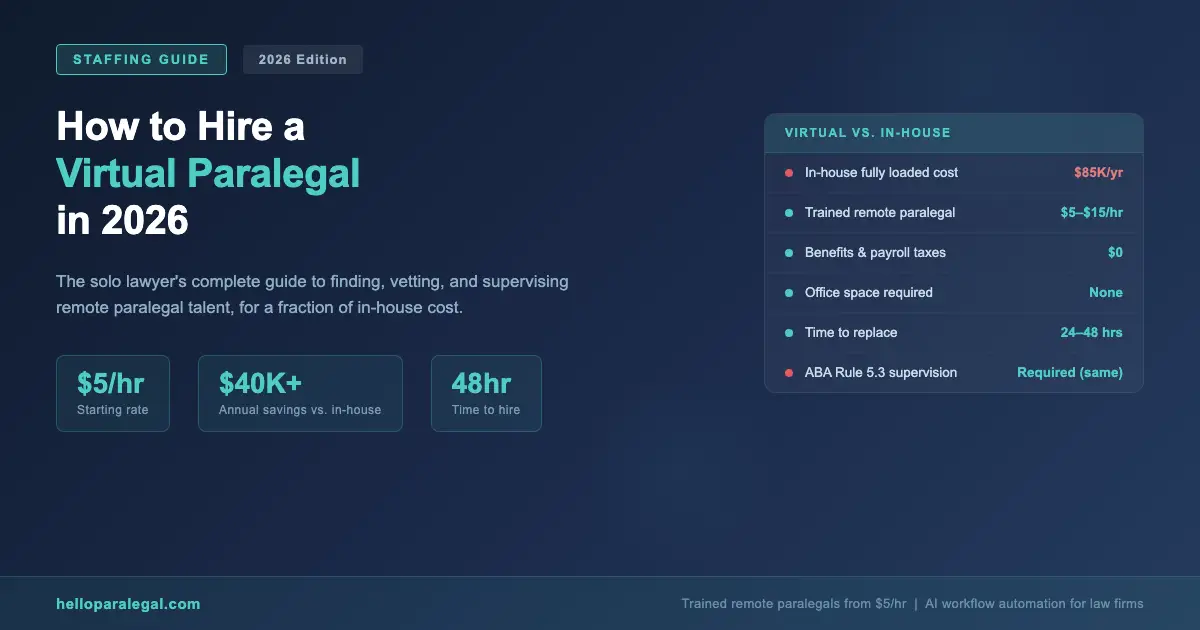
Most attorneys think the comparison is simple: an in-house paralegal costs $50,000/year, a virtual one costs $25,000/year. That math is wrong, and it actually undersells how big the difference is.
| Cost Category | In-House Paralegal | Virtual Paralegal (Hello Paralegal) |
|---|---|---|
| Base salary | $52,000–$65,000/yr | $5–$15/hr (project or retainer) |
| Employer FICA (7.65%) | $3,978–$4,973/yr | $0 |
| Health insurance | $7,000–$15,000/yr | $0 |
| PTO / sick leave | ~$2,500–$4,000/yr | $0 |
| Office space + equipment | $5,000–$12,000/yr | $0 |
| Recruiting / onboarding | $3,000–$8,000 (one-time) | $0 |
| Total true annual cost | $73,000–$109,000/yr | $10,400–$31,200/yr |
A family law solo in Denver told us she spent $347/month more than she needed to for three years before she made the switch. That’s $12,492 she paid to keep a desk warm. It’s a number that’s hard to look at.
The math changes depending on how many hours you need. Part-time virtual support (20 hrs/week) at $10/hr runs $10,400/year. Full-time at $15/hr is $31,200/year. Even at the top end, you’re saving $40,000+ compared to a fully loaded in-house hire, and you’re not paying for the hours when there’s nothing to do.
What Most Articles Get Wrong About Hiring a Virtual Paralegal
Most guides tell you to “post on Upwork” or “find a legal VA service.” That’s incomplete advice, and in some cases it’ll get you into trouble.
Here’s what they skip:
1. Not all “legal virtual assistants” are paralegals. A lot of VA services market themselves to law firms but employ general administrative staff with no legal training. They can schedule your calendar. They can’t draft a valid discovery response. The terminology is loose and the difference matters.
2. Supervision is not optional, and “remote” doesn’t change that. ABA Model Rule 5.3 applies the same whether your paralegal is down the hall or in Manila. You need a workflow that puts attorney eyes on work product before it goes out. Most articles mention this in one sentence and move on. We’ll cover it properly below.
3. The cheapest option isn’t always the best, but it’s rarely the worst either. Trained offshore paralegals from countries like the Philippines often have law degrees, are fluent in English, and are supervised by onshore legal professionals. The stereotype that “cheap means bad” doesn’t hold in a market where a Filipino attorney working as a paralegal costs $8/hr and a U.S. paralegal with the same credentials costs $35/hr.
4. You need systems before you need a person. The biggest failure mode we see is a solo attorney who hires a great virtual paralegal, then spends the first month explaining everything verbally, ad hoc, with no written SOPs. The paralegal leaves. The attorney starts over. Systems first. Hire second.
The Ethics Rules You Must Know Before You Hire
You already know you’re responsible for your staff’s conduct. ABA Model Rule 5.3 makes that explicit. What you might not know is how that applies when your paralegal is overseas or working across state lines.
The good news: physical location doesn’t change the ethics analysis. The ABA Guidelines for the Utilization of Paralegal Services are clear that paralegals can work remotely under appropriate supervision. The key word is “appropriate.”
Here’s what that looks like in practice:
- Attorney review before anything goes out. No correspondence, no document, no filing leaves without attorney eyes. Non-negotiable.
- Client disclosure. Your engagement letter should note that paralegals work under attorney supervision. Don’t hide the ball.
- Conflict checks. Your virtual paralegal needs access to your conflict system before they touch a new matter.
- Confidentiality agreements. Every person who touches client files signs one. Remote paralegals included.
- Secure communication. Clio’s secure client portal, encrypted email, or a practice management system with proper access controls. Not WhatsApp.
New York State Bar Ethics Opinion 1259 specifically addressed AI-assisted and remote paralegal collaboration, confirming the supervision standard applies regardless of the tool or location. Read it if you’re in New York. If you’re in Texas, the Texas Paralegal Division’s standards are worth bookmarking.
The bottom line: you can absolutely hire a virtual paralegal. You cannot abdicate supervision. The two aren’t in conflict, you just need a system.
How to Hire a Virtual Paralegal: Step-by-Step
Here’s exactly how we recommend approaching this, in order:
- Audit your current workload. Spend one week tracking every task that doesn’t require a law license. Be honest. Most solo attorneys find 60–70% of their weekly hours fall into this category. Those are the tasks you’re about to hand off.
- Write your SOPs before you post a job. A standard operating procedure doesn’t need to be fancy. A Google Doc with numbered steps is fine. Cover your top five recurring tasks: client intake, deadline tracking, document templates, billing entry, and status updates. If you can’t describe the task in writing, you can’t delegate it safely.
- Decide on your engagement model. Do you need a part-time retainer (10–20 hours/week), full-time dedicated support, or project-based help? This determines your budget and what type of service you should look for.
- Choose your sourcing channel. Options: a managed service like Hello Paralegal (where we pre-train and vet every paralegal and handle supervision workflow), a marketplace like Lawfecta or Upwork Legal, or a staffing agency like Stafi or Legal Soft. Each has trade-offs (covered in the next section).
- Interview for legal knowledge, not just English. Ask candidates to explain the difference between a motion to dismiss and a motion for summary judgment. Ask them to walk you through how they’d organize a new personal injury file. Generic VA experience doesn’t translate to legal work. Actual legal knowledge does.
- Run a paid test project. Give your top candidate a real task: draft a demand letter from your template, enter five time entries into Clio, or summarize a 30-page deposition. Pay them for the time. Review the output. This tells you more than any interview.
- Set up your supervision workflow. Before day one: share your SOP docs, set up a Slack channel for daily check-ins, define what needs attorney review (everything) versus what can go out with a quick approval email. Build the system now. Don’t build it while things are on fire.
- Define a 30-day onboarding ramp. Week 1: observation and documentation review. Week 2: supervised task execution. Week 3: semi-independent work with daily check-ins. Week 4: full workflow with weekly review. Fast ramps fail. Give the process room.
Where to Find Virtual Paralegals in 2026
Not all sourcing channels are the same. Here’s an honest comparison of the main options:
| Platform / Service | Type | Approx. Cost | Legal Training | Supervision Support |
|---|---|---|---|---|
| Hello Paralegal | Managed service | From $5/hr | Yes, pre-trained | Yes, built-in workflows |
| Legal Soft | Staffing / VA service | $25–$45/hr | Varies | No |
| Lawfecta | Marketplace | $30–$75/hr | Vetted profiles | No |
| Stafi | Offshore staffing | $8–$18/hr | Variable | No |
| Upwork Legal | Freelance marketplace | $15–$60/hr | Self-reported | No |
| ZipRecruiter / Indeed | Job board | Full salary hire | Depends on hire | No |
The managed service model is worth paying attention to. When you hire off a job board or marketplace, you own the whole onboarding and quality-control problem. When you use a service that pre-trains their paralegals in legal workflows and builds supervision into the process, a lot of that risk transfers.
That’s the model we run at Hello Paralegal. We don’t just find you someone. We deploy a trained paralegal with the workflow infrastructure already built around them.
What Tasks Should You Actually Delegate?
Start with tasks that are high-volume, repetitive, and have clear right-or-wrong answers. Those are the easiest to hand off and the fastest to produce ROI.
High-confidence delegation (start here):
- Client intake forms and initial file setup
- Deadline calendaring and statute-of-limitations tracking
- Requesting medical records, police reports, and insurance documents
- Time entry and billing reconciliation in Clio, MyCase, or PracticePanther
- Drafting routine correspondence from templates
- Preparing first drafts of discovery responses (attorney finalizes)
- Updating case management notes after calls
Medium-confidence delegation (build up to):
- Legal research with attorney-defined scope
- Deposition and document summaries
- Settlement demand drafts from template
- Preparing court filing packages for attorney review
Never delegate (this list is short but absolute):
- Legal advice to clients
- Court appearances
- Fee negotiations
- Any communication that could be read as practicing law
The fastest way to build trust with a virtual paralegal is to start with the high-confidence list, review their work consistently for the first 30 days, and expand scope gradually as they demonstrate accuracy. Trying to hand off everything on day one is how this goes wrong.
Real Results: What Solo Lawyers Are Saving
We don’t love vague case studies, so here are specific ones.
A solo estate planning attorney in Phoenix was spending 18.4 hours a week on tasks that didn’t require a law license: intake calls, document assembly, Clio entry, client status emails. She hired a full-time virtual paralegal at $8/hr through Hello Paralegal. Total monthly cost: $1,408. In the first 90 days, she took on 11 additional estate planning clients she’d previously turned away because she didn’t have bandwidth. At her average fee of $2,200 per estate plan, that’s $24,200 in new revenue against $4,224 in paralegal cost.
A PI firm in Atlanta with two attorneys and one in-house paralegal added two virtual paralegals at $10/hr to handle demand letter preparation and medical record collection. They cut their average case cycle time by 23 days. That’s not a soft metric. Faster resolution means faster contingency fee collection.
A family law solo in Seattle replaced a $62,000/year in-house paralegal with a virtual paralegal at $12/hr (part-time). Annual savings after accounting for all costs: $41,300. She reinvested $18,000 of that into Lawmatics for automated follow-up, which generated 34 new consultations in the first six months.
None of these are unusual. They’re the standard outcome when the setup is done right.
Frequently Asked Questions
Is it ethical for a lawyer to use a virtual paralegal?
Yes. ABA Model Rule 5.3 permits lawyers to delegate work to non-lawyers, including virtual paralegals, as long as the attorney maintains direct supervision of all work product. The paralegal’s physical location is irrelevant to the ethics analysis. What matters is that the attorney reviews output before it goes to clients or courts, and that clients are informed paralegals are involved in their matter.
How much does a virtual paralegal cost per hour?
Virtual paralegal rates vary significantly by model. Trained offshore paralegals through managed services like Hello Paralegal start at $5/hr. U.S.-based remote paralegals typically charge $25–$75/hr depending on experience. Marketplace platforms like Upwork Legal run $15–$60/hr. The rate you pay depends on legal training, experience level, practice area specialization, and whether you’re hiring through a managed service or directly.
What tasks can a virtual paralegal do for a solo attorney?
A virtual paralegal can handle client intake, document drafting from templates, legal research, court filing preparation, medical record requests, time entry and billing in Clio or MyCase, client status communications, deadline calendaring, and discovery preparation. They cannot give legal advice, represent clients, set fees, or establish attorney-client relationships. The attorney must review all substantive work product before it goes out.
How do I supervise a virtual paralegal properly?
Proper supervision means: written SOPs for every recurring task, a daily or weekly check-in system (Slack works well), attorney review of all work product before it reaches clients or courts, a confidentiality agreement signed before any client files are accessed, and a secure communication platform. Tools like Clio, MyCase, and PracticePanther all support role-based access controls that let virtual paralegals work in your system without seeing matters they shouldn’t.
Can a virtual paralegal work across state lines?
Yes. Paralegals aren’t licensed by state, so there’s no bar admission issue. The attorney they work for must be licensed in the state where the work is being performed, and the attorney remains fully responsible for all work product. The paralegal can be located anywhere. Remote work arrangements don’t change the underlying ethics rules, only the supervision logistics.
How long does it take to hire a virtual paralegal?
Through a managed staffing service, you can have a vetted virtual paralegal placed and starting within 24 to 48 hours. Through a marketplace like Upwork or Lawfecta, expect one to two weeks to post, interview, and test candidates. Hiring directly via job boards takes longer, typically two to four weeks, and requires you to handle all vetting. The tradeoff is cost versus speed versus quality assurance.
What’s the difference between a virtual paralegal and a legal virtual assistant?
A virtual paralegal has substantive legal training and can handle tasks like document drafting, legal research, and discovery preparation. A legal virtual assistant typically handles administrative tasks like scheduling, email management, and data entry. The distinction matters because legal work requires legal knowledge. Hiring a general VA for paralegal tasks creates quality and liability risk. Always verify what training and legal experience a candidate actually has before handing them substantive work.
If you’re ready to stop doing $15/hr work with a $400/hr brain, the next step is straightforward. Hello Paralegal places trained remote paralegals starting at $5/hr, with supervision workflows built in from day one. We’ve been inside the law offices. We know what breaks down. And we built the system around that.
Leave a Reply